ERP Inventory Optimization Checklist: A Step-by-Step Guide to Success
Published: 12/19/2025 10:00 PM Updated: 12/20/2025 12:15 PM
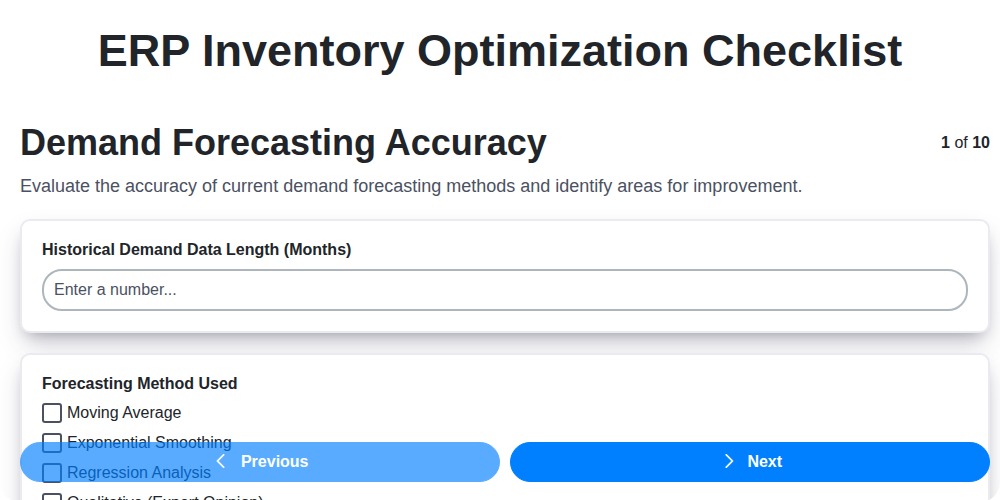
Table of Contents
- Introduction: Why ERP Inventory Optimization Matters
- 1. Demand Forecasting Accuracy: Laying the Foundation
- 2. Safety Stock Levels: Balancing Risk and Cost
- 3. Lead Time Reduction: Speeding Up the Supply Chain
- 4. Inventory Turnover Rate: Measuring Efficiency
- 5. ABC Analysis Implementation: Prioritizing Your Inventory
- 6. Reorder Point Calculations: Knowing When to Replenish
- 7. Cycle Counting Processes: Maintaining Data Integrity
- 8. ERP System Integration (Inventory Module): Leveraging Your ERP
- 9. Warehouse Layout & Efficiency: Optimizing Space and Flow
- 10. Vendor Performance Evaluation: Building Strong Partnerships
- 11. Key Performance Indicators (KPIs) for Inventory Optimization
- 12. Continuous Improvement: A Long-Term Strategy
- Conclusion: Achieving Inventory Excellence with Your ERP
- Resources & Links
TLDR: Struggling with inventory chaos? This checklist guides you through essential ERP inventory optimization steps - from accurate forecasting and safety stock to warehouse efficiency and vendor performance - ensuring you're minimizing costs, maximizing stock availability, and leveraging your ERP system effectively. Use it to pinpoint areas for improvement and unlock inventory success!
Introduction: Why ERP Inventory Optimization Matters
In today's competitive landscape, simply having inventory isn't enough. Excess stock ties up valuable capital, while shortages can cripple operations and damage customer relationships. That's where ERP inventory optimization comes in. An ERP (Enterprise Resource Planning) system, when leveraged effectively, can be a game-changer for managing your inventory, transforming it from a potential liability into a strategic asset.
This isn't just about minimizing costs; it's about maximizing efficiency, responsiveness, and profitability. Properly optimized inventory allows you to meet customer demand precisely, avoid costly stockouts, and free up working capital for other vital business functions. This post outlines a comprehensive checklist - a roadmap, if you will - to guide you through the process of optimizing your inventory using your ERP system. By systematically addressing the key areas we're about to explore, you can unlock significant improvements in your inventory management and ultimately, your bottom line.
1. Demand Forecasting Accuracy: Laying the Foundation
Accurate demand forecasting is the bedrock of any successful inventory optimization strategy. Without a reliable understanding of what your customers will need, when, and in what quantities, your inventory management efforts are essentially flying blind. Overstocking leads to tied-up capital, storage costs, and potential obsolescence. Understocking, on the other hand, results in lost sales, dissatisfied customers, and damage to your brand reputation.
So, where do you start? It's not just about throwing numbers at a spreadsheet. Here's a breakdown of essential considerations for improving demand forecasting accuracy within your ERP system:
- Historical Data Analysis: Leverage your ERP's historical sales data. Look for trends, seasonality, and cyclical patterns. Don't just look at overall sales; break it down by product, region, and customer segment.
- External Factors: Don't ignore external influences. Consider economic indicators, market trends, promotions, competitor actions, and even weather patterns.
- Collaboration is Key: Break down silos! Involve sales, marketing, and customer service teams. They often possess valuable insights into upcoming promotions, customer demand, and potential disruptions.
- Forecasting Methods: Experiment with different forecasting methods - moving averages, exponential smoothing, regression analysis - to find what works best for your unique product portfolio. Many ERPs have built-in forecasting tools to help.
- Regular Review & Adjustment: Forecasting isn't a set it and forget it activity. Regularly review your forecasts against actual sales and adjust your models accordingly. The faster you identify and correct errors, the better your inventory optimization will be.
2. Safety Stock Levels: Balancing Risk and Cost
Safety stock - that buffer of extra inventory - is a critical component of any inventory optimization strategy. It's there to protect you from unexpected demand spikes or supply chain disruptions. But holding too much safety stock ties up valuable capital and increases storage costs. Finding the sweet spot requires careful consideration.
Calculating optimal safety stock isn't a simple task. It's influenced by factors like demand variability, lead time variability, desired service level (the percentage of customer orders you want to fulfill immediately), and the cost of holding inventory versus the cost of stockouts.
Here's a breakdown of how to approach safety stock optimization:
- Understand Your Variability: Analyze historical demand data to understand the range of potential fluctuations. Look beyond averages - identify patterns, seasonality, and any predictable spikes. Similarly, examine your lead times. Are they consistently reliable, or do they vary significantly?
- Define Your Service Level: How crucial is it to avoid stockouts? A higher service level (e.g., 99%) means more safety stock is needed, while a lower service level (e.g., 90%) allows for less. Consider the cost implications of both scenarios.
- Utilize Statistical Formulas: ERP systems often have built-in formulas to calculate safety stock based on historical data, desired service levels, and lead time variability. Common formulas include considering standard deviation of demand and lead time.
- Dynamic Adjustment: Safety stock shouldn't be a 'set it and forget it' number. Regularly review and adjust your safety stock levels based on changing market conditions, supplier performance, and demand patterns. Integrate this into your ERP system to automate the process where possible.
- Segment Your Inventory: Not all items require the same safety stock level. High-demand, critical items need more buffer than slow-moving, less important items.
Ignoring safety stock altogether is risky, but overdoing it wastes resources. A well-calculated safety stock level minimizes both risks and costs, contributing significantly to efficient inventory management.
3. Lead Time Reduction: Speeding Up the Supply Chain
Lead time - the time it takes from order placement to receiving goods - is a critical factor impacting inventory levels and overall efficiency. Long lead times necessitate higher safety stock to buffer against potential stockouts, tying up capital and increasing storage costs. Reducing lead time, therefore, is a direct path to inventory optimization.
But it's rarely a simple fix. It requires a multifaceted approach examining various points in your supply chain. Here's what to consider:
- Supplier Collaboration: Open communication with your vendors is paramount. Discussing potential improvements in their processes, exploring alternative shipping methods (expedited options, if feasible), and negotiating shorter production times can significantly impact lead time.
- Order Processing Efficiency: Evaluate your internal order processing. Are there bottlenecks in approvals, data entry, or communication? Automating processes and streamlining workflows can shave valuable time off the order cycle.
- Transportation Optimization: Review your shipping methods. Can you consolidate shipments? Explore alternative carriers or logistics providers who offer faster delivery options? Consider the impact of routing and customs clearance.
- Nearshoring/Reshoring: For certain products, re-evaluating your sourcing locations to bring production closer to your consumer base (nearshoring or reshoring) can dramatically shorten transit times.
- Technology Adoption: Leveraging ERP system features designed for vendor managed inventory (VMI) or collaborative planning, forecasting, and replenishment (CPFR) can increase transparency and synchronization with your suppliers.
Remember that even small reductions in lead time can result in substantial improvements in inventory performance. Continuously monitor and analyze lead times, seeking opportunities for further optimization.
4. Inventory Turnover Rate: Measuring Efficiency
Inventory turnover rate is a crucial KPI that reveals how effectively you're managing your stock. It essentially tells you how many times you sell and replenish your inventory over a specific period (usually a year). A higher turnover rate generally indicates strong sales, efficient inventory management, and less capital tied up in stock. Conversely, a low turnover rate might signal overstocking, slow-moving items, or obsolescence.
The formula is simple: Cost of Goods Sold / Average Inventory.
- Cost of Goods Sold (COGS): This is the direct costs associated with producing the goods you sold.
- Average Inventory: Calculate this by adding the beginning and ending inventory levels for the period and dividing by two.
What's a good turnover rate? That's industry-dependent. A grocery store, with perishable goods, will naturally have a much higher turnover rate than a furniture retailer. Research your industry benchmarks to gauge your performance.
What to do if your turnover rate is low: Investigate the slow-moving items. Are they priced correctly? Is there sufficient marketing? Could they be bundled with other products to stimulate sales? Review your safety stock levels - you might be holding too much buffer. ERP systems can significantly aid in identifying slow-moving items and providing accurate sales data for analysis.
5. ABC Analysis Implementation: Prioritizing Your Inventory
ABC analysis is a powerful tool for inventory optimization, categorizing your inventory based on its value and usage. It's not about the physical size or weight of an item; it's about its contribution to overall inventory value.
Here's a breakdown of the categories:
- A Items: These constitute roughly 20% of your inventory but account for 80% of your total inventory value. These are your high-value, high-impact items. Strict control, accurate forecasting, and close monitoring are crucial. Consider vendor-managed inventory (VMI) or consignment arrangements for these items.
- B Items: Represent around 30% of your inventory and contribute to about 15% of the total value. These items require moderate control and attention. Regular review of performance and occasional adjustments to reorder points are sufficient.
- C Items: This category comprises approximately 50% of your inventory but only contributes 5% of the total value. These are low-value, high-volume items. Simplified control methods, such as larger order quantities and less frequent review, are appropriate.
Implementing ABC Analysis within your ERP:
Your ERP system should have capabilities to support ABC analysis. Steps typically include:
- Data Collection: Import historical sales data and item costs into the system.
- Value Calculation: The ERP will calculate the annual consumption value for each item (Annual Demand x Unit Cost).
- Classification: The system will automatically classify items based on pre-defined thresholds (e.g., top 20% are 'A', next 30% are 'B', remaining 50% are 'C').
- Review & Adjustment: Periodically review the classifications and adjust thresholds as needed to ensure accuracy and relevance.
By focusing your resources on 'A' items, you can significantly improve inventory efficiency and reduce carrying costs.
6. Reorder Point Calculations: Knowing When to Replenish
Reorder points (ROP) are the bedrock of proactive inventory management. They tell you exactly when to place an order to avoid stockouts while minimizing excess inventory. A poorly calculated ROP can lead to either lost sales (due to being out of stock) or tied-up capital (due to overstocking).
Here's the fundamental formula: Reorder Point = (Average Daily Demand x Lead Time in Days) + Safety Stock
Let's break down each component:
- Average Daily Demand: This is the average number of units sold per day. Accurate demand forecasting (addressed earlier!) is crucial here. The more precise your forecast, the more accurate your average daily demand will be.
- Lead Time: This is the time it takes from placing an order with your supplier to receiving the goods in your warehouse. It includes processing time, transit time, and receiving time. Understanding your lead time variability is also important; inconsistent lead times necessitate a higher safety stock.
- Safety Stock: As we've already discussed, this is your buffer against unexpected demand surges or lead time delays.
Beyond the Basics: Considerations for Your ERP
Your ERP system should be instrumental in automating these calculations. Look for features that:
- Allow for dynamic ROP adjustments based on seasonality or promotions.
- Provide alerts when inventory levels approach the reorder point.
- Integrate with demand forecasting models to automatically update ROPs.
- Support different calculation methods (e.g., considering lead time variability).
Example:
Let's say a product has an average daily demand of 10 units, a lead time of 5 days, and a safety stock of 20 units. The reorder point would be: (10 units/day * 5 days) + 20 units = 70 units. When your inventory level reaches 70 units, the ERP system should trigger a reorder.
Regularly review and adjust your reorder points, especially when demand patterns change or supplier performance fluctuates. This ensures your inventory levels stay optimized and responsive to changing business needs.
7. Cycle Counting Processes: Maintaining Data Integrity
Inventory accuracy is the bedrock of a well-functioning ERP system and optimized inventory. While periodic full physical inventory counts are valuable, they're disruptive and often reveal issues that should have been addressed sooner. That's where cycle counting comes in.
Cycle counting is the practice of counting a small subset of your inventory on a regular, ongoing basis - rather than a massive, annual count. Think of it as a continuous quality control check for your inventory records. Here's what you need to consider for effective cycle counting:
- Define Counting Frequency: Determine how often each item should be counted. High-value or fast-moving items should be counted more frequently than slower-moving, lower-value items.
- Random Selection vs. Targeted Counting: While random selection offers unbiased audits, targeted cycle counts focusing on items with a history of discrepancies or those flagged by ERP system alerts (variance reports) are often more impactful.
- Clearly Defined Procedures: Create detailed, documented procedures for cycle counting teams. This includes instructions on how to count, record discrepancies, and escalate issues.
- Root Cause Analysis: Don't just correct the count. Investigate why the discrepancy occurred. Was it a data entry error, picking error, or a problem with receiving processes?
- ERP System Integration: Your ERP system should automatically generate cycle count tasks, track results, and update inventory records. Discrepancies should immediately flag the item for further investigation and adjustments.
- Employee Training: Ensure cycle counters are well-trained and understand the importance of accuracy.
- Regular Review: Periodically review your cycle counting program to ensure its effectiveness and make adjustments as needed. Are you catching discrepancies early enough? Are the procedures clear and being followed?
Implementing a robust cycle counting program significantly reduces the risk of major inventory discrepancies, improves data integrity within your ERP system, and contributes directly to overall inventory optimization.
8. ERP System Integration (Inventory Module): Leveraging Your ERP
Your ERP system isn't just a data repository; it's the engine driving your inventory optimization efforts. A seamless integration of your inventory module with the rest of your ERP - accounting, sales, purchasing, and manufacturing - is critical. Here's what to look for:
- Real-time Data Synchronization: Ensure data flows immediately between your warehouse, sales orders, and the ERP. Delayed updates lead to inaccuracies and poor decisions.
- Automated Transactions: Automate receipt of goods, stock adjustments, and order fulfillment. Reduce manual data entry, minimizing errors and freeing up staff.
- Centralized Visibility: A unified view of inventory levels across all locations. No more siloed data - see everything at a glance.
- Reporting & Analytics: Utilize the ERP's built-in reporting capabilities to track key inventory metrics (turnover, carrying costs, obsolescence) generated by your optimization efforts. Custom reports are even better.
- Workflow Automation: Automate reorder point notifications, cycle count scheduling, and vendor communication based on your optimized parameters.
- Mobile Accessibility: Enable warehouse staff to access inventory data and perform tasks using mobile devices for increased efficiency.
- Integration with Other Modules: Confirm that data is flowing effectively between the inventory module and your other vital ERP functions (sales forecasting, production planning).
Without a robust ERP integration, your optimized inventory strategies will be significantly hampered. It's an investment that yields long-term efficiency gains.
9. Warehouse Layout & Efficiency: Optimizing Space and Flow
Your ERP system might be perfectly calculating your inventory needs, but a poorly designed warehouse can negate all those gains. A chaotic layout leads to wasted time, increased labor costs, and higher error rates. Optimizing your warehouse isn't just about aesthetics; it's a vital component of inventory optimization.
Here's what to consider:
- Slotting Optimization: Analyze product velocity (how quickly items move) and place high-velocity items in easily accessible locations. Heavy or bulky items should be placed lower and closer to shipping docks.
- Flow Optimization: Design a logical flow for receiving, put-away, picking, packing, and shipping. Minimize backtracking and congestion points. Consider one-way flow patterns.
- Aisle Widths & Space Utilization: Ensure adequate aisle widths for safe movement of personnel and equipment. Explore vertical space - racking systems can dramatically increase storage capacity.
- Equipment & Technology: Invest in appropriate material handling equipment (forklifts, conveyors, etc.) and consider automation solutions (e.g., automated guided vehicles (AGVs)) to improve efficiency.
- Clear Labeling & Signage: Implement a clear and consistent labeling system to easily identify locations and products, reducing search time.
- Regular Audits: Conduct regular audits of your warehouse layout to identify bottlenecks and areas for improvement, adapting as your product mix and order volumes change.
A well-designed warehouse isn's just a storage space; it's a strategic asset that directly impacts your ERP's inventory optimization efforts.
10. Vendor Performance Evaluation: Building Strong Partnerships
Your inventory optimization efforts are only as strong as your supply chain. That's why regularly evaluating vendor performance is crucial. It's not just about catching issues - it's about fostering collaborative partnerships that drive mutual success.
What to Evaluate:
- On-Time Delivery: Consistently meeting agreed-upon delivery dates is paramount. Track percentage of deliveries on time and analyze any recurring delays.
- Order Accuracy: Errors in orders lead to costly rework and disruptions. Monitor order accuracy rates and address root causes.
- Quality of Goods: Defective or substandard materials impact production and customer satisfaction. Implement quality control checks and track defect rates.
- Pricing & Payment Terms: Regularly review pricing against market rates and negotiate for favorable terms that optimize your costs.
- Communication & Responsiveness: Assess the vendor's ability to promptly respond to inquiries and resolve issues. Open communication is key.
- Flexibility & Adaptability: How well does the vendor adapt to changes in demand or unexpected situations?
Leveraging Your ERP: Your ERP system provides valuable data for vendor performance tracking. Utilize reporting features to generate performance scorecards and identify areas for improvement.
Moving Beyond Scores: While performance scores are helpful, don't just focus on the numbers. Schedule regular review meetings with key vendors to discuss performance, collaborate on solutions, and build stronger relationships. A proactive approach can lead to proactive solutions and ultimately, a more resilient and optimized inventory.
11. Key Performance Indicators (KPIs) for Inventory Optimization
Inventory optimization isn't just about implementing changes; it's about continuously monitoring and refining your approach. Key Performance Indicators (KPIs) provide that crucial feedback loop. Here are some vital metrics to track:
- Demand Forecasting Accuracy: This measures how closely your predictions match actual demand. Lower error percentages indicate better planning. Track metrics like Mean Absolute Deviation (MAD) and Mean Squared Error (MSE).
- Inventory Turnover Rate: This shows how many times your inventory is sold and replenished in a specific period. A higher turnover generally signifies efficient inventory management.
- Service Level: Represents the percentage of orders fulfilled on time and in full. A high service level indicates strong inventory availability.
- Days of Supply (DOS): This calculation shows how many days your current inventory will last at the average daily sales rate.
- Obsolescence Rate: Monitors the percentage of inventory that becomes obsolete or unusable. Reducing this is vital for minimizing losses.
- Holding Costs: Tracks the total expenses associated with storing inventory, including warehousing, insurance, and capital costs.
- Order Fill Rate: The percentage of customer orders fulfilled from available stock.
- Backorder Rate: Represents the percentage of orders that cannot be fulfilled immediately due to insufficient stock.
- Lead Time: The time it takes to receive inventory from a vendor, from order placement to receipt. Monitor trends and identify areas for reduction.
- Inventory Carrying Cost: The total cost of holding inventory, including storage, insurance, obsolescence, and capital costs.
Regularly reviewing these KPIs will highlight areas of strength and weakness, allowing you to make data-driven adjustments to your inventory optimization strategy.
12. Continuous Improvement: A Long-Term Strategy
Inventory optimization isn't a one-and-done project; it's an ongoing journey. The data and insights gleaned from your initial ERP implementation and the checklist items above provide a valuable baseline, but market dynamics, seasonality, vendor performance, and even internal processes are constantly evolving. Regularly revisit your inventory optimization strategies - at least quarterly, if not more frequently - to identify areas for further refinement. This means analyzing your key metrics (demand forecast accuracy, turnover rate, etc.), revisiting your assumptions, and proactively adjusting your safety stock, reorder points, and vendor relationships. Embrace a culture of continuous improvement where everyone from the warehouse staff to the purchasing team is encouraged to suggest and implement process enhancements. Consider implementing a feedback loop - soliciting input from those directly handling inventory - to identify pain points and opportunities you might otherwise miss. Ultimately, sustained success in inventory optimization requires a commitment to ongoing learning, adaptation, and a proactive approach to problem-solving.
Conclusion: Achieving Inventory Excellence with Your ERP
Implementing an ERP system is a significant investment, but the true value lies in how you leverage it to optimize your inventory. This checklist provides a roadmap for moving beyond basic inventory management and achieving operational excellence. By systematically addressing each area-from accurate demand forecasting to vendor performance-and consistently utilizing your ERP's inventory module, you can drastically reduce carrying costs, minimize stockouts, and improve overall efficiency. Remember, inventory optimization isn't a one-time project; it's an ongoing process. Regularly review these checkpoints, adapt to changing market conditions, and fine-tune your strategies. With dedication and a data-driven approach, your ERP can become the central nervous system for a truly optimized inventory, driving profitability and a competitive edge.
Resources & Links
- NetSuite: Comprehensive ERP solution with robust inventory management capabilities. Offers insights and articles on inventory optimization.
- Oracle ERP Cloud: Oracle's ERP Cloud offers modules for inventory optimization, supply chain management, and demand planning.
- SAP S/4HANA: SAP's ERP system includes advanced inventory management features and analytics to improve optimization.
- Infor ERP: Infor provides industry-specific ERP solutions that often include inventory optimization functionalities.
- Supply Chain Digital: Website providing news, analysis, and resources related to supply chain management and inventory optimization.
- APICS (ASCM): Professional association for supply chain and operations management, offering certifications and resources on inventory control.
- ISC (International Supply Chain Professionals): Provides education, certifications, and resources for supply chain professionals, with a focus on optimization.
- Lean Enterprise Institute: Focuses on lean principles, which are highly relevant to warehouse layout, efficiency, and cycle counting processes - foundational to inventory optimization.
- EY (Ernst & Young): Offers consulting services and reports on supply chain and inventory management, including optimization strategies.
- Deloitte: Provides consulting services and thought leadership on inventory optimization and supply chain excellence.
- McKinsey & Company: Management consulting firm with expertise in supply chain optimization and inventory management.
- Gartner: Provides research and analysis on ERP and supply chain technologies, helping businesses make informed decisions.
- Smartsheet: Project management and collaboration platform that can be used to build and manage inventory optimization checklists and track progress. Offers templates for inventory management.
Frequently Asked Questions
What is ERP inventory optimization?
ERP inventory optimization refers to using your Enterprise Resource Planning (ERP) system to improve inventory levels, reduce costs, and increase efficiency. It's about finding the right balance between having enough stock to meet demand and minimizing excess inventory that ties up capital and increases storage costs.
Why is inventory optimization important for my business?
Inventory optimization leads to reduced carrying costs (storage, insurance, obsolescence), improved cash flow, better customer satisfaction through fewer stockouts, more accurate demand forecasting, and increased profitability. It's crucial for maintaining a competitive edge.
Who should use this checklist?
This checklist is designed for businesses utilizing an ERP system and looking to improve their inventory management processes. It's helpful for inventory managers, operations managers, supply chain professionals, and anyone involved in demand planning and procurement.
What types of ERP systems does this checklist apply to?
This checklist is generally applicable to most ERP systems, regardless of vendor (e.g., SAP, Oracle, NetSuite, Microsoft Dynamics). However, the specific steps may need slight adjustments based on your ERP's capabilities and modules.
What does 'ABC Analysis' refer to in the checklist?
ABC Analysis is a technique where inventory is categorized based on its value and usage. 'A' items are high-value, fast-moving items requiring close monitoring. 'B' items are moderately important, and 'C' items are low-value, slow-moving items requiring less scrutiny.
What are safety stock levels and why are they important?
Safety stock is extra inventory held to buffer against unexpected demand surges or supply chain disruptions. It helps prevent stockouts and maintain customer service levels, but excessive safety stock increases carrying costs.
What is demand forecasting, and how does it relate to inventory optimization?
Demand forecasting is predicting future demand for products. Accurate demand forecasts are crucial for effective inventory optimization, allowing you to order the right quantities at the right times and avoid both stockouts and excess inventory.
Can I implement all of these steps at once?
Implementing all steps simultaneously might be overwhelming. Prioritize the steps based on your business's most pressing inventory challenges and implement them in phases. Start with the foundational steps and gradually move to more advanced techniques.
Found this Article helpful?
Comments
There are no comments yet. Be the first to add one!
ERP - Enterprise Resource Planning Solution Demo
Overwhelmed by disconnected systems? ChecklistGuro provides a centralized ERP solution, connecting your business processes - finance, operations, & more - for improved visibility and control. Simplify operations & boost efficiency.
Related Articles
MRP System Go-Live Checklist: Your Path to a Successful Implementation

Top 10 CMiC Alternatives for 2025
The Ultimate Foundation Waterproofing Installation Checklist Template
Top 10 Odoo Alternatives for 2025

How to Save Money on Bill of Materials (BOM) Management Software
The Ultimate Waterproofing Checklist: Ensuring a Leak-Proof Installation

The 10 Best Manufacturing Management Software of 2025
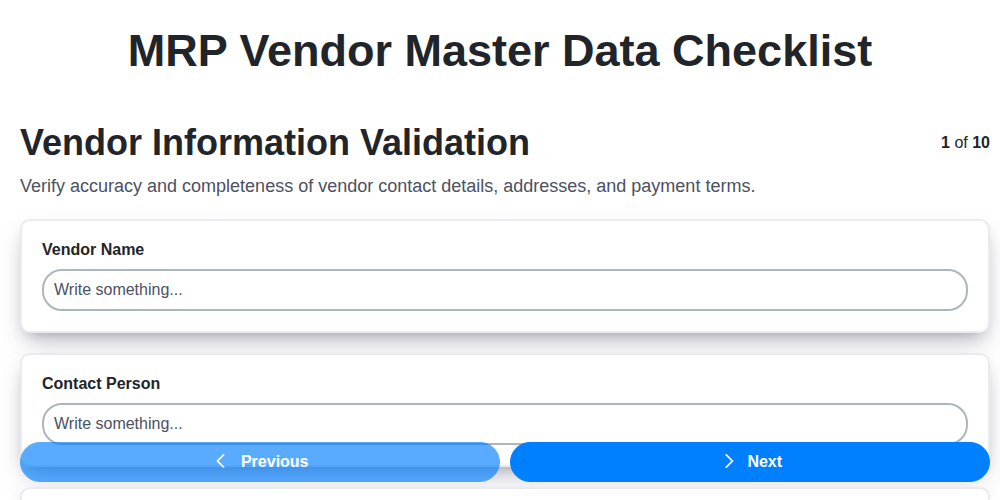
MRP Vendor Master Data Checklist: Ensuring Accuracy and Efficiency
We can do it Together
Need help with
Enterprise Resource Planning (ERP)?
Have a question? We're here to help. Please submit your inquiry, and we'll respond promptly.