Master Your Data: The Ultimate ERP Master Data Governance Checklist
Published: 12/19/2025 Updated: 07/02/2026
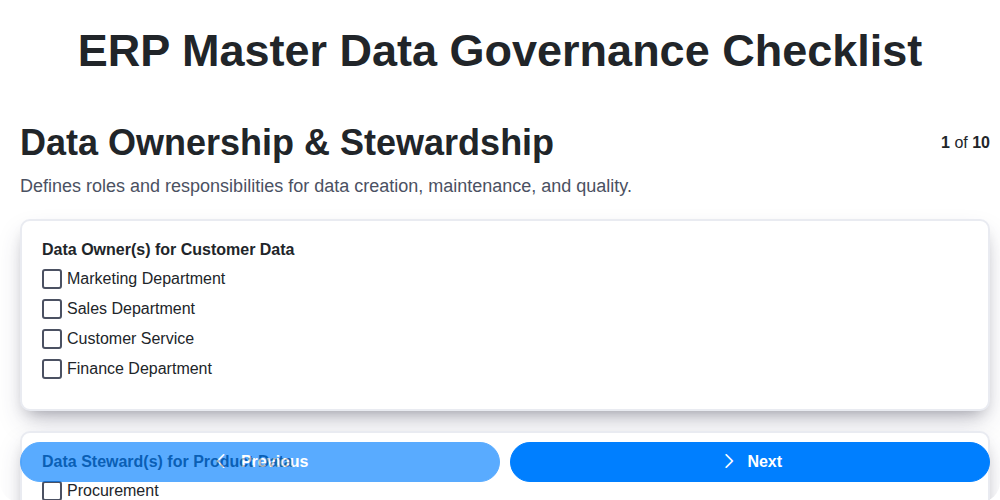
Table of Contents
- Introduction: Why Master Data Governance Matters for ERP
- 1. Defining Data Ownership & Stewardship
- 2. Establishing Clear Data Standards & Definitions
- 3. Implementing Data Creation & Modification Rules
- 4. Data Cleansing & Deduplication: A Foundational Step
- 5. Securing Your Data: Access Control & Permissions
- 6. Data Integration & Synchronization: Keeping Systems Aligned
- 7. Managing Change: A Data Change Management Process
- 8. Continuous Improvement: Data Audit & Monitoring
- 9. Empowering Your Team: Training and Documentation
- 10. Addressing the Unexpected: Exception Handling & Resolution
- 11. Technology & Tools: Supporting Your MDG Efforts
- 12. Measuring Success: Key Performance Indicators (KPIs) for MDG
- Conclusion: Your Path to Data Excellence
- Resources & Links
TLDR: Overwhelmed by messy ERP data? This checklist is your roadmap! It covers everything from data ownership and standards to security and change management, ensuring your master data is accurate, consistent, and protected. Use it to build a solid foundation for data-driven decisions and avoid costly errors.
Introduction: Why Master Data Governance Matters for ERP
Your ERP system is the backbone of your business, driving critical processes and informing strategic decisions. But its value is only as good as the data flowing through it. Inaccurate, inconsistent, or poorly managed master data - think customer records, product information, vendor details - can lead to a cascade of problems: inefficient operations, inaccurate reporting, compliance issues, and ultimately, lost revenue.
Master Data Governance (MDG) isn't just a nice-to-have; it's a necessity for maximizing your ERP investment. It establishes a framework for consistent, reliable, and trustworthy master data. A robust MDG program ensures everyone across your organization is on the same page, using the same definitions and adhering to the same standards. This fosters collaboration, minimizes errors, and builds a foundation for data-driven decision-making. Think of it as the rules of the road for your most important data, guaranteeing smooth and efficient journeys throughout your business. Failing to address master data governance proactively can quickly erode the promised benefits of your ERP system.
1. Defining Data Ownership & Stewardship
Master Data Governance (MDG) hinges on accountability. Without clearly defined ownership and stewardship, data drifts, inconsistencies proliferate, and the entire MDG program risks failure. This isn't about assigning blame; it's about establishing responsibility and fostering a culture of data quality.
Data Ownership refers to the individual or team who ultimately owns the business outcome driven by a particular master data domain (e.g., Customer, Product, Vendor). They are responsible for the overall health and accuracy of that data, ensuring it supports the business processes that rely on it. They have the authority to make decisions about how the data is used and managed. Think of them as the "business champions" for that data.
Data Stewardship, on the other hand, is the practical execution of the owner's vision. Data Stewards are the individuals who actively manage and maintain the data, adhering to established policies and procedures. They might be subject matter experts, data analysts, or process owners. Stewards bridge the gap between business needs and technical implementation.
Key considerations when defining ownership and stewardship:
- Identify Key Data Domains: Clearly delineate the scope of each data domain (e.g., Customer data includes contact information, order history, etc.).
- Align Ownership with Business Functions: Owners should be individuals with a strong understanding of the business processes and outcomes reliant on the data.
- Define Roles & Responsibilities: Document specific responsibilities for both Owners and Stewards, outlining their decision-making authority and escalation paths.
- Formalize Appointments: Officially assign Owners and Stewards, communicating their roles to the entire organization.
- Establish Communication Channels: Facilitate regular communication between Owners, Stewards, and IT to ensure alignment and address concerns.
Ultimately, a robust Data Ownership & Stewardship program ensures that the right people are accountable for the right data, fostering a culture of data excellence.
2. Establishing Clear Data Standards & Definitions
Without a shared understanding of what your data is, its quality and usability plummet. This section focuses on establishing the bedrock of your ERP Master Data Governance (MDG) - clear, concise, and universally understood data standards and definitions.
This isn't just about renaming fields; it's about defining exactly what each data element represents. Consider these key steps:
- Develop a Data Dictionary: This centralized repository should detail each master data element, including its name, description, data type (e.g., text, number, date), format, and allowed values. Think of it as the ultimate reference guide.
- Standardize Terminology: Eliminate ambiguity by establishing consistent terminology across departments and systems. Customer should always mean the same thing, regardless of whether it's used in Sales, Finance, or Customer Service.
- Define Valid Values & Formats: Restrict entries to pre-approved values whenever possible. For example, country codes should follow ISO standards, and address fields should adhere to a standardized format. This minimizes errors and ensures consistency.
- Document Approved Abbreviations & Aliases: Recognize that different groups might use different terms. Document approved abbreviations and aliases to avoid confusion and ensure everyone understands the underlying data element.
- Data Type Specification: Precisely define the data type for each field (e.g., Integer, Decimal, Text, Date). This helps prevent data entry errors and ensures compatibility between systems.
- Business Rules Integration: Embed business rules directly into the data dictionary to guide data entry and validation (e.g., Material Group must be selected from the approved list).
By taking the time to create and maintain a robust data dictionary and adhere to clearly defined data standards, you lay the groundwork for accurate reporting, efficient operations, and ultimately, better business decisions.
3. Implementing Data Creation & Modification Rules
Data creation and modification are constant processes within any organization using an ERP system. Without well-defined rules, these processes can quickly lead to inconsistent, inaccurate, and unreliable data. This section outlines how to establish and implement effective data creation and modification rules to maintain data integrity.
Defining the Rules:
- Mandatory Fields: Identify fields that must be populated during data creation or modification. Clearly define acceptable values and data types for these fields.
- Validation Rules: Implement rules to ensure data entered aligns with pre-defined criteria (e.g., a date field must be a valid date, a number field cannot be text). Use ERP system capabilities for data type validation, range checks, and format restrictions.
- Allowed Modifiers: Specify who is authorized to modify specific data fields. Some fields, like product costs or vendor terms, may require approval workflows.
- Business Logic Enforcement: Embed business rules directly into the ERP system to automatically enforce data constraints. For instance, automatically assigning a default shipping method based on product category.
- Versioning: Consider implementing versioning for key master data elements. This allows you to track changes, revert to previous states if necessary, and understand the evolution of data over time.
Implementation & Enforcement:
- Leverage ERP Functionality: Utilize your ERP's built-in validation rules, workflow capabilities, and business rules engine.
- Custom Development (If Necessary): If standard ERP features are insufficient, consider custom development to enforce complex business logic.
- User Interface Guidance: Provide clear and concise instructions within the user interface, highlighting mandatory fields and providing acceptable value ranges.
- Regular Review & Updates: Data rules are not static. Review and update them periodically to reflect changing business requirements.
4. Data Cleansing & Deduplication: A Foundational Step
Master data governance isn't just about defining rules; it's about ensuring the data itself is reliable and usable. Data cleansing and deduplication form a critical foundation for this. Think of it like this: even the best governance framework will struggle if it's built on a shaky base of inaccurate or duplicated data.
Why is it so important?
- Improved Data Quality: Cleansing tackles inaccuracies, inconsistencies, and missing values. This creates a more trustworthy and reliable dataset for informed decision-making.
- Reduced Costs: Duplicate data consumes storage space, increases processing time, and can lead to costly errors in operational processes. Eliminating duplicates directly impacts the bottom line.
- Enhanced Analytics: Accurate data is essential for meaningful insights. Cleansing and deduplication ensure analytics provide a true picture of your business performance.
- Better Customer Experience: Duplicate customer records can lead to miscommunication, inaccurate order fulfillment, and ultimately, dissatisfied customers.
- Regulatory Compliance: Many regulations (like GDPR) require accurate and complete data. Cleansing supports compliance efforts.
Key Activities:
- Profiling: Analyze data to identify patterns of errors, inconsistencies, and duplicates.
- Standardization: Convert data into a consistent format (e.g., address formats, date formats).
- Error Correction: Correct inaccurate values (e.g., fixing typos, validating against reference data).
- Deduplication: Identify and merge or eliminate duplicate records based on defined matching rules. Consider fuzzy matching techniques to account for variations in data entry.
- Validation: Verify data against external sources or defined business rules.
This isn't a one-time task. Data cleansing and deduplication should be incorporated into ongoing data governance processes to maintain data quality over time.
5. Securing Your Data: Access Control & Permissions
Master data is the lifeblood of your organization, and protecting it is paramount. Implementing robust data security and access control is not just a compliance requirement; it's a critical component of maintaining data integrity and preventing unauthorized changes or breaches.
This goes far beyond simply assigning user accounts. A truly effective system defines granular permissions based on roles and responsibilities. Consider these key steps:
- Role-Based Access Control (RBAC): Define specific roles within your organization (e.g., Data Steward, Data Analyst, Read-Only User) and assign appropriate permissions to each role. This minimizes the risk of individual user error and simplifies permission management.
- Principle of Least Privilege: Grant users only the access they absolutely need to perform their job functions. This limits the potential damage from compromised accounts or accidental modifications.
- Regular Access Reviews: Periodically review user access privileges - at least annually, or more frequently for sensitive data. Ensure permissions remain aligned with evolving roles and responsibilities. Revoke access promptly when employees leave or change roles.
- Multi-Factor Authentication (MFA): Implement MFA to add an extra layer of security, requiring users to verify their identity through multiple channels (e.g., password and a code sent to their phone).
- Data Masking & Encryption: For sensitive data elements (e.g., customer identification numbers), consider data masking or encryption to protect them from unauthorized viewing or manipulation, even for authorized users.
- Audit Trails: Ensure all access and modification activities are logged and auditable. This provides a valuable record for investigating security incidents and ensuring accountability.
6. Data Integration & Synchronization: Keeping Systems Aligned
In today's complex business landscape, data rarely resides in a single system. It's fragmented across ERP, CRM, SCM, and various other applications. This fragmentation, if unmanaged, can lead to inconsistencies, errors, and ultimately, flawed decision-making. Effective data integration and synchronization are crucial for maintaining a single source of truth and ensuring data accuracy across your organization.
This section focuses on establishing a robust process for how data moves between systems. It's not just about transferring data; it's about ensuring consistency and reliability. Here's what to consider:
- Identify Integration Points: Map all systems that contribute to or consume master data. This includes understanding the data flow direction for each connection.
- Define Integration Methods: Determine the appropriate integration approach. Options include batch processing, real-time integration (APIs), and ETL (Extract, Transform, Load) processes. Choose the method that best suits the data volume, urgency, and system capabilities.
- Establish Data Transformation Rules: Data formats and structures often differ between systems. Clearly define the rules for transforming data during integration, ensuring compatibility and preventing data loss or corruption.
- Implement Error Handling & Validation: Integration processes can fail. Build in robust error handling and validation routines to identify, capture, and resolve integration errors promptly. Automated alerts are vital.
- Monitor Integration Performance: Regularly monitor the performance of integration processes, tracking metrics like data latency and error rates. This helps identify bottlenecks and areas for optimization.
- Version Control & Change Management for Integrations: Treat data integrations as code. Use version control to track changes, ensuring traceability and facilitating rollback in case of issues. Align integration changes with broader data governance change management processes.
7. Managing Change: A Data Change Management Process
Master data isn't static; it evolves as your business does. New products are introduced, customer details change, and business processes are refined. Without a structured Data Change Management (DCM) process, these changes can easily introduce inconsistencies, errors, and ultimately, erode trust in your ERP data.
A robust DCM process shouldn't be a reactive firefighting exercise; it's a proactive framework for managing data modifications safely and effectively. Here's what it should include:
- Change Request Initiation: Define a clear pathway for users to request changes to master data. This should include a standardized form or system for documenting the proposed change, the rationale behind it, and the impacted data elements.
- Impact Assessment: Before any change is implemented, assess the potential impact on other systems, reports, and business processes. Identify dependencies and downstream effects. This prevents unintended consequences.
- Approval Workflow: Establish a defined approval workflow, routing change requests to the appropriate data owners and stewards for review and authorization. Clearly outline the approval thresholds and who has the authority to approve changes.
- Testing & Validation: Implement a rigorous testing phase to validate the accuracy and integrity of changes before they are deployed to production. This should include testing in a non-production environment.
- Controlled Implementation: Deploy changes in a controlled and phased approach, minimizing disruption and allowing for monitoring and rollback capabilities if necessary.
- Post-Implementation Review: After implementation, conduct a post-implementation review to assess the success of the change, identify any lessons learned, and improve the DCM process for future changes.
- Communication: Keep stakeholders informed throughout the change process, communicating upcoming changes, their impact, and the status of implementation.
A well-defined and consistently followed DCM process is critical for maintaining data integrity and ensuring your ERP system remains a reliable foundation for your business decisions.
8. Continuous Improvement: Data Audit & Monitoring
Data governance isn't a one-and-done project; it's an ongoing journey. That's why a robust data audit and monitoring program is absolutely critical. Think of it as your early warning system, alerting you to potential issues before they impact your business.
Here's what a continuous improvement cycle around data audit & monitoring should include:
- Regular Data Quality Assessments: Schedule routine checks - weekly, monthly, or quarterly - to assess data accuracy, completeness, consistency, and timeliness. Don't just look at aggregate metrics; dive into specific data elements to understand root causes of any issues.
- Performance Metrics & KPIs: Define Key Performance Indicators (KPIs) for your master data. Examples include data accuracy rates, data completeness percentages, time to resolve data quality issues, and number of data quality incidents. Track these regularly to gauge the effectiveness of your governance program.
- Automated Monitoring Tools: Leverage technology to automate data profiling, anomaly detection, and data quality rule validation. This frees up your data stewards to focus on investigation and remediation rather than manual checking.
- Trend Analysis: Don't just react to immediate problems. Analyze data quality trends over time to identify recurring patterns and systemic weaknesses in your data governance processes.
- Feedback Loops: Establish clear channels for data users to report data quality issues. This harnesses the collective intelligence of your organization and identifies blind spots in your monitoring.
- Audit Trail Review: Regularly review audit trails of data changes to identify unauthorized modifications or potential security breaches.
- Periodic Review of Rules & Processes: Your data governance rules and processes aren't static. Review them periodically (at least annually) to ensure they remain relevant and effective in light of changing business needs and data landscapes.
By proactively monitoring your master data and making continuous improvements based on your findings, you'll safeguard data integrity and build a sustainable foundation for data-driven decision-making.
9. Empowering Your Team: Training and Documentation
Master Data Governance (MDG) isn't just about processes and technology; it's about people. A robust MDG program will fail if your team doesn's understand their roles, responsibilities, and how to execute them effectively. That's where comprehensive training and readily accessible documentation become crucial.
Why Training is Essential:
- Role Clarity: Training clarifies who is responsible for what - data owners, data stewards, data consumers. Misunderstandings lead to gaps and inefficiencies.
- Process Adoption: Even the best-designed MDG processes are useless if people don't follow them. Training ensures consistent execution.
- System Proficiency: Your team needs to know how to use the MDG tools and systems properly to create, maintain, and validate master data.
- Data Quality Understanding: Training can raise awareness about the importance of data quality and its impact on business outcomes.
Documentation is Your Backbone:
Your documentation should be a living resource, easily accessible and regularly updated. Key elements include:
- Data Governance Policies: Outline the overarching principles and expectations.
- Data Standards & Definitions Glossary: A single source of truth for all data terminology.
- Process Flow Diagrams: Visually illustrate key MDG processes, like data creation and modification.
- User Guides: Step-by-step instructions for using the MDG system and performing specific tasks.
- FAQs: Address common questions and issues.
- Contact Information: Clearly identify who to contact for support and clarification.
Ongoing Investment:
Training and documentation aren't one-time events. Regular refresher courses, updates to documentation as processes evolve, and ongoing support are vital for sustained success. Consider incorporating data governance principles into onboarding programs for new employees. A well-trained and informed team is the cornerstone of a thriving MDG program.
10. Addressing the Unexpected: Exception Handling & Resolution
No matter how meticulously planned your ERP master data governance program is, exceptions will happen. Data inconsistencies, system errors, user mistakes - they're all part of the reality. Ignoring these exceptions can quickly unravel your efforts, introducing errors back into the system and eroding trust in your data.
This section focuses on establishing a robust process for identifying, documenting, and resolving these unexpected occurrences. It's not enough to simply recognize an anomaly; you need a clear path to address it and prevent recurrence.
Here's what a strong exception handling and resolution process should include:
- Clear Identification: Define what constitutes an exception. This might include data outside defined ranges, missing mandatory fields, or inconsistencies with other data points. Implement automated alerts and workflows where possible to flag potential exceptions.
- Documentation: Establish a standardized process for documenting every exception. This documentation should include details like the data element affected, the nature of the error, the user who identified it, and the actions taken. A dedicated exception log is invaluable.
- Prioritization: Not all exceptions are created equal. Define a prioritization scheme (e.g., High, Medium, Low) based on the potential impact of the error. High-priority exceptions require immediate attention.
- Root Cause Analysis: Don't just fix the symptom; investigate the cause of the exception. Was it a system glitch, a process breakdown, or a misunderstanding of the data standards?
- Corrective Actions: Implement the necessary corrections to the data. This might involve manual updates or adjustments to automated processes.
- Process Improvement: The learnings from exception handling should be fed back into your governance processes. Can processes be updated to prevent similar exceptions in the future? Can training be improved?
- Regular Review: Periodically review your exception log to identify trends and patterns. This ongoing analysis will help refine your governance program and proactively mitigate risks.
A well-defined and consistently applied exception handling process isn't just about fixing errors; it's about continuous improvement and building a resilient and trustworthy master data environment.
11. Technology & Tools: Supporting Your MDG Efforts
Master Data Governance (MDG) isn't just about processes; it's about enabling those processes with the right technology. While a robust MDG program can be initiated with spreadsheets and manual workflows, scaling and maintaining effectiveness requires dedicated tools. Here's a look at how technology can support each MDG pillar:
- Data Ownership & Stewardship: Workflow engines and collaboration platforms facilitate assignment, notifications, and tracking of stewardship responsibilities.
- Data Standards & Definitions: Data dictionaries and metadata management tools are essential for creating, maintaining, and sharing common data definitions.
- Data Creation & Modification Rules: Rule engines and validation tools enforce data creation and modification standards, preventing errors and ensuring data quality at the source.
- Data Cleansing & Deduplication: Dedicated data quality tools with matching and merging capabilities automate cleansing and deduplication processes.
- Data Security & Access Control: Role-based access control within MDG platforms and integration with existing security infrastructure are critical.
- Data Integration & Synchronization: MDG platforms often include or integrate with ETL (Extract, Transform, Load) tools to manage data flow across systems.
- Data Change Management: Version control systems and audit trails, often built into MDG platforms, document and track changes.
- Data Audit & Monitoring: Data lineage tools and dashboards provide visibility into data quality metrics and identify potential issues.
- Training and Documentation: Learning Management Systems (LMS) can be integrated to deliver MDG training and centralize documentation.
- Exception Handling & Resolution: Workflow engines and ticketing systems help manage and resolve data exceptions efficiently.
Choosing the right technology is crucial. Consider factors like integration capabilities with existing systems (ERP, CRM, etc.), scalability, user-friendliness, and the ability to automate key tasks. A phased approach to tool implementation, starting with the most critical areas, is often recommended. Remember, technology is an enabler, not a replacement, for well-defined MDG processes and a committed team.
12. Measuring Success: Key Performance Indicators (KPIs) for MDG
Implementing a robust MDG program is only half the battle; you need to consistently measure its effectiveness to ensure continued improvement and demonstrate its value. Here's a breakdown of key KPIs you should track, categorized for clarity:
Data Quality & Accuracy:
- Data Accuracy Rate: The percentage of data records that are correct and free from errors. Track this by data domain (e.g., customer, product, vendor).
- Data Completeness: Percentage of mandatory fields populated. Low completeness indicates gaps in data collection or enforcement.
- Data Validity: Percentage of data conforming to defined formats and constraints (e.g., correct date format, valid country code).
- Duplicate Record Rate: The proportion of duplicate records present in the system. A high rate signifies weaknesses in deduplication processes.
Governance & Compliance:
- Policy Adherence Rate: Percentage of data creation, modification, and deletion requests adhering to established policies.
- Stewardship Engagement: Measures the level of active participation from data stewards (e.g., number of issue resolutions, proactive data quality checks).
- Exception Resolution Time: Average time taken to resolve data quality exceptions.
Efficiency & Operational Impact:
- Data Creation Cycle Time: Time taken to create a new data record, from request to approval.
- Data Modification Request Volume: Tracks the number of requests for data changes, which can highlight areas needing process improvements.
- Impact on Downstream Systems: Measure improvements in the performance and accuracy of reporting and analytics driven by governed master data. (e.g., reduction in report errors, faster reporting cycles).
- Return on Investment (ROI): Ultimately, quantify the financial benefits of improved data quality (reduced errors, increased efficiency, better decision-making).
Continuous Improvement:
- Number of MDG Process Improvements Implemented: Tracks the proactive steps taken to refine the MDG program over time.
Regularly reviewing these KPIs, alongside user feedback, is crucial for identifying areas for improvement and demonstrating the ongoing value of your MDG program. Remember to establish baseline metrics before implementation to accurately measure progress.
Conclusion: Your Path to Data Excellence
Implementing ERP Master Data Governance isn't a one-time project; it's a continuous journey. This checklist provides a robust framework, but its true value lies in its consistent application and adaptation to your organization's evolving needs. By embracing these principles - establishing clear ownership, defining standards, enforcing rules, securing data, and continuously monitoring its quality - you're not just cleaning up your data; you're building a foundation for informed decisions, operational efficiency, and a significant competitive advantage. Remember to regularly revisit and refine your processes, ensuring they remain aligned with your business strategy. Your commitment to master data governance is an investment in your organization's long-term success, paving the way for data excellence and unlocking the true potential of your ERP system.
Resources & Links
- Gartner: Provides research and analysis on data governance and master data management, offering insights into industry trends and best practices.
- Data Management Association (DMA): Offers resources, certifications, and events related to data management, including master data governance.
- TDWI (Data Warehousing Institute): Provides education and best practices for data management, warehousing, and business intelligence, often covering MDM aspects.
- Inno4Business - MDM & Data Governance Experts: A consulting firm specializing in Master Data Management and Data Governance. Offers insights and practical guidance.
- Collibra: A data intelligence platform that offers solutions for data governance, data cataloging, and data quality, crucial for MDG initiatives. (Focus on platform capabilities).
- Informatica: Offers data integration and data quality solutions that are frequently used in master data governance implementations. (Focus on platform capabilities).
- SAP: As a major ERP provider, SAP offers MDM and data governance solutions tightly integrated with its ERP system. (Useful for SAP users).
- Oracle: Similar to SAP, Oracle offers MDM and data governance solutions, especially relevant for companies using Oracle's technology stack.
- Dataversity: A comprehensive online community and resource for data professionals, featuring articles, webinars, and courses on data governance and MDM.
- Ideal Governance: Provides resources and templates for data governance frameworks, including aspects relevant to Master Data Governance.
- Bizzone: Offers a variety of data governance related courses, tutorials and templates, some of which can relate to MDG. Focus on learning resources.
- DataQuest: Offers hands-on, project-based learning for data skills, including data quality and data governance topics that support MDG.
Frequently Asked Questions
What is Master Data Governance (MDG)?
Master Data Governance (MDG) is a set of processes, policies, and technologies that ensure the accuracy, consistency, and reliability of your organization's critical data - often referred to as 'master data.' This data includes information like customers, products, suppliers, and locations, and it's used across multiple business processes and systems.
Why is MDG important for ERP systems?
ERP systems rely on accurate and consistent data to function effectively. Poor master data leads to errors in order processing, inaccurate reporting, compliance issues, and ultimately, impacts business performance and customer satisfaction. MDG provides the framework to proactively manage and improve this data within your ERP environment.
Who should use this checklist?
This checklist is designed for anyone involved in managing data within an ERP system, including data stewards, IT professionals, business analysts, and ERP implementation teams. It's beneficial for organizations of all sizes, whether just starting their MDG journey or looking to refine existing processes.
What types of master data are typically covered by MDG?
Commonly governed master data includes: Customer data, Product data, Supplier data, Material data, Location data, and Employee data. The specific data domains will vary based on your organization's business needs.
What is a 'golden record' and how does it relate to MDG?
A 'golden record' is the single, most accurate and reliable version of a master data record, created and maintained through MDG processes. It serves as the definitive source of truth and is used across all systems and processes where that data is needed.
How does this checklist help me implement MDG?
The checklist provides a structured approach, outlining key areas to consider and actions to take for establishing and maintaining effective MDG practices. It serves as a starting point for developing your own customized MDG program.
What are some common challenges in implementing MDG?
Common challenges include securing buy-in from stakeholders, defining clear data ownership and responsibility, dealing with legacy data, integrating with existing systems, and establishing sustainable governance processes.
How often should I review and update my MDG processes?
MDG processes should be reviewed and updated regularly, at least annually, or more frequently if there are significant changes to your business, systems, or data sources. Continuous improvement is key to maintaining data quality.
Can this checklist be customized?
Absolutely. This checklist is intended as a guideline. Feel free to add, modify, or remove items to align with your organization's specific needs and context.
What's the difference between MDM and MDG?
While related, MDM (Master Data Management) and MDG are distinct. MDG focuses on the *processes* and *governance* around master data, while MDM often refers to the *technology* used to manage and synchronize that data. MDG often leverages MDM tools, but isn't solely dependent on them.
Comments
There are no comments yet. Be the first to add one!
ERP - Enterprise Resource Planning Solution Demo
Overwhelmed by disconnected systems? ChecklistGuro provides a centralized ERP solution, connecting your business processes - finance, operations, & more - for improved visibility and control. Simplify operations & boost efficiency.
Related Articles
MRP System Go-Live Checklist: Your Path to a Successful Implementation

Top 10 CMiC Alternatives for 2025
The Ultimate Foundation Waterproofing Installation Checklist Template
Top 10 Odoo Alternatives for 2025
How to Save Money on Bill of Materials (BOM) Management Software
The Ultimate Waterproofing Checklist: Ensuring a Leak-Proof Installation
The 10 Best Manufacturing Management Software of 2025
MRP Vendor Master Data Checklist: Ensuring Accuracy and Efficiency
Need help with
Enterprise Resource Planning (ERP)?
Have a question? We're here to help. Please submit your inquiry, and we'll respond promptly.