Navigating Compliance: Your ERP Regulatory Compliance Checklist Template
Published: 12/20/2025 10:00 PM Updated: 12/21/2025 6:20 AM

Table of Contents
- Introduction: Why ERP Regulatory Compliance Matters
- 1. Data Privacy & Protection: Safeguarding Sensitive Information
- 2. Financial Reporting Compliance: Accuracy and Transparency
- 3. Tax Management: Staying Ahead of Tax Laws
- 4. Industry-Specific Regulations: Tailoring Compliance
- 5. Audit Trail & Record Keeping: Demonstrating Accountability
- 6. Security Controls & Access Management: Protecting Your ERP System
- 7. Contract Management & Compliance: Ensuring Agreement Adherence
- 8. Inventory & Supply Chain Compliance: Tracking and Verification
- 9. Reporting & Documentation: Maintaining a Clear Record
- 10. Change Management & Updates: Adapting to Evolving Regulations
- 11. ERP Configuration for Compliance: Setting the Foundation
- 12. Employee Training & Awareness: The Human Element
- 13. Regularly Reviewing and Updating Your Checklist
- Conclusion: Proactive Compliance for Business Success
- Resources & Links
TLDR: Overwhelmed by regulatory compliance? This checklist template, designed for use with your ERP system, breaks it down into 11 key areas (data privacy, financial reporting, taxes, industry rules, security, contracts, inventory, reporting, changes, etc.). It's your go-to guide to ensure your ERP data stays compliant and avoids costly penalties - a simple way to stay on top of your obligations!
Introduction: Why ERP Regulatory Compliance Matters
In today's complex business landscape, regulatory compliance isn's just a box to tick - it's a cornerstone of stability, reputation, and long-term success. Failing to adhere to regulations can result in hefty fines, legal battles, operational disruptions, and irreparable damage to your brand. An Enterprise Resource Planning (ERP) system, when properly implemented and managed, can be a powerful tool in navigating this complexity. However, simply having an ERP isn't enough; it needs to be configured and utilized to proactively support your regulatory obligations. This checklist outlines crucial areas where your ERP system plays a vital role, ensuring you stay ahead of the curve and minimize compliance risks. From safeguarding sensitive data to maintaining meticulous records, let's explore how your ERP can be a key ally in maintaining regulatory adherence.
1. Data Privacy & Protection: Safeguarding Sensitive Information
In today's digital landscape, data privacy and protection are paramount. Failure to comply with regulations like GDPR, CCPA, and others can result in hefty fines and significant reputational damage. Your ERP system likely handles a substantial amount of sensitive data - customer information, employee details, financial records - making robust data privacy protocols absolutely critical.
This section of your ERP regulatory compliance checklist should focus on:
- Data Mapping: Identify what personal data is collected, where it's stored, how it's processed, and who has access.
- Consent Management: Implement systems to obtain, record, and manage user consent for data collection and usage.
- Data Minimization: Only collect the data you absolutely need. Regularly review collected data and purge unnecessary information.
- Data Security Measures: Implement encryption (both at rest and in transit), access controls, and data loss prevention (DLP) mechanisms.
- Data Subject Rights Fulfillment: Ensure processes are in place to handle requests from data subjects - access, rectification, erasure, portability.
- Privacy Impact Assessments (PIAs): Conduct PIAs for new projects or changes that involve personal data processing.
- Vendor Management: If your ERP uses third-party integrations, verify their compliance with data privacy regulations.
- Employee Training: Regularly train employees on data privacy best practices and their responsibilities.
By prioritizing data privacy within your ERP system, you're not just fulfilling legal obligations - you're building trust with your customers and stakeholders.
2. Financial Reporting Compliance: Accuracy and Transparency
Maintaining accurate and transparent financial reporting is paramount for any organization, not just for satisfying regulatory bodies but also for building trust with investors, stakeholders, and the public. Non-compliance can result in hefty fines, legal repercussions, and reputational damage. This section outlines key areas to consider for robust financial reporting compliance.
Key Considerations:
- Adherence to Accounting Standards: Ensure your organization consistently applies relevant accounting standards like GAAP (Generally Accepted Accounting Principles) or IFRS (International Financial Reporting Standards), depending on your jurisdiction and reporting requirements. Regularly update your accounting policies to reflect changes in these standards.
- Accurate Record Keeping: Implement robust processes for recording all financial transactions, ensuring they are complete, accurate, and properly classified. This includes verifying sources, reconciling accounts, and addressing discrepancies promptly.
- Internal Controls: Develop and maintain effective internal controls over financial reporting. This involves segregation of duties, authorization protocols, and regular reconciliation processes to prevent errors and fraud.
- Consistent Reporting Periods: Adhere strictly to established reporting periods (e.g., monthly, quarterly, annually) and consistently apply the same accounting methods across those periods.
- Audit Preparation: Proactively prepare for external audits by maintaining thorough documentation, ensuring internal controls are functioning effectively, and addressing any identified weaknesses.
- Disclosure Requirements: Be fully aware of and comply with all applicable disclosure requirements, providing clear and understandable information to stakeholders.
- Fraud Prevention: Implement measures to prevent and detect fraudulent financial reporting, including employee training and whistleblower protection policies.
3. Tax Management: Staying Ahead of Tax Laws
Tax regulations are notoriously complex and constantly evolving. Failing to stay current can lead to costly penalties, audits, and reputational damage. An ERP system can be a powerful tool, but only if you actively manage your tax compliance within it. This checklist item isn't just about entering data correctly; it's about building a proactive and adaptive process.
Here's what to focus on:
- Automated Tax Calculation: Ensure your ERP automatically calculates sales tax, VAT, and other relevant taxes based on location, product, and customer. Regularly update tax rates and rules - manual updates are prone to error.
- Tax Rate Management: Implement a system for managing tax rates, including version control and updates. Leverage your ERP's built-in tools or integrate with tax rate providers to automate this process.
- Tax Reporting & Filing: Configure your ERP to generate accurate and timely tax reports (sales tax returns, income tax returns, etc.) in the required formats. Automate submission wherever possible.
- International Tax Considerations: If you operate internationally, your ERP must handle complexities like transfer pricing, withholding taxes, and double taxation agreements. Ensure proper configuration and expert consultation.
- Sales Tax Nexus Management: With the ever-changing landscape of sales tax nexus, ensure your ERP accurately tracks your obligations in different states or countries.
- Stay Informed: Regularly monitor legislative changes and tax law updates. Subscribe to relevant publications, attend webinars, and consider engaging with tax professionals.
Proactive tax management within your ERP isn't just about avoiding penalties; it's about optimizing your business's financial health and ensuring long-term sustainability.
4. Industry-Specific Regulations: Tailoring Compliance
Navigating regulatory compliance isn't a one-size-fits-all endeavor. What applies to a manufacturing company will differ significantly from a healthcare provider or a financial institution. This is where understanding and adhering to industry-specific regulations becomes critical.
Your ERP system needs to be configured and utilized in a way that reflects the unique demands of your sector. For example, the pharmaceutical industry faces stringent requirements from agencies like the FDA regarding Good Manufacturing Practices (GMP) and data integrity. Retailers might need to comply with PCI DSS standards for handling credit card information. Construction companies will have specific safety and environmental regulations to address.
This involves more than just knowing the regulations exist; it's about building those requirements directly into your ERP workflows. This could include specific data fields for tracking required documentation, automated alerts for deadlines, and customized reports to demonstrate compliance. Failing to address industry-specific regulations can lead to hefty fines, legal action, and reputational damage. Regularly review and update your ERP configuration to ensure it continues to support these evolving requirements. Consulting with industry experts and regulatory specialists is often invaluable in this process.
5. Audit Trail & Record Keeping: Demonstrating Accountability
In the realm of ERP regulatory compliance, a robust audit trail and meticulous record keeping aren't just "nice to haves" - they's cornerstones of demonstrating accountability and proving adherence to regulations. Think of it as a digital breadcrumb trail that allows you to reconstruct every significant action taken within your ERP system.
Why is this so vital? Auditors, both internal and external, will scrutinize these records. Regulatory bodies like GDPR, SOX, and industry-specific organizations demand transparency. A well-maintained audit trail allows you to:
- Identify Errors and Fraud: Quickly pinpoint the source of discrepancies or potential fraudulent activities.
- Facilitate Investigations: Provide a complete history of transactions and actions for investigations.
- Demonstrate Compliance: Show regulators and auditors exactly how you meet regulatory requirements.
- Improve Operational Efficiency: Reveal process bottlenecks and areas for optimization through analysis of activity logs.
What should your audit trail include? Your ERP system should automatically capture vital information, including:
- User IDs: Who performed the action.
- Date and Time: When the action occurred.
- Action Performed: What specific action was taken (e.g., created invoice, updated customer record).
- Changes Made: The original and new values for data fields.
- Related Records: Links to the records affected by the action.
Record Retention Policies: Don't forget about record retention! Establish clear policies outlining how long records must be stored to meet legal and regulatory requirements. Regular archiving and secure storage are crucial.
6. Security Controls & Access Management: Protecting Your ERP System
Your ERP system holds a wealth of sensitive data - from customer details and financial records to proprietary product information. A robust security controls and access management framework isn't just a nice-to-have; it's a critical component of regulatory compliance and overall business resilience.
This section focuses on ensuring only authorized personnel can access specific data and functionalities within your ERP. Here's what you need to consider:
- Role-Based Access Control (RBAC): Implement RBAC to define roles with specific permissions. Instead of assigning permissions to individual users, assign them to roles and then assign users to those roles. This simplifies management and reduces the risk of accidental over-permissioning. Regularly review and update role definitions.
- Strong Password Policies: Enforce complex password requirements (length, character types, rotation frequency) and utilize multi-factor authentication (MFA) wherever possible.
- Least Privilege Principle: Grant users only the minimum access they need to perform their job functions. Avoid blanket access rights.
- Regular Access Reviews: Periodically review user access rights to ensure they remain appropriate. Offboarding processes must immediately revoke access for departing employees.
- Network Segmentation: Isolate your ERP system from less secure network segments to limit potential attack vectors.
- Data Encryption: Employ encryption both at rest (data stored on servers) and in transit (data being transmitted).
- Intrusion Detection/Prevention Systems (IDS/IPS): Monitor network traffic for suspicious activity and proactively block potential threats.
- Vulnerability Scanning & Patch Management: Regularly scan your ERP system for vulnerabilities and promptly apply necessary security patches.
- User Activity Monitoring & Logging: Implement logging mechanisms to track user actions within the ERP system, enabling auditing and investigation of potential security breaches.
7. Contract Management & Compliance: Ensuring Agreement Adherence
Contracts are the backbone of most businesses, outlining obligations, deliverables, and legal frameworks. Failing to manage these agreements effectively can lead to costly disputes, missed opportunities, and even legal repercussions. ERP systems offer invaluable tools for streamlining contract management and ensuring compliance, but a proactive approach is still required.
Here's how to leverage your ERP for robust contract management:
- Centralized Repository: Your ERP should act as a single source of truth for all contracts - from vendor agreements to customer deals. Eliminate scattered documents and ensure everyone accesses the latest versions.
- Automated Reminders: Set up automated reminders for key dates - renewal deadlines, performance reviews, and obligation fulfillment. This prevents missed opportunities and late fees.
- Compliance Mapping: Link contract clauses to relevant regulatory requirements. The ERP can flag potential compliance gaps and trigger alerts when changes occur.
- Performance Tracking: Monitor vendor and customer performance against agreed-upon metrics. Identify areas of improvement and proactively address potential issues.
- Version Control: Implement strict version control to track changes and maintain an audit trail of all modifications.
- Approval Workflows: Integrate contract approval workflows within the ERP to ensure proper authorization and adherence to internal policies.
- Integration with Other Modules: Seamlessly integrate contract information with other ERP modules like procurement, finance, and sales for a holistic view of the agreement lifecycle.
Effective contract management within your ERP isn't just about storing documents; it's about actively ensuring adherence and minimizing risk.
8. Inventory & Supply Chain Compliance: Tracking and Verification
Maintaining a compliant inventory and supply chain is crucial, not just for operational efficiency but also for legal and regulatory adherence. This area is often scrutinized, and failures can lead to significant penalties and reputational damage. Here's what you need to consider:
Key Considerations & Checklist Items:
- Traceability: Implement a system to track materials and products from origin to delivery. This includes knowing the suppliers, manufacturing processes, and distribution channels.
- Lot/Batch Tracking: Utilize lot or batch numbers for effective recall management and to pinpoint the source of any quality issues.
- Supplier Due Diligence: Regularly assess your suppliers to ensure they adhere to relevant regulations, including ethical sourcing and environmental standards. Document this due diligence.
- Inventory Accuracy: Maintain accurate inventory records to prevent discrepancies, overstocking, and potential regulatory issues related to product liability. Cycle counts and regular physical inventory checks are essential.
- Storage Conditions: Ensure proper storage conditions for all materials and products, adhering to temperature, humidity, and handling guidelines. Document storage protocols and monitor compliance.
- Transportation Compliance: Verify that transportation methods and carriers comply with regulations concerning hazardous materials, temperature control, and product safety.
- Product Labeling & Documentation: Ensure all products are accurately labeled according to regulatory requirements, including ingredient lists, safety warnings, and origin information. Maintain complete product documentation.
- Chain of Custody: Establish and maintain a clear chain of custody for sensitive materials or products, documenting handling and transfer between parties.
- Regulatory Updates: Stay informed about changes to regulations impacting your inventory and supply chain, such as those related to product safety, import/export controls, and environmental protection.
9. Reporting & Documentation: Maintaining a Clear Record
Robust reporting and comprehensive documentation are cornerstones of ERP regulatory compliance. It's not enough to do the right things; you need a clear, auditable trail demonstrating that you did. This includes far more than just meeting reporting deadlines.
What to Document:
- Policy & Procedure Documentation: Clearly defined, documented policies and procedures relating to all compliance areas (data privacy, financial reporting, etc.) are critical. These should be readily accessible and regularly reviewed.
- Training Records: Maintain records of all employee training related to compliance requirements. This proves due diligence and understanding within the organization.
- Compliance Assessments & Remediation Plans: Document the findings of internal and external audits, along with any corrective actions taken to address identified gaps.
- Regulatory Updates & Impact Assessments: Track changes in relevant regulations and document how these changes impact your ERP system and processes. This demonstrates proactive adaptation.
- System Configuration Records: Maintain records of any changes made to your ERP system's configuration that affect compliance, including user permissions and data flows.
- Exception Handling: Document any instances where compliance procedures were not followed, along with the reasons, corrective actions, and approval process.
Best Practices:
- Centralized Repository: Store all compliance documentation in a centralized, secure location, accessible to authorized personnel.
- Version Control: Implement version control for all documents to track changes and ensure that everyone is using the most current version.
- Regular Reviews: Schedule regular reviews of your documentation to ensure accuracy, completeness, and relevance.
- Automated Reporting: Leverage your ERP system's reporting capabilities to automate the generation of compliance reports whenever possible.
Effective reporting and documentation offer more than just regulatory protection; they provide valuable insights into your business operations and strengthen your overall risk management strategy.
10. Change Management & Updates: Adapting to Evolving Regulations
Regulatory compliance isn't a one-and-done activity. Laws, standards, and industry best practices are constantly evolving. Your ERP system, and your compliance processes, must adapt alongside them. Failing to do so can lead to costly penalties, reputational damage, and legal challenges.
This section focuses on establishing a robust change management process specifically tailored to regulatory compliance. Here's what you need to consider:
- Proactive Monitoring: Don't wait for notifications - actively monitor regulatory bodies, industry news, and legal updates. Subscribe to relevant newsletters, participate in webinars, and consult with legal counsel or compliance experts.
- Impact Assessment: Whenever a regulatory change is identified, assess its potential impact on your ERP system and business processes. This involves identifying which modules, reports, and workflows will need adjustment.
- Formal Change Request Process: Establish a clear process for submitting, reviewing, and approving changes required for compliance. This should include documentation of the change, rationale, and assigned responsibilities.
- Testing & Validation: Thoroughly test any changes implemented in your ERP system to ensure they meet the new regulatory requirements and don't negatively impact other functions. User acceptance testing (UAT) is crucial.
- Version Control & Documentation: Maintain meticulous version control for all compliance-related configurations and documentation within your ERP. This provides an audit trail and facilitates rollbacks if necessary.
- Training & Communication: Communicate changes effectively to all relevant employees and provide necessary training on updated procedures and system functionalities.
- Regular Review: Periodically review your entire compliance checklist and ERP configuration to ensure it remains accurate and aligned with the latest regulations. Schedule this as part of your ongoing audit plan.
By proactively managing change and keeping your ERP system updated, you can transform compliance from a burden into a competitive advantage.
11. ERP Configuration for Compliance: Setting the Foundation
Implementing an ERP system is more than just installing software; it's about configuring it to actively support your compliance obligations. Incorrect or incomplete configuration can create vulnerabilities and expose your organization to risk. This section outlines essential ERP configuration considerations for each compliance area.
Data Privacy & Protection: Configure user roles and permissions to restrict access to sensitive data based on the principle of least privilege. Implement data masking and encryption capabilities where necessary. Ensure data residency requirements are met through appropriate regional settings.
Financial Reporting Compliance: Precisely configure chart of accounts, reporting periods, and consolidation rules to accurately reflect your financial position and adhere to reporting standards like GAAP or IFRS. Automate reconciliation processes within the system.
Tax Management: Configure tax codes and rates accurately based on your geographic locations and product/service offerings. Integrate with tax calculation services for real-time accuracy. Maintain audit trails for tax calculations.
Industry-Specific Regulations: Customize workflows and data fields to capture information required by your specific industry regulations. Leverage industry-specific modules if available.
Audit Trail & Record Keeping: Ensure the ERP system's audit trail functionality is enabled and properly configured to track user actions and data modifications. Define retention policies for records within the system.
Security Controls & Access Management: Implement multi-factor authentication, regularly review user access rights, and restrict access based on the principle of least privilege. Employ system hardening techniques to mitigate vulnerabilities.
Contract Management & Compliance: Configure contract templates, approval workflows, and automated reminders for key dates and compliance obligations outlined in contracts.
Inventory & Supply Chain Compliance: Configure lot tracking, serial number tracking, and expiration date management to support product recall procedures and traceability requirements.
Reporting & Documentation: Customize standard reports to include compliance-related data points and create custom reports as needed. Document all configuration changes.
Change Management & Updates: Establish a formal change management process for ERP system modifications to ensure that changes are properly assessed for compliance impact and documented. Regularly update the ERP system to patch security vulnerabilities and maintain regulatory compliance.
12. Employee Training & Awareness: The Human Element
Regulatory compliance isn's just about software and processes; it's fundamentally about people. Your ERP system can enforce controls, but it's your employees who are on the front lines, interacting with data, processing transactions, and ultimately, making decisions that impact compliance. A robust training and awareness program is therefore crucial.
This shouldn't be a one-off event. Instead, implement ongoing training modules covering key areas like data privacy (especially GDPR or CCPA implications), financial reporting best practices, recognizing phishing attempts, and understanding the importance of accurate record keeping. Tailor the training to specific roles - a warehouse worker's needs are different from an accountant's.
Regular refresher courses and simulations (like mock phishing tests) are vital to keep compliance top-of-mind. Encourage a culture of open communication where employees feel comfortable asking questions and reporting concerns without fear of reprisal. Remember, even the most sophisticated ERP system is vulnerable to human error. Investing in employee training and awareness is an investment in a stronger, more resilient compliance posture.
13. Regularly Reviewing and Updating Your Checklist
Regulatory landscapes are rarely static. New laws emerge, existing ones are amended, and industry best practices evolve. What was compliant yesterday might not be today. That's why regularly reviewing and updating your ERP regulatory compliance checklist isn't a one-and-done task; it's an ongoing commitment.
Aim to schedule formal review sessions at least annually, or more frequently if your industry experiences rapid regulatory change. During these reviews, consider:
- Legislative Updates: Stay informed about new laws and amendments impacting your business. Subscribe to relevant industry publications, participate in webinars, and consult with legal counsel.
- Industry Best Practices: Regulations often build upon or reference industry standards. Keep abreast of changes in these benchmarks.
- Internal Process Changes: As your business grows and evolves, internal processes can shift. Ensure your checklist aligns with these changes.
- Audit Findings: Past audit findings should be incorporated into checklist revisions to prevent recurrence.
- Technological Advancements: New ERP functionalities and technological solutions can impact compliance. Evaluate how they influence your checklist.
Document all changes made to the checklist, including the rationale behind them and the date of implementation. This provides an audit trail and demonstrates your commitment to ongoing compliance. Don't be afraid to adjust the checklist as needed - a living document is a truly effective one.
Conclusion: Proactive Compliance for Business Success
Navigating the complexities of ERP regulatory compliance isn't just about avoiding penalties; it's about building a foundation for sustainable business success. By actively managing your ERP system through a thorough checklist like the one outlined above, you demonstrate a commitment to ethical operations, build trust with stakeholders, and ultimately, unlock greater efficiency and resilience. Don't view compliance as a burden - see it as an investment in your future. Continuous monitoring, regular updates, and a proactive approach to change management are key to remaining compliant and seizing opportunities for growth in an increasingly regulated landscape. Embracing this mindset will not only safeguard your business today but also position you for long-term prosperity.
Resources & Links
- National Institute of Standards and Technology (NIST): Provides frameworks, guidelines, and standards for cybersecurity and data privacy, crucial for ERP compliance (particularly around security controls and data protection).
- GDPR Official Website: The official website for the General Data Protection Regulation. Essential for understanding data privacy requirements if your ERP handles EU citizen data.
- Internal Revenue Service (IRS): The primary resource for understanding US tax laws and compliance requirements, crucial for financial reporting and tax management within your ERP.
- U.S. Securities and Exchange Commission (SEC): Relevant for publicly traded companies, providing guidance on financial reporting and disclosure requirements (important for financial reporting compliance).
- International Organization for Standardization (ISO): Provides a range of standards (e.g., ISO 27001 for Information Security Management) that can help demonstrate compliance and improve processes. Useful across many checklist items.
- American Institute of Certified Public Accountants (AICPA): Offers resources, standards, and guidance for financial reporting and auditing, beneficial for Financial Reporting Compliance and Audit Trail sections.
- Society of the Plastics Industry (SPI) - Example of Industry Specific: Provides information and resources relating to Plastics Industry which is an example of industry specific regulations. Replace with relevant industry bodies for your business.
- ISACA - COBIT Framework: COBIT provides a comprehensive framework for IT governance and management, aiding in establishing controls and demonstrating accountability (essential for Audit Trail & Record Keeping).
- Compliance Week: A news and information site covering regulatory compliance issues across various industries. Stay current on emerging regulations.
- HITRUST Alliance: Specifically relevant for organizations handling healthcare data. Demonstrates compliance with HIPAA and other regulations (important if applicable).
- Lexology: Provides legal updates and analysis on compliance regulations across multiple jurisdictions. Useful for understanding the legal landscape impacting ERP systems.
Frequently Asked Questions
What is ERP regulatory compliance and why is it important?
ERP regulatory compliance refers to ensuring your Enterprise Resource Planning (ERP) system and the data within it adheres to relevant laws, regulations, and industry standards. It's important to avoid legal penalties, maintain data integrity, protect sensitive information, and maintain customer trust. Failure to comply can lead to fines, lawsuits, and reputational damage.
What types of regulations might impact my ERP system?
The regulations that apply to you depend on your industry and location. Common examples include GDPR (data privacy), SOX (financial reporting), HIPAA (healthcare data), CCPA (California Consumer Privacy Act), and industry-specific regulations (e.g., FDA for pharmaceuticals).
What is an ERP regulatory compliance checklist template?
A checklist template provides a structured guide to identify, assess, and manage compliance requirements related to your ERP system. It helps you systematically address potential gaps and document your compliance efforts, making the process more organized and repeatable.
Who should use this checklist template?
This template is beneficial for various roles, including IT managers, compliance officers, ERP system administrators, business owners, and anyone responsible for ensuring regulatory adherence within an organization.
Can I customize the template to fit my specific business?
Absolutely! The template is designed to be customizable. You should review each item and modify it to reflect your organization's specific regulations, processes, and ERP configuration. Add or remove items as needed based on your unique circumstances.
How do I use the checklist template effectively?
1. Review the checklist items carefully. 2. Assess your current status for each item (compliant, partially compliant, non-compliant). 3. Document your findings and any remediation plans. 4. Assign responsibility for each item. 5. Regularly review and update the checklist to reflect changes in regulations or business processes.
What if I'm not sure if a particular regulation applies to me?
If you're unsure, consult with legal counsel, compliance experts, or industry-specific consultants. They can help you identify applicable regulations and understand your obligations.
How often should I review and update my ERP regulatory compliance checklist?
We recommend reviewing and updating the checklist at least annually, or more frequently if regulations change or your business operations evolve significantly. Significant ERP system updates also necessitate a review.
Where can I find more information about specific regulations mentioned in the checklist?
The checklist provides links to relevant resources. You can also search official government websites, industry associations, and legal databases for more detailed information.
Found this Article helpful?
Comments
There are no comments yet. Be the first to add one!
ERP - Enterprise Resource Planning Solution Demo
Overwhelmed by disconnected systems? ChecklistGuro provides a centralized ERP solution, connecting your business processes - finance, operations, & more - for improved visibility and control. Simplify operations & boost efficiency.
Related Articles
MRP System Go-Live Checklist: Your Path to a Successful Implementation

Top 10 CMiC Alternatives for 2025
The Ultimate Foundation Waterproofing Installation Checklist Template
Top 10 Odoo Alternatives for 2025

How to Save Money on Bill of Materials (BOM) Management Software
The Ultimate Waterproofing Checklist: Ensuring a Leak-Proof Installation
The 10 Best Manufacturing Management Software of 2025
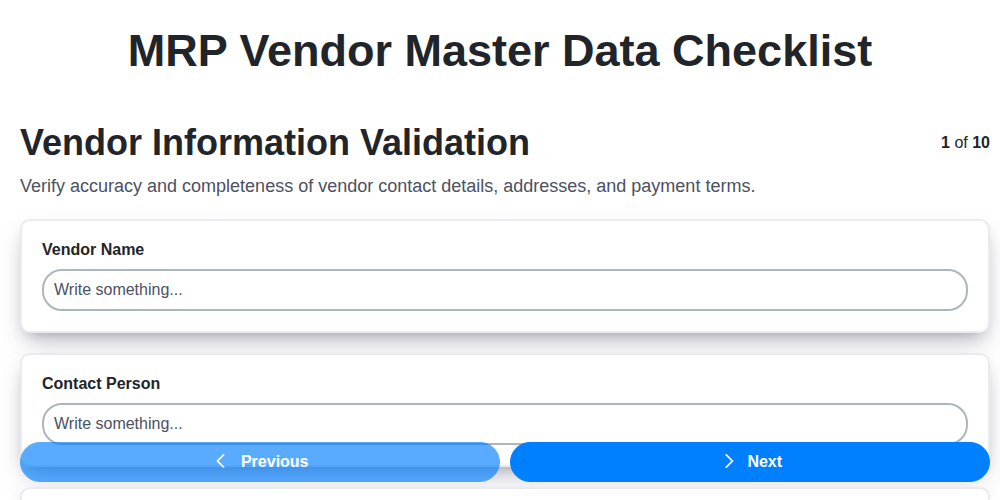
MRP Vendor Master Data Checklist: Ensuring Accuracy and Efficiency
We can do it Together
Need help with
Enterprise Resource Planning (ERP)?
Have a question? We're here to help. Please submit your inquiry, and we'll respond promptly.