Mastering Pharmaceutical Deviation Trend Analysis: Your Checklist Guide
Published: 11/25/2025 Updated: 07/02/2026
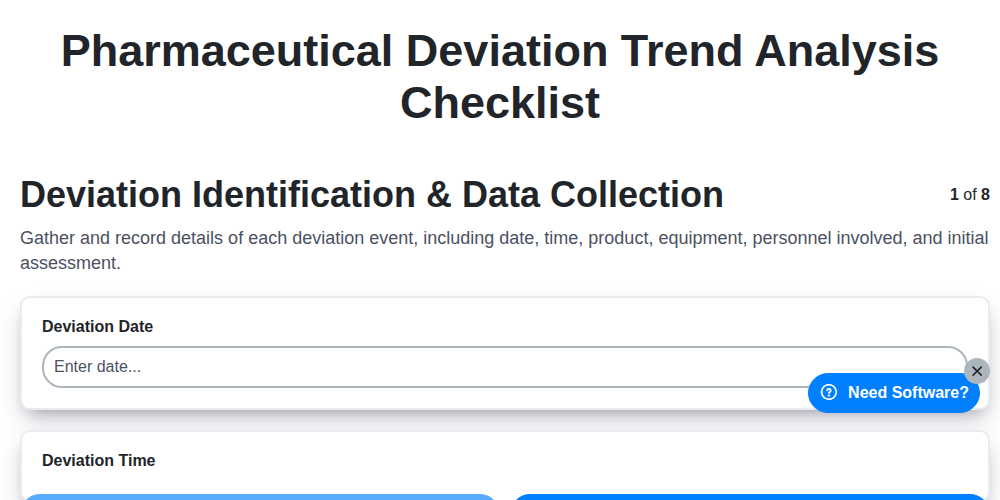
Table of Contents
- Introduction: Why Trend Analysis Matters in Pharmaceuticals
- 1. Deviation Identification & Data Collection: Laying the Foundation
- 2. Categorization & Coding: Structuring Your Deviation Data
- 3. Root Cause Analysis Documentation: Digging Deeper
- 4. Trend Identification & Analysis: Spotting Emerging Patterns
- 5. Pareto Chart Creation: Prioritizing Your Efforts
- 6. Corrective & Preventative Actions (CAPA) Tracking: Driving Resolution
- 7. Effectiveness Verification: Ensuring CAPA Success
- 8. Reporting & Review: Keeping Stakeholders Informed
- 9. Data Integrity and Audit Trail: Maintaining Compliance
- 10. Leveraging Technology for Trend Analysis
- Conclusion: Continuous Improvement Through Deviation Trend Analysis
- Resources & Links
TLDR: Struggling to spot patterns in pharmaceutical deviations? This checklist provides a step-by-step guide - from identifying the issue and finding the root cause to tracking fixes and verifying their impact. It's your shortcut to proactive risk management and regulatory compliance!
Introduction: Why Trend Analysis Matters in Pharmaceuticals
In the highly regulated pharmaceutical industry, maintaining product quality and patient safety is paramount. Deviations - those unexpected events that stray from established procedures - are inevitable. However, treating each deviation as a singular, isolated incident is a missed opportunity. Pharmaceutical Deviation Trend Analysis is the key to transforming these deviations from potential problems into valuable insights.
Analyzing deviation trends allows us to move beyond reactive responses and proactively address underlying systemic issues. It's about identifying patterns, understanding contributing factors, and preventing future occurrences. This not only reduces the risk of costly recalls and regulatory scrutiny but also demonstrates a commitment to continuous improvement and robust quality management. Ultimately, a proactive approach to deviation trend analysis translates to safer medications and greater confidence in our processes.
1. Deviation Identification & Data Collection: Laying the Foundation
The bedrock of any robust pharmaceutical deviation trend analysis program is a thorough and consistent approach to identifying and collecting deviation data. This initial step isn't just about noting that a deviation occurred, but about capturing the 'who, what, when, where, and how' with precision.
Key Considerations:
- Establish Clear Reporting Channels: Ensure all personnel, from production floor operators to quality control analysts, know how and to whom to report deviations. Multiple reporting pathways (electronic, paper, verbal) can improve capture rates.
- Standardized Deviation Forms/Templates: Utilize standardized forms or electronic templates to ensure consistent data collection. These forms should include fields for date/time, product/batch number, equipment involved, personnel involved, description of the deviation, and initial assessment of severity.
- Comprehensive Data Sources: Deviations can arise from various sources - manufacturing records, laboratory investigations, equipment logs, training records, and even internal audits. Consider all potential sources.
- Real-Time vs. Periodic Collection: While immediate reporting of critical deviations is vital, ensure a system is in place to capture deviations discovered during routine reviews or investigations.
- Initial Assessment: A preliminary assessment of the deviation's severity and potential impact should be documented at the time of identification. This helps prioritize investigations.
- Data Integrity: Implement controls to ensure the accuracy and completeness of deviation data. This includes access controls, audit trails, and regular data verification.
Without accurate and complete data, subsequent analysis steps will be flawed. Investing time and resources into this foundation will yield significant dividends in preventing future issues.
2. Categorization & Coding: Structuring Your Deviation Data
Effective deviation trend analysis hinges on consistently and accurately classifying each deviation. Without a standardized categorization and coding system, you're essentially drowning in a sea of unstructured data, making meaningful trend identification nearly impossible. This isn't just about ticking a box - it's about building a foundation for actionable insights.
Why is Categorization & Coding Important?
- Facilitates Trend Identification: Consistent categories allow you to easily group and analyze deviations, revealing patterns and trends that would otherwise be buried.
- Enables Data-Driven Decision Making: Structured data allows for more informed decisions regarding resource allocation and process improvements.
- Supports Regulatory Compliance: Demonstrates a systematic approach to deviation management, a key expectation of regulatory bodies.
- Streamlines Reporting: Simplifies the process of generating reports for internal stakeholders and regulatory agencies.
Building Your Categorization System:
Your categories should be specific enough to be useful, but broad enough to avoid creating an overwhelming number of codes. Consider these common areas for pharmaceutical deviation categorization:
- Process Step: Which process was affected (e.g., Weighing, Mixing, Granulation, Drying)?
- Equipment: Which equipment was involved (e.g., Blender, Tablet Press, HVAC System)?
- Material: Was there an issue with raw material, packaging, or excipient?
- Personnel: Did personnel error contribute to the deviation?
- Environmental Conditions: Was temperature, humidity, or other environmental factors a contributing factor?
- Procedure: Was the deviation caused by an inadequate or unclear procedure?
Coding Considerations:
Assigning numerical or alphanumeric codes to each category provides consistency. For example:
- Process Step: WS-Weighing, MX-Mixing, GR-Granulation
- Personnel: PE-Personnel Error, TR-Training Needed
Key Tips for Success:
- Involve Key Stakeholders: Collaborate with process owners, quality assurance, and data integrity personnel when developing your coding system.
- Document Clearly: Create a comprehensive coding manual that defines each category and code.
- Train Personnel: Ensure all personnel involved in deviation reporting understand and consistently apply the coding system.
- Regularly Review & Update: Periodically review your coding system to ensure it remains relevant and effective, adapting as processes evolve.
3. Root Cause Analysis Documentation: Digging Deeper
Deviation investigations often surface symptoms, but truly effective pharmaceutical quality systems demand we uncover the underlying cause. Root Cause Analysis (RCA) documentation is the cornerstone of this process. It's not enough to state a deviation occurred; we need a meticulously documented investigation demonstrating why it happened.
A robust RCA documentation should include more than just a brief explanation. It should contain:
- Detailed Investigation Narrative: A step-by-step account of the investigation, including all team members involved, the methods employed (e.g., 5-Whys, Fishbone Diagram, Fault Tree Analysis), and the rationale behind each conclusion. Avoid assumptions - focus on facts and observations.
- Evidence & Supporting Data: This is critical. Include raw data, batch records, instrument printouts, interview transcripts, and any other information that supports the identified root cause. Don't rely solely on recollections.
- Clearly Defined Root Cause(s): State the identified root cause(s) precisely and avoid ambiguity. If multiple root causes are identified, differentiate them clearly. Distinguish between direct causes and systemic issues.
- Causal Factors & Contributors: Outline all contributing factors, even if they weren't the primary root cause. These often reveal underlying systemic weaknesses.
- Assessment of Systemic Weaknesses: Connect the root cause to weaknesses within processes, procedures, training, or equipment. This highlights areas needing broader improvement.
- Documentation of Validation/Verification: If testing or validation was used to confirm the root cause, clearly document the methodology, results, and acceptance criteria.
Poor RCA documentation leads to recurring deviations and undermines the credibility of the quality system. Thorough, evidence-based RCA documentation fosters a culture of continuous improvement and ensures genuine corrective actions are implemented.
4. Trend Identification & Analysis: Spotting Emerging Patterns
Once you've successfully categorized and coded your deviations, the real power of trend analysis begins. This isn't simply about looking at individual incidents; it's about uncovering patterns and potential systemic issues.
Start by aggregating your deviation data within defined time periods (e.g., monthly, quarterly, annually). Visualize this data using various techniques - line graphs are excellent for showing trends over time, while bar charts can highlight frequency differences between categories. Look for spikes, recurring issues, and areas where the number of deviations consistently exceeds established thresholds.
Don't limit yourself to just numerical data. Qualitative data gleaned from deviation narratives and investigations can also provide crucial insights. For example, consistently hearing similar phrases or observations in root cause analysis documentation can signal an underlying procedural gap or training need.
Consider factors that might influence deviation rates. Are there seasonal trends related to raw material supply or manufacturing processes? Have any recent changes in equipment, personnel, or procedures coincided with an increase in specific deviation types? Correlating deviation trends with these factors can help identify contributing causes. Remember, a true trend isn't just a single event; it's a consistent pattern across multiple instances.
5. Pareto Chart Creation: Prioritizing Your Efforts
Deviation trend analysis isn't just about identifying patterns; it's about strategically focusing your resources. That's where the Pareto chart, also known as the 80/20 rule chart, becomes invaluable. This visual tool helps you prioritize corrective actions by showcasing which deviation categories contribute to the majority of issues.
Typically, a Pareto chart is constructed with deviation categories (e.g., equipment failure, human error, raw material defect) plotted on the horizontal axis and the frequency or severity of each deviation on the vertical axis. The categories are arranged in descending order of frequency/severity. A cumulative percentage line is then overlaid, visually demonstrating the point where a relatively small number of categories account for a large percentage of the total deviations.
For example, you might find that 20% of your deviation categories are responsible for 80% of the problems. This immediately highlights those critical areas demanding immediate attention and targeted CAPA initiatives. Without the Pareto chart, you risk spreading resources thinly across all categories, potentially hindering significant improvement in the most impactful areas.
By focusing your corrective and preventative actions on the vital few categories identified through the Pareto chart, you maximize your return on investment and significantly improve the overall quality and compliance posture of your pharmaceutical operations. Don't just identify trends - prioritize them!
6. Corrective & Preventative Actions (CAPA) Tracking: Driving Resolution
Deviation trend analysis isn't complete until you're meticulously tracking the actions taken to resolve the issues identified. This isn't just about closing out investigations; it's about ensuring those actions are effective, preventing recurrence, and demonstrating a commitment to continuous improvement. A robust CAPA tracking system is critical for pharmaceutical quality assurance.
Here's what a comprehensive approach to CAPA tracking should encompass:
- Action Assignment & Responsibility: Clearly assign responsibility for implementing corrective and preventative actions to specific individuals or teams. Ambiguity leads to inaction.
- Due Dates & Timelines: Establish realistic due dates for each action item and monitor progress regularly. Utilize a system (e.g., spreadsheet, specialized software) to track these deadlines.
- Status Updates & Escalation: Implement a clear system for updating the status of CAPAs (e.g., Planned, In Progress, Completed, On Hold). Define escalation paths for overdue or stalled CAPAs to ensure timely intervention.
- Documentation & Verification: Document all CAPA activities, including implementation steps, verification methods, and results. This provides an audit trail and supports ongoing assessment of effectiveness.
- Risk Assessment Integration: Ideally, CAPA plans should directly address the risk level associated with the original deviation. Higher risk deviations warrant more rigorous and robust CAPA plans.
- Cross-Functional Collaboration: Encourage and facilitate collaboration between departments (e.g., Quality, Manufacturing, Engineering) to ensure comprehensive CAPA implementation and prevent siloed problem-solving.
Effective CAPA tracking is a proactive investment in pharmaceutical quality and a key element of your deviation trend analysis program.
7. Effectiveness Verification: Ensuring CAPA Success
Corrective and Preventative Actions (CAPA) aren't a "set it and forget it" endeavor. True CAPA success hinges on rigorous effectiveness verification. This critical step ensures your implemented actions actually addressed the deviation and prevented recurrence. Without it, you're essentially throwing resources at a problem without knowing if they're working.
Here's what effective verification entails:
- Defined Metrics: Before implementing a CAPA, clearly define what effective looks like. Establish measurable metrics linked to the original deviation. These could include reduced deviation frequency, improved process stability, decreased impact on product quality, or enhanced employee training comprehension.
- Data Collection Post-Implementation: Gather data following CAPA implementation over a defined period. This data should be directly related to the established metrics. Ensure consistent data collection methods are used for accurate comparison with pre-CAPA data.
- Statistical Analysis: Employ appropriate statistical methods (e.g., control charts, t-tests) to compare pre- and post-CAPA data. Don't rely on anecdotal evidence; use data to objectively assess the impact.
- Trend Monitoring: Continue monitoring key indicators even after initial verification. Deviations can sometimes reappear or new issues can surface as a consequence of the CAPA itself.
- Documentation: Meticulously document the verification process, including the metrics used, data collected, statistical analysis performed, and conclusions drawn.
- Re-evaluation & Adjustment: If the CAPA is deemed ineffective, don't hesitate to re-evaluate the root cause analysis and implement a revised action. Flexibility and a willingness to adapt are vital.
Effectiveness verification isn't just about compliance; it's about continuous improvement and ensuring the safety and quality of your pharmaceutical products.
8. Reporting & Review: Keeping Stakeholders Informed
Deviation trend analysis isn't a one-and-done activity; it's a continuous cycle requiring consistent reporting and review. This final step ensures transparency, fosters accountability, and facilitates ongoing improvement.
What needs to be reported? The reports shouldn't just present data; they should tell a story. Include:
- Summary of Deviation Trends: Highlight significant patterns, emerging risks, and areas of concern. Avoid technical jargon - clarity is paramount.
- Pareto Chart Visualization: Visually representing the Pareto chart reinforces the focus on the "vital few" deviations driving the overall trend.
- CAPA Status: Provide updates on the progress and effectiveness of implemented corrective and preventative actions.
- Effectiveness Verification Results: Clearly articulate whether CAPAs achieved the desired impact and if further action is needed.
- Key Performance Indicators (KPIs): Track metrics like deviation frequency, severity, and time to resolution to demonstrate progress over time.
Who needs to be informed? Tailor your reporting to your audience. Consider these groups:
- Quality Assurance (QA): For detailed trend analysis and CAPA validation.
- Management: For strategic insights and resource allocation decisions.
- Relevant Departments (e.g., Manufacturing, R&D): For departmental-specific insights and collaborative problem-solving.
- Regulatory Bodies (as required): For transparency and compliance.
Review Frequency & Scope: Establish a regular review cadence (e.g., monthly, quarterly, annually) and ensure the scope includes:
- Data Accuracy: Confirm the integrity of the data used in the analysis.
- Process Effectiveness: Evaluate if the deviation trend analysis process itself is working effectively.
- System Improvements: Identify opportunities to enhance data collection, coding, or analysis techniques.
This continuous reporting and review loop closes the feedback cycle, solidifying your commitment to continuous improvement and demonstrating a robust quality system.
9. Data Integrity and Audit Trail: Maintaining Compliance
Deviation trend analysis isn't just about identifying problems; it's about demonstrating a robust, compliant system. A critical component of this is meticulous data integrity and a clear audit trail. Every step of your checklist - from initial deviation identification to CAPA effectiveness verification - must be thoroughly documented and traceable.
This means:
- Electronic Signatures: Implement electronic signatures for all entries, approvals, and modifications made to deviation records. This ensures accountability and provides a timestamped record of actions.
- Change Control: Establish a strict change control process. Any modifications to the checklist itself, data entry fields, coding systems, or analysis methods should be documented and approved, preventing unintentional data manipulation.
- Access Control: Limit access to deviation data and analysis tools based on role and responsibility. Ensure only authorized personnel can make changes or generate reports.
- Data Backup and Recovery: Regularly back up all deviation data and analysis files to prevent data loss and ensure recoverability in case of system failures.
- Audit Trail Maintenance: Preserve the audit trail for the required retention period (typically defined by regulations and company policy). This includes all user actions, data modifications, and report generation.
- Validation of Systems: Any software or systems used for deviation tracking, data analysis, or reporting must be validated to ensure they function as intended and produce reliable results.
Maintaining this level of data integrity is paramount for demonstrating compliance with regulations (such as FDA 21 CFR Part 11) and providing assurance to internal and external stakeholders.
10. Leveraging Technology for Trend Analysis
Manually analyzing pharmaceutical deviations is time-consuming, prone to human error, and often struggles to provide a holistic view of underlying trends. Thankfully, technology offers powerful solutions to streamline and enhance this critical process. Several software options can automate much of the workflow, from data collection to reporting.
Consider these technological enhancements:
- Deviation Management Systems (DMS): These platforms centralize deviation data, automating entry, categorization, and coding. Many integrate with other quality systems (like LIMS or MES).
- Business Intelligence (BI) Tools: Platforms like Tableau, Power BI, and others allow for sophisticated data visualization, enabling you to easily identify trends and outliers through interactive dashboards and charts. Connect these to your DMS for a complete picture.
- Statistical Process Control (SPC) Software: Offers automated trend identification, control chart generation, and alert systems to flag unusual patterns.
- AI and Machine Learning: Emerging technologies can analyze large datasets to proactively identify potential deviations and predict future trends, minimizing risks.
- Automated Reporting: Reduce manual report generation by utilizing reporting modules within your DMS or integrating your data with reporting tools.
By embracing these technologies, pharmaceutical companies can significantly improve the efficiency and effectiveness of their deviation trend analysis, leading to enhanced product quality and regulatory compliance.
Conclusion: Continuous Improvement Through Deviation Trend Analysis
Deviation trend analysis isn't a one-time project; it's a journey of continuous improvement. By diligently working through the checklist - from meticulous deviation identification to robust CAPA tracking and effectiveness verification - pharmaceutical companies can move beyond reactive problem-solving and proactively mitigate risks. The insights gleaned from trend identification, particularly when visualized through tools like Pareto charts, empower informed decision-making and prioritization of resources. Remember, a commitment to this structured approach fosters a culture of quality, reinforces regulatory compliance, and ultimately, strengthens patient safety. Regularly revisiting and refining your deviation trend analysis process, alongside fostering open communication and collaboration across departments, will ensure you are consistently learning from past events and building a more resilient and robust quality system.
Resources & Links
- Pharmaceutical Online: A leading industry resource covering pharmaceutical manufacturing, quality, regulatory affairs, and process technology. Provides articles and webinars often relevant to deviation management and trend analysis. Explore their 'Quality' and 'Manufacturing' sections.
- American Society for Quality (ASQ): A global leader in quality. Offers training, certifications, and resources on quality management systems, statistical process control, and root cause analysis - all crucial for deviation trend analysis. Their publications cover methodologies directly applicable.
- International Society for Pharmaceutical Engineering (ISPE): Focuses on pharmaceutical engineering and manufacturing. Provides guidance, white papers, and training on GMP, quality systems, and process validation - all intertwined with deviation management and trend analysis. Consider their Good Practice Guides.
- GMP Compliance: A dedicated source for GMP regulations and compliance information. Provides news, articles, and training materials directly related to regulatory requirements impacting deviation trend analysis.
- Quality Assurance Magazine: A publication covering quality assurance topics across various industries, including pharmaceuticals. Find articles on quality management, risk management, and regulatory compliance - relevant themes for effective deviation trend analysis.
- National Institute of Standards and Technology (NIST): While not directly pharmaceutical, NIST provides valuable information and resources on measurement science, data integrity, and statistical analysis, which are fundamental to robust deviation trend analysis. Explore their publications related to data management.
- FDA Center: FDA Center provides news and insights regarding FDA regulations, inspections, and guidance documents. Crucial for ensuring trend analysis practices align with current compliance expectations. Focus on their Quality/Compliance section.
- The Lean Enterprise Institute: While known for manufacturing, Lean principles of continuous improvement and waste reduction can be applied to deviation management. Reduces redundancy and improves efficiency of your deviation review process.
- Statistics.com: Provides statistical consulting and training. If you need a deeper understanding of statistical methods for analyzing trends, this is a resource for advanced statistical analysis applicable to pharmaceutical data.
- Minitab: A statistical software package often used in pharmaceuticals for data analysis, including trend identification and control charting. Offers tutorials and resources for using statistical tools.
- Tableau: Data visualization software that can be used to visually represent deviation trends and make them easier to understand. Provides interactive dashboards to communicate findings to stakeholders.
- Hexagon: Offers manufacturing intelligence and analytics software solutions which often include tools for deviation management and root cause analysis, covering the entire product lifecycle.
Frequently Asked Questions
What is Pharmaceutical Deviation Trend Analysis and why is it important?
Pharmaceutical Deviation Trend Analysis (DTA) involves systematically reviewing and analyzing deviation data over time to identify patterns, trends, and root causes of recurring issues. It's crucial for proactive risk management, continuous improvement, and ensuring product quality and patient safety, fulfilling regulatory requirements like FDA 21 CFR Part 11 and EU GMP Annex 16.
Who should be involved in Deviation Trend Analysis?
A multidisciplinary team is ideal, including representatives from Quality Assurance, Quality Control, Manufacturing, Engineering, and potentially Regulatory Affairs. The team should possess sufficient knowledge of the process and systems being analyzed.
What types of data should be included in a Deviation Trend Analysis?
Data to include encompasses deviation reports, investigation findings, corrective and preventive actions (CAPAs), change control records, training records, equipment maintenance logs, and potentially raw material data. The scope should be defined based on the specific issue being investigated.
What constitutes a 'trend' in deviation data?
A trend isn't just about the number of deviations. It's about recurring deviation types, consistent root causes, patterns related to specific equipment, operators, time periods, or process steps. Look for clusters or increases in specific deviation categories.
What are some common tools and techniques used in DTA?
Common tools include spreadsheets (e.g., Excel), statistical process control (SPC) charts, Pareto charts, fishbone diagrams (Ishikawa), and specialized deviation management software. Data visualization tools are also beneficial.
How do I define a 'significant' trend requiring immediate attention?
Establish clear criteria for significance, such as a pre-defined increase in deviation frequency, repeated occurrences of high-risk deviations, or consistent failure of CAPAs to resolve underlying issues. These criteria should be documented and regularly reviewed.
What are CAPAs, and how do they relate to Deviation Trend Analysis?
Corrective and Preventive Actions (CAPAs) are actions taken to eliminate the cause of a deviation and prevent its recurrence. DTA informs CAPA planning by highlighting root causes and trends, while CAPA effectiveness is then monitored during subsequent DTA cycles to ensure they're working.
How often should Deviation Trend Analysis be performed?
The frequency depends on the risk level of the processes and products involved. Generally, analysis should occur quarterly or semi-annually. Higher-risk areas might require monthly or even weekly reviews. A documented schedule is essential.
How do I document the Deviation Trend Analysis process and findings?
Document the analysis plan, data sources, methodology, findings, conclusions, and action items. Maintain records of review meetings, CAPA status, and any changes to the analysis process. Ensure traceability and auditability.
What role does training play in reducing deviation trends?
Often, deviations stem from operator errors or procedural misunderstandings. Targeted training based on identified trends is crucial to address knowledge gaps and improve performance, directly impacting deviation reduction.
How do I incorporate Deviation Trend Analysis into a Quality Management System (QMS)?
Integrate DTA into established QMS procedures, ensuring it's linked to risk management, CAPA management, and change control processes. Assign responsibilities and define clear timelines for analysis and follow-up actions.
Comments
There are no comments yet. Be the first to add one!
Pharmaceutical Management Solution Demo
Navigating complex regulations and ensuring quality in pharmaceutical manufacturing? ChecklistGuro's Work OS platform streamlines processes from R&D to production, packaging, and distribution. Maintain compliance, improve efficiency, and reduce risk. Discover how ChecklistGuro can transform your pharmaceutical operations!
Related Articles
Ensuring Quality: A Pharmaceutical Compound Record Review Checklist Guide
Pharmaceutical Labeling Compliance Checklist: Your Step-by-Step Guide
Mastering Medication Management: Your Pharmaceutical Inventory Compliance Checklist Template
Navigating Adverse Event Reporting: Your Pharmaceutical Checklist Guide
Pharmaceutical Inventory Management Checklist: Your Guide to Compliance & Accuracy
Your Essential GLP Checklist Template: A Practical Guide
Your Pharmaceutical Development Checklist: A Template for Success
Pharmaceutical Validation Checklist Template: Your Guide to Compliance
Need help with
Pharmaceutical?
Have a question? We're here to help. Please submit your inquiry, and we'll respond promptly.