Mastering Pharmaceutical Document Control: Your Essential Checklist Template
Published: 11/25/2025 Updated: 07/02/2026
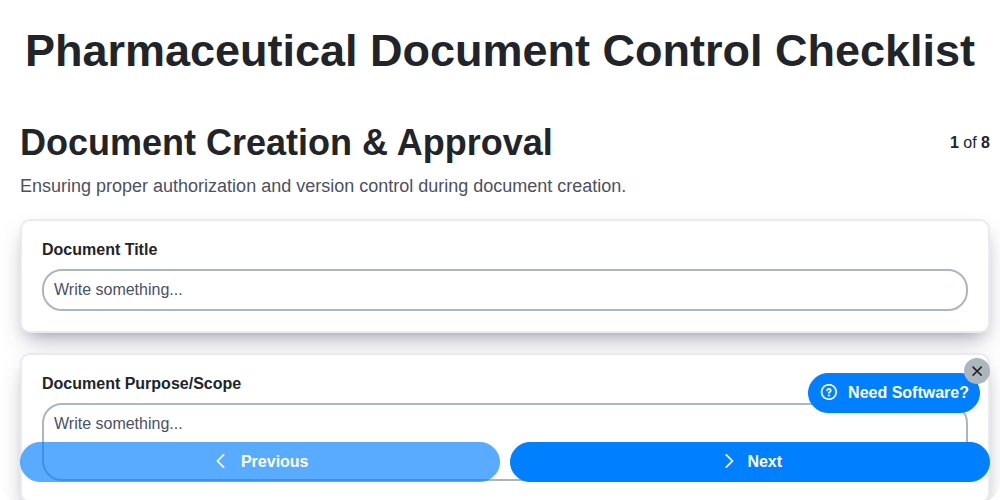
Table of Contents
- Why Pharmaceutical Document Control Matters
- Document Creation & Approval: Laying the Foundation
- Document Review & Revision: Ensuring Accuracy and Compliance
- Document Distribution & Access: Controlled Sharing
- Document Storage & Retention: A Secure and Compliant Archive
- Document Retrieval & Availability: Ready When You Need It
- Managing Obsolete Documents: Proper Decommissioning
- Document Master Record (DMR) Review: The Cornerstone of Quality
- Resources & Links
TLDR: Pharmaceutical companies need rock-solid document control to stay compliant. This checklist template walks you through every critical step - from creation and approval to obsolete document management and DMR reviews - ensuring your processes are organized, auditable, and ready for inspection. Download it and simplify your document control today!
Why Pharmaceutical Document Control Matters
In the highly regulated pharmaceutical industry, meticulous document control isn't just a best practice - it's a legal and ethical imperative. Robust document control directly impacts product quality, patient safety, and regulatory compliance. A single misplaced or outdated document can trigger costly recalls, impact audit findings, and even jeopardize market authorization.
Think of it this way: every process, from raw material sourcing to manufacturing and release, is documented. These documents serve as a complete, verifiable record of how a drug is made and maintained. They demonstrate adherence to Good Manufacturing Practices (GMP) and provide a traceable audit trail. Poor document control breaks this chain of trust, potentially exposing a company to significant risks. Beyond regulatory compliance, effective document control fosters efficiency, minimizes errors, and ensures consistent processes across the organization. It's the backbone of a reliable and trustworthy pharmaceutical operation.
Document Creation & Approval: Laying the Foundation
The entire document control system hinges on a robust and meticulously followed document creation and approval process. This isn't just about putting words on paper (or pixels on a screen); it's about establishing the baseline for accuracy, consistency, and compliance.
Here's a breakdown of key considerations:
- Defined Templates: Utilize standardized templates for all document types (SOPs, batch records, specifications, etc.). Templates ensure consistent formatting, required sections, and pre-defined approval workflows.
- Author Qualification: Clearly define who is qualified to author documents, based on their knowledge and experience related to the content.
- Content Accuracy & Completeness: The initial draft must be technically accurate, comprehensive, and easily understandable. Subject Matter Experts (SMEs) should always be involved in authoring critical documents.
- Approval Workflow: Implement a documented and controlled workflow for review and approval. The workflow should clearly identify the roles and responsibilities of each approver and specify acceptance criteria. Multiple levels of review may be required depending on the document's criticality.
- Version Control Implementation: Version numbers and dates must be assigned during the creation stage. This is foundational for tracking changes and ensuring users are referencing the current version.
- Document Control System Integration: The creation and approval process should be seamlessly integrated into your Document Control System (DCS) to ensure proper tracking and audit trail.
- Controlled Distribution: Once approved, the document is officially released and ready for distribution, adhering to defined access protocols (covered later).
Failing to lay a strong foundation during document creation and approval can lead to downstream issues like incorrect procedures being followed, regulatory non-compliance, and ultimately, compromised product quality.
Document Review & Revision: Ensuring Accuracy and Compliance
Pharmaceutical document control isn't just about having documents; it's about having accurate and compliant documents. The review and revision stage is a critical point in the document lifecycle, acting as a quality gate to prevent errors and ensure alignment with current regulations, SOPs, and company policies.
This process shouldn't be a mere formality. It requires a structured approach involving qualified personnel with the appropriate expertise. Key elements to consider within the review and revision phase include:
- Defined Reviewers: Clearly identify who is responsible for reviewing specific document types, ensuring they possess the necessary technical knowledge and understanding of applicable regulations (e.g., GMP, GxP).
- Review Criteria: Establish clear and objective criteria for reviews. What are reviewers looking for? Is the information accurate, complete, and up-to-date? Does it align with current SOPs and regulatory requirements?
- Revision Tracking: Implement a system to meticulously track all revisions. This includes documenting the reviewer's name, date of review, specific changes made, and rationale for those changes. Version control is paramount.
- Change Justification: All revisions must be justified. A simple correction or clarification needs a reason behind it. This transparency provides an audit trail and demonstrates the reasoning behind alterations.
- Re-Approval: Following revisions, the document must be re-approved by authorized personnel. This confirms that the changes are acceptable and maintain the document's integrity.
- Regular Review Cadence: Implement scheduled reviews, even for documents deemed "stable." This proactive approach helps identify potential issues before they escalate.
Effective document review and revision practices dramatically reduce the risk of errors, ensure compliance, and strengthen the overall quality management system.
Document Distribution & Access: Controlled Sharing
In the pharmaceutical industry, uncontrolled document distribution is a compliance nightmare. Simply emailing a document to multiple recipients isn't acceptable. A robust document control system ensures that only authorized personnel have access to the correct versions of documents, and that access is meticulously tracked.
Here's what a well-managed document distribution & access process looks like:
- Defined User Roles & Permissions: Implement a system with clearly defined user roles (e.g., reviewer, approver, read-only) and assign permissions accordingly. This prevents unauthorized access and modification.
- Controlled Distribution Lists: Maintain accurate and updated distribution lists for each document type. Ensure that new employees are added to appropriate lists and individuals leaving the company are removed promptly.
- Audit Trail of Distribution: The system must record who accessed a document, when, and for what purpose. This provides a critical audit trail for demonstrating compliance.
- Secure Delivery Methods: Utilize secure methods for document delivery, such as a controlled document management system (DMS) with version control and access controls, rather than unsecured email.
- Document Management System Integration: Ideally, your document distribution process is tightly integrated with your document management system, automating the process and minimizing manual errors.
- Regular Access Reviews: Periodically review user access rights to ensure they remain appropriate for their current roles and responsibilities.
Failure to control document distribution and access can lead to inaccurate information being used in critical processes, potentially impacting product quality and safety.
Document Storage & Retention: A Secure and Compliant Archive
Pharmaceutical companies face rigorous regulatory scrutiny, and a robust document storage and retention program is paramount for demonstrating compliance. It's not enough to have documents; they must be reliably stored, readily retrievable, and maintained for the mandated retention periods.
Here's a breakdown of key considerations for a compliant pharmaceutical document storage and retention program:
- Defined Retention Periods: Clearly define retention periods for every document type, based on regulatory requirements (e.g., FDA 21 CFR Part 11, EMA guidelines) and internal policies. A retention schedule should be readily accessible to all relevant personnel.
- Secure Storage Environment: Implement secure storage, whether physical or electronic. For physical archives, consider factors like temperature, humidity, fire suppression, and access control. For electronic systems, robust cybersecurity measures, including access controls, audit trails, and data encryption, are essential.
- Controlled Access: Limit access to stored documents based on roles and responsibilities. This minimizes the risk of unauthorized modification or deletion.
- Audit Trails: Maintain comprehensive audit trails to track document access, modification, and deletion. This provides a verifiable record of document history.
- Disaster Recovery Plan: Develop a robust disaster recovery plan to protect against data loss due to natural disasters, system failures, or other unforeseen events. This should include backups and offsite storage.
- Media Migration: Plan for periodic media migration as storage media becomes obsolete. Ensure data integrity is maintained throughout the migration process.
- Periodic Review: Conduct regular reviews of your retention schedule and storage practices to ensure continued compliance and effectiveness.
A well-managed document storage and retention program isn's just about meeting regulations; it's a cornerstone of operational excellence and risk mitigation within the pharmaceutical industry.
Document Retrieval & Availability: Ready When You Need It
In the fast-paced pharmaceutical environment, delays in accessing critical documents can have serious consequences, potentially impacting production, quality, and regulatory compliance. A robust document control system isn't just about creating and storing documents; it's about ensuring they are readily accessible when and where they're needed.
This section focuses on the often-overlooked, but vital, aspect of document retrieval and availability. It's not enough to simply know a document exists. You need to confidently and quickly locate it.
Key Elements for Efficient Retrieval:
- Robust Indexing & Search Functionality: Your document management system (DMS) needs a powerful search engine. Tagging documents with accurate keywords, version numbers, document types, and relevant departments is crucial. Don't rely solely on file names - utilize metadata!
- Clear Access Control: Define roles and permissions carefully. Ensure authorized personnel can access the documents they need, while protecting sensitive information. Regularly review access rights to maintain security.
- User Training: Even the best DMS is useless if users don't know how to use it effectively. Provide training on search techniques and understanding the document taxonomy.
- Regular System Audits: Verify that the search function is working correctly and that documents are being retrieved as expected. Test searches with various search terms to identify any gaps in indexing or accessibility.
- Contingency Planning: What happens if the primary system goes down? Have backup procedures in place to ensure critical documents are still accessible.
Ensuring document retrieval and availability is seamless is a cornerstone of a well-managed pharmaceutical document control system. It minimizes delays, reduces errors, and ultimately contributes to operational efficiency and regulatory compliance.
Managing Obsolete Documents: Proper Decommissioning
Obsolete documents pose a significant risk to pharmaceutical quality and compliance. Simply deleting them isn't enough; improper handling can lead to confusion, accidental use, and potential regulatory scrutiny. A robust process for identifying, reviewing, and decommissioning obsolete documents is critical.
Here's a breakdown of best practices:
- Identification: Clearly define what constitutes an obsolete document. This often relates to superseded versions, changes in procedures, regulatory updates, or product discontinuations. Establish clear criteria and regularly review documents against these criteria.
- Review & Approval: Before any document is marked obsolete, it must undergo a formal review. This review should involve relevant stakeholders, including document authors, quality assurance personnel, and potentially subject matter experts. The review should confirm the document is indeed obsolete and no longer required for any purpose.
- Marking & Notification: Once approved for decommissioning, the obsolete document must be clearly marked as such. This marking should be visible on the document itself (e.g., OBSOLETE - DO NOT USE) and within the document control system. Notification to users who previously accessed the document is also recommended to prevent inadvertent use.
- Controlled Removal: The document should then be removed from active distribution lists and access points. This needs to be a controlled process, tracked within the document control system.
- Retention Requirements: Remember that even obsolete documents are often subject to retention requirements. While they are no longer in active use, they must be preserved for the required period to support audits, investigations, and legal proceedings.
- System Updates: Ensure that any references to the obsolete document are updated within other documents, systems, and training materials. This minimizes the risk of confusion and ensures continued compliance.
Proper decommissioning prevents errors, maintains data integrity, and demonstrates a commitment to pharmaceutical quality and compliance.
Document Master Record (DMR) Review: The Cornerstone of Quality
The Document Master Record (DMR) isn't just another document; it's the foundation upon which your pharmaceutical processes are built. It represents the most current, approved version of a crucial document - often batch records, standard operating procedures (SOPs), or manufacturing instructions - and serves as the definitive guide for execution. A robust DMR review process is critical for maintaining compliance, ensuring consistency, and minimizing errors.
Regular DMR reviews shouldn't be a reactive exercise prompted by an audit finding. Instead, they should be a proactive, scheduled activity. Here's what a thorough DMR review entails:
- Verification of Accuracy & Completeness: Does the DMR accurately reflect current processes and equipment? Are all relevant sections and appendices included?
- Comparison to Source Documents: Is the DMR directly traceable to the originating documentation and does it accurately represent it? Any discrepancies need immediate investigation and correction.
- Alignment with Changes: Does the DMR reflect any recent changes to raw materials, equipment, processes, or regulatory requirements?
- Reviewer Qualifications: Ensure reviewers possess the necessary expertise and training to understand the document and identify potential issues.
- Documentation of Review: Maintain a clear record of review dates, reviewer names, and any corrective actions taken. This provides an audit trail and demonstrates due diligence.
- Frequency: Establish a defined review frequency based on risk assessment - higher-risk documents warrant more frequent reviews.
Neglecting DMR reviews can lead to serious consequences, including deviations, regulatory scrutiny, and potentially compromised product quality. Investing in a well-defined and consistently executed DMR review process is an investment in your entire quality system.
Resources & Links
- U.S. Food and Drug Administration (FDA): The FDA's website provides essential regulations, guidance documents, and industry resources related to pharmaceutical quality, including specific requirements impacting document control. Explore 21 CFR Part 11, 21 CFR Part 21, and related guidance for context.
- European Medicines Agency (EMA): The EMA offers similar regulatory information for the European market, particularly regarding GMP guidelines that impact pharmaceutical document control. Focus on Annex 11 - Computerized Systems and Annex 13 - Manufacture of Investigational Medicinal Products.
- International Organization for Standardization (ISO): ISO 9001 (Quality Management Systems) and related standards provide a framework for quality management, often encompassing document control procedures. Review these standards to understand best practices.
- GMP Training: Offers comprehensive Good Manufacturing Practice (GMP) training courses and resources, including detailed modules on document control. Useful for understanding practical application and regulatory expectations.
- Pharmaceutical Online: A leading industry publication with articles, webinars, and resources covering pharmaceutical manufacturing, quality, and regulatory compliance. Search for specific articles related to document management.
- Compliance 4 Compliance: Provides regulatory consulting and training services, with a significant focus on GMP and pharmaceutical compliance. They often publish articles and whitepapers relating to document control.
- American Society for Quality (ASQ): ASQ is a global authority on quality, providing resources, certifications, and training related to quality management systems, including those relevant to document control. Explore their publications and training offerings.
- PDA (Parenteral Drug Association): PDA is a professional organization focused on sterile products and pharmaceutical manufacturing. They offer technical reports and resources that often address document control considerations in sterile manufacturing environments.
- Nice Quest: Provides Document Management Systems (DMS) specifically designed for pharmaceutical companies. Their website offers valuable insights into digital document control best practices and the benefits of a structured approach.
- Velostity: Velostity offers validated document management software and related services. Explore their website for information on compliant document control implementation and system validation.
Frequently Asked Questions
What is pharmaceutical document control and why is it important?
Pharmaceutical document control is the systematic process of managing documents throughout their lifecycle - from creation and approval to revision, distribution, and eventual obsolescence. It's crucial for maintaining data integrity, compliance with regulations (like FDA 21 CFR Part 11 and EU Annex 11), ensuring product quality, and avoiding costly recalls or regulatory actions.
Who needs to use a pharmaceutical document control checklist?
Anyone involved in creating, reviewing, approving, distributing, or archiving pharmaceutical documents. This includes quality assurance personnel, regulatory affairs specialists, validation teams, R&D scientists, manufacturing personnel, and document controllers.
What types of documents are typically managed through pharmaceutical document control?
This includes a wide range of documents, such as SOPs (Standard Operating Procedures), validation protocols and reports, batch records, change controls, deviation reports, training records, equipment logs, and audit trails.
What are the key components of a comprehensive pharmaceutical document control checklist template?
A good checklist template should include elements like document identification (title, document number, revision number), author, reviewer, approver, approval dates, document purpose, distribution list, version control tracking, review cycle dates, and a field for change control history. The template should also outline the responsibilities of each role involved.
How does this checklist template help ensure compliance with regulations?
The checklist helps enforce consistent processes for document creation, review, and approval, thereby reducing the risk of non-compliance. It helps establish accountability, provides an audit trail, and ensures that documents meet the requirements outlined in relevant regulations such as 21 CFR Part 11 and EU Annex 11.
Can this checklist template be customized for different types of documents?
Yes, absolutely. The template is designed to be a starting point. You should customize it to reflect the specific requirements of different document types and your company's internal procedures. For example, a validation protocol checklist will differ from an SOP checklist.
What is a change control process and why is it important in document control?
A change control process is a structured approach for managing modifications to documents. It ensures that all changes are properly evaluated, approved, and documented before implementation, minimizing the risk of errors and maintaining data integrity. The checklist should facilitate this process.
How should I handle obsolete or superseded documents?
Obsolete documents should be clearly marked as such and removed from active use. They should be archived securely with a documented reason for obsolescence and the date of removal from circulation. The checklist can include steps for archiving and disposal.
What are some common mistakes to avoid in pharmaceutical document control?
Common mistakes include inadequate training, lack of version control, failure to follow change control procedures, inconsistent approvals, and failing to archive documents properly. Using a checklist helps to mitigate these risks.
Where can I find resources for further learning about pharmaceutical document control?
Resources include regulatory guidelines (like FDA and EMA publications), industry best practices, training courses, and professional organizations focused on quality assurance and regulatory compliance. Your company's quality department is also a valuable resource.
Comments
There are no comments yet. Be the first to add one!
Pharmaceutical Management Solution Demo
Navigating complex regulations and ensuring quality in pharmaceutical manufacturing? ChecklistGuro's Work OS platform streamlines processes from R&D to production, packaging, and distribution. Maintain compliance, improve efficiency, and reduce risk. Discover how ChecklistGuro can transform your pharmaceutical operations!
Related Articles
Ensuring Quality: A Pharmaceutical Compound Record Review Checklist Guide
Pharmaceutical Labeling Compliance Checklist: Your Step-by-Step Guide
Mastering Medication Management: Your Pharmaceutical Inventory Compliance Checklist Template
Navigating Adverse Event Reporting: Your Pharmaceutical Checklist Guide
Pharmaceutical Inventory Management Checklist: Your Guide to Compliance & Accuracy
Your Essential GLP Checklist Template: A Practical Guide
Your Pharmaceutical Development Checklist: A Template for Success
Pharmaceutical Validation Checklist Template: Your Guide to Compliance
Need help with
Pharmaceutical?
Have a question? We're here to help. Please submit your inquiry, and we'll respond promptly.