Pharmaceutical Supply Chain and Logistics Optimization: A Comprehensive Workflow Template
Published: 05/31/2026 Updated: 10/05/2026
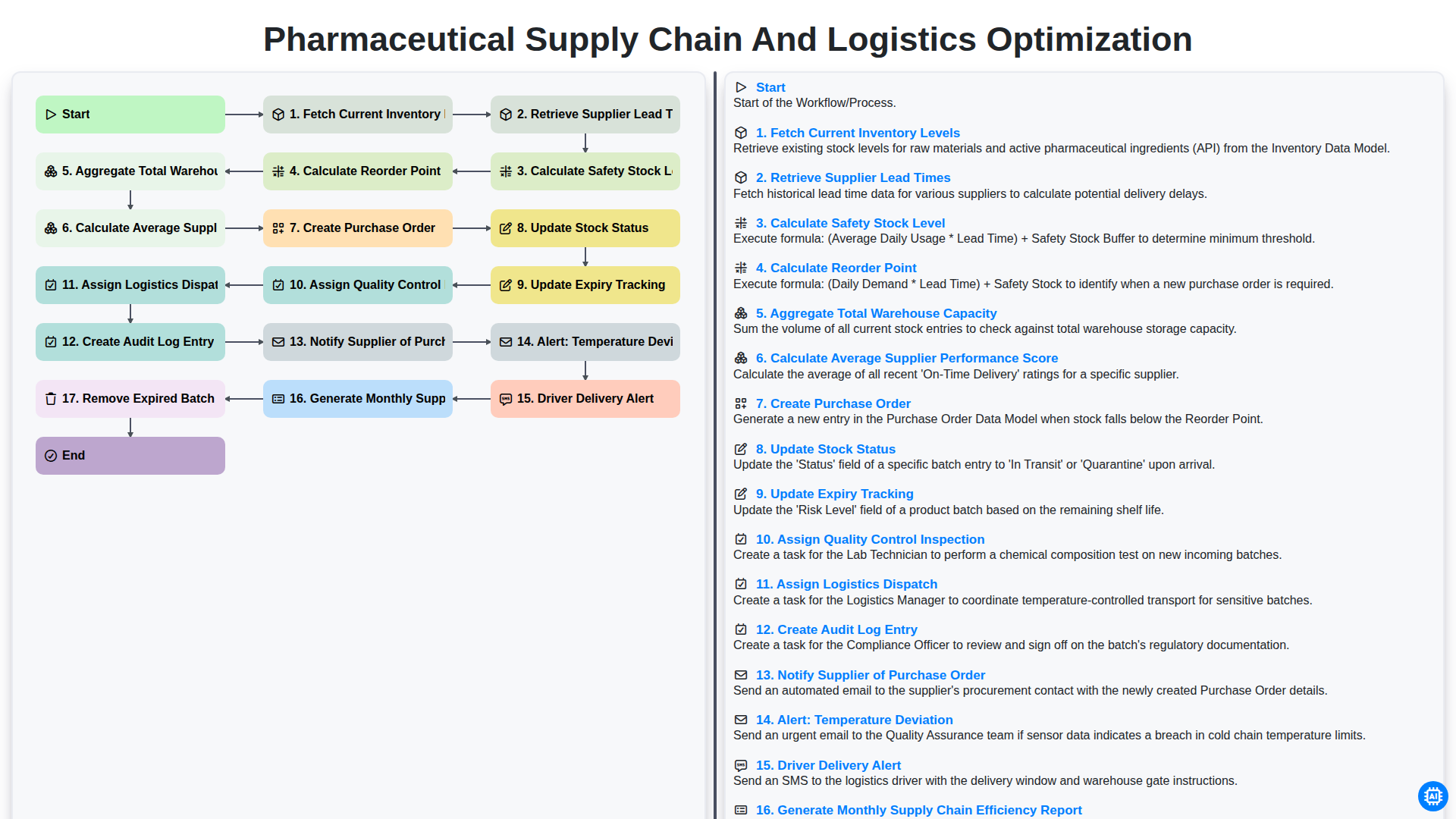
Table of Contents
- Introduction to Pharmaceutical Supply Chain Optimization
- Phase 1: Real-Time Inventory and Supplier Intelligence
- Fetching Current Inventory Levels and Supplier Lead Times
- Phase 2: Predictive Analytics for Demand and Risk Management
- Calculating Safety Stock Levels and Reorder Points
- Evaluating Supplier Performance and Warehouse Capacity
- Phase 3: Automated Procurement and Order Execution
- Generating Purchase Orders and Supplier Notification
- Phase 4: Inventory Maintenance and Quality Assurance
- Updating Stock Status and Expiry Tracking Protocols
- Implementing Quality Control and Inspection Workflows
- Phase 5: Logistics, Distribution, and Real-Time Monitoring
- Managing Dispatch, Driver Alerts, and Temperature Compliance
- Phase 6: Continuous Improvement and Audit Compliance
- Generating Efficiency Reports and Maintaining Audit Logs
- Resources & Links
TLDR: This blog post introduces an automated workflow template designed to streamline pharmaceutical supply chain operations. It explains how the end-to-end process-ranging from inventory forecasting and automated reordering to quality control and real-time temperature monitoring-optimizes stock accuracy, ensures regulatory compliance, and enhances logistics efficiency to prevent product expiration and stockouts.
Introduction to Pharmaceutical Supply Chain Optimization
In the highly regulated landscape of the pharmaceutical industry, the margin for error is virtually non-existent. Unlike general retail, pharmaceutical supply chain management involves much more than simply moving products from point A to point B; it requires the meticulous management of temperature-sensitive biologics, strictly monitored expiration dates, and unwavering compliance with global safety standards. A single breakdown in the logistics chain-whether through a temperature excursion or a stockout of life-saving medication-can have devastating consequences for patient health and regulatory standing.
Optimizing this complex ecosystem requires moving away from reactive troubleshooting toward a proactive, automated workflow. Efficiency in this sector is driven by the seamless integration of real-time data, predictive analytics, and automated decision-making. By optimizing every touchpoint-from calculating precise safety stock levels to automating quality control inspections-pharmaceutical companies can mitigate risks, reduce waste from expired batches, and ensure that the right medication reaches the right patient at the right time, in perfect condition.
Phase 1: Real-Time Inventory and Supplier Intelligence
The foundation of a resilient pharmaceutical supply chain lies in the transition from reactive management to proactive, data-driven intelligence. The first phase of our optimized workflow focuses on establishing a single source of truth by integrating real-time visibility across both internal and external data streams.
To eliminate the risk of stockouts or costly overstocking, the process begins by fetching current inventory levels directly from the warehouse management system. This real-time snapshot is immediately cross-referenced with the retrieval of supplier lead times, ensuring that our planning is grounded in the current reality of global logistics rather than outdated estimates.
However, visibility alone is insufficient; we must transform this raw data into actionable insights. By analyzing historical trends alongside current stock levels, the system automatically calculates the safety stock level required to buffer against unforeseen market volatility. This is paired with the precise calculation of the reorder point, ensuring that replenishment triggers are mathematically optimized to prevent any gap in medicine availability.
To ensure this intelligence remains grounded in physical reality, we aggregate total warehouse capacity, ensuring that procurement decisions never exceed the physical constraints of our storage facilities. Finally, we layer in a qualitative dimension by calculating the average supplier performance score. This allows the system to weigh replenishment strategies based on which vendors are most reliable, effectively turning logistics data into a strategic competitive advantage.
Fetching Current Inventory Levels and Supplier Lead Times
The foundation of an optimized pharmaceutical supply chain lies in real-time visibility and data accuracy. The process begins with Fetching Current Inventory Levels, a critical step where the system scans all warehouse management modules to provide a single source of truth regarding available stock. In the pharmaceutical industry, where product availability can be a matter of patient safety, eliminating discrepancies between recorded and physical stock is paramount.
However, knowing what is currently on the shelf is only half of the equation. To build a proactive replenishment strategy, the workflow must simultaneously Retrieve Supplier Lead Times. By integrating historical data and real-time logistics updates, the system evaluates how long it takes for each vendor to deliver specific raw materials or finished goods. By pairing current stock levels with precise lead time data, the supply chain transitions from a reactive state to a predictive one, setting the stage for much more sophisticated calculations like safety stock and reorder points.
Phase 2: Predictive Analytics for Demand and Risk Management
Once the foundational data is collected, the focus shifts from simple tracking to proactive intelligence. This stage of the workflow utilizes historical data and real-time variables to move beyond reactive troubleshooting and into the realm of predictive foresight. By integrating advanced computational logic, the system transforms raw metrics into actionable insights that mitigate risks before they escalate into supply chain disruptions.
The core of this phase relies on a sophisticated sequence of analytical steps designed to balance availability with cost-efficiency. The process begins by fetching current inventory levels and retrieving supplier lead times to establish a baseline of the current landscape. To prevent stockouts while minimizing capital tie-up, the system then calculates safety stock levels and determines the precise reorder point for every SKU. To ensure operational feasibility, the workflow aggregates total warehouse capacity, ensuring that incoming shipments do not exceed physical storage constraints.
Beyond mere quantity, the system evaluates the reliability of the supply network by calculating average supplier performance scores. This allows the workflow to dynamically adjust procurement strategies based on proven vendor dependability. This analytical rigor culminates in the automated execution of procurement tasks: the system will create purchase orders, update stock status, and update expiry tracking to maintain a seamless digital twin of the physical inventory.
To safeguard product integrity, the workflow integrates strict quality and logistics protocols. Each incoming shipment is assigned a quality control inspection and a logistics dispatch instruction. Simultaneously, the system maintains a high-integrity audit log entry for every transaction, ensuring full regulatory compliance.
Finally, the predictive engine acts as a continuous monitoring sentinel. It provides real-time responsiveness through automated triggers, such as notifying suppliers of purchase orders, issuing a driver delivery alert for inbound transit, and triggering a critical alert for temperature deviations to protect sensitive biologics. The cycle concludes with a high-level strategic review, where the system generates a monthly supply chain efficiency report and maintains database hygiene by removing expired batch records, ensuring that your decision-making is always based on accurate, high-quality, and real-time data.
Calculating Safety Stock Levels and Reorder Points
To maintain a seamless flow in the pharmaceutical supply chain, precision is non-negotiable. Moving beyond simple inventory counts, the optimization workflow relies on two critical mathematical pillars: Calculating Safety Stock Levels and Calculating the Reorder Point.
In the pharmaceutical industry, a stockout isn't just a lost sale-it can be a critical failure in patient care. To prevent this, the system first Retrieves Supplier Lead Times to understand the window of vulnerability between placing an order and receiving goods. By combining this with historical demand volatility, the workflow Calculates the Safety Stock Level. This acts as a strategic buffer, protecting the supply chain against unexpected surges in demand or unexpected delays in transit.
Once the safety buffer is established, the workflow Calculates the Reorder Point (ROP). This is the precise inventory threshold that triggers a new procurement cycle. By integrating the daily usage rate with the lead time and the pre-calculated safety stock, the system ensures that a Purchase Order is generated exactly when needed-never too late to risk a shortage, and never too early to unnecessarily tie up working capital in excess stock. This automated calculation transforms reactive replenishment into a proactive, data-driven strategy.
Evaluating Supplier Performance and Warehouse Capacity
To maintain a resilient pharmaceutical supply chain, optimization must extend beyond simple stock counts; it requires a deep dive into the variables that influence reliability and spatial constraints. A critical component of this workflow involves the ability to Calculate Average Supplier Performance Score. By analyzing historical data, the system evaluates how consistently suppliers meet their commitments, allowing for a data-driven approach to vendor management. This prevents the hidden risks of selecting low-cost suppliers who lack the reliability required for life-saving medications.
Simultaneously, the optimization process must Aggregate Total Warehouse Capacity to ensure that incoming shipments do not compromise storage integrity. In a pharmaceutical context, capacity planning is not just about volume, but about maintaining the strict environmental controls required for different product classes. By integrating supplier reliability metrics with real-time warehouse utilization data, the workflow ensures that procurement decisions are always aligned with the physical realities of the distribution center, preventing bottlenecks before they occur.
Phase 3: Automated Procurement and Order Execution
Once the system has determined the necessary replenishment levels through the calculation of safety stocks and reorder points, the workflow transitions from analytical monitoring to active execution. This phase is where data-driven insights are transformed into actionable logistics operations.
The process begins with the automated Creation of a Purchase Order (PO), which is immediately followed by a synchronized Notification to the Supplier. This eliminates the latency associated with manual communication, ensuring that replenishment processes are triggered the moment inventory dips below critical thresholds. Simultaneously, the system performs a real-time Update of Stock Status, ensuring that the digital twin of your warehouse always reflects the anticipated incoming goods.
To maintain the rigorous standards required in pharmaceutical logistics, the execution phase also integrates critical quality and compliance steps. As soon as a PO is initiated, the system automatically Assigns a Quality Control Inspection task to the receiving team, ensuring that every batch is scrutinized for integrity upon arrival. This is paired with a mandatory Creation of an Audit Log Entry, providing a continuous, traceable trail of every procurement decision for regulatory compliance. By automating these downstream actions, the workflow ensures that procurement is not just about restocking, but about maintaining an unbroken chain of quality and accountability.
Generating Purchase Orders and Supplier Notification
Once the system has successfully calculated the Reorder Point and ensured that the total warehouse capacity can accommodate the incoming shipment, the workflow moves into the execution phase: Creating the Purchase Order. This stage transitions the process from analytical calculation to actionable procurement. The system automatically generates a formal Purchase Order (PO) containing precise quantities, required specifications, and requested delivery dates, eliminating the risk of human error in manual data entry.
Immediately following the generation of the PO, the workflow triggers the Notify Supplier of Purchase Order step. This automated communication ensures that your vendors receive real-time procurement requests via integrated email or EDI (Electronic Data Interchange) protocols. By streamlining this hand-off, you reduce the order-to-acknowledgment latency, ensuring that suppliers can begin preparing shipments as soon as the replenishment need is identified. This synchronization is critical in pharmaceutical logistics, where maintaining a seamless flow of much-needed medication is a matter of both operational efficiency and patient safety.
Phase 4: Inventory Maintenance and Quality Assurance
Once the procurement cycle is initiated, the focus shifts toward the continuous oversight of existing stock and the rigorous maintenance of product integrity. This phase is critical in a pharmaceutical context, where the margin for error is zero.
The workflow begins with the automated process to Update Stock Status and Update Expiry Tracking, ensuring that every unit in the warehouse is accounted for and that the system provides real-time visibility into the remaining shelf life of sensitive medications. To maintain compliance and safety, the system automatically triggers a task to Assign Quality Control Inspection for all incoming batches, verifying that the physical product meets all pharmaceutical standards before it is cleared for distribution.
In tandem with quality oversight, the system actively manages waste and risk by proactively executing the command to Remove Expired Batch Records, preventing the accidental distribution of unusable products. Furthermore, the integrity of the cold chain is monitored through continuous surveillance; the system is configured to trigger an immediate Alert: Temperature Deviation should any environmental parameters fall outside of the required range, allowing for instant corrective action.
Finally, to ensure total traceability and operational transparency, every action taken during this phase-from inspections to stock adjustments-is captured within a Create Audit Log Entry step. This ensures that the supply chain remains audit-ready and compliant with global regulatory standards.
Updating Stock Status and Expiry Tracking Protocols
Maintaining data integrity within the pharmaceutical supply chain requires more than just tracking quantities; it demands a rigorous, real-time approach to Updating Stock Status and managing Expiry Tracking. In a highly regulated industry where product potency and patient safety are paramount, these two processes form the backbone of inventory reliability.
Updating stock status is the immediate, automated response to every movement within the warehouse-whether it is the arrival of a new shipment via a newly created Purchase Order or the depletion of stock during a dispatch. By ensuring that stock levels are updated instantaneously, the system prevents the phantom inventory phenomenon, reducing the risk of stockouts or over-ordering that can lead to capital tied up in unnecessary excess.
However, quantity management is only half the battle. The Update Expiry Tracking protocol acts as a critical safeguard against the distribution of sub-standard or degraded medicine. Every batch entering the facility is timestamped with its expiration date, triggering automated alerts as products approach their use-by thresholds. This proactive tracking allows for advanced strategies like FEFO (First-Expired, First-Out), ensuring that older stock is prioritized for dispatch.
By integrating these updates into a seamless workflow, pharmaceutical providers can transition from reactive firefighting to a proactive, precision-based model, effectively eliminating the risk of expired products reaching the end-user and ensuring that every unit in the warehouse is both safe and available.
Implementing Quality Control and Inspection Workflows
In the pharmaceutical industry, the margin for error is zero. Maintaining product integrity is not just a logistical requirement but a critical regulatory mandate. Integrating a dedicated quality control (QC) layer into your supply chain workflow ensures that every batch passing through your facility meets stringent safety and efficacy standards.
As part of our optimized workflow, the Assign Quality Control Inspection step acts as a vital gatekeeper. Once a shipment is received, the system automatically triggers an inspection protocol, ensuring that every incoming unit is evaluated against pre-defined pharmaceutical specifications. This step is seamlessly linked to our automated monitoring systems; for instance, if sensors detect an Alert: Temperature Deviation during transit, the inspection priority is instantly escalated to investigate potential protein denaturation or chemical instability.
By embedding quality control directly into the digital workflow, we move away from reactive troubleshooting toward a proactive culture of compliance. This automated oversight ensures that no product moves to the Update Stock Status phase without passing rigorous validation, thereby protecting both patient safety and your organization's regulatory standing.
Phase 5: Logistics, Distribution, and Real-Time Monitoring
Once the procurement phase is finalized, the focus shifts from inventory management to the critical execution of movement and real-time oversight. This phase ensures that the pharmaceutical products move from the warehouse to the end destination while maintaining strict adherence to safety and stability standards.
The process begins with the Assignment of Logistics Dispatch, where optimized routes are determined to ensure timely delivery. To maintain the integrity of the cold chain, the system implements an Alert: Temperature Deviation protocol, providing instantaneous notifications if any shipment departs from its required thermal parameters. Parallel to this, a Driver Delivery Alert keeps all stakeholders informed of the shipment's progress and estimated arrival time.
To ensure total transparency and regulatory compliance, every movement is recorded through the Creation of an Audit Log Entry, providing a permanent, immutable trail of the product's journey. Finally, the lifecycle of the supply chain is closed by the Generation of a Monthly Supply Chain Efficiency Report, allowing management to analyze performance metrics, identify bottlenecks, and continuously refine the distribution network for maximum reliability.
Managing Dispatch, Driver Alerts, and Temperature Compliance
Maintaining the integrity of pharmaceutical products requires much more than just efficient inventory management; it demands rigorous oversight during the physical movement of goods. A critical component of our optimized workflow involves the transition from warehouse departure to final delivery. Once the Assign Logistics Dispatch step is triggered, the system moves into an active monitoring phase where real-time visibility is paramount.
To ensure zero-gap compliance with Good Distribution Practices (GDP), our workflow integrates automated Driver Delivery Alerts. These notifications provide logistics managers with instant updates on the shipment's progress, allowing for proactive adjustments to arrival windows and dock scheduling. However, the most vital layer of this process is our automated Temperature Deviation Alert system. Given the highly sensitive nature of biologics and vaccines, any fluctuation outside of the required thermal range triggers an immediate, high-priority alert. This allows for instantaneous intervention, preventing the loss of high-value batches and ensuring that every product reaching the end-user remains safe, potent, and effective.
Phase 6: Continuous Improvement and Audit Compliance
The final stage of an optimized pharmaceutical supply chain focuses on long-term stability, regulatory compliance, and the refinement of operational processes. In an industry where precision is non-negotiable, the workflow transitions from active management to rigorous oversight through three critical pillars: automated auditing, proactive waste management, and data-driven optimization.
To maintain a state of inspection readiness, the system automatically generates a comprehensive Audit Log Entry for every significant movement or decision within the chain. This ensures a transparent, immutable trail of accountability-essential for meeting stringent GMP (Good Manufacturing Practice) and GDP (Good Distribution Practice) standards. Furthermore, the workflow integrates a proactive Monthly Supply Chain Efficiency Report, which aggregates data from supplier performance scores and delivery timelines to identify bottlenecks and systemic vulnerabilities.
Complementing this oversight is the critical task of inventory hygiene: the system periodically executes the Removal of Expired Batch Records, ensuring that the digital inventory reflects only the viable, safe stock available for distribution. By combining real-time monitoring with scheduled audits and automated data cleaning, the supply chain moves beyond mere reactive logistics into a cycle of continuous, self-correcting improvement.
Generating Efficiency Reports and Maintaining Audit Logs
To ensure long-term operational excellence, the workflow extends beyond immediate procurement and into the realms of continuous improvement and regulatory compliance. The final stages of our optimized process focus on two critical pillars: Generating Monthly Supply Chain Efficiency Reports and maintaining a rigorous Audit Log Entry system.
The efficiency report serves as the brain of the supply chain, aggregating data from every preceding step-from supplier performance scores to lead time accuracy-to provide a high-level view of organizational health. By analyzing these monthly metrics, stakeholders can identify recurring bottlenecks, such as frequent temperature deviations or inconsistent supplier lead times, allowing for data-driven decision-making rather than reactive firefighting.
Simultaneously, maintaining an immutable audit log is non-negotiable in the pharmaceutical industry. Every action-from the moment a Purchase Order is created to the assignment of Quality Control inspections-is recorded in a dedicated log. This provides a transparent, end-to-end trail of every transaction and movement within the warehouse. When coupled with the automated process to Remove Expired Batch Records, this systematic approach ensures that your database remains clean, your operations remain compliant with global regulatory standards, and your supply chain remains both agile and auditable.
Resources & Links
- FDA - Drug Supply Chain Security Act (DSCSA): Official regulatory guidelines on track-and-trace requirements and pharmaceutical supply chain security standards.
- Council of Supply Chain Management Professionals (CSCMP): Industry-leading resources for logistics best practices, inventory optimization, and global supply chain management.
- Gavi, the Vaccine Alliance - Cold Chain Management: Expert insights into temperature-sensitive logistics, vaccine storage, and managing temperature deviations in the supply chain.
- ISO - Quality Management Systems: Information on ISO standards for quality control, risk management, and audit compliance in manufacturing and logistics.
- Supply Chain Brain: Deep-dive articles and case studies on predictive analytics, automated procurement, and warehouse capacity optimization.
- Ministry of Health, Labour and Welfare (Global Standards): Resources regarding international pharmaceutical safety, expiry tracking protocols, and drug distribution regulations.
Frequently Asked Questions
What is the main purpose of a pharmaceutical supply chain optimization template?
The template provides a structured framework to identify inefficiencies, mitigate risks such as temperature excursions, and streamline the movement of medicines from manufacturers to patients to ensure product integrity and availability.
What are the key components of a pharmaceutical logistics workflow?
A comprehensive workflow includes demand forecasting, procurement, temperature-controlled warehousing (cold chain), inventory management, transportation management, regulatory compliance, and last-mile delivery tracking.
How does this template address cold chain management?
The template integrates specific checkpoints for continuous temperature monitoring, use of validated thermal packaging, and protocols for handling deviations during transit to prevent spoilage of sensitive biologics and vaccines.
What role does regulatory compliance play in the discussed optimization process?
Compliance with Good Distribution Practices (GDP) and local regulatory requirements is integrated into every stage of the workflow to ensure traceability, data integrity, and the safety of medicinal products.
How can companies use this template to mitigate supply chain risks?
By implementing the template's risk assessment modules, companies can proactively identify vulnerabilities in the supply chain, such as single-source dependencies or logistics bottlenecks, and develop robust contingency plans.
Can this workflow template be applied to small-scale distributors?
Yes, while the complexity of the implementation may vary, the core principles of visibility, quality control, and standardized processes are applicable to both large-scale pharmaceutical manufacturers and smaller distributors.
Comments
There are no comments yet. Be the first to add one!
Pharmaceutical Management Solution Demo
Navigating complex regulations and ensuring quality in pharmaceutical manufacturing? ChecklistGuro's Work OS platform streamlines processes from R&D to production, packaging, and distribution. Maintain compliance, improve efficiency, and reduce risk. Discover how ChecklistGuro can transform your pharmaceutical operations!
Related Articles
Ensuring Quality: A Pharmaceutical Compound Record Review Checklist Guide
Pharmaceutical Labeling Compliance Checklist: Your Step-by-Step Guide
Mastering Medication Management: Your Pharmaceutical Inventory Compliance Checklist Template
Navigating Adverse Event Reporting: Your Pharmaceutical Checklist Guide
Pharmaceutical Inventory Management Checklist: Your Guide to Compliance & Accuracy
Your Essential GLP Checklist Template: A Practical Guide
Your Pharmaceutical Development Checklist: A Template for Success
Pharmaceutical Validation Checklist Template: Your Guide to Compliance
Need help with
Checklists?
Have a question? We're here to help. Please submit your inquiry, and we'll respond promptly.