Mastering the Regulatory Submission Dossier Management Workflow
Published: 06/18/2026 9:00 PM Updated: 06/19/2026 11:50 AM
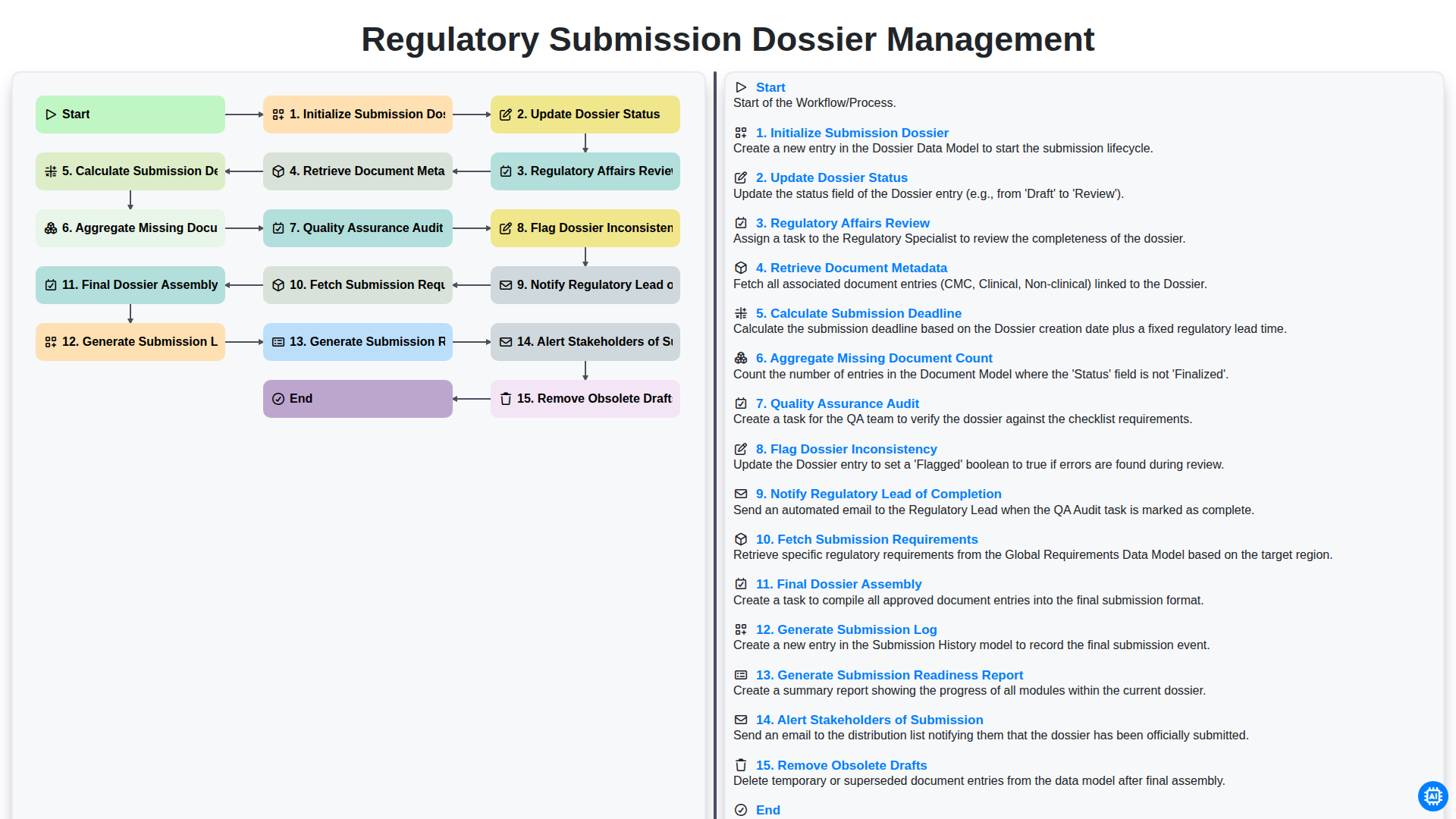
Table of Contents
- Introduction to Regulatory Submission Dossier Management
- Phase 1: Initializing and Structuring the Submission Dossier
- Establishing the Foundation: Fetching Submission Requirements
- Phase 2: Active Dossier Maintenance and Tracking
- Real-Time Monitoring: Updating Dossier Status and Removing Obsolete Drafts
- Automating Timelines: Calculating Submission Deadlines
- Phase 3: Content Validation and Data Integrity
- Deep Dive: Regulatory Affairs Review and Metadata Retrieval
- Ensuring Compliance: Quality Assurance Audits and Inconsistency Flagging
- Tracking Completeness: Aggregating Missing Document Counts
- Phase 4: Final Assembly and Submission Preparation
- Finalizing the Package: Final Dossier Assembly and Generating Submission Logs
- Phase 5: Completion, Reporting, and Stakeholder Communication
- Closing the Loop: Generating Readiness Reports and Notifying Leads
- Resources & Links
TLDR: Learn how to streamline your regulatory compliance process using our comprehensive Dossier Management workflow. This guide covers everything from initial dossier creation and automated deadline calculations to quality assurance audits and stakeholder notifications, ensuring a seamless, error-free path from document assembly to final submission.
Introduction to Regulatory Submission Dossier Management
In the highly regulated landscape of life sciences, the integrity and timeliness of regulatory submissions are the cornerstones of market access and patient safety. Regulatory Submission Dossier Management is not merely a clerical task; it is a high-stakes, end-to-end orchestration of complex data, stringent compliance standards, and cross-functional collaboration.
A submission dossier represents the culmination of years of research, clinical trials, and manufacturing documentation. Managing this assembly requires much more than simply gathering files; it demands a highly structured workflow capable of tracking every version, verifying every metadata point, and ensuring that every required component meets the rigorous standards of global health authorities. Even a minor oversight-a missing document, an outdated draft, or an undetected inconsistency-can lead to costly Refusal to File (RTF) decisions, delayed product launches, and significant financial repercussions.
Effective dossier management transforms a chaotic collection of documents into a synchronized, auditable, and submission-ready asset. By implementing a systematic workflow-ranging from the initial creation of the dossier to the final automated readiness reports-organizations can mitigate risk, ensure data integrity, and maintain a continuous state of compliance throughout the product lifecycle.
Phase 1: Initializing and Structuring the Submission Dossier
The foundation of any successful regulatory strategy lies in the precision of its commencement. The process begins with Initializing the Submission Dossier, a critical stage where the scope and purpose of the regulatory filing are formally defined. This stage sets the trajectory for the entire lifecycle, establishing the core framework that all subsequent activities will inhabit.
To ensure the dossier remains a dynamic and accurate reflection of the current regulatory landscape, the workflow immediately integrates the ability to Fetch Submission Requirements. By pulling the most recent-to-date-guidelines from global health authorities, the team ensures that the dossier structure is compliant with the latest-specific mandates, preventing costly rework due to outdated templates.
As the structure takes shape, the workflow initiates the process to Remove Obsolete Drafts. This is a vital housekeeping step; by purging superseded versions and redundant files at the very onset, the team eliminates version sprawl. This ensures that the regulatory team is working within a single source of truth, significantly reducing the risk of accidentally including outdated data in the final submission. Once these initial steps are completed, the dossier moves into a controlled state, ready for the detailed data integration and rigorous review phases that follow.
Establishing the Foundation: Fetching Submission Requirements
The lifecycle of a regulatory submission begins long before the first document is drafted. The true foundation of a successful submission lies in the critical phase of Fetching Submission Requirements. Before any data is entered or any dossier is initialized, the regulatory team must establish a clear, unambiguous roadmap of what is required for the specific target market and therapeutic area.
This stage involves a deep dive into the evolving landscape of global health authority guidelines-be it FDA, EMA, PMDA, or others. It requires the systematic gathering of specific technical, administrative, and clinical documentation standards, including format specifications (such as eCTD requirements), language mandates, and region-specific labeling rules. By prioritizing the retrieval of these precise requirements at the very onset, teams can prevent the costly and time-consuming rework that occurs when missing or outdated criteria are discovered late in the process. Establishing this baseline ensures that every subsequent step in the workflow is aligned with the ultimate goal: a compliant, high-quality, and timely submission.
Phase 2: Active Dossier Maintenance and Tracking
Once a submission dossier has been initiated, the focus shifts from preparation to rigorous lifecycle management. This phase is critical for ensuring that the dossier remains accurate, compliant, and ready for final submission. The process begins by Initializing the Submission Dossier, establishing the foundation for all subsequent activities. As the regulatory landscape or internal data changes, the workflow requires constant vigilance to Update Dossier Status, ensuring the entire team has real-time visibility into the progress of the filing.
Maintaining a single source of truth relies heavily on the ability to Retrieve Document Metadata, allowing for precise tracking of versions, authors, and expiration dates. To prevent costly delays, the system must proactively Calculate Submission Deadlines and Aggregate Missing Document Counts, providing an automated way to identify gaps in the dossier before they become critical issues.
To ensure the highest standards of compliance, the workflow incorporates a multi-layered verification approach. This includes a thorough Regulatory Affairs Review and a dedicated Quality Assurance Audit to catch errors early. During these stages, the system is programmed to Flag Dossier Inconsistency, automatically highlighting any discrepancies between the required documentation and the current contents. To keep the momentum steady, the workflow will Fetch Submission Requirements dynamically, ensuring that the dossier evolves alongside changing regulatory mandates.
As the submission nears its target date, the process moves toward consolidation. The system will Remove Obsolete Drafts to prevent version control errors and proceed to the Final Dossier Assembly. Once the dossier is complete, the system will Generate a Submission Log and a Submission Readiness Report, providing a final audit trail of all components. The cycle concludes by Notifying the Regulatory Lead of Completion and triggering an automated Alert to Stakeholders of Submission, ensuring that all relevant departments are informed the moment the dossier is ready for regulatory authorities.
Real-Time Monitoring: Updating Dossier Status and Removing Obsolete Drafts
Effective regulatory management relies on maintaining a single, accurate version of the truth. Real-time monitoring of a submission dossier's lifecycle is impossible if the workflow is cluttered with outdated information. A critical component of an efficient regulatory workflow is the ability to Update Dossier Status instantaneously as milestones are reached. By tracking every transition-from initial drafting to final approval-regulatory teams gain immediate visibility into the progress of every filing, allowing for proactive management of bottlenecks.
However, visibility is only as good as the data integrity within the system. As teams iterate through various iterations of a dossier, the accumulation of redundant or outdated files can lead to catastrophic errors, such as the accidental inclusion of incorrect versions in a final submission. Integrating an automated process to Remove Obsolete Drafts ensures that the working environment remains streamlined and that only the most current, validated documents are visible to the review team. This dual approach of continuous status updates and aggressive version control minimizes human error, reduces cognitive load on regulatory affairs specialists, and ensures that the final dossier is truly the definitive version.
Automating Timelines: Calculating Submission Deadlines
In the high-stakes world of regulatory compliance, timing is everything. A missed deadline doesn't just mean a delay in product launch; it can result in significant financial loss and-regulatory scrutiny. Manually tracking submission windows across multiple global markets is an error-prone endeavor that consumes valuable man-hours.
By automating the process of calculating submission deadlines, teams can move from a reactive to a proactive stance. An automated workflow integrates directly with your regulatory calendar, instantly computing critical milestones-such as internal review cut-offs and final submission dates-the moment a dossier is initialized. By leveraging logic-based automation, the system accounts for regional variations and complexity levels, ensuring that every stakeholder is working against an accurate, real-time timeline. This eliminates the risk of human error in date calculation and allows your Regulatory Affairs team to focus on content integrity rather than calendar management.
Phase 3: Content Validation and Data Integrity
Once the initial dossier structure is established, the focus shifts toward rigorous validation to ensure the submission is both complete and compliant. This phase is critical for mitigating the risk of regulatory delays caused by clerical errors or missing information. The process begins with the Regulatory Affairs Review, where subject matter experts scrutinize the content against established standards. During this stage, the system performs a Retrieve Document Metadata operation to ensure all files are correctly tagged and categorized, while simultaneously executing a Calculate Submission Deadline function to keep the timeline aligned with global regulatory milestones.
To maintain a high standard of data integrity, the workflow incorporates automated checks such as Aggregate Missing Document Count, which provides an immediate view of any gaps in the required documentation. This is closely followed by a Quality Assurance Audit to verify that every element meets the predefined submission criteria. If discrepancies are found, the system will Flag Dossier Inconsistency, triggering a feedback loop for corrections. To streamline the workflow, the process also includes Remove Obsolete Drafts, ensuring that only the most recent, validated versions of a document are included in the final set, thereby preventing the inclusion of outdated or redundant information.
Deep Dive: Regulatory Affairs Review and Metadata Retrieval
The core of a successful regulatory workflow lies in the critical transition between content creation and-data-driven oversight. This stage, centered on the Regulatory Affairs Review and Retrieve Document Metadata steps, acts as the intellectual checkpoint where the dossier moves from a mere collection of files to a validated, compliant submission package.
During the Regulatory Affairs Review, subject matter experts scrutinize the dossier for scientific accuracy,-regulatory alignment, and adherence to specific regional health authority guidelines. This is not merely a cursory glance; it is an in-depth evaluation to ensure that every claim made in the documentation is supported by the underlying data and that the dossier structure conforms to the required eCTD (Electronic Common Technical Document) or other applicable formats.
However, a review is only as reliable as the data supporting it. To facilitate this high-level oversight, the process must simultaneously execute the Retrieve Document Metadata step. By automatically pulling metadata-such as document version numbers, author credentials, expiration dates, and file formats-the system provides the review team with an organized, searchable index of the dossier's contents. This automated retrieval ensures that reviewers are not just looking at the what, but also the when and how of every document. This synergy between human expertise and automated metadata extraction minimizes the risk of human error, ensuring that the regulatory team is reviewing the most current, accurate, and traceable information available before the dossier proceeds to the final stages of assembly.
Ensuring Compliance: Quality Assurance Audits and Inconsistency Flagging
In the high-stakes environment of regulatory affairs, even a minor oversight can lead to costly delays or even rejection from health authorities. This is why the Quality Assurance (QA) Audit serves as a critical gatekeeper within the dossier management workflow. A QA audit is not merely a final check; it is a systematic, rigorous evaluation of every component within the submission to ensure that the dossier adheres to both internal standards and stringent global regulatory requirements.
During this phase, the workflow proactively employs automated intelligence to Flag Dossier Inconsistency. This process involves cross-referencing data points across various documents to identify discrepancies-such as mismatched dates, conflicting clinical data, or inconsistent version numbers-that could undermine the integrity of the submission. By identifying these red flags early, the system prevents human error from propagating through the assembly process. This proactive detection ensures that the final dossier is a cohesive, unified package, significantly reducing the risk of Refusal to File (RTF) decisions and ensuring that the submission is robust, accurate, and fully compliant.
Tracking Completeness: Aggregating Missing Document Counts
In the complex landscape of regulatory compliance, the difference between a timely approval and a costly delay often lies in the visibility of gaps within a submission. Tracking completeness is not merely about checking boxes; it is about real-time identification of vulnerabilities. By implementing an automated process to aggregate missing document counts, regulatory teams can move away from manual, error-prone spreadsheets and toward a unified view of dossier readiness.
This step of the workflow systematically scans the entire dossier structure to compare the required document index against the actual files present. By calculating the total number of missing elements in real-time, the system provides an instant completeness score. This high-level metric allows regulatory affairs professionals to immediately grasp the magnitude of the work remaining, enabling them to prioritize high-impact gaps and allocate resources effectively before the submission deadline approaches. This automated aggregation ensures that missing does not remain hidden until it is too late to rectify.
Phase 4: Final Assembly and Submission Preparation
Once the dossier has successfully passed the rigorous Quality Assurance audit and all inconsistencies have been flagged and resolved, the workflow transitions into the critical final stage: Final Assembly and Submission Preparation. This phase is where individual components are unified into a cohesive, submission-ready package.
The process begins with the Final Dossier Assembly, where all verified documents, validated metadata, and finalized modules are compiled into the master structure. During this stage, the system must also perform a cleanup of the working directory to remove obsolete drafts, ensuring that only the single, authoritative version of each document is included, thereby preventing the catastrophic error of submitting superseded data.
To ensure complete transparency and regulatory compliance, the workflow then triggers the automated generation of a Submission Log and a Submission Readiness Report. The log provides a detailed audit trail of every file included, while the readiness report serves as the final checklist, confirming that all mandatory elements are present and formatted correctly.
The workflow concludes with a high-priority communication loop. The system will automatically alert stakeholders of the submission status, providing the necessary visibility to cross-functional teams. This automated notification ensures that all relevant departments-from Clinical to CMC-are aware that the dossier is transitioning from a work-in-progress state to a formal regulatory filing, allowing for seamless handovers and immediate post-submission tracking.
Finalizing the Package: Final Dossier Assembly and Generating Submission Logs
Once the rigorous stages of review, auditing, and validation are complete, the workflow enters its most critical phase: the transition from individual components to a unified,-compliant submission package. This stage, known as Final Dossier Assembly, is where all verified documents, metadata, and validated updates are consolidated into a single, structured format ready for regulatory bodies. It is the culmination of the entire lifecycle, ensuring that the disparate pieces of the puzzle are integrated into a cohesive, hyper-organized dossier.
To ensure complete traceability and transparency during this final push, the process includes the simultaneous Generation of a Submission Log. This log serves as the definitive record of the dossier's contents, documenting every file included, its version, and its verified status. By generating this automated log, teams eliminate the risk of human error and create an immutable audit trail that is essential for post-submission queries. This dual step of assembly and logging ensures that when the dossier reaches the regulator, it is not just complete, but also perfectly documented and prepared for immediate scrutiny.
Phase 5: Completion, Reporting, and Stakeholder Communication
Once the final dossier is assembled and the integrity of the documents is verified, the workflow transitions into its critical closing phase. This stage is dedicated to ensuring transparency, accountability, and seamless communication across the regulatory landscape.
The process begins with the Final Dossier Assembly, where all validated components are compiled into a submission-ready format. To maintain a clean and compliant environment, the system automatically performs a cleanup by removing obsolete drafts, ensuring that only the most current, approved versions are part of the official record. Following this, the system performs automated logging and reporting: it will generate a submission log to provide an audit trail of all actions taken, and generate a submission readiness report to offer a high-level snapshot of the dossier's compliance status.
The final step in the lifecycle is the dissemination of information. To ensure all decision-makers are aligned, the system will notify the Regulatory Lead of completion and simultaneously alert stakeholders of the submission. This proactive communication ensures that the entire cross-functional team-from clinical to quality assurance-is informed the moment the dossier is ready for filing, minimizing delays and enabling immediate downstream actions.
Closing the Loop: Generating Readiness Reports and Notifying Leads
Once the final dossier assembly is complete and the submission log is generated, the workflow shifts from active compilation to critical validation. The final stages of the process-Generating a Submission Readiness Report and Alerting Stakeholders of Submission-serve as the essential fail-safe mechanisms that ensure no error reaches the regulatory authorities.
The process begins with the automated generation of the Submission Readiness Report. This report acts as a comprehensive digital audit, cross-referencing the assembled dossier against the Fetched Submission Requirements. It provides a high-level overview of the dossier's integrity, confirming that every required element is present, correctly formatted, and has passed the Quality Assurance Audit. By synthesizing data from the Aggregate Missing Document Count and the Flag Dossier Inconsistency steps, this report provides an immediate, data-driven snapshot of whether the submission is truly ready to file or if last-minute corrections are required.
The loop closes with a high-priority notification sequence. Once the system verifies that the dossier meets all predefined compliance benchmarks, it automatically triggers the Notify Regulatory Lead of Completion action. This ensures that the Regulatory Lead is immediately informed that the heavy lifting of dossier management is finished and the file is ready for final sign-off. Simultaneously, the system initiates an Alert to Stakeholders, broadcasting the submission status to the broader project team. This proactive communication eliminates manual follow-ups, reduces the risk of communication silos, and ensures that all relevant departments-from Clinical to Legal-are synchronized for the imminent regulatory filing.
Resources & Links
- FDA Guidance Documents: Official regulatory guidelines and industry standards for electronic submissions and dossier structure.
- EMA Regulatory Framework: Resources regarding European regulatory requirements, document standards, and compliance workflows.
- ISO Quality Management Standards: International standards for quality assurance audits and document control processes in highly regulated industries.
- PMDA Submission Instructions: Technical documentation regarding the preparation and assembly of regulatory dossiers for the Japanese market.
- ICH Guidelines: The International Council for Harmonisation of Technical Requirements for Pharmaceuticals for Human Use, essential for understanding global dossier formatting (eCTD).
- ISPE Good Practice Guides: Best practices for managing data integrity, metadata retrieval, and lifecycle management of regulatory documents.
Found this Article helpful?
Comments
There are no comments yet. Be the first to add one!
Pharmaceutical Management Solution Demo
Navigating complex regulations and ensuring quality in pharmaceutical manufacturing? ChecklistGuro's Work OS platform streamlines processes from R&D to production, packaging, and distribution. Maintain compliance, improve efficiency, and reduce risk. Discover how ChecklistGuro can transform your pharmaceutical operations!
Related Articles
Ensuring Quality: A Pharmaceutical Compound Record Review Checklist Guide
Pharmaceutical Labeling Compliance Checklist: Your Step-by-Step Guide
Mastering Medication Management: Your Pharmaceutical Inventory Compliance Checklist Template
Navigating Adverse Event Reporting: Your Pharmaceutical Checklist Guide
Pharmaceutical Inventory Management Checklist: Your Guide to Compliance & Accuracy
Your Essential GLP Checklist Template: A Practical Guide
Your Pharmaceutical Development Checklist: A Template for Success
Pharmaceutical Validation Checklist Template: Your Guide to Compliance
We can do it Together
Need help with
Checklists?
Have a question? We're here to help. Please submit your inquiry, and we'll respond promptly.