Mastering Subcontractor Compliance and Insurance Tracking: An Automated Workflow Guide
Published: 06/04/2026 Updated: 10/05/2026
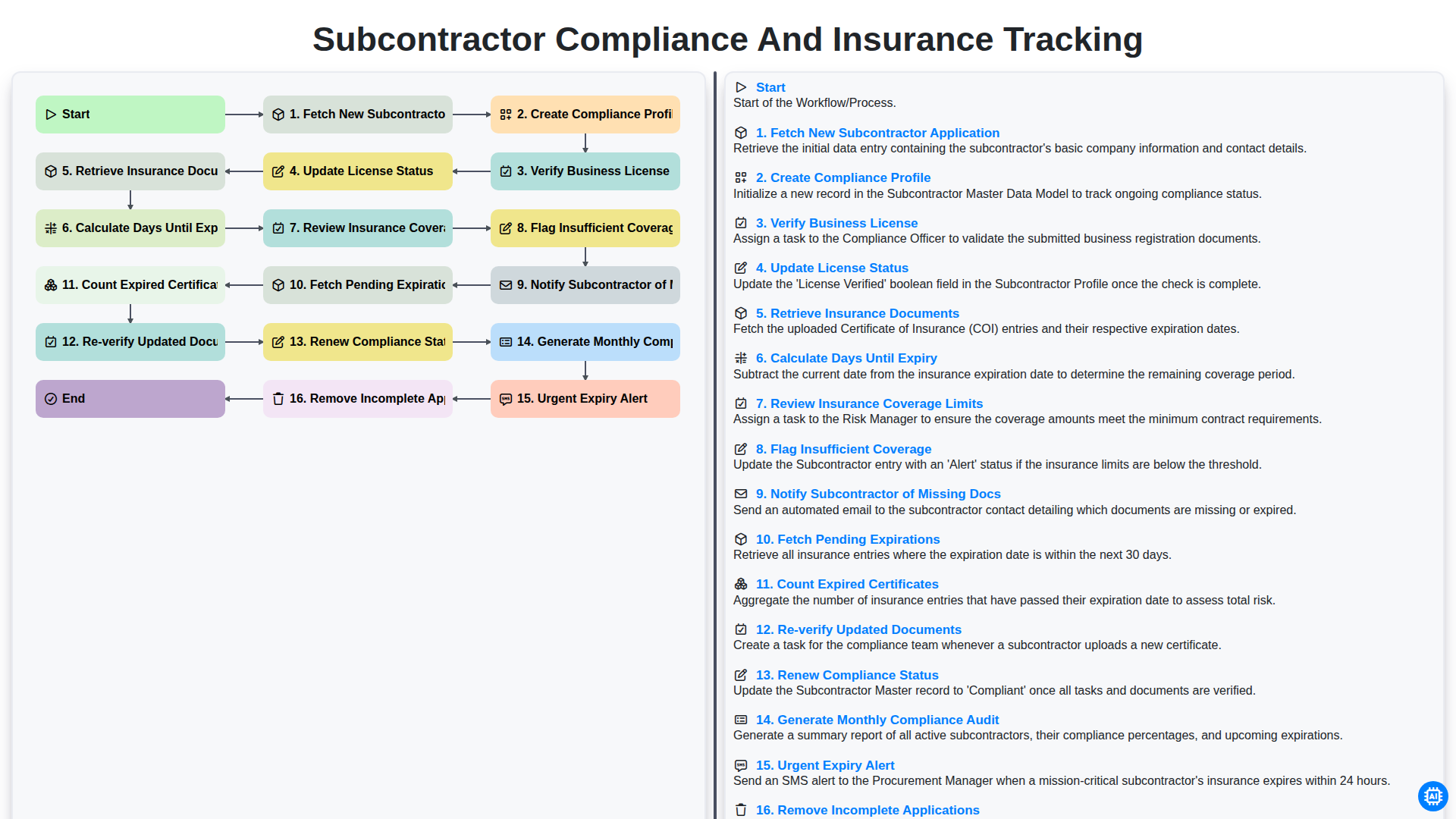
Table of Contents
- Introduction: The Importance of Automated Compliance Management
- Step 1: Onboarding - Fetching New Subcontractor Applications
- Step 2: Establishing the Foundation - Creating Compliance Profiles
- Step 3: Verifying Legal Standing - Business License Validation
- Step 4: Managing Documentation - Retrieving Insurance Certificates
- Step 5: Proactive Risk Assessment - Reviewing Coverage Limits and Identifying Gaps
- Step 6: Automated Communication - Notifying Subcontractors of Missing Documentation
- Step 7: Maintaining Continuity - Tracking Expirations and Calculating Renewal Windows
- Step 8: The Re-verification Loop - Updating and Renewing Compliance Status
- Step 9: Continuous Oversight - Generating Monthly Compliance Audits
- Step 10: Incident Prevention - Implementing Urgent Expiry Alerts
- Step 11: Maintaining Data Integrity - Removing Incomplete Applications
- Conclusion: Streamlining Operations Through Systematic Tracking
- Resources & Links
TLDR: Streamline your vendor management with this automated workflow designed to eliminate manual oversight. Learn how to automate the entire subcontractor lifecycle-from initial application and license verification to real-time insurance tracking, expiry alerts, and monthly compliance auditing-ensuring your project stays protected and risk-free.
Introduction: The Importance of Automated Compliance Management
In the fast-paced world of construction and project management, managing subcontractors is a high-stakes balancing act. While bringing on new partners can drive project momentum, it also introduces significant liability. If a subcontractor steps onto your job site with an expired business license or insufficient general liability insurance, the legal and financial consequences can fall squarely on your shoulders.
Manual compliance tracking-relying on scattered emails, spreadsheets, and manual calendar reminders-is no longer sustainable. Human error in monitoring expiration dates or overlooking a missing certificate can lead to catastrophic gaps in coverage and costly litigation. This is why transitioning from manual oversight to an automated workflow is not just a luxury, but a necessity. By implementing a structured, automated system, companies can ensure that every partner is vetted, every document is verified, and every risk is mitigated in real-time, allowing project managers to focus on building rather than chasing paperwork.
Step 1: Onboarding - Fetching New Subcontractor Applications
The lifecycle of a successful project begins long before any boots hit the ground on-site. It starts with the initial intake process. The first critical step in our automated workflow is Fetching New Subcontractor Applications.
Instead of manual data entry or hunting through cluttered email inboxes, our system proactively monitors incoming submissions. As soon as a potential partner submits their details, the workflow captures the data in real-time. This immediate ingestion ensures that no application falls through the cracks and allows the compliance engine to trigger the subsequent stages of the onboarding pipeline without delay. By automating this initial handshake, we eliminate the manual lag that often leads to project delays and administrative bottlenecks.
Step 2: Establishing the Foundation - Creating Compliance Profiles
Once a new subcontractor application is successfully fetched into your system, the next critical step is the creation of a dedicated Compliance Profile. This stage serves as the single source of truth for every vendor in your network.
Rather than treating a subcontractor as just a name on a list, the creation of a profile allows you to build a centralized digital dossier. This profile acts as the foundation for all subsequent automated workflows, housing not only basic contact information but also the historical record of their regulatory standing. By establishing this structured profile early, you ensure that every subsequent verification step-from business license validation to insurance audits-is anchored to a consistent, searchable, and auditable entity. This organized approach is what transforms a manual, error-prone process into a scalable, automated ecosystem.
Step 3: Verifying Legal Standing - Business License Validation
Once a new subcontractor application is successfully fetched and a compliance profile is created, the next critical phase begins: Verifying Business License Validation. This step serves as the first line of defense in ensuring that every partner you bring onto a project is a legally recognized entity authorized to operate in your jurisdiction.
The workflow follows a systematic process to eliminate manual oversight. First, the system automatically triggers a Verify Business License task, cross-referencing the details provided in the application against official state or local regulatory databases. This is not merely a checkbox exercise; the system actively monitors the legitimacy of the business entity and proceeds to Update License Status within the subcontractor's profile.
By automating this validation, you move away from the risks of human error. If a license is found to be invalid or improperly documented, the system provides immediate visibility, preventing the subcontractor from moving further into the onboarding pipeline. This ensures that your compliance ecosystem is built on a foundation of verified, legal, and legitimate partnerships from day one.
Step 4: Managing Documentation - Retrieving Insurance Certificates
Once the compliance profile is established, the focus shifts to the critical task of gathering the necessary proof of coverage. The process begins by automatically retrieving insurance documents provided during the application phase. This step is more than just a simple download; it is the foundation of your risk management strategy.
Once the documents are pulled into the system, the workflow transitions into a detailed analytical phase. The system performs two vital automated checks:
- Calculating Days Until Expiry: To prevent sudden lapses in coverage, the system extracts expiration dates from every certificate and calculates the remaining window of validity. This allows for proactive management rather than reactive firefighting.
- Reviewing Insurance Coverage Limits: It isn't enough to simply have an active policy; the limits must meet your specific project requirements. The system scans the documentation to ensure that the insured amounts align with your contractual mandates.
By automating the retrieval and initial audit of these documents, you eliminate the manual burden of opening PDFs and manually checking dates, ensuring that your risk assessment is both instantaneous and error-free.
Step 5: Proactive Risk Assessment - Reviewing Coverage Limits and Identifying Gaps
Once the necessary insurance documents have been retrieved, the workflow moves beyond simple document collection and into the critical phase of technical evaluation. Simply having a certificate of insurance (COI) on file is not enough; the core of effective risk management lies in the ability to Review Insurance Coverage Limits against your specific project requirements.
During this stage, the system automatically compares the subcontractor's policy limits-such as General Liability, Workers' Compensation, and Auto Liability-against the minimum thresholds defined in your contracts. This automated scrutiny allows the system to instantly Flag Insufficient Coverage, identifying discrepancies where a subcontractor's protection may be inadequate for the scope of work assigned.
By automating the identification of these gaps, you eliminate the human error associated with manual reviews and ensure that no subcontractor is cleared for work unless they meet your organization's rigorous safety and financial standards. This proactive step prevents coverage gaps from becoming liabilities that could leave your company exposed in the event of a claim.
Step 6: Automated Communication - Notifying Subcontractors of Missing Documentation
Manual follow-ups are one of the biggest time-wasters in compliance management. When a review reveals gaps in a subcontractor's paperwork, the process can quickly stall if the responsibility falls solely on your team to manually draft and send reminders.
By integrating an automated notification step into your workflow, you eliminate the waiting game. Once the system identifies a discrepancy-such as a missing certificate or an outdated business license-it automatically triggers a notification to the subcontractor. This real-time communication ensures that the subcontractor is immediately aware of exactly what is missing, allowing them to rectify the issue without waiting for your next manual audit. This proactive approach reduces the friction of the approval process, slashes your administrative workload, and keeps your project timelines on track by minimizing delays caused by preventable documentation gaps.
Step 7: Maintaining Continuity - Tracking Expirations and Calculating Renewal Windows
Compliance is not a one-time event, but an ongoing cycle. Once a subcontractor is fully vetted, the focus shifts from initial onboarding to long-term maintenance. To prevent gaps in coverage that could expose your company to immense liability, the workflow must transition into a proactive monitoring phase.
This stage begins by automatically fetching pending expirations from your database to identify upcoming risks before they become active issues. The system should proactively calculate days until expiry for every critical document, allowing you to anticipate lapses well in advance. By systematically counting expired certificates, you can quickly identify which partners have fallen out of compliance and require immediate intervention.
The goal is to transform your process from reactive to preventative. By integrating urgent expiry alerts and automated workflows, you ensure that the transition from active to renewed is seamless, allowing you to re-verify updated documents and renew compliance status without manual oversight. This continuous loop ensures that your project sites remain protected and your subcontractor roster stays audit-ready at all times.
Step 8: The Re-verification Loop - Updating and Renewing Compliance Status
Once the initial verification process is complete, the workflow enters a critical continuous loop. The process of Re-verifying Updated Documents begins as soon as a subcontractor submits new or corrected paperwork in response to a deficiency notice. This is not merely a formality; it is a rigorous secondary audit to ensure that the new documentation meets all predefined company standards and that the previously flagged issues have been fully resolved.
Once the new documents are validated, the system automatically triggers the Renew Compliance Status phase. This step transitions the subcontractor from a pending or non-compliant state back to active or compliant. By automating this transition, you eliminate the administrative bottleneck of manual status updates and ensure that subcontractors can be deployed to job sites immediately upon meeting requirements, maintaining project momentum without sacrificing safety or risk management.
Step 9: Continuous Oversight - Generating Monthly Compliance Audits
The final stage of a truly robust compliance workflow is the transition from reactive monitoring to proactive governance. Instead of waiting for a document to expire and reacting to an emergency, the system automates the Generation of Monthly Compliance Audits.
This step serves as a high-level health check for your entire subcontractor database. Rather than manually digging through individual files, the automated audit aggregates data across all active profiles to provide a comprehensive snapshot of your risk exposure. This report summarizes key metrics, such as the total number of active versus non-compliant subcontractors, a tally of upcoming expirations, and a breakdown of identified coverage gaps.
By establishing this regular cadence, you transform compliance from a series of disconnected tasks into a continuous loop of oversight. These monthly audits ensure that no subcontractor slips through the cracks, providing your management team with the documented evidence needed for internal audits, insurance reviews, and even legal protection in the event of a claim. It turns your compliance data into actionable intelligence, allowing you to maintain a high standard of safety and accountability across your entire supply chain.
Step 10: Incident Prevention - Implementing Urgent Expiry Alerts
In the complex landscape of construction and project management, reactive management is the enemy of profitability. Waiting for a certificate to expire before taking action is a recipe for litigation and costly project delays. The final, and perhaps most critical, stage of an automated compliance workflow is the implementation of Urgent Expiry Alerts.
An effective alert system acts as your project's early warning mechanism. Instead of manually auditing spreadsheets to find out who is out of compliance, the system proactively scans your database for upcoming milestones. By automating notifications-sent 30, 60, or even 90 days in advance-you provide subcontractors with a sufficient window to renew their policies and submit updated documentation without disrupting the project timeline.
Implementing these alerts does more than just save time; it mitigates risk. An automated alert ensures that human error or oversight never becomes the reason an uninsured vendor is working on your job site. By integrating these triggers directly into your workflow, you transform your compliance process from a manual checklist into a self-sustaining shield that protects your company's assets and reputation around the clock.
Step 11: Maintaining Data Integrity - Removing Incomplete Applications
A clean database is the foundation of an efficient compliance workflow. As your business grows, the volume of subcontractor applications can increase significantly, and not every application will reach the finish line. Without a systematic way to handle abandoned or stalled entries, your dashboard becomes cluttered with ghost profiles that skew your reporting and create unnecessary administrative noise.
The final, critical step in maintaining a high-performing workflow is the regular removal of incomplete applications. An incomplete application-defined as one where a subcontractor has failed to provide essential documentation or respond to follow-up requests within a predefined grace period-acts as data pollution. It makes it difficult for your team to distinguish between active, pending vendors and those who are simply no longer pursuing the opportunity.
By implementing a periodic cleanup process, you achieve three key benefits:
- Operational Clarity: Your team can focus their energy on high-priority, actionable files rather than chasing unresponsive leads.
- Accurate Reporting: Your compliance audits and monthly reports will reflect true operational capacity, providing leadership with an honest look at your active vendor landscape.
- Resource Optimization: Automating the removal of stale data ensures that your notifications, follow-ups, and tracking systems are only targeting subcontractors who are actively participating in the onboarding process.
Treating application removal as a standard maintenance task ensures that your compliance engine remains lean, agile, and focused solely on verified, ready-to-work partners.
Conclusion: Streamlining Operations Through Systematic Tracking
Implementing a structured workflow for subcontractor compliance and insurance tracking is more than just a way to mitigate risk-it is a strategic move toward operational excellence. By transitioning from manual, reactive monitoring to a proactive, automated system, you eliminate the administrative burden of chasing expired certificates and manually verifying business licenses. A systematic approach ensures that every new application is vetted, every insurance limit is scrutinized, and every expiration is flagged long before it becomes a liability.
Ultimately, the goal of automating these steps-from the initial retrieval of documents to the generation of monthly audit reports-is to create a set and forget layer of security. This allows your team to shift their focus from tedious data entry to high-level project management, knowing that your supply chain remains fully compliant, fully insured, and ready to work at a moment's notice. In an industry where oversight can lead to significant financial and legal exposure, a streamlined tracking workflow is not just a convenience; it is an essential safeguard for your business continuity.
Resources & Links
- OSHA Compliance Guidelines: Essential regulatory standards and safety requirements for managing subcontractor safety and documentation compliance.
- ISO Standards for Quality Management: Frameworks for implementing standardized processes in vendor management and operational auditing.
- Insurance Information Institute: In-depth resources for understanding insurance coverage limits, liability, and risk assessment principles.
- Project Management Institute (PMI): Best practices for workflow automation, process optimization, and managing project-based vendor lifecycles.
- Forbes Business Strategy: Insights into the digital transformation of supply chain management and automated enterprise workflows.
- Gartner Research: Expert analysis on risk management technology and the automation of compliance-driven business processes.
Frequently Asked Questions
What is subcontractor compliance in the context of construction management?
Subcontractor compliance refers to the process of ensuring that all external contractors meet specific contractual obligations, including safety standards, licensing, and maintaining valid insurance coverage, to mitigate risk to the general contractor.
Why is manual insurance tracking considered a risk to construction projects?
Manual tracking is prone to human error, such as overlooking expiration dates or missing critical endorsements. This can lead to gaps in coverage, leaving the project owner and general contractor liable for accidents or damages caused by uninsured subcontractors.
What are the key components of an automated compliance workflow?
An automated workflow typically includes digital document submission, automated expiration alerts, real-time verification of insurance certificates (COIs), and a centralized dashboard for tracking the compliance status of all active subcontractors.
How can automation reduce administrative overhead for project managers?
Automation reduces the need for manual data entry, follow-up emails, and constant spreadsheet updates. By using automated notifications, project managers are only alerted when action is required, allowing them to focus on core project tasks.
What specific documents should be included in an automated tracking system?
Beyond Certificates of Insurance (COI), the system should track Workers' Compensation certificates, General Liability policies, Professional Liability, Auto Liability, and any required permits or safety certifications (like OSHA training records).
Comments
There are no comments yet. Be the first to add one!
Construction Management Solution Demo
Build smarter, not harder! ChecklistGuro streamlines construction projects from planning to closeout. Manage tasks, inspections, safety protocols & more - all in one place. Reduce delays, improve communication, and deliver projects on time & on budget.
Related Articles
The Ultimate Concrete Vibration Checklist Template
Unlock Value: Your Free Value Engineering Checklist Template
The Ultimate HVAC Ductwork Installation Checklist Template

The Ultimate Rebar Placement Checklist Template
Your Concrete Mix Design Verification Checklist: A Step-by-Step Guide
Backfilling & Compaction Checklist: A Foundation's Best Friend
The Ultimate Concrete Delivery & Placement Checklist Template
Your Ultimate Stakeholder Communication Plan Checklist Template
Need help with
Checklists?
Have a question? We're here to help. Please submit your inquiry, and we'll respond promptly.