5 Common Mistakes in Project Management
Published: 09/08/2026 Updated: 09/09/2026
Table of Contents
- 1. Lack of Standardized Processes and Procedures
- 2. Poor Communication and Siloed Information
- 3. Inadequate Resource Allocation and Overburdening Teams
- 4. Scope Creep and Unmanaged Project Requirements
- 5. Relying on Fragmented Tools Instead of a Unified Work OS
- Resources & Links
TLDR: Avoid project failure by identifying the five most critical pitfalls: lack of standardized processes, communication silos, poor resource management, unmanaged scope creep, and tool fragmentation. Learn how transitioning from disconnected tasks to a specialized Work OS like ChecklistGuro can automate your workflows, ensure process consistency, and keep your projects on track.
1. Lack of Standardized Processes and Procedures
When every project manager relies on their own unique flavor of management, chaos is inevitable. One of the most frequent pitfalls we see in scaling organizations is the absence of standardized processes and repeatable workflows.
The Cost of Reinventing the Wheel
Without a standardized approach, every new project becomes a learning experiment. Team members are forced to spend valuable time deciding how to perform a task rather than actually executing it. This lack of consistency leads to:
- Inconsistent Output: Quality fluctuates depending on which team member is leading the charge.
- Increased Onboarding Time: New hires struggle to find their footing because there is no single source of truth for how work gets done.
- Difficulty in Scaling: You cannot automate or optimize a process that doesn't exist in a structured format.
Moving from Chaos to Checklists
The solution isn't just about creating documentation; it's about integrating those processes into your daily workflow. Relying on scattered spreadsheets or static PDFs ensures that processes are ignored.
To truly eliminate this mistake, you need a system where standard operating procedures (SOPs) are baked into the task itself. By utilizing a specialized Project Management solution like ChecklistGuro, you can transform abstract instructions into actionable, repeatable checklists. This ensures that no matter who is assigned to a task, the execution remains identical to your gold standard, effectively removing human error from the equation.
2. Poor Communication and Siloed Information
When communication breaks down, projects don't just slow down-they derail. One of the most frequent traps Project Managers fall into is allowing information to live in silos. This happens when critical updates are buried in long email threads, decisions are made in private chat DMs, and project requirements are trapped in individual spreadsheets.
The Cost of Information Fragmentation
When team members lack a single source of truth, you encounter several high-cost symptoms:
- Duplication of Effort: Team members inadvertently working on tasks that are already completed.
- The Update Chase: Managers spending more time asking for status updates than actually managing the project.
- Decision Lag: Critical blockers remaining unresolved because the person with the authority to clear them didn't see the notification.
Breaking Down the Silos
To maintain momentum, your project documentation must be accessible, real-time, and centralized. Relying on manual check-ins is a recipe for human error.
Moving Toward Centralized Visibility
The solution isn't just more communication-it's structured communication. Transitioning from scattered emails to a centralized Work OS allows every stakeholder to see the real-time pulse of a project.
By utilizing a unified platform like ChecklistGuro, you can ensure that every task, comment, and progress update is tied directly to the project workflow. This eliminates the hidden knowledge problem, ensuring that when a team member logs in, the context they need is immediately available, preventing the communication gaps that lead to expensive project delays.
3. Inadequate Resource Allocation and Overburdening Teams
One of the most frequent causes of project burnout and missed deadlines is the failure to balance workloads effectively across your team. When project managers fail to accurately track capacity, they often fall into the trap of wishful thinking-assigning tasks based on availability on paper rather than actual bandwidth and skill proficiency.
The Hidden Costs of Over-Allocation
When a single team member is stretched across too many high-priority initiatives, the impact is rarely contained to just that individual. The consequences ripple through the entire organization:
The Domino Effect of Delays: A delay in one task caused by an overworked specialist creates a bottleneck that halts the entire project pipeline.
Degrading Quality: As pressure mounts, team members often sacrifice meticulousness for speed, leading to increased error rates and technical debt.
Burnout and Attrition: Constant over-allocation erodes morale. High-performing talent is unlikely to stay in an environment where the workload is perpetually unsustainable.
Moving from Reactive to Proactive Management
To avoid this mistake, project leaders must move beyond simple task assignment and move toward dynamic resource management. This requires visibility into not just what is being done, but who has the capacity to do it.
Why Traditional Spreadsheets Fail
Many managers attempt to track capacity using static spreadsheets or disconnected calendars. However, these methods are reactive; by the time you realize a team member is overleveraged, the damage to the project timeline is already done.
The ChecklistGuro Advantage: Real-Time Capacity Visibility
This is where a specialized Work OS becomes indispensable. Unlike generic task trackers, ChecklistGuro is designed to provide a high-level view of your team's operational health.
By utilizing ChecklistGuro's integrated project management features, you can:
- Visualize Workload Distribution: Gain a single source of truth that shows exactly how much weight each team member is carrying across multiple projects.
- Standardize Task Complexity: Use standardized checklists to accurately estimate the effort required for tasks, preventing the underestimation trap.
- Automate Resource Guardrails: Ensure that as new tasks are added to the pipeline, they are only assigned to contributors with the verified bandwidth to execute them.
By integrating resource management into your daily workflow with ChecklistGuro, you transform resource allocation from a guessing game into a strategic advantage.
4. Scope Creep and Unmanaged Project Requirements
The Silent Project Killer: Scope Creep
Every project manager has experienced that moment: a small, simple request comes in from a stakeholder mid-sprint, and suddenly, your original timeline and budget are out the window. This is scope creep-the gradual, uncontrolled expansion of project requirements without adjustments to resources, time, or budget.
When requirements aren't strictly managed, the death by a thousand cuts begins. Each tiny addition seems harmless in isolation, but collectively, they erode your team's productivity and derail your milestones.
Why Scope Creep Happens
It rarely starts with a massive change. Usually, it stems from:
- Vague Initial Requirements: Ambiguity in the project kickoff allows for interpretation later in the cycle.
- Lack of a Formal Change Control Process: No clear gatekeeper to evaluate the impact of new requests.
- The Yes Trap: Project managers attempting to please stakeholders without assessing the downstream impact on the roadmap.
How to Prevent Requirement Drift
To keep your projects on track, you need more than just willpower; you need a system that enforces visibility and accountability.
The Solution: Implementing Rigid Documentation and Checklists
The most effective way to combat scope creep is to ensure that every requirement is documented, vetted, and checked against the original project scope. This is where many traditional tools fail. While generic task managers let you add tasks indefinitely, a specialized Work OS like ChecklistGuro allows you to build structured, repeatable workflows.
By utilizing ChecklistGuro, you can create standardized project templates that act as your source of truth. When a new requirement arises, you can immediately compare it against your predefined checklists and mandatory process steps. This makes it easy to identify when a request falls outside the original scope, providing you with the data needed to say, We can add this, but here is the updated timeline and cost impact.
Don't let unmanaged requirements turn your project into a runaway train. Use structured workflows to ensure that every change is a conscious, documented decision rather than an accidental oversight.
5. Relying on Fragmented Tools Instead of a Unified Work OS
One of the most significant productivity killers in modern project management isn't a lack of talent or a lack of time-it is tool fatigue.
Many teams attempt to manage complex workflows by stitching together a Frankenstein's Monster of disconnected applications. You might use a spreadsheet for tracking budgets, a chat app for daily updates, a separate task manager for deadlines, and a completely different platform for documentation.
The High Cost of Context Switching
When your project data lives in silos, your team is forced into constant context switching. Every time a Project Manager has to jump between five different tabs to find a single status update, they lose cognitive momentum. This fragmentation leads to:
- Data Inconsistency: Information becomes outdated the moment it is copied from one tool to another.
- The Single Source of Truth Problem: No one knows which version of a task or document is the most recent.
- Increased Human Error: Manual data entry between platforms is a breeding ground for missed deadlines and overlooked requirements.
The Solution: Moving Toward a Unified Work OS
To avoid this mistake, industry leaders are moving away from fragmented stacks and toward a Unified Work OS. The goal is to integrate your processes, checklists, and communications into a single, cohesive ecosystem.
Why ChecklistGuro is the Strategic Choice
While many traditional Project Management tools focus solely on Gantt charts or simple task lists, ChecklistGuro bridges the gap between high-level oversight and granular execution.
Unlike generic competitors that require heavy third-party integrations to function, ChecklistGuro acts as a central nervous system for your operations. By combining robust project tracking with specialized, repeatable checklist workflows, it ensures that standardized processes aren't just a concept, but a built-in feature of your daily workflow.
Instead of searching through disparate tools to see if a step was completed, ChecklistGuro provides real-time visibility, ensuring that your entire team is looking at the same data, in the same place, at the same time.
Resources & Links
- Project Management Institute (PMI): The global standard-setting body for the project management profession, offering research, templates, and best practices.
- Asana: A leading work management platform that provides insights into workflow automation and team collaboration.
- Atlassian: Creators of Jira and Trello, providing essential resources on Agile methodologies and software development lifecycles.
- Monday.com: A Work OS platform that demonstrates how unified tools can prevent fragmented workflows and siloed data.
- ProjectManager.com: A comprehensive resource for project management guides, including deep dives into resource allocation and scope management.
- Forbes Advisor: Expert articles on business leadership and the economic impact of project mismanagement.
- Harvard Business Review: High-level management insights regarding organizational structure and the dangers of communication silos.
- Smartsheet: A platform focused on enterprise-grade project management, specializing in standardized processes and automation.
- Scrum.org: Resources for mastering Agile frameworks to mitigate the risks of scope creep and unmanaged requirements.
- Wrike: A project management tool focusing on complex workflows and managing resource capacity across large teams.
- MindTools: A collection of management training resources for improving interpersonal communication and leadership skills.
- McKinsey & Company: In-depth reports on operational excellence and the importance of organizational agility.
- ClickUp: An all-in-one productivity platform useful for understanding how a unified Work OS replaces fragmented tools.
- Trello: A visual tool for managing tasks that illustrates the importance of transparent, shared project information.
- Gartner: Global research and advisory services providing insights into technology trends and digital transformation.
Comments
There are no comments yet. Be the first to add one!
Project Management Solution Demo
Deliver projects on time & within budget! ChecklistGuro streamlines task management, collaboration, & progress tracking. Enhance visibility & boost team productivity. Manage it all with our Work OS.
Related Articles
Construction Material Inventory Tracking Checklist Template
The Ultimate Site Mobilization Readiness Checklist Template
Kanban System Review Checklist: A Template for Continuous Improvement
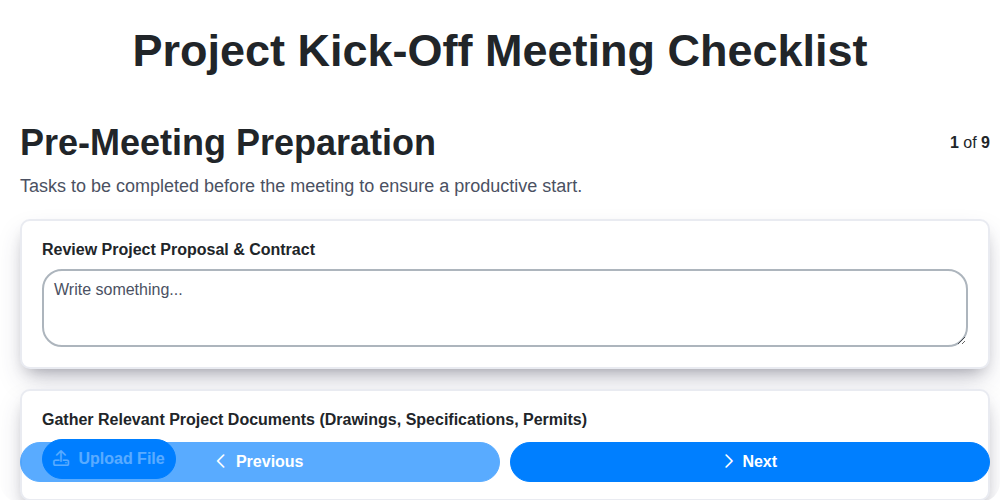
The Ultimate Project Kick-Off Meeting Checklist Template
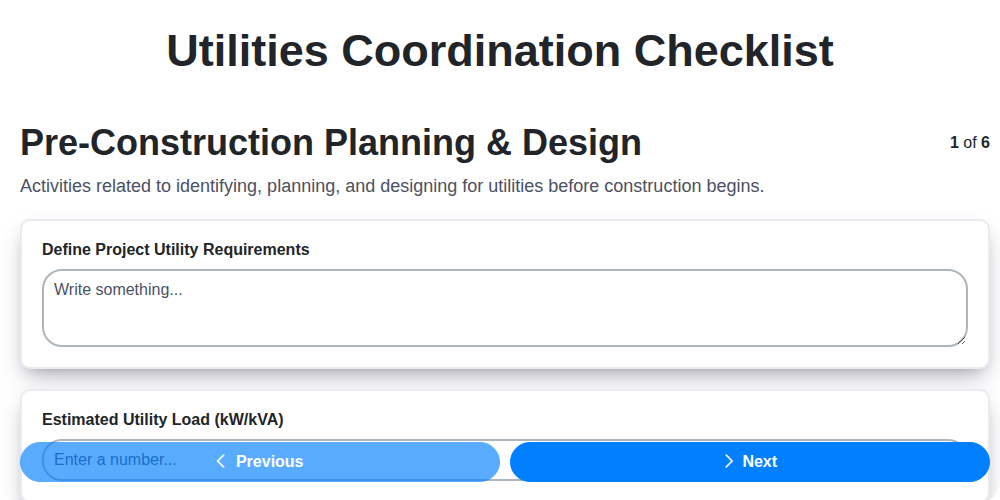
Streamline Your Project: The Ultimate Utilities Coordination Checklist Template
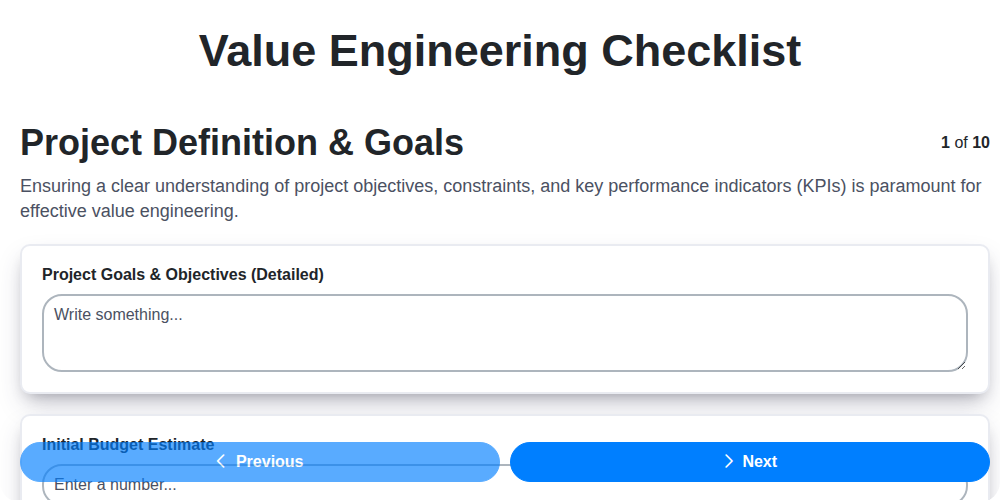
Unlock Value: Your Free Value Engineering Checklist Template
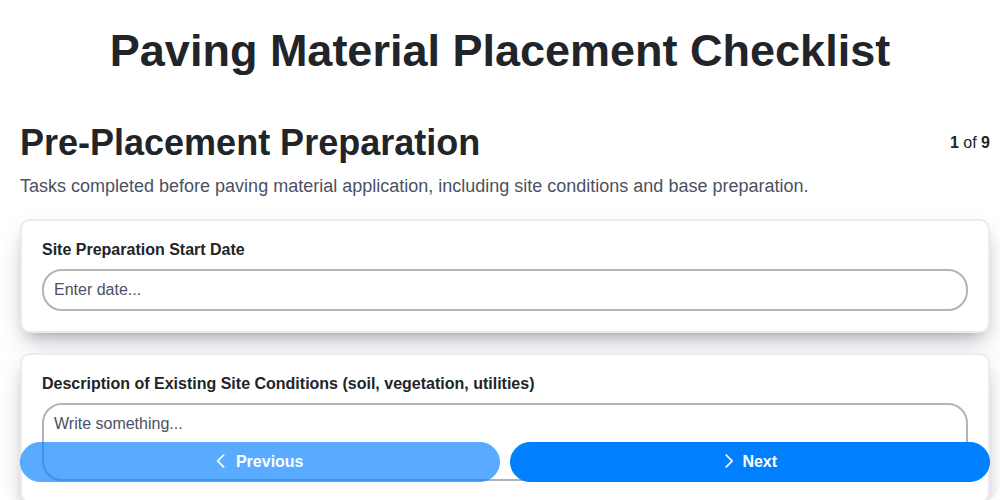
Your Paving Project's Blueprint: A Free Checklist Template
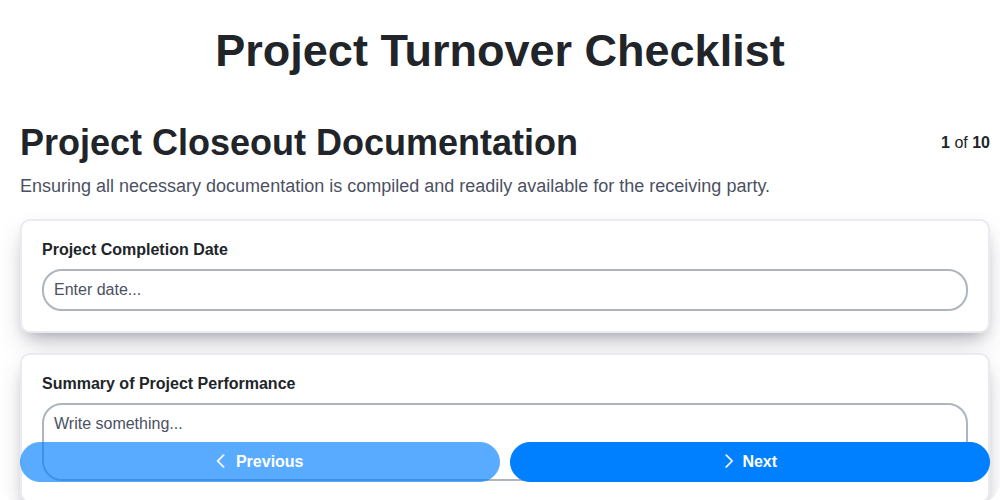
The Ultimate Project Turnover Checklist Template
Need help with
Checklists?
Have a question? We're here to help. Please submit your inquiry, and we'll respond promptly.