Digital Transformation Project Workflow: A Step-by-Step Guide to Seamless Execution
Published: 06/04/2026 Updated: 10/05/2026
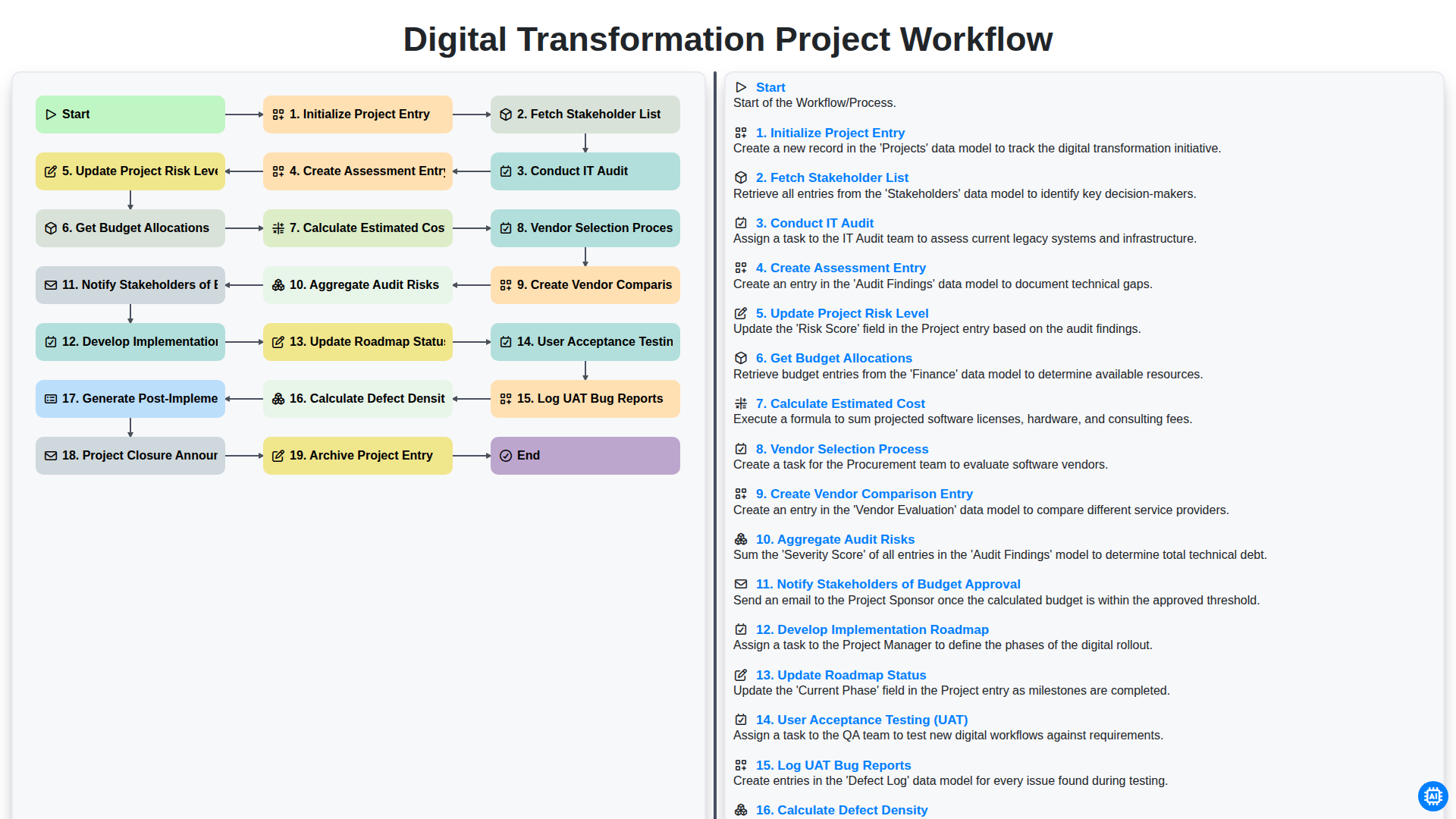
Table of Contents
- Introduction: The Importance of a Structured Digital Transformation Workflow
- Phase 1: Project Initiation and Stakeholder Engagement
- Phase 2: Infrastructure Assessment and IT Auditing
- Phase 3: Risk Management and Financial Planning
- Phase 4: Strategic Sourcing and Vendor Management
- Phase 5: Strategic Roadmap Development and Execution
- Phase 6: Quality Assurance and User Acceptance Testing (UAT)
- Phase 7: Post-Implementation Review and Project Closure
- Resources & Links
TLDR: Learn how to streamline complex digital transitions using our comprehensive workflow template. This guide covers the end-to-end lifecycle-from initial IT audits and budget allocation to vendor selection and UAT-providing a structured roadmap to manage risks, ensure stakeholder alignment, and achieve successful project closure.
Introduction: The Importance of a Structured Digital Transformation Workflow
In the modern business landscape, digital transformation is no longer an option but a necessity for survival. However, many organizations fail to realize its full potential not because of a lack of vision, but due to a lack of execution. Digital transformation is a complex, multi-layered evolution that touches every corner of an enterprise-from upgrading legacy infrastructure to reshaping organizational culture. Without a predefined, repeatable, and structured workflow, these large-scale transitions often descend into chaos, characterized by budget overruns, scope creep, and stakeholder misalignment.
A structured workflow serves as the strategic backbone of any digital initiative. It provides a clear roadmap that guides a project from its initial conception through to final implementation and closure. By following a disciplined sequence-ranging from the initial project entry and IT audits to vendor selection and rigorous User Acceptance Testing (UAT)-organizations can mitigate risks, manage resources effectively, and ensure that every technological shift aligns with overarching business objectives. A well-defined process ensures that no critical step, such as assessing risk levels or calculating defect density, is overlooked, ultimately turning a high-stakes transformation into a measurable, scalable success.
Phase 1: Project Initiation and Stakeholder Engagement
The foundation of any successful digital transformation lies in a structured start. The process begins with the Initialize Project Entry step, where the project's scope, objectives, and core parameters are formally documented to establish a single source of truth. Once the project framework is set, the next critical movement is to Fetch Stakeholder List. Identifying everyone from executive sponsors to end-users ensures that no key voice is overlooked during the transition.
To ensure the transformation is grounded in reality, the workflow moves into the Conduct IT Audit stage. This involves a deep dive into the existing infrastructure, identifying legacy systems, and pinpointing technical bottlenecks. Simultaneously, we Create Assessment Entry to capture all findings from the audit, providing a baseline for change. As these findings emerge, the team must proactively Update Project Risk Level, ensuring that any identified technical or operational hurdles are immediately flagged for mitigation. Finally, to ensure the project remains financially viable, we Get Budget Allocations, ensuring that the necessary resources are secured before moving into the detailed planning stages.
Phase 2: Infrastructure Assessment and IT Auditing
Once the project has been formally initiated and the key stakeholders have been identified, the focus shifts from high-level planning to deep-dive technical evaluation. This phase is critical for establishing a baseline of your current digital maturity and identifying the gaps that the transformation aims to bridge.
The process begins with the formal creation of an Assessment Entry, which serves as the central repository for all diagnostic data. To ensure a comprehensive view of the landscape, we perform a rigorous IT Audit. This audit is not merely a checklist; it is an investigation into existing hardware, software compatibility, cybersecurity protocols, and data integrity.
As the audit progresses, a vital sub-process occurs: Aggregating Audit Risks. By consolidating the findings from the technical deep-dive, the project team can identify systemic vulnerabilities and technical debt that could jeopardize the implementation. This intelligence is then used to Update the Project Risk Level, allowing the leadership team to adjust the project's contingency plans in real-time. This phase ensures that the transformation strategy is built on a foundation of technical reality rather than optimistic assumptions.
Phase 3: Risk Management and Financial Planning
Once the initial assessment is complete, the focus shifts toward mitigating potential roadblocks and securing the necessary resources. This phase is critical for ensuring that the transformation remains viable and that the project is shielded from unforeseen complications.
The process begins with the aggregation of audit risks, where all vulnerabilities identified during the IT audit are consolidated to provide a clear picture of the project's threat landscape. Based on this comprehensive view, the system will update the project risk level, allowing project managers to prioritize high-impact issues.
Parallel to risk mitigation, the financial framework must be solidified. During this stage, we get budget allocations to ensure the project aligns with the organization's fiscal capabilities. We then calculate the estimated cost of the transformation, providing a granular breakdown of the required investment. Once the financial feasibility is verified, the system will automatically notify stakeholders of budget approval, signaling that the project has the green light to proceed into the procurement and execution stages.
Phase 4: Strategic Sourcing and Vendor Management
Once the financial parameters are established, the focus shifts from internal assessment to external procurement. This stage is critical, as the success of a digital transformation depends heavily on the quality of the third-party technologies and services integrated into your ecosystem.
The process begins with the Vendor Selection Process, where potential partners are evaluated against the specific technical and operational requirements identified during the audit phase. To ensure an objective decision-making process, we then move to Create Vendor Comparison Entry. This step involves a side-by-side analysis of various proposals, weighing factors such as compatibility, scalability, service level agreements (SLAs), and total cost of ownership. By documenting these comparisons systematically, the project team can mitigate the risk of vendor lock-in and ensure that the chosen partner aligns perfectly with the long-term strategic goals of the organization.
Phase 5: Strategic Roadmap Development and Execution
Once the financial parameters are solidified and the budget approval is communicated to all key stakeholders, the project transitions from assessment to action. This phase focuses on turning data-driven insights into a tangible execution plan.
The process begins with the Development of the Implementation Roadmap, a strategic blueprint that outlines the deployment timeline, key milestones, and resource allocation required to integrate new technologies into the existing ecosystem. As the project progresses through these predefined stages, the Update Roadmap Status task becomes critical, ensuring that all team members have real-time visibility into progress, potential bottlenecks, and upcoming deadlines.
The final hurdle of the execution phase is ensuring the solution meets the actual needs of the business. This is achieved through rigorous User Acceptance Testing (UAT), where end-users validate the new system against functional requirements. During this period, any discrepancies are meticulously documented as we Log UAT Bug Reports, ensuring that every technical glitch is tracked. To measure the quality of the deployment, we Calculate Defect Density, providing a mathematical metric to determine if the system is stable enough for full-scale production. This phase ensures that the transformation is not just a technical deployment, but a functional success.
Phase 6: Quality Assurance and User Acceptance Testing (UAT)
Once the implementation roadmap has been executed, the project enters its most critical phase: Quality Assurance and User Acceptance Testing (UAT). This stage serves as the final gatekeeper, ensuring that the digital solution not only functions technically but also meets the actual needs of the end-users.
The process begins with the systematic execution of User Acceptance Testing (UAT), where designated stakeholders interact with the new system in a real-world scenario to validate its performance against the original business requirements. During this period, any discrepancies, glitches, or usability issues are meticulously documented as we Log UAT Bug Reports.
To maintain objective oversight of the system's stability, we do not simply count errors; we Calculate Defect Density. By analyzing the number of confirmed defects relative to the size of the software module, we can scientifically determine if the system is stable enough for production or if further development cycles are required. This data-driven approach ensures that going live is a decision based on empirical evidence rather than intuition, minimizing the risk of post-launch failures.
Phase 7: Post-Implementation Review and Project Closure
The final phase of the digital transformation journey is where the true value of the project is codified and the transition to operational stability begins. This stage is not merely about turning off the development environment; it is about evaluating success through data-driven insights and ensuring institutional knowledge is preserved.
The process begins with the generation of the Post-Implementation Report. This comprehensive document serves as the source of truth, detailing whether the project met its initial KPIs, analyzing the final cost versus the estimated budget, and documenting the lessons learned during the development lifecycle. This report is critical for stakeholders to understand the ROI of the transformation.
Once the performance data has been reviewed, the Project Closure Announcement is issued to all relevant parties. This formal communication signals that the project has officially moved from the transformation team to the business-as-usual (BAU) operational teams, marking the successful end of the project's active lifecycle.
Finally, to maintain organizational integrity and data governance, the Archive Project Entry step is executed. By archiving the project documentation, audit trails, and technical specifications, you ensure that while the active workflow concludes, a searchable, permanent record remains available for future audits, compliance checks, or as a blueprint for upcoming digital initiatives.
Resources & Links
- Project Management Institute (PMI): The gold standard for project management frameworks, providing global standards for managing complex digital transformations and risk assessment.
- Gartner: Expert insights and research on IT auditing, vendor selection strategies, and digital transformation trends to inform your infrastructure assessments.
- Scrum Alliance: Resources for implementing agile methodologies within your project roadmap and managing iterative user acceptance testing (UAT) processes.
- Atlassian: Tools and methodologies for tracking UAT bug reports, managing defect density, and maintaining a centralized project workflow.
- McKinsey & Company: Strategic frameworks for digital transformation leadership, focusing on stakeholder engagement and large-scale organizational change.
- ISO (International Organization for Standardization): Essential standards for IT auditing, risk management protocols, and ensuring quality control during the project closure phase.
Frequently Asked Questions
What is a digital transformation project workflow?
A digital transformation project workflow is a structured, step-by-step series of processes and stages designed to integrate digital technology into all areas of a business, fundamentally changing how the organization operates and delivers value to customers.
What are the most critical stages in a digital transformation workflow?
While workflows can vary, the essential stages typically include strategic planning, assessment of current digital maturity, technology selection, implementation/integration, change management, and continuous monitoring/optimization.
Why is change management considered a key part of the workflow?
Digital transformation is as much about people as it is about technology. Change management ensures that employees are trained, engaged, and prepared to adopt new digital tools and processes, reducing resistance and increasing the project's success rate.
How can organizations avoid common pitfalls during execution?
To ensure seamless execution, organizations should define clear objectives, ensure executive buy-in, prioritize scalable technologies, maintain transparent communication throughout the workflow, and adopt an iterative approach rather than a 'big bang' implementation.
How do you measure the success of a digital transformation project?
Success can be measured through various Key Performance Indicators (KPIs), such as increased operational efficiency, improved customer satisfaction scores (CSAT), reduced manual errors, faster time-to-market, and measurable Return on Investment (ROI) from new technologies.
Comments
There are no comments yet. Be the first to add one!
Project Management Solution Demo
Deliver projects on time & within budget! ChecklistGuro streamlines task management, collaboration, & progress tracking. Enhance visibility & boost team productivity. Manage it all with our Work OS.
Related Articles
Construction Material Inventory Tracking Checklist Template
The Ultimate Site Mobilization Readiness Checklist Template
Kanban System Review Checklist: A Template for Continuous Improvement
The Ultimate Project Kick-Off Meeting Checklist Template
Streamline Your Project: The Ultimate Utilities Coordination Checklist Template
Unlock Value: Your Free Value Engineering Checklist Template
Your Paving Project's Blueprint: A Free Checklist Template
The Ultimate Project Turnover Checklist Template
Need help with
Checklists?
Have a question? We're here to help. Please submit your inquiry, and we'll respond promptly.