Fortify Your Grid: An Energy Cybersecurity Risk Assessment Checklist Template
Published: 12/05/2025 Updated: 07/02/2026
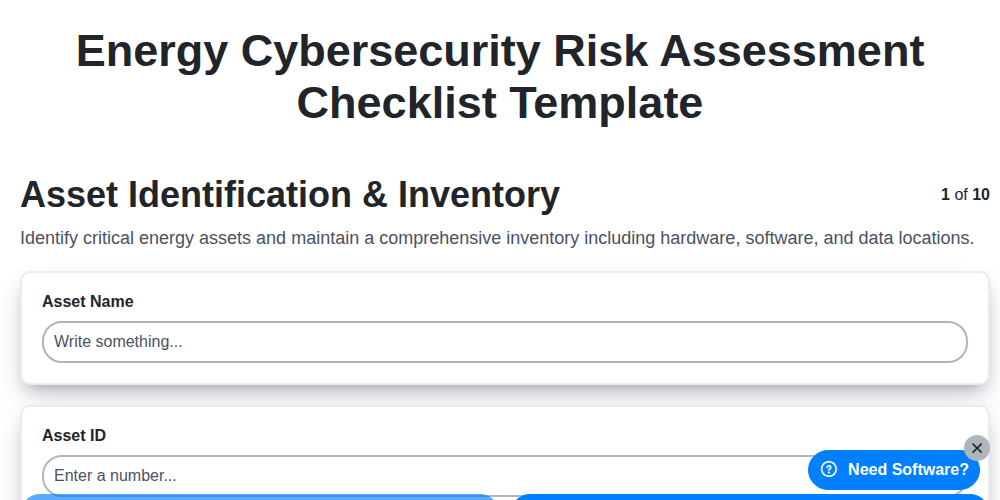
Table of Contents
- Introduction: Why Energy Cybersecurity Matters
- 1. Asset Identification & Inventory: Knowing What You Need to Protect
- 2. Network Security: Securing the Foundation
- 3. Endpoint Security: Protecting Your Devices
- 4. Data Security & Privacy: Safeguarding Critical Information
- 5. Identity & Access Management (IAM): Controlling Who Can Do What
- 6. Supply Chain Risk Management: Addressing Third-Party Vulnerabilities
- 7. Incident Response & Recovery: Planning for the Inevitable
- 8. Security Awareness & Training: Empowering Your Workforce
- 9. Regulatory Compliance: Meeting Legal Obligations
- 10. Physical Security: Protecting Infrastructure
- Checklist Template Overview
- Prioritizing Risks & Remediation
- Continuous Monitoring & Improvement
- Resources & Links
TLDR: Worried about cyberattacks on your energy infrastructure? This checklist template walks you through 10 critical areas - from identifying assets and securing your network to training employees and complying with regulations - to systematically assess and mitigate cybersecurity risks. It's your first step towards a more resilient and protected energy grid.
Introduction: Why Energy Cybersecurity Matters
The energy sector is a critical infrastructure pillar, powering homes, businesses, and essential services. However, this vital role also makes it a prime target for cyberattacks. A successful attack can disrupt power grids, compromise sensitive data, and even endanger lives. Unlike traditional industries, energy infrastructure often blends legacy operational technology (OT) - often vulnerable and unpatched - with modern IT systems, creating a complex and expansive attack surface. The consequences extend beyond financial losses; they can include widespread outages, environmental damage, and national security implications. A proactive and robust cybersecurity posture isn't just a best practice - it's a necessity for the resilience and safety of our communities and the stability of our nation. This checklist provides a foundational framework to begin that journey.
1. Asset Identification & Inventory: Knowing What You Need to Protect
Before you can secure anything, you need to know what you're securing. This foundational step in an energy cybersecurity risk assessment involves a comprehensive identification and inventory of all assets - both tangible and intangible - crucial to your operations. Think beyond just servers and computers. This includes:
- Critical Infrastructure Assets: SCADA systems, PLCs, RTUs, smart meters, substations, pipelines, and other operational technology (OT) devices.
- Information Technology (IT) Assets: Servers, workstations, laptops, mobile devices, cloud infrastructure, databases, and software applications.
- Data: Proprietary algorithms, operational data, customer information, financial records, and intellectual property.
- Personnel: Recognizing employees as potential assets (and vulnerabilities) requiring security awareness and training.
- Third-Party Systems: Identify and catalog all third-party systems integrated into your operations.
Key Checklist Items:
- Create a Detailed Asset Register: Include asset name, location, function, owner, criticality level, and associated risks.
- Automate Discovery: Utilize automated asset discovery tools where possible to ensure completeness and accuracy.
- Regular Updates: The asset landscape changes constantly. Implement a process for regular updates to the asset register (at least quarterly).
- Shadow IT Identification: Proactively identify and catalog unauthorized devices and applications (shadow IT) connected to your network.
- Assign Ownership: Clearly define roles and responsibilities for asset management and security.
- Prioritize Criticality: Categorize assets based on their impact on safety, environmental impact, financial stability, and regulatory compliance.
Understanding your assets is the bedrock of effective energy cybersecurity. Without it, your defenses are built on shifting sand.
2. Network Security: Securing the Foundation
Your operational technology (OT) network is the backbone of your energy operations, and a critical target for cyberattacks. A robust network security posture is fundamental to energy cybersecurity. This section of the checklist focuses on protecting this vital infrastructure.
Here's what to assess:
- Network Segmentation: Is your OT network segmented from your IT network and other critical zones? Poor segmentation allows attackers to easily pivot between networks once inside. Verify the effectiveness of your segmentation strategy.
- Firewall Configuration & Management: Are firewalls properly configured and actively managed? Review rule sets, ensure they're updated to reflect current threats, and validate they're blocking unauthorized traffic.
- Intrusion Detection/Prevention Systems (IDS/IPS): Are IDS/IPS deployed and actively monitoring network traffic for malicious activity? Evaluate their effectiveness, signature updates, and alert management processes.
- Remote Access Control: Scrutinize remote access methods (VPNs, etc.). Are they secured with multi-factor authentication (MFA) and least privilege access controls? Regularly review remote access permissions.
- Wireless Security: If wireless networks are used, are they secured with strong encryption (e.g., WPA3) and access controls? Consider disabling unnecessary wireless access points.
- Network Monitoring & Logging: Are you actively monitoring network traffic and logs? Centralized logging and SIEM (Security Information and Event Management) systems are crucial for anomaly detection and incident investigation.
- Vulnerability Scanning: Conduct regular vulnerability scans of network devices (routers, switches, HMIs). Promptly remediate identified vulnerabilities.
- Patch Management: Implement a robust patch management process for network devices. Outdated firmware is a major attack vector.
- DDoS Protection: Evaluate your defenses against Distributed Denial of Service (DDoS) attacks that can disrupt operations.
3. Endpoint Security: Protecting Your Devices
Endpoints - laptops, desktops, mobile devices, IoT devices - represent a significant attack surface for energy organizations. These devices often reside outside the traditional network perimeter and are vulnerable to malware, ransomware, and unauthorized access. A robust endpoint security program is critical.
Here's what your checklist should cover:
- Inventory & Management: Do we have a complete inventory of all endpoints (including BYOD)? Are they centrally managed and patched regularly?
- Antivirus/Anti-Malware: Are all endpoints equipped with up-to-date antivirus and anti-malware software? Are scans automated and regularly scheduled?
- Endpoint Detection and Response (EDR): Do we have EDR solutions in place to detect and respond to advanced threats beyond traditional signature-based detection?
- Host-Based Firewalls: Are host-based firewalls enabled and configured to restrict unauthorized network connections?
- Application Control/Whitelisting: Do we utilize application control or whitelisting to restrict the execution of unauthorized applications?
- Data Loss Prevention (DLP): Are DLP measures in place to prevent sensitive data from leaving endpoints?
- Encryption: Are hard drives and removable media encrypted to protect data at rest?
- Mobile Device Management (MDM): If mobile devices are used, do we have a comprehensive MDM solution in place to enforce security policies?
- Vulnerability Scanning: Are endpoints regularly scanned for vulnerabilities?
- Secure Configuration: Are endpoints configured with hardened security settings according to industry best practices?
4. Data Security & Privacy: Safeguarding Critical Information
Data is the lifeblood of most energy organizations, from operational data controlling grid stability to sensitive customer information. A data security breach can result in significant financial losses, reputational damage, and operational disruption. This section focuses on ensuring the confidentiality, integrity, and availability of your data.
Key Considerations & Checklist Items:
- Data Classification: Identify and classify your data based on sensitivity (e.g., public, confidential, restricted). This dictates appropriate security controls.
- Data Encryption: Implement encryption both in transit and at rest for sensitive data. Consider using strong encryption algorithms and robust key management practices.
- Data Loss Prevention (DLP): Deploy DLP solutions to prevent unauthorized data exfiltration. Configure rules to monitor and control data movement across your network.
- Data Masking & Anonymization: Utilize data masking and anonymization techniques when dealing with sensitive data in non-production environments (e.g., testing, development).
- Database Security: Secure your databases with strong passwords, access controls, and regular vulnerability scanning. Implement database activity monitoring.
- Data Backup & Recovery: Regularly back up critical data and ensure the recovery process is tested and validated. Consider offsite storage for backups.
- Privacy Policies & Compliance: Develop and maintain clear privacy policies that outline how you collect, use, and protect personal data. Ensure compliance with relevant privacy regulations (e.g., GDPR, CCPA).
- Data Access Controls: Implement the principle of least privilege, granting users only the data access they need to perform their job functions. Regularly review and audit access permissions.
- Data Retention & Disposal: Establish clear data retention policies and secure disposal methods to minimize risk and comply with legal requirements.
5. Identity & Access Management (IAM): Controlling Who Can Do What
Identity and Access Management (IAM) forms a critical layer of defense in energy cybersecurity. It's about much more than just usernames and passwords; it's the foundation for ensuring the right people have the right access to the right resources at the right time. A weak IAM system is a gaping hole attackers can exploit to move laterally within your organization and compromise sensitive data and critical infrastructure.
Your Checklist Should Address:
- Centralized Identity Repository: Do you have a single source of truth for user identities? This prevents shadow IT and inconsistencies.
- Multi-Factor Authentication (MFA): Is MFA enforced for all critical systems and remote access? Something you know (password) isn't enough; MFA adds layers of security with "something you have" (like a phone) or "something you are" (biometrics).
- Least Privilege Principle: Are users granted only the minimum access necessary to perform their job duties? Regularly review and update permissions.
- Role-Based Access Control (RBAC): Are access rights assigned based on job roles, simplifying management and reducing errors?
- Regular Access Reviews: Are user access rights periodically reviewed and recertified by supervisors? This ensures individuals still require the access they have.
- Privileged Access Management (PAM): Are administrative accounts and privileged access tightly controlled and monitored? These accounts pose the highest risk if compromised.
- Automated Provisioning and Deprovisioning: Are new user accounts automatically created and deactivated when employees join or leave the organization? This prevents orphaned accounts.
- Password Policies: Are strong password policies enforced (length, complexity, rotation)?
Proper IAM implementation isn't just a "nice-to-have" - it's a vital security control, especially in the energy sector where the consequences of a breach can be devastating.
6. Supply Chain Risk Management: Addressing Third-Party Vulnerabilities
Your organization's security is only as strong as its weakest link, and increasingly, that weakness lies within your supply chain. Cyberattacks are evolving, and attackers are actively targeting vendors, contractors, and other third-party providers to gain access to their clients' systems and data. A compromised supplier can be a backdoor into your entire operation.
This checklist element focuses on proactively identifying and mitigating those risks. It's not enough to simply know you use third-party vendors; you need a systematic approach to evaluating their security posture.
Here's what to consider:
- Vendor Mapping: Create a comprehensive inventory of all vendors who access your systems, data, or infrastructure. Categorize them based on criticality and access level.
- Risk Assessment Questionnaires: Implement standardized questionnaires to assess vendors' security practices, covering areas like data encryption, access controls, vulnerability management, and incident response.
- Contractual Obligations: Include robust security requirements in vendor contracts, outlining expectations for data protection, incident reporting, and compliance audits. Ensure these clauses are enforceable.
- Security Audits & Assessments: Regularly conduct security audits of critical vendors, either through self-assessments, third-party assessments, or on-site visits.
- Continuous Monitoring: Don't treat vendor security as a one-time assessment. Implement ongoing monitoring solutions to detect suspicious activity and track changes in vendor risk profiles.
- Business Continuity Planning: Integrate vendor resilience into your overall business continuity plan. What happens if a critical vendor experiences a cyber incident?
Failing to address supply chain risk can lead to significant financial losses, reputational damage, and legal liabilities. Prioritizing this area demonstrates a commitment to comprehensive energy cybersecurity.
7. Incident Response & Recovery: Planning for the Inevitable
Energy cybersecurity incidents will happen. It's not a matter of if, but when. Having a robust Incident Response and Recovery (IRR) plan is no longer optional - it's a critical defense against potential disruption and damage. This isn't just about restoring systems; it's about minimizing impact, protecting data, and ensuring business continuity.
Your checklist should include steps to:
- Define Roles & Responsibilities: Clearly outline who is responsible for what during an incident. This includes communication, containment, eradication, and recovery.
- Develop Incident Response Plans (IRPs): Create detailed, scenario-specific IRPs that cover potential attack vectors (ransomware, phishing, denial-of-service, etc.). Regularly review and update these plans.
- Establish Communication Channels: Designate primary and backup communication methods (internal and external) to ensure timely information flow.
- Data Backup & Recovery Procedures: Implement regular, secure data backups - both onsite and offsite - with documented recovery procedures. Test these procedures frequently.
- System Restoration Procedures: Outline the steps to restore critical systems and processes following an incident. Prioritize based on business impact.
- Post-Incident Analysis & Lessons Learned: After any incident (even minor ones), conduct a thorough analysis to identify vulnerabilities and improve your defenses. Document findings and actions taken.
- Regular Tabletop Exercises: Conduct simulated incident response exercises to test your plan, identify gaps, and train your team.
A well-defined and tested Incident Response & Recovery plan allows you to transition from reactive firefighting to a proactive and controlled response, minimizing downtime and safeguarding your critical energy infrastructure.
8. Security Awareness & Training: Empowering Your Workforce
Your technical safeguards are only as strong as the people using them. A sophisticated firewall is useless if an employee clicks a phishing link and compromises the entire network. That's why a robust security awareness and training program is absolutely critical for energy cybersecurity risk assessment.
This isn't just about yearly reminders or generic online courses. It needs to be an ongoing, engaging, and tailored approach. Consider the following:
- Regular Phishing Simulations: Test your employees' ability to identify and avoid phishing attacks - and provide immediate feedback and retraining when they fall for it.
- Role-Based Training: Different roles require different levels of security knowledge. Tailor training to address the specific risks each role faces (e.g., engineers handling SCADA systems need specialized training).
- Real-World Scenarios: Use relatable scenarios relevant to the energy sector - compromised credentials, social engineering targeting field workers, etc.
- Gamification & Engagement: Make security training interactive and fun to boost participation and retention. Quizzes, competitions, and rewards can all be effective.
- Continuous Updates: Threats evolve constantly. Keep your training materials updated with the latest attack vectors and best practices.
- Reporting Mechanisms: Provide clear channels for employees to report suspicious activity or security concerns without fear of reprisal.
A well-trained workforce becomes your first and best line of defense against cyber threats.
9. Regulatory Compliance: Meeting Legal Obligations
The energy sector faces a particularly stringent and evolving regulatory environment. Staying compliant isn't just about avoiding fines; it's about ensuring the reliability and security of critical infrastructure. Several key regulations directly impact cybersecurity practices, and failing to adhere to them can have serious consequences.
Here's a look at some key areas and how they intersect with cybersecurity:
- NERC CIP (North American Electric Reliability Corporation Critical Infrastructure Protection): This is arguably the most significant regulatory framework for electric utilities. CIP standards cover a broad range of cybersecurity requirements, from vulnerability management and access control to incident response and security awareness. Compliance is mandatory for entities deemed "critical infrastructure."
- TSA Security Directives: The Transportation Security Administration (TSA) has issued Security Directives for the pipeline sector, mandating specific cybersecurity measures. These directives are becoming increasingly detailed and require robust risk management practices.
- State-Level Regulations: Many states are enacting their own cybersecurity regulations tailored to the energy sector. These can cover areas like data breach notification, vulnerability disclosure, and security standards for specific energy sub-sectors.
- Federal Energy Regulatory Commission (FERC) Orders: FERC has issued orders emphasizing cybersecurity resilience and requiring energy companies to report cyber incidents and develop cybersecurity preparedness plans.
- GDPR/CCPA (for Data Handling): If your organization handles personal data of customers, regulations like GDPR (Europe) and CCPA (California) have cybersecurity implications related to data protection and breach notification.
Your Cybersecurity Risk Assessment Checklist should include:
- Mapping Controls to Requirements: Document how your cybersecurity controls align with specific regulatory requirements (e.g., which NERC CIP standards are addressed by your access control policy).
- Regular Updates: Continuously monitor regulatory changes and update your cybersecurity program accordingly.
- Audit Trails & Documentation: Maintain comprehensive records of your cybersecurity activities to demonstrate compliance during audits.
- Reporting Processes: Establish clear procedures for reporting security incidents to regulators as required.
Ignoring these regulations is not an option. Proactive compliance demonstrates a commitment to security and helps protect the energy sector from evolving threats.
10. Physical Security: Protecting Infrastructure
Often overlooked in the rush to secure digital assets, physical security forms a foundational layer in a robust energy cybersecurity posture. A compromised physical location can bypass all digital safeguards, granting unauthorized access to critical infrastructure and data. This checklist item isn't just about locks and fences; it's a comprehensive assessment of your facility's vulnerability.
Consider these key areas:
- Perimeter Security: Evaluate fencing, lighting, surveillance systems (CCTV), and intrusion detection systems. Are they effective and regularly maintained? Are blind spots identified and addressed?
- Access Control: Review badge systems, biometric scanners, and visitor management procedures. Are access rights granted based on the principle of least privilege? Are access logs regularly audited?
- Server Room/Control Room Security: Implement strict access controls, environmental monitoring (temperature, humidity), and redundant power systems. Consider physical barriers and specialized security personnel.
- Equipment Security: Ensure critical equipment (generators, substations, pipelines) are physically protected from tampering, vandalism, and natural disasters. Secure cabinets and enclosures should be used.
- Visitor Screening: Implement procedures for identifying and monitoring visitors, including background checks and escorts.
- Environmental Controls: Protect equipment from weather, pests, and other environmental hazards.
- Security Personnel: Are security personnel adequately trained to recognize and respond to physical security threats?
- Regular Audits: Conduct periodic physical security audits to identify vulnerabilities and ensure compliance with policies.
Addressing physical security vulnerabilities isn't a one-time task; it requires ongoing vigilance and adaptation to evolving threats. A strong physical security plan complements digital defenses, creating a truly resilient energy infrastructure.
Checklist Template Overview
This checklist template serves as a foundational guide to assess your organization's energy cybersecurity posture. It's designed to be adaptable - feel free to tailor it to your specific operational environment, criticality of assets, and regulatory requirements. Each section includes key questions and considerations; a simple Yes/No/N/A scoring system is suggested for easy tracking and prioritization.
How to Use This Checklist:
- Assemble Your Team: Include representatives from IT, OT (Operational Technology), Engineering, Security, and Compliance.
- Review & Customize: Familiarize yourself with each section and modify questions to accurately reflect your systems and processes.
- Conduct the Assessment: Work through each area, documenting findings and assigning scores.
- Analyze Results: Identify areas of strength and weakness, and prioritize remediation efforts based on risk level and potential impact.
- Document and Track: Maintain a record of your assessment results, corrective actions taken, and ongoing monitoring activities. Regular reassessments (at least annually, or more frequently for high-risk environments) are crucial to ensure continued protection.
Download the full checklist template to begin your cybersecurity risk assessment today.
Prioritizing Risks & Remediation
Identifying vulnerabilities is just the first step. A true energy cybersecurity risk assessment delivers actionable insights, and that hinges on prioritizing those risks and outlining clear remediation strategies. Not all risks are created equal - some pose an immediate threat to critical infrastructure, while others represent longer-term concerns.
Risk Scoring & Categorization: We recommend employing a risk scoring methodology (e.g., using a matrix that considers likelihood and impact) to categorize identified risks. This allows for clear differentiation between "critical," "high," "medium," and "low" risks. Define specific criteria for each category; for instance, a critical risk might be one that has a high probability of occurring and would result in significant operational disruption, financial loss, or safety hazard.
Remediation Planning: Once risks are categorized, create a remediation plan outlining steps to mitigate or eliminate them. This plan should include:
- Owner: Assign responsibility for each remediation task to a specific individual or team.
- Timeline: Establish realistic deadlines for completion.
- Resources: Identify the necessary budget, personnel, and tools.
- Prioritization: Focus initially on critical and high-priority risks. Quick wins - easily implemented, high-impact controls - should be pursued early on to demonstrate progress and build momentum.
- Risk Acceptance: In some cases, remediation may be too costly or impractical. Document these instances clearly, justifying the risk acceptance and outlining compensating controls.
- Continuous Monitoring: Regularly review the remediation plan's progress and re-evaluate risk scores as controls are implemented.
Remember, cybersecurity is not a one-time event; it's an ongoing process of assessment, mitigation, and adaptation.
Continuous Monitoring & Improvement
Cybersecurity isn't a "set it and forget it" endeavor. The threat landscape is constantly evolving, and your organization's systems and vulnerabilities will change over time. A robust energy cybersecurity program demands continuous monitoring and improvement to remain effective.
This involves regularly reviewing your risk assessment findings, security controls, and performance metrics. Don't just check boxes - actively analyze the data. Are your current controls effectively mitigating identified risks? Are new vulnerabilities emerging that require adjustments?
Here are a few key actions to include:
- Regular Vulnerability Scanning: Schedule automated and manual vulnerability scans to identify weaknesses in your systems.
- Log Analysis & SIEM: Implement a Security Information and Event Management (SIEM) system to centralize log data, detect anomalies, and respond to potential incidents.
- Performance Metrics: Track key performance indicators (KPIs) like time to detect and respond to incidents, patch management effectiveness, and training completion rates.
- Periodic Risk Reassessment: Conduct full or targeted risk assessments at least annually, or more frequently if significant changes occur within your environment or the threat landscape.
- Feedback Loops: Establish channels for employees to report security concerns and incorporate their feedback into your program.
- Stay Informed: Actively monitor industry alerts, threat intelligence feeds, and regulatory updates to anticipate and address emerging risks.
By embracing a culture of continuous improvement, you can strengthen your energy cybersecurity posture and proactively address evolving threats.
Resources & Links
- CISA (Cybersecurity and Infrastructure Security Agency): The US government's leading cybersecurity agency. Offers advisories, tools, and resources specifically for critical infrastructure, including the energy sector. A crucial starting point for understanding energy cybersecurity best practices and threats.
- NERC (North American Electric Reliability Corporation): Develops and enforces reliability standards for the bulk power system. Their CIP (Critical Infrastructure Protection) standards are a key compliance requirement for energy companies. Check their website for standards, guidance, and training.
- U.S. Energy Information Administration (EIA): Provides data and analysis on energy production, consumption, and security. Understanding the energy landscape is vital for identifying potential vulnerabilities and impacts.
- NIST (National Institute of Standards and Technology): Develops cybersecurity frameworks, standards, and guidelines. The NIST Cybersecurity Framework (CSF) is widely adopted and provides a structured approach to risk management. Useful for all aspects of the checklist.
- SANS Institute: Provides cybersecurity training, certifications, and resources. They offer specific courses and materials relevant to industrial control systems (ICS) and energy sector cybersecurity. Great for security awareness and training component.
- ISC²: A global leader in cybersecurity certifications and training. Their resources and certifications (e.g., CISSP) provide a baseline for understanding cybersecurity concepts and best practices. Relevant for prioritizing risk and remediation.
- Cybersecurity Coalition: A non-profit organization providing resources and analysis related to cybersecurity threats and vulnerabilities, often with specific relevance to critical infrastructure. Helpful for understanding the current threat landscape.
- CyberAbacus: Specializes in ICS/OT security assessments and risk management. Their website offers whitepapers and guidance on protecting industrial control systems. Valuable for asset identification, network security and incident response.
- Rapid7: Provides vulnerability management and threat detection solutions. Their blog and research can help with identifying vulnerabilities and improving threat detection capabilities, important for continuous monitoring.
- Splunk: A leading platform for data analytics and security information and event management (SIEM). SIEM tools are critical for continuous monitoring and incident response. Their site has resources on using data for security.
- Tripwire: Focuses on security information and event management (SIEM) and vulnerability management for ICS/OT environments. Crucial for asset identification, continuous monitoring and prioritization of remediation tasks.
- ENISA (European Union Agency for Cybersecurity): Provides guidance and resources for cybersecurity, including considerations for energy infrastructure. Useful for understanding regulatory compliance and best practices outside of the US.
- RSA: Provides security solutions focused on identity and access management (IAM) which is mentioned in section 10. Their website offers valuable insight into securing access controls and authentication.
- Recorded Future: Provides threat intelligence and analysis. Useful for understanding emerging threats and improving supply chain risk management - keeping abreast of current attack trends.
Frequently Asked Questions
What is an energy cybersecurity risk assessment and why is it important?
An energy cybersecurity risk assessment identifies vulnerabilities in your grid's systems and infrastructure that could be exploited by cyberattacks. It's crucial because energy grids are critical infrastructure, and attacks can cause widespread disruption, economic damage, and even endanger lives. This checklist template helps guide you through the process of assessing those risks and prioritizing mitigation strategies.
Who should use this checklist template?
This checklist is designed for a broad audience involved in energy grid cybersecurity, including: cybersecurity professionals, IT managers, operations personnel, risk managers, and anyone responsible for the security of energy infrastructure. The level of detail you focus on will depend on your role and expertise.
What does 'critical infrastructure' mean in the context of this checklist?
Critical infrastructure refers to assets, systems, and networks, whether physical or virtual, that are so vital to a nation's security and economic stability that their disruption would have devastating consequences. Energy grids fall squarely within this category.
What types of assets are included in the checklist's scope?
The checklist covers a wide range of assets including: Supervisory Control and Data Acquisition (SCADA) systems, Programmable Logic Controllers (PLCs), communication networks, data centers, endpoint devices, cloud services, and even physical security measures surrounding these assets.
What is the difference between vulnerability and risk?
A vulnerability is a weakness in a system (e.g., an outdated software version). Risk is the *likelihood* that a vulnerability will be exploited and the *impact* if it is. The checklist helps you assess both.
How do I prioritize risks identified using this checklist?
The checklist includes a prioritization matrix. Risks are assessed based on their likelihood and potential impact. High likelihood/high impact risks should be addressed first. Lower priority risks can be mitigated as resources allow.
What is a Common Vulnerability Scoring System (CVSS) score, and why is it mentioned in the checklist?
CVSS is an industry standard for assessing the severity of software vulnerabilities. The checklist encourages using CVSS scores to objectively rank vulnerabilities and inform remediation efforts.
What is a Security Information and Event Management (SIEM) system, and how does it relate to this checklist?
A SIEM system collects and analyzes security data from various sources. The checklist encourages leveraging SIEM data to identify and monitor threats, providing valuable input into your risk assessment process.
Is this checklist a substitute for formal cybersecurity audits or compliance requirements?
No. This checklist is a helpful tool for self-assessment but doesn't replace formal cybersecurity audits or adherence to industry regulations (e.g., NERC CIP). It's a complementary measure.
How often should I perform a cybersecurity risk assessment using this checklist?
We recommend conducting a cybersecurity risk assessment at least annually, or more frequently if there are significant changes to your systems, networks, or threat landscape.
Comments
There are no comments yet. Be the first to add one!
Energy Management Solution Demo
Managing operations, safety, and compliance in the energy sector is critical. ChecklistGuro's Work OS platform streamlines your workflow from exploration and production to distribution and maintenance. Enhance safety, improve efficiency, and ensure regulatory adherence. Discover how ChecklistGuro can transform your energy business!
Related Articles
Stay Compliant: Your Energy Metering Compliance Checklist Template
Unlock Savings: Your Complete Energy Efficiency Audit Checklist
Your Ultimate Energy Efficiency Audit Checklist Template
Power Through: Your Essential Energy Grid Outage Support Checklist
Oil & Gas Well Safety Inspection Checklist: Ensuring a Secure Operation
HVAC System Maintenance Checklist: Building Climate Control & Energy Savings
Renewable Energy Project Checklist Template
Energy Audit Reporting Compliance: Your Checklist for Success
Need help with
Energy?
Have a question? We're here to help. Please submit your inquiry, and we'll respond promptly.