Power Up Your Data: The Ultimate Energy Data Governance Checklist Template
Published: 12/05/2025 Updated: 07/02/2026
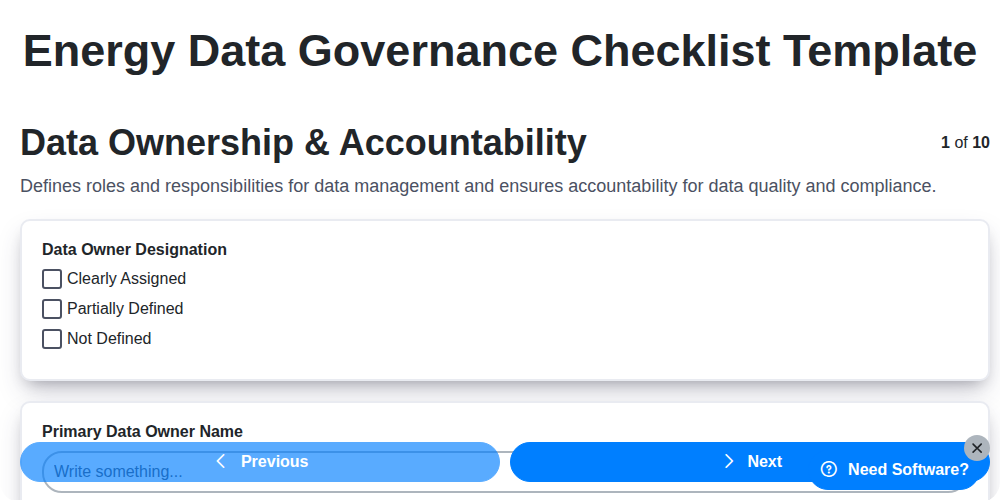
Table of Contents
- Introduction: Why Energy Data Governance Matters
- 1. Data Ownership & Accountability: Defining Responsibility
- 2. Data Quality Assessment: Ensuring Accuracy and Reliability
- 3. Data Security & Privacy: Protecting Sensitive Information
- 4. Data Lineage & Traceability: Mapping Your Data's Journey
- 5. Metadata Management: Documenting Your Data Assets
- 6. Data Integration & Interoperability: Connecting Your Systems
- 7. Data Retention & Archiving: Managing Data Lifecycle
- 8. Compliance & Regulatory Alignment: Meeting Industry Standards
- 9. Data Access Control: Who Sees What?
- 10. Data Incident Response: Planning for the Unexpected
- 11. Checklist Template: A Practical Guide
- Beyond the Checklist: Continuous Improvement
- Conclusion: Empowering Your Energy Business with Data Governance
- Resources & Links
TLDR: Feeling overwhelmed by energy data? This checklist template is your roadmap! It covers everything from data ownership and quality to security, compliance, and incident response, ensuring your energy data is trustworthy, secure, and compliant. Download it and start organizing your data governance today!
Introduction: Why Energy Data Governance Matters
The energy sector is undergoing a profound transformation, driven by renewable integration, smart grids, electrification, and increasing consumer expectations. This evolution generates an unprecedented volume and variety of data - from generation output and consumption patterns to grid stability and market dynamics. Effectively managing this data isn't just about storage; it's about unlocking its value to drive informed decision-making, optimize operations, and foster innovation.
Without robust data governance, energy companies risk data silos, inaccuracies, security breaches, compliance failures, and missed opportunities. Poor data quality leads to flawed analytics, hindering accurate forecasting and efficient resource allocation. Lack of data security exposes sensitive information, leading to financial and reputational damage. Ultimately, failing to govern energy data puts organizations at a competitive disadvantage and can impede the entire industry's progress toward a sustainable and reliable future. This checklist provides a framework for establishing that governance, ensuring your data is a strategic asset, not a liability.
1. Data Ownership & Accountability: Defining Responsibility
Energy data, encompassing everything from generation output to consumption patterns, is a valuable asset. However, its value is only realized when it's reliable, secure, and properly managed. The first, and arguably most critical, step in energy data governance is establishing clear data ownership and accountability. Without it, data quality suffers, security risks increase, and compliance becomes a constant uphill battle.
Data ownership isn't about possession; it's about responsibility. The Data Owner is the individual or team ultimately accountable for the data's quality, accuracy, and appropriate use. They understand the data's context, its purpose, and its limitations. They are empowered to define access rules and ensure adherence to data policies.
Alongside Data Owners, define Data Stewards. These individuals act as the Data Owner's representatives, often with a more hands-on role in data management activities. They might be involved in data cleansing, issue resolution, and training users.
Key actions for this stage include:
- Identify Key Data Domains: Categorize your data (e.g., generation data, grid operations, customer data).
- Assign Data Owners: Clearly designate individuals responsible for each data domain. Document these assignments.
- Define Roles & Responsibilities: Outline specific duties for both Data Owners and Data Stewards.
- Establish Escalation Paths: Determine how data-related issues are reported and resolved.
- Communicate Ownership: Ensure all relevant personnel understand who is responsible for specific datasets.
Lack of clarity here leads to blame-shifting and inaction when problems arise. A well-defined ownership structure fosters a culture of responsibility and ensures data is managed effectively.
2. Data Quality Assessment: Ensuring Accuracy and Reliability
Energy data, like any data, isn't inherently trustworthy. A robust data quality assessment is crucial to ensure the insights you're drawing from it are accurate and reliable. This goes beyond simply having data; it's about ensuring it's fit for purpose.
This assessment should be a continuous process, not a one-time event. It involves evaluating data against defined quality dimensions, commonly including:
- Accuracy: Does the data correctly reflect the reality it's representing (e.g., is the meter reading actually the consumption)?
- Completeness: Are there missing values or records? Identify gaps and understand the reasons behind them.
- Consistency: Is the data consistent across different systems and sources? Discrepancies can lead to flawed analysis.
- Timeliness: Is the data up-to-date and available when needed? Delayed data can impact critical decisions.
- Validity: Does the data conform to defined formats, ranges, and business rules? (e.g., voltage readings are within acceptable limits)
How to Approach Data Quality Assessment:
- Define Quality Metrics: Establish clear, measurable criteria for each data quality dimension, specific to your energy data.
- Data Profiling: Use automated tools to analyze data characteristics and identify anomalies.
- Data Validation Rules: Implement rules to identify and flag data that doesn't meet established quality standards.
- Regular Audits: Conduct periodic manual reviews of data samples to assess accuracy and identify areas for improvement.
- Root Cause Analysis: When data quality issues are discovered, investigate the underlying causes and implement corrective actions. This might involve training, system updates, or process changes.
- Documentation: Document your data quality assessment methods, findings, and corrective actions to ensure transparency and repeatability.
A proactive data quality assessment program not only enhances the reliability of your energy data but also strengthens your overall data governance framework and fuels better-informed decision-making.
3. Data Security & Privacy: Protecting Sensitive Information
Energy data often contains sensitive information - customer details, operational specifics, and potentially even financial data. Robust security and privacy measures are paramount. This checklist item goes beyond basic password protection.
Here's what you need to consider:
- Data Encryption: Implement encryption both at rest (storage) and in transit (during transmission). Consider using industry-standard encryption algorithms and manage keys securely.
- Access Control Lists (ACLs): Strictly limit data access based on the principle of least privilege. Only those who need access should have it, and their access should be tailored to their specific roles. Regularly review and update ACLs.
- Privacy-Enhancing Technologies (PETs): Explore and implement PETs like differential privacy or anonymization techniques, particularly when sharing data for analytics or external collaborations.
- Data Masking & Pseudonymization: Mask or pseudonymize sensitive data fields during testing and development to prevent accidental exposure.
- Regular Security Audits & Vulnerability Scanning: Conduct regular internal and external security audits and vulnerability scans to identify and remediate potential weaknesses.
- Privacy Impact Assessments (PIAs): Perform PIAs for any new data initiatives or changes to existing processes that may impact personal data.
- Employee Training: Provide ongoing training for all employees who handle energy data on data security best practices and privacy regulations.
- Compliance with Privacy Regulations: Ensure compliance with relevant privacy regulations such as GDPR, CCPA, or other applicable laws, based on geographic location and data types.
- Data Loss Prevention (DLP): Implement DLP tools and policies to prevent sensitive data from leaving the organization's control.
4. Data Lineage & Traceability: Mapping Your Data's Journey
Understanding where your energy data originates, how it transforms, and where it ultimately resides is crucial for trust, accuracy, and informed decision-making. Data lineage and traceability provides a visual roadmap of your data's journey - a critical component of robust energy data governance.
Without it, troubleshooting data errors becomes a frustrating scavenger hunt. Imagine trying to pinpoint why a performance report is inaccurate; without lineage, you're essentially guessing. With a clear lineage map, you can quickly trace the error back to its source, whether it's a faulty sensor, a flawed calculation, or a misconfigured system.
Here's what a strong data lineage and traceability program should encompass:
- Documented Data Flows: Visually map the movement of data from its origin (e.g., smart meters, weather stations, market feeds) through all transformations (calculations, aggregations, analyses) and to its final destination (dashboards, reports, models).
- Version Control: Track changes to data transformations, algorithms, and systems over time. This allows for auditing and rollback capabilities if needed.
- Automated Lineage Tools: Leverage tools that automatically generate and maintain lineage documentation, reducing manual effort and ensuring accuracy.
- Business Context: Integrate business metadata alongside technical lineage information to provide context and facilitate understanding for both technical and non-technical stakeholders.
By implementing thorough data lineage and traceability, you'll significantly enhance your ability to maintain data integrity, identify and resolve issues quickly, and build confidence in your energy data assets.
5. Metadata Management: Documenting Your Data Assets
Think of metadata as data about your data. It's the who, what, when, where, and why of your energy data. Without robust metadata management, your data becomes a black box - difficult to understand, trust, and effectively utilize.
A comprehensive metadata management strategy includes documenting critical information like data definitions, sources, formats, transformations, and business rules. This isn't just about creating a spreadsheet; it's about building a searchable, accessible, and constantly updated repository of information.
Why is it vital for energy data? Consider the complexity of your data landscape - smart meter readings, renewable energy generation profiles, grid stability metrics, consumption patterns, and more. Each dataset comes with its own nuances. Poorly documented data leads to misinterpretations, flawed analyses, and ultimately, bad decisions.
Key elements of your metadata checklist should include:
- Standardized Data Dictionaries: Define terms consistently across the organization.
- Data Source Tracking: Maintain a clear record of where data originates.
- Data Transformation Documentation: Describe all processes that modify data.
- Business Glossary Integration: Link technical metadata to business terminology.
- Automated Metadata Harvesting: Where possible, automate the extraction and update of metadata.
Implementing a strong metadata management process isn't just good practice; it's an essential component of successful energy data governance.
6. Data Integration & Interoperability: Connecting Your Systems
Energy data often resides in disparate systems - SCADA, EMS, weather forecasting models, billing platforms, IoT devices, and more. Siloed data hinders comprehensive analysis and prevents a holistic view of energy operations. Effective data integration and interoperability are crucial for breaking down these silos and unlocking the full potential of your data assets.
This checklist item focuses on ensuring that your data can flow seamlessly between systems. Here's what to consider:
- Standardized Data Formats: Are you using consistent data formats across all systems? Lack of standardization leads to complex and error-prone transformations. Invest in defining and enforcing common formats.
- APIs & Connectors: Utilize APIs and connectors where available to automate data exchange. Are these APIs well-documented and reliable?
- Data Transformation Processes: If transformations are necessary, are they documented, tested, and monitored? Establish clear data transformation rules.
- Interoperability Standards: Explore and leverage industry-specific interoperability standards (e.g., IEC 61970, CIM) to promote data exchange with external partners and utilities.
- Data Mapping: Thoroughly map data elements between different systems to understand relationships and ensure accuracy during integration.
- Real-time vs. Batch Integration: Determine the required frequency of data exchange - real-time for critical applications, or batch for reporting and analysis.
- Error Handling & Reconciliation: Implement robust error handling mechanisms to manage integration failures and reconciliation processes to ensure data consistency.
7. Data Retention & Archiving: Managing Data Lifecycle
Energy data, like any data, isn't useful forever. It accrues volume, consumes storage, and can become a compliance headache if not managed properly. A robust data retention and archiving strategy is crucial for balancing operational needs, regulatory requirements, and cost-effectiveness.
This section of your governance checklist focuses on establishing clear policies for how long energy data should be kept and how it should be archived. Consider these key aspects:
- Define Retention Periods: Based on legal, regulatory, operational, and business requirements, determine how long different types of energy data should be actively stored. This might vary significantly - meter data might need to be retained for several years for billing and dispute resolution, while some operational logs might have a shorter lifespan.
- Archiving Strategy: Outline how data will be moved from active storage to archive storage. Will it be a tiered approach based on accessibility needs? Consider technologies like cloud storage or tape backups.
- Legal Hold Procedures: Establish a clear process for suspending standard retention policies when data is needed for legal or investigative purposes. This prevents accidental deletion of potentially crucial evidence.
- Data Destruction Policy: Document a secure data destruction process to ensure sensitive information is permanently and irretrievably removed when it reaches the end of its retention period. This includes procedures for physical media disposal.
- Regular Review: Retention policies shouldn't be set in stone. Regularly review them (at least annually) to ensure they remain aligned with evolving regulations, business needs, and technological advancements.
- Documentation: Maintain thorough documentation of your data retention and archiving policies, including justifications for the chosen retention periods and the processes for managing archived data.
8. Compliance & Regulatory Alignment: Meeting Industry Standards
Energy companies operate within a complex web of regulations, and failing to comply can result in hefty fines, reputational damage, and even legal action. Your energy data governance framework must address these requirements proactively. This section moves beyond just internal policy and dives into external obligations.
Key Considerations:
- Identify Applicable Regulations: Begin by comprehensively identifying all relevant regulations impacting your data. This might include (but isn't limited to) GDPR (if handling EU citizen data), CCPA (California Consumer Privacy Act), ISO 50001 (for energy management systems), FERC regulations (for utilities in the US), and industry-specific reporting requirements (e.g., environmental reporting). Don't forget to consider regional and local regulations as well.
- Map Regulations to Data Elements: Once you know what regulations apply, map them to specific data elements within your energy data landscape. For instance, certain meter data might be subject to privacy regulations, while emissions data triggers environmental reporting obligations.
- Documentation is Key: Thoroughly document how your data governance policies and procedures are designed to meet each identified regulation. This documentation serves as evidence of your commitment to compliance and is invaluable during audits.
- Regular Audits & Reviews: Compliance isn't a one-time exercise. Implement a schedule for regular audits of your data governance framework to ensure it remains aligned with evolving regulations and industry best practices. Include reviews of data processing agreements with third-party vendors.
- Training & Awareness: Educate your employees on their responsibilities regarding data compliance. This helps to embed a culture of responsibility and reduces the risk of unintentional violations.
- Stay Updated: Regulations change. Subscribe to industry updates, engage with legal counsel, and actively monitor regulatory landscapes to ensure your practices remain compliant.
9. Data Access Control: Who Sees What?
Energy data is a powerful asset, but its value is quickly diminished if it falls into the wrong hands or is accessed inappropriately. Robust data access control is paramount to safeguarding your energy data and ensuring its integrity. This goes far beyond simply setting up passwords; it's a layered approach that defines who can access what data, when, and why.
Defining Roles and Permissions: Begin by clearly defining user roles within your organization. Examples include energy analysts, engineers, management, and potentially external vendors. Each role should have specific, documented permissions tied to data sets or systems. Principle of Least Privilege - grant users only the access they absolutely need to perform their duties - should be a guiding principle.
Implementing Access Controls: This involves the technical implementation of those defined permissions. Common methods include:
- Role-Based Access Control (RBAC): Assign users to roles, and roles are associated with specific data access privileges. This simplifies management and ensures consistency.
- Attribute-Based Access Control (ABAC): Offers more granular control by using attributes (e.g., job title, department, project) to define access rules.
- Multi-Factor Authentication (MFA): Adds an extra layer of security beyond passwords, such as biometric scans or one-time codes.
Regular Reviews and Audits: Data access control isn's a "set it and forget it" process. Regularly review user permissions, especially when roles change or employees leave. Conduct audits to ensure compliance with defined policies and identify any potential vulnerabilities. Track access logs to monitor data usage and detect any unauthorized activity.
Consider External Access: When granting access to external vendors or partners, establish clear contracts outlining their permitted data usage and security obligations. Implement secure data transfer protocols and monitor their activities closely.
By implementing a comprehensive data access control framework, you're not just protecting your data; you're fostering trust, ensuring regulatory compliance, and maximizing the value you derive from your energy data.
10. Data Incident Response: Planning for the Unexpected
Energy data incidents - whether stemming from cyberattacks, accidental leaks, or system failures - can have devastating consequences, impacting everything from grid stability to regulatory compliance and financial performance. A robust Data Incident Response plan isn't just about reacting after something goes wrong; it's about proactively minimizing damage and ensuring a swift, controlled recovery.
This checklist item focuses on establishing a clear, documented process for handling data breaches and other incidents. This should include:
- Incident Identification & Reporting: Define what constitutes an incident and establish clear reporting channels for all personnel. Make reporting easy and encourage it.
- Incident Response Team: Assemble a dedicated team with clearly defined roles and responsibilities (e.g., communication lead, technical lead, legal counsel).
- Containment & Eradication: Outline immediate steps to isolate the affected data, prevent further spread, and eliminate the root cause.
- Investigation & Analysis: A thorough investigation to understand the scope, cause, and impact of the incident.
- Recovery & Restoration: Procedures for restoring data integrity and availability, including backup restoration and system recovery.
- Communication Plan: Pre-approved messaging for internal and external stakeholders (including regulatory bodies), managed by a designated spokesperson.
- Post-Incident Review & Lessons Learned: A critical review of the incident and the response, identifying areas for improvement in data governance and security practices.
- Regular Testing & Training: Conduct tabletop exercises and simulations to test the plan's effectiveness and ensure team readiness.
A well-defined and tested Data Incident Response plan is a vital component of a comprehensive energy data governance framework, providing a critical layer of protection and resilience.
11. Checklist Template: A Practical Guide
Implementing energy data governance is a journey, not a destination. To help you stay on track and ensure consistent progress, we've created a practical checklist template you can adapt and use within your organization. This isn't exhaustive - tailor it to your specific needs and regulatory landscape - but it provides a solid foundation.
Energy Data Governance Checklist Template
Here's a breakdown of each area with key considerations and suggested actions. Checkboxes are for your internal use; this document is designed for planning and discussion.
1. Data Ownership & Accountability:
- Define data owners for each data domain (e.g., generation, consumption, grid).
- Document roles and responsibilities for data management activities.
- Establish a Data Governance Committee or similar oversight body.
- Communicate ownership clearly to all stakeholders.
2. Data Quality Assessment:
- Identify critical data elements.
- Define data quality dimensions (accuracy, completeness, timeliness, consistency).
- Implement data quality checks and validation rules.
- Regularly monitor and report on data quality metrics.
- Establish a process for data quality issue resolution.
3. Data Security & Privacy:
- Classify data based on sensitivity.
- Implement appropriate security controls (encryption, access controls, authentication).
- Conduct regular vulnerability assessments and penetration testing.
- Ensure compliance with privacy regulations (e.g., GDPR, CCPA).
- Provide data privacy training to employees.
4. Data Lineage & Traceability:
- Document data sources, transformations, and destinations.
- Implement tools and processes to track data lineage.
- Ensure ability to trace data back to its origin for auditing and troubleshooting.
5. Metadata Management:
- Define metadata standards and guidelines.
- Implement a metadata repository or catalog.
- Ensure metadata is accurate, complete, and up-to-date.
- Promote metadata usage across the organization.
6. Data Integration & Interoperability:
- Define data integration standards and protocols.
- Ensure interoperability between different systems and data sources.
- Implement data integration tools and processes.
7. Data Retention & Archiving:
- Define data retention policies based on legal and business requirements.
- Implement data archiving procedures.
- Securely dispose of data when it reaches the end of its lifecycle.
8. Compliance & Regulatory Alignment:
- Identify relevant regulatory requirements (e.g., ISO 50001, reporting mandates).
- Map data governance practices to regulatory requirements.
- Document compliance efforts.
- Stay up-to-date on regulatory changes.
9. Data Access Control:
- Implement role-based access controls.
- Regularly review and update access permissions.
- Enforce the principle of least privilege.
10. Data Incident Response:
- Develop a data incident response plan.
- Define roles and responsibilities for incident response.
- Conduct regular incident response drills.
Remember to adapt this checklist to your organization's specific context.
Beyond the Checklist: Continuous Improvement
Checklists are fantastic starting points, but energy data governance isn't a "set it and forget it" endeavor. The energy landscape, regulations, and technologies are constantly evolving, meaning your governance framework needs to be too. Think of this checklist as version 1.0. To truly thrive, embrace a culture of continuous improvement. Regularly revisit each item - not just annually, but potentially quarterly or even monthly depending on the criticality of the data and the volatility of your operations. Encourage feedback from data users and stakeholders; they often surface overlooked vulnerabilities or areas ripe for optimization. Schedule periodic audits - both internal and potentially external - to validate adherence to the checklist and identify opportunities for refinement. Invest in training and awareness programs to keep your team up-to-date on best practices and emerging threats. Most importantly, build a feedback loop - track metrics related to data quality, security incidents, and compliance, and use those insights to drive iterative improvements to your data governance processes. This ongoing commitment to learning and adaptation is what separates a reactive governance framework from a proactive and resilient one.
Conclusion: Empowering Your Energy Business with Data Governance
Ultimately, implementing a robust energy data governance framework isn't just about ticking boxes; it's about unlocking the true potential of your data. By diligently working through a checklist like the one presented, you're establishing a foundation for informed decision-making, operational efficiency, and sustainable growth. This isn't a one-time project, but an ongoing commitment to maintaining data integrity and maximizing value. Embrace data governance as a strategic imperative, and your energy business will be well-positioned to navigate the complexities of the evolving energy landscape and thrive in a data-driven future.
Resources & Links
- Energistics: A non-profit consortium that develops and maintains data exchange standards for the upstream oil and gas industry. Their standards are incredibly relevant to energy data governance, focusing on interoperability and data quality. Useful for understanding industry best practices and potentially adapting their approaches to broader energy data contexts.
- International Organization for Standardization (ISO): Provides a range of standards applicable to data governance, including ISO/IEC 27001 (Information Security Management) and ISO 20022 (financial message standards that have implications for data exchange). Useful for establishing a framework for data security and standardization.
- Data.gov: The U.S. Government's open data portal. While focused on public data, provides examples of data governance principles in action and can provide insight into how data is managed at scale. Useful for inspiration on data cataloging and documentation.
- National Institute of Standards and Technology (NIST): NIST develops standards and guidelines, including those related to cybersecurity and data management. Their frameworks, like the Cybersecurity Framework, are essential for energy data security governance. Provides guidance on risk management and data security best practices.
- Gartner: A leading research and advisory company. While much of their content is behind a subscription, they publish insights and reports on data governance trends. Helpful for understanding industry best practices and emerging challenges in data governance, especially for larger organizations.
- Data Governance Institute (DGI): Offers training, certification, and resources for data governance professionals. Provides a deeper understanding of data governance principles and methodologies. Can offer advanced concepts on data governance.
- The Open Group: Develops architecture standards like TOGAF which although not exclusively focused on data governance, provide a framework for enterprise architecture that includes data governance considerations. Helpful for understanding how data governance integrates with broader IT strategy.
- IBM: Offers data governance tools and services. While promotional, their resources often contain valuable insights into data governance implementation and best practices across different sectors. Provides examples of how data governance platforms can be implemented.
- Microsoft: Similar to IBM, Microsoft offers data governance solutions and publishes content on data governance topics. Provides solutions and a vendor perspective on data governance implementation.
- Oracle: Offers data governance solutions and resources. Provides another vendor perspective on data governance implementation.
Frequently Asked Questions
What is energy data governance and why is it important?
Energy data governance is the framework of rules, policies, and processes that ensures your energy data is accurate, reliable, secure, and usable. It's crucial for informed decision-making, regulatory compliance, cost optimization, and achieving sustainability goals. Poor data governance leads to inaccurate reporting, wasted resources, and missed opportunities.
Who should use this checklist template?
This checklist is designed for anyone involved in managing energy data, including energy managers, sustainability officers, data analysts, IT professionals, and compliance teams. It's helpful for organizations of all sizes, from small businesses to large corporations.
What does this checklist cover?
The checklist covers key areas including data quality, security, privacy, compliance, access control, documentation, and process definition. It helps you establish a clear roadmap for building a robust energy data governance program.
Is this checklist customizable?
Yes! The template is designed to be highly customizable. You can add, remove, or modify items based on your organization's specific needs, regulatory requirements, and data landscape. There are notes within the template to guide customization.
What's the difference between data governance and data management?
While related, they are distinct. Data management focuses on the technical aspects of storing, processing, and accessing data. Data governance is the overarching strategy and framework that dictates how data should be managed, ensuring it aligns with business objectives and regulatory requirements. Data governance informs data management practices.
What are some common pitfalls in energy data governance?
Common pitfalls include lack of clearly defined roles and responsibilities, inadequate data quality checks, inconsistent data definitions, insufficient security measures, and poor documentation. The checklist is designed to help you avoid these common issues.
How does this checklist help with regulatory compliance (e.g., SEC climate disclosure rules)?
The checklist specifically addresses key areas often required for regulatory compliance, such as data accuracy, audit trails, and documentation. By implementing the checklist, you can demonstrate a proactive approach to compliance and build confidence in your data reporting.
What kind of data should this checklist apply to?
This checklist is applicable to all types of energy data, including electricity consumption, natural gas usage, renewable energy generation, emissions data, and energy procurement information. It's a general framework adaptable to various data types.
How often should I review and update this checklist?
We recommend reviewing and updating the checklist at least annually, or more frequently if there are significant changes to your energy data landscape, regulatory requirements, or organizational processes. This ensures your data governance program remains effective.
Where can I find more resources on energy data governance?
Several organizations and websites provide valuable resources on energy data governance, including industry associations, regulatory agencies, and data governance consultants. We can provide some links upon request following your use of the checklist.
Comments
There are no comments yet. Be the first to add one!
Energy Management Solution Demo
Managing operations, safety, and compliance in the energy sector is critical. ChecklistGuro's Work OS platform streamlines your workflow from exploration and production to distribution and maintenance. Enhance safety, improve efficiency, and ensure regulatory adherence. Discover how ChecklistGuro can transform your energy business!
Related Articles
Stay Compliant: Your Energy Metering Compliance Checklist Template
Unlock Savings: Your Complete Energy Efficiency Audit Checklist
Your Ultimate Energy Efficiency Audit Checklist Template
Power Through: Your Essential Energy Grid Outage Support Checklist
Oil & Gas Well Safety Inspection Checklist: Ensuring a Secure Operation
HVAC System Maintenance Checklist: Building Climate Control & Energy Savings
Renewable Energy Project Checklist Template
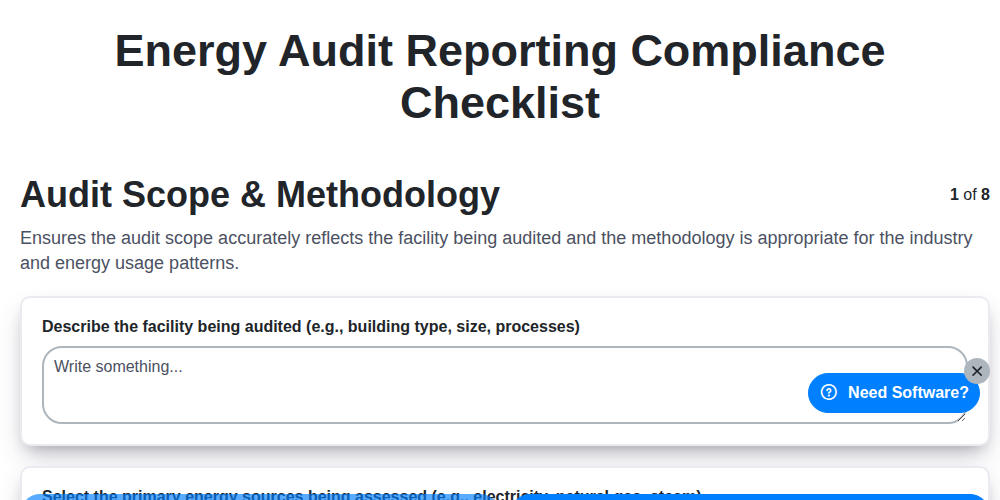
Energy Audit Reporting Compliance: Your Checklist for Success
Need help with
Energy?
Have a question? We're here to help. Please submit your inquiry, and we'll respond promptly.