The Ultimate Freight Forwarder Audit & Selection Checklist 2026: A Strategic Template for Supply Chain Excellence
Published: 10/31/2026 Updated: 11/01/2026
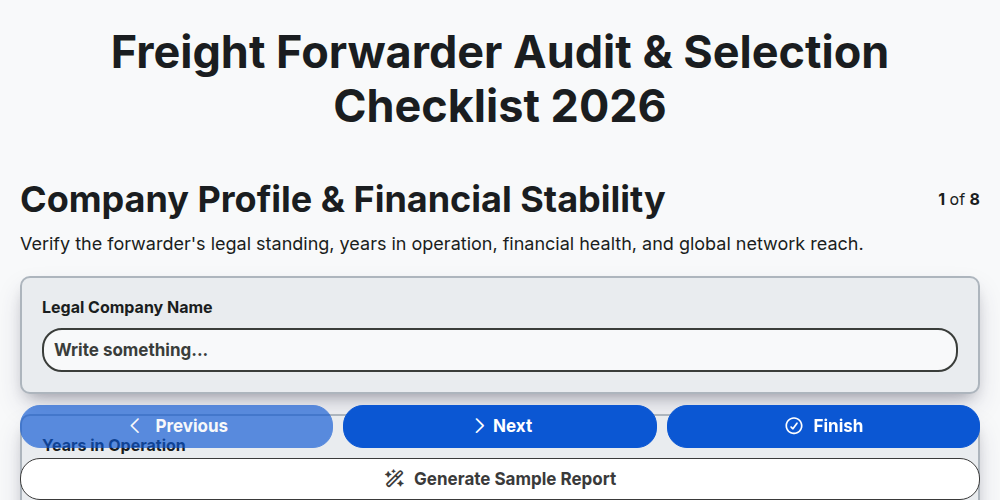
Table of Contents
- Introduction: Navigating the Complexity of Global Logistics in 2026
- Phase 1: Assessing Foundation - Company Profile & Financial Stability
- Phase 2: Evaluating Global Reach - Service Capabilities & Network Strength
- Phase 3: Ensuring Legal Integrity - Compliance & Regulatory Certifications
- Phase 4: The Digital Edge - Operational Infrastructure & Technology Integration
- Phase 5: Mitigating Uncertainty - Risk Management & Insurance Coverage
- Phase 6: Measuring Success - Performance Metrics & KPI Framework
- Phase 7: Cost Control & Clarity - Pricing Structure & Billing Transparency
- Phase 8: The Human Element - Customer Service & Communication Protocols
- Finalizing the Selection: Moving from Audit to Partnership
- Conclusion: Building a Resilient Supply Chain for the Future
- Resources & Links
TLDR: Navigating the complexities of global logistics in 2026 requires more than just comparing shipping rates. This comprehensive audit checklist provides a strategic framework to evaluate potential freight forwarders across eight critical dimensions-from financial stability and technological integration to compliance, risk management, and KPI transparency-ensuring you select a resilient partner capable of driving long-term supply chain excellence.
Introduction: Navigating the Complexity of Global Logistics in 2026
The Evolving Landscape of Global Trade
As we approach 2026, the global logistics landscape is no longer defined merely by moving goods from point A to point B. We are operating in an era of unprecedented volatility, characterized by shifting geopolitical alliances, rapid-fire regulatory changes, and the profound integration of artificial intelligence within supply chain ecosystems. For modern shippers, selecting a freight forwarder is no longer a simple procurement task; it is a critical strategic decision that can determine the resilience of your entire enterprise.
Beyond Cost: The Shift Toward Strategic Partnership
In years past, the primary driver for selecting a logistics partner was often a race to the lowest freight rate. However, in the current climate, cheap often translates to unreliable. With the rise of nearshoring, regionalization, and the increasing complexity of green logistics mandates, the cost of a single logistics failure-be it a missed customs compliance update or a lack of real-time visibility-can far outweigh any initial savings on shipping lanes.
Why an Audit-First Approach is Mandatory
The goal of this checklist is to move your procurement process from a reactive mode to a proactive, audit-driven strategy. A robust audit ensures that your chosen partner is not just a vendor, but a sophisticated extension of your own operations.
By utilizing this framework, you are not simply checking boxes; you are evaluating a partner's ability to:
- Absorb Disruption: Assessing their ability to pivot when ports congest or routes close.
- Leverage Digital Intelligence: Ensuring they provide the predictive analytics necessary for modern decision-making.
- Maintain Compliance Integrity: Mitigating the legal and financial risks associated with ever-evolving international trade laws.
This guide serves as your blueprint for vetting partners who possess the financial stability, technological maturity, and operational agility required to thrive in the 2026 global marketplace.
Phase 1: Assessing Foundation - Company Profile & Financial Stability
Evaluating the Bedrock of Your Logistics Partnership
Before diving into transit times or shipping lanes, you must first evaluate the structural integrity of your potential partner. In the volatile economic landscape of 2026, selecting a forwarder based solely on price is a high-risk strategy. A low-cost provider that lacks financial liquidity can lead to stranded cargo, disrupted supply chains, and catastrophic downstream costs.
Assessing Long-Term Viability
The first step in your audit must be a deep dive into the provider's corporate health. You are not just looking for a vendor; you are looking for a long-term strategic ally.
Key Audit Points:
- Financial Solvency & Creditworthiness: Request audited financial statements or credit reports. You need to ensure the forwarder has the liquidity to manage high-volume movements and pay sub-contracted carriers (ocean lines, airlines, truckers) without delays that could lead to held shipments.
- Years in Operation & Market Experience: Analyze their history within your specific industry vertical. A forwarder with decades of experience understands the nuances of specialized cargo-such as temperature-controlled goods or hazardous materials-that a newcomer might struggle to manage.
- Scalability & Growth Trajectory: Does the company's growth trajectory align with your company's expansion plans? Evaluate whether they have the organizational depth to handle an increase in your shipment volume over the next 3-5 years.
- Ownership Structure & Ownership Stability: Understand if they are an independent agent, part of a massive global conglomerate, or a localized boutique firm. This impacts how much autonomy the local office has to make decisions regarding your urgent shipments.
- Reputational Integrity: Perform due diligence through industry references and third-party reviews. Look beyond the sales pitch to understand their track record during global disruptions or peak seasons.
The 2026 Pro-Tip: In an era of rapid consolidation in the logistics industry, prioritize providers who demonstrate a stable, predictable financial roadmap. A sudden merger or bankruptcy mid-contract can derail your entire seasonal inventory cycle.
Phase 2: Evaluating Global Reach - Service Capabilities & Network Strength
Navigating the Global Landscape: Beyond Basic Logistics
In 2026, a freight forwarder's value is no longer measured solely by their ability to move a container from Point A to Point B. As supply chains become increasingly fragmented and geopolitically complex, you must evaluate whether your partner possesses the connective tissue required to navigate modern disruptions.
When auditing service capabilities, move past surface-level promises and interrogate the structural integrity of their global footprint.
Assessing Network Depth and Breadth
A common mistake is equating a large number of offices with a high-quality network. During your audit, distinguish between owned assets and agent networks.
- Owned vs. Agent-Led Models: Does the forwarder operate their own offices in your key markets, or do they rely on third-party agents? Owned offices typically offer superior control and standardized service, whereas agent-heavy models may introduce blind spots in communication and local handling.
- Regional Specialization: Evaluate their strength in your high-growth corridors. A forwarder might excel in Trans-Pacific lanes but lack the localized customs expertise required for emerging Southeast Asian or African markets.
- Multimodal Versatility: Ensure their capabilities extend beyond ocean and air. In an era of port congestion and rail volatility, a robust partner must demonstrate seamless integration of intermodal, road, and even last-mile delivery solutions.
The Complexity of Specialized Cargo Handling
Not all freight is created equal. Your selection process must determine if the forwarder's expertise aligns with your specific product requirements.
- Temperature-Controlled Logistics: If you deal with perishables or pharmaceuticals, audit their cold chain integrity, including sensor technology and contingency protocols for power failures.
- Dangerous Goods (DG) & Hazmat: Verify their specialized training and the equipment availability necessary for handling regulated substances.
- High-Value & Oversized Cargo: Inquire about their experience with Project Cargo. Do they have the heavy-lift capabilities and the specialized permitting processes required for out-of-gauge (OOG) shipments?
Integrated End-to-End Visibility
In 2026, visibility is a baseline requirement, not a premium feature. During this phase of the audit, investigate how their service capabilities integrate with your internal visibility needs. A true strategic partner doesn't just move goods; they provide the data layers that allow you to anticipate delays before they impact your customers.
Phase 3: Ensuring Legal Integrity - Compliance & Regulatory Certifications
Navigating the Regulatory Landscape
In the 2026 global trade environment, compliance is no longer a check-the-box exercise; it is a critical component of supply chain resilience. As geopolitical shifts and environmental regulations become more complex, your freight forwarder's ability to navigate legal frameworks directly impacts your risk exposure and bottom line.
Essential Certifications to Verify
When auditing a potential partner, look beyond their ability to move cargo and scrutinize their formal credentials. A high-tier forwarder should present verifiable documentation in the following areas:
- Customs-Trade Partnership Against Terrorism (C-TPAT) / Authorized Economic Operator (AEO): Ensure your partner is part of these-security programs. Membership indicates a vetted, secure supply chain that can benefit from expedited customs processing and reduced inspection rates.
- IATA Accreditation: For air freight operations, verified IATA accreditation is non-negotiable to ensure they can handle much-needed capacity and adhere to global aviation safety standards.
- ISO Certifications (9001, 14001, 45001): Look for ISO 9001 (Quality Management) to ensure consistent service, and ISO 14001 (Environmental Management) to align with your company's ESG (Environmental, Social, and Governance) mandates.
Regulatory Agility and Trade Compliance
A robust forwarder must demonstrate more than just a collection of certificates; they must prove operational competence in managing modern regulatory hurdles.
1. Customs Brokerage Expertise
Does the forwarder have in-house expertise for navigating complex tariff classifications (HS Codes)? In an era of fluctuating trade wars and shifting sanctions, their ability to provide accurate duty/tax calculations and prevent costly customs delays is vital.
2. Sanctions and Embargo Monitoring
With the rapid implementation of international trade sanctions, your forwarder must utilize advanced screening tools. Ask specifically how they monitor Denied Party Lists and how they ensure cargo does not inadvertently transit through restricted territories or involve sanctioned entities.
3. Environmental & ESG Compliance
As we move through 2026, regulatory bodies are increasingly focused on carbon reporting. Audit your forwarder on their ability to provide accurate emissions data and their compliance with emerging Green Logistics mandates. A partner who cannot track the carbon footprint of your shipments will soon become a liability to your corporate sustainability reporting.
Phase 4: The Digital Edge - Operational Infrastructure & Technology Integration
Assessing the Digital Ecosystem
In 2026, a freight forwarder's physical assets are secondary to their digital intelligence. As supply chains become increasingly autonomous and data-driven, your selection criteria must move beyond where they ship to how they communicate. An audit of a provider's technological infrastructure is no longer an optional step; it is the foundation of real-time visibility and proactive decision-making.
1. Real-Time Visibility and Control Towers
The era of email-based tracking is obsolete. Your prospective partner must demonstrate a robust Digital Control Tower capability.
- Live Tracking Capabilities: Does the provider offer GPS-based, real-time milestone updates, or are they relying on manual EDI updates from carriers?
- Predictive Analytics: Can their platform use AI to predict potential delays (due to weather, port congestion, or labor strikes) before they impact your cargo?
- End-to-End Visibility: Does their dashboard integrate sea, air, and road freight into a single pane of glass, or is the data fragmented across different modules?
2. API and EDI Integration Compatibility
Your supply chain is only as strong as its weakest digital link. A forwarder must be able to speak the same language as your existing ERP (e.g., SAP, Oracle) or TMS (Transportation Management System).
- Seamless Data Exchange: Evaluate their ability to utilize API (Application Programming Interface) for instantaneous data transfers versus the slower, batch-processed EDI (Electronic Data Interchange).
- Automated Document Management: Look for digital workflows that automate the distribution of commercial invoices, packing lists, and Bills of Lading, reducing manual entry errors.
3. Data Security and Cybersecurity Resilience
As logistics becomes more digitized, freight forwarders are prime targets for ransomware and supply chain cyber-attacks.
- Cybersecurity Protocols: Audit their compliance with international standards such as ISO/IEC 27001.
- Data Integrity: How do they ensure the sanctity of your proprietary trade data and sensitive supplier information?
- Disaster Recovery: What is their protocol for maintaining operational continuity in the event of a systemic digital outage?
4. Cloud-Native Scalability
The logistics landscape of 2026 requires extreme agility. A provider using legacy, on-premise software will struggle to scale with your growth.
- Cloud-Based Accessibility: Ensure their platform is cloud-native, allowing your team to access critical shipment data securely from any global location or mobile device.
- Self-Service Portals: A high-tier forwarder should provide a client-facing portal where you can request quotes, book shipments, and manage documentation without needing to initiate a manual support ticket.
Phase 5: Mitigating Uncertainty - Risk Management & Insurance Coverage
Evaluating Resilience: Risk Management & Insurance Coverage
In the volatile landscape of 2026 global logistics-marked by shifting geopolitical alliances and unpredictable climate-driven disruptions-your freight forwarder's ability to navigate crisis is just as important as their ability to move cargo. Auditing this phase is about determining whether your partner acts as a safety net or a liability.
Assessing Liability and Insurance Adequacy
A standard disclaimer of limited liability is not a risk management strategy. During your audit, you must move beyond simply asking if they have insurance and instead scrutinize the specifics of their coverage:
- Cargo Insurance Scope: Does their coverage account for modern-day risks, such as Acts of God, theft, and port congestion delays? Ensure there are no gaps between their standard carrier liability and the actual value of your high-stakes shipments.
- Error and Omissions (E&O) Coverage: Verify that the forwarder carries robust E&O insurance to protect your business against administrative errors, documentation mistakes, and misrouted shipments.
- Limits of Liability: Clearly define the monetary limits of their coverage and ensure they align with your specific commodity values.
Crisis Management and Contingency Planning
In 2026, a plan is only as good as its last stress test. Use this part of the checklist to evaluate their proactive response mechanisms:
- Disruption Protocols: Ask for documented procedures regarding sudden port strikes, maritime route closures (e.g., Suez or Panama Canal fluctuations), and extreme weather events.
- Alternative Routing Agility: Does the forwarder have pre-established Plan B and Plan C logistics lanes? A premium provider should demonstrate an ability to pivot modes (e.g., from Ocean to Air/Rail) with minimal lead time.
- Cybersecurity Preparedness: With the rise of digital supply chain attacks, audit their data protection protocols. How do they ensure that a breach in their system does not compromise your proprietary shipping data or customs documentation?
Subcontractor Oversight
One of the greatest hidden risks in freight forwarding is the fourth-party element. You must investigate how your forwarder manages their own network:
- Vetting Processes: What criteria do they use to audit the trucking companies, warehouses, and local agents they employ?
- Chain of Custody Integrity: Ensure they maintain rigorous oversight of every touchpoint in the multimodal journey, ensuring that secondary carriers adhere to the same safety and compliance standards you require.
Phase 6: Measuring Success - Performance Metrics & KPI Framework
Defining the Yardstick for Long-Term Success
Selecting a freight forwarder is not a one-time event; it is the beginning of a continuous performance lifecycle. To ensure your logistics partner remains an asset rather than a liability, you must move beyond anecdotal feedback and implement a data-driven evaluation framework. In 2026, gut feelings are no longer sufficient for global supply chain resilience; you need a rigorous KPI (Key Performance Indicator) framework to audit service levels consistently.
Establishing Core Operational KPIs
To effectively audit your forwarder, you must track specific, measurable metrics that directly impact your bottom line and customer satisfaction. Your framework should prioritize the following:
- On-Time Delivery (OTD) Rate: The most critical metric for supply chain reliability. Measure the percentage of shipments that arrive at the destination within the agreed-upon delivery window.
- Transit Time Accuracy: Track the variance between the estimated time of arrival (ETA) and the actual time of arrival (ATA). Persistent discrepancies indicate underlying issues in their carrier management or routing efficiency.
- Freight Claim Ratio: Monitor the frequency and value of cargo damage or loss claims. A high ratio may indicate poor handling practices or inadequate oversight during transshipment.
- Documentation Accuracy Rate: In an era of increasingly complex customs regulations, even minor errors in commercial invoices, packing lists, or Bills of Lading can cause costly port delays.
Advanced Metrics for the 2026 Landscape
As global logistics becomes more digitized, your audit process should also evaluate how well your partner integrates with modern supply chain demands:
- Data Visibility & Latency: Measure how quickly shipment updates are reflected in your tracking systems. In 2026, real-time should be the standard, not the exception.
- Carbon Footprint Reporting Accuracy: With increasing ESG (Environmental, Social, and Governance) mandates, your forwarder must be able to provide precise CO2 emission data per shipment.
- Response Time & Issue Resolution: Audit the speed and efficacy of their communication during exception events (e.g., port strikes, weather delays, or equipment shortages).
The Quarterly Business Review (QBR) Protocol
A checklist is only effective if it is applied regularly. We recommend integrating these metrics into a formal Quarterly Business Review (QBR) process. Use these reviews to:
- Compare Performance vs. SLA: Hold the forwarder accountable to the Service Level Agreements (SLAs) established during the selection phase.
- Identify Root Causes: Don't just note a failure; demand a formal Corrective Action Plan (CAP) for recurring delays or errors.
- Collaborative Optimization: Use the data to identify opportunities for lane optimization, cost reduction, and improved lead times.
By implementing this KPI framework, you transform the relationship from a mere vendor-client transaction into a strategic partnership built on transparency, accountability, and continuous improvement.
Phase 7: Cost Control & Clarity - Pricing Structure & Billing Transparency
Evaluating the Total Cost of Ownership (TCO)
In the 2026 logistics landscape, selecting a freight forwarder based solely on the lowest quote is a recipe for hidden cost disasters. A truly strategic audit requires looking beyond the initial freight rate to understand the full economic impact of the partnership. To ensure long-term budget predictability, your evaluation must focus on structural transparency and the elimination of unexpected surcharges.
Beyond the Base Rate: Auditing the Quote Anatomy
A professional forwarder should provide a granular breakdown of costs. During your audit, verify that the following elements are clearly defined and standardized:
- Standard Freight Charges: Ocean, air, or road transit rates.
- Ancillary Fees: Fuel surcharges (BAF/FAF), security fees, and documentation costs.
- Terminal & Handling Charges: Port congestion surcharges, demurrage, and detention predictability.
- Variable vs. Fixed Costs: Identifying which costs are subject to market volatility and which remain stable under long-term agreements.
The Transparency Test: Billing Accuracy and Auditability
The efficiency of your accounts payable department depends heavily on the clarity of your forwarder's invoicing. Use this section of the checklist to assess the following:
- Invoice Precision: Does the invoice match the initial quotation exactly? Discrepancies in miscellaneous fees are a major red flag.
- Digital Audit Trails: Does the forwarder provide digital access to supporting documents (e.g., Bill of Lading, Arrival Notices) that justify every line item on the invoice?
- Standardized Billing Cycles: Are billing periods consistent, and is there a clear process for dispute resolution when errors occur?
- Currency and Tax Compliance: For global operations, how does the forwarder handle multi-currency transactions and VAT/GST applications across different jurisdictions?
Strategic Goal: Avoiding the Surcharge Trap
The goal of this phase is to move from reactive payment to proactive cost management. By prioritizing providers who offer transparent, itemized, and predictable pricing structures, you mitigate the risk of sudden margin erosion and ensure that your supply chain remains both resilient and cost-effective in an unpredictable global market.
Phase 8: The Human Element - Customer Service & Communication Protocols
Beyond the Tracking Number: Assessing Communication and Support
In the era of automated logistics, it is easy to fall into the trap of prioritizing digital interfaces over human expertise. However, when a global disruption occurs-be it a port strike, a sudden customs delay, or a geopolitical shift-the strength of your supply chain depends less on your dashboard and more on the responsiveness of your freight forwarder's account management team.
When auditing potential partners for 2026, you must look beyond 24/7 availability and evaluate the actual substance of their communication ecosystem.
Key Evaluation Criteria for Communication Excellence
To ensure your logistics partner can navigate high-pressure scenarios, evaluate their service model against these four critical pillars:
1. Account Management Structure and Accessibility
A premium forwarder should provide more than just a generic support email address. You need to define the level of dedicated expertise assigned to your account.
- Dedicated vs. Shared Models: Will you have a single point of contact (SPOC) who understands your specific commodity requirements, or will your queries be routed through a rotating queue of generalists?
- Escalation Matrices: Does the provider have a clearly defined hierarchy for resolving urgent issues? You should be able to identify exactly who to contact when a shipment is stuck in customs and the standard procedure fails.
2. Proactive vs. Reactive Communication
The true test of a logistics partner is their ability to communicate bad news before you discover it yourself.
- The Proactive Pulse: Does the forwarder notify you of delays as soon as they are detected, or do they wait for you to query a delayed milestone in the portal?
- Disruption Management: Ask for specific examples of how they communicated during recent global logistics crises. A high-performing partner provides not just the problem, but a proposed solution or rerouting strategy alongside the alert.
3. Integration of Communication Channels
In 2026, seamless communication means a single source of truth. Your provider's communication should be synchronized across all touchpoints.
- Omnichannel Consistency: Does the information provided via email match the updates in their digital tracking portal? Discrepancies between human updates and automated data are a major red flag for operational silos.
- Standardized Reporting Cadence: Establish expectations for regular performance reviews (e.g., monthly or quarterly business reviews) to discuss lane performance, transit time accuracy, and continuous improvement opportunities.
4. Language Proficiency and Regional Expertise
If your supply chain spans continents, linguistic and cultural competence is a functional necessity, not a luxury.
- Localized Support: For critical origin points, does the forwarder have local agents or offices with native-level fluency? This is vital for resolving documentation errors with local customs authorities or communicating with overseas manufacturers.
- Cultural Nuance in Logistics: Effective communication requires an understanding of regional business customs and holiday calendars, which can significantly impact lead times and booking windows.
Finalizing the Selection: Moving from Audit to Partnership
From Checklist to Collaboration: Navigating the Final Decision
Completing a comprehensive audit is a monumental task, but the transition from evaluating to onboarding is where the true strategic value is realized. The final stage of your selection process should not be treated as a simple binary choice between the highest and lowest bidders. Instead, view this phase as the final stress test of a potential long-term partnership.
To move from a spreadsheet of scores to a signed service agreement, focus on these three critical pillars of finalization:
1. The Capability-Complexity Alignment
Before signing, perform a final stress test using a real-world scenario specific to your 2026 supply chain roadmap. If your strategy involves expanding into emerging Southeast Asian markets or shifting toward more sustainable, low-carbon shipping lanes, ask the finalist to map out a specific execution plan for these exact routes. A provider may pass the financial stability audit, but if their network strength doesn't align with your upcoming geographical shifts, the partnership will become obsolete within twelve months.
2. The Service Level Deep Dive
The data from your KPI framework and communication protocol audits must be translated into a formal Service Level Agreement (SLA). Do not leave good communication to interpretation. The final stage of selection is the opportunity to codify exactly what transparency means for your organization.
- What is the guaranteed response time for a customs clearance inquiry?
- What are the specific penalties for missed delivery windows?
- How will the billing transparency protocols be audited quarterly?
3. The Pilot Program Implementation
If you are choosing between two equally qualified candidates, consider a staged onboarding approach. Rather than migrating your entire global volume to a new forwarder overnight, initiate a 90-day pilot program on a single, non-critical lane. This allows you to verify that the operational infrastructure and technology promised during the audit phase actually perform under real-world pressure.
Summary of the Selection Framework
By treating the audit not just as a checklist, but as a blueprint for a strategic alliance, you transform your logistics function from a cost center into a competitive advantage. The goal for 2026 is simple: select a partner whose resilience matches your ambition and whose technological roadmap is synchronized with your digital transformation.
Conclusion: Building a Resilient Supply Chain for the Future
Moving Beyond Transactions to Strategic Partnerships
As we approach 2026, the role of a freight forwarder has evolved from a mere logistics provider to a critical architect of supply chain resilience. The complexities of global trade-ranging from geopolitical shifts and fluctuating trade lanes to the integration of AI-driven logistics-mean that your choice of partner can be the difference between a seamless flow of goods and a catastrophic bottleneck.
Utilizing this audit and selection checklist is not a one-time task to be completed during the RFP process; it is a blueprint for continuous supply chain optimization. By rigorously evaluating your partners across these eight critical dimensions, you are doing more than just comparing prices-you are stress-testing your ability to navigate uncertainty.
Proactive Auditing as a Competitive Advantage
In an era of just-in-case inventory and heightened visibility requirements, a robust audit framework allows you to:
- Mitigate Unforeseen Risks: By verifying compliance, insurance, and risk management protocols before a crisis hits.
- Drive Digital Transformation: By ensuring your partners possess the technological maturity to integrate with your ERP and provide real-time, predictive data.
- Optimize Total Landed Cost: By looking past the initial freight rate to understand the true transparency of billing and the long-term value of service reliability.
The Path Forward
The logistics landscape of 2026 demands agility, transparency, and deep expertise. As you move forward with your selection process, remember that the most valuable partner is not necessarily the one with the lowest quote, but the one whose operational capabilities and technological infrastructure align most closely with your long-term strategic goals.
Use this checklist as your compass to navigate the complexities of global trade and build a supply chain that is not just functional, but truly resilient.
Resources & Links
- World Cargo Alliance (WCA): The world's largest network of independent freight forwarders, essential for verifying global network strength and reliability.
- International Air Transport Association (IATA): The industry standard for air cargo regulations, safety protocols, and airline-related logistics compliance.
- International Federation of Freight Forwarders Associations (FIATA): The global voice of freight forwarding, providing insights into international standards and best practices for the industry.
- U.S. Customs and Border Protection (CBP): Critical resource for understanding regulatory compliance, import/export regulations, and security requirements.
- Supply Chain Dive: Provides real-time news and deep-dive analysis on logistics trends, technology shifts, and global supply chain disruptions.
- Gartner Supply Chain Research: Industry-leading research on digital transformation, technology integration, and strategic logistics management.
- Freightos: A leading digital marketplace for global freight, useful for benchmarking digital capabilities and real-time pricing trends.
- Inbound Logistics: Comprehensive magazine and resource hub covering logistics management, warehousing, and transportation strategies.
- Logistics Management: Focuses on operational excellence, technology adoption, and management strategies within the logistics sector.
- The Loadstar: In-depth analysis of the global air and ocean freight markets, perfect for assessing global reach and market volatility.
- ASCM (Association for Supply Chain Management): The gold standard for supply chain professionals, offering frameworks for KPIs and operational excellence.
- BMC Digital Transformation Insights: Useful for auditing the 'Digital Edge' and understanding how automation and AI impact logistics infrastructure.
- Maritime Executive: Essential for monitoring the sea freight landscape, port congestion, and maritime risk management.
- Forisk Consulting: Provides specialized market intelligence and economic forecasting for the global logistics and shipping industries.
- Trade Compliance Insights: A resource for auditing the legal integrity and regulatory compliance of international freight partners.
- Supply Chain Management Review: Academic and practical perspectives on building resilient, long-term strategic partnerships in the supply chain.
- Reuters Logistics News: Global news coverage regarding trade wars, fuel costs, and geopolitical risks affecting freight forwarding.
- International Organization for Standardization (ISO): Reference for verifying quality management systems (ISO 9001) and security standards (ISO 28000) in logistics.
Comments
There are no comments yet. Be the first to add one!
SCM - Supply Chain Management Solution Demo
Struggling with supply chain disruptions & lack of visibility? ChecklistGuro delivers a centralized SCM solution, connecting your suppliers, manufacturers, & distributors for improved collaboration and control. Simplify operations & boost efficiency.
Related Articles
The Ultimate Supply Chain Inventory Accuracy Audit Checklist: A Step-by-Step Guide
Supply Chain Capacity Planning Checklist: Ensure Readiness for Peak Demand
The Ultimate Supply Chain Network Optimization Checklist: A Step-by-Step Guide
Supply Chain Risk Assessment Checklist: Your Guide to Resilience
Navigating Sustainability: Your Supply Chain Compliance Checklist

Top 10 SAP Logistics Business Network (LBN) Alternatives for 2025

Fortify Your Supply Chain: The Ultimate Resilience Assessment Checklist
Navigating Global Trade: Your Essential Import/Export Compliance Checklist
Need help with
Supply Chain Management (SCM)?
Have a question? We're here to help. Please submit your inquiry, and we'll respond promptly.