The Ultimate Supply Chain Inventory Accuracy Audit Checklist: A Step-by-Step Guide
Published: 12/09/2025 Updated: 07/02/2026
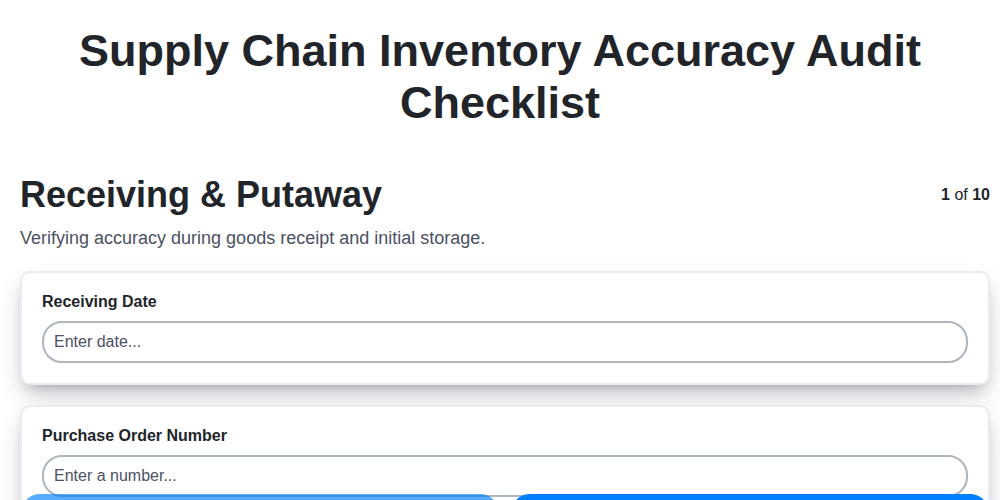
Table of Contents
- Introduction: Why Inventory Accuracy Matters
- 1. Receiving & Putaway: The Foundation of Accuracy
- 2. Cycle Counting Procedures: A Proactive Approach
- 3. Inventory Record Integrity: Ensuring Data Consistency
- 4. Warehouse Management System (WMS) Configuration: System Alignment
- 5. Physical Inventory Counts: The Big Picture Assessment
- 6. Stock Location Management: Mapping and Verification
- 7. Returns Processing: A Critical Control Point
- 8. Data Reconciliation & Variance Investigation: Identifying Discrepancies
- 9. Training & Competency: Empowering Your Team
- 10. Documentation & Record Keeping: Building a Traceable System
- 11. Audit Checklist Summary: Key Areas for Focus
- 12. Common Pitfalls & How to Avoid Them
- Conclusion: Continuous Improvement in Inventory Accuracy
- Resources & Links
TLDR: Losing money to inaccurate inventory? This checklist provides a comprehensive guide to auditing your supply chain inventory accuracy, covering everything from receiving to returns. Follow these steps to pinpoint weaknesses, improve data integrity, and boost your bottom line - a proactive approach to preventing costly errors and optimizing stock levels.
Introduction: Why Inventory Accuracy Matters
Inventory accuracy - it's more than just a nice-to-have; it's the backbone of a thriving supply chain. Inaccurate inventory data leads to a domino effect of problems: missed orders, frustrated customers, increased operational costs, and ultimately, a hit to your bottom line. Think about it - if your system says you have 100 units of a critical component, but you actually only have 60, what happens when a customer places an order? Backorders, expedited shipping (at a premium!), and damaged relationships are just the beginning.
Conversely, high inventory accuracy translates to increased efficiency, improved customer satisfaction, and a significant competitive advantage. It allows for better forecasting, optimized ordering, and a smoother flow of goods - all vital for resilience in today's volatile market. This audit checklist is designed to help you pinpoint areas for improvement and solidify a foundation of reliable inventory data, ensuring you're operating with confidence and maximizing your supply chain's potential.
1. Receiving & Putaway: The Foundation of Accuracy
The receiving and putaway process is the critical first step in maintaining accurate inventory. Errors introduced here snowball throughout the entire supply chain, leading to downstream problems like stockouts, overstocking, and inaccurate order fulfillment. A rigorous audit of this phase should focus on consistency and adherence to established procedures.
Here's what to look for:
- Blind Receiving Verification: Are incoming shipments verified against purchase orders before being put away? This includes quantity, product description, and condition. Are discrepancies immediately flagged and resolved?
- Unique Identification: Is each item scanned and assigned a unique identifier upon receipt? Barcodes or RFID tags should be utilized consistently.
- Proper Putaway Procedures: Are items put away in their designated locations based on the WMS instructions? Are exceptions (e.g., damaged goods, items requiring quarantine) handled correctly?
- Location Accuracy: Are location codes and bin numbers accurately recorded in the WMS during putaway? Are there processes to prevent incorrect placement?
- Damage Assessment & Reporting: Is a thorough damage assessment conducted upon receipt, and are damaged goods properly documented and segregated?
- Receiving Team Training: Are receiving personnel adequately trained on proper procedures and system usage? Are refresher trainings scheduled?
2. Cycle Counting Procedures: A Proactive Approach
Cycle counting isn't just about correcting errors; it's about preventing them. A robust cycle counting procedure is a proactive strategy to maintain inventory accuracy and minimize the need for disruptive, full physical inventory counts. Here's what a solid cycle counting program should include:
- Prioritization: Don't count everything at once. Focus on high-value items, fast-moving goods, and items with a history of inaccuracies. ABC analysis is your friend here - categorize inventory based on usage and value.
- Frequency & Sample Size: Establish a regular cycle counting schedule. Some items might require daily counts, while others can be counted monthly or quarterly. Define the quantity of items to be counted within each cycle.
- Defined Process: Outline clear steps for cycle counters: how to select items, how to perform the count, how to document discrepancies, and the escalation process for significant variances.
- Root Cause Analysis: Don't just correct the count; investigate why the discrepancy occurred. Was it a receiving error? A WMS configuration issue? Poor putaway practices? Addressing the root cause is crucial for long-term accuracy.
- Continuous Improvement: Regularly review your cycle counting program's effectiveness. Are discrepancies decreasing? Are root causes being effectively resolved? Adjust your procedures as needed.
- Integration with WMS: Ensure your cycle counting process is tightly integrated with your WMS. Real-time updates and automated reconciliation are key to accuracy and efficiency.
3. Inventory Record Integrity: Ensuring Data Consistency
Accurate inventory records are the backbone of a reliable supply chain. Without them, everything from order fulfillment to financial reporting suffers. But accuracy isn't just about a physical count; it's about the integrity of the data reflecting that count. This section focuses on verifying that the information in your system genuinely represents what's in your warehouse.
Here's what we'll be examining:
- Bill of Materials (BOM) Accuracy: Are your BOMs up-to-date and correctly reflect the components and quantities needed for your finished goods? Errors here cascade downstream, impacting production and material requirements.
- Unit of Measure Consistency: Are all items consistently recorded with the correct unit of measure (e.g., each, case, pallet)? Discrepancies lead to ordering and picking errors.
- Serial/Lot Number Tracking: If applicable, are serial and lot numbers being accurately recorded and tracked? This is crucial for traceability and recall management.
- Item Master Data Verification: Regularly check the item master data to ensure descriptions, classifications, and associated attributes are correct. Typos and inaccuracies can cause confusion and delays.
- Engineering Change Order (ECO) Implementation: Ensure that ECOs are promptly and accurately reflected in the inventory system. Outdated data can lead to shipping incorrect versions of products.
- Costing Accuracy: Verify that item costs are correct and up-to-date, as inaccurate costing impacts margin calculations and financial reporting.
A robust review process should include periodic audits of a representative sample of items to validate data consistency. Don't underestimate the importance of this step - it's a critical link in ensuring that your inventory records are truly reliable.
4. Warehouse Management System (WMS) Configuration: System Alignment
Your Warehouse Management System (WMS) is the backbone of your inventory accuracy. However, a powerful system is only as good as its configuration. A misconfigured WMS can actively create inaccuracies, even if your warehouse team is diligently following procedures. This section focuses on evaluating how your WMS setup supports - and doesn't hinder - inventory accuracy.
Checklist Items to Review:
- Receiving & Putaway Logic: Does the WMS enforce proper receiving processes (e.g., blind receiving, barcode scanning)? Is putaway directed to correct locations and is location data accurately updated in real-time? Look for situations where manual overrides are frequent - this often points to a process or system mismatch.
- Location Master Data: Are your location codes accurate, complete, and consistently applied? Verify that the WMS isn't using outdated or incorrect location information.
- Unit of Measure (UOM) Consistency: Confirm UOMs are consistently applied across all transactions - receiving, picking, shipping, and cycle counting. Discrepancies here are a significant source of error.
- Lot/Serial Number Tracking: If applicable, are lot and serial numbers being tracked accurately and consistently? Verify scan requirements and data validation rules.
- Inventory Movement Authorization: Does the system require proper authorization for adjustments and movements? Are these approvals tracked and auditable?
- Integration with Other Systems (ERP, Accounting): Are data flows between your WMS and other critical systems (ERP, accounting) reliable and error-free? Test a sample transaction end-to-end.
- Reporting Capabilities: Does the WMS provide the necessary reports (aging reports, discrepancy reports, location utilization reports) to proactively identify and address inventory issues?
A thorough review of your WMS configuration can reveal hidden vulnerabilities and ensure your technology is actively contributing to accurate inventory data.
5. Physical Inventory Counts: The Big Picture Assessment
Physical inventory counts are more than just a headcount of your stock; they's a crucial opportunity to validate your entire inventory management process. This isn't just about finding discrepancies; it's about understanding why they exist. A thorough assessment during a physical count should move beyond simply reconciling what's physically present with what the system says.
Here's what we're looking for:
- Accuracy of Count Teams: Observe the counting teams. Are they following procedures? Are they properly identifying and segregating items? Are they trained to handle damaged or obsolete goods?
- Adequacy of Resources: Do you have enough personnel and equipment (scanners, carts, etc.) to complete the count efficiently and accurately? Bottlenecks can lead to rushed counts and increased errors.
- Coverage and Sampling: Is the physical count covering all locations and items, or are you using a sampling method? If sampling, is the sample size representative and statistically sound?
- Process Effectiveness: Is the physical inventory count process disruptive to daily operations? Could improvements be made to minimize downtime and optimize workflow?
- Post-Count Reconciliation: How efficiently are discrepancies resolved? Is a clear audit trail maintained, documenting the investigation and corrective actions taken?
Ultimately, a well-executed physical inventory count provides invaluable data for continuous improvement. It's a chance to identify systemic issues and refine processes, leading to greater inventory accuracy and overall supply chain efficiency.
6. Stock Location Management: Mapping and Verification
Accurate stock location management is the backbone of efficient warehouse operations and directly impacts inventory accuracy. Without a clear and consistently followed system, items can easily be misplaced, leading to picking errors, delays, and ultimately, inaccurate inventory records.
This section focuses on ensuring your stock location management processes are robust. It's not enough to have locations; they need to be consistently used and verified. Here's what to assess:
- Location Master Data: Are your location codes and descriptions clear, consistent, and accurately reflected in your WMS? Are new locations properly documented and integrated into the system? A poorly defined location master data is a breeding ground for confusion.
- Location Mapping: Do you have a physical map of your warehouse, clearly indicating all storage locations? This isn't just for new employees; it's a valuable reference for all staff. Regularly update the map to reflect any changes in layout or storage strategies.
- Slotting Strategy: Do you have a documented slotting strategy? Are fast-moving items located closer to picking areas? Is heavy or bulky stock placed in accessible locations for ease of handling? A well-defined strategy optimizes space and efficiency.
- Regular Verification: Periodically audit a sample of locations to verify the items stored there match the WMS records. This can be a random audit or focused on locations with a history of discrepancies.
- Labeling: Are all locations clearly and durably labeled? Ensure labels are easily readable and resistant to wear and tear. Damaged or missing labels are a significant error risk.
- Change Management: Implement a process for managing changes to stock locations. Any changes must be documented in the WMS and communicated to relevant staff.
By prioritizing stock location management and implementing these checks, you can significantly improve inventory accuracy and operational efficiency.
7. Returns Processing: A Critical Control Point
Returns processing is often an overlooked area when assessing supply chain inventory accuracy, but it's a significant contributor to discrepancies if not managed correctly. Improperly handled returns can easily inflate inventory records, lead to phantom stock, and create confusion for fulfillment teams.
Our Audit Checklist Focuses On:
- Return Authorization (RMA) Verification: Are RMAs properly generated, documented, and linked to the original order? Missing or incomplete RMAs create a paper trail nightmare.
- Inspection & Damage Assessment: Is returned merchandise systematically inspected upon receipt? Damage assessment documentation should be clear and linked to the return record. This is crucial for determining if the item is restockable or requires disposition (e.g., scrap, refurbishment).
- Restocking Procedures: Does a clearly defined process dictate whether returned items are returned to active stock, quarantined, or disposed of? Are restocked items accurately recorded back into inventory?
- Labeling & Identification: Are returned items correctly labeled to indicate their return status and any associated condition notes? Prevent accidentally shipping a returned item as new.
- Data Entry Accuracy: Verify the accuracy of data entry during the returns processing stage. Incorrect quantities, SKUs, or lot numbers can quickly derail inventory accuracy.
- Reverse Logistics Tracking: Are returns tracked throughout the entire reverse logistics process? A lack of visibility exposes opportunities for error and loss.
- Integration with WMS: How well is the returns processing module integrated with your Warehouse Management System? Seamless data flow is essential to avoid manual errors and maintain accuracy.
A robust returns processing procedure and diligent adherence to it are essential for maintaining inventory accuracy and minimizing losses.
8. Data Reconciliation & Variance Investigation: Identifying Discrepancies
No inventory accuracy audit is complete without a thorough examination of data reconciliation and variance investigation. This crucial step goes beyond simply counting; it's about understanding why discrepancies exist. It's the detective work that pinpoints systemic issues, not just isolated errors.
Here's what this process should involve:
- Regular Reconciliation: Schedule routine comparisons between physical inventory counts and your WMS records. This shouldn't be a one-time event; it should be a regular cadence - daily, weekly, or monthly, depending on your business needs and inventory turnover.
- Variance Thresholds: Establish clear variance thresholds. What percentage difference triggers an investigation? Smaller discrepancies might be acceptable, while larger ones demand immediate attention.
- Root Cause Analysis: When variances are detected, don't just mark them as "errors." Conduct a thorough root cause analysis. Common culprits include:
- Data Entry Errors: Mistakes during receiving, putaway, or adjustments.
- Process Breakdowns: Gaps in procedures, leading to miscounts or misplaced items.
- System Errors: WMS glitches or inaccurate data migration.
- Theft or Damage: Although uncomfortable to consider, this possibility must be investigated.
- Documentation: Meticulously document all variances found, the investigation process, and corrective actions taken. This creates a traceable history of issues and solutions.
- Trend Analysis: Track variances over time. Are certain product categories or locations consistently showing discrepancies? This can reveal patterns indicative of underlying process weaknesses.
- Closed-Loop Corrective Action: Implement corrective actions based on the investigation findings. Track the effectiveness of these actions to ensure the problem is truly resolved and doesn't reappear.
By actively seeking out and addressing data reconciliation variances, you're not just improving inventory accuracy; you're strengthening your entire supply chain.
9. Training & Competency: Empowering Your Team
Inventory accuracy isn't solely about processes and systems; it's fundamentally about the people executing them. A flawed process performed flawlessly by a well-trained team is still better than a perfect process riddled with human error. This section focuses on ensuring your team has the knowledge and skills to maintain accurate inventory records.
What to Audit:
- Initial Onboarding: Is there a structured onboarding process that covers fundamental inventory principles, your company's specific procedures, and the importance of accuracy?
- Role-Specific Training: Does training address the nuances of each role - receiving clerks, putaway operators, cycle counters, etc.? Each role has specific tasks that require unique training.
- WMS Training: Ensure everyone using the Warehouse Management System is proficient. This includes data entry, transaction processing, and understanding system alerts. Regular refresher training is vital.
- Cross-Training: Encouraging cross-training allows for flexibility and a better understanding of how different functions impact inventory accuracy. It also creates backup coverage when team members are absent.
- Refresher & Update Training: The supply chain landscape changes constantly. Ensure your team receives periodic updates on new procedures, system changes, or industry best practices.
- Competency Assessments: Implement assessments - practical tests or quizzes - to evaluate understanding and identify areas needing improvement.
- Performance Feedback: Regularly provide feedback on accuracy performance. Recognize successes and address areas for improvement with constructive coaching.
Key Questions to Ask:
- How often is inventory training conducted?
- What records exist to document training completion?
- How are employee competency levels assessed?
- What is the process for addressing accuracy errors - is it punitive or coaching-focused?
10. Documentation & Record Keeping: Building a Traceable System
A robust inventory accuracy audit isn't just about identifying problems; it's about proving your processes work and creating a system you can consistently improve. Comprehensive documentation and meticulous record-keeping are the bedrock of this. Without a clear trail, pinpointing root causes of discrepancies becomes significantly harder, and demonstrating compliance with industry standards is impossible.
What should you document? Everything. This includes:
- Audit Procedures: Clearly define the scope, methods, and frequency of your inventory accuracy audits. This ensures consistency and provides a benchmark for future comparisons.
- Audit Results: Detailed records of each audit, including dates, personnel involved, specific discrepancies found, and corrective actions taken. Don't just note what was wrong, but where and when.
- Process Workflows: Document your standard operating procedures (SOPs) for all inventory-related tasks - receiving, putaway, cycle counting, picking, packing, shipping, and returns. Visual aids like flowcharts can be extremely helpful.
- Training Records: Keep records of all training provided to warehouse staff, detailing the topics covered, dates, and attendees. This proves competency and accountability.
- WMS Configuration Changes: Maintain a log of any modifications made to your Warehouse Management System, including the reason for the change, who authorized it, and when it was implemented.
- Exception Handling: Document any deviations from standard processes and the rationale behind them. This demonstrates that your team is responsive and adaptable.
Finally, establish a clear retention policy for these records, ensuring you comply with legal and regulatory requirements. A well-documented system isn't just about proving you're accurate today; it's about building a sustainable foundation for continuous inventory accuracy improvement.
11. Audit Checklist Summary: Key Areas for Focus
This audit checklist highlights critical areas impacting your supply chain inventory accuracy. Focusing on these elements will provide a robust assessment and identify opportunities for improvement. Here's a summarized view of where your efforts should be concentrated:
Foundational Accuracy (Receiving & Putaway, Stock Location Management): Get the basics right from the start. Ensure receiving processes are rigorous and putaway procedures are consistently followed to accurately reflect what's entering your warehouse. Well-defined stock location management prevents misplacement and confusion.
Proactive Management (Cycle Counting Procedures, Physical Inventory Counts): Implement regular, scheduled cycle counts and occasional full physical inventory counts. These aren't just about finding discrepancies; they's about building a culture of accuracy and proactively addressing potential issues.
System Integrity (Inventory Record Integrity, WMS Configuration): Your data is only as good as your system. Verify the accuracy of inventory records and meticulously review your WMS configuration to ensure it accurately reflects your operations.
Process Control (Returns Processing, Data Reconciliation & Variance Investigation): Returns are a common source of inventory errors. Tighten your returns processing and diligently investigate any discrepancies found during reconciliation and variance analysis.
People & Processes (Training & Competency, Documentation & Record Keeping): Equip your team with the knowledge and skills to maintain accuracy. Solid documentation and record-keeping provide an audit trail and support continuous improvement. Prioritizing these areas provides a framework for a successful and insightful inventory accuracy audit.
12. Common Pitfalls & How to Avoid Them
Even with a robust supply chain inventory accuracy audit checklist, mistakes can happen. Here's a look at some common pitfalls and practical steps to sidestep them:
Rushing Receiving & Putaway: Speed isn't everything. Incorrect data entry during receiving or misplacing items during putaway are primary culprits. Solution: Implement barcode scanning at receiving and require a second verification step for putaway. Train staff on proper location codes and physical placement guidelines.
Cycle Counting Frequency Mismatch: Performing cycle counts too infrequently allows inaccuracies to compound. Conversely, too frequent counts become resource-intensive. Solution: Analyze historical error rates to determine optimal cycle count frequency for each item category (ABC analysis is helpful here).
Ignoring WMS Configuration Errors: A beautifully implemented WMS is useless if its configuration is flawed. Incorrect unit of measure settings, inaccurate item masters, or poorly defined workflows can lead to discrepancies. Solution: Regularly review WMS configuration settings. Conduct user acceptance testing (UAT) during any system updates or changes.
Lack of Data Reconciliation Discipline: Simply having data isn't enough; actively comparing it and investigating differences is key. Solution: Schedule regular data reconciliation activities. Develop a clear process for investigating and resolving variances promptly.
Ignoring Returns Processing Errors: Returns often bypass standard receiving procedures, leading to errors in inventory counts. Solution: Integrate returns processing into your receiving workflow, ensuring proper inspection, data entry, and putaway procedures.
Insufficient Training & Lack of Accountability: Untrained staff are a significant risk factor. Solution: Provide ongoing training on all inventory-related processes. Clearly define roles and responsibilities and hold individuals accountable for accuracy.
Poor Stock Location Management: Unorganized or poorly maintained stock locations make it difficult to find items, leading to picking errors and inaccurate counts. Solution: Implement a clear and consistent stock location coding system. Conduct periodic location audits to ensure accuracy and organization.
Overlooking Data Entry Errors: Even seemingly minor data entry mistakes can snowball into major discrepancies. Solution: Implement double-data entry for critical items. Utilize validation rules within your WMS to minimize errors.
Not Tracking Discrepancy Root Causes: Repeated errors in the same area indicate a deeper issue. Solution: Document all variance investigations and identify root causes. Implement corrective actions to prevent recurrence.
Neglecting Documentation: Lack of proper documentation creates audit trail gaps and hinders problem-solving. Solution: Maintain detailed records of receiving documents, cycle count results, discrepancy investigations, and corrective actions.
Failure to Regularly Review Procedures: Processes aren't static. Changing products, volume fluctuations, and team changes necessitate periodic review. Solution: Schedule regular (e.g., quarterly or annual) reviews of all inventory-related procedures.
Relying Solely on Physical Inventory: While crucial, physical inventories are resource-intensive. Ignoring cycle counting and ongoing accuracy checks will create a cycle of needing huge physical counts. Solution: Maintain a robust cycle counting program in addition to scheduled physical inventories.
Conclusion: Continuous Improvement in Inventory Accuracy
Achieving and maintaining high inventory accuracy isn't a one-time fix; it's a journey of continuous improvement. Regularly revisiting and refining your processes, guided by a checklist like the one we's explored, is crucial. Don't view audits as punitive, but as opportunities to identify weaknesses, implement corrective actions, and celebrate successes. By fostering a culture of accountability and embracing data-driven decision-making, you can minimize discrepancies, optimize stock levels, and ultimately, drive greater efficiency and profitability within your supply chain. Remember, the investment in inventory accuracy audits pays dividends in reduced costs, improved customer satisfaction, and a more resilient operation.
Resources & Links
- APICS: APICS (The Association for Supply Chain Management) offers certifications, resources, and educational materials related to supply chain and inventory management. A great source for industry best practices and professional development.
- Supply Chain Management (SCM) Society: The SCM Society provides resources, webinars, and tools to help professionals improve supply chain performance, including inventory accuracy.
- Supply Chain Dive: Supply Chain Dive provides news, insights, and analysis on supply chain trends, including inventory management and accuracy. Offers practical examples and real-world case studies.
- Warehouse Settlement: This site provides articles and insights into warehouse operations, with a focus on inventory control, cycle counting and data analysis. Particularly helpful for details on WMS configuration and physical inventory counts.
- WMS Expert: Offers a comprehensive overview of Warehouse Management Systems (WMS), including functionality, vendor comparisons, and implementation guidance - crucial for header 4.
- Barcode Guru: Barcode Guru is an authoritative resource for barcode, RFID, and mobile data capture technologies which are essential components of inventory accuracy solutions. Covers topics from label design to scanning best practices.
- Zebra Technologies: Zebra is a leader in barcode scanners, RFID readers, and mobile computers. Their site offers technical documentation and solutions related to inventory management and data capture.
- Infor: A leading provider of enterprise resource planning (ERP) software, including modules for inventory management. Their site offers detailed information on inventory control features and integration capabilities.
- Oracle: Oracle offers a wide range of software solutions for businesses, including supply chain management (SCM) and warehouse management systems (WMS). Their site provides product information and industry insights.
- SAP: SAP is a global leader in enterprise resource planning (ERP) software, with robust inventory management capabilities. Offers case studies and information on best practices.
- The Lean Enterprise Institute: The Lean Enterprise Institute promotes lean principles and methodologies, which can be applied to inventory management to reduce waste and improve accuracy. Useful for optimization of processes described in the post.
- International Supply Chain Professionals: Resources and information on best practices, trends and innovation in the supply chain field, including best practices around inventory accuracy and audits.
Frequently Asked Questions
What is a supply chain inventory accuracy audit and why is it important?
A supply chain inventory accuracy audit is a systematic review of your inventory records and physical stock levels. It's important because inaccurate inventory leads to stockouts, overstocking, lost sales, increased costs (carrying, obsolescence), and damaged customer trust. An audit identifies the root causes of these discrepancies.
Who should conduct the inventory accuracy audit?
While anyone with a good understanding of your inventory processes can participate, a team is ideal. This could include warehouse managers, inventory specialists, data analysts, and even an auditor from outside the company for an unbiased perspective. It's important to have someone with strong analytical skills to interpret the findings.
What's the difference between a cycle count and a full physical inventory?
A cycle count is a small-scale, ongoing inventory review of a portion of your inventory, often done daily or weekly. A full physical inventory is a comprehensive count of all inventory, typically done annually (or less frequently). An audit utilizes both, starting with cycle counts and potentially leading to a full physical if significant discrepancies are found.
What are some common causes of inventory inaccuracies?
Common culprits include human error during receiving, picking, and put-away; system errors (e.g., incorrect data entry, software bugs); damage or loss; theft; and inadequate processes for handling returns and adjustments.
What equipment or tools might I need for the audit?
Basic tools include barcode scanners, mobile computers, counting devices (e.g., tally counters), label printers, measuring tools (for volume), and potentially weighing scales. Reliable software to record and analyze data is also crucial. Consider using tools that integrate with your existing inventory management system.
What are the key steps in the inventory accuracy audit process?
The checklist covers these in detail, but generally includes: 1) Planning & Scope Definition, 2) Cycle Counts, 3) Root Cause Analysis, 4) System Verification, 5) Data Reconciliation, 6) Reporting & Recommendations, and 7) Implementation of Corrective Actions.
How do I determine the scope of the audit (which items to count)?
Prioritize items based on several factors: value (high-value items require more attention), velocity (fast-moving items are more prone to errors), criticality (items essential for production or customer fulfillment), and recent history (items with a history of inaccuracies). Stratified sampling can also be used.
What does 'root cause analysis' involve?
Root cause analysis digs deeper than just identifying discrepancies. It uses techniques like the '5 Whys' or Fishbone diagrams (Ishikawa diagrams) to find the underlying reasons *why* the errors are happening. It's not enough to just fix the symptom; you need to fix the cause.
What types of system verification should I perform?
This includes checking data entry procedures, user permissions, integration with other systems (e.g., WMS, ERP), and the accuracy of master data (item descriptions, SKUs, vendor information). Review reports for anomalies or patterns.
What should I do with the findings of the audit?
Document all findings clearly, prioritize corrective actions based on impact and feasibility, create a plan for implementation, and track progress regularly. Share the findings and recommendations with relevant stakeholders across the supply chain.
How often should I perform an inventory accuracy audit?
The frequency depends on the complexity of your operations and the risk tolerance. A good starting point is quarterly cycle counts with an annual full physical inventory. High-risk items may require more frequent monitoring. Continuous improvement dictates regularly re-evaluating the audit frequency.
Comments
There are no comments yet. Be the first to add one!
SCM - Supply Chain Management Solution Demo
Struggling with supply chain disruptions & lack of visibility? ChecklistGuro delivers a centralized SCM solution, connecting your suppliers, manufacturers, & distributors for improved collaboration and control. Simplify operations & boost efficiency.
Related Articles
Incoterms Compliance Checklist for Supply Chain: Your Guide to Smooth Operations
Supply Chain Capacity Planning Checklist: Ensure Readiness for Peak Demand
The Ultimate Supply Chain Network Optimization Checklist: A Step-by-Step Guide
Supply Chain Risk Assessment Checklist: Your Guide to Resilience
Navigating Sustainability: Your Supply Chain Compliance Checklist

Top 10 SAP Logistics Business Network (LBN) Alternatives for 2025

Fortify Your Supply Chain: The Ultimate Resilience Assessment Checklist
Navigating Global Trade: Your Essential Import/Export Compliance Checklist
Need help with
Supply Chain Management (SCM)?
Have a question? We're here to help. Please submit your inquiry, and we'll respond promptly.