The Ultimate Supply Chain Network Optimization Checklist: A Step-by-Step Guide
Published: 12/09/2025 Updated: 07/02/2026
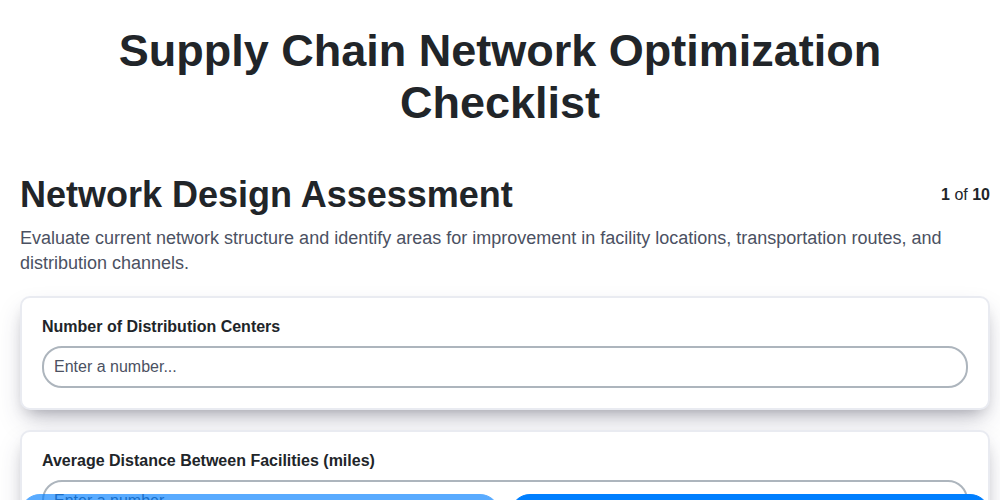
Table of Contents
- Introduction: Why Optimize Your Supply Chain Network?
- 1. Network Design Assessment: Understanding Your Current State
- 2. Facility Location Analysis: Finding the Optimal Hubs
- 3. Transportation Mode Optimization: Balancing Speed, Cost, and Sustainability
- 4. Inventory Placement Strategy: Right Stock, Right Place, Right Time
- 5. Distribution Channel Analysis: Reaching Your Customers Effectively
- 6. Technology Integration: Leveraging Tools for Visibility & Control
- 7. Risk Mitigation & Resilience: Preparing for the Unexpected
- 8. Cost Analysis & ROI: Justifying the Investment
- 9. Performance Measurement & KPIs: Tracking Your Progress
- 10. Sustainability Assessment: Minimizing Environmental Impact
- 11. Demand Forecasting Accuracy: The Foundation for Optimization
- 12. Collaboration & Communication: Internal and External Alignment
- Conclusion: Building a Future-Proof Supply Chain Network
- Resources & Links
TLDR: Feeling overwhelmed by your supply chain? This checklist guides you through 10 critical steps - from assessing your network to boosting sustainability - ensuring optimized locations, efficient transport, smart inventory, and a resilient, cost-effective supply chain. Download the template and simplify your network optimization journey!
Introduction: Why Optimize Your Supply Chain Network?
In today's dynamic business landscape, a well-optimized supply chain network isn't just a competitive advantage - it's a necessity. Global events, shifting consumer demands, and ever-increasing cost pressures are forcing companies to re-evaluate how they move goods, manage inventory, and serve customers. A poorly designed network can lead to inflated costs, delayed deliveries, frustrated customers, and ultimately, lost revenue.
But what does "optimized" really mean? It's about strategically aligning your facilities, transportation, inventory, and distribution channels to meet your business goals. This means more than just cutting costs; it's about building a resilient, agile, and customer-centric network that can adapt to change and drive sustainable growth. This checklist will guide you through the key areas to consider, empowering you to unlock the full potential of your supply chain.
1. Network Design Assessment: Understanding Your Current State
Before embarking on any optimization journey, you need a crystal-clear understanding of your current supply chain network. A thorough Network Design Assessment is the crucial first step. This isn't just about knowing where your facilities are; it's about understanding why they're there, how they interact, and whether they're still serving your business effectively.
This assessment should go beyond a simple map. It involves a deep dive into data - volumes, lead times, costs, service levels - and a holistic view of processes. Key areas to scrutinize include:
- Facility Footprint: Are you using the right number of facilities? Are they appropriately sized? Are they functionally aligned with your business needs?
- Network Topology: How are your facilities connected? What are the flow patterns of goods and information?
- Process Efficiency: Evaluate the efficiency of operations within each facility and across the network. Identify bottlenecks and areas of waste.
- Data Accuracy & Availability: Assess the quality and accessibility of the data informing your network decisions. Outdated or inaccurate data can lead to flawed conclusions.
- Alignment with Business Strategy: Does your current network design support your overall business strategy, growth plans, and customer service expectations?
Without this foundational assessment, optimization efforts risk being misdirected or even counterproductive. It provides the baseline against which future improvements can be measured.
2. Facility Location Analysis: Finding the Optimal Hubs
Where you place your facilities - warehouses, distribution centers, manufacturing plants - is a foundational decision that dramatically impacts your supply chain's efficiency and cost. A thorough facility location analysis goes far beyond simply finding available real estate; it's about strategically positioning your hubs to minimize costs, improve service levels, and bolster resilience.
This isn't a one-size-fits-all approach. The ideal locations depend heavily on factors specific to your business, including your customer base, product characteristics, supplier locations, transportation infrastructure, and regulatory environment. Here's what a robust facility location analysis involves:
- Demand Mapping: Accurately pinpointing customer demand isn't just about sales figures; it's about understanding where demand is growing and projecting future needs. Geographic Information Systems (GIS) are invaluable for visualizing this data.
- Proximity to Customers: Minimizing delivery distances and transit times is crucial for customer satisfaction. Consider the trade-off between proximity and the cost of land and labor in different regions.
- Proximity to Suppliers: Reducing inbound transportation costs and lead times can significantly improve overall supply chain efficiency.
- Transportation Infrastructure: Access to major highways, ports, airports, and rail lines is essential for efficient movement of goods. Evaluate the reliability and cost-effectiveness of available transportation options.
- Labor Market: Availability of skilled labor, wage rates, and workforce development programs all factor into the equation.
- Real Estate Costs & Incentives: Land prices, construction costs, and potential tax incentives vary widely by location.
- Regulatory Environment: Consider zoning laws, environmental regulations, and other legal factors that could impact facility operations.
- Modeling & Simulation: Utilize location modeling software to evaluate different scenarios and identify optimal locations based on weighted criteria. This often involves complex algorithms and data analysis.
- Sensitivity Analysis: Understand how changes in key assumptions (e.g., transportation costs, demand forecasts) impact the optimal locations.
A poorly chosen location can result in higher costs, longer lead times, and reduced customer satisfaction. Investing in a comprehensive facility location analysis is a critical step in optimizing your supply chain network.
3. Transportation Mode Optimization: Balancing Speed, Cost, and Sustainability
Getting your goods from point A to point B efficiently is a critical component of a robust supply chain network. But "efficient" isn't just about speed; it's about the optimal balance of cost, transit time, reliability, and increasingly, environmental impact. Transportation mode optimization involves carefully evaluating all available options - truckload (TL), less-than-truckload (LTL), rail, air, ocean, and even emerging modes like drone delivery - and selecting the best fit for each leg of your journey.
Here's what to consider:
- Cost Analysis: Each mode carries a different price tag. Trucking is often the most flexible but can be expensive for long distances. Rail offers cost savings for bulk goods over longer distances. Ocean freight is the most economical for international shipments, but with longer transit times. Air freight is the fastest, but significantly more expensive.
- Transit Time Requirements: Urgency dictates mode selection. Time-sensitive goods often necessitate air or expedited trucking, while less critical items can leverage slower, more cost-effective options.
- Product Characteristics: Size, weight, fragility, and temperature sensitivity all influence mode choice. Perishable goods demand temperature-controlled transport, while fragile items require careful handling.
- Network Geography: The distances involved, the availability of infrastructure (rail lines, ports), and geographical barriers all impact route options and mode suitability.
- Sustainability Considerations: The environmental impact of each mode varies significantly. Rail and ocean freight generally have lower carbon emissions per mile compared to trucking or air freight. Explore options like electric vehicles or alternative fuels when possible.
- Modal Shift Opportunities: Identify points in your network where shifting from one mode to another (e.g., from truck to rail) could yield significant cost savings or reduce your carbon footprint.
- Carrier Negotiation & Consolidation: Leverage volume and negotiate favorable rates with carriers. Consider consolidating shipments to maximize efficiency and minimize costs.
Optimizing transportation modes is an ongoing process. Regularly review your choices, adapt to changing market conditions, and embrace new technologies to ensure you're delivering goods in the most effective and sustainable way possible.
4. Inventory Placement Strategy: Right Stock, Right Place, Right Time
A well-defined inventory placement strategy is the backbone of a responsive and cost-effective supply chain. It's not just about having inventory; it's about strategically positioning it to minimize lead times, reduce carrying costs, and improve customer service. A flawed approach can lead to stockouts, excess inventory, and ultimately, a strained bottom line.
Here's what you need to consider:
- Demand Segmentation: Not all products have the same demand patterns. Segment your products based on factors like seasonality, lead time, margin, and criticality. This allows for tailored inventory placement.
- Service Level Requirements: Define the desired service level for each product segment. Higher service levels necessitate more safety stock and potentially multiple stocking locations.
- Location Optimization: Utilize advanced modeling techniques (e.g., network optimization software) to determine the optimal number and location of distribution centers and warehouses. Consider factors like customer proximity, transportation costs, and local market conditions.
- Safety Stock Calculation: Accurate safety stock calculations are vital to buffer against demand variability and supply disruptions. Leverage statistical methods and incorporate forecast accuracy into your formulas. Don't just rely on rules of thumb.
- Postponement Strategies: Explore postponement where possible. Delaying final product configuration or packaging until closer to the point of sale can significantly reduce inventory obsolescence and improve flexibility.
- Inventory Pooling: Consider pooling inventory across multiple locations to reduce overall safety stock levels. However, carefully analyze transportation costs and lead times to ensure it's truly beneficial.
- Regular Review & Adjustment: Inventory placement isn't a set it and forget it activity. Continuously monitor performance, analyze demand trends, and adjust your placement strategy accordingly. Changes in the market, customer behavior, or supplier capabilities all require a responsive approach.
5. Distribution Channel Analysis: Reaching Your Customers Effectively
Your supply chain network might be brilliantly designed and your facilities perfectly located, but it's all for naught if you can't efficiently and effectively get your products to your customers. Distribution channel analysis is the vital step that bridges the gap between your optimized network and the end consumer.
This isn't just about choosing between direct-to-consumer (DTC), wholesale, retail, or online marketplaces. It's a deep dive into how those channels operate, their reach, their cost structures, and their alignment with your overall business strategy.
Consider these critical areas:
- Channel Mapping: Visually map your current distribution channels. Identify all intermediaries - wholesalers, distributors, retailers, e-commerce platforms - and understand their role in getting your product to the customer.
- Customer Segmentation & Channel Preference: Different customer segments have different channel preferences. Analyze data to understand where your customers want to buy your products. Are they digitally savvy, or do they prefer traditional brick-and-mortar stores?
- Channel Performance Evaluation: Assess the performance of each channel based on factors like sales volume, profit margins, customer satisfaction, and delivery times. Identify underperforming channels and explore options for improvement or discontinuation.
- Channel Conflict Management: If you use multiple channels, ensure they don't compete against each other. Analyze pricing discrepancies, promotional activities, and product offerings to minimize conflict and maximize overall sales.
- Emerging Channels: Stay abreast of new distribution channels and platforms. The rise of social commerce, quick commerce (Q-commerce), and direct-to-consumer models can unlock significant opportunities if integrated strategically.
- Channel Partner Relationships: Building strong, collaborative relationships with your channel partners is crucial. Regular communication, shared incentives, and data sharing can lead to mutual benefit and improved efficiency.
Don't just have distribution channels - actively manage them to ensure they're delivering the right product, to the right customer, at the right place, and at the right time.
6. Technology Integration: Leveraging Tools for Visibility & Control
Supply chain network optimization isn't just about process improvements; it's about empowering those improvements with the right technology. Manually optimizing a complex network is simply unsustainable. We're talking about a shift from reactive problem-solving to proactive, data-driven decision-making.
Here's what technology integration should encompass:
- Network Modeling Software: These platforms allow you to simulate different network configurations, assess the impact of changes (like new facilities or routes) before implementation, and visually represent your entire supply chain. Look for tools with robust scenario planning capabilities.
- Real-Time Visibility Platforms: Knowing where your goods are, when they're arriving, and potential disruptions is crucial. Implement platforms that provide end-to-end visibility - from supplier to customer. IoT devices, GPS tracking, and blockchain solutions can all play a role.
- Advanced Analytics & AI: Harness the power of data. AI and machine learning can identify patterns, predict demand, optimize routes dynamically, and even flag potential risks before they materialize. Predictive analytics can be invaluable for inventory management and resource allocation.
- Transportation Management Systems (TMS): Streamline freight operations, optimize routing, and gain visibility into carrier performance. A good TMS will integrate with your other systems for seamless data flow.
- Warehouse Management Systems (WMS): Optimize warehouse processes, improve inventory accuracy, and enhance order fulfillment.
- Cloud-Based Collaboration Platforms: Facilitate communication and information sharing between all stakeholders in your network - suppliers, manufacturers, distributors, and customers.
Investing in the right technology isn't just about adopting new tools; it's about building a connected, intelligent supply chain that can adapt to ever-changing market conditions.
7. Risk Mitigation & Resilience: Preparing for the Unexpected
Supply chains are inherently vulnerable. From natural disasters and geopolitical instability to supplier bankruptcies and sudden demand spikes, unexpected events will happen. A robust supply chain network isn't just about efficiency; it's about resilience - the ability to withstand and recover from disruptions.
Here's what to include in your risk mitigation & resilience checklist:
- Identify Potential Risks: Conduct a thorough risk assessment, categorizing potential disruptions (e.g., supplier concentration, geographic vulnerabilities, cybersecurity threats, regulatory changes). Don't just think about what could happen, but how it would impact your network.
- Map Critical Nodes & Dependencies: Visually map your entire network - from raw material sourcing to final delivery. Identify critical nodes (single points of failure) and key dependencies between suppliers, facilities, and transportation routes.
- Develop Contingency Plans: For high-priority risks, create detailed contingency plans. These should outline alternative sourcing options, facility backup locations, transportation routes, and communication protocols. Think "Plan B," "Plan C," and beyond.
- Diversify Sourcing & Production: Reduce reliance on single suppliers or geographic regions. Explore dual or multi-sourcing strategies to enhance flexibility.
- Build Inventory Buffers (Strategically): While lean inventory is generally desirable, strategic buffer stock can cushion against disruptions. Determine critical items requiring safety stock and optimal placement.
- Cybersecurity & Data Protection: Implement robust cybersecurity measures to protect sensitive data and prevent disruptions from cyberattacks.
- Regularly Test & Update Plans: Risk landscapes evolve. Conduct tabletop exercises and simulations to test your plans, identify weaknesses, and ensure everyone understands their roles. Update plans based on lessons learned and changing conditions.
- Insurance & Risk Transfer: Explore insurance options to mitigate financial losses stemming from specific risks.
- Build Relationships: Foster strong relationships with suppliers and logistics partners. Open communication and collaboration are vital during crises.
8. Cost Analysis & ROI: Justifying the Investment
Supply chain network optimization isn't just about efficiency; it's about delivering tangible financial benefits. A thorough cost analysis and Return on Investment (ROI) calculation are crucial to justifying the investment in optimization initiatives and securing buy-in from stakeholders.
This step goes beyond simply identifying cost savings. It involves a comprehensive breakdown of all relevant costs, both pre- and post-optimization. Consider the following:
- Current State Costs: Document existing costs associated with warehousing, transportation, inventory holding, labor, and potential penalties for late deliveries or stockouts.
- Optimization Implementation Costs: Account for expenses related to software, consulting services, training, and potential disruptions during the optimization process.
- Projected Post-Optimization Costs: Model the expected costs after implementing changes, considering factors like reduced transportation distances, optimized inventory levels, and streamlined processes.
- Revenue Impact: Assess how network optimization can positively influence revenue through improved service levels, expanded market reach, and reduced lead times.
Calculate ROI by comparing the total benefits (cost savings plus revenue increase) with the total costs. This quantifiable evidence demonstrates the value of the optimization efforts and helps prioritize projects with the highest potential returns. Furthermore, sensitivity analysis-examining how ROI changes based on fluctuating variables like fuel prices or demand - can provide valuable insights and build confidence in the projections. Don't forget to factor in both tangible and intangible benefits; even improved brand reputation can contribute to long-term value.
9. Performance Measurement & KPIs: Tracking Your Progress
Optimizing your supply chain network isn't a one-and-done project; it's an ongoing journey of refinement. To ensure your efforts are yielding tangible results and to identify areas for continued improvement, robust performance measurement and Key Performance Indicators (KPIs) are absolutely critical.
What gets measured, gets managed. Without a clear understanding of your network's performance, you risk straying from your optimization goals and potentially even experiencing regression.
Here are some vital KPIs to track, categorized for clarity:
Network Efficiency:
- Order Fulfillment Cycle Time: Measures the time from order placement to customer receipt.
- On-Time Delivery Rate: A percentage indicating the proportion of orders delivered within the promised timeframe.
- Inventory Turnover Rate: Reflects how efficiently inventory is being sold and replenished.
- Warehouse Utilization Rate: Shows how effectively warehouse space is being used.
- Transportation Cost per Unit: Tracks the cost associated with moving goods.
Cost & Financials:
- Total Supply Chain Cost: The sum of all costs associated with the network - warehousing, transportation, inventory, etc.
- Cost of Goods Sold (COGS): A key indicator of overall profitability related to your product's supply chain.
- Return on Investment (ROI) on Optimization Initiatives: Directly measures the financial benefit of your network optimization efforts.
Customer Satisfaction:
- Customer Service Levels: Measured through surveys, feedback forms, and tracking response times.
- Order Accuracy: Percentage of orders shipped correctly and completely.
Sustainability:
- Carbon Footprint per Unit: Tracks the environmental impact of your supply chain.
- Waste Reduction Rate: Measures progress in minimizing waste across the network.
Regularly review these KPIs, benchmark them against industry standards, and use the insights to drive continuous improvement. Don't just track; analyze and act on the data to maximize the benefits of your optimized supply chain network.
10. Sustainability Assessment: Minimizing Environmental Impact
Modern supply chains are under increasing pressure to operate sustainably. Consumers demand it, regulations enforce it, and frankly, it's the right thing to do. A thorough sustainability assessment within your supply chain network optimization project isn't just a 'nice-to-have' - it's a critical component for long-term viability and responsible business practices.
This assessment goes beyond simply reducing carbon emissions. It encompasses a holistic view of environmental impact, considering factors like:
- Carbon Footprint Analysis: Mapping and quantifying greenhouse gas emissions across all stages of the supply chain, from raw material sourcing to final delivery.
- Resource Consumption: Evaluating the use of water, energy, and raw materials, and identifying opportunities for conservation and efficiency.
- Waste Management: Analyzing waste generation and disposal practices, seeking opportunities for reduction, reuse, and recycling.
- Packaging Optimization: Reducing packaging material usage, transitioning to sustainable materials (recycled, biodegradable), and minimizing packaging weight and volume.
- Ethical Sourcing: Ensuring suppliers adhere to environmentally responsible practices and ethical labor standards.
- Circular Economy Principles: Exploring opportunities to close the loop on materials and products, promoting reuse, refurbishment, and recycling.
- Lifecycle Assessment (LCA): Evaluating the environmental impact of a product or service throughout its entire lifecycle.
Integrating sustainability considerations into your network optimization plan can unlock both cost savings and enhanced brand reputation. For instance, relocating facilities closer to renewable energy sources, optimizing transportation routes to reduce fuel consumption, and partnering with eco-conscious suppliers can yield significant benefits. Furthermore, transparently communicating your sustainability efforts builds trust with customers and stakeholders.
11. Demand Forecasting Accuracy: The Foundation for Optimization
No supply chain network optimization effort can truly succeed without a solid foundation of accurate demand forecasting. Even the most brilliantly designed network will falter if it's constantly reacting to unpredictable fluctuations in customer demand.
Why is forecasting so critical? It directly impacts inventory levels, facility capacity planning, transportation needs, and even workforce scheduling. Inaccurate forecasts lead to either stockouts (lost sales and dissatisfied customers) or excess inventory (increased holding costs and potential obsolescence).
Here's why focusing on demand forecasting accuracy should be your first step in any network optimization project:
- Data Quality is Key: Garbage in, garbage out. Ensure your historical sales data is clean, complete, and representative of future demand.
- Consider External Factors: Don't just rely on past sales. Integrate external data like economic indicators, marketing promotions, competitor activities, and even weather patterns.
- Embrace Advanced Techniques: Explore statistical forecasting models, machine learning algorithms, and collaborative planning, forecasting, and replenishment (CPFR) to improve accuracy.
- Regularly Review and Refine: Demand patterns evolve. Continuously monitor forecast performance, identify biases, and adjust your forecasting methods accordingly.
Investing in improved demand forecasting isn't just about prediction; it's about building agility and resilience into your entire supply chain network.
12. Collaboration & Communication: Internal and External Alignment
Supply chain network optimization isn't a solo effort. It requires seamless collaboration and communication both within your organization and with external partners. Siloed departments and disconnected suppliers can quickly derail even the best-laid plans.
Internal Alignment: Break down departmental barriers. Sales, marketing, procurement, manufacturing, logistics - everyone needs to understand the overarching optimization goals and their role in achieving them. Regular cross-functional meetings, shared dashboards showcasing key metrics, and clearly defined roles and responsibilities are vital. Ensure that the optimization recommendations are understood and supported by all involved.
External Alignment: Open communication with suppliers, distributors, and even customers is paramount. Share forecasts, inventory data, and potential changes to your network. Solicit their feedback and incorporate it into your plans. Collaborative planning, forecasting, and replenishment (CPFR) initiatives can foster stronger relationships and improve overall efficiency. Transparency builds trust and enables partners to proactively adjust their operations to align with your optimized network. Remember, a successful optimization benefits everyone in the supply chain.
Conclusion: Building a Future-Proof Supply Chain Network
The journey to supply chain network optimization isn't a one-time project, but an ongoing evolution. By systematically working through the checklist-from initial assessment to continuous performance measurement-you're not just streamlining your operations today; you're building a future-proof network. Remember that flexibility and adaptability are key. Regularly revisit each area, particularly in response to market shifts, technological advancements, and evolving customer expectations. Embracing a proactive and data-driven approach, focusing on sustainability and resilience, will ensure your supply chain network remains a competitive advantage, delivering value, minimizing risk, and driving long-term success. The ongoing commitment to these principles transforms your network from a cost center into a strategic engine for growth.
Resources & Links
- McKinsey & Company: McKinsey's supply chain and operations practice provides in-depth insights, reports, and frameworks for network optimization, often including case studies and thought leadership. A good place to search for network design and optimization related articles.
- Bain & Company: Similar to McKinsey, Bain offers consulting services and publishes thought leadership on supply chain strategy, including network design and optimization. Look for their reports on cost-to-serve and operational excellence.
- Boston Consulting Group (BCG): BCG's supply chain practice offers research and consulting on supply chain network design, resilience, and digital transformation. Their 'Henderson Institute' has relevant articles.
- APICS (ASCM): The Association for Supply Chain Management (ASCM, formerly APICS) provides certifications, training, and resources for supply chain professionals. Their website offers publications, webinars, and standards related to network design and inventory management.
- Institute for Supply Management (ISM): ISM provides surveys, reports, and education for supply management professionals. While not solely focused on network optimization, their insights on market conditions and disruptions are valuable for risk mitigation.
- Gartner: Gartner provides research and advisory services, including supply chain network design and visibility tools. Their Magic Quadrants for supply chain planning software can inform technology integration decisions.
- Supply Chain Brain: A leading online resource providing news, trends, and analysis related to supply chain management. Search for articles specifically covering network optimization, facility location, and transportation strategies.
- Council of Supply Chain Management Professionals (CSCMP): Provides in-depth analysis of logistics and supply chain trends.
- Orion Logistics: Content on optimizing logistics and supply chain network.
- LLamasoft (now part of Coupa): Tools and resources on supply chain design and optimization.
- Coupa: Now owns Llamasoft, Coupa offers a range of supply chain management software, including network optimization capabilities. Explore their resources and case studies.
- Blue Yonder (formerly JDA Software): Blue Yonder provides supply chain planning and optimization software. Their website offers insights on network design and inventory optimization.
- Everest Group: Everest Group is a research and advisory firm specializing in IT and business process services. They publish reports and insights on supply chain technology and vendor selection.
- Supply Chain 24/7: Online publication delivering news, features, and analysis covering the entire supply chain, including optimization and technology.
- Infor: Infor offers a suite of supply chain management software, including capabilities for network optimization and inventory management. Look for case studies and white papers.
Frequently Asked Questions
What is supply chain network optimization and why is it important?
Supply chain network optimization is the process of designing and refining your network of facilities (factories, warehouses, distribution centers, suppliers) to minimize costs, improve service levels, and increase resilience. It's important because it directly impacts profitability, customer satisfaction, and your ability to adapt to changing market conditions.
Who is this checklist for?
This checklist is designed for supply chain professionals, logistics managers, operations managers, and anyone involved in designing, analyzing, or improving a supply chain network. It's beneficial for companies of all sizes looking to gain a competitive edge.
What types of factors does this checklist cover?
The checklist covers a wide range of factors, including network design, location analysis, transportation optimization, inventory management, risk assessment, technology integration, and sustainability considerations.
Can I adapt this checklist to my specific industry?
Absolutely! This is a general framework. Feel free to customize it by adding or removing steps that are relevant to your industry, company size, and specific business needs. Add in industry-specific metrics and considerations.
What tools or software are helpful for supply chain network optimization?
While the checklist outlines the process, tools like network modeling software (e.g., Llamasoft, Coupa), GIS software (e.g., ArcGIS), optimization solvers, and data analytics platforms can significantly aid in the analysis and implementation. Spreadsheets like Excel can also be useful for smaller-scale projects.
How often should I review and update my supply chain network?
It's recommended to review your network at least annually, or more frequently if there are significant changes in your business environment (e.g., market shifts, new regulations, disruptions). Ideally, perform a full network design review every 3-5 years.
What is 'location analysis' and why is it included in the checklist?
Location analysis is the process of determining the optimal placement of facilities within your network. It considers factors like proximity to customers, transportation costs, labor availability, and tax incentives. It's crucial for minimizing costs and improving service levels.
The checklist mentions risk assessment. What types of risks should I be considering?
Consider risks like natural disasters, geopolitical instability, supplier disruptions, cybersecurity threats, transportation delays, and changing customer demand. The goal is to build resilience and contingency plans into your network design.
How does sustainability factor into supply chain network optimization?
Sustainability considerations include reducing carbon emissions from transportation, optimizing facility energy usage, sourcing materials responsibly, and minimizing waste. Incorporating these factors aligns with growing consumer and regulatory expectations.
Where can I find more information or resources related to supply chain network optimization?
There are numerous resources available, including industry publications (e.g., Supply Chain Management Review, APICS Magazine), professional organizations (e.g., APICS, CSCMP), and online courses. Your company's internal expertise is also a valuable resource.
Comments
There are no comments yet. Be the first to add one!
SCM - Supply Chain Management Solution Demo
Struggling with supply chain disruptions & lack of visibility? ChecklistGuro delivers a centralized SCM solution, connecting your suppliers, manufacturers, & distributors for improved collaboration and control. Simplify operations & boost efficiency.
Related Articles
Incoterms Compliance Checklist for Supply Chain: Your Guide to Smooth Operations
Navigating Sustainability: Your Supply Chain Compliance Checklist

Fortify Your Supply Chain: The Ultimate Resilience Assessment Checklist
Supply Chain Capacity Planning Checklist: Ensure Readiness for Peak Demand
Navigating Global Trade: Your Essential Import/Export Compliance Checklist

Top 10 SAP Logistics Business Network (LBN) Alternatives for 2025
Supply Chain Risk Assessment Checklist: Your Guide to Resilience
The Ultimate Supply Chain Inventory Accuracy Audit Checklist: A Step-by-Step Guide
Need help with
Supply Chain Management (SCM)?
Have a question? We're here to help. Please submit your inquiry, and we'll respond promptly.