Supply Chain Capacity Planning Checklist: Ensure Readiness for Peak Demand
Published: 12/09/2025 Updated: 12/14/2025
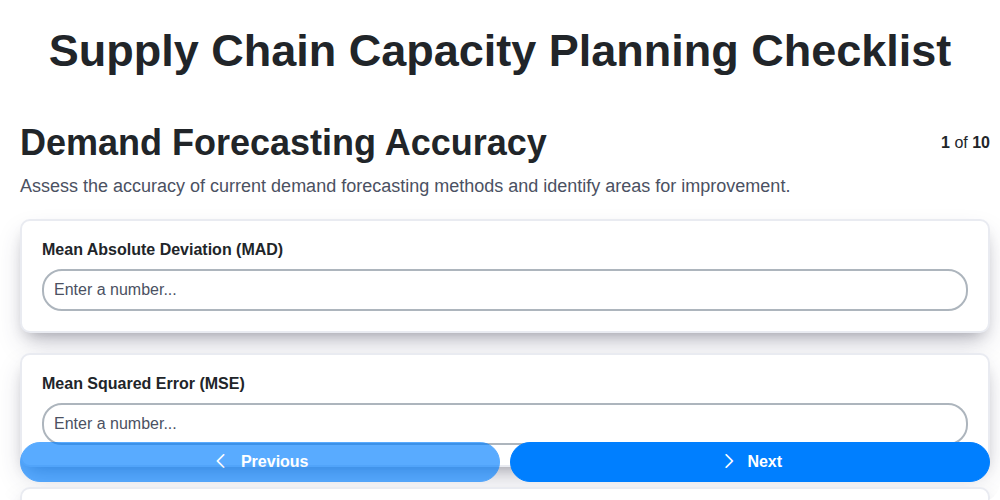
Table of Contents
- Introduction: Why Capacity Planning Matters
- 1. Demand Forecasting Accuracy: The Foundation of Capacity
- 2. Production Capacity Assessment: Evaluating Your Manufacturing Power
- 3. Supplier Capacity Analysis: Beyond Your Four Walls
- 4. Inventory Buffer Strategy: Balancing Risk and Cost
- 5. Logistics & Transportation Capacity: Moving Goods Efficiently
- 6. Warehouse & Distribution Center Capacity: Storing and Shipping
- 7. Labor & Equipment Availability: The Human and Machine Factor
- 8. Scalability & Flexibility Planning: Preparing for Growth and Change
- 9. Technology Infrastructure Assessment: Enabling Visibility and Control
- 10. Contingency Planning & Risk Mitigation: Addressing Potential Disruptions
- 11. Scenario Planning: Testing Your Limits
- 12. Key Performance Indicators (KPIs) for Capacity Planning
- Conclusion: Building a Resilient Supply Chain
- Resources & Links
TLDR: Feeling overwhelmed by potential supply chain bottlenecks? This checklist guides you through crucial areas like forecasting, production, supplier capabilities, warehousing, and technology to ensure you can handle peak demand. It's your roadmap to identifying vulnerabilities and proactively building a resilient and scalable supply chain.
Introduction: Why Capacity Planning Matters
In today's volatile business environment, reactive capacity management simply won't cut it. Supply chain disruptions, fluctuating customer demand, and evolving market conditions require a proactive approach. Capacity planning - the process of aligning your supply chain's resources with anticipated demand - is no longer a "nice-to-have," but a critical necessity for survival and growth.
Failing to anticipate your capacity needs can lead to costly consequences: missed orders, delayed shipments, frustrated customers, and ultimately, lost revenue. Conversely, effectively planned capacity provides a competitive edge, enabling you to meet (and even exceed) customer expectations, respond quickly to opportunities, and optimize your operational efficiency. This checklist provides a framework to systematically evaluate your supply chain's capabilities and build a resilient plan for the future.
1. Demand Forecasting Accuracy: The Foundation of Capacity
Accurate demand forecasting is the bedrock of any successful supply chain capacity planning process. If your forecasts are consistently off, all subsequent planning efforts will be undermined, leading to either stockouts or excess inventory - both costly outcomes.
But accurate isn't about being perfect. It's about minimizing error and understanding the sources of that error. Here's what to consider:
- Review Forecasting Methods: Are you relying solely on historical data? Consider incorporating market trends, promotional activities, seasonality, and external factors (like economic indicators) into your models. Explore statistical methods like moving averages, exponential smoothing, and regression analysis. Machine learning algorithms are increasingly valuable for complex patterns.
- Collaboration is Key: Sales, marketing, and customer service teams hold valuable insights. Regularly collaborate to gather their perspectives and incorporate them into the forecasting process. Don't work in silos!
- Forecast Bias Analysis: Track your forecast accuracy over time. Are you consistently over- or under-forecasting? Identify and address the biases in your forecasting approach.
- Segmentation Matters: Don't treat all products or regions the same. Segment your demand and apply different forecasting methods based on the specific characteristics of each segment.
- Regularly Evaluate Performance: Key metrics include Mean Absolute Deviation (MAD), Mean Squared Error (MSE), and Mean Absolute Percentage Error (MAPE). Track these metrics regularly and adjust your forecasting techniques accordingly.
- Scenario Planning: Develop multiple demand scenarios (optimistic, pessimistic, and most likely) to prepare for a range of possibilities.
2. Production Capacity Assessment: Evaluating Your Manufacturing Power
Understanding your production capacity is more than just knowing how many units you can produce; it's about knowing reliably and efficiently producing what your customers need, when they need it. A thorough assessment goes beyond simple numbers and dives deep into the factors impacting your output.
Here's what a comprehensive Production Capacity Assessment should cover:
- Current Output & Bottlenecks: Start with a clear picture of your current production volume. Identify bottlenecks - the points in your process that limit overall output. Are these bottlenecks in machinery, processes, or specific workstations? Data-driven analysis is key here, tracking metrics like cycle time, throughput, and utilization rates.
- Equipment Performance & Maintenance: Evaluate the health and reliability of your equipment. Review maintenance schedules, downtime records, and remaining useful life. Aging equipment often leads to unplanned downtime, impacting capacity. Consider preventative maintenance strategies and potential equipment upgrades.
- Process Efficiency: Analyze your production processes for inefficiencies. Look for waste, unnecessary steps, and areas ripe for automation. Lean manufacturing principles and process mapping can be incredibly valuable.
- Resource Utilization: Are your machines and workstations operating at optimal levels? Overburdening resources leads to decreased performance and increased failure rates. Look for opportunities to balance workload and improve overall efficiency.
- Changeover Times: How long does it take to switch between different product runs? Reducing changeover times can significantly increase your effective capacity, especially in environments with frequent product variations.
- Capacity Utilization Rate: What percentage of your potential capacity are you currently using? This helps identify headroom for growth and areas where investment might be needed.
- Future Demand Projections: Align your capacity assessment with anticipated future demand. A mismatch can lead to either shortages or excessive inventory.
Tools & Techniques:
- Capacity Planning Software: Can assist with simulations and what-if scenarios.
- Process Mapping: Visual representation of your production process to identify bottlenecks.
- Time Studies: Observing and recording the time taken for each process step.
- Value Stream Mapping: Analyzing the flow of materials and information required to bring a product to a customer.
3. Supplier Capacity Analysis: Beyond Your Four Walls
Your production capacity is only as strong as your weakest link, and that often extends to your suppliers. Relying on them to deliver materials and components on time and in the volumes you need is crucial, but assuming their capacity matches your demands can be a recipe for disaster. A thorough supplier capacity analysis is no longer optional; it's a fundamental pillar of effective supply chain capacity planning.
This goes far beyond simply checking if a supplier can deliver. It involves a deep dive into their operations, financials, and potential vulnerabilities. Here's what you need to consider:
- Capacity Utilization: What percentage of their capacity are they currently using? High utilization might indicate potential bottlenecks or limited ability to absorb surges in your demand.
- Lead Times & Scalability: Can they realistically scale production to meet your projected increases? Are their lead times predictable and reliable, or prone to fluctuations?
- Financial Stability: A financially unstable supplier can't invest in necessary upgrades or expansions, making them a risk to your supply chain. Review their financial health and credit rating.
- Geographic Risk: Assess potential geographic risks affecting the supplier's location - natural disasters, political instability, or local labor market conditions.
- Sub-Tier Supplier Visibility: Do you know their suppliers? Gaining visibility beyond your direct suppliers can identify hidden dependencies and potential vulnerabilities.
- Communication & Collaboration: Establish open communication channels and collaborative planning sessions. This fosters trust and allows for proactive problem-solving.
- Alternative Sourcing Options: Identify and qualify alternative suppliers as a backup plan. Diversification reduces your reliance on a single source.
Don't assume. Verify. A robust supplier capacity analysis is a critical investment in your supply chain's resilience and ability to meet future demand.
4. Inventory Buffer Strategy: Balancing Risk and Cost
A robust supply chain capacity plan isn't just about maximizing output; it's about ensuring availability when demand spikes. That's where your inventory buffer strategy comes in. Holding inventory costs money - storage, insurance, potential obsolescence - but not having enough can lead to lost sales, delayed orders, and frustrated customers. Finding the sweet spot is crucial.
Here's what to consider when crafting your inventory buffer strategy:
- Demand Variability: Highly variable demand requires larger buffers. Analyze historical data, factor in seasonality, promotions, and potential market fluctuations.
- Lead Time Reliability: Longer, less predictable lead times from suppliers necessitate more safety stock.
- Service Level Goals: What percentage of orders do you need to fulfill immediately? Higher service levels require larger buffers.
- Cost of Stockouts: Quantify the financial impact of running out of product - lost sales, penalties, damage to reputation. This will help justify the cost of holding more inventory.
- Inventory Segmentation (ABC Analysis): Don't treat all items the same. High-value, critical items (A items) deserve larger buffers than lower-value, less critical items (C items).
- Dynamic Buffer Adjustment: Consider implementing a system that automatically adjusts buffer levels based on real-time data and predictive analytics. This allows for a proactive response to changing conditions.
- Collaboration with Suppliers: Communicate your buffer strategies and forecasts with suppliers to ensure alignment and potentially negotiate shorter lead times or prioritized shipments.
Ignoring inventory buffers puts your entire capacity plan at risk. A well-planned strategy provides a crucial safety net, mitigating potential disruptions and protecting your supply chain's resilience.
5. Logistics & Transportation Capacity: Moving Goods Efficiently
A robust supply chain isn't just about producing goods; it's about getting them to the right place, at the right time, and in perfect condition. Logistics and transportation capacity are critical links in this chain, and often overlooked in capacity planning. Here's what you need to assess:
- Current Carrier Performance: Evaluate your existing carriers' on-time delivery rates, damage rates, and overall service levels. Are they consistently meeting your needs? Don't solely rely on historical data - understand current pressures and potential disruptions impacting them.
- Freight Capacity Availability: Are there enough trucks, rail cars, or shipping containers available to meet projected demand? Consider seasonal fluctuations and broader industry trends (e.g., driver shortages, port congestion).
- Mode Optimization: Are you using the most efficient modes of transportation? Could shifting some volume to rail or intermodal transport improve capacity or reduce costs?
- Route Optimization: Review your routes for efficiency. Can technology or updated mapping improve delivery times and reduce fuel consumption?
- Infrastructure Limitations: Are there bottlenecks at ports, highways, or rail lines that could impact your ability to move goods?
- Cost Analysis: Understand the true cost of your transportation - including fuel, tolls, and potential surcharges. Can you negotiate better rates or optimize routes to lower expenses?
- Future Capacity Needs: Project future transportation capacity requirements based on anticipated demand growth. Factor in potential new markets or product lines.
6. Warehouse & Distribution Center Capacity: Storing and Shipping
Your warehouse and distribution centers are the crucial final link in your supply chain, directly impacting order fulfillment speed and customer satisfaction. Capacity planning here isn't just about square footage; it's about optimizing space, efficiency, and responsiveness.
Assess Current Utilization: Begin with a thorough evaluation of your current warehouse utilization. Track metrics like storage density, picking efficiency, shipping accuracy, and throughput. Are aisles cluttered? Is there wasted vertical space? Are processes streamlined?
Forecast Future Needs: Project your storage and shipping needs based on demand forecasts. Consider seasonal peaks, promotional events, and potential growth. Don't just look at total volume; analyze the mix of SKUs and product sizes - a surge in oversized items will impact your capacity differently than an increase in small, lightweight goods.
Evaluate Throughput & Layout: Analyze the speed at which goods can move through your facilities. Bottlenecks in receiving, picking, packing, and shipping directly limit capacity. Consider your layout: is it optimized for flow? Are different areas strategically located to minimize travel time?
Consider Automation: Explore automation solutions like automated guided vehicles (AGVs), conveyor systems, and automated storage and retrieval systems (AS/RS). While upfront investment is significant, they drastically increase throughput and reduce labor dependence.
Space Optimization: Implement space optimization strategies such as vertical racking, narrow aisle storage, and cross-docking to maximize storage density. Regularly review and adjust slotting strategies to place frequently-ordered items in accessible locations.
Dock Door Capacity: Don't underestimate the importance of dock door capacity. Ensure you have enough docks to handle peak inbound and outbound shipments without creating congestion.
Future Expansion: Plan for future expansion needs. Do you have room to grow within your current facility? Or will you need to consider additional warehouse space? Factor in lead times for construction or lease agreements.
7. Labor & Equipment Availability: The Human and Machine Factor
Capacity planning isn't just about numbers and spreadsheets; it's fundamentally about people and the machines they operate. Ignoring the realities of your workforce and equipment can derail even the most meticulously crafted plans.
Assessing Your Labor Pool:
- Current Staffing Levels: Start with a clear picture of your existing workforce. How many employees do you have in each critical role (production, quality control, logistics, etc.)?
- Skill Sets & Training: Do your employees possess the skills required to handle anticipated demand? Consider the need for upskilling, cross-training, or new hires. Factor in the time and cost of training programs.
- Absenteeism & Turnover: Absenteeism and employee turnover are inevitable. Analyze historical data to understand typical rates and factor these into your available labor pool. High turnover can disrupt workflows and necessitate constant training.
- Overtime Potential: While overtime can provide short-term flexibility, it's not a sustainable solution. Assess the overtime capacity of your workforce, considering potential burnout and reduced efficiency.
- Future Hiring Plans: Develop a clear hiring plan to address projected labor gaps. Consider lead times for recruitment and onboarding processes.
Evaluating Equipment Readiness:
- Maintenance Schedules: Proactive maintenance is critical. Review and update equipment maintenance schedules to minimize downtime.
- Equipment Performance: Track key performance indicators (KPIs) for your equipment (throughput, cycle time, defect rates). Identify bottlenecks and areas for improvement.
- Equipment Age & Condition: Older equipment is more prone to breakdowns. Assess the age and overall condition of your machinery and factor in potential replacement costs.
- Spare Parts Availability: Ensure you have adequate spare parts on hand to quickly address equipment failures and minimize disruptions.
- Equipment Utilization: Analyze how effectively your equipment is being utilized. Are there opportunities to optimize processes and increase output?
By thoroughly evaluating both your human and machine resources, you're laying the foundation for a responsive and reliable supply chain.
8. Scalability & Flexibility Planning: Preparing for Growth and Change
The best-laid supply chain plans can quickly crumble under unexpected surges in demand or sudden disruptions. That's why proactive scalability and flexibility planning isn't just nice to have - it's critical for resilience. It goes beyond simply reacting to current needs; it's about building a system that can adapt and grow with your business.
Here's what to consider:
- Modular Design: Can your processes be broken down into manageable, modular components? This allows you to easily add or remove resources as needed. Think about production lines that can switch between products, or warehouse layouts that can be reconfigured.
- Contractual Flexibility: Review your supplier agreements. Do they include clauses for volume increases, expedited delivery options, or alternative sourcing in case of emergencies? Negotiate for greater flexibility upfront.
- Resource Pooling: Explore opportunities to pool resources with partners or other companies. This can provide access to additional capacity without significant capital investment.
- Geographic Diversification: Consider diversifying your suppliers and distribution locations to reduce reliance on a single region.
- Scenario Planning: Regularly run what-if scenarios - what happens if demand doubles? What if a key supplier is unavailable? How quickly can you ramp up production or find alternative suppliers?
- Embrace Agility: Cultivate a culture of adaptability within your team. Encourage cross-training, empower employees to make decisions, and be willing to experiment with new approaches.
- Cloud-Based Solutions: Leverage cloud-based supply chain management (SCM) tools that can easily scale with your business and provide real-time visibility.
Ignoring scalability and flexibility planning is essentially betting against the future. By embracing a proactive approach, you're investing in a supply chain that's ready to handle whatever comes your way.
9. Technology Infrastructure Assessment: Enabling Visibility and Control
In today's dynamic supply chain landscape, relying on spreadsheets and manual processes simply won't cut it. A robust technology infrastructure is no longer a nice-to-have - it's a must-have for effective capacity planning. This assessment isn't just about having the latest software; it's about ensuring your existing systems can support your planning needs, now and in the future.
Key areas to scrutinize:
- Demand Planning Software: Does your system provide accurate and timely demand forecasts, incorporating historical data, market trends, and promotional activities? Can it handle complexity and various forecasting models?
- ERP Integration: How well is your demand planning and capacity planning integrated with your Enterprise Resource Planning (ERP) system? Seamless data flow is critical for accurate production scheduling and inventory management.
- Real-time Visibility: Can you access real-time data on inventory levels, production status, and transportation progress? Lack of visibility introduces delays and increases the risk of disruptions.
- Data Analytics & Reporting: Are you able to analyze data to identify bottlenecks, optimize resource allocation, and track key performance indicators (KPIs)?
- Cloud vs. On-Premise: Evaluate the benefits and drawbacks of cloud-based solutions versus on-premise systems in terms of scalability, cost, and security.
- Automation Capabilities: Explore opportunities to automate tasks like order processing, inventory replenishment, and transportation scheduling to free up resources and reduce errors.
- Cybersecurity: Assess your cybersecurity posture to protect sensitive supply chain data and ensure business continuity.
A thorough technology assessment should identify gaps and recommend upgrades or new solutions to improve visibility, control, and agility across your supply chain. Don't underestimate the power of technology to unlock true capacity planning success.
10. Contingency Planning & Risk Mitigation: Addressing Potential Disruptions
Supply chains are inherently vulnerable. Unexpected events - natural disasters, geopolitical instability, supplier bankruptcies, sudden demand surges - can cripple operations and devastate bottom lines. Robust contingency planning and risk mitigation aren't just nice-to-haves; they're essential for resilience.
This checklist element moves beyond proactive planning and focuses on what happens when things go wrong. It's about anticipating potential pitfalls and having pre-determined actions ready to deploy.
Here's what to consider:
- Identify Potential Risks: Conduct a thorough risk assessment. Brainstorm every conceivable disruption - from component shortages to port closures. Prioritize risks based on likelihood and impact.
- Develop Alternative Sourcing Options: Don't rely on a single supplier. Identify and vet backup suppliers, even if they're more expensive. Understand their capacity and lead times.
- Create Transportation Redundancy: Explore alternative routes and carriers. Build relationships with multiple logistics providers.
- Establish Communication Protocols: Define clear communication channels and escalation procedures for all stakeholders - suppliers, customers, employees, and executives.
- Simulate Disruptions (Stress Testing): Conduct what-if scenarios to test your contingency plans. This could involve simulated factory shutdowns, transportation delays, or demand spikes.
- Financial Resilience: Ensure you have financial buffers to weather disruptions, including working capital and insurance coverage.
- Regular Review & Updates: Risk landscapes evolve constantly. Review and update your contingency plans at least annually, or more frequently if circumstances warrant.
By proactively addressing potential disruptions, you're not just mitigating risk; you're building a more resilient and adaptable supply chain that can thrive in the face of uncertainty.
11. Scenario Planning: Testing Your Limits
Capacity planning isn't about predicting the future - it's about preparing for it, whatever it may hold. That's where scenario planning comes in. It's more than just "what if" thinking; it's a structured process for exploring potential future states of your supply chain and validating your capacity plans.
Think beyond the optimistic baseline forecast. What happens if demand spikes unexpectedly due to a competitor's product recall? What if a key supplier faces a sudden disruption, like a natural disaster or labor strike? What if transportation costs double due to fuel price increases or port congestion?
To effectively scenario plan:
- Identify Key Uncertainties: Determine the variables with the highest potential to impact your capacity. These might include demand fluctuations, supplier performance, geopolitical events, or technological advancements.
- Develop Plausible Scenarios: Create 3-5 distinct scenarios, each representing a different potential future. Don't just focus on the negative - consider scenarios representing unexpected growth or shifts in consumer preferences.
- Test Your Plans: For each scenario, run simulations or use modeling tools to assess how your current capacity plans would perform. Identify potential bottlenecks and vulnerabilities.
- Develop Response Strategies: Based on your testing, outline specific actions you could take to adapt to each scenario. This might involve securing backup suppliers, building more flexible production lines, or negotiating preferential rates with logistics providers.
- Regularly Review and Update: Scenario planning isn't a one-and-done exercise. As your business evolves and external factors change, revisit your scenarios and adjust your plans accordingly.
By proactively considering a range of possibilities, you can build a more resilient and adaptable supply chain that's prepared to meet whatever challenges the future throws your way.
12. Key Performance Indicators (KPIs) for Capacity Planning
Capacity planning isn't just about creating a plan; it's about consistently monitoring and improving it. That's where Key Performance Indicators (KPIs) come in. These metrics provide valuable insights into your capacity plan's effectiveness and highlight areas needing adjustment. Here are some critical KPIs to track:
- Forecast Accuracy (MAPE, Bias): A direct reflection of your demand forecasting reliability. Consistently inaccurate forecasts render capacity plans useless.
- Production Utilization Rate: Shows how efficiently your production resources are being used. Low utilization suggests overcapacity, while consistently high utilization indicates a potential bottleneck.
- Supplier On-Time Delivery Rate: Highlights supplier reliability. Late deliveries significantly impact your production schedule and ability to meet demand.
- Inventory Turnover Rate: Indicates the efficiency of your inventory management. A low turnover rate suggests excess inventory and tied-up capital.
- Order Fulfillment Cycle Time: Measures the time from order placement to delivery. Slow cycle times signal capacity constraints.
- Warehouse Utilization Rate: Tracks how much of your warehouse space is actually being used.
- Labor Productivity: Measures output per labor hour. Declining productivity can point to training needs or equipment issues.
- Transportation Cost per Unit: Monitors the efficiency of your logistics operations.
- Downtime Percentage (Equipment & Production): Identifies potential maintenance needs and highlights inefficiencies.
- Bottleneck Identification Frequency: How often are bottlenecks being identified and resolved? A high frequency suggests systemic issues.
- Plan Adherence Rate: Measures how closely your actual operations follow the capacity plan. Significant deviations warrant investigation.
- Cost of Expediting: A high cost indicates that your plan isn't sufficient, and you're frequently needing to rush orders.
Conclusion: Building a Resilient Supply Chain
Ultimately, robust supply chain capacity planning isn't a one-time project, but an ongoing process. The checklist outlined above provides a solid framework, but its true value lies in consistent review and adaptation. Market volatility, technological advancements, and evolving customer expectations demand agility. Regularly revisiting each point - from demand forecasting to contingency planning - will allow you to proactively identify potential bottlenecks, optimize resource allocation, and build a supply chain that not only meets current needs but also thrives amidst future disruptions. Remember, a resilient supply chain isn't just about having enough capacity; it's about having the foresight and flexibility to respond effectively to whatever challenges arise.
Resources & Links
- APICS (The Association for Supply Chain Management): APICS is a global resource for supply chain professionals. They offer certifications (like CPIM and CSCP), educational resources, and industry best practices directly relevant to capacity planning and forecasting.
- Project Management Institute (PMI): While focused on project management, PMI offers frameworks and methodologies applicable to capacity planning initiatives. Their principles of planning, risk management, and stakeholder engagement are valuable.
- Gartner: Gartner provides research and advisory services covering supply chain technologies and strategies. They publish reports on trends in supply chain planning and analytics (often requiring subscription).
- McKinsey & Company: McKinsey publishes articles and reports on supply chain management, including capacity planning and resilience. They often have high-level strategic insights.
- Deloitte: Deloitte offers supply chain consulting services and publishes thought leadership pieces on trends like demand sensing and digital supply chains, useful for understanding future capacity needs.
- Supply Chain Dive: Supply Chain Dive is a news website covering supply chain trends, technologies, and best practices. Provides insights into current capacity planning challenges.
- Forbes: Forbes often features articles on business strategy and supply chain topics, which can offer valuable perspectives on capacity planning and risk mitigation. Search for relevant articles.
- SAS: SAS is a leader in analytics software. Their site contains resources and case studies on using analytics for demand forecasting and capacity optimization.
- Blue Prism: Blue Prism and similar robotic process automation (RPA) vendors offer solutions that can automate aspects of capacity planning, improving accuracy and efficiency.
- Tableau: Tableau is a data visualization tool that can help visualize capacity planning data and identify bottlenecks, enabling better decision-making.
- Oracle: Oracle provides supply chain management software solutions that include capacity planning modules. Their site provides information on their offerings and related resources.
- SAP: SAP is a leading enterprise resource planning (ERP) provider with robust supply chain planning capabilities, including capacity planning and optimization.
- Microsoft: Microsoft's Power BI offers data visualization and analytics capabilities that can be applied to capacity planning data to improve insight and decision-making.
Frequently Asked Questions
What is supply chain capacity planning?
Supply chain capacity planning is the process of determining the resources (labor, equipment, materials, and facilities) needed to meet anticipated demand. It's about ensuring you have the right amount of capacity at the right time to avoid bottlenecks and meet customer needs, especially during peak seasons.
Why is capacity planning important, especially for peak demand?
Capacity planning is crucial because it prevents stockouts, missed delivery dates, and customer dissatisfaction. During peak demand, these issues can be amplified, leading to lost sales, reputational damage, and increased costs. A robust plan proactively addresses these risks.
Who should be involved in supply chain capacity planning?
A cross-functional team is essential. This includes representatives from sales, marketing, operations, procurement, logistics, and finance. Collaboration ensures all perspectives are considered and the plan aligns with overall business goals.
What are some common capacity planning mistakes to avoid?
Common mistakes include relying solely on historical data, failing to consider lead times, neglecting supplier capacity, not accounting for variability in demand, and lacking a flexible plan to adapt to unexpected changes.
What are some key data points to consider when capacity planning?
Key data points include historical sales data, projected demand forecasts, lead times for raw materials and components, production capacity, warehouse capacity, transportation capacity, and supplier capabilities.
How does demand forecasting fit into capacity planning?
Demand forecasting provides the foundation for capacity planning. Accurate forecasts allow you to anticipate demand and proactively adjust capacity to meet it. The more accurate the forecast, the more effective your capacity planning will be.
What's the difference between capacity planning and demand planning?
Demand planning focuses on predicting what customers will buy. Capacity planning determines how much you can produce or deliver to meet that demand. Demand planning feeds into capacity planning, but they are distinct processes.
How can technology help with supply chain capacity planning?
Technology solutions, such as advanced planning systems (APS), demand forecasting software, and real-time visibility tools, can automate processes, improve accuracy, and provide a more holistic view of your supply chain.
What is the role of supplier capacity planning in overall capacity planning?
Supplier capacity is a critical component. You must assess your suppliers' ability to meet increased demand and proactively address any potential bottlenecks in their operations. This often involves collaborative planning and communication.
What does 'buffer capacity' mean in the context of supply chain planning?
Buffer capacity is extra capacity built into your supply chain to absorb unexpected fluctuations in demand or disruptions in supply. It acts as a safety net to minimize the impact of unforeseen events.
Found this Article helpful?
Comments
There are no comments yet. Be the first to add one!
SCM - Supply Chain Management Solution Demo
Struggling with supply chain disruptions & lack of visibility? ChecklistGuro delivers a centralized SCM solution, connecting your suppliers, manufacturers, & distributors for improved collaboration and control. Simplify operations & boost efficiency.
Related Articles
Incoterms Compliance Checklist for Supply Chain: Your Guide to Smooth Operations
Navigating Sustainability: Your Supply Chain Compliance Checklist
The Ultimate Supply Chain Network Optimization Checklist: A Step-by-Step Guide
Supply Chain Risk Assessment Checklist: Your Guide to Resilience
Navigating Global Trade: Your Essential Import/Export Compliance Checklist

Top 10 SAP Logistics Business Network (LBN) Alternatives for 2025

Fortify Your Supply Chain: The Ultimate Resilience Assessment Checklist
The Ultimate Supply Chain Inventory Accuracy Audit Checklist: A Step-by-Step Guide
We can do it Together
Need help with
Supply Chain Management (SCM)?
Have a question? We're here to help. Please submit your inquiry, and we'll respond promptly.