How to improve your Material Requirements Planning (MRP) Management
Published: 12/14/2025 10:00 PM Updated: 12/15/2025 2:05 PM
Table of Contents
- What is Material Requirements Planning (MRP)? A Quick Primer
- Why is Effective MRP Management Crucial for Your Business?
- Common Challenges in MRP Management
- Understanding the Key Components of an MRP System
- Step-by-Step: Implementing an MRP Checklist
- Demand Forecasting: The Foundation of Accurate MRP
- Inventory Management: Balancing Act
- Bill of Materials (BOM) - Your Recipe for Production
- Production Scheduling and Capacity Planning
- Order Placement & Procurement - Getting the Right Materials
- MRP Checklist: Your Practical Guide
- Automating Your MRP Process with Software
- Measuring and Refining Your MRP Performance
- Choosing the Right MRP Software for ChecklistGuro Users
- Resources & Links
TLDR: Struggling to keep your production on track? This checklist helps you streamline your Material Requirements Planning (MRP) - from demand forecasting and inventory checks to order placement and schedule adherence. It ensures you have the right materials, at the right time, minimizing delays and maximizing efficiency. Get organized and optimize your production process!
What is Material Requirements Planning (MRP)? A Quick Primer
Material Requirements Planning (MRP) is a system used to plan and manage inventory and production schedules. Think of it as a roadmap for your manufacturing process. It takes your sales forecasts (or actual orders) and translates them into a detailed plan for what materials and components you'll need, when you'll need them, and in what quantities.
Essentially, it's a computer-based system that helps answer three crucial questions:
- What: What materials and components are needed to fulfill production orders?
- When: When do these materials need to be ordered or produced?
- How Much: How much of each material is required?
MRP isn't just about ordering materials; it's about coordinating your entire supply chain, ensuring a smooth flow of goods from raw materials to finished products. It considers factors like lead times (the time it takes to receive ordered materials), current inventory levels, and production capacity. A well-implemented MRP system helps avoid stockouts, reduces excess inventory, and ultimately optimizes your operational efficiency.
Why is Effective MRP Management Crucial for Your Business?
Effective MRP management isn't just a nice-to-have; it's a cornerstone of a well-oiled production machine. Without it, you're flying blind, susceptible to costly disruptions and missed opportunities. Here's why it's so critical:
- Reduced Inventory Costs: Overstocking ties up capital and incurs storage expenses. Understocking leads to production halts and lost sales. MRP helps you pinpoint the optimal inventory levels, minimizing both scenarios.
- Improved Production Scheduling: Knowing exactly what materials you need and when allows for accurate production schedules, reducing lead times and improving on-time delivery performance.
- Enhanced Customer Satisfaction: Consistent and timely order fulfillment leads to happier customers and stronger brand loyalty.
- Lower Operational Costs: Minimizing waste, reducing expedited shipping charges, and optimizing resource utilization all contribute to lower overall operational costs.
- Increased Profitability: All of the above factors ultimately contribute to a healthier bottom line. Efficient MRP management directly impacts your profitability by optimizing resource allocation and maximizing output.
- Better Decision Making: Accurate data provided by a well-managed MRP system empowers you to make informed decisions regarding production planning, procurement, and overall resource allocation.
Common Challenges in MRP Management
MRP systems, while powerful, aren't a magic bullet. Many businesses face recurring hurdles that can significantly hinder the effectiveness of their MRP. Let's explore some of the most common ones:
- Inaccurate Demand Forecasting: The entire MRP process hinges on accurate forecasts. Overestimating demand leads to excess inventory and increased storage costs. Underestimating, and you risk stockouts and missed deadlines. Many companies rely on outdated or overly simplistic forecasting methods.
- Data Inaccuracies: Garbage in, garbage out applies perfectly to MRP. Incorrect bill of materials (BOMs), inaccurate lead times, and inaccurate inventory data will generate flawed plans. Regular audits and verification processes are crucial.
- Lack of Integration: Siloed systems - for example, MRP not connected to sales, accounting, or warehouse management - create bottlenecks and delays. Information needs to flow seamlessly between departments.
- Insufficient Planning Horizon: Many MRP systems are limited to short-term planning. This can lead to reactive decision-making and an inability to anticipate long-term material needs.
- Resistance to Change & Lack of Training: Implementing MRP is a significant change, and user adoption is critical. Lack of proper training and resistance from employees can derail even the best-designed system.
- Dynamic Business Conditions: Unexpected surges in demand, supplier disruptions, or changes in product design can quickly render MRP plans obsolete. Flexibility and the ability to adjust plans rapidly are essential.
- Complex Product Structures: Products with intricate BOMs and numerous components are significantly more challenging to manage within an MRP system.
Understanding the Key Components of an MRP System
An effective MRP system isn't just one tool; it's a carefully orchestrated process built upon several core components working in harmony. Let's break down what those are:
- Bill of Materials (BOM): This is your recipe list! It details all the raw materials, parts, and assemblies required to produce a finished product. Accuracy here is critical; even a small error can cascade into significant material shortages.
- Inventory Records: Real-time visibility into your current stock levels is paramount. This includes not just what you have, but also what's on order, in transit, and allocated to specific orders.
- Demand Forecasting: Predicting future demand is at the heart of MRP. While precise forecasting is challenging, incorporating historical data, market trends, and sales projections is crucial. Sophisticated MRP systems use statistical forecasting techniques.
- Production Schedules: Based on demand forecasts and BOMs, the production schedule outlines when and how much to produce. It considers lead times, capacity constraints, and resource availability.
- Capacity Planning: Ensuring you have the resources (labor, machinery) to execute the production schedule. This often involves a separate, but interconnected, capacity planning module.
Understanding how these components interact is the first step toward leveraging MRP effectively.
Step-by-Step: Implementing an MRP Checklist
Okay, let's break down how to actually use this MRP checklist and integrate it into your workflow. It's more than just ticking boxes; it's about creating a system.
1. Define Your Bill of Materials (BOM): This is foundational. Your BOM lists every component and raw material needed to manufacture a finished product. Ensure your BOM is accurate and up-to-date. The checklist's "BOM Accuracy Verification" section will prompt you to review and revise as needed.
2. Forecast Demand: Accurate demand forecasting is the cornerstone of effective MRP. Use historical data, market trends, and sales projections to estimate future demand. The checklist's "Demand Forecasting Review" step guides you through analyzing these factors. Don't be afraid to adjust your forecasting methods - what worked last year might not work this year.
3. Calculate Requirements: Now, use your BOM and demand forecast to calculate the total material requirements. This isn't just about what you need now; it accounts for lead times (how long it takes to receive materials) and safety stock (buffer inventory to handle unexpected demand). The Material Requirements Calculation section will help ensure your calculations are correct.
4. Check Inventory Levels: Compare your calculated requirements against your current inventory levels. The checklist's "Inventory Level Verification" prompts you to account for all inventory - raw materials, work-in-progress, and finished goods. Don't forget to factor in quality holds or materials awaiting inspection.
5. Generate Purchase Orders (POs): Based on the shortfall between your requirements and inventory, generate POs for the necessary materials. The PO Generation & Approval section guides you through creating and routing POs for approval, ensuring budget adherence.
6. Schedule Production: Use the MRP output to create a production schedule that aligns with material availability. The "Production Schedule Alignment" step checks if the production plan is feasible based on the ordered materials' delivery dates.
7. Monitor and Adjust: MRP isn't a "set it and forget it" process. Regularly monitor the system's performance, identify bottlenecks, and make adjustments as needed. The checklist's "Performance Monitoring & Adjustments" section includes checkpoints for review and refinement. This is critical for continuous improvement.
8. Integrate with Other Systems: Ideally, your MRP system should be integrated with your accounting, sales, and warehouse management systems. This creates a seamless flow of information and reduces errors. The System Integration Verification point in the checklist encourages assessing this crucial aspect.
Demand Forecasting: The Foundation of Accurate MRP
Accurate demand forecasting is the bedrock upon which a successful MRP system is built. Without it, your MRP calculations are essentially guesses, leading to either stockouts (lost sales and frustrated customers) or excess inventory (tied-up capital and potential waste).
Several methods can be employed for demand forecasting, ranging in complexity:
- Simple Moving Average: This method averages past demand over a specific period. It's easy to understand and implement but doesn't account for trends or seasonality.
- Weighted Moving Average: Similar to the simple moving average, but gives more weight to recent data points, making it more responsive to changes.
- Exponential Smoothing: A more sophisticated technique that uses a smoothing constant to give more weight to recent data, while also considering past trends.
- Regression Analysis: A statistical method that analyzes historical data to identify patterns and predict future demand. This requires more expertise and data.
- Qualitative Forecasting: Incorporates expert opinions, market research, and sales team insights. This is particularly useful for new products or when historical data is limited.
The best forecasting method will depend on your industry, product, and available data. Don't be afraid to experiment and combine different techniques to refine your predictions. Regularly review and adjust your forecasting methods based on actual demand to continuously improve accuracy. Remember, the closer your forecast is to reality, the more effective your MRP will be.
Inventory Management: Balancing Act
Effective MRP hinges on accurate inventory data. It's a constant balancing act - too much stock ties up capital and risks obsolescence, while too little leads to production bottlenecks and missed deadlines. Your MRP system is only as good as the information you feed it. Regularly review your current inventory levels, considering lead times, safety stock requirements, and anticipated demand fluctuations. Implement cycle counting to maintain accuracy and address discrepancies promptly. Integrating your inventory management system with your MRP software provides a real-time view of stock levels, allowing for proactive adjustments and preventing costly errors. Don't forget to factor in potential disruptions like supplier delays or unexpected demand spikes - a robust safety stock strategy is crucial for weathering these challenges.
Bill of Materials (BOM) - Your Recipe for Production
Think of your Bill of Materials (BOM) as the recipe for your finished product. It's a comprehensive list of all the raw materials, components, sub-assemblies, and quantities needed to manufacture one unit. A well-structured BOM isn't just a list; it's the foundation of accurate MRP.
There are different types of BOMs:
- Engineering BOM (EBOM): Focuses on the technical specifications and design of the product. Primarily used by engineers.
- Manufacturing BOM (MBOM): Translates the EBOM into a production-ready list, outlining the precise materials and processes needed for manufacturing.
- Sales BOM: Used to fulfill customer orders; it might combine different products or variations into a single sales offering.
Your MRP system will rely heavily on the accuracy and detail of your MBOM. Inaccurate or outdated BOMs lead to incorrect material orders, production bottlenecks, and ultimately, dissatisfied customers. Regularly review and update your BOMs to reflect design changes, supplier alterations, or process improvements. A clear, detailed, and current BOM is absolutely critical for effective MRP management.
Production Scheduling and Capacity Planning
MRP isn't just about knowing what materials you need; it's about when you need them and ensuring you have the capacity to produce those items. Effective production scheduling and capacity planning are critical components of a robust MRP system.
Here's how your MRP checklist can help:
- Resource Availability: The checklist should prompt you to verify the availability of key resources - machinery, labor, and specialized equipment - for each production stage. This isn't just about quantity; it's about skill and training. A shortage of skilled operators can derail your schedule, even with ample materials.
- Bottleneck Identification: Your checklist should include sections to identify potential bottlenecks in your production process. Where are the points of potential slowdown? Are there tasks that consistently take longer than expected? By proactively highlighting these areas, you can allocate resources or implement process improvements to mitigate these issues.
- Lead Time Analysis: Accurate lead times are fundamental to effective scheduling. The checklist should encourage you to regularly review and update lead times for all materials and processes, accounting for potential delays or disruptions.
- Capacity Utilization: Monitor your capacity utilization rates. Are you consistently running at or near 100%? While this might seem efficient, it leaves little room for unexpected problems. The checklist can prompt you to analyze trends and identify opportunities to optimize resource allocation.
- "What-If" Scenarios: A good MRP checklist includes prompts to consider what-if scenarios. What happens if a key supplier experiences delays? What if demand spikes unexpectedly? Plan for contingencies to avoid reactive firefighting.
Order Placement & Procurement - Getting the Right Materials
Once you're confident in your MRP calculations and have a clear picture of your material needs, the next critical step is order placement and procurement. This isn't just about placing orders; it's about smart order placement.
Here's what to focus on:
- Supplier Communication: Maintain open communication with your suppliers. Share your MRP forecasts (within reasonable boundaries, respecting their capacity planning needs) to allow them to prepare. This fosters stronger relationships and can lead to better pricing and lead times.
- Lead Time Analysis: Consistently review and update your supplier lead times. External factors (shipping delays, port congestion, supplier capacity issues) can dramatically impact delivery schedules. Having accurate lead times in your MRP system is vital.
- Minimum Order Quantities (MOQs): MOQs can be a challenge. Balancing the need for materials with avoiding excessive inventory requires careful planning. Your MRP system should help you analyze the cost implications of different order quantities.
- Purchase Order Accuracy: Double-check everything on your purchase orders - part numbers, quantities, delivery dates, and payment terms. Errors here create downstream problems. Consider automating purchase order generation from your MRP system.
- Expediting & De-escalation: Have a clear process for when orders need to be expedited (and the justification for doing so) and when they can be de-escalated if demand changes.
- Quality Control on Delivery: Don't just accept deliveries blindly. Implement a quick quality check on incoming materials to identify any discrepancies or defects early on. This prevents production interruptions later.
MRP Checklist: Your Practical Guide
Let's dive into the specifics of what an MRP checklist entails and how to effectively use it. This isn't just a list of tasks; it's a structured framework to guide your MRP process and ensure nothing falls through the cracks.
Our checklist is broken down into key phases, each with actionable items. Think of it as your step-by-step playbook for MRP success. Here's a snapshot of what you'll find:
1. Demand Forecasting & Planning: This section focuses on accurately predicting future demand. Tasks include reviewing historical sales data, analyzing market trends, and collaborating with sales and marketing teams to refine forecasts. A faulty forecast here will ripple through the entire MRP process, so accuracy is paramount.
2. Inventory Assessment: Knowing what you already have is crucial. This section includes tasks to verify current inventory levels, identify obsolete or slow-moving items, and account for any safety stock requirements. Regular cycle counts and accurate record-keeping are vital for this phase.
3. Bill of Materials (BOM) Validation: Is your BOM accurate and up-to-date? This is the recipe for your products. Mistakes here can lead to incorrect material orders and production errors. The checklist ensures you're using the correct versions.
4. Material Requirements Calculation: This is the core of MRP. The checklist guides you through calculating the quantity of each material needed, considering lead times, safety stock, and planned production.
5. Purchase Order Creation & Management: Once you know what you need, the checklist helps you create and track purchase orders, ensuring timely delivery from suppliers. It includes tasks like supplier communication and order confirmations.
6. Production Scheduling & Monitoring: This phase focuses on scheduling production runs based on material availability and demand forecasts. The checklist provides prompts for monitoring progress, identifying potential bottlenecks, and making necessary adjustments.
7. Ongoing Review & Improvement: MRP isn't a set it and forget it process. The checklist emphasizes the importance of regular reviews, identifying areas for improvement, and adapting to changing business conditions. This includes analyzing MRP performance metrics and updating planning parameters.
We're not just handing you a list; we're providing a framework for continuous improvement and a way to build a more resilient and efficient supply chain. Remember, consistency and diligence are key to realizing the full benefits of an MRP checklist.
Automating Your MRP Process with Software
While manual MRP management using checklists can be a good starting point, the reality is that most modern businesses require a more robust solution. That's where MRP software comes in. Automation significantly reduces the risk of human error, frees up valuable time, and provides deeper insights into your supply chain.
Here's how MRP software can elevate your process:
- Real-time Data Updates: Say goodbye to spreadsheets and manual calculations. MRP software integrates with your existing systems (like your ERP or accounting software) to provide live data on inventory levels, sales forecasts, and production schedules.
- Demand Forecasting: Sophisticated algorithms help you predict future demand with greater accuracy, preventing both stockouts and excess inventory.
- Automated Order Generation: Based on your forecasts and safety stock levels, the system automatically generates purchase orders for materials.
- Production Scheduling: Optimize your production schedule to minimize lead times and meet delivery deadlines.
- Exception Reporting: Quickly identify and address any potential disruptions to your supply chain, such as late deliveries or supplier issues.
- Improved Collaboration: Many MRP systems offer collaborative features, allowing different departments (e.g., sales, production, purchasing) to work together more effectively.
Choosing the right MRP software is crucial. Consider factors like your business size, industry-specific needs, and integration capabilities. ChecklistGuro itself integrates with several popular business tools to streamline your workflows - further amplifying the benefits of an automated MRP system.
Measuring and Refining Your MRP Performance
Once you're implementing MRP checklists and processes, it's not enough to just do them. You need to actively measure their effectiveness and refine your approach. Here's how:
Key Performance Indicators (KPIs) to Track:
- Inventory Turnover Rate: A higher rate generally indicates efficient inventory management. Analyze if your checklist procedures are contributing to this.
- Fill Rate: The percentage of customer orders fulfilled on time. A low fill rate can signal issues with material availability identified through your MRP.
- On-Time Delivery Performance: This reflects the overall effectiveness of your production planning and material availability.
- Excess Inventory: Too much inventory ties up capital and increases storage costs. Your MRP checklists should help you minimize this.
- Stockout Frequency: Frequent stockouts disrupt production and lead to lost sales. Track how often this happens, and investigate contributing factors identified in your MRP process.
- Material Cost Variance: Monitor the difference between planned material costs and actual costs. This helps identify areas where you can negotiate better prices or optimize purchasing practices.
Regular Review and Adjustment:
- Monthly Performance Reviews: Schedule regular reviews of your MRP KPIs. Involve relevant team members - purchasing, production, and sales - to gain diverse perspectives.
- Root Cause Analysis: When KPIs deviate from targets, use your checklists to guide a thorough root cause analysis. Don't just look at the numbers; examine the processes themselves. Did a forecast change unexpectedly? Was there a supplier delay?
- Checklist Iteration: Your MRP checklists aren't static documents. Based on your performance reviews and root cause analyses, regularly update them to reflect changing business conditions, new supplier relationships, or process improvements. What worked six months ago might need adjusting now.
- Feedback Loops: Encourage open communication between all departments involved in the MRP process. Frontline employees often have valuable insights into what's working and what's not.
Choosing the Right MRP Software for ChecklistGuro Users
Okay, let's find the perfect MRP software to complement your ChecklistGuro workflows. Many MRP systems exist, ranging from basic spreadsheet-based solutions to complex, fully integrated platforms. Here's a breakdown to guide your selection, specifically considering how it will interact with your existing checklist management.
Key Considerations for ChecklistGuro Users:
- API Integration: This is critical. Ideally, you want an MRP system with a robust API allowing direct integration with ChecklistGuro. This means triggered checklist updates based on MRP events (e.g., a purchase order being generated automatically creates a 'Materials Received' checklist). Conversely, checklist completion status could update MRP data (e.g., marking an item as 'inspected' automatically updates inventory levels in the MRP).
- Customization: ChecklistGuro thrives on customization. Look for an MRP solution that's flexible enough to adapt to your unique processes. Can you tailor workflows, reports, and data fields?
- Scalability: While you may have a specific need now, will the software grow with your business? Consider future requirements and whether the MRP system can handle increased complexity.
- Ease of Use: Even the most powerful software is useless if your team doesn't adopt it. Look for a user-friendly interface that minimizes the learning curve. Think about training requirements.
- Reporting & Analytics: Powerful reporting features will allow you to identify bottlenecks, track key performance indicators (KPIs), and make data-driven decisions to continuously improve your MRP management.
- Cost: Factor in not just the initial software cost, but also implementation costs, training, and ongoing maintenance. Don't forget about potential hidden costs.
Popular MRP Options to Explore (Keep ChecklistGuro Integration in Mind):
- NetSuite MRP: A comprehensive ERP with strong MRP capabilities. Integration is possible but requires careful planning.
- Fishbowl Inventory: Popular among small to medium-sized businesses with a focus on inventory management. Offers integration possibilities.
- Katana MRP: A cloud-based option designed for manufacturers, often praised for its ease of use. API availability should be investigated.
- MRPeasy: A simpler, more affordable option targeting smaller businesses. Check API documentation for ChecklistGuro compatibility.
- Odoo: A modular ERP system. The MRP module can be integrated, requiring custom development or utilizing available connectors.
Next Steps:
- Define Your Requirements: Document your specific MRP needs and how they align with ChecklistGuro processes.
- Research and Demo: Thoroughly research potential MRP vendors and schedule demos to see the software in action.
- Assess Integration Capabilities: Prioritize vendors that offer robust APIs or pre-built integrations with checklist management systems.
- Pilot Program: Consider running a pilot program with a small team to test the software and integration before a full rollout.
Resources & Links
- APICS (The Association for Supply Chain Management): A leading professional organization for supply chain and operations management, offering resources, certifications, and industry best practices related to MRP and related topics.
- NetSuite ERP: Offers a comprehensive ERP solution including MRP functionality, providing an example of a software implementation for businesses. Useful for understanding potential feature sets.
- Oracle ERP Cloud: Another major ERP provider with MRP capabilities, providing insight into enterprise-level solutions and potential integrations.
- Microsoft Dynamics 365: Offers various modules including supply chain management, which can be used to enhance MRP processes. Demonstrates how MRP can be integrated into a broader business system.
- ChecklistGuro: Our platform itself! Learn how checklists can be a powerful tool for managing your MRP process and other business functions. Explore our template library and consider building custom checklists.
- Investopedia - MRP Definition: A straightforward explanation of Material Requirements Planning, useful for readers unfamiliar with the acronym and core concepts. Good for a quick refresher.
- Supply Chain 24/7: A news and information source covering a wide range of supply chain topics, including MRP and related technology. Provides context on current industry trends.
- Gartner - Supply Chain Management Research: While requiring a subscription for full access, Gartner provides valuable research and insights into supply chain technologies and best practices. Useful for understanding market trends.
- Manufacturing.com: Provides resources, articles, and news related to manufacturing processes, often covering topics relevant to MRP and production planning.
- LinkedIn - MRP Groups & Discussions: Search for and join MRP or Supply Chain Management groups on LinkedIn to connect with industry professionals, ask questions, and share experiences.
Frequently Asked Questions
What is Material Requirements Planning (MRP)?
Material Requirements Planning (MRP) is a computer-based inventory management system that helps businesses plan and control their production processes. It uses bills of materials, inventory data, and a production schedule to calculate the materials needed and when they are needed. It's designed to ensure you have the right materials on hand at the right time to meet production demands, avoiding shortages or excess inventory.
Why is MRP management important?
Effective MRP management is crucial for several reasons: it minimizes inventory costs (reducing storage and obsolescence), prevents production delays due to material shortages, improves on-time delivery performance, optimizes resource utilization, and enhances overall operational efficiency. Poor MRP management leads to costly problems like stockouts, overstocking, and production slowdowns.
What are the common challenges in MRP management?
Common challenges include inaccurate demand forecasting, inconsistent bill of materials (BOMs), data entry errors, lack of integration between systems (e.g., MRP and CRM), inadequate planning horizons, and a lack of user training. These can all lead to inaccurate material requirements and impact production.
How can I improve demand forecasting in my MRP system?
Improve demand forecasting by using a combination of historical sales data, market trends, customer orders, and sales team input. Implement forecasting techniques like moving averages, exponential smoothing, and regression analysis. Regularly review and adjust forecasts based on actual demand and market conditions. Consider using demand planning software for more sophisticated forecasting capabilities.
What is a Bill of Materials (BOM) and how does its accuracy impact MRP?
A Bill of Materials (BOM) is a comprehensive list of all the raw materials, components, and assemblies required to manufacture a finished product. Accurate BOMs are essential for MRP because they directly inform the system's material requirements calculations. Inaccurate BOMs lead to incorrect material orders, potentially causing shortages or excess inventory.
How can I ensure data accuracy in my MRP system?
Data accuracy is paramount. Implement data validation rules, conduct regular audits of master data (BOMs, inventory levels, lead times), standardize data entry procedures, and provide thorough training to all users involved in data input. Consider using barcode scanning or other automated data collection methods to minimize human error.
What does 'lead time' mean in MRP and why is it important?
Lead time is the time it takes from placing an order for materials to receiving them and making them available for production. Accurate lead time data is crucial for MRP because it determines when orders need to be placed to avoid shortages. Incorrect lead times can result in either early orders (leading to excess inventory) or late orders (causing production delays).
How can I integrate my MRP system with other business systems?
Integration with systems like CRM (Customer Relationship Management), ERP (Enterprise Resource Planning), and WMS (Warehouse Management System) is vital. This allows for a more streamlined flow of information and improves accuracy. Integration can be achieved through APIs, middleware, or direct connections, depending on the systems involved.
What is a safety stock and how does it factor into MRP?
Safety stock is extra inventory held to buffer against unexpected demand fluctuations or supply chain disruptions. It's factored into MRP calculations to ensure a certain level of inventory is always available to meet unforeseen circumstances. The level of safety stock depends on factors like demand variability, lead time variability, and desired service levels.
What role does MRP software play in effective MRP management?
MRP software automates many MRP processes, from calculating material requirements to generating purchase orders. It improves accuracy, reduces manual effort, and provides real-time visibility into inventory levels and production schedules. Selecting the right MRP software depends on your business size, complexity, and specific needs.
Found this Article helpful?
Comments
There are no comments yet. Be the first to add one!
Related Articles
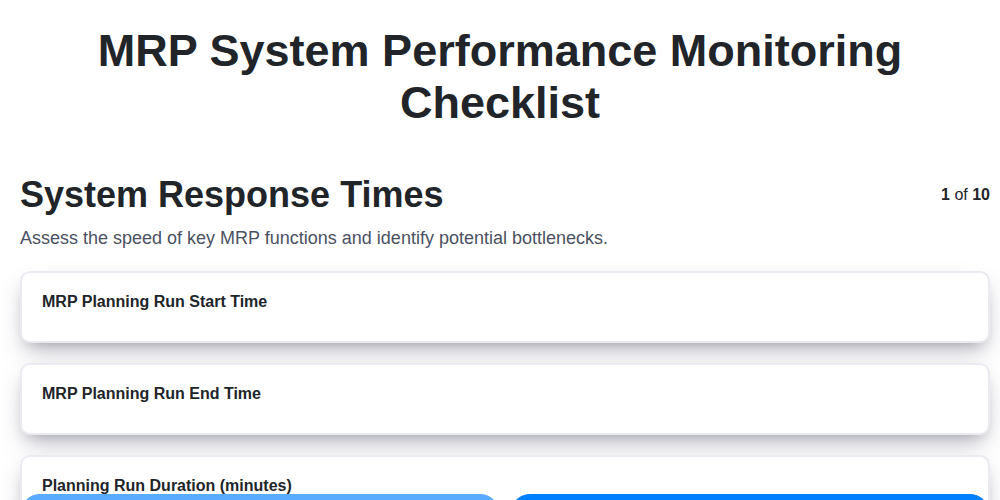
MRP System Performance Monitoring Checklist: Ensure Peak Efficiency
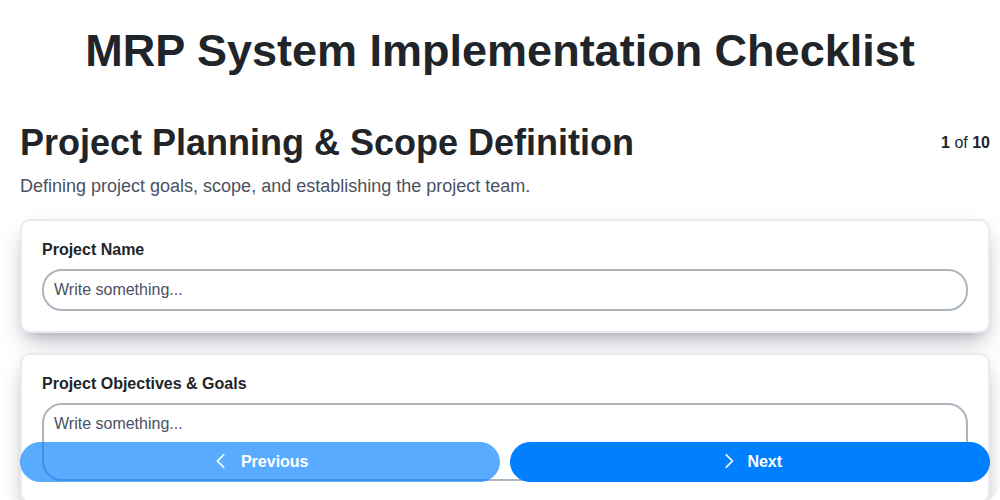
MRP System Implementation Checklist: Your Step-by-Step Guide

Top 10 MRPeasy Alternatives for 2025

The 5 Best Bill of Materials (BOM) Management Software of 2025
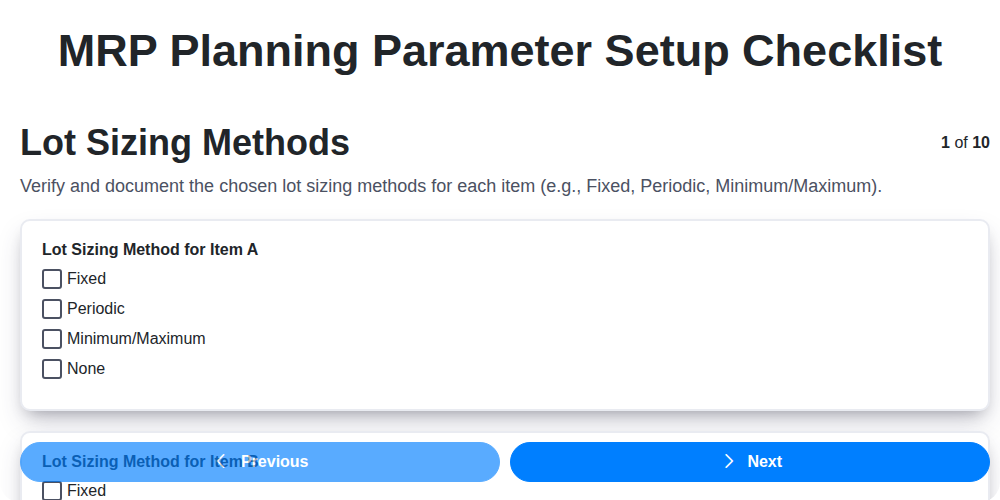
MRP Planning Parameter Setup Checklist: Your Guide to Accuracy & Efficiency

The 10 Best Manufacturing Management Software of 2025
How to improve your Bill of Materials (BOM) Management
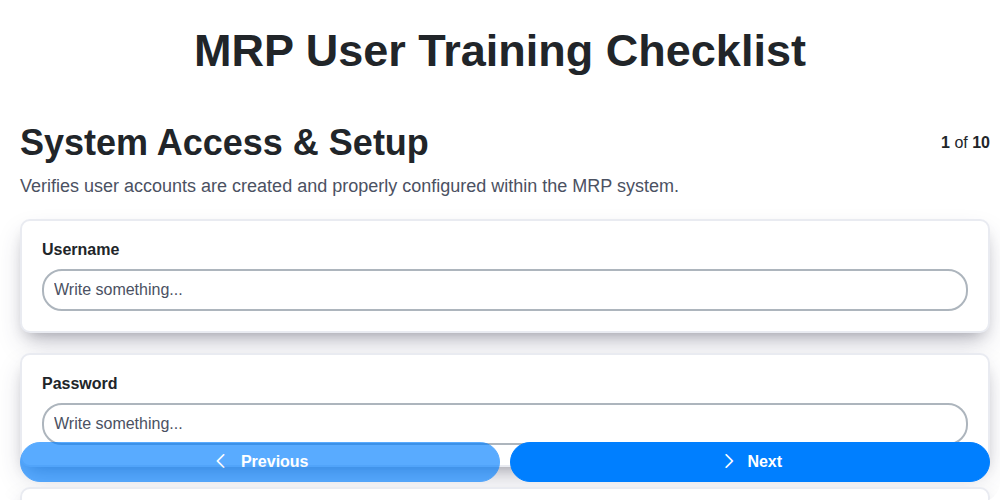
MRP User Training Checklist: Ensuring Proficiency & Success
We can do it Together
Need help with
Checklists?
Have a question? We're here to help. Please submit your inquiry, and we'll respond promptly.