MRP Planning Parameter Setup Checklist: Your Guide to Accuracy & Efficiency
Published: 12/14/2025 10:00 PM Updated: 05/18/2026 2:20 PM
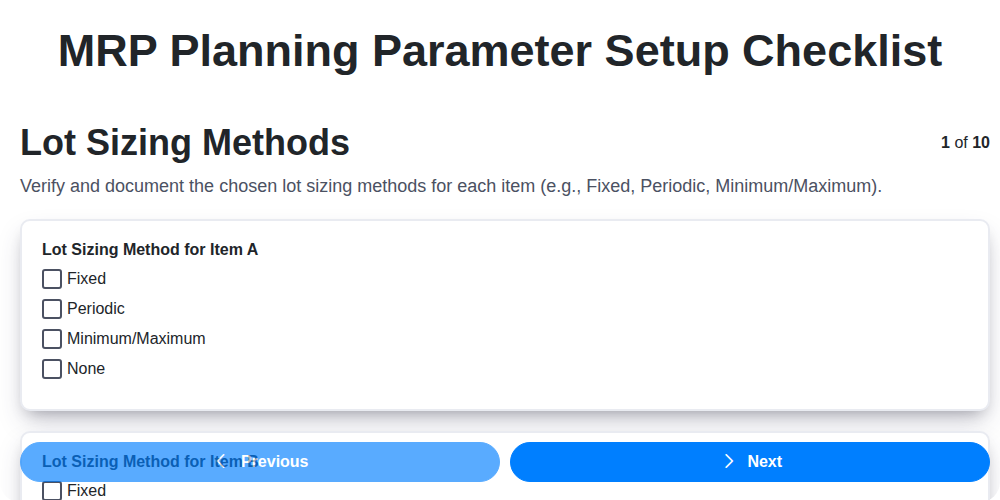
Table of Contents
- Introduction: Why Accurate MRP Parameters Matter
- 1. Lot Sizing Methods: Choosing the Right Approach
- 2. Defining Lead Times: Realistic Expectations
- 3. Safety Stock Levels: Balancing Risk and Cost
- 4. Planning Horizon: Looking Ahead
- 5. Scheduling Parameters: Optimizing Production Flow
- 6. Work Centers and Routing: The Production Pathway
- 7. Item Master Data Integration: The Foundation of Accuracy
- 8. BOM (Bill of Materials) Accuracy: Ensuring Correct Components
- 9. Unit of Measure (UOM) Consistency: Avoiding Confusion
- 10. Planning Types and Strategies: Tailoring to Your Needs
- 11. Data Validation: The Crucial Verification Step
- 12. Continuous Monitoring and Adjustment
- Conclusion: Mastering MRP Parameter Setup
- Resources & Links
TLDR: Setting up your MRP system correctly is vital for accurate production planning. This checklist guides you through key parameters like lot sizing, lead times, safety stock, and more, ensuring your MRP system reflects reality, minimizes waste, and keeps your production on track. It's your shortcut to avoiding costly errors and maximizing efficiency!
Introduction: Why Accurate MRP Parameters Matter
Material Requirements Planning (MRP) is the backbone of efficient production scheduling, but its effectiveness hinges entirely on the accuracy of its underlying parameters. Think of it like a GPS - if your starting point or destination is wrong, you're going nowhere useful. Incorrect MRP planning parameters can lead to stockouts, excess inventory, production bottlenecks, and ultimately, frustrated customers and lost revenue. This isn't just about ticking boxes; it's about ensuring your MRP system accurately reflects your business's unique operational realities. This checklist will guide you through the critical setup areas - from lot sizing to routing - to help you build a robust and reliable MRP foundation, ensuring your production runs smoothly and aligns with demand. Ignoring these details can turn MRP from a powerful tool into a costly liability.
1. Lot Sizing Methods: Choosing the Right Approach
Choosing the right lot sizing method is foundational to efficient MRP planning. It directly impacts inventory levels, production costs, and responsiveness to demand fluctuations. Several options exist, each with its own strengths and weaknesses. Let's break down the most common ones:
Lot-for-Order: This simplest method produces exactly the quantity needed to meet demand. It minimizes work-in-progress (WIP) and finished goods inventory but can lead to frequent setups, particularly for high-volume items. It's best suited for low-volume, custom-made products or when setup costs are minimal.
Economic Order Quantity (EOQ): EOQ calculates the optimal order quantity based on ordering costs, carrying costs, and demand. While theoretically ideal for minimizing total costs, it doesn's always practical in a manufacturing environment with varying demand and production constraints. It works best when demand is relatively stable and predictable.
Period Lot Sizing: This method combines demand over a planning period (e.g., weekly or monthly) to determine a single production order. It reduces the number of setups but can result in larger inventory buildups. Ideal for items with relatively predictable period demand and high setup costs.
Forward Consumption: This approach consumes available inventory first, then plans production to cover remaining demand. It helps to minimize inventory but can be challenging to manage if materials are frequently depleted.
Backward Consumption: Similar to forward consumption, but it begins by meeting planned orders first and then consumes available inventory.
Key Considerations:
- Demand Variability: Highly variable demand often favors methods that minimize setup costs or prioritize responsiveness.
- Setup Costs: High setup costs justify methods that consolidate orders.
- Carrying Costs: High carrying costs encourage smaller lot sizes.
- Material Availability: Consider the lead times and availability of raw materials when selecting a method.
Carefully analyze your product portfolio and production environment to determine the most appropriate lot sizing method for each item. A hybrid approach, using different methods for different items, is often the most effective solution.
2. Defining Lead Times: Realistic Expectations
Lead times are the backbone of any MRP (Material Requirements Planning) system. They represent the total time elapsed from when a production order is released to when it's fully completed and available. Getting these numbers wrong can have a ripple effect, leading to stockouts, excessive inventory, and missed deadlines.
So, how do you define realistic lead times? It's more than just looking at a calendar. Here's a breakdown of the considerations:
- Break it Down: Don't just have one overall lead time. Deconstruct it into its component parts: order placement lead time, procurement lead time (if external), setup time, run time, inspection time, and move time. Understanding each stage allows for targeted improvements.
- Account for Variability: Lead times aren't static. Factor in potential delays due to machine downtime, supplier issues, or material shortages. Use historical data to calculate average lead times and consider standard deviations to understand the range of possible outcomes.
- Supplier Lead Times: When sourcing materials externally, collaborate closely with your suppliers. Verify their lead times are accurate and reliable. Factor in any potential delays they might experience.
- Internal Processing Times: For in-house production, meticulously analyze the time required for each operation. Don't underestimate setup times; they often account for a significant portion of the total lead time.
- Regular Review & Adjustment: Lead times change. New equipment, process improvements, or supplier changes will all impact them. Schedule regular reviews (at least quarterly) to ensure your lead times are still accurate.
- Document Assumptions: Clearly document the assumptions used to calculate lead times. This transparency makes it easier to identify the source of any future discrepancies.
Incorrect lead times can throw off the entire MRP process. Invest the time to get them right - it's an investment that pays off in a more efficient and responsive supply chain.
3. Safety Stock Levels: Balancing Risk and Cost
Safety stock acts as a buffer against uncertainty - fluctuating demand and potential supply disruptions. Setting appropriate safety stock levels is a delicate balancing act. Too little, and you risk stockouts, lost sales, and dissatisfied customers. Too much, and you're tying up valuable working capital, increasing storage costs, and risking obsolescence.
Several factors influence optimal safety stock levels:
- Demand Variability: Higher demand fluctuations necessitate higher safety stock. Analyze historical sales data to quantify this variability (consider standard deviation).
- Lead Time Variability: Longer and more unpredictable lead times (the time between placing an order and receiving it) also require higher safety stock.
- Service Level Goals: What's your desired service level? A 99% service level (meaning you want to fulfill 99% of demand without stockouts) requires significantly higher safety stock than a 95% service level.
- Cost of Stockout: The financial impact of a stockout (lost sales, expedited shipping, potential penalties) influences the level of safety stock you're willing to hold.
- Cost of Holding Inventory: This includes storage costs, insurance, potential spoilage, and the cost of capital tied up in inventory.
Formulas like the basic safety stock calculation (Safety Stock = Z * σ * √(Lead Time)) can provide a starting point. However, advanced MRP systems often incorporate more sophisticated algorithms that consider seasonal trends, forecast accuracy, and other factors. Regularly review and adjust safety stock levels - a static safety stock isn't a sustainable strategy. A well-maintained safety stock strategy can dramatically improve responsiveness and reduce risk.
4. Planning Horizon: Looking Ahead
The planning horizon defines how far into the future your MRP system considers demand and available resources. It's a crucial parameter because it directly impacts your ability to anticipate material shortages or excess inventory. A short horizon might lead to reactive planning and frequent expediting, while an overly long horizon can tie up capital and obscure more immediate needs.
Generally, a planning horizon of 6-12 months is common, but the ideal length depends heavily on your industry and product lead times. For industries with long lead times (like aerospace or heavy machinery), a longer horizon - potentially 18-24 months - is necessary. Conversely, fast-moving consumer goods might only require a 3-6 month horizon.
Consider these factors when setting your planning horizon:
- Lead Times: Longer lead times require a longer planning horizon to account for the time it takes to procure and receive materials.
- Seasonal Demand: If your products experience seasonal peaks and valleys, the horizon should extend far enough to cover those fluctuations.
- Product Lifecycle: New product introductions and planned obsolescence should be factored in. Don't plan indefinitely for products that will be discontinued.
- Data Accuracy: Extending the horizon beyond what you have reliable data for is counterproductive.
Regularly review your planning horizon - ideally quarterly - to ensure it remains appropriate for your current business environment.
5. Scheduling Parameters: Optimizing Production Flow
Effective MRP planning hinges on accurately defining your scheduling parameters. These dictate when and how production runs are executed, directly impacting lead times, on-time delivery, and overall efficiency. It's not enough to know what needs to be made; you need a clear plan for how to make it.
Here's a breakdown of key scheduling parameters and considerations:
- Finite vs. Infinite Capacity Scheduling: Choose the appropriate method. Finite capacity scheduling accounts for limited resources and work center availability, leading to more realistic schedules. Infinite scheduling assumes unlimited capacity, which is a simplification best suited for stable production environments.
- Forward and Backward Scheduling: Understand the differences. Forward scheduling plans operations starting from the start date, while backward scheduling starts from the due date and works backward. The best choice depends on your production constraints and priorities.
- Lead Time Offset: Precisely define the time offsets associated with different operations. This ensures planned start and finish dates accurately reflect real-world processing times.
- Work Center Priorities: Establish clear priorities for work centers to optimize throughput and minimize bottlenecks. High-priority work centers should handle critical operations first.
- Setup Times: Accurately capture the time required to set up machinery for each production run. This is crucial for realistic scheduling and avoiding delays.
- Sequence-Dependent Setup Times: Some setups depend on the preceding and succeeding operations. Ensure your system captures these dependencies to generate optimized sequences.
- Production Batch Sizes & Changeover Times: Consider the impact of different batch sizes and changeover times on overall production efficiency.
Review and refine these parameters regularly as production volumes, product mix, and resource availability change. Poorly defined scheduling parameters can negate the benefits of even the most robust MRP system.
6. Work Centers and Routing: The Production Pathway
MRP systems thrive on accurate information about how your products are made. Work centers and routing define that production pathway. Work centers represent the physical locations where operations are performed (e.g., Milling, Assembly, Painting). Routing, on the other hand, is the sequence of operations - the precise order in which a product moves through these work centers.
Incorrect work center or routing data can wreak havoc on your MRP plan. Imagine planning for a milling operation at a work center that's permanently offline, or directing parts to the wrong sequence - production bottlenecks and delays are inevitable.
Key Considerations:
- Work Center Capacity: Ensure your MRP system accurately reflects the capacity of each work center (machines, personnel, shift schedules). Over-planning a congested work center will lead to missed deadlines.
- Routing Sequence Accuracy: Double-check that the sequence of operations in your routing is correct. Even a minor error can lead to significant rework and wasted materials.
- Lead Times per Operation: Each operation within a routing has its own processing time. These lead times must be accurately defined in your MRP system.
- Setup Times: Don't forget to include setup times between operations. These contribute to the overall lead time and impact material planning.
- Regular Review & Updates: Production processes evolve. Routings and work center information should be reviewed and updated regularly to reflect changes.
By carefully defining and maintaining your work center and routing data, you lay the foundation for a reliable and responsive MRP plan.
7. Item Master Data Integration: The Foundation of Accuracy
Your MRP system is only as good as the data you feed it. Item Master Data Integration is absolutely critical for accurate planning and avoids a cascade of downstream errors. This isn't just about uploading a spreadsheet; it's about establishing a robust, ongoing connection between your Item Master (where you define your products and their characteristics) and your MRP system.
Think of it this way: if your MRP system believes a part weighs 1 lb when it actually weighs 2, or if it's classifying a component as a "finished good" when it's a raw material, your planned orders will be wildly inaccurate.
Key Considerations:
- Real-time Synchronization: Ideally, changes made to your Item Master should automatically reflect in your MRP system. This minimizes manual updates and reduces the risk of discrepancies.
- Data Mapping: Ensure accurate data mapping between the Item Master fields and the corresponding MRP fields. This includes everything from part numbers and descriptions to lead times and UOMs.
- Validation Rules: Implement data validation rules in your Item Master to prevent incorrect data from ever being entered. This is a proactive measure that catches errors at their source.
- Regular Audits: Conduct regular audits of the data synchronization to verify that the integration is functioning correctly and that no data is being missed or misinterpreted.
- User Access Control: Restrict access to Item Master data to authorized personnel to maintain data integrity and prevent accidental modifications.
A clean and consistent Item Master Data Integration forms the bedrock of your MRP planning. Without it, even the most sophisticated algorithms will produce unreliable results.
8. BOM (Bill of Materials) Accuracy: Ensuring Correct Components
The Bill of Materials (BOM) is the cornerstone of your MRP system. It's a comprehensive list of all the raw materials, components, sub-assemblies, and parts required to manufacture a finished product. An inaccurate BOM throws the entire planning process into chaos, leading to material shortages, excess inventory, production delays, and ultimately, dissatisfied customers.
Why is BOM Accuracy Critical?
- Incorrect Quantities: If the BOM lists the wrong quantity of a component, your MRP system will generate incorrect material requirements, leading to either too much or too little of that component on hand.
- Missing Components: Omitting a necessary component completely halts production. Imagine starting to build a product only to discover a vital part is missing - a costly and frustrating situation.
- Incorrect Component Versions: Using outdated or incorrect versions of components can result in compatibility issues and rework.
- Phantom BOM Errors: Phantom BOMs (assemblies that disappear after use) need meticulous review to ensure they're correctly defined and don't cause planning issues.
How to Ensure BOM Accuracy:
- Engineering Review: Have engineering teams rigorously review and approve all BOM changes.
- Version Control: Implement a robust version control system for BOMs, clearly documenting changes and their justifications.
- Regular Audits: Conduct periodic audits of the BOM to compare it against actual production processes. This can involve physical verification and cross-referencing with engineering drawings.
- Change Management Process: Establish a formal change management process that requires approvals for any BOM modifications.
- Integration with CAD/PLM: Ideally, your BOM system should be integrated with your CAD (Computer-Aided Design) and PLM (Product Lifecycle Management) systems to ensure changes are automatically reflected.
- Training: Train personnel responsible for managing BOMs on best practices and the importance of accuracy.
A small investment in BOM accuracy will yield significant returns in improved production efficiency and reduced costs.
9. Unit of Measure (UOM) Consistency: Avoiding Confusion
One of the most deceptively simple, yet incredibly impactful, aspects of MRP planning is maintaining consistent Unit of Measure (UOM) across your entire system. A mismatch here can lead to significant errors in material requirements, procurement, and ultimately, production.
Think about it: are you ordering raw materials in pounds, but planning production in kilograms? Are finished goods being tracked in each in inventory, while sales orders are using cases? These inconsistencies can quickly snowball into inaccurate forecasts and unexpected shortages or surpluses.
Here's what to check:
- Review all items: Carefully examine each item master record. Ensure the UOM used for purchasing, inventory tracking, and sales/production planning is the same.
- Conversion Factors: If different UOMs are unavoidable (e.g., supplier provides in one unit, you use another), absolutely maintain accurate conversion factors within your MRP system. Regularly verify these conversions.
- BOM Consistency: Your Bill of Materials must also adhere to the defined UOM. A BOM using pounds when the parent item's UOM is kilograms will throw everything off.
- Reporting & Analysis: Ensure all reports and analyses use the correct and consistent UOM. Confusing reports lead to incorrect decisions.
- User Training: Ensure your team understands the defined UOMs and knows how to interpret data correctly.
By paying close attention to UOM consistency, you can avoid costly errors and improve the overall accuracy of your MRP planning.
10. Planning Types and Strategies: Tailoring to Your Needs
MRP planning isn't a one-size-fits-all approach. Selecting the right planning types and strategies is crucial for optimizing your production and inventory. This section dives into considerations for choosing the best fit for your business.
Understanding Planning Types: Most MRP systems offer a range of planning types. Common ones include:
- Make-to-Stock (MTS): Ideal for products with stable demand and long lead times. Materials are produced based on forecasted demand.
- Make-to-Order (MTO): Suitable for highly customized products or those with volatile demand. Production begins only after a customer order is received.
- Assemble-to-Order (ATO): A hybrid approach where base components are readily available, and final assembly occurs after an order is placed. Offers quicker fulfillment than MTO while allowing some customization.
- Engineer-to-Order (ETO): Used for complex projects with unique requirements, involving design and fabrication. Requires longer lead times and more extensive planning.
Strategic Considerations: Beyond the core planning type, you need to define strategies within that type. Think about:
- Demand Forecasting Methods: Will you rely on historical data, statistical models, or a combination of both? Accurate forecasting dramatically improves MRP accuracy.
- Planning Buckets: The granularity of your planning - daily, weekly, or monthly - significantly impacts responsiveness.
- Dynamic vs. Static Planning: Do you need the system to automatically adjust plans based on real-time data (dynamic) or are fixed plans sufficient (static)?
- Collaborative Planning: Implementing collaborative planning, forecasting, and replenishment (CPFR) can enhance accuracy and alignment across departments and with key suppliers.
Carefully evaluate your product portfolio, demand patterns, and operational constraints to select planning types and strategies that align with your business goals and ensure efficient resource utilization. Regularly review and adjust these settings as your business evolves.
11. Data Validation: The Crucial Verification Step
After meticulously setting up your MRP planning parameters, don't simply assume everything is perfect. A robust data validation process is the final, and arguably most critical, step. This isn't just about catching typos; it's about ensuring the system's calculations and recommendations are reliable and lead to accurate production and inventory decisions.
Begin with a sample run - ideally covering a representative selection of your items and production scenarios. Carefully compare the MRP system's planned orders, proposed schedules, and inventory projections against your historical data and current demand signals. Look for significant discrepancies.
Key areas to scrutinize during validation include:
- Lot Sizes: Are the calculated lot sizes practical and cost-effective, or are they generating unusually large or small orders?
- Lead Times: Do the planned order dates and ship dates align with actual lead times you experience?
- Safety Stock: Is the calculated safety stock preventing stockouts without excessively inflating inventory levels?
- BOM Accuracy: Validate that planned orders generated by the system correctly reflect the components needed based on the BOM.
- Routing & Work Centers: Ensure the system's routing considers realistic processing times and available work center capacity.
- UOM Consistency: Confirm that all data uses consistent units of measure, eliminating potential calculation errors.
Document your validation findings meticulously. If errors or inconsistencies are identified, systematically correct the underlying data or planning parameters. Repeat the validation process until the system's output consistently aligns with your expectations. Remember, the accuracy of your MRP system directly impacts your business's ability to meet demand, minimize costs, and maintain optimal inventory levels. Data validation isn't a one-time task; it should be incorporated as a regular practice to maintain system integrity and adapt to changing business conditions.
12. Continuous Monitoring and Adjustment
MRP planning isn't a set it and forget it endeavor. The parameters you meticulously set up initially are based on assumptions and historical data, which can change. Market fluctuations, supplier delays, production bottlenecks, and evolving customer demand all impact your material requirements.
Therefore, continuous monitoring and adjustment are crucial for maintaining MRP accuracy and preventing costly disruptions. Regularly review key performance indicators (KPIs) such as:
- Forecast Accuracy: How close are your forecasts to actual demand?
- Inventory Turns: Are you moving inventory efficiently?
- On-Time Delivery Performance: Are you meeting your customer commitments?
- Obsolescence Rates: Are you minimizing the risk of excess or obsolete inventory?
Based on these insights, be prepared to revisit and refine your MRP planning parameters. This might involve adjusting safety stock levels based on increased demand variability, shortening lead times due to process improvements, or updating work center capacities to reflect changes in staffing or equipment. Embrace a culture of continuous improvement and treat your MRP system as a dynamic tool that needs ongoing calibration. Scheduled reviews (e.g., monthly, quarterly) are a good starting point, but be ready to react quickly to unexpected events.
Conclusion: Mastering MRP Parameter Setup
Setting up your MRP parameters isn't a set it and forget it exercise. It's a continuous process of refinement and optimization. This checklist provides a solid foundation, but remember that your specific business, industry, and product complexity will dictate the ideal settings. Regularly review these parameters - ideally, at least quarterly - and adjust them based on demand fluctuations, supplier performance, and internal process improvements. A well-configured MRP system, driven by accurate and consistently reviewed parameters, will drastically reduce stockouts, minimize excess inventory, and ultimately, improve your overall production efficiency and profitability. Don't be afraid to experiment (with controlled testing and analysis!) to find what works best for your unique operational landscape. The effort invested in mastering your MRP parameter setup will pay dividends in streamlined processes and a more responsive supply chain.
Resources & Links
- APICS: The Association for Supply Chain Management (APICS) is a global resource for supply chain professionals. They offer certifications (like CPIM and CSCP) and resources related to MRP, planning, and inventory management. Explore their website for definitions, best practices, and educational materials.
- NetSuite: NetSuite is a popular ERP system with robust MRP functionality. Their website offers articles, guides, and resources on MRP implementation, parameter setup, and optimization. While geared towards their platform, many concepts are universally applicable.
- Oracle: Oracle offers various ERP solutions with MRP capabilities. They provide whitepapers, case studies, and tutorials that delve into MRP parameter configuration and best practices within their systems, but the principles discussed are broadly relevant.
- Infor: Infor is another leading ERP provider specializing in industry-specific solutions. Their website has a wealth of information on MRP, production planning, and inventory optimization - including how to configure key parameters.
- Mrp II: This site focuses heavily on Manufacturing Resource Planning (MRP II) and often covers deeper dives into parameter setup, lot sizing, and scheduling. Their detailed explanations are helpful for understanding the 'why' behind each parameter.
- QAD: QAD is an ERP vendor with strong manufacturing focus. They provide resources, including whitepapers and webinars, that discuss MRP parameter configuration, accuracy, and related best practices.
- Supply Chain Dive: Supply Chain Dive is a news and information source covering topics related to supply chain management, including MRP and related topics. Search their website for articles discussing challenges, trends, and best practices.
- The Lean Enterprise Institute: While not exclusively focused on MRP, Lean principles heavily influence efficient production planning. Understanding Lean concepts like Value Stream Mapping and continuous improvement are critical for effective parameter selection.
- YouTube - MRP Parameter Setup: YouTube offers numerous tutorials and explanations related to MRP parameter setup. Search using specific terms from the blog post for more focused content (e.g., 'MRP Lot Sizing', 'Safety Stock Calculation').
- iSixSigma: iSixSigma provides information and training on Six Sigma methodologies, which can be applied to optimize MRP processes, including data validation, parameter setting, and performance monitoring. Search for articles related to process improvement in manufacturing.
Frequently Asked Questions
What is MRP planning and why is parameter setup so important?
MRP (Material Requirements Planning) is a system that helps plan and manage production and inventory levels. Parameter setup defines how the MRP system calculates those levels. Incorrect parameters can lead to overstocking, stockouts, and inefficient production schedules. Accurate parameter setup ensures the MRP system provides reliable forecasts and efficient production plans.
Who should use this checklist?
This checklist is designed for anyone involved in MRP planning, including production planners, inventory managers, supply chain professionals, and anyone responsible for configuring and maintaining MRP systems.
What types of MRP parameters are covered in this checklist?
The checklist covers essential parameters like lead times, safety stock levels, lot sizes, planning horizons, and procurement methods. It also touches upon parameters related to BOM (Bill of Materials) and routing.
What is 'lead time' in the context of MRP, and why is it crucial to get right?
Lead time refers to the total time it takes to receive a material or complete a production step, from order placement to availability. Accurate lead times are critical for calculating when to order or produce, preventing delays and stockouts.
What is 'safety stock' and how do I determine the correct level?
Safety stock is extra inventory held to buffer against unexpected demand or supply disruptions. Determining the right level involves considering demand variability, lead time variability, and desired service level (the probability of avoiding stockouts). The checklist provides guidance on calculation methods.
What is 'lot size' and what are the different lot sizing methods?
Lot size refers to the quantity ordered or produced at one time. Common methods include Fixed Order Quantity (FOQ), Economic Order Quantity (EOQ), and Periodic Order Quantity. The checklist helps you understand the pros and cons of each and choose the best fit for your products and processes.
What's the difference between a 'planning horizon' and a 'bucket size'?
The planning horizon is the total timeframe the MRP system plans for. The bucket size is the smallest unit of time the system considers (e.g., days, weeks). These parameters influence how granular the planning is.
How does a BOM (Bill of Materials) affect MRP planning, and how does this checklist address it?
The BOM defines the components and quantities required to manufacture a finished product. Accurate BOMs are essential for accurate material requirements. The checklist emphasizes the need to review and validate BOMs regularly.
What is a 'routing' and why is it relevant to MRP parameters?
A routing defines the sequence of operations needed to manufacture a product. Routing times are key components of lead time calculations within MRP. The checklist highlights the importance of accurate routing data.
Can I use this checklist as a standalone document, or does it require referencing the original article?
While the checklist provides a good starting point, it's designed to be used in conjunction with the original article. The article provides the context, explanations, and deeper insights behind each parameter.
Found this Article helpful?
Comments
There are no comments yet. Be the first to add one!
Related Articles
MRP Integration Testing Checklist: A Comprehensive Guide
MRP System Implementation Checklist: Your Step-by-Step Guide

Top 10 MRPeasy Alternatives for 2025

The 5 Best Bill of Materials (BOM) Management Software of 2025
MRP User Training Checklist: Ensuring Proficiency & Success

The 10 Best Manufacturing Management Software of 2025
How to improve your Bill of Materials (BOM) Management
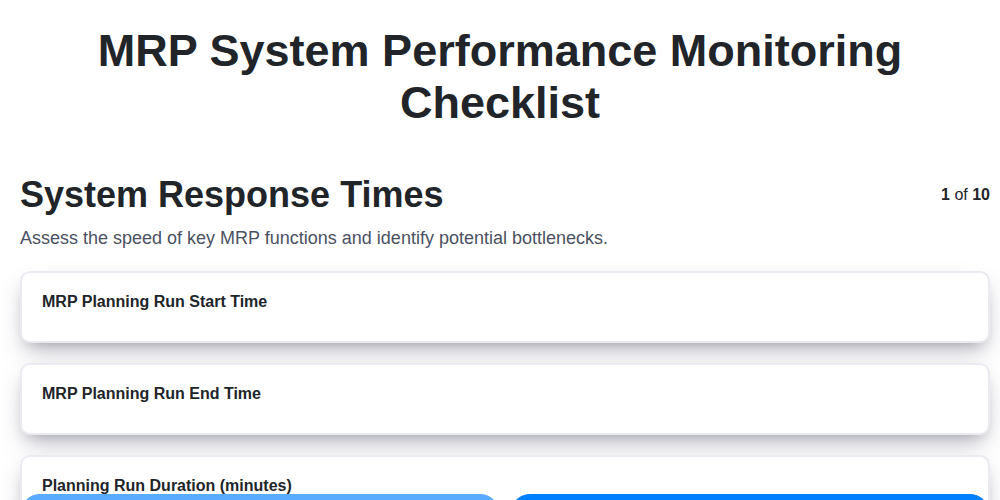
MRP System Performance Monitoring Checklist: Ensure Peak Efficiency
We can do it Together
Need help with
Material Requirements Planning (MRP)?
Have a question? We're here to help. Please submit your inquiry, and we'll respond promptly.