How to Improve your Warehouse Management System (WMS) with AI in 2026?
Published: 05/09/2026 9:00 PM Updated: 05/10/2026 6:12 AM
Table of Contents
- The Evolution of Warehouse Management: Moving Beyond Static Systems
- The 2026 Landscape: Why Traditional WMS is No Longer Enough
- The Core Benefits of Integrating AI into Your WMS
- Predictive Analytics: Anticipating Demand Before It Hits the Dock
- Smart Inventory Management: Reducing Shrinkage with Real-Time AI Audits
- Optimizing Labor Productivity with AI-Driven Task Sequencing
- Meet Tony: How the ChecklistGuro AI Assistant Revolutionizes Workflow Execution
- Automating Quality Control with Computer Vision and Intelligent Checklists
- Reducing Human Error: Transforming Manual Processes into Intelligent Workflows
- Scaling Your Operations: How AI Adapts to Fluctuating Supply Chain Demands
- Implementation Strategies: Integrating AI into Your Existing ChecklistGuro Setup
- The ROI of AI-Enhanced WMS: Measuring Success in 2026
- Conclusion: Preparing Your Warehouse for an Autonomous Future
- Resources & Links
TLDR: Discover how to future-proof your logistics operations using AI-driven checklists. This guide explains how to implement intelligent automation within your WMS, specifically leveraging the ChecklistGuro ecosystem and our AI Assistant, Tony, to eliminate manual errors, optimize inventory accuracy, and streamline complex warehouse workflows through actionable, AI-powered task management.
The Evolution of Warehouse Management: Moving Beyond Static Systems
For decades, traditional Warehouse Management Systems (WMS) have functioned as digital filing cabinets-static repositories of data that tell you what is in your warehouse, but rarely what should happen next. These legacy systems rely heavily on manual data entry and reactive decision-making, leaving managers to constantly firefight discrepancies, stockouts, and shipping delays. In these older models, the software is merely a passive observer of the workflow.
As we move into 2026, the industry standard is shifting from reactive record-keeping to proactive orchestration. A static system can tell you that an item is out of stock, but a modern, AI-enhanced system can predict the shortage before it occurs by analyzing historical trends and incoming shipment data. The evolution lies in transitioning from a system that simply stores information to a dynamic Work OS that actively guides your team through optimized, error-free processes. To stay competitive, businesses must move away from manual oversight and toward intelligent, automated workflows that transform the WMS from a passive tool into an active operational partner.
The 2026 Landscape: Why Traditional WMS is No Longer Enough
As we approach 2026, the era of static software is officially over. For years, a standard Warehouse Management System (WMS) served as a digital filing cabinet-a place to record what happened, where items were located, and which orders were shipped. While this provided visibility, it was fundamentally reactive. It could tell you that an error occurred, but it couldn't prevent it.
Today's supply chains are moving too fast for reactive systems. With the rise of hyper-personalization, same-day delivery expectations, and global volatility, the margin for error has shrunk to near zero. Traditional WMS platforms struggle to keep up with the sheer volume of real-time data generated by IoT sensors, automated sorters, and fluctuating demand signals. Relying solely on a legacy system creates data silos and manual bottlenecks that lead to costly shipping delays and inventory discrepancies.
In 2026, the competitive advantage has shifted from those who simply record data to those who interpret it. Modern warehouses require a system that doesn't just store information but actively participates in the decision-making process. To stay relevant, businesses must move beyond simple record-keeping and transition toward an intelligent, proactive ecosystem where AI-driven insights drive every movement on the warehouse floor.
The Core Benefits of Integrating AI into Your WMS
Integrating AI into your Warehouse Management System is no longer a futuristic concept reserved for tech giants; in 2026, it is a fundamental necessity for maintaining a competitive edge. By moving beyond static data entry and embracing intelligent automation, business owners can transition from reactive troubleshooting to proactive management.
The primary advantage lies in the shift from descriptive to predictive capabilities. While a traditional WMS tells you what has happened, an AI-enhanced system tells you what is likely to happen. Here are the core benefits you can expect:
- Enhanced Accuracy and Error Reduction: Human error in picking, packing, and inventory counting is one of the highest costs in warehousing. AI-driven checklists, powered by assistants like Tony, can verify tasks in real-time, flagging discrepancies the moment they occur rather than during end-of-day audits.
- Intelligent Demand Forecasting: AI algorithms analyze historical trends and seasonal patterns to predict upcoming surges. This allows you to optimize your stock levels, ensuring you are never overstocked on slow-moving items or caught in a stockout situation during peak demand.
- Optimized Resource Allocation: AI can analyze warehouse traffic and labor availability to suggest the most efficient workflows. This means smarter slotting strategies and optimized picking routes, significantly reducing the travel time of warehouse staff and increasing overall throughput.
- Automated Decision Support: Instead of managers spending hours parsing through spreadsheets, AI provides instant, actionable insights. When an anomaly is detected, the system doesn't just alert you-it suggests the best course of action, allowing for rapid, data-backed decision-making.
- Seamless Scalability: As your business grows, your complexity grows. AI-integrated systems are designed to handle increased data loads and more complex SKU architectures without a proportional increase in administrative overhead, making your operations inherently scalable.
Predictive Analytics: Anticipating Demand Before It Hits the Dock
In 2026, the era of reactive warehousing is officially over. Waiting for an order to arrive before deciding how to allocate labor or space is a recipe for bottlenecks and soaring operational costs. By integrating AI into your WMS, you shift from a defensive posture to a proactive one.
Through predictive analytics, AI analyzes vast streams of historical data, seasonal trends, and even external market signals to forecast upcoming order volumes with startling precision. Instead of reacting to a sudden surge in demand, your system identifies the pattern days or even weeks in advance. This allows managers to optimize labor scheduling, pre-allocate high-demand SKUs to golden zones near packing stations, and adjust replenishment cycles before a stockout occurs.
With ChecklistGuro, this isn't just about viewing a graph of projected sales; it's about execution. Our AI Assistant, Tony, can bridge the gap between insight and action by automatically generating Pre-Peak Readiness checklists. Tony can prompt your team to verify stock levels and prepare specialized picking zones based on predicted surges, ensuring your warehouse is always one step ahead of the incoming tide of orders.
Smart Inventory Management: Reducing Shrinkage with Real-Time AI Audits
In 2026, the era of periodic inventory counts is becoming obsolete. Traditional manual audits are often reactive, identifying discrepancies weeks after they have occurred, by which time shrinkage-whether due to theft, damage, or administrative error-has already impacted your bottom line.
Integrating AI into your WMS transforms inventory management from a reactive struggle into a proactive strategy. By leveraging Tony, our advanced AI Assistant, your warehouse no longer relies solely on human oversight. AI-driven audits work by continuously analyzing real-time data streams from every movement within your facility. Every time a picker scans a barcode or a bin is updated, the AI cross-references the action against historical patterns, weight sensors, and even computer vision feeds to detect anomalies instantly.
Instead of waiting for the end of the month to find a discrepancy, the AI identifies phantom inventory or misplaced items the moment they deviate from the expected digital record. This allows managers to trigger immediate, automated micro-audits. By using ChecklistGuro's intelligent templates, the system can automatically generate high-priority verification tasks for floor staff, ensuring that shrinkage is caught and corrected in real-time, effectively turning your WMS from a passive database into an active guardian of your stock accuracy.
Optimizing Labor Productivity with AI-Driven Task Sequencing
In 2026, the greatest challenge in warehousing isn't just managing inventory-it's managing human effort. Traditional WMS setups often rely on static picking lists that fail to account for real-time shifts in warehouse congestion or sudden order spikes. This leads to dead mileage, where workers spend more time walking between aisles than actually picking products.
By integrating AI into your task sequencing, you move from reactive to proactive management. Instead of a simple queue, an AI-enhanced system analyzes the entire floor in real-time. It evaluates current staff locations, equipment availability, and order priority to dynamically re-sequence tasks.
With ChecklistGuro, this becomes seamless. Our AI Assistant, Tony, doesn't just present a list of tasks; he optimizes the order of operations. For example, if a high-priority shipment enters the system, Tony can instantly recalculate the most efficient route for your team, ensuring that pickers are directed to adjacent zones to minimize travel time. By automating the thinking part of logistics, you empower your workforce to focus on execution, significantly reducing fatigue and maximizing throughput per man-hour.
Meet Tony: How the ChecklistGuro AI Assistant Revolutionizes Workflow Execution
While a standard WMS provides the data, Tony, the flagship AI Assistant within ChecklistGuro, provides the intelligence. Think of Tony not just as a chatbot, but as a proactive warehouse supervisor embedded directly into your digital workflow.
In 2026, the gap between knowing what needs to be done and actually doing it is where most warehouse inefficiencies live. Tony bridges this gap by transforming static data into active execution. Instead of managers manually auditing logs to find discrepancies, Tony proactively scans your WMS data to identify anomalies, such as picking errors or delayed shipments, before they escalate into costly delays.
When integrated into your operational checklists, Tony can:
- Automate Verification: Instantly cross-reference incoming shipments against digital manifests to ensure 100% accuracy without manual data entry.
- Predictive Troubleshooting: Analyze patterns in your warehouse tasks to alert you when a specific zone is becoming a bottleneck.
- Smart Task Routing: Dynamically update staff checklists based on real-time inventory shifts, ensuring your team is always working on the highest-priority tasks.
- Natural Language Querying: Allow managers to ask complex questions like, Tony, which outbound orders are at risk of missing today's carrier cutoff? and receive instant, actionable answers.
By integrating Tony into your daily checklists, you transition from reactive management to predictive orchestration, ensuring that your WMS isn't just a database, but a living, breathing engine of productivity.
Automating Quality Control with Computer Vision and Intelligent Checklists
In 2026, quality control is no longer just about human eyes and manual logs; it is about the seamless integration of visual intelligence and structured verification. By integrating Computer Vision (CV) with the intelligent checklists provided by ChecklistGuro, warehouse managers can transition from reactive error detection to proactive prevention.
Imagine a scenario where high-resolution cameras at your packing stations automatically scan outgoing parcels. Using AI, the system identifies damaged packaging or incorrect labeling in real-time. However, the true power lies in the Closed-Loop Verification process: when the AI detects a discrepancy, it instantly triggers a dynamic, high-priority checklist via Tony, our AI Assistant.
Instead of a worker manually searching for a supervisor, Tony immediately pushes a specialized Discrepancy Resolution Checklist to the operator's handheld device. This checklist guides the staff through specific verification steps-such as re-scanning the SKU, checking the weight, and verifying the pallet integrity-ensuring that every error is documented and corrected before the shipment ever leaves the dock. This synergy between visual AI and structured task management ensures that your WMS isn't just a database, but an active participant in maintaining 100% accuracy.
Reducing Human Error: Transforming Manual Processes into Intelligent Workflows
In a traditional warehouse environment, human error is often an inevitability rather than an exception. Manual data entry, missed scanning steps, and misplaced inventory create a ripple effect of costly discrepancies that drain profitability. As we move into 2026, the manual approach to oversight is becoming a competitive liability.
The integration of AI within your WMS changes the fundamental nature of warehouse workflows from reactive correction to proactive prevention. Instead of relying solely on a worker's memory or paper-based logs, AI-driven workflows use intelligent checklists to guide every movement. When you use an AI-powered system like ChecklistGuro, the technology doesn't just record what happened-it anticipates what should happen.
By implementing intelligent workflows, the system can cross-reference real-time sensor data and historical patterns to flag anomalies the moment they occur. For example, if a picker deviates from the optimized route or skips a critical verification step, Tony, our AI Assistant, can instantly intervene with a real-time prompt. This transforms a checklist from a passive piece of documentation into an active, smart supervisor. By automating the verification of complex tasks, you reduce the cognitive load on your staff, allowing them to focus on speed and efficiency without sacrificing the precision required in modern logistics.
Scaling Your Operations: How AI Adapts to Fluctuating Supply Chain Demands
In the modern era of e-commerce, the only constant is unpredictability. Seasonal surges, sudden shifts in consumer behavior, and global supply chain disruptions can turn a well-oiled warehouse into a bottleneck overnight. Traditional, static WMS platforms often struggle to react to these swings, leaving managers to manually scramble through spreadsheets and updated spreadsheets to compensate for the chaos.
This is where AI-integrated systems change the game. Unlike traditional software that merely records what has already happened, an AI-enhanced WMS acts as a predictive engine. By analyzing historical data patterns and real-time throughput, AI can forecast upcoming spikes in order volume and suggest preemptive adjustments to your labor allocation and slotting strategies.
With ChecklistGuro, scaling doesn't mean adding more manual oversight; it means deploying smarter processes. Our AI Assistant, Tony, helps bridge the gap between planning and execution. When demand surges, Tony can automatically trigger specialized Peak Season checklists, re-prioritizing high-velocity items and adjusting picking routes to ensure that increased volume doesn't lead to increased errors. Instead of your team working harder to manage the scale, the technology adapts the workflow to handle the pressure, ensuring your operational efficiency remains stable even when the market is anything but.
Implementation Strategies: Integrating AI into Your Existing ChecklistGuro Setup
Transitioning to an AI-enhanced warehouse doesn't require a complete overhaul of your existing infrastructure. The beauty of the ChecklistGuro ecosystem is that it is designed for seamless integration. Instead of replacing your current workflows, the goal is to augment them with intelligent automation.
To successfully integrate AI into your current setup, follow these three strategic steps:
1. Digitizing the Foundation
Before AI can assist, your processes must be structured. Start by migrating your paper-based or fragmented manual processes into standardized digital checklists within ChecklistGuro. By creating a digital audit trail of every picking, packing, and receiving task, you provide the training data that AI needs to understand your unique operational patterns.
2. Deploying Tony as your Operational Co-Pilot
Once your workflows are digitized, introduce Tony, your AI Assistant, to the floor. Rather than just acting as a static database, Tony can be integrated into your active checklists to provide real-time intelligence. For example, while a supervisor is reviewing a receiving checklist, Tony can automatically cross-reference incoming stock against historical trends and alert the team to potential discrepancies or replenishment needs before they become bottlenecks.
3. Enabling Predictive Auditing
The final stage of implementation is moving from reactive to proactive management. Use the data captured in your completed checklists to empower the AI to perform Predictive Auditing. By analyzing completed task histories, the system can identify specific shifts, zones, or time periods where errors are most likely to occur. You can then use ChecklistGuro to automatically trigger Smart Verification checklists for those high-risk areas, ensuring that the AI is actively preventing errors rather than just reporting them after they happen.
The ROI of AI-Enhanced WMS: Measuring Success in 2026
Investing in AI-integrated warehouse technology is no longer just about staying ahead of the curve-it is about measurable bottom-line impact. In 2026, the true value of an AI-enhanced WMS is found in the transition from reactive management to predictive execution. When you integrate an intelligent assistant like Tony into your workflows, the Return on Investment (ROI) manifests in three critical areas:
1. Drastic Reduction in Operational Errors Traditional WMS platforms rely on human diligence to follow protocols. AI-driven checklists act as a digital safety net. By using predictive error detection, the system can alert managers to discrepancies in picking or packing before they leave the dock. The reduction in costly mis-shipments and subsequent return logistics (reverse logistics) provides an immediate, measurable boost to your profit margins.
2. Optimized Labor Productivity Labor is often the highest overhead in warehousing. AI doesn't replace your team; it makes them hyper-efficient. By automating the complex decision-making processes-such as intelligent slotting and dynamic task prioritization-AI reduces dead travel time for warehouse staff. You will see an increase in orders processed per man-hour, allowing your existing workforce to handle higher volumes without a proportional increase in headcount.
3. Improved Inventory Accuracy and Capital Efficiency Stockouts and overstocking are both silent profit killers. An AI-enhanced WMS utilizes real-time data analysis to provide highly accurate demand forecasting. By minimizing the gap between recorded and actual inventory, you reduce the capital tied up in excess safety stock and mitigate the loss of revenue caused by unfulfillable orders.
When calculating your ROI, look beyond the initial software cost. Measure the decrease in error rates, the uptick in throughput, and the reduction in manual audit hours. In the era of ChecklistGuro, the math is simple: smarter workflows lead to leaner, more profitable operations.
Conclusion: Preparing Your Warehouse for an Autonomous Future
The transition toward an AI-integrated warehouse is no longer a luxury reserved for industry giants; it is a strategic necessity for any business owner aiming to remain competitive in 2026. As supply chains become increasingly complex and consumer demands for instant fulfillment grow, the margin for human error shrinks. Moving toward an autonomous future doesn't mean replacing your workforce, but rather empowering them with smarter tools.
By integrating AI-driven checklists and intelligent assistants like Tony into your existing WMS, you are not just automating tasks-you are building a self-optimizing ecosystem. You are moving from a reactive state of fixing mistakes to a proactive state of preventing discrepancies.
The technology is ready, and the roadmap is clear. The question is no longer whether your warehouse can adopt AI, but how quickly you can implement these intelligent frameworks to ensure your operations are scalable, resilient, and ready for the next decade of digital transformation. Start small, implement structured AI workflows today, and watch your warehouse evolve from a cost center into a high-speed engine of growth.
Resources & Links
- Gartner Supply Chain Research: In-depth market analysis and predictions regarding the evolution of warehouse automation and AI implementation in global supply chains.
- McKinsey & Company - Operations Practice: Strategic insights into how AI and machine learning are driving productivity gains and ROI in modern logistics and manufacturing.
- Forbes Technology Council: Expert commentary on the digital transformation of traditional business models through the adoption of predictive analytics and automation.
- Supply Chain Brain: Industry news and deep dives into real-time inventory management, computer vision applications, and labor optimization strategies.
- ChecklistGuro: The primary platform for intelligent workflow execution, featuring the 'Tony' AI Assistant designed to automate quality control and reduce manual errors.
- IBM Watson Supply Chain: Technical resources and case studies regarding the application of predictive analytics and AI-driven demand forecasting in logistics.
- Logistics Management Magazine: A resource for staying updated on the transition from static WMS to autonomous, AI-integrated warehouse ecosystems.
Found this Article helpful?
Comments
There are no comments yet. Be the first to add one!
WMS - Warehouse Management System Solution Demo
Optimize your warehouse operations & boost efficiency! ChecklistGuro's WMS streamlines inventory management, order fulfillment, and shipping. Reduce errors, improve accuracy, & maximize space utilization. Manage it all with our Work OS.
Related Articles
Ensuring Success: Your WMS Batch Process Checklist Template
Seamless RFID Integration: Your WMS Checklist Template for Success
WMS System Performance Monitoring Checklist: A Comprehensive Guide

Mastering Your Yard: A Warehouse WMS Yard Management Checklist Template

Ensuring Success: Your WMS Automation Validation Checklist Template
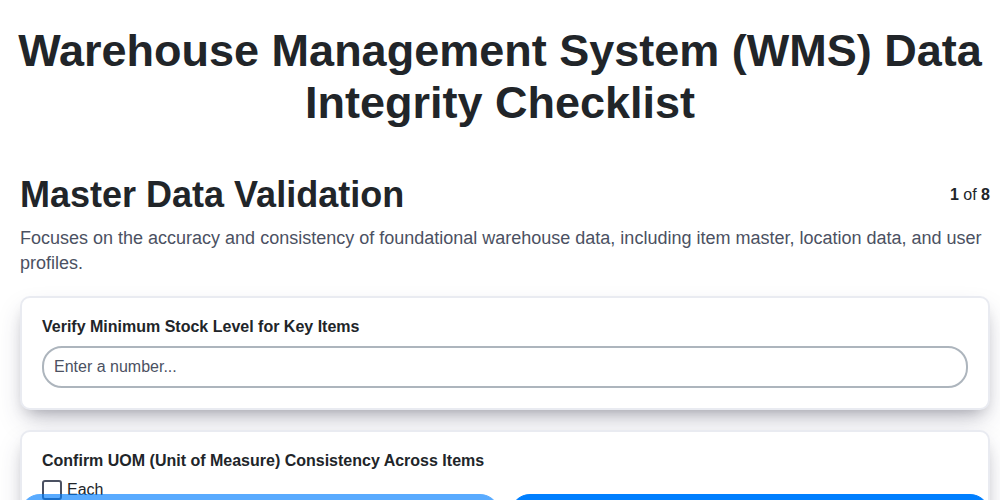
Warehouse Data Integrity: Your WMS Checklist Template
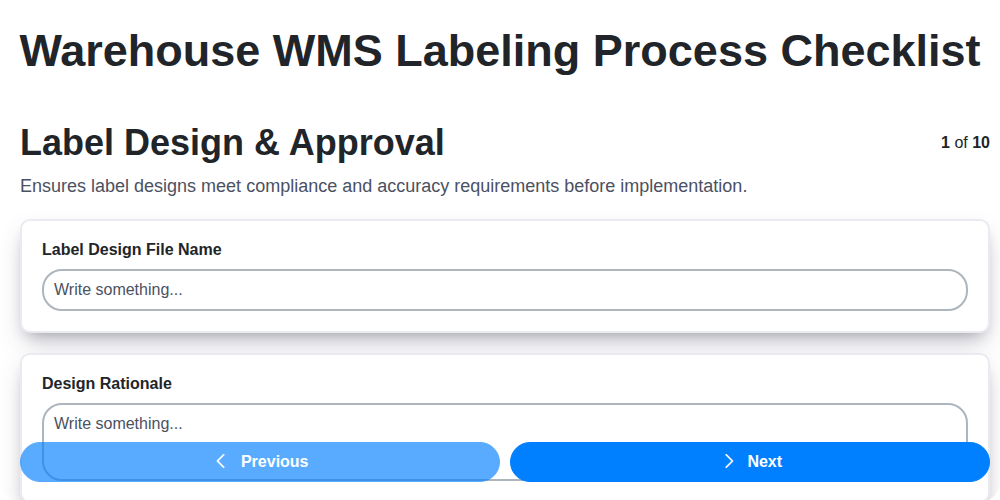
Mastering Warehouse Labeling: Your WMS Process Checklist Template

Warehouse WMS Security Checklist: A Comprehensive Guide to Protecting Your Operations
We can do it Together
Need help with
Checklists?
Have a question? We're here to help. Please submit your inquiry, and we'll respond promptly.