Seamless RFID Integration: Your WMS Checklist Template for Success
Published: 12/20/2025 10:00 PM Updated: 12/21/2025 6:54 AM
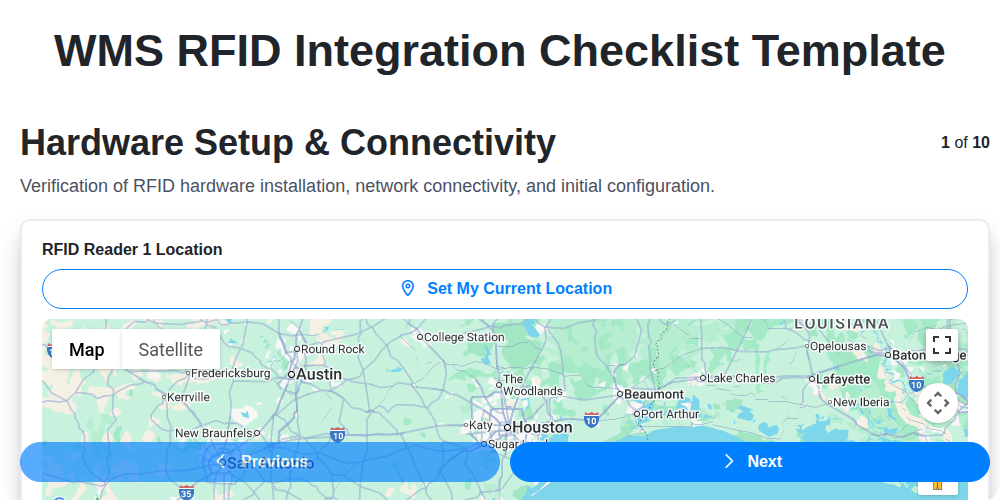
Table of Contents
- Introduction: Why Integrate RFID with Your WMS?
- 1. Hardware Setup & Connectivity: Laying the Foundation
- 2. Data Mapping & Integration: Bridging the Systems
- 3. Tag Encoding and Assignment: Unique Identification
- 4. Reader Configuration & Calibration: Ensuring Accuracy
- 5. Inventory Accuracy & Reconciliation: Verifying the Data
- 6. Workflow Integration & Testing: Streamlining Processes
- 7. User Training & Documentation: Empowering Your Team
- 8. Security & Access Controls: Protecting Sensitive Information
- 9. Performance Monitoring & Optimization: Continuous Improvement
- 10. Disaster Recovery & Contingency Planning: Preparing for the Unexpected
- 11. Data Validation and Error Handling
- 12. Regulatory Compliance & Audit Trails
- 13. Phased Rollout & Go-Live Strategy
- Conclusion: Realizing the Benefits of RFID-WMS Integration
- Resources & Links
TLDR: Integrating RFID with your Warehouse Management System (WMS) can be complex! This checklist template breaks down the process into 10 key steps - from hardware setup to disaster recovery - ensuring a smooth, accurate, and efficient RFID implementation that boosts inventory visibility and streamlines warehouse operations. Download the template and avoid costly mistakes!
Introduction: Why Integrate RFID with Your WMS?
Warehouse Management Systems (WMS) are the backbone of efficient operations, but even the best WMS can be limited by manual processes and traditional barcode scanning. Integrating Radio-Frequency Identification (RFID) with your WMS unlocks a new level of automation, accuracy, and visibility. This isn't just about upgrading technology; it's about fundamentally transforming how your warehouse operates.
Think about the possibilities: real-time tracking of inventory, drastically reduced labor costs, minimized errors in picking and packing, and a significant boost to overall throughput. RFID provides a constant stream of data, eliminating the need for line-of-sight scanning and enabling automated processes that were previously impossible.
This integration addresses critical challenges faced by modern warehouses, from managing increasingly complex supply chains to meeting the demands of e-commerce and same-day delivery. Ultimately, RFID-WMS integration translates to a more agile, responsive, and profitable warehouse operation. This checklist will guide you through the key steps to ensure a successful implementation.
1. Hardware Setup & Connectivity: Laying the Foundation
Successful WMS-RFID integration hinges on a robust and reliable hardware infrastructure. This initial phase is critical and shouldn't be rushed. Here's a breakdown of key steps:
- RFID Reader Deployment: Strategically place RFID readers at key points within your warehouse - receiving docks, shipping areas, aisles, and storage locations. Consider read range requirements and potential interference sources when determining placement.
- Network Connectivity: Ensure reliable network connectivity for all readers. This typically involves wired Ethernet connections, but wireless options (Wi-Fi, cellular) might be suitable in specific scenarios. Verify bandwidth capacity to handle the data volume.
- Antenna Selection and Placement: Choose the appropriate antennas based on read range, coverage area, and environment. Proper antenna polarization and mounting are crucial for optimal performance.
- Power Supply: Ensure a stable and sufficient power supply for all RFID readers and associated devices. Consider backup power solutions to minimize downtime.
- Physical Security: Protect the hardware from physical damage and theft. Secure mounting and enclosures are recommended.
- Testing Initial Connectivity: Before moving on, rigorously test connectivity between each reader and the central WMS system. This includes verifying data transmission and acknowledging reader status. Document test results for future reference.
2. Data Mapping & Integration: Bridging the Systems
Successful WMS-RFID integration hinges on accurate and seamless data flow between your Warehouse Management System (WMS) and the RFID infrastructure. This isn't just about moving data; it's about ensuring meaningful data exchange.
This section focuses on meticulously defining how RFID tag data translates to WMS records. We need to determine which RFID data fields (tag ID, product description, lot number, etc.) correspond to which fields within the WMS. A comprehensive data mapping document is crucial. This document should detail each field and its intended purpose in both systems, highlighting any transformations or calculations required.
Consider these key considerations:
- Data Types: Ensure compatibility between data types in both systems (e.g., number format, date format, text length limitations).
- Unique Identifiers: Clearly define how RFID tag IDs relate to existing WMS product IDs, serial numbers, or lot numbers. Duplicate IDs can cause significant errors.
- Real-time vs. Batch Processing: Determine whether data needs to be transmitted in real-time, near real-time, or in scheduled batches. This impacts integration method and system load.
- Error Handling: Define how integration errors will be detected, logged, and corrected. Implement alerts for discrepancies to ensure data integrity.
- Data Transformation: Some data may require transformation during the integration. For example, converting unit of measure or formatting a date. This needs to be clearly defined and tested.
Incorrect data mapping will lead to inaccurate inventory records, order fulfillment errors, and ultimately, decreased operational efficiency. This is not a task to be rushed - thorough planning and validation are paramount.
3. Tag Encoding and Assignment: Unique Identification
A crucial step in successful WMS RFID integration is the meticulous encoding and assignment of RFID tags. This isn't simply about slapping a tag on an item; it's about giving each item a unique digital identity that the WMS can recognize and track.
Planning Your Tag Encoding Scheme:
Before you even touch a tag, define your encoding strategy. Consider:
- Data to Encode: What data will you store on the tag? Common examples include SKU, lot number, serial number, date of manufacture, and expiration date. The amount of data directly impacts the type of tag required (memory capacity).
- Encoding Standard: Choose a standard encoding format (e.g., EPCglobal, AIM). Consistency is paramount for interoperability and data integrity.
- Naming Conventions: Establish clear naming conventions for tag IDs. This helps with troubleshooting and avoids confusion. For instance, you might prefix tag IDs based on product category.
The Encoding Process:
- Tag Programming: This is typically done using specialized RFID encoding software connected to an encoder. Ensure your software supports the chosen encoding standard and provides robust error checking.
- Sequential vs. Random Encoding: Sequential encoding (e.g., 00001, 00002, 00003) simplifies inventory auditing, while random encoding offers increased security against tag cloning. Choose based on your specific needs.
- Verification: Implement a verification process immediately after encoding. This could involve scanning a batch of encoded tags and comparing the data read back against the intended data. Errors must be caught and corrected.
- Tag Assignment within the WMS: Link the encoded tag IDs to corresponding item records within your WMS. This association is the foundation of accurate tracking. Automate this process where possible to minimize manual errors.
Best Practices:
- Quality Control: Regularly audit your encoding process to identify and rectify any recurring errors.
- Documentation: Keep detailed records of your encoding schemes, software versions, and procedures.
- Consider Future Expansion: Design your encoding scheme with potential future product lines and data requirements in mind.
4. Reader Configuration & Calibration: Ensuring Accuracy
Proper reader configuration and calibration are absolutely critical for a successful WMS-RFID integration. It's not enough to simply install the readers; they need to be precisely tuned to your environment and tag types. This process goes beyond basic setup and involves several key steps:
- Antenna Placement Optimization: Experiment with antenna positioning to maximize read range and minimize interference. Consider factors like obstructions, metal surfaces, and tag orientation. Use reader tools or specialized software to visualize read zones and identify dead spots.
- Power Level Adjustment: Fine-tune reader power levels to balance read range with potential interference. Excessive power can create signal clashes and inaccurate reads.
- Reader Firmware Updates: Ensure all readers are running the latest firmware. Updates often include performance enhancements, bug fixes, and support for new tag types.
- Tag Orientation Testing: Determine the optimal tag orientation for consistent reads. Sometimes a slight rotation can dramatically improve performance.
- Calibration Against Known Standards: Regularly calibrate readers against known standards or reference tags to ensure accuracy over time. This can involve testing with a collection of tagged items with known identifiers.
- Environmental Factors: Account for environmental factors like temperature and humidity, which can affect RFID performance. Some readers allow for environmental compensation.
Neglecting this stage can lead to significant errors in inventory tracking, leading to costly discrepancies and inefficiencies.
5. Inventory Accuracy & Reconciliation: Verifying the Data
Integrating RFID into your Warehouse Management System (WMS) promises incredible gains in inventory accuracy, but realizing that promise requires meticulous verification and reconciliation. Simply connecting the systems isn't enough; you need to actively validate that the data flowing between them is correct.
This phase focuses on ensuring that the RFID-captured data aligns with your existing WMS records. Here's what you need to do:
- Cycle Counts with RFID Validation: Implement regular cycle counts, but now leverage RFID reads to confirm the counts. Compare the RFID-identified quantities against the WMS records. Discrepancies should be immediately investigated and corrected.
- Spot Checks: Conduct random spot checks across various locations and item types. Physically verify items and compare them to both the RFID tags and WMS records. This helps identify systematic errors that might not be revealed in regular cycle counts.
- Blind Tests: Conduct blind tests where a small team counts inventory without accessing the WMS or RFID data. Compare their manual count to the RFID-WMS combined data. This provides a baseline accuracy assessment.
- Root Cause Analysis: When discrepancies arise, don't just correct the numbers. Investigate why the errors occurred. Were tags misapplied? Is there a data mapping issue? Is a reader malfunctioning? Addressing the root cause prevents recurring problems.
- Reconciliation Reports: Generate regular reconciliation reports highlighting differences between RFID data and WMS records. Track trends and analyze recurring errors to identify areas for improvement in processes or system configurations.
- Establish Thresholds: Define acceptable discrepancy thresholds. Anything exceeding those thresholds should trigger immediate review and corrective action.
6. Workflow Integration & Testing: Streamlining Processes
Successfully integrating RFID into your Warehouse Management System (WMS) isn't just about getting the technology to work. It's about making it seamlessly fit into your existing warehouse workflows and significantly improve them. This phase focuses on ensuring the RFID solution actively enhances, rather than disrupts, daily operations.
Begin by mapping out your critical warehouse processes - receiving, putaway, picking, packing, shipping - and identifying where RFID can provide the greatest impact. Don't just consider individual tasks, but also the handoffs and dependencies between them. For example, does real-time location data from RFID tags improve putaway efficiency? Does automated cycle counting streamline reconciliation?
Create detailed test scenarios that mimic real-world operations. These should encompass a range of conditions - peak season, unexpected discrepancies, partial data loss - to stress-test the integration. Involve warehouse staff from all levels in the testing process. Their practical experience is invaluable in identifying usability issues and potential bottlenecks.
Focus on:
- Data Flow Validation: Verify the accuracy and timeliness of data moving between the RFID readers, middleware, and WMS.
- Process Automation: Confirm that workflows are automated correctly, triggering appropriate actions based on RFID events (e.g., automatically updating stock levels upon receiving).
- Error Handling: Test how the system handles errors - tag read failures, data discrepancies, system outages - and ensure appropriate notifications and recovery procedures are in place.
- User Acceptance Testing (UAT): This is crucial! Warehouse staff must be comfortable and confident in the new workflows.
Iterative testing and refinement are key. Don't be afraid to adjust configurations and processes based on feedback and performance data. A well-integrated RFID/WMS solution will not only reduce errors but also create a more efficient and productive warehouse environment.
7. User Training & Documentation: Empowering Your Team
Successful WMS-RFID integration isn't solely about technology; it's about the people using it. Robust user training and comprehensive documentation are critical for ensuring adoption and maximizing ROI. Simply implementing the system doesn't guarantee its effectiveness - your team needs to understand how it works and know how to use it correctly.
Here's what a comprehensive user training program should include:
- Role-Based Training: Tailor training to specific job functions (e.g., warehouse operators, supervisors, administrators). What a picker needs to know is different from what a system administrator requires.
- Hands-On Experience: Include plenty of practical exercises using the new system and RFID hardware. Simulations and real-world scenarios are invaluable.
- System Functionality Overview: Clearly explain the purpose of the integrated system and how it benefits them and the organization.
- RFID Technology Basics: A basic understanding of RFID principles can help users troubleshoot common issues and appreciate the technology's capabilities.
- Troubleshooting & FAQs: Equip users with resources to address common problems independently.
- Ongoing Support: Provide readily available support channels for questions and assistance after the initial training.
Documentation is equally vital:
- User Manuals: Detailed guides covering all aspects of system operation.
- Standard Operating Procedures (SOPs): Step-by-step instructions for common tasks.
- Quick Reference Guides: Concise summaries of key functions and commands.
- Video Tutorials: Visual aids demonstrating procedures.
- Regular Updates: Keep documentation updated as the system evolves.
Investing in user training and documentation isn't just a nice-to-have; it's a necessity for a successful and sustainable WMS-RFID integration.
8. Security & Access Controls: Protecting Sensitive Information
Integrating RFID with your Warehouse Management System (WMS) significantly expands the visibility and control you have over your inventory, but it also introduces new security considerations. Protecting the data flowing between your RFID readers, tags, and WMS is paramount to prevent unauthorized access, data breaches, and potential disruptions to your operations.
This checklist section focuses on establishing robust security measures. It's not enough to simply connect the hardware; you need a layered approach. This includes defining granular access control permissions for users based on their roles and responsibilities. Only authorized personnel should be able to read, write, or modify RFID tag data, reader configurations, or integration settings. Regularly review these permissions and ensure they remain appropriate.
Consider implementing multi-factor authentication for sensitive WMS and RFID system logins. Encryption, both at rest and in transit, should be utilized to protect data from interception. Network segmentation can isolate the RFID system from less secure parts of your network. Conduct periodic vulnerability assessments and penetration testing to identify and address potential weaknesses. Finally, establish a clear incident response plan specifically addressing RFID-related security breaches, outlining steps for containment, eradication, and recovery. Remember, proactive security measures are far more effective - and less costly - than reactive responses to a security compromise.
9. Performance Monitoring & Optimization: Continuous Improvement
Integrating RFID into your Warehouse Management System (WMS) isn't a set it and forget it endeavor. To truly maximize the benefits and ROI, ongoing performance monitoring and optimization are crucial. This phase ensures your integration continues to deliver expected results and adapts to evolving needs.
Here's what needs to be addressed:
- Key Performance Indicators (KPIs): Define clear KPIs before go-live and consistently track them. Examples include read rate accuracy, cycle time reduction in receiving/putaway, picking accuracy improvements, and overall inventory visibility enhancements.
- Data Analysis: Regularly analyze collected data. Identify bottlenecks, inefficiencies, and areas where read rates are consistently low. Correlate RFID performance data with WMS data to understand the broader impact.
- Reader Placement Review: Periodically reassess reader placement. Environmental changes, material accumulation, and even changes in racking configurations can impact performance. Minor adjustments can often yield significant gains.
- Tag Performance Evaluation: While initial tag testing is vital, ongoing evaluation is important. Consider the impact of factors like tag orientation, material composition of goods, and proximity to metal surfaces.
- System Tuning: Based on data analysis, fine-tune reader power levels, antenna configurations, and data filtering parameters within both the RFID system and the WMS.
- Regular Audits: Conduct routine audits of the entire RFID-WMS integration process to identify potential areas for improvement and ensure ongoing compliance with best practices.
- Feedback Loops: Establish a feedback loop from warehouse staff. Their on-the-ground experience provides invaluable insights into real-world challenges and opportunities for refinement.
By embracing a proactive approach to performance monitoring and continuous improvement, you can unlock the full potential of your RFID-WMS integration and drive ongoing operational excellence.
10. Disaster Recovery & Contingency Planning: Preparing for the Unexpected
RFID and WMS integration is a critical operation; its disruption can severely impact your business. A robust disaster recovery (DR) and contingency planning process is not optional-it's essential for maintaining business continuity. This involves anticipating potential failures, outlining response procedures, and regularly testing your recovery strategies.
Here's what to consider:
- Identify Potential Risks: Consider scenarios like power outages, network failures, hardware malfunctions (readers, antennas, servers), data corruption, natural disasters, and even cyberattacks.
- Data Backup & Redundancy: Implement regular, automated backups of your WMS data, RFID tag data, and system configurations. Explore options for redundant systems - a secondary WMS instance or backup RFID server - that can take over in case of primary system failure. Consider offsite backups for geographical disaster resilience.
- Failover Procedures: Document step-by-step instructions for switching to backup systems. This should detail who is responsible for triggering the failover, how to access backup data, and how to restore normal operations.
- Reader & Network Redundancy: Consider redundant RFID readers and network connections to minimize downtime from localized failures.
- Manual Processes: Define manual processes for critical functions (receiving, shipping, inventory checks) to be utilized during system downtime. Ensure staff are familiar with these procedures.
- Regular Testing: Don't just have a DR plan; test it. Conduct regular drills (at least annually, ideally more often) to simulate system failures and evaluate the effectiveness of your recovery procedures. Document findings and update the plan accordingly.
- Communication Plan: Establish a clear communication plan for notifying relevant personnel (staff, management, stakeholders) during a disaster.
- Vendor Agreements: Review vendor agreements (WMS provider, RFID hardware supplier) to understand their disaster recovery capabilities and support.
Proactive disaster recovery planning is a small investment with a potentially huge return - protecting your business from costly disruptions and preserving valuable inventory data.
11. Data Validation and Error Handling
Integrating RFID with your Warehouse Management System (WMS) generates a significant volume of data. Ensuring that data is accurate and consistent is paramount to realizing the full benefits of the integration. This stage focuses on establishing robust data validation and error handling processes.
Key Considerations:
- Real-Time Validation Rules: Implement rules during data transmission to check for data type mismatches, invalid values (e.g., negative quantities, incorrect product codes), and formatting errors. For instance, verify that an RFID tag's data matches expected product characteristics defined in the WMS.
- Exception Handling: Design a system for gracefully handling exceptions. When errors are detected (invalid tag read, communication failure), don't halt the process entirely. Instead, flag the error, log the details (tag ID, timestamp, error type), and route the item for manual inspection and correction.
- Data Reconciliation Processes: Establish regular reconciliation routines. Periodically compare the RFID data with the WMS records. Investigate and correct discrepancies, identifying root causes to prevent recurrence. This is especially crucial during the initial rollout.
- Tag Data Integrity Checks: Include checksums or other data integrity checks within the RFID tag data to ensure data hasn't been corrupted during transmission or storage.
- Feedback Loops: Create a feedback loop to alert WMS users of potential data issues and allow for quick corrective action. This could be through visual cues in the WMS interface or automated email notifications.
- Error Logging and Reporting: Implement comprehensive error logging and reporting mechanisms. Regularly review these logs to identify recurring issues and refine the integration's data validation rules.
- Testing for Edge Cases: Specifically test the system's ability to handle edge cases: damaged tags, obstructed reads, tags with missing data.
12. Regulatory Compliance & Audit Trails
Integrating RFID into your Warehouse Management System (WMS) isn't just about efficiency; it's about accountability. Many industries face stringent regulatory requirements regarding inventory tracking, chain of custody, and data security. Your RFID-WMS integration must be designed to support these regulations and facilitate audits.
This includes establishing comprehensive audit trails that record all RFID-related actions, including tag reads, data updates, and user logins. These logs should include timestamps, user IDs, and details of the changes made. Consider the specific regulations relevant to your industry (e.g., HIPAA for healthcare, FDA for pharmaceuticals, or specific import/export regulations).
Regularly review your system's configuration and processes to ensure continued compliance. Conduct internal audits and be prepared for external audits - having well-documented procedures and easily accessible data will demonstrate your commitment to regulatory adherence. Document all changes made to the system and their justification, ensuring a clear lineage for auditing purposes.
13. Phased Rollout & Go-Live Strategy
Jumping directly into a full-scale WMS-RFID integration can be risky and disruptive. A phased rollout minimizes disruption, allows for adjustments based on real-world feedback, and builds confidence in the new system. Here's a breakdown of a recommended approach:
Phase 1: Pilot Program (Small-Scale Implementation)
- Location Selection: Choose a representative area within your warehouse - perhaps a specific product line, a single receiving dock, or a small zone. This area should ideally be complex enough to highlight potential integration challenges but manageable in scope.
- Limited User Group: Involve a small, dedicated team for the pilot. These users should be early adopters, comfortable with technology, and willing to provide detailed feedback.
- Focused Testing: Concentrate on validating the core functionalities: tag readability, data accuracy, workflow efficiency. Document everything meticulously.
- Iterative Adjustments: Based on pilot feedback, refine data mapping, reader configurations, and user training.
Phase 2: Controlled Expansion
- Gradual Rollout: Expand the RFID integration to additional areas and product lines, adding complexity incrementally.
- Parallel Operation (Optional): For a period, consider running the new RFID system alongside your existing WMS processes to compare data and identify discrepancies. This provides a safety net and facilitates easier troubleshooting.
- Continuous Monitoring: Track key performance indicators (KPIs) like inventory accuracy, cycle time, and error rates.
Phase 3: Full-Scale Deployment
- Comprehensive Training: Ensure all warehouse personnel receive thorough training on the new RFID-integrated workflows.
- Data Migration & Validation: Carefully migrate all remaining data and thoroughly validate its accuracy within the integrated system.
- Go-Live Support: Provide dedicated support during and immediately after the full deployment to address any unforeseen issues.
A well-planned phased approach significantly increases the likelihood of a successful WMS-RFID integration, minimizing risks and maximizing returns on your investment.
Conclusion: Realizing the Benefits of RFID-WMS Integration
Successfully integrating RFID technology with your Warehouse Management System (WMS) isn't just a technical project; it's a strategic investment in efficiency, accuracy, and scalability. By systematically following a checklist - like the one we've outlined - you can minimize risks, avoid costly errors, and maximize the return on your investment. Remember, consistent performance hinges on ongoing monitoring and optimization. Don't treat integration as a "one and done" endeavor. Continuous refinement of your processes, data mapping, and hardware configuration will ensure your WMS-RFID solution remains a competitive advantage for years to come. Embracing this integrated approach will unlock a new level of visibility and control over your warehouse operations, ultimately leading to improved customer satisfaction and a stronger bottom line.
Resources & Links
- Impinj: A leading provider of RFID solutions, including readers, tags, and software. Their website offers extensive resources, whitepapers, and case studies related to RFID technology and integration.
- Zebra Technologies: Another major player in the RFID market, offering a wide range of hardware, software, and services. Provides guides, product information, and integration support.
- RFID Journal: A leading industry publication covering RFID news, technologies, and best practices. Offers articles, events, and research reports relevant to WMS integration.
- GS1: An organization that develops and maintains global standards for supply chain identification, including RFID tag numbering and data formats. Crucial for interoperability and compliance.
- National Institute of Standards and Technology (NIST): Provides standards and guidelines related to data security, cybersecurity, and RFID, often relevant to aspects like security & access controls and compliance.
- WMS Experts: Provides information and resources on Warehouse Management Systems. Can offer insights on WMS selection and integration best practices, relevant to data mapping & integration and workflow integration.
- Apricot: Provides RFID software solutions, including data management and integration tools. They offer information on RFID data validation and error handling.
- Honeywell: Offers a diverse portfolio including RFID solutions and data capture devices. Can provide resources on hardware setup and connectivity.
- TAGG Technology: Specializes in RFID solutions and services, providing integration support and expertise. Helpful for understanding phased rollouts and go-live strategies.
- AIT-ProLogix: Offers RFID testing and simulation equipment. Critical for reader configuration & calibration and performance monitoring & optimization.
Frequently Asked Questions
What is RFID and why should I consider integrating it with my WMS?
RFID (Radio-Frequency Identification) uses radio waves to automatically identify and track tags attached to objects. Integrating it with your Warehouse Management System (WMS) enhances accuracy, speeds up processes like receiving, putaway, picking, and shipping, reduces labor costs, and provides real-time inventory visibility.
What is a WMS checklist template and how will it help with RFID integration?
A WMS checklist template is a structured document outlining the steps and considerations needed for successful RFID integration with your WMS. It helps you stay organized, avoid common pitfalls, and ensure a smooth and efficient implementation.
Who is this checklist template designed for?
This checklist is designed for warehouse managers, IT professionals, and anyone involved in planning or executing an RFID integration project within a warehouse environment.
Does the checklist cover all aspects of RFID integration?
The checklist covers key areas including needs assessment, hardware selection, software compatibility, data migration, training, testing, and ongoing maintenance. While comprehensive, it may need to be tailored to your specific warehouse environment and WMS.
What kind of hardware considerations are included in the checklist?
The checklist prompts you to consider factors like RFID tag selection (passive, active, battery-powered), reader types (fixed, mobile), antennas, and infrastructure requirements (power, network connectivity).
What software compatibility issues should I be aware of?
The checklist reminds you to verify that your WMS supports RFID integration, including data formats, APIs, and any necessary middleware or connectors.
How important is staff training for RFID integration?
Training is crucial! The checklist highlights the need to train warehouse staff on using RFID readers, understanding tag placement, and adapting to new workflows.
What kind of testing is recommended in the checklist?
The checklist advocates for thorough testing of RFID functionality at each stage, including tag read range, data accuracy, and integration with the WMS, before full-scale deployment.
Is the checklist a one-time thing or does it require ongoing maintenance?
RFID integration requires ongoing maintenance. The checklist includes considerations for regular hardware checks, software updates, and performance monitoring to ensure continued efficiency.
Where can I find the WMS checklist template mentioned in the article?
The article provides a link (or instructions on how to access) the WMS checklist template. Please refer to the article content for the specific link or download instructions.
Found this Article helpful?
Comments
There are no comments yet. Be the first to add one!
WMS - Warehouse Management System Solution Demo
Optimize your warehouse operations & boost efficiency! ChecklistGuro's WMS streamlines inventory management, order fulfillment, and shipping. Reduce errors, improve accuracy, & maximize space utilization. Manage it all with our Work OS.
Related Articles

Ensuring Success: Your WMS Automation Validation Checklist Template
Mastering Warehouse Labeling: Your WMS Process Checklist Template
The Ultimate Supply Chain Inventory Accuracy Audit Checklist: A Step-by-Step Guide
Mastering Putaway: Your WMS Optimization Checklist

Mastering Your Yard: A Warehouse WMS Yard Management Checklist Template
Warehouse Data Integrity: Your WMS Checklist Template
WMS System Performance Monitoring Checklist: A Comprehensive Guide
Warehouse WMS Error Handling Checklist: A Proactive Guide to Minimizing Disruptions
We can do it Together
Need help with
Warehouse Management System (WMS)?
Have a question? We're here to help. Please submit your inquiry, and we'll respond promptly.