Ensuring Success: Your WMS Automation Validation Checklist Template
Published: 12/19/2025 10:00 PM Updated: 12/20/2025 12:12 PM

Table of Contents
- Introduction: Why Validate Your WMS Automation?
- 1. System Configuration: Laying the Foundation
- 2. Workflow Validation: Mapping the Process
- 3. Data Mapping and Transformation: Ensuring Data Integrity
- 4. Exception Handling: Preparing for the Unexpected
- 5. User Interface & Task Automation: Streamlining User Experience
- 6. Integration Points: Testing the Connections
- 7. Reporting & Analytics: Validating Insights
- 8. Security & Access Controls: Protecting Your Data
- 9. Performance & Scalability: Testing Under Load
- 10. Monitoring & Logging: Establishing Visibility
- 11. Regression Testing: Maintaining Stability
- 12. User Acceptance Testing (UAT): Getting End-User Approval
- Conclusion: Continuous Validation for Optimal Performance
- Resources & Links
TLDR: Automating your Warehouse Management System (WMS)? Don't skip validation! This checklist template provides a structured approach - covering system setup, data flow, error handling, user experience, integrations, security, and performance - to ensure your automation runs smoothly, accurately, and securely before going live. It's your safety net for a successful WMS automation project.
Introduction: Why Validate Your WMS Automation?
Automating your Warehouse Management System (WMS) offers incredible potential - increased efficiency, reduced errors, and ultimately, a stronger bottom line. However, simply flipping the automation switch isn't enough. A robust validation process is essential to ensuring that your automation truly delivers on its promise and doesn't introduce new, potentially costly, problems.
Think of it like building a house. You wouldn't skip the inspections and assume everything is structurally sound, right? Similarly, WMS automation validation acts as your quality control, identifying and correcting issues before they impact your operations. A rushed or incomplete validation can lead to inaccurate inventory counts, order fulfillment errors, bottlenecks in workflows, and frustrated employees - all negating the benefits you hoped to achieve. This checklist will guide you through the critical areas to scrutinize, guaranteeing a smooth transition and maximizing the return on your automation investment.
1. System Configuration: Laying the Foundation
A robust Warehouse Management System (WMS) automation hinges on impeccable system configuration. This isn't just about ticking boxes; it's about setting the stage for accurate, efficient, and reliable automated processes. Here's what to scrutinize:
- Parameter Verification: Review all system parameters - storage locations, units of measure, product classifications, and cycle count frequencies. Ensure they align precisely with your warehouse's physical layout and operational needs. Mismatched parameters can lead to routing errors and inaccurate inventory levels.
- Hardware Compatibility: Confirm compatibility between the WMS and all connected hardware, including barcode scanners, printers, scales, and conveyors. Test thoroughly to ensure seamless communication and data transfer.
- User Role Definition: Validate that user roles and permissions are appropriately defined and assigned. Automation should be restricted to authorized personnel to prevent errors and maintain data integrity.
- Device Setup & Calibration: Verify the proper setup and regular calibration of all connected devices. Incorrect scale readings or scanner inaccuracies can have cascading effects on the entire automation workflow.
- Configuration Documentation Review: Ensure comprehensive documentation exists for all system configurations. This is crucial for troubleshooting, future modifications, and knowledge transfer within the team.
- Sandbox Testing: Always test configuration changes in a sandbox environment before implementing them in production. This minimizes disruption and allows for error detection in a controlled setting.
2. Workflow Validation: Mapping the Process
Workflow validation is arguably the most critical step in WMS automation validation. It's not enough that the system can do something; it must do it correctly within the established business processes. This phase moves beyond simply checking configurations to observing how the system handles goods from receipt to shipment.
Here's what needs to be meticulously validated:
- Receiving Validation: Verify that incoming goods are accurately identified, inspected, and placed in designated locations. Confirm correct handling of discrepancies like damaged goods or incorrect quantities.
- Putaway Process Verification: Ensure the putaway logic directs items to the correct storage locations based on established rules (e.g., FIFO, LIFO, optimized space utilization). Validate location assignments are accurate and adhered to.
- Picking & Packing Verification: Validate picking routes, packing strategies (single order, batch picking), and the accuracy of item selection for each order. Simulate various picking scenarios to test the system's adaptability.
- Shipping Validation: Confirm that orders are correctly grouped, labeled, and dispatched according to carrier requirements and delivery schedules. Trace the entire shipping process from warehouse to customer.
- Returns Processing: Thoroughly test the reverse logistics process, from receiving returns to restocking or disposal. Validate data accuracy and correct handling of different return reasons.
Key Considerations:
- Real-World Scenarios: Don't just test ideal conditions. Incorporate scenarios involving partial shipments, order modifications, and expedited requests.
- Process Documentation: Ensure the automated workflow mirrors documented business processes. Any deviations require careful review and approval.
- User Involvement: Include warehouse staff in testing to provide practical feedback on workflow efficiency and usability.
- Traceability: Maintain a clear audit trail of all steps within the workflow for accountability and troubleshooting.
Proper workflow validation ensures the automated WMS is not only efficient but also aligns with established business rules, minimizes errors, and maintains operational integrity.
3. Data Mapping and Transformation: Ensuring Data Integrity
One of the most critical, and often complex, aspects of WMS automation validation is meticulously verifying data mapping and transformation processes. This isn't just about moving data from point A to point B; it's about ensuring its accuracy, consistency, and usability throughout the automated workflow. Errors here can cascade into downstream issues, impacting inventory accuracy, order fulfillment, and overall business operations.
Here's what needs rigorous testing:
- Source-to-Target Mapping Verification: Validate that each data field in the source system (e.g., legacy ERP, external vendor feeds) is correctly mapped to its corresponding field in the WMS. Check for data type mismatches, incorrect field assignments, and missing mappings. A simple spreadsheet mapping document isn't enough - execute tests that prove the data flows correctly.
- Transformation Rule Validation: The WMS often requires transforming data - calculating weights, converting units of measure, combining multiple fields, or applying business logic. Scrutinize each transformation rule, verifying calculations, logic application, and data formatting. Use sample data with various scenarios (edge cases, boundary conditions) to ensure accuracy.
- Data Enrichment and Standardization: If the WMS enriches data (e.g., adding geographic location based on zip code) or standardizes data formats, thoroughly test the enrichment and standardization processes for accuracy and consistency. Poor standardization can lead to reporting inaccuracies and difficulties in data analysis.
- Data Validation Rules: Confirm that validation rules are correctly implemented and actively preventing invalid data from entering the system. Test edge cases and incorrect data inputs to ensure the system flags them appropriately and prevents processing.
- Error Handling for Transformation Failures: Define and test how the system handles situations where data transformation fails. Does it log the error, reject the transaction, or attempt a correction? Ensure appropriate error messages are generated and routed to the correct personnel for resolution.
- Impact of Business Rule Changes: Any changes to business rules affecting data mapping and transformation must be re-validated to ensure continued accuracy and integrity.
Proper validation in this area is a preventative measure against costly mistakes and ensures your WMS automated processes are working with clean, reliable data.
4. Exception Handling: Preparing for the Unexpected
Automated Warehouse Management Systems (WMS) aren't perfect. Unexpected events - from network outages to mislabeled inventory - will occur. A robust validation checklist must include rigorous testing of exception handling capabilities. This isn't just about identifying errors; it's about ensuring the system gracefully recovers and minimizes disruption.
Here's what to cover during WMS automation validation in this critical area:
- Identify Potential Exceptions: Brainstorm a comprehensive list of potential errors and unusual scenarios. Think beyond the obvious. Consider things like incorrect barcode scans, unexpected weight discrepancies, system timeouts, and data entry mistakes.
- Define Recovery Procedures: For each potential exception, clearly define the expected recovery procedure. What steps should the system take? How should users be alerted? What manual intervention (if any) is required? Document these procedures meticulously.
- Simulate Exception Scenarios: Don't just rely on theory. Actively simulate these exception scenarios during validation. Use testing tools or manual interventions to trigger the expected error conditions.
- Verify Error Messaging & User Guidance: Ensure error messages are clear, concise, and helpful to users. They should provide enough information to understand the problem and know how to proceed.
- Test Automated Retry Mechanisms: If the system is designed to automatically retry failed processes (e.g., after a temporary network issue), verify that these retries function correctly and don't create cascading errors.
- Validate Escalation Paths: Define and test the escalation process for exceptions that cannot be automatically resolved. Who is notified, and what are their responsibilities?
- Document Exception Handling Logic: The exception handling logic should be fully documented, including details about triggering conditions, recovery steps, and escalation procedures.
Failing to thoroughly validate exception handling leaves your warehouse vulnerable to costly errors, delays, and frustrated users. A proactive approach to exception testing is a cornerstone of a successful WMS automation implementation.
5. User Interface & Task Automation: Streamlining User Experience
The WMS user interface isn't just about aesthetics; it's a critical component of operational efficiency. A poorly designed or overly complex interface leads to errors, slows down processes, and frustrates users. Thorough validation of the user interface and its associated task automation is therefore paramount.
Here's what to assess:
- Intuitive Navigation: Are menus and functions logically organized and easily discoverable? Can users quickly find the information or actions they need? Conduct usability testing with representative users to gather feedback.
- Clear Task Guidance: Does the system guide users through tasks with clear instructions and prompts? Are there helpful tooltips and contextual help available?
- Automation Validation: Examine all automated tasks - picking, packing, receiving, putaway - to ensure they operate correctly and efficiently. Verify accuracy and identify any potential bottlenecks. Test edge cases and unexpected scenarios.
- Error Prevention & Correction: Are input validations in place to prevent errors? Are error messages clear, actionable, and guide users towards resolution? Can users easily correct mistakes?
- Role-Based Access and Task Visibility: Does the UI dynamically adjust based on user roles, showing only relevant tasks and functionalities?
- Mobile Compatibility: If mobile access is a requirement, confirm the interface is responsive and usable on various devices.
Properly validating this area minimizes training time, reduces operational errors, and empowers warehouse staff to work more effectively, ultimately contributing to a more productive and satisfying work environment.
6. Integration Points: Testing the Connections
Warehouse Management System (WMS) rarely operates in isolation. It's typically interwoven with other crucial business systems like ERP, e-commerce platforms, transportation management systems (TMS), and even legacy systems. These integrations are vital for seamless data flow and operational efficiency. However, they've also become a common source of errors and bottlenecks. Thorough validation of these integration points is non-negotiable.
Here's what your testing should cover:
- Data Integrity Verification: Ensure data transmitted between systems is accurate, complete, and formatted correctly. Test both inbound and outbound data flows. Pay close attention to data types and field lengths to avoid truncation or errors.
- Real-Time vs. Batch Processing Validation: Confirm data synchronization works as expected whether it's a real-time push or a scheduled batch process. Test the frequency and timing of updates.
- Error Handling & Retry Mechanisms: Simulate connection failures and data errors during integration. Verify the WMS handles these gracefully and implements appropriate retry mechanisms without data loss. Document these error handling procedures.
- Transaction Consistency: Confirm that transactions are atomic and consistent across all integrated systems. What happens if an order is partially processed in the WMS and fails during transmission to the ERP system? The system should roll back changes to maintain data integrity.
- API Testing (if applicable): If integrations rely on APIs, perform thorough API testing, including authentication, authorization, and payload validation. Document all API endpoints tested.
- System Dependency Mapping: Clearly map out all dependencies between the WMS and integrated systems. This allows for quicker troubleshooting when issues arise.
- End-to-End Testing: Execute end-to-end scenarios that span multiple systems to identify any unexpected behavior or delays.
7. Reporting & Analytics: Validating Insights
A Warehouse Management System (WMS) is only as valuable as the insights it provides. Robust reporting and analytics are crucial for informed decision-making, optimizing warehouse operations, and demonstrating ROI. This validation step ensures the data presented is accurate, comprehensive, and actionable.
Key Validation Points:
- Report Accuracy: Verify that reports accurately reflect actual warehouse activities. Cross-reference data from the WMS with physical inventory counts, shipping records, and other relevant sources. Don't just look at totals; scrutinize individual records.
- Report Completeness: Ensure all necessary data is included in reports. Are all transactions, users, and locations accounted for? Confirm that the reporting timeframe is configured correctly and includes all relevant periods.
- Data Granularity: Assess whether the level of detail available in reports is sufficient for your needs. Can you drill down to specific transactions, users, or locations?
- Custom Report Functionality: If custom reports were developed, thoroughly test their functionality and accuracy. Validate the formulas, filters, and calculations used.
- Dashboard Accuracy: If the WMS incorporates dashboards, verify that the displayed metrics are accurate and reflect real-time data.
- KPI Alignment: Confirm that the key performance indicators (KPIs) tracked by the WMS align with your business goals and are calculated correctly.
- Report Delivery: Validate the scheduled report delivery mechanisms - ensuring reports are generated and distributed to the intended recipients on time and in the expected format.
8. Security & Access Controls: Protecting Your Data
Warehouse Management System (WMS) automation holds immense power, but with that power comes responsibility - particularly regarding data security. A robust WMS validation checklist must thoroughly scrutinize access controls. This isn't just about preventing unauthorized logins; it's about ensuring data integrity and operational resilience.
Here's what your validation should cover:
- Role-Based Access Control (RBAC): Verify that user roles are clearly defined and aligned with job responsibilities. Users should only have access to the functionalities and data required for their roles. Test these permissions rigorously.
- Authentication Mechanisms: Assess the strength of authentication methods. Are you utilizing multi-factor authentication (MFA)? Is password complexity enforced? Are single sign-on (SSO) options securely configured?
- Data Encryption (At Rest and In Transit): Confirm that sensitive data is encrypted both when stored (at rest) and when being transmitted (in transit). Validate encryption key management practices.
- Audit Trails: Ensure comprehensive audit trails are enabled and functioning correctly. These trails should track user actions, data modifications, and system events, enabling forensic analysis in case of security incidents.
- Least Privilege Principle: Confirm that users are granted the minimum necessary privileges to perform their tasks. Overly broad access rights are a significant security risk.
- Regular Security Audits: Include a check to confirm a plan for regular security audits and vulnerability scanning is in place. These should go beyond initial validation and be ongoing.
- Compliance Requirements: Validate that the WMS configuration aligns with relevant industry compliance regulations (e.g., GDPR, HIPAA, PCI DSS).
- Data Masking/Anonymization (where applicable): If dealing with sensitive personal data, ensure appropriate masking or anonymization techniques are implemented for non-production environments.
9. Performance & Scalability: Testing Under Load
A robust Warehouse Management System (WMS) isn't just about functionality; it's about how well it functions, especially when things get busy. This section of your validation checklist focuses on ensuring your automated WMS can handle peak loads and future growth.
Why is this crucial? Poor performance during peak seasons (like holiday rushes) can lead to order delays, frustrated employees, and ultimately, lost revenue. Similarly, failing to plan for scalability can leave you scrambling to upgrade your system when your business expands.
Key Validation Points:
- Load Testing: Simulate realistic peak order volumes and user concurrency. Measure response times for critical operations like receiving, putaway, picking, packing, and shipping. Establish baseline performance metrics.
- Stress Testing: Push the system beyond expected peak loads to identify breaking points and bottlenecks. This helps understand the system's limits and informs capacity planning.
- Concurrency Testing: Verify the WMS can effectively manage multiple users performing various tasks simultaneously without impacting performance.
- Database Performance: Assess database query speeds and indexing efficiency. Slow database performance is a common cause of WMS slowdowns.
- Resource Utilization: Monitor CPU, memory, and network utilization during load and stress tests. Identify potential resource constraints.
- Scalability Planning: Document anticipated future growth (order volume, warehouse space, user count) and confirm the WMS architecture can accommodate it. Consider options like adding servers or optimizing database configurations.
- Hardware and Infrastructure Review: Ensure the underlying hardware (servers, network) is adequate to support the WMS's requirements, both now and in the future.
Acceptance Criteria: Response times should remain within predefined limits under peak load conditions. The system should not experience crashes or data corruption during stress testing. The documented scalability plan should provide a clear roadmap for future growth.
10. Monitoring & Logging: Establishing Visibility
A fully automated WMS is only as good as your ability to observe and understand its operation. Robust monitoring and logging are crucial for proactive problem identification, performance optimization, and ensuring ongoing system stability. This section focuses on validating that your automated WMS provides adequate visibility into its activities.
Here's what to check:
- Comprehensive Logging: Verify that the system logs all significant events - errors, warnings, successful transactions, system alerts, user actions (with appropriate masking for sensitive data), and workflow state changes. Don't just look for errors; understanding typical workflows through logs is equally important.
- Log Levels & Granularity: Confirm that different log levels (e.g., DEBUG, INFO, WARNING, ERROR, CRITICAL) are appropriately utilized and that you can control the level of detail captured based on your needs.
- Centralized Logging: Ideally, logs should be aggregated and stored in a centralized location accessible to relevant teams (IT, operations, support). This simplifies analysis and troubleshooting.
- Real-Time Monitoring Dashboards: Are there dashboards providing real-time insights into key performance indicators (KPIs) such as throughput, latency, error rates, and resource utilization? These dashboards should be customizable and accessible to the appropriate stakeholders.
- Alerting & Notifications: Define clear thresholds for key metrics. Confirm that automated alerts are triggered when these thresholds are breached, notifying the correct personnel promptly. The alert mechanism should be reliable (e.g., email, SMS, integration with incident management systems).
- Log Retention Policies: Establish and document log retention policies that comply with regulatory requirements and organizational needs. Ensure these policies are consistently applied.
- Log Search & Analysis Capabilities: Verify that you have the tools and expertise to effectively search, filter, and analyze log data to identify patterns, root causes, and potential areas for improvement.
- Audit Trails: Confirm that detailed audit trails are maintained to track all user actions, system changes, and critical events, supporting compliance and security requirements.
- Testing of Monitoring Systems: Don't just assume your monitoring works. Simulate errors and unusual scenarios to verify that alerts are triggered correctly and that response procedures are effective.
Validating these aspects of monitoring and logging helps prevent reactive firefighting and enables you to continuously improve the performance and reliability of your automated WMS.
11. Regression Testing: Maintaining Stability
Once your WMS automation is live, it's not a "set it and forget it" scenario. Ongoing stability and performance are paramount. Regression testing is the key to ensuring that new changes, whether they've been implemented for enhancements or bug fixes, haven't inadvertently broken existing functionality.
This isn't just about rerunning the initial validation checklist. Regression testing should be a regularly scheduled process, ideally integrated into your deployment pipeline. Focus on critical workflows and areas heavily impacted by ongoing changes. Think about:
- Core Functionality: Re-validate key processes like receiving, putaway, picking, packing, and shipping.
- Impacted Areas: If a change affects data mapping or exception handling, prioritize regression tests in those areas.
- Automated Tests: Leverage your existing automated tests (ideally those created during the initial validation) to efficiently cover a broad range of scenarios.
- Documentation: Keep a clear record of your regression test suite, including which tests cover which areas. Update it as your WMS evolves.
- Frequency: Determine the appropriate frequency based on the rate of change. Agile environments may require more frequent regression testing than more stable systems.
Neglecting regression testing can lead to unexpected errors, disruptions to operations, and ultimately, a loss of confidence in your automated WMS. Proactive regression testing is a critical investment in the long-term success and reliability of your system.
12. User Acceptance Testing (UAT): Getting End-User Approval
UAT is the crucial final gate before a WMS automation deployment. It's not just about verifying that the system works; it's about confirming that it works for your people and delivers the intended business value. This phase involves real users - warehouse operators, supervisors, and relevant stakeholders - interacting with the automated system in a simulated, real-world environment.
The goal of UAT isn't to find bugs (although those are welcome to be identified too!). It's about validating that the system aligns with user expectations, supports established workflows, and ultimately, improves efficiency. Carefully planned UAT scenarios are essential. These scenarios should reflect common and complex warehouse processes, encompassing tasks like receiving, putaway, picking, packing, shipping, and inventory management.
During UAT, users should document all deviations from expectations, no matter how seemingly minor. Gathering feedback through structured questionnaires, observation, and open discussions is vital. It's important to actively encourage users to break the system - to try unexpected actions and uncover potential usability issues. Successful UAT involves not just passing scenarios, but also a confident sign-off from key users, demonstrating their readiness to adopt the new automated workflows. Address all identified issues, re-test, and secure user sign-off before proceeding to the next stage - go-live.
Conclusion: Continuous Validation for Optimal Performance
Successfully implementing and launching a Warehouse Management System (WMS) is a significant achievement. However, it's not the finish line - it's the starting point for ongoing optimization. The validation checklist outlined in this article isn't a one-time activity; it's a framework for continuous improvement. Regularly revisiting these areas - system configuration, workflow performance, data accuracy, and the robustness of your integrations - will proactively identify and address potential bottlenecks and errors. Embrace a culture of ongoing validation, incorporating these checks into your routine operational processes. This commitment to continuous validation will not only ensure your WMS continues to meet your evolving business needs, but also maximizes its return on investment and safeguards against costly disruptions. Remember, a validated WMS is a resilient and high-performing WMS.
Resources & Links
- Warehouse Management System (WMS) Providers: General resource for understanding WMS functionality and vendors. Useful for background information on WMS systems being automated.
- SAICA Agile - Automation Validation Checklist: Provides a general automation validation checklist - while not WMS specific, it offers a good framework for thinking about validation approaches applicable to WMS automation.
- Test Automation University: Offers numerous courses and resources on test automation principles and best practices, valuable for understanding how to apply validation techniques to WMS automation.
- Guru99 - Software Testing: A comprehensive resource for software testing concepts and methodologies, including techniques for validation and verification, helpful for understanding the broader context of WMS automation validation.
- IBM - Software Testing: Provides information on different testing approaches, including automated testing and continuous integration, relevant for implementing a robust WMS automation validation process.
- Atlassian - Jira & Confluence: Tools like Jira and Confluence can be integrated to manage testing efforts, track defects, and document validation processes related to WMS automation.
- ISITPOSSIBLE - Integration Testing: Focuses on integration testing - a crucial aspect of WMS automation validation, especially concerning integrations with other systems (ERP, TMS, etc.).
- ServiceNow: Often used in conjunction with WMS for IT Service Management. Documentation on ServiceNow integration might be helpful when validating those connections.
- Oracle: If your WMS is an Oracle product, their official documentation and support resources will be invaluable for understanding specific validation procedures.
- SAP: Similarly, if you're using SAP's WMS solutions, their documentation and support will be critical resources for WMS Automation validation
Frequently Asked Questions
What is WMS automation validation and why is it important?
WMS automation validation is the process of verifying that your Warehouse Management System (WMS) automated processes are working as intended, delivering accurate results, and meeting your business requirements. It's crucial for ensuring data integrity, operational efficiency, and preventing costly errors that can arise from flawed automation.
Who should use this validation checklist template?
This template is designed for anyone involved in implementing, testing, or maintaining WMS automation. This includes warehouse managers, IT specialists, process owners, quality assurance teams, and anyone responsible for ensuring the reliability of your warehouse operations.
What types of WMS automation should this checklist cover?
The checklist is designed to be adaptable, but it primarily focuses on validating common automation tasks like putaway, picking, packing, shipping, receiving, cycle counting, and inventory management. Customize it to cover any specific automation processes relevant to your warehouse.
How do I customize the checklist template?
The checklist is structured to allow for easy customization. You can add, remove, or modify steps based on your specific WMS implementation, automated processes, and business rules. Pay close attention to the 'Notes' section for guidance on tailoring each validation point.
What are some key areas to focus on when validating WMS automation?
Key areas include verifying data accuracy (input, output, and transformations), process logic and workflows, error handling and exception management, security and access controls, and integration with other systems. Consider both positive and negative testing scenarios.
What does 'positive' and 'negative' testing mean in the context of this checklist?
Positive testing involves verifying that the automated process works correctly when given valid inputs. Negative testing involves attempting to break the process by providing invalid or unexpected inputs to ensure proper error handling and data protection.
What should I do if I find an error during validation?
Document the error thoroughly, including steps to reproduce it. Report the error to the appropriate team (IT, WMS vendor, process owner) for investigation and resolution. Retest after the fix is implemented to confirm the issue is resolved.
How often should I perform WMS automation validation?
Validation should be performed during initial implementation, after significant changes to the WMS or automated processes, and periodically (e.g., quarterly or annually) to ensure ongoing accuracy and reliability. The frequency depends on the criticality and complexity of your automation.
Where can I find additional resources or support for WMS automation?
Consult your WMS vendor's documentation and support resources. Look for industry best practices and guidelines related to WMS validation. Consider engaging with a WMS consultant for specialized assistance.
Can this checklist be used for regulatory compliance?
While the checklist provides a framework for thorough validation, it's important to adapt it to meet the specific requirements of any applicable regulations. Consult with compliance experts to ensure complete adherence to relevant standards.
Found this Article helpful?
Comments
There are no comments yet. Be the first to add one!
WMS - Warehouse Management System Solution Demo
Optimize your warehouse operations & boost efficiency! ChecklistGuro's WMS streamlines inventory management, order fulfillment, and shipping. Reduce errors, improve accuracy, & maximize space utilization. Manage it all with our Work OS.
Related Articles
Seamless RFID Integration: Your WMS Checklist Template for Success
Mastering Warehouse Labeling: Your WMS Process Checklist Template
The Ultimate Supply Chain Inventory Accuracy Audit Checklist: A Step-by-Step Guide
Mastering Putaway: Your WMS Optimization Checklist

Mastering Your Yard: A Warehouse WMS Yard Management Checklist Template
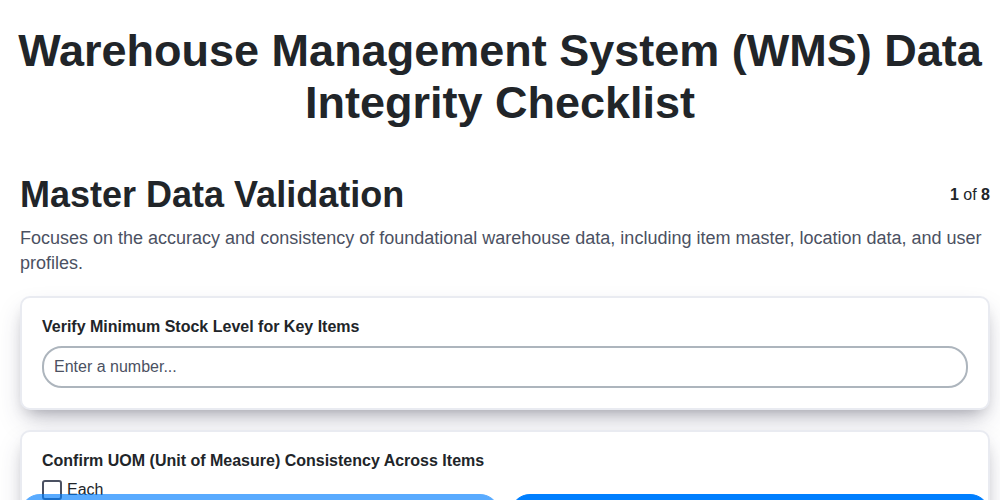
Warehouse Data Integrity: Your WMS Checklist Template
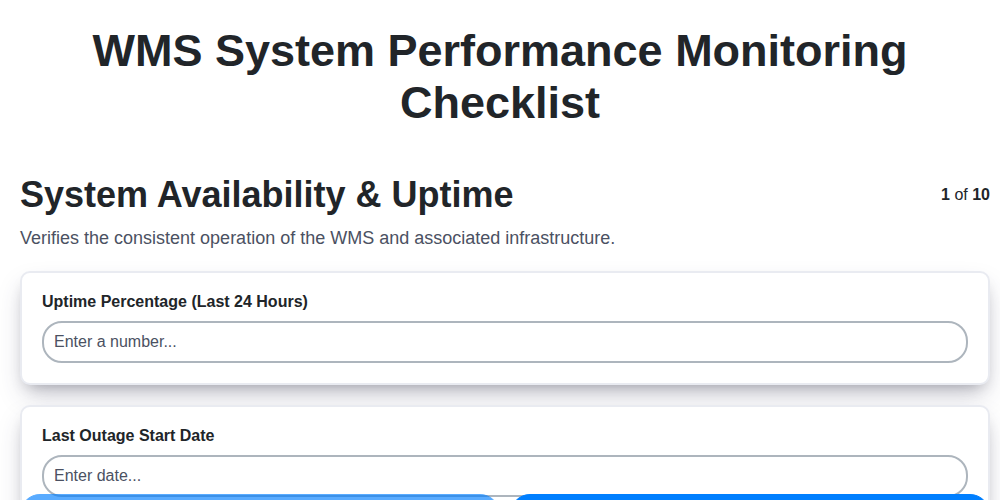
WMS System Performance Monitoring Checklist: A Comprehensive Guide
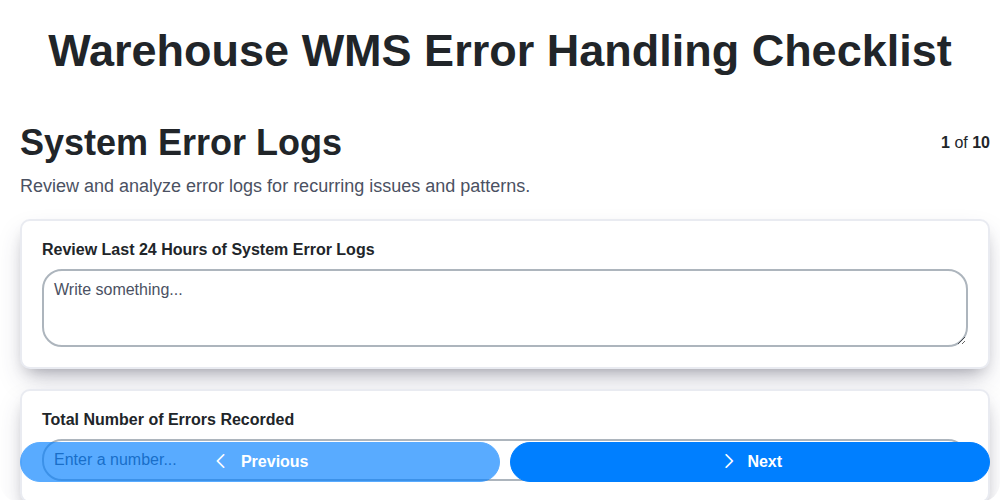
Warehouse WMS Error Handling Checklist: A Proactive Guide to Minimizing Disruptions
We can do it Together
Need help with
Warehouse Management System (WMS)?
Have a question? We're here to help. Please submit your inquiry, and we'll respond promptly.