Laboratory Equipment Inspection Workflow: GLP/GLP Compliance and Calibration Management
Published: 06/18/2026 9:00 PM Updated: 06/19/2026 11:48 AM
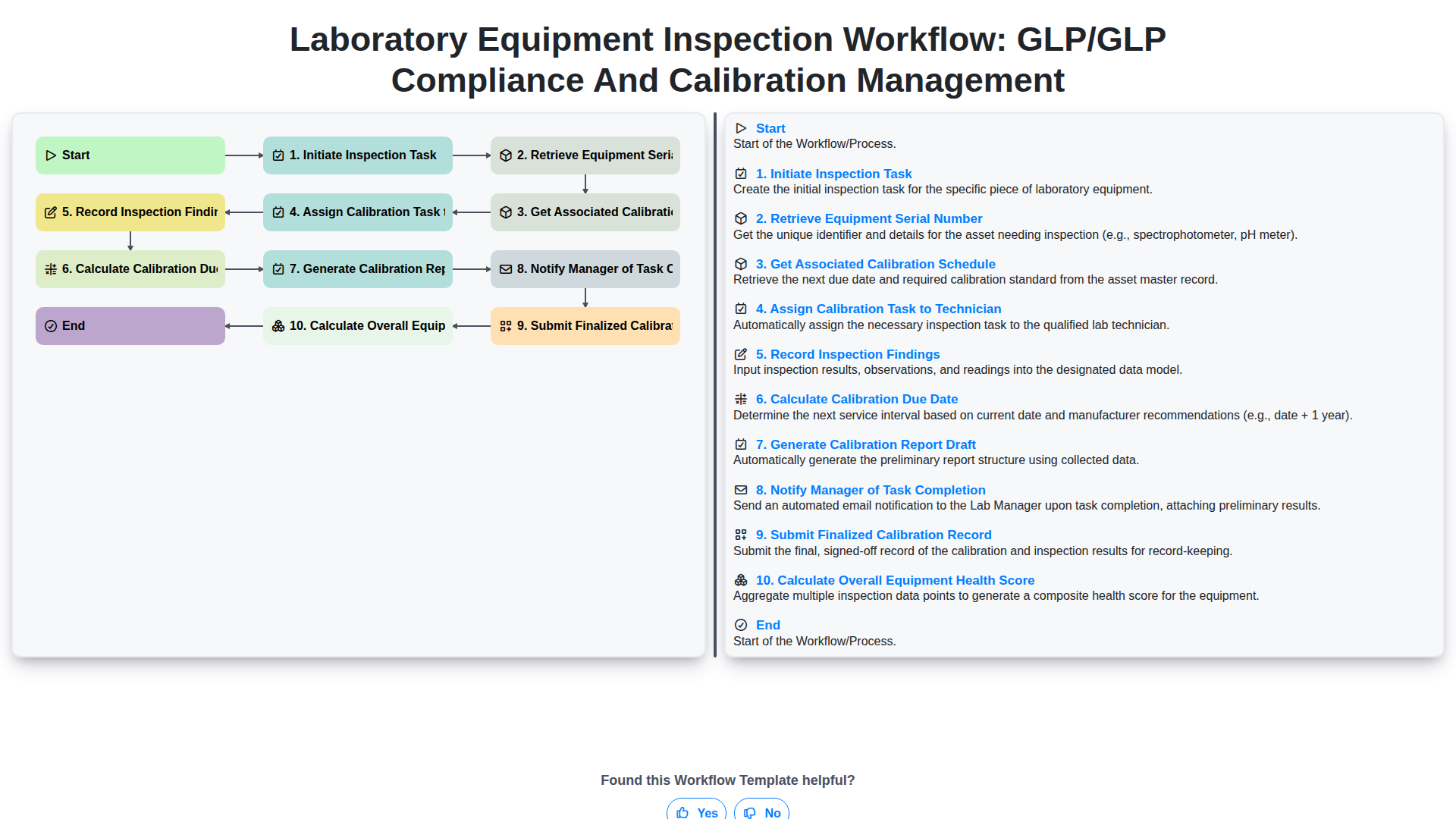
Table of Contents
- Introduction: The Importance of Rigorous Equipment Inspection in GLP/GMP Environments
- The Critical Role of Calibration Management in Regulatory Compliance
- Step 1: Initiating the Inspection Task: Setting the Compliance Foundation
- Step 2: Ensuring Traceability: Retrieving Equipment Serial Numbers
- Step 3: Aligning with Maintenance Cycles: Retrieving the Associated Calibration Schedule
- Step 4: Resource Allocation: Assigning Calibration Tasks to Qualified Technicians
- Step 5: Data Integrity in the Field: Recording Detailed Inspection Findings
- Step 6: Predictive Maintenance: Calculating the Next Calibration Due Date
- Step 7: Documentation Control: Generating the Calibration Report Draft
- Step 8: Supervisory Oversight: Notifying Managers of Task Completion
- Step 9: Finalizing the Audit Trail: Submitting the Finalized Calibration Record
- Step 10: Advanced Analytics: Calculating the Overall Equipment Health Score
- Conclusion: Streamlining Workflows for Uninterrupted Laboratory Excellence
- Resources & Links
TLDR: This guide breaks down a streamlined laboratory equipment inspection workflow designed to ensure strict GLP/GLPC compliance. Learn how to automate the entire lifecycle of equipment maintenance-from initiating inspections and managing calibration schedules to calculating equipment health scores-ensuring your lab remains audit-ready and all instruments stay within precise calibration limits.
Introduction: The Importance of Rigorous Equipment Inspection in GLP/GMP Environments
In the highly regulated landscape of Good Laboratory Practice (GLP) and Good Manufacturing Practice (GMP), the integrity of scientific data is inextricably linked to the reliability of the instruments used to generate it. In these environments, laboratory equipment is more than just a tool; it is a critical component of a validated process. Any deviation in instrument performance, caused by uncalibrated or poorly maintained hardware, can lead to compromised results, regulatory non-compliance, and even the invalidation of entire research studies.
Maintaining compliance requires more than just periodic checks; it demands a robust, standardized, and auditable workflow. A failure to follow a structured inspection and calibration protocol doesn't just risk technical inaccuracies-it creates significant regulatory vulnerabilities during audits. Therefore, implementing a systematic approach to equipment management is essential to ensure that every piece of hardware operates within its specified tolerances, maintaining the traceability and reproducibility that are the cornerstones of laboratory excellence.
The Critical Role of Calibration Management in Regulatory Compliance
In the highly regulated landscapes of Good Laboratory Practice (GLP) and Good Manufacturing Practice (GMP), the integrity of your data is only as reliable as the instruments used to generate it. Calibration management is not merely a maintenance routine; it is a fundamental pillar of regulatory compliance. When laboratory equipment drifts out of calibration, the downstream effects can be catastrophic-leading to invalidated test results, failed audits, and the potential for costly product recalls.
Maintaining a rigorous, standardized inspection workflow ensures that every piece of equipment remains within its verified operational parameters. Effective calibration management provides a traceable, time-stamped audit trail that proves to regulatory bodies that your measurement processes are controlled, consistent, and accurate. By moving beyond reactive repairs and adopting a proactive, scheduled approach to inspection and calibration, laboratories can mitigate the risks of non-compliance, ensure data integrity, and maintain the highest standards of scientific precision.
Step 1: Initiating the Inspection Task: Setting the Compliance Foundation
The foundation of a robust quality management system lies in how a process begins. In a strictly regulated GLP (Good Laboratory Practice) environment, an inspection cannot be a reactive or haphazard event; it must be a controlled, documented, and intentional action.
The workflow begins with the Initiate Inspection Task phase. This step is the trigger that sets the entire compliance chain in motion. Whether an inspection is triggered by a scheduled interval, a post-maintenance requirement, or a suspected deviation, the initiation process ensures that a formal record is created within the Laboratory Information Management System (LIMS) or Quality Management Software.
By formally initiating the task, the laboratory establishes a clear audit trail from second one. This step serves several critical functions:
- Defining Scope: It identifies exactly which piece of equipment is under review, preventing scope creep or missed assets.
- Establishing Accountability: It creates a timestamped entry that proves the laboratory is proactively monitoring its assets, a key requirement for regulatory inspectors.
- Resource Planning: It signals to the laboratory management that an inspection is imminent, allowing for the necessary downtime to be scheduled without disrupting active experimental workflows.
In essence, initiating the task is more than just a to-do item; it is the formal commitment to maintaining the integrity of the laboratory's analytical data by ensuring that no piece of equipment bypasses the necessary scrutiny required for GLP compliance.
Step 2: Ensuring Traceability: Retrieving Equipment Serial Numbers
In the realm of GLP/GMP compliance, data integrity is non-negotiable. Once an inspection task has been initiated, the next critical step in the workflow is the retrieval of the specific equipment serial number. This process serves as the foundation for the entire traceability chain.
Relying on vague descriptions or manual entry of equipment names is a significant compliance risk. By precisely identifying the unique serial number, the system creates an immutable link between the physical asset and its digital twin. This step ensures that every subsequent action-from viewing calibration history to recording findings-is mapped to the correct instrument. Without this precise identification, the risk of cross-contamination of data (applying a calibration record to the wrong machine) becomes dangerously high, potentially leading to failed audits and compromised laboratory results.
Step 3: Aligning with Maintenance Cycles: Retrieving the Associated Calibration Schedule
Once the equipment's unique identity is confirmed via its serial number, the workflow moves into a critical phase of synchronization: retrieving the associated calibration schedule.
In a GLP-compliant environment, an inspection is never a standalone event; it is a single link in a much larger chain of preventive maintenance. To ensure continuous compliance, the system must automatically pull the historical and future-dated parameters tied specifically to that serial number. This step involves cross-referencing the equipment with its specific calibration frequency-whether it is monthly, quarterly, or annually-and identifying any drift in previous cycles.
By retrieving the pre-established schedule, the workflow bridges the gap between a simple manual check and a robust, automated compliance strategy. This prevents the common pitfall of performing inspections in a vacuum, ensuring that every technician is working with the context of the equipment's entire lifecycle and that no upcoming deadlines are overlooked.
Step 4: Resource Allocation: Assigning Calibration Tasks to Qualified Technicians
Once the calibration schedule is retrieved and the specific requirements of the equipment are identified, the next critical step in the workflow is the strategic assignment of the task. In a GLP-compliant environment, this is not merely about distributing workload; it is about ensuring competency-based allocation.
Effective resource allocation involves matching the complexity of the equipment-whether it is a simple pH meter or a sophisticated mass spectrometer-with a technician who possesses the specific training, certification, and documented proficiency for that particular instrument. This step ensures that the Qualified aspect of Qualified Personnel (a core pillar of GLP) is strictly upheld.
During this stage, the system or supervisor must consider several variables:
- Technician Competency: Matching the technician's skill set to the instrument's technical specifications.
- Availability and Workload: Balancing the inspection queue to prevent bottlenecks that could lead to expired calibration windows.
- Traceability: Ensuring that the assignment is digitally logged to maintain a clear audit trail of who was responsible for the task.
By precisely assigning tasks to the right hands, the laboratory minimizes the risk of human error, reduces the likelihood of failed inspections, and ensures that the subsequent recording of findings is performed by a subject matter expert.
Step 5: Data Integrity in the Field: Recording Detailed Inspection Findings
The integrity of a GLP/GMP-compliant laboratory relies heavily on the precision of the data captured during the inspection process. Once a technician is on-site with the equipment, the Record Inspection Findings stage becomes the most critical touchpoint for regulatory compliance. This is not merely about checking a box; it is about capturing a granular, real-time account of the equipment's operational state.
During this step, technicians must document every observation, including physical wear, unexpected fluctuations in performance, or any deviations from standard operating procedures (SOPs). In a digital workflow, this involves entering structured data-such as temperature readings, pressure levels, or voltage stability-alongside qualitative notes.
To ensure audit readiness, this phase should prioritize:
- Unambiguous Documentation: Avoiding vague terms like okay or fine in favor of measurable, objective data.
- Real-Time Entry: Minimizing transcription lag by recording findings immediately to prevent memory-based errors.
- Evidence Attachment: Utilizing mobile capabilities to attach photographic evidence of discrepancies or calibration certificates directly to the inspection task.
By capturing high-fidelity data at the point of inspection, the laboratory creates a transparent, permanent, and immutable audit trail that satisfies even the most stringent regulatory inspections.
Step 6: Predictive Maintenance: Calculating the Next Calibration Due Date
Once the inspection findings have been recorded, the workflow moves from retrospective analysis to proactive planning. The core of a robust GLP-compliant system lies in its ability to prevent downtime before it occurs. By utilizing the data gathered during the inspection, the system automatically calculates the next calibration due date.
This step is not merely about marking a calendar; it is about precision-driven maintenance. The calculation engine analyzes the equipment's current performance, the frequency of use, and any deviations noted during the inspection to determine the optimal interval for the next service. By automating this calculation, laboratories can eliminate the human error associated with manual scheduling, ensuring that no piece of critical equipment ever drifts out of compliance. This transition from reactive fixes to predictive scheduling is what transforms a standard inspection into a comprehensive calibration management strategy.
Step 7: Documentation Control: Generating the Calibration Report Draft
Once the inspection findings have been recorded and the new calibration due date has been calculated, the workflow transitions into a critical phase of the compliance cycle: Generating the Calibration Report Draft.
In a GLP/GLIMS-compliant environment, data integrity is paramount. This step is not merely about creating a summary; it is about transforming raw inspection data into a structured, traceable document that serves as the official record of the equipment's performance. The system automatically pulls the technician's recorded observations, the equipment's unique serial number, and the newly determined calibration deadline to populate a standardized template.
Automating the generation of this draft ensures that no critical parameters are omitted and reduces the risk of human error during manual entry. A well-structured draft serves as the foundation for the finalized record, providing a transparent audit trail that proves the inspection was conducted according to predefined protocols. This stage acts as the bridge between the physical inspection in the lab and the formal administrative oversight required to maintain regulatory readiness.
Step 8: Supervisory Oversight: Notifying Managers of Task Completion
Once the technician has finalized the inspection and the data is logged, the workflow moves into its critical oversight phase. The system automatically triggers a notification to the Laboratory Manager or Quality Assurance (QA) lead, signaling that the calibration task is complete.
This automated alert is more than just a simple notification; it serves as a vital checkpoint for regulatory compliance. In a GLP-regulated environment, transparency is paramount. By notifying management immediately upon completion, the workflow ensures that supervisors can perform real-time audits of the recorded findings and verify that the technician has adhered to the required Standard Operating Procedures (SOPs). This prevents silent tasks from lingering in the system and ensures that no piece of equipment remains in an unverified state without management's awareness, maintaining a continuous loop of accountability and oversight.
Step 9: Finalizing the Audit Trail: Submitting the Finalized Calibration Record
The final stage of the inspection workflow is the formal submission of the finalized calibration record. This step represents the transition from active data collection to permanent record-keeping, serving as the seal on the entire inspection process. Once all findings, measurements, and technician notes have been reviewed for accuracy, the record must be officially submitted into the laboratory's Quality Management System (QMS).
In a GLP/GMP-compliant environment, this step is critical for maintaining a robust audit trail. Submitting the record ensures that the data is timestamped, locked from further unauthorized edits, and becomes a part of the permanent equipment history. This prevents the risk of retrospective data manipulation and ensures that during a regulatory inspection, the laboratory can provide an immutable, chronological account of the equipment's maintenance history. A finalized record acts as the single source of truth, providing auditors with the necessary confidence that all predefined protocols were strictly followed and that the equipment remains fit for intended use.
Step 10: Advanced Analytics: Calculating the Overall Equipment Health Score
The final stage of the workflow moves beyond simple record-keeping and enters the realm of predictive maintenance. Once the calibration record is finalized, the system automatically calculates an Overall Equipment Health Score for each asset.
This metric is not based solely on the most recent inspection, but rather an algorithmic synthesis of several critical data points:
- Calibration Drift Trends: Analyzing whether the equipment is consistently trending toward the upper or lower tolerance limits over multiple inspection cycles.
- Maintenance Frequency: Evaluating the consistency of scheduled vs. unscheduled interventions.
- Age and Usage Intensity: Factoring in the operational hours or usage cycles since the last major overhaul.
- Historical Deviation Rate: Assessing how often the equipment has failed to meet precision standards during previous inspections.
By transforming raw inspection data into a single, quantifiable health score, laboratory managers can transition from a reactive stance to a proactive one. Instead of waiting for an equipment failure to disrupt a study, the health score provides an early warning system. A declining score serves as a signal to investigate potential underlying issues before they result in a non-compliance event or a failed audit, ensuring that your laboratory remains in a constant state of inspection readiness.
Conclusion: Streamlining Workflows for Uninterrupted Laboratory Excellence
Maintaining a rigorous inspection and calibration workflow is more than just a regulatory obligation; it is the backbone of scientific integrity. By transitioning from manual, fragmented processes to a structured, automated workflow-from the initial task initiation to the calculation of real-time equipment health scores-laboratories can eliminate the risks of human error and non-compliance. Implementing a standardized cycle ensures that every piece of equipment is tracked, every technician is informed, and every calibration record is audit-ready. Ultimately, embracing this level of systematic oversight allows your team to move away from reactive troubleshooting and toward a state of proactive, uninterrupted excellence, ensuring that your laboratory remains a trusted environment for accurate, reproducible, and high-quality scientific discovery.
Resources & Links
- FDA Good Laboratory Practice (GLP) Regulations: Official regulatory guidelines regarding non-clinical laboratory studies and the requirements for equipment maintenance and documentation.
- ISO/IEC 17025: General Requirements for the Competence of Testing and Calibration Laboratories: The international standard that outlines the technical competence and management system requirements for calibration laboratories.
- EMA Good Manufacturing Practice (GMP) Guidelines: Regulatory resources regarding the maintenance of laboratory equipment to ensure product quality and safety in pharmaceutical environments.
- NIST Calibration and Traceability Standards: Resources for understanding the importance of metrological traceability and the scientific foundation of calibration accuracy.
- ASQ Quality Assurance and Equipment Management: Professional resources and best practices for implementing quality control workflows and preventive maintenance schedules in technical environments.
Found this Article helpful?
Comments
There are no comments yet. Be the first to add one!
Audit/Inspection Management Solution Demo
Ensure compliance & improve performance! ChecklistGuro streamlines audit/inspection creation, execution, and reporting. Reduce risk, enhance quality, & maintain consistency. Manage it all with our Work OS.
Related Articles
Restaurant Kitchen Safety Inspection Checklist Template
The Ultimate Brewery Equipment Sanitation & Safety Checklist Template
Wind Turbine Inspection Checklist Template: Your Comprehensive Guide
The Ultimate Apartment Building Maintenance Inspection Checklist Template
Your Essential Guide to a Manufacturing Quality Control Inspection Checklist
The Ultimate Solar Panel Inspection Checklist Template
Your Ultimate HVAC Inspection Checklist Template
The Ultimate Data Center Inspection Checklist Template
We can do it Together
Need help with
Checklists?
Have a question? We're here to help. Please submit your inquiry, and we'll respond promptly.