Mastering Supply Chain Scarcity: The MRP Finished Goods Allocation Strategy Checklist 2026
Published: 10/28/2026 Updated: 10/29/2026
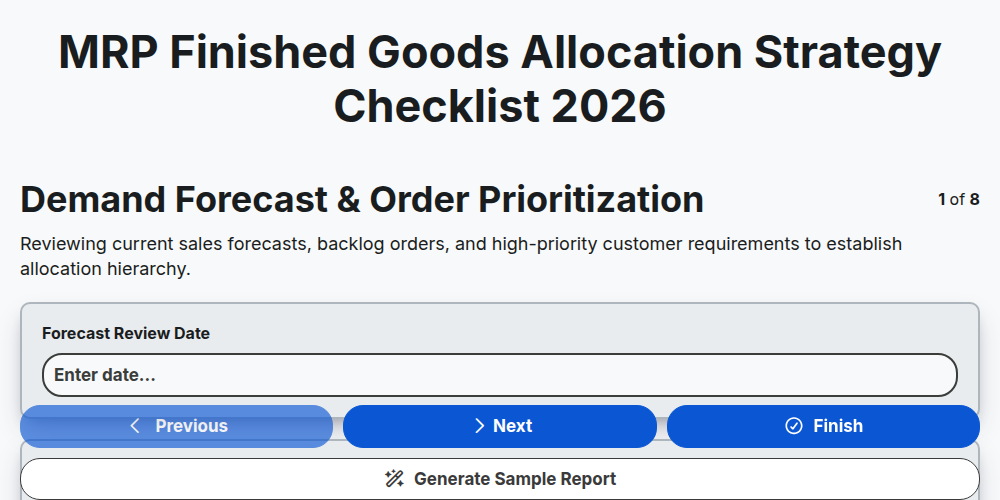
Table of Contents
- Introduction: Navigating the Complexity of 2026 Supply Chains
- 1. Demand Forecast & Order Prioritization: Aligning Supply with Strategic Value
- 2. Inventory Availability Assessment: Real-Time Visibility is Non-Negotiable
- 3. Order Segmentation & Customer Tiering: Protecting Your Most Valuable Relationships
- 4. Constraint & Bottleneck Identification: Mapping the Limits of Production
- 5. Allocation Logic & Rule Validation: Building Transparent, Data-Driven Decision Frameworks
- 6. Risk Mitigation & Shortage Contingency: Preparing for the Unexpected
- 7. Communication & Stakeholder Alignment: Synchronizing Sales, Operations, and Logistics
- 8. Post-Allocation Audit & Performance Tracking: Continuous Improvement through Data
- Conclusion: Future-Proofing Your Allocation Strategy
- Resources & Links
TLDR: As supply chain volatility remains a constant in 2026, efficient inventory distribution is critical. This guide provides a comprehensive 8-step checklist-covering everything from demand forecasting and customer tiering to risk mitigation and post-allocation audits-to help manufacturers optimize finished goods allocation, maximize profitability, and maintain customer trust during periods of scarcity.
Introduction: Navigating the Complexity of 2026 Supply Chains
As we approach 2026, the global supply chain landscape is no longer defined by the just-in-time stability of the past, but by a state of permanent volatility. Rising geopolitical tensions, unpredictable climate-driven logistics disruptions, and the rapid integration of AI-driven demand fluctuations have made a single, predictable forecast a relic of the past. For manufacturing leaders, the challenge has shifted from simply managing production to mastering the art of scarcity.
The Shift from Distribution to Strategic Allocation
In an era of unpredictable lead times and fluctuating raw material availability, the question for many Material Requirements Planning (MRP) professionals is no longer, How much can we ship? but rather, Who gets what when we can't meet total demand?
When finished goods inventory falls short of global orders, a reactive approach leads to customer dissatisfaction, strained relationships, and lost market share. A reactive approach creates a first-come, first-served chaos that ignores long-term strategic value. To survive 202 and beyond, companies must transition to a proactive Allocation Strategy-a disciplined, rule-based framework that ensures limited inventory is directed toward the most critical business drivers.
Why a Checklist is Non-Negotiable in 2026
The complexity of modern MRP environments means that manual, ad-hoc decisions are prone to error and bias. An effective allocation strategy requires a systematic way to balance:
- Revenue Protection: Ensuring high-margin orders are prioritized.
- Customer Loyalty: Honoring commitments to Tier 1 strategic partners.
- Operational Efficiency: Minimizing the logistical nightmare of split shipments and partial deliveries.
- Risk Management: Building buffers for the known unknowns of the 2026 landscape.
The following checklist is designed to serve as your strategic blueprint. It is not merely a set of operational steps, but a governance framework to help you navigate shortages with precision, transparency, and strategic intent.
1. Demand Forecast & Order Prioritization: Aligning Supply with Strategic Value
Navigating Uncertainty with Data-Driven Foresight
In the volatile landscape of 2026, reacting to demand is no longer sufficient; you must anticipate it. The foundation of a successful allocation strategy lies in your ability to bridge the gap between high-level market intelligence and granular order management.
Synchronizing Projections with Reality
The first step in the allocation process is a rigorous evaluation of your Demand Forecast. In an era of heightened market volatility, relying solely on historical data is a recipe for failure. Your strategy must integrate real-time market signals, promotional calendars, and macroeconomic indicators to create a single version of the truth regarding expected volume.
Determining Order Priority
Once the forecast is established, the focus shifts from how much is needed to which orders take precedence. Not all orders are created equal. To prevent a first-come, first-served trap-which often penalizes your most strategic partners-you must implement a systematic approach to prioritization.
Key Sub-steps for Success:
- Signal Validation: Cross-reference incoming sales orders against the baseline forecast to identify significant variances or demand spikes.
- Strategic Weighting: Assign priority scores to orders based on predefined criteria such as contract importance, margin contribution, and long-term partnership value.
- Lead-Time Integration: Evaluate whether the requested delivery dates align with current production capacities to avoid creating artificial bottlenecks.
By mastering this initial phase, you ensure that your allocation logic is not just managing scarcity, but actively driving your company's most profitable and strategic objectives.
2. Inventory Availability Assessment: Real-Time Visibility is Non-Negotiable
In the volatile market landscape of 2026, guessing is no longer a viable strategy. When facing supply shortages, your allocation decisions are only as accurate as your underlying data. An allocation strategy built on fragmented or outdated information is fundamentally flawed, leading to missed shipments and eroded customer trust.
Moving Beyond Static Data
To execute an effective allocation strategy, you must move away from end-of-day snapshots and transition toward real-time, continuous visibility. Assessing inventory availability is not merely about checking a warehouse management system (WMS) for a total quantity; it requires a granular understanding of where that stock is physically located and its current status.
The Three Pillars of Assessment
To ensure your allocation logic is applied to true available stock, your assessment must evaluate three critical dimensions:
- On-Hand vs. Available-to-Promise (ATP): Do not confuse physical stock with allocatable stock. Your assessment must automatically subtract safety stock buffers, existing backorders, and stock already committed to high-priority channels before determining what is truly available for new allocation.
- In-Transit & In-Production Visibility: In 2026, inventory must include the pipeline. An effective assessment integrates real-time tracking of goods in transit and progress updates from the production floor. Knowing that 5,000 units are clearing customs in 48 hours changes your ability to commit to new orders.
- Inventory Quality and Disposition: Availability is also about usability. Your checklist must account for quarantined stock, items undergoing quality re-inspection, and units with packaging damage that may be unsuitable for premium tier customers.
Eliminating the Data Lag Risk
The biggest threat to your allocation strategy is the latency between a physical movement in the warehouse and its reflection in your MRP system. If your assessment relies on data that is even a few hours old, you risk over-allocating-promising the same unit to two different priority customers.
The 2026 Standard: Your assessment process should leverage integrated IoT and automated ERP syncing to ensure that the moment a pallet is scanned, the allocation engine reflects the change. Without this level of real-time accuracy, your prioritization and segmentation efforts will be built on a foundation of sand.
3. Order Segmentation & Customer Tiering: Protecting Your Most Valuable Relationships
Prioritizing Profitability and Loyalty
When supply cannot meet demand, your allocation strategy shifts from simple order fulfillment to strategic relationship management. You cannot treat every order with the same level of urgency; doing so leads to first-come, first-served chaos, where high-volume, low-margin orders may inadvertently cannibalize stock intended for your most strategic partners.
Defining Your Customer Tiers
To execute an effective 2026 allocation plan, you must categorize your customer base using a data-driven tiering system. This goes beyond simple geography or order size. Consider the following dimensions:
- Tier 1: Strategic Partners: High-lifetime value (LTV) customers, those with long-term contracts, or those who provide critical market access. These orders receive protected status.
- Tier 2: Core Reliables: Consistent, high-volume accounts that represent the backbone of your predictable revenue.
- Tier 3: Transactional/Spot Buyers: Occasional customers or low-margin distributors who are subject to availability only after Tier 1 and 2 obligations are met.
The Logic of Segmentation
Segmentation allows you to apply different allocation weights to your MRP outputs. By segmenting orders by product category and customer importance, you can implement specific rules, such as:
- Full Fulfillment for Strategic Accounts: Ensuring zero-stockout scenarios for key accounts to maintain brand integrity.
- Proportional Allocation (Fair Share) for Tier 2: Distributing limited stock across your mid-tier base to prevent any single partner from being left empty-handed.
- Backorder/Waitlist for Tier 3: Managing expectations by placing low-priority orders into a queue to be filled only when excess capacity becomes available.
Avoiding the Revenue Trap
A common pitfall in 2026's volatile market is focusing solely on immediate order value. A massive, one-time order from a Tier 3 customer might look great on a weekly revenue report, but if it depletes the inventory needed to fulfill a recurring, high-margin contract for a Tier 1 partner, the long-term cost to your brand equity will far outweigh the short-term gain. Use this stage of the checklist to ensure your allocation logic aligns with your long-term corporate strategy, not just your immediate quarterly targets.
4. Constraint & Bottleneck Identification: Mapping the Limits of Production
Navigating the Pressure Points of Production
In the 2026 manufacturing landscape, an allocation strategy is only as strong as its understanding of physical and operational limitations. Even the most sophisticated demand forecast becomes irrelevant if your production lines or logistics networks cannot execute the plan. To prevent phantom allocation-committing stock to customers that you physically cannot deliver-you must rigorously map your operational bottlenecks.
Identifying the Critical Constraints
Allocation cannot happen in a vacuum; it must be bounded by the reality of your capacity. This stage of the checklist requires a deep dive into three specific areas:
- Manufacturing Throughput Limits: Evaluate machine uptime, labor availability, and maintenance schedules. Are there specific production lines or shifts that are hitting a ceiling?
- Material & Component Dependencies: An allocation plan for finished goods is subject to the availability of sub-assemblies and raw materials. Identify if a shortage in a single long-lead component will bottleneck the entire finished goods output.
- Logistics and Distribution Throughput: Even if the product is built, can it move? Assess warehouse outbound capacity, trucking availability, and international shipping lane congestion.
Analyzing the Impact of Bottlenecks
Once constraints are identified, the goal is to determine their ripple effect on your allocation logic.
Bottleneck Sensitivity Analysis
Don't just identify a bottleneck; quantify its impact on your service levels. If a primary assembly line experiences a 10% drop in efficiency, how does that force a change in your customer prioritization? This requires moving from reactive troubleshooting to proactive modeling, ensuring your allocation rules automatically adjust when capacity shifts.
Synchronizing Capacity with Allocation Priority
The final step in this phase is ensuring your allocation rules are capacity-aware. If your highest-tier customers are assigned a specific volume, but a bottleneck reduces total output by 20%, your strategy must include predefined instructions on how to trim orders proportionally across the board without triggering a total breakdown in service.
5. Allocation Logic & Rule Validation: Building Transparent, Data-Driven Decision Frameworks
The Core of the Strategy: From Intuition to Automation
In an era of volatile lead times and fluctuating global demand, the gut feeling approach to stock distribution is no longer a viable business model. By 2026, the complexity of multi-channel demand means that allocation cannot be a reactive measure; it must be a pre-defined, algorithmic process. The goal of this stage is to translate your high-level business priorities into programmable logic that your MRP (Material Requirements Planning) system can execute without bias.
Defining the Decision Matrix
To ensure your allocation logic is robust, you must move beyond simple first-come, first-served models. Your validation framework should test how your rules handle various scenarios, such as:
- Pro-Rata Distribution: Automatically scaling orders based on the percentage of total demand each region or channel represents.
- Percentage of Demand Fulfillment: Ensuring every customer receives a minimum survival quantity to maintain market presence, even during severe shortages.
- Margin-Based Weighting: Prioritizing high-contribution products and high-margin SKUs to protect bottom-line profitability during supply crunches.
Validating the Logic Stress Test
A rule is only as good as its performance under pressure. Before deploying your allocation logic into your live ERP or MRP environment, you must perform rigorous validation through digital twins or historical back-testing.
Ensuring Algorithmic Integrity
As we move deeper into 2026, the integration of AI-driven decision-making makes the Validation step even more critical. You must audit your logic for three specific risks:
- The Starvation Risk: Does your logic inadvertently starve small but strategically vital customers of stock in favor of high-volume giants?
- The Deadlock Scenario: Are there conflicting rules (e.g., prioritizing Customer Tier 1 while simultaneously trying to Minimize Shipping Costs) that cause the system to stall or produce illogical outputs?
- The Bias Audit: Is the logic unintentionally penalizing specific geographic regions due to secondary constraints like logistics availability?
By documenting and validating these rules, you transform your allocation strategy from a source of departmental conflict into a transparent, repeatable, and scalable competitive advantage.
6. Risk Mitigation & Shortage Contingency: Preparing for the Unexpected
Anticipating the Unpredictable: Building Resilient Contingency Plans
In the volatile landscape of 2026, a robust allocation strategy is only as strong as its ability to withstand sudden disruptions. Even the most sophisticated MRP (Material Requirements Planning) logic can be rendered obsolete by a single-source supplier failure, a sudden geopolitical shift, or a localized logistics bottleneck.
To move beyond reactive firefighting and toward proactive resilience, your allocation strategy must include predefined Plan B protocols. This stage of the checklist focuses on building a safety net that preserves your most critical customer relationships when the supply chain inevitably falters.
Identifying Worst-Case Scenarios
Risk mitigation begins with rigorous scenario planning. Your strategy should not just account for minor delays, but simulate extreme shortage events.
- Supply Chain Fragility Mapping: Identify which high-priority orders are most vulnerable to specific disruption types (e.g., transit delays vs. raw material shortages).
- Threshold Triggers: Define clear, data-driven tripwires. At what percentage of inventory depletion does the allocation logic automatically shift from standard fulfillment to emergency rationing?
Implementing Buffer Strategies
While safety stock is a standard component of inventory management, contingency planning requires a more strategic application of buffers.
- Strategic Decoupling: Maintain strategic reserves of finished goods that are exempt from standard allocation logic, reserved exclusively for catastrophic recovery or ultra-premium tier customers.
- Alternative Sourcing Readiness: Ensure that your allocation logic is integrated with pre-qualified secondary suppliers. If a primary production line fails, your allocation rules should be able to pivot to available secondary stock instantly.
The Minimum Viable Fulfillment Concept
When a shortage becomes unavoidable, the goal shifts from optimization to damage control.
- Partial Shipment Protocols: Develop standardized rules for breaking down large orders into smaller, more frequent deliveries. This keeps customers operational-even if not at 100% capacity-preventing total order cancellations.
- Substitute Product Mapping: Create a pre-approved list of allowable substitutes. If Finished Good A is unavailable, does your system have the logic to automatically offer Finished Good B (with similar specs) to prevent a complete fulfillment gap?
By embedding risk mitigation directly into your allocation checklist, you transform your supply chain from a fragile chain of dependencies into a flexible, adaptive network capable of maintaining service levels despite the era's inherent uncertainty.
7. Communication & Stakeholder Alignment: Synchronizing Sales, Operations, and Logistics
Breaking Down the Silos
In the complex landscape of 2026 supply chains, an allocation strategy is only as strong as the consensus behind it. The greatest failure in MRP (Material Requirements Planning) execution isn't usually a mathematical error, but a communication breakdown. When the logic used to distribute limited finished goods is kept within the confines of the supply planning team, it creates a vacuum of distrust among other critical departments.
Achieving Cross-Functional Buy-in
To ensure your allocation strategy is executed seamlessly, you must move beyond informing stakeholders and move toward aligning them. Effective alignment requires three key pillars:
- Sales & Account Management Alignment: Your sales teams are on the front lines. They need to understand the why behind allocation decisions. If a Tier-1 customer is receiving a lower percentage of their order due to a specific constraint, the sales lead must be equipped with the data-driven rationale to manage that client's expectations without damaging the relationship.
- Operations & Production Synergy: The allocation plan must be grounded in the reality of the shop floor. Close loops between the allocation logic and the production schedule ensure that promised allocations are physically achievable, preventing the phantom inventory trap where orders are allocated but cannot be fulfilled.
- Logistics & Distribution Coordination: An allocation strategy is useless if the downstream logistics network cannot handle the redistributed flow. Ensuring that warehousing and outbound logistics are synchronized with the new allocation priorities prevents bottlenecks at the loading dock and ensures high-priority orders move through the network first.
The Unified Truth: Centralized Visibility
The cornerstone of successful stakeholder alignment is a Single Source of Truth (SSOT). By 2026, relying on fragmented spreadsheets is a recipe for operational chaos.
Implement a centralized digital dashboard where every stakeholder-from the Procurement Manager to the Regional Sales Director-can view the real-time status of inventory availability, the current allocation logic being applied, and the identified constraints. When everyone views the same data, finger-pointing is replaced by problem-solving, transforming the allocation process from a source of internal friction into a strategic driver of business resilience.
8. Post-Allocation Audit & Performance Tracking: Continuous Improvement through Data
Closing the Loop: Turning Post-Allocation Data into Strategic Intelligence
An allocation strategy is not a set and forget mechanism. In the volatile landscape of 2026, the true competitive advantage lies not just in how you distribute limited stock, but in how quickly you learn from the results of that distribution. The final step of your checklist is the most critical for long-term resilience: the post-allocation audit.
The Anatomy of an Effective Audit
Once the allocation cycle is complete and orders have been fulfilled, the focus must shift from execution to evaluation. A robust audit should move beyond simple did we ship it? metrics to a deeper investigation of systemic efficiency.
Key Audit Dimensions:
- Accuracy Verification: Did the actual allocation match the predefined logic and rules established in your strategy? Any deviation-whether due to manual overrides or system errors-must be documented.
- Service Level Impact: Analyze the Fill Rate versus Order Fill Rate across different customer tiers. Did the priority customers receive the promised quantities, or did unforeseen bottlenecks erode their service levels?
- Constraint Re-evaluation: Review whether the bottlenecks identified in Step 4 were accurately predicted. If a bottleneck shifted unexpectedly, it indicates a need for more granular visibility in your real-time monitoring tools.
Tracking KPIs for Long-Term Stability
To transform an audit into a strategic asset, you must track specific Key Performance Indicators (KPIs) that bridge the gap between logistics and finance.
Essential Metrics for 2026
- Allocation Precision Score: A metric measuring the delta between the planned allocation and the actual execution. High variance suggests a breakdown in communication or a failure in the automated logic.
- Stockout Cost Analysis: Quantify the lost margin and potential customer churn risk resulting from unfulfilled high-priority orders. This provides the financial justification for investing in increased safety stock or capacity.
- Lead Time Volatility: Monitor how allocation shifts impacted downstream lead times. If prioritizing one segment caused an unmanageable backlog in another, your segmentation logic requires recalibration.
Building a Feedback Loop
The ultimate goal of post-allocation tracking is to create a self-correcting ecosystem. The insights gathered here should serve as the direct input for the Demand Forecast & Order Prioritization stage of your next cycle. By treating every shortage as a data point rather than a failure, you transition your supply chain from a reactive state to a predictive, optimized engine capable of navigating the complexities of the 2026 market.
Conclusion: Future-Proofing Your Allocation Strategy
Navigating the Complexity of 2026 and Beyond
As we move deeper into 2026, the volatility of global supply chains is no longer an anomaly-it is the baseline. The era of set and forget production planning has officially ended. The organizations that will thrive in this era of scarcity are not those with the largest inventories, but those with the most agile and disciplined allocation frameworks.
Implementing this MRP Finished Goods Allocation Strategy Checklist is not merely about managing a shortage; it is about strategic decision-making. By moving beyond simple first-come, first-served models and adopting a structured approach-integrating customer tiering, rigorous bottleneck identification, and continuous post-allocation audits-you transform your supply chain from a reactive cost center into a proactive competitive advantage.
The Path to Resilience
The ultimate goal of this checklist is to build a repeatable, transparent, and data-driven culture of accountability. When you master the ability to prioritize demand, validate allocation logic, and communicate clearly with stakeholders, you protect your most valuable customer relationships and safeguard your brand reputation during periods of peak stress.
As disruptions continue to evolve, let this checklist serve as your operational North Star. Use it to bridge the gap between high-level strategic intent and ground-level execution, ensuring that even when resources are limited, your impact remains maximized.
Resources & Links
- Gartner Supply Chain Research: Industry-leading insights and strategic research on supply chain management, digital transformation, and risk mitigation.
- ASCM (Association for Supply Chain Management): The global leader in supply chain organizational capability, offering frameworks for MRP, inventory, and demand planning.
- MIT Center for Transportation & Logistics: Academic excellence and cutting-edge research on global logistics, scarcity modeling, and supply chain resilience.
- SAP Integrated Business Planning: Advanced software solutions for real-time visibility, demand forecasting, and automated allocation logic.
- Oracle Cloud SCM: Enterprise-grade tools for managing production constraints, bottleneck identification, and end-to-end visibility.
- McKinsey & Company - Operations Practice: Strategic consulting resources regarding global supply chain volatility and risk management strategies.
- Supply Chain Brain: A premier news and analysis site for supply chain professionals focusing on logistics and inventory management.
- Demand Driven Institute: Resources on Demand Driven MRP (DDMRP) and methods for managing volatility and scarcity.
- Supply Chain Management Review: In-depth analysis and case studies on operational excellence and manufacturing strategy.
- ISS World - Supply Chain Intelligence: Focuses on risk management, global logistics, and navigating international trade complexities.
- Institute for Supply Management (ISM): Professional resources for procurement and supply management, focusing on strategic sourcing and supplier relationships.
- Forbes - Supply Chain Insights: Business-centric perspectives on how global economic shifts impact manufacturing and distribution.
- Inbound Logistics: Comprehensive coverage of transportation, warehousing, and the logistics technology landscape.
- CIPS (Chartered Institute of Procurement & Supply): Global standards for procurement, essential for understanding customer tiering and supplier risk.
- Blue Yonder: Specialists in AI-driven supply chain planning, essential for the 'Allocation Logic' and 'Real-Time Visibility' sections.
- Logistics Management: Focuses on the practical application of logistics technology and inventory allocation strategies.
Comments
There are no comments yet. Be the first to add one!
Related Articles
MRP System Performance Monitoring Checklist: Ensure Peak Efficiency
MRP System Implementation Checklist: Your Step-by-Step Guide

Top 10 MRPeasy Alternatives for 2025
The 5 Best Bill of Materials (BOM) Management Software of 2025
MRP Planning Parameter Setup Checklist: Your Guide to Accuracy & Efficiency

The 10 Best Manufacturing Management Software of 2025
How to improve your Bill of Materials (BOM) Management
MRP User Training Checklist: Ensuring Proficiency & Success
Need help with
Material Requirements Planning (MRP)?
Have a question? We're here to help. Please submit your inquiry, and we'll respond promptly.