New Feature Request Management Workflow
Published: 06/04/2026 Updated: 10/05/2026
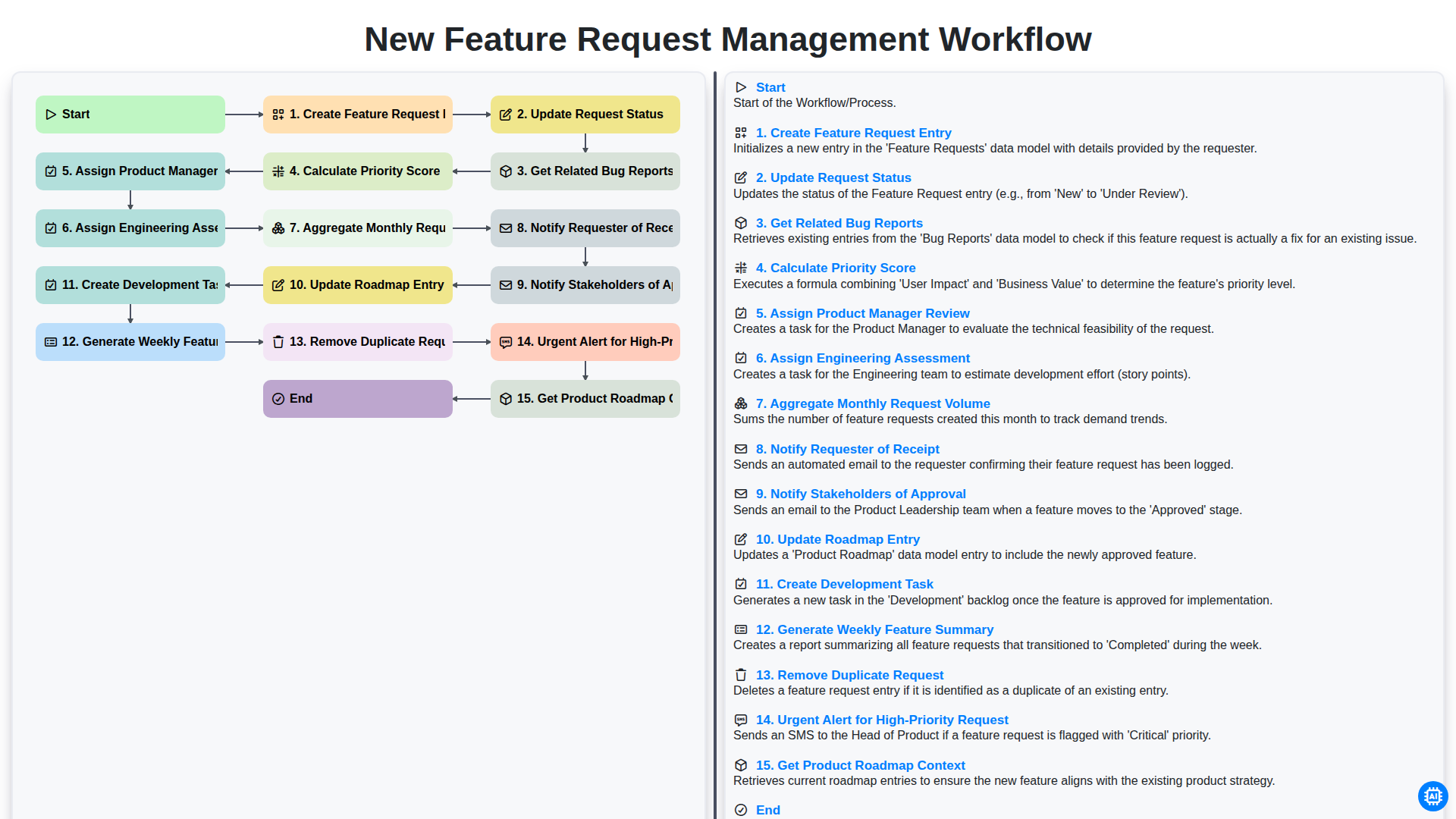
Table of Contents
- Introduction: Streamlining Product Innovation
- Phase 1: Intake and Initial Processing
- Step 1: Create Feature Request Entry & Notify Requester
- Step 2: Deduplication and Data Integrity
- Phase 2: Contextual Analysis and Prioritization
- Step 3: Gathering Intelligence: Bug Reports and Roadmap Context
- Step 4: Calculating the Priority Score
- Step 5: Triage and Cross-Functional Assessment
- Step 6: Product Manager Review & Engineering Assessment
- Phase 3: Execution and Workflow Automation
- Step 7: Handling Urgent Alerts and High-Priority Requests
- Step 8: Approval, Roadmap Updates, and Task Creation
- Phase 4: Communication and Reporting
- Step 9: Stakeholder Notification and Weekly Summaries
- Resources & Links
TLDR: Streamline your product development lifecycle with this automated workflow designed to manage feature requests from initial submission to roadmap integration. Learn how to automate priority scoring, cross-reference bug reports, and coordinate reviews between Product Managers and Engineering to ensure high-impact features are identified, vetted, and tracked efficiently.
Introduction: Streamlining Product Innovation
In the fast-paced world of product development, the difference between market leadership and obsolescence often lies in how effectively a team listens to its users. Every day, a stream of feedback, suggestions, and complaints flows into product teams from customers, sales representatives, and internal stakeholders. Without a structured approach, this influx of information can quickly transform from a valuable goldmine of insights into a chaotic backlog of unmanaged noise.
Managing feature requests is about more than just collecting ideas; it is about creating a repeatable, transparent, and data-driven engine for innovation. When a request is lost in an email thread or sits forgotten in a spreadsheet, the product loses its ability to evolve alongside its users. To build a world-class product, teams need a standardized lifecycle-a workflow that moves a raw idea through rigorous assessment, technical validation, and strategic alignment.
By implementing a robust management workflow, organizations can move away from gut-feeling decision-making and toward a system that prioritizes impact, manages technical debt, and ensures that the most critical innovations always reach the roadmap. In this article, we will explore a comprehensive new workflow designed to transform feature requests from scattered feedback into actionable development tasks.
Phase 1: Intake and Initial Processing
The journey of a new feature begins the moment a user or stakeholder identifies a potential enhancement. The process starts with the Create Feature Request Entry step, where all initial requirements and user needs are documented in a centralized system. To maintain a clean and efficient backlog, the system immediately performs a Remove Duplicate Request check, ensuring that the team isn't wasting resources on redundant ideas.
Once a unique entry is established, the workflow triggers an automated Notify Requester of Receipt action, providing immediate feedback to the stakeholder that their idea has been captured. To ensure the request is evaluated within the broader scope of the product's evolution, the system will Get Product Roadmap Context, allowing the team to see how the new idea aligns with existing strategic goals. At this stage, any critical issues are flagged via an Urgent Alert for High-Priority Request, ensuring that mission-critical feedback is fast-tracked for immediate visibility.
Step 1: Create Feature Request Entry & Notify Requester
The lifecycle of a new feature begins the moment a stakeholder or customer identifies a potential enhancement. The first critical step in our optimized workflow is the Create Feature Request Entry. This process is designed to capture essential details-such as the problem statement, use case, and desired impact-ensuring that no valuable insight is lost in translation.
To ensure transparency and build trust from the very beginning, the workflow triggers an automated Notify Requester of Receipt action. As soon as the entry is successfully logged in our system, the requester receives an immediate confirmation. This automated acknowledgment serves two purposes: it provides instant gratification to the user, confirming their voice has been heard, and it provides a clear audit trail for the product team, ensuring that every request is accounted for from its moment of inception.
Step 2: Deduplication and Data Integrity
To maintain a clean and actionable backlog, the workflow includes a critical automated step: Remove Duplicate Request. When multiple users submit requests for the same functionality, it can lead to fragmented data and skewed priority metrics. Our system scans incoming entries for overlapping descriptions and similar requirements, flagging potential duplicates for review. This ensures that every feature request is unique, preventing the engineering team from being overwhelmed by redundant tasks and ensuring that the true demand for a specific feature is captured under a single, unified thread.
Phase 2: Contextual Analysis and Prioritization
Once a feature request is successfully logged and initial duplicates are removed, the workflow moves into a more rigorous stage of evaluation. This phase is designed to move beyond simple data entry, transforming a raw suggestion into a data-driven development opportunity through deep contextual analysis.
The process begins by automatically performing a Get Related Bug Reports check to determine if the new request is actually a symptom of existing technical debt or a recurring user pain point. To ensure we are focusing on the most impactful changes, the system will Get Product Roadmap Context, comparing the new request against our current long-term goals to ensure strategic alignment.
To strip away subjectivity, the workflow then executes a Calculate Priority Score. This automated calculation weighs the request against several variables, allowing for an Urgent Alert for High-Priority Request to be triggered if a critical need is identified. Following this scoring, the workflow transitions into human-led evaluation: first, by assigning a Product Manager Review to validate the business value, and subsequently, an Engineering Assessment to estimate technical feasibility and effort. This dual-layer review ensures that our roadmap remains both ambitious and achievable.
Step 3: Gathering Intelligence: Bug Reports and Roadmap Context
Once a feature request is officially logged, the workflow moves beyond mere documentation into the critical phase of intelligence gathering. To understand the true impact of a request, the system automatically performs two vital automated lookups: Get Related Bug Reports and Get Product Roadmap Context.
The first step is to cross-reference the new request with existing issue trackers to see if the proposed feature is actually a workaround for ongoing technical debt or a known defect. By pulling in related bug reports, the team can determine if the feature is actually a much-needed fix, preventing the fragmentation of development efforts.
Simultaneously, the workflow integrates with your broader strategic vision by analyzing the current product roadmap. This contextual layer ensures that every new idea is evaluated against your existing commitments. By understanding where the request sits in relation to planned milestones, the system provides the necessary visibility to decide whether the request aligns with our current trajectory or represents a strategic pivot. This stage transforms a simple entry into a data-rich dossier, providing the foundation for an informed priority assessment.
Step 4: Calculating the Priority Score
Once the initial feature requests are gathered and duplicates are removed, the workflow moves into its most critical analytical phase: Calculating the Priority Score. Rather than relying on subjective intuition, this step employs a data-driven formula to transform raw feedback into actionable intelligence.
The scoring engine evaluates each request against several key dimensions. It integrates the Product Roadmap Context to determine how well a request aligns with current strategic goals, alongside the Urgent Alert logic for high-priority items that require immediate attention. By weighing factors such as user impact, technical complexity, and strategic importance, the system generates a standardized numerical value. This ensures that when the workflow moves to the Assign Product Manager Review stage, the PM is presented with a ranked list of opportunities, allowing them to focus their energy on the features that will drive the most significant value for the product and its users.
Step 5: Triage and Cross-Functional Assessment
Once a feature request has been successfully logged and initial duplicates have been removed, the workflow enters the critical triage phase. This stage is designed to transform a raw idea into a data-driven assessment by leveraging both automated logic and human expertise.
The process begins by enriching the request with context. The system automatically performs a Get Related Bug Reports action to see if the requested feature is actually a workaround for an existing issue, while simultaneously executing Get Product Roadmap Context to ensure the request aligns with our long-term strategic goals. To ensure the team focuses on the most impactful items, the workflow will Calculate Priority Score based on predefined metrics like user reach and business value. If a request hits a critical threshold, an Urgent Alert for High-Priority Request is triggered to ensure immediate visibility.
The heart of this step lies in the dual-layered review process. First, the workflow will Assign Product Manager Review to validate the market need and user impact. Following this, the workflow will Assign Engineering Assessment to evaluate technical feasibility and effort. During this period, the system will Update Request Status in real-time, ensuring transparency. This rigorous assessment ensures that only well-vetted, high-value features move forward, preventing feature creep and keeping the engineering pipeline focused on meaningful innovation.
Step 6: Product Manager Review & Engineering Assessment
Once a feature request has been vetted for duplicates and assigned a calculated priority score, it enters the critical evaluation phase. This stage is divided into two distinct but collaborative workflows: Assign Product Manager Review and Assign Engineering Assessment.
During the Product Manager (PM) Review, the PM evaluates the request within the broader strategic landscape. By utilizing the Get Product Roadmap Context step, the PM determines if the new feature aligns with our current quarterly goals and long-term vision. This ensures that we aren't just building cool features, but are instead driving towards our established product milestones.
Simultaneously, the Assign Engineering Assessment step triggers a technical feasibility study. Engineers review the request to identify potential architectural impacts, necessary resource allocation, and any underlying technical constraints. This dual-layered approach ensures that every potential feature is vetted for both market value and technical viability before it ever reaches the development backlog.
Phase 3: Execution and Workflow Automation
Once the initial intake of ideas is established, the true power of the system lies in its ability to transform raw input into actionable intelligence through a structured, automated lifecycle. Phase 3 focuses on the engine of the process: Execution and Workflow Automation. This stage moves beyond simple data entry, implementing a sophisticated series of automated triggers and logic-based steps that ensure no request is lost in the shuffle and that every feature is vetted with high precision.
The workflow begins the moment a Create Feature Request Entry action occurs. To maintain a clean backlog, the system immediately executes a Remove Duplicate Request check, cross-referencing new entries against existing data to prevent redundancy. Once validated, the system automatically triggers a Notify Requester of Receipt email, ensuring immediate transparency for the stakeholder.
To ensure data-driven decision-making, the workflow then performs deep-dive analysis. The system will Get Related Bug Reports to identify if a new feature is actually a workaround for existing issues and Get Product Roadmap Context to ensure alignment with long-term company goals. These data points feed into a sophisticated algorithm to Calculate Priority Score, a metric that considers impact, effort, and urgency. If the score crosses a specific threshold, the system triggers an Urgent Alert for High-Priority Request to catch the attention of leadership immediately.
The refinement process then transitions into professional evaluation. The workflow facilitates an automated hand-off, first to Assign Product Manager Review for strategic alignment, followed by the Assign Engineering Assessment to determine technical feasibility. As the status moves through these gates, the system will Update Request Status in real-time, ensuring the single source of truth remains accurate.
As requests reach a decision point, the automation handles the heavy lifting of implementation. Upon a positive decision, the system will Notify Stakeholders of Approval and automatically Update Roadmap Entry to reflect the new commitment. To bridge the gap between product management and development, the workflow will Create Development Task within your project management tool, effectively turning a concept into a sprint-ready item.
Finally, the system ensures continuous visibility for the entire organization. By using the Aggregate Monthly Request Volume function, leadership can track trends and resource needs, while the Generate Weekly Feature Summary automation keeps all departments informed of progress without the need for manual reporting. This closed-loop automation transforms feature management from a manual chore into a streamlined, scalable competitive advantage.
Step 7: Handling Urgent Alerts and High-Priority Requests
In a fast-paced development environment, not all feature requests carry the same weight. While most entries follow the standard lifecycle of assessment and roadmap integration, certain requests demand immediate attention. Our workflow includes a dedicated Urgent Alert for High-Priority Requests trigger, which activates when a submission meets specific high-impact criteria-such as critical client dependencies or significant revenue implications.
When a request is flagged as urgent, the system bypasses the standard queue to trigger an immediate notification to the assigned Product Manager and Engineering Lead. This ensures that high-priority items are vetted for feasibility and impact without waiting for the next weekly summary cycle. By isolating these fast-track requests, we can maintain our structured roadmap integrity while remaining agile enough to respond to critical market shifts and urgent customer needs.
Step 8: Approval, Roadmap Updates, and Task Creation
Once a feature request passes the rigorous evaluation of both Product Management and Engineering, it enters the final, most critical stage of the workflow: transition from an idea to an actionable plan. This phase ensures that approved features are not just documented, but actively integrated into the product's future.
The process begins with the Notification of Stakeholders of Approval, ensuring that everyone from the sales team to the customer success department is aligned on the new direction. Simultaneously, the system automatically triggers an Update Roadmap Entry, moving the feature from the backlog or evaluation phase into the official product timeline. This provides a single source of truth for the entire organization.
To ensure momentum, the workflow then triggers the Create Development Task step, automatically generating a technical ticket in your engineering backlog (such as Jira or Linear). This bridge between product intent and engineering execution minimizes manual handoff errors and reduces lost requirements. By automating these final steps, the workflow ensures that once a decision is made, the path to development is cleared and ready for immediate execution.
Phase 4: Communication and Reporting
Once a feature request has moved through the evaluation and assessment stages, the final phase of the workflow focuses on closing the feedback loop and maintaining transparency across the organization. This phase ensures that both the original requesters and the broader team remain informed of progress, preventing the black hole effect where requests seem to disappear after submission.
The workflow automates several critical communication touchpoints to maintain momentum:
- Immediate Feedback Loops: As soon as a new entry is logged, the system triggers a Notify Requester of Receipt action, providing instant confirmation that their input has been captured.
- Stakeholder Alignment: When a feature passes the assessment stage, the workflow will Notify Stakeholders of Approval, ensuring that marketing, sales, and customer success teams are aligned with upcoming changes.
- Real-time Urgency Handling: To ensure critical issues never slip through the cracks, the system is configured to trigger an Urgent Alert for High-Priority Request, instantly notifying leadership when a high-impact feature is identified.
- Visibility through Reporting: To keep the product vision clear, the workflow includes a Generate Weekly Feature Summary. This automated report compiles the latest updates into a digestible format for the entire company. Furthermore, the system will Aggregate Monthly Request Volume, providing product leadership with long-term trends to inform strategic planning.
By automating these notification and reporting layers, the workflow transforms a manual tracking process into a dynamic, transparent ecosystem that keeps everyone-from developers to customers-on the same page.
Step 9: Stakeholder Notification and Weekly Summaries
Once a feature request reaches the final stages of approval, the workflow transitions from internal evaluation to active communication. This phase is critical for maintaining transparency and ensuring that both the development team and the users remain aligned with the product vision.
The process begins with the Notify Stakeholders of Approval step, which ensures that key decision-makers and department heads are immediately informed when a request is greenlit for development. This prevents communication silos and allows for synchronized planning across the organization.
To maintain high-level visibility, the workflow also includes the Generate Weekly Feature Summary step. This automated process compiles all approved requests, status updates, and newly prioritized items into a single, digestible report. By distributing this summary every week, the entire team can stay informed about the evolving product trajectory without needing to manually audit individual tickets. This automated cadence ensures that the momentum of the development cycle is always visible and measurable.
Resources & Links
- Atlassian Product Management Guide: Comprehensive guides on managing product backlogs and streamlining feature request workflows using Jira.
- ProductPlan Roadmap Strategies: Best practices for roadmap visualization and integrating feature requests into long-term product strategy.
- Monday.com Workflow Automation: Tutorials on automating status updates and notification triggers for cross-functional team collaboration.
- Asana Work Management Frameworks: Templates and insights for managing task assignment and tracking development progress from intake to completion.
- Intercom Product Feedback Loops: Strategies for managing customer feedback and converting feature requests into actionable engineering tasks.
- Aha! Feature Prioritization Frameworks: Deep dives into calculating priority scores and balancing bug reports with new feature development.
Frequently Asked Questions
What is the primary purpose of the New Feature Request Management Workflow?
The workflow is designed to streamline the process of receiving, evaluating, prioritizing, and implementing new feature requests from users and stakeholders.
Who can submit a new feature request under this workflow?
Feature requests can be submitted by any registered user, including end-users, internal stakeholders, and product managers.
How are feature requests prioritized?
Requests are prioritized based on a combination of factors including user impact, strategic alignment, technical feasibility, and effort required for implementation.
What are the different stages a request goes through in the workflow?
The typical stages include Submission, Initial Review, Triage, Evaluation, Backlog, In Development, Testing, and Deployed.
Will I be notified when the status of my feature request changes?
Yes, the workflow includes automated notifications to the requester whenever a request moves to a new stage or if more information is required.
How can I track the progress of my existing request?
You can track your requests through the dedicated 'My Requests' dashboard within the management portal.
Comments
There are no comments yet. Be the first to add one!
Project Management Solution Demo
Deliver projects on time & within budget! ChecklistGuro streamlines task management, collaboration, & progress tracking. Enhance visibility & boost team productivity. Manage it all with our Work OS.
Related Articles
Construction Material Inventory Tracking Checklist Template
The Ultimate Site Mobilization Readiness Checklist Template
Kanban System Review Checklist: A Template for Continuous Improvement
The Ultimate Project Kick-Off Meeting Checklist Template
Streamline Your Project: The Ultimate Utilities Coordination Checklist Template
Unlock Value: Your Free Value Engineering Checklist Template
Your Paving Project's Blueprint: A Free Checklist Template
The Ultimate Project Turnover Checklist Template
Need help with
Checklists?
Have a question? We're here to help. Please submit your inquiry, and we'll respond promptly.