How to Find and Choose the Best Warehouse Management System (WMS) Software
Published: 12/20/2025 Updated: 12/21/2025
Table of Contents
- What is a Warehouse Management System (WMS)?
- Why Do You Need a WMS? (Benefits & Pain Points)
- Assessing Your Warehouse Needs: A Self-Assessment
- Key Features to Look for in a WMS
- Types of WMS Solutions: Cloud vs. On-Premise
- Researching WMS Vendors: Where to Start
- Creating a Shortlist of Potential WMS Providers
- Requesting Demos and Trials: Seeing the System in Action
- Evaluating WMS Proposals: Cost vs. Value
- Considering Integration with Existing Systems
- Scalability: Planning for Future Growth
- User Friendliness and Training Requirements
- Security and Data Management
- Making the Final Decision and Implementation Planning
- Resources & Links
TLDR: Overwhelmed by WMS options? This checklist guides you through understanding your warehouse needs, defining key features, researching vendors, evaluating demos, and ultimately selecting a WMS that optimizes your operations - from receiving to shipping. It breaks down the complex process into manageable steps, ensuring you choose the right system for your business's specific challenges and future growth.
What is a Warehouse Management System (WMS)?
A Warehouse Management System (WMS) is far more than just a glorified inventory tracker. It's a software solution designed to manage and optimize all aspects of warehouse operations, from the moment goods arrive until they leave. Think of it as the brain of your warehouse, coordinating everything to ensure efficiency, accuracy, and cost-effectiveness.
Traditionally, warehouses relied on manual processes, spreadsheets, or basic inventory software. However, as businesses grow and supply chains become more complex, these methods often prove inadequate. A robust WMS automates tasks, provides real-time visibility into inventory levels, optimizes storage space, streamlines picking and packing processes, and improves shipping accuracy.
Key functionalities often include:
- Inventory Management: Real-time tracking of stock levels, locations, and attributes (like expiration dates or lot numbers).
- Receiving & Putaway: Streamlining the process of receiving goods and placing them in optimal storage locations.
- Order Management: Efficiently processing and prioritizing customer orders.
- Picking & Packing: Optimizing routes and workflows for picking and packing orders accurately and quickly.
- Shipping: Managing outbound shipments and integrating with carriers.
- Reporting & Analytics: Providing data-driven insights into warehouse performance.
Why Do You Need a WMS? (Benefits & Pain Points)
Managing a warehouse - even a small one - is more than just moving boxes. It's about efficiency, accuracy, and ultimately, profitability. Many businesses start with spreadsheets or basic inventory tracking, but as operations grow, these methods quickly become unsustainable. Here's a look at the benefits a WMS can bring and the pain points it solves:
The Pain Points of Without a WMS:
- Inventory Inaccuracies: Manual counting and tracking are prone to human error, leading to stockouts, overstocking, and costly write-offs.
- Inefficient Order Fulfillment: Picking, packing, and shipping processes are slow and prone to errors, impacting customer satisfaction.
- Lack of Visibility: Difficulty tracking inventory in real-time, hindering decision-making and forecasting.
- Poor Space Utilization: Wasted warehouse space due to inefficient storage strategies.
- Increased Labor Costs: More time and effort spent on manual tasks, leading to higher labor expenses.
- Difficulty Scaling: Limited ability to handle increased order volume and complexity as your business grows.
The Benefits of Implementing a WMS:
- Improved Inventory Accuracy: Real-time tracking and automated processes minimize errors and ensure you always know what's in stock.
- Increased Order Fulfillment Speed & Accuracy: Optimized picking routes, automated packing, and streamlined shipping reduce errors and speed up delivery.
- Enhanced Visibility: Gain a comprehensive view of your entire warehouse operation, including inventory levels, order status, and employee performance.
- Optimized Space Utilization: Intelligent storage strategies maximize warehouse capacity and reduce wasted space.
- Reduced Labor Costs: Automation and efficiency improvements free up employees to focus on higher-value tasks.
- Improved Customer Satisfaction: Faster, more accurate order fulfillment leads to happier customers and repeat business.
- Data-Driven Decision Making: Gain valuable insights into warehouse performance to identify areas for improvement and optimize operations.
- Scalability: A WMS provides the foundation for sustainable growth, allowing you to handle increased order volume and complexity with ease.
Assessing Your Warehouse Needs: A Self-Assessment
Before diving into the exciting world of WMS software, it's crucial to take a thorough look at your current warehouse operations. This isn't just about identifying pain points; it's about quantifying them and understanding how a WMS can specifically address them.
Start by mapping your current processes - receiving, put-away, picking, packing, shipping, and inventory management. Document each step, noting who's responsible, the tools used, and the approximate time taken. Look for bottlenecks, inaccuracies, and areas of inefficiency.
Consider these questions:
- Inventory Accuracy: How accurate is your current inventory count? What are the costs associated with discrepancies (e.g., stockouts, overstocking)?
- Order Fulfillment: What's your average order fulfillment time? How often do you miss delivery deadlines?
- Space Utilization: Are you maximizing your warehouse space? Is your layout efficient?
- Labor Productivity: Are your warehouse staff operating at peak efficiency? What are the primary tasks consuming their time?
- Scalability: How do you anticipate your warehouse volume and complexity to grow in the next 1-3 years?
- Reporting Needs: What key performance indicators (KPIs) do you need to track to manage your warehouse effectively? (e.g., order accuracy, shipping costs, inventory turnover)
Be brutally honest with yourself. This self-assessment will form the foundation for defining your WMS requirements and evaluating potential solutions. Don't skip this step - it's the key to finding a system that truly solves your warehouse challenges.
Key Features to Look for in a WMS
A robust WMS isn't a one-size-fits-all solution. The features that are essential for your business will depend heavily on your warehouse size, complexity, and specific needs. However, certain core functionalities are almost universally valuable. Here's a breakdown of critical features to consider:
- Receiving & Putaway: The system should efficiently manage incoming shipments, verify accuracy against purchase orders, and direct goods to optimal storage locations. Look for features like barcode scanning integration and directed putaway.
- Inventory Management: Real-time inventory visibility is paramount. A good WMS provides accurate stock levels, tracks lot numbers and expiration dates (especially important for regulated industries), and supports cycle counting and physical inventory processes.
- Order Management & Picking: Streamlined order fulfillment is key. Look for features that optimize picking routes (wave picking, zone picking), support different picking methods (pick-to-light, voice picking), and minimize errors.
- Shipping & Packing: The system should integrate with shipping carriers, generate labels, and ensure accurate packing and shipment tracking.
- Reporting & Analytics: Robust reporting is vital for identifying areas for improvement and tracking key performance indicators (KPIs) like order fulfillment rates, inventory turnover, and shipping costs.
- Integration Capabilities: Your WMS shouldn't operate in a silo. It needs to integrate seamlessly with your existing ERP, accounting software, and e-commerce platforms.
- Mobile Functionality: Warehouse employees need access to real-time data and tasks on the warehouse floor. A mobile-friendly WMS enhances productivity and reduces errors.
- Scalability: Choose a system that can grow with your business. Consider your future needs and ensure the WMS can handle increased volume and complexity.
- Security: Data security is critical. Ensure the WMS offers robust security measures to protect sensitive inventory and customer information.
Types of WMS Solutions: Cloud vs. On-Premise
Choosing the right deployment model - cloud-based or on-premise - is a foundational decision when selecting a WMS. Each approach has distinct advantages and disadvantages that align with different business needs and resources.
Cloud-Based WMS (Software-as-a-Service - SaaS):
- What it is: A cloud WMS is hosted and managed by the vendor, accessible via the internet. You essentially rent the software.
- Pros: Lower upfront costs (no server hardware needed), faster implementation, automatic updates and maintenance handled by the vendor, scalability to accommodate growing businesses, accessibility from anywhere with an internet connection.
- Cons: Reliance on vendor's infrastructure and security, potential vendor lock-in, less customization control (typically offers configurable options, but not full development). Concerns about data privacy and security (though reputable vendors invest heavily in these).
- Best for: Small to medium-sized businesses, companies with limited IT resources, businesses that prioritize quick implementation and scalability, and those wanting predictable monthly expenses.
On-Premise WMS:
- What it is: This involves installing and running the WMS software on your company's own servers, located within your physical premises.
- Pros: Full control over data security and infrastructure, greater customization possibilities (can tailor the software to extremely specific needs), independent of internet connectivity (critical for some operations).
- Cons: High upfront costs (hardware, software licenses, IT staff), longer implementation time, responsibility for all maintenance, upgrades, and security, requires specialized IT expertise, less flexible and scalable.
- Best for: Large enterprises with complex warehousing needs, companies with strict regulatory compliance requirements, and businesses with significant in-house IT resources and a need for maximum control.
Ultimately, the "better" choice depends entirely on your specific circumstances. Carefully weigh the pros and cons of each model in relation to your budget, technical expertise, security requirements, and long-term business goals.
Researching WMS Vendors: Where to Start
Okay, let's dive into finding those potential WMS vendors. Don't just go with the first name that pops up in a search! A little focused research goes a long way.
Start with the Big Directories: Sites like Capterra, G2, and Software Advice are excellent starting points. They aggregate reviews, features comparisons, and pricing information for a wide range of WMS solutions. Pay attention to user ratings, but also read the reviews themselves - look for patterns and specific pain points mentioned by other users.
Industry-Specific Solutions: Consider vendors specializing in your industry. A WMS tailored for e-commerce will likely have features different from one designed for manufacturing or food & beverage. These specialized systems often understand your unique operational challenges and regulatory requirements better.
Ask for Referrals: Talk to peers in your industry. Networking is invaluable. Chances are someone you know has already gone through the WMS selection process and can offer firsthand recommendations - and warnings!
Check Vendor Websites & Case Studies: Once you have a short list of vendors, really explore their websites. Look beyond the marketing fluff and dig into their case studies. Do their clients look similar to your business? What specific challenges did the WMS solve for them?
Don't Overlook Smaller, Niche Players: While the big names have their advantages, smaller vendors sometimes offer more personalized service and more flexible solutions - especially for businesses with unique needs or tighter budgets.
Finally, remember that vendor reputation extends beyond their software. Look into their customer support, implementation services, and ongoing training - these are just as important as the WMS itself.
Creating a Shortlist of Potential WMS Providers
Once you're clear on your needs and priorities (as defined in the previous section), it's time to start building a shortlist of potential WMS providers. Don't fall into the trap of thinking the first few you find are automatically the best. A methodical approach is crucial.
Start Broad, Then Narrow: Begin with a wider net. Search online using keywords like warehouse management system, inventory management software, supply chain management solutions, and related terms. Leverage industry directories and review sites like Capterra, G2, and TrustRadius to see what other businesses are saying. Don't forget to ask for recommendations from colleagues, industry peers, or consultants.
Consider Different Types of WMS: Recognize that WMS solutions come in various forms:
- Cloud-Based (SaaS): Offered as a subscription service, accessible via the internet. Typically faster to deploy and less upfront investment.
- On-Premise: Installed on your own servers, providing more control over data and infrastructure. Requires more IT resources.
- Hybrid: A combination of both cloud and on-premise elements.
Evaluate Preliminary Fit: As you identify potential vendors, quickly assess their initial fit based on publicly available information. Look for:
- Industry Specialization: Do they cater to your specific industry (e.g., e-commerce, manufacturing, food & beverage)?
- Company Size & Scale: Are they equipped to handle a business of your size and complexity?
- Pricing Models: Get a general understanding of their pricing structure (per user, transaction-based, etc.).
- Core Functionality: Do they offer the core features you identified as essential?
Don't Overlook Smaller, Niche Providers: While established names have their advantages, smaller, niche providers often offer specialized functionality and a more personalized approach. They can be particularly valuable if you have unique operational needs.
Create a Spreadsheet: Organize your findings in a spreadsheet. Include vendor name, website, brief description, initial price range (if available), core features offered, industry specialization, and any initial red flags or positives. This allows for easy comparison and tracking of your progress.
Requesting Demos and Trials: Seeing the System in Action
Once you've narrowed down your potential WMS solutions, it's time to get hands-on. Don't skip this crucial step - demos and free trials are invaluable for truly understanding a system's capabilities.
Here's what to focus on during these sessions:
- Prepare Specific Scenarios: Don't just let the vendor give a general overview. Think about your actual daily workflows - receiving a large shipment, dealing with returns, performing cycle counts, fulfilling a complex order - and request that they demonstrate how the system handles those specific situations.
- Involve Your Team: Bring representatives from different departments (warehouse staff, shipping, accounting) to the demo. Their feedback is essential in ensuring the system fits everyone's needs and is user-friendly.
- Ask Tough Questions: Go beyond the polished presentation. Probe into areas like integration with your existing ERP/accounting software, scalability for future growth, and the vendor's support and training resources.
- Pay Attention to the User Interface (UI) & User Experience (UX): Is the system intuitive and easy to navigate? A complex, clunky interface will lead to frustration and low adoption rates.
- Test Key Features: If a trial is offered, use it! Attempt to complete common tasks yourself to get a feel for the system's functionality and identify any potential roadblocks.
Asking the right questions and actively engaging with the system during demos and trials will dramatically increase your chances of choosing a WMS that delivers on its promises.
Evaluating WMS Proposals: Cost vs. Value
Don't get fixated on the price tag alone. A cheap WMS can end up costing you far more in the long run due to hidden fees, limited functionality, poor integration, or increased labor requirements to work around its shortcomings. Instead, focus on the value the system delivers.
Consider the total cost of ownership (TCO), which includes:
- Software Licensing Fees: These can vary widely - subscription models (SaaS) are increasingly common, but perpetual licenses still exist. Understand the licensing structure thoroughly.
- Implementation Costs: This is often a significant expense. Factor in hardware, data migration, system configuration, and employee training. Some vendors offer implementation services, while others expect you to handle it in-house or with a third-party consultant.
- Ongoing Maintenance & Support: What level of support is included? Are there additional charges for upgrades or troubleshooting?
- Integration Costs: How well does the WMS integrate with your existing ERP, accounting software, and other business systems? Complex integrations can be costly and time-consuming.
- Hidden Costs: Be wary of fees for data storage, user access, or customizations.
Then, quantify the benefits the WMS provides. This might include:
- Increased Inventory Accuracy: Reducing errors and shrinkage.
- Improved Order Fulfillment Rates: Faster and more accurate order processing.
- Reduced Labor Costs: Automating tasks and optimizing workflows.
- Enhanced Visibility: Real-time data on inventory levels, order status, and warehouse performance.
- Scalability: Can the system handle your future growth?
Create a weighted scoring system to evaluate proposals based on both cost and value. Assign weights to different criteria based on their importance to your business. This will help you make a more informed decision that considers the long-term impact of your WMS investment. Remember to ask vendors for detailed breakdowns of all costs and references from other clients who can speak to their experiences.
Considering Integration with Existing Systems
A WMS rarely operates in a vacuum. It needs to talk to your other systems - your Enterprise Resource Planning (ERP), accounting software, e-commerce platforms, and potentially even transportation management systems (TMS). Integration is critical for data accuracy and process efficiency. Without it, you're likely to face manual data entry, increased errors, and a lack of real-time visibility across your entire operation.
Before you even begin evaluating WMS software, map out your current systems and data flows. Identify the key data points that need to be exchanged between the WMS and these other platforms. Consider:
- Order Management: How will orders flow from your sales channels to the warehouse?
- Inventory Data: Real-time inventory updates between the WMS and ERP are essential.
- Shipping & Receiving: Integration with shipping carriers streamlines the process.
- Financial Data: How will the WMS impact your accounting and financial reporting?
Many WMS solutions offer pre-built integrations with popular platforms. However, custom integrations may be necessary depending on your specific needs and legacy systems. Be sure to factor in the cost and complexity of integration into your overall WMS selection process. Don't be afraid to ask potential vendors about their integration capabilities and available APIs.
Scalability: Planning for Future Growth
Your warehouse won't stay the same size forever. A growing business means increased order volume, potentially new product lines, and maybe even multiple warehouse locations. Choosing a WMS that can't adapt to these changes will be a costly mistake down the line.
Consider these scalability factors when evaluating WMS solutions:
- Capacity: Does the system have the bandwidth to handle your anticipated order volume and inventory levels in 3-5 years? Don't just think about current needs.
- User Limits: Can the system accommodate a growing team? Factor in potential new hires and departments.
- Module Flexibility: Can you easily add modules as your business expands (e.g., transportation management, advanced reporting, yard management)?
- Integration Capabilities: As you grow, you'll likely integrate with more systems (e.g., e-commerce platforms, accounting software, shipping carriers). Ensure the WMS can handle these integrations and doesn't create bottlenecks.
- Deployment Options: Cloud-based WMS solutions generally offer greater scalability than on-premise options, as they can easily adapt to fluctuating demands. While on-premise can scale, it requires significant infrastructure investment and expertise.
User Friendliness and Training Requirements
A powerful WMS is useless if your team can't use it. Don't underestimate the importance of user friendliness. A clunky, confusing interface will lead to frustration, errors, and ultimately, a failed implementation.
Consider these factors when assessing user-friendliness:
- Intuitive Navigation: Can users easily find what they need without extensive training?
- Clean Design: Is the interface visually appealing and uncluttered? Avoid systems that feel outdated or overwhelming.
- Mobile Accessibility: Can your warehouse staff access the system on mobile devices for real-time updates and task management?
- Customization: Does the system allow for some level of customization to adapt to your team's specific workflows?
But user-friendliness isn't just about aesthetics. It's also tied to training. Even the most intuitive WMS will require some level of training for your team. Evaluate the vendor's training resources:
- Availability & Cost: What training options are offered (online courses, on-site training, documentation)? What is the cost associated with these options?
- Quality: Are the training materials comprehensive and easy to understand?
- Ongoing Support: Does the vendor offer ongoing support and refresher training?
Don't be afraid to ask for trial accounts or demos specifically focused on usability. Observing your team interacting with the system during a demo can reveal hidden usability challenges you might not otherwise discover.
Security and Data Management
Warehouse Management Systems handle sensitive data - inventory levels, order details, customer information, and more. Robust security features are not optional; they're essential. Consider the following:
- Data Encryption: Ensure data is encrypted both in transit and at rest. This protects information from unauthorized access, even if breaches occur.
- Access Control & Permissions: Implement role-based access control. Not everyone needs access to everything. Clearly define user roles and permissions to restrict access to only necessary information.
- Audit Trails: A detailed audit trail logs all user activity within the WMS. This is crucial for identifying potential security breaches, tracking errors, and maintaining accountability.
- Compliance: Does the WMS help you comply with relevant industry regulations (e.g., GDPR, HIPAA if applicable)? Look for features that support compliance requirements.
- Backup & Disaster Recovery: A reliable backup and disaster recovery plan is paramount. Ensure the vendor has a proven track record of data recovery in case of unforeseen events.
- Vendor Security Practices: Investigate the vendor's own security measures. Do they undergo regular security audits? What are their data center security protocols? A vendor's vulnerability can become your vulnerability.
Making the Final Decision and Implementation Planning
Once you've narrowed down your options and conducted thorough demos, the final decision-making process can feel weighty. It's not just about the features anymore; it's about the long-term partnership you're forming.
Beyond the Demo: Don't rely solely on the polished demo. Ask follow-up questions probing edge cases and unique aspects of your workflow. Request references from vendors and speak directly to businesses using the system in similar scenarios. Pay close attention to their experiences - what were the unexpected challenges? What did they wish they'd known upfront?
Total Cost of Ownership (TCO): Many vendors present attractive upfront pricing, but the true cost extends far beyond that. Factor in implementation costs (consulting, training, data migration), ongoing maintenance fees, potential hardware upgrades, and internal resource allocation for ongoing management. A detailed TCO analysis will reveal the most cost-effective solution in the long run.
Implementation is Key: Choosing the software is only half the battle. A well-planned implementation is critical for success. Here's a simplified roadmap:
- Define Clear Objectives: What specific goals are you trying to achieve with the WMS (e.g., reduced order fulfillment time, improved inventory accuracy)?
- Assemble an Implementation Team: Include representatives from key departments (warehouse operations, IT, finance).
- Data Migration Strategy: Plan how you're transferring your existing data. Data cleansing and validation are essential.
- Training & Change Management: Invest heavily in training your team. Resistance to change is common; address concerns proactively and clearly communicate the benefits of the new system.
- Phased Rollout: Consider a phased rollout (e.g., by product line, warehouse location) to minimize disruption and allow for adjustments.
- Continuous Improvement: A WMS isn't a set it and forget it solution. Regularly review performance metrics, solicit user feedback, and optimize workflows to maximize its value.
Resources & Links
- Supply Chain Digital: Provides news, analysis, and insights on supply chain and logistics technology, including WMS solutions. A good source for industry trends.
- APICS (The Association for Supply Chain Management): A professional organization offering resources, certifications, and information on supply chain management, including WMS best practices.
- Gartner: Provides in-depth research and analysis of technology vendors, including WMS providers. (Note: access to detailed reports often requires a subscription).
- Forbes: Often publishes articles and rankings related to business technology and software, which may cover WMS solutions and vendors.
- Capterra: A software review site where users can compare and review various WMS solutions. Offers user ratings and feature comparisons.
- Invesp: Focuses on eCommerce and provides articles, reports, and consulting on logistics, fulfillment, and WMS technologies within an eCommerce context.
- DC Velocity: A publication focused on distribution and logistics, offering news, analysis, and case studies related to warehouse management systems.
- Supply Chain Management Review: Features content focused on supply chain professionals. Often includes articles covering WMS implementations and best practices.
- SimplerCloud: A platform offering comparisons and reviews of cloud-based software, including WMS solutions. Helpful for evaluating cloud options.
Frequently Asked Questions
What is a Warehouse Management System (WMS)?
A Warehouse Management System (WMS) is software that helps businesses manage and optimize their warehouse operations. It tracks inventory, manages labor, optimizes storage locations, and streamlines order fulfillment processes. It goes beyond basic inventory tracking and aims to improve efficiency, accuracy, and visibility within the warehouse.
Why do I need a WMS?
A WMS becomes increasingly important as your business grows and warehouse operations become more complex. It can help reduce errors, improve order fulfillment speed, optimize inventory levels, lower labor costs, and increase overall warehouse productivity. Manual processes become unsustainable with increased volume and complexity.
What are the different types of WMS solutions?
WMS solutions range from cloud-based to on-premise and can vary in functionality. Cloud-based WMS are typically subscription-based and offer flexibility, while on-premise systems are installed on your own servers and offer more control. You'll also find tiered solutions ranging from basic inventory tracking to advanced features like labor management and automation integration.
What features should I look for in a WMS?
Key features to consider include inventory tracking (real-time visibility), order management, receiving and putaway, picking and packing, shipping, labor management, reporting and analytics, barcode scanning support, and integration capabilities with other systems (e.g., ERP, e-commerce platforms). The 'best' features depend on your specific needs.
What's the difference between a cloud-based WMS and an on-premise WMS?
Cloud-based WMS (Software as a Service - SaaS) are hosted by the vendor and accessed via the internet. They offer faster deployment, lower upfront costs, and automatic updates. On-premise WMS are installed on your own servers, offering greater control over data and customization options, but require more IT resources for management and maintenance.
How much does a WMS cost?
WMS costs vary widely based on factors like the size of your warehouse, the number of users, and the features included. Cloud-based WMS typically have monthly or annual subscription fees ranging from a few hundred to several thousand dollars. On-premise solutions involve upfront licensing fees plus ongoing maintenance costs. Factor in implementation costs as well.
How long does it take to implement a WMS?
Implementation time varies greatly, from a few weeks for a basic system to several months for a more complex solution. Factors influencing implementation time include data migration, system configuration, user training, and integration with other systems. Careful planning and a dedicated implementation team are crucial.
How do I choose the right WMS vendor?
Consider factors like vendor reputation, industry experience, customer support, scalability, and integration capabilities. Request demos, read reviews, and talk to other companies using the system. Ensure the vendor understands your business needs and has a proven track record of success.
What integrations are important for a WMS?
Common integrations include ERP (Enterprise Resource Planning) systems for financial and accounting data, e-commerce platforms for order fulfillment, shipping carriers for label generation and tracking, and barcode scanning devices for inventory management. Seamless integration eliminates data silos and improves efficiency.
What is the difference between a WMS and an ERP system?
While both manage business processes, an ERP system covers a broad range of business functions (finance, HR, sales, etc.), while a WMS specifically focuses on warehouse operations and inventory management. They often work together, with the WMS feeding data into the ERP for broader business insights.
Comments
There are no comments yet. Be the first to add one!
WMS - Warehouse Management System Solution Demo
Optimize your warehouse operations & boost efficiency! ChecklistGuro's WMS streamlines inventory management, order fulfillment, and shipping. Reduce errors, improve accuracy, & maximize space utilization. Manage it all with our Work OS.
Related Articles
Ensuring Success: Your WMS Batch Process Checklist Template
Seamless RFID Integration: Your WMS Checklist Template for Success
WMS System Performance Monitoring Checklist: A Comprehensive Guide

Mastering Your Yard: A Warehouse WMS Yard Management Checklist Template

Ensuring Success: Your WMS Automation Validation Checklist Template
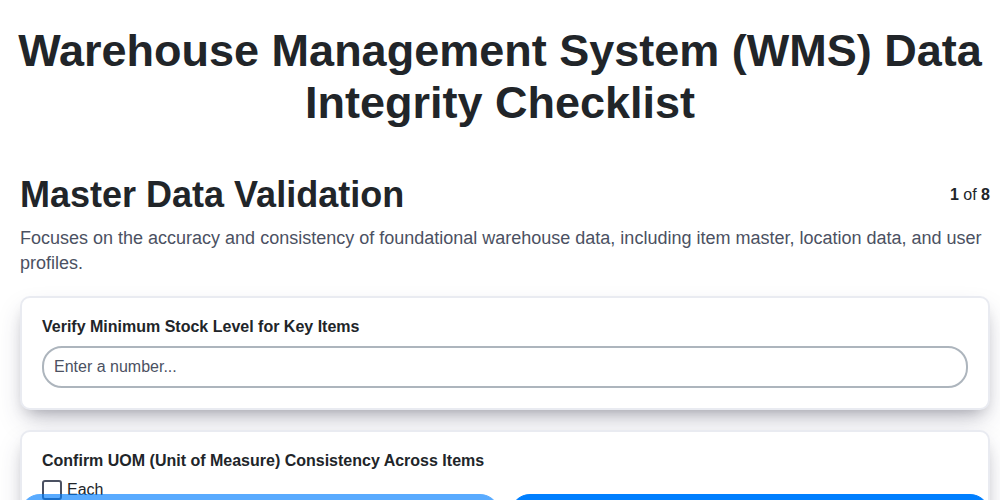
Warehouse Data Integrity: Your WMS Checklist Template
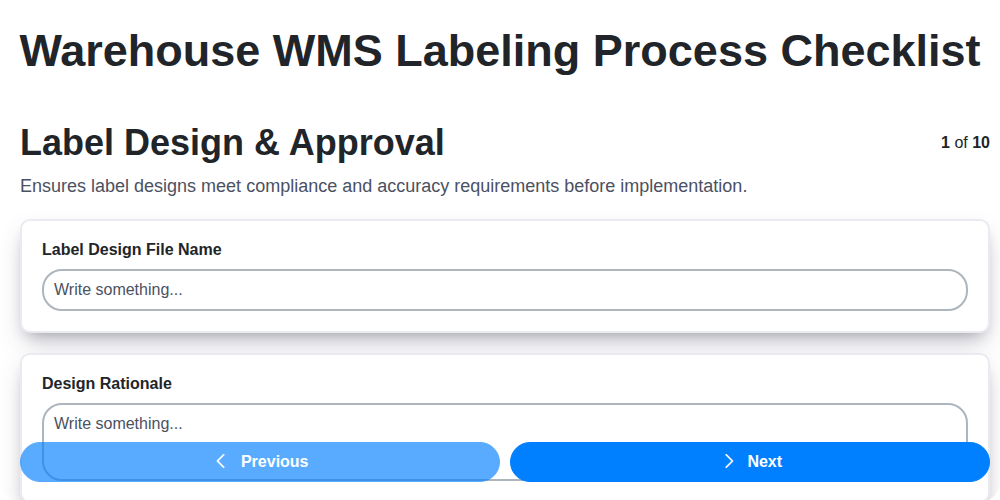
Mastering Warehouse Labeling: Your WMS Process Checklist Template

Warehouse WMS Security Checklist: A Comprehensive Guide to Protecting Your Operations
We can do it Together
Need help with
Checklists?
Have a question? We're here to help. Please submit your inquiry, and we'll respond promptly.