How to improve your Warehouse Management System (WMS)
Published: 12/20/2025 Updated: 12/21/2025
Table of Contents
- What is a Warehouse Management System (WMS)?
- Why is a WMS Important?
- Common WMS Challenges Businesses Face
- Assessing Your Current WMS - Where to Begin
- Leveraging Checklist Templates to Optimize WMS Processes
- Receiving and Inventory Accuracy with Checklists
- Streamlining Putaway Procedures
- Optimizing Picking and Packing Efficiency
- Improving Shipping and Delivery Processes
- Real-Time Visibility and Reporting with WMS Checklists
- Training and Employee Accountability
- Integrating Checklists with Your Existing WMS
- Beyond Checklists: Other WMS Improvement Strategies
- Future-Proofing Your WMS
- Resources & Links
TLDR: Overwhelmed by warehouse chaos? Our checklist templates help you streamline your WMS! We break down essential tasks like receiving, putaway, picking, packing, and shipping into actionable steps. Use these checklists to ensure accuracy, efficiency, and accountability across your warehouse operations, ultimately saving time and money.
What is a Warehouse Management System (WMS)?
A Warehouse Management System (WMS) is more than just software; it's the backbone of efficient warehouse operations. At its core, it's a software solution designed to manage and optimize every aspect of your warehouse, from the moment inventory arrives to the moment it leaves. Think of it as a digital control tower for your goods.
Historically, warehouses relied on manual processes - spreadsheets, paper-based systems, and a whole lot of guesswork. However, modern WMS solutions offer a significant upgrade. They leverage technology to automate tasks, track inventory in real-time, optimize storage locations, and improve overall workflow.
Key features typically include:
- Inventory Tracking: Real-time visibility into stock levels, location, and status.
- Receiving & Putaway: Streamlined processes for receiving goods and placing them in optimal storage locations.
- Order Management: Efficiently processing and fulfilling customer orders.
- Picking & Packing: Optimizing routes and procedures for order fulfillment.
- Shipping: Managing carrier information, generating shipping labels, and tracking shipments.
- Reporting & Analytics: Providing insights into warehouse performance and identifying areas for improvement.
A good WMS isn't just about managing inventory; it's about maximizing warehouse efficiency, reducing errors, and improving customer satisfaction.
Why is a WMS Important?
A Warehouse Management System (WMS) isn't just about fancy technology; it's the backbone of a well-functioning supply chain. Without one, you're likely dealing with manual processes, spreadsheets, and a whole lot of guesswork. This often leads to inefficiencies, errors, and lost profits.
Think about it: how much time do your employees spend searching for items, reconciling inventory discrepancies, or dealing with shipping errors? A WMS automates many of these tasks, giving your team more time to focus on strategic initiatives.
Beyond simple tracking, a good WMS offers a wealth of benefits:
- Improved Inventory Accuracy: Real-time visibility into your stock levels minimizes stockouts and overstocking.
- Increased Efficiency: Optimized workflows and automated tasks reduce labor costs and speed up order fulfillment.
- Reduced Errors: Streamlined processes and barcode scanning minimize picking, packing, and shipping errors.
- Better Space Utilization: Efficient storage strategies maximize warehouse capacity.
- Enhanced Customer Satisfaction: Faster and more accurate order fulfillment leads to happier customers.
- Data-Driven Insights: Robust reporting capabilities provide valuable data to identify areas for improvement and make informed decisions.
Essentially, a WMS transforms your warehouse from a potential bottleneck into a competitive advantage.
Common WMS Challenges Businesses Face
Many businesses, especially those experiencing rapid growth or dealing with complex supply chains, encounter a range of challenges with their warehouse management. These often go beyond simple inventory tracking and significantly impact operational efficiency and profitability. Here are some common pain points:
- Lack of Real-Time Visibility: Operating with outdated information is a recipe for disaster. Without real-time data on inventory levels, location, and order status, decision-making becomes reactive and prone to errors.
- Inefficient Inventory Management: This can manifest as stockouts (losing sales), overstocking (tying up capital), and difficulties in tracking expiration dates or lot numbers.
- Order Fulfillment Errors: Picking the wrong items, shipping to incorrect addresses, or failing to meet promised delivery times erode customer trust and increase returns.
- Labor Inefficiencies: Manual processes, poorly optimized workflows, and a lack of proper training lead to wasted time and effort from warehouse staff.
- Scalability Issues: As your business grows, your existing WMS might struggle to handle increased volume, complexity, and new operational requirements.
- Integration Difficulties: Inability to seamlessly integrate the WMS with other business systems (e.g., ERP, eCommerce platforms, shipping carriers) creates data silos and bottlenecks.
- High Operational Costs: A poorly managed warehouse can lead to increased labor costs, higher error rates requiring correction, and increased storage expenses.
- Difficulty Tracking KPIs: Without the right metrics and reporting capabilities, it's hard to identify areas for improvement and measure the effectiveness of warehouse operations.
Assessing Your Current WMS - Where to Begin
Before diving into improvements, it's crucial to understand your current WMS's strengths and weaknesses. This isn't just about identifying glitches; it's about understanding how the system currently supports (or hinders) your business processes. Start with a comprehensive assessment.
Here's a structured approach:
- Talk to Your Team: Warehouse staff are the most familiar with the daily operations. Conduct interviews or surveys to gather feedback on usability, efficiency, and pain points. What tasks are they struggling with? Where are bottlenecks occurring?
- Analyze Key Performance Indicators (KPIs): Track and review vital metrics like order accuracy, inventory turnover rate, picking efficiency, and shipping costs. Significant deviations from targets are red flags.
- Map Your Warehouse Processes: Visually document your existing workflows, from receiving goods to shipping orders. This helps identify inefficiencies and areas where automation could be beneficial.
- Evaluate System Integration: How well does your WMS integrate with other business systems (e.g., ERP, accounting software)? Integration issues often lead to data silos and manual data entry.
- Consider Scalability: Is your current WMS capable of handling future growth? Anticipate changes in order volume, product lines, and warehouse footprint.
- Document Findings: Create a detailed report outlining the assessment's findings, including both positive aspects and areas for improvement. This serves as a baseline for measuring the effectiveness of any changes you implement.
Leveraging Checklist Templates to Optimize WMS Processes
Checklist templates offer a remarkably straightforward way to inject structure and consistency into your WMS processes. Instead of relying on memory or inconsistent verbal instructions, checklists provide a standardized framework for each key task. Think about receiving a shipment - a well-designed checklist can guide your team through verifying quantities, inspecting for damage, labeling, and properly entering the items into your inventory system. Similarly, for picking and packing, checklists ensure the correct items are selected, accurately packaged, and thoroughly documented for shipping.
The beauty of using checklists isn't just about following steps; it's about fostering accountability and identifying areas for improvement. Each completed checklist serves as a record of the work performed, making it easier to track progress, pinpoint bottlenecks, and identify training needs. You can even incorporate quality checks within the checklist itself - for example, requiring a signature or initials to confirm a task was completed correctly. This visual confirmation reduces errors and reinforces best practices.
Furthermore, checklist templates aren't static. They should be treated as living documents, constantly evolving based on feedback and changing operational needs. Regularly review and update your checklists to ensure they remain relevant and effective. This iterative approach, combined with consistent implementation, will yield significant gains in warehouse efficiency and accuracy.
Receiving and Inventory Accuracy with Checklists
Receiving is the crucial first step in any warehouse operation. Errors here - incorrect quantities, damaged goods, or misidentification - can ripple through your entire system, leading to stock discrepancies, order fulfillment delays, and ultimately, unhappy customers. A well-designed receiving checklist ensures everything is accounted for from the moment a shipment arrives.
Our receiving checklist template typically includes sections for verifying the shipment against the purchase order (PO), documenting any discrepancies (overages, shortages, or damages), and recording the condition of the received goods. Each item should be scanned or manually entered into the system, with designated areas for signatures and timestamps to maintain a clear audit trail.
Following the receiving process, accurate putaway is essential. Our putaway checklist guides warehouse staff through the process of moving received items to their designated storage locations. This includes confirming the correct location, ensuring proper handling procedures are followed (especially for fragile or hazardous materials), and updating inventory records in real-time.
By incorporating these checklists into your receiving and putaway procedures, you're creating a robust system for maintaining inventory accuracy and minimizing costly errors. Regular review of these checklists and the associated data can also identify areas for process improvement and staff training needs.
Streamlining Putaway Procedures
Putaway is arguably one of the most critical, and often overlooked, processes in a warehouse. Inefficient putaway leads to misplaced inventory, wasted space, and increased picking times. A structured checklist ensures consistent and accurate placement of goods.
Here's how a putaway checklist can help:
- Clearly Defined Locations: The checklist should reference specific bin locations, considering factors like product type, size, and accessibility. This eliminates guesswork and reduces misplacement.
- Verification Steps: Implement checks to confirm the item matches the receiving documentation (PO number, SKU, quantity). This catches errors early on.
- Equipment Checks: Include a quick check of equipment used (forklifts, pallet jacks) to ensure proper function and safety.
- Documentation: Record the putaway completion in your WMS, updating inventory levels and location information in real-time. This fosters transparency and improves tracking.
- Exception Handling: Include a section for noting any discrepancies or issues encountered during putaway, triggering a resolution process.
By standardizing putaway using a checklist, you're not just moving boxes; you're building a foundation for a well-organized and efficient warehouse.
Optimizing Picking and Packing Efficiency
Picking and packing are often the most labor-intensive processes in a warehouse. Inefficiencies here directly impact order fulfillment times and customer satisfaction. Implementing structured checklists can dramatically improve both.
Consider these checklist applications:
- Picking Route Optimization: A checklist can guide pickers through the most efficient route within the warehouse, minimizing travel time and reducing errors. It might include details like aisle numbers, bin locations, and item quantities.
- Item Verification: Include checklist steps for verifying picked items against the order. This reduces the risk of shipping incorrect products, a common source of returns and dissatisfied customers. Photos of the item being picked can be integrated for extra confirmation.
- Packing Standards: Create a checklist outlining proper packing procedures, including appropriate box sizes, cushioning materials, and labeling requirements. This minimizes damage during transit and ensures packages meet carrier specifications.
- Quality Control: A final checklist step should involve a quality check before sealing the package. This can include verifying quantity, checking for damage, and ensuring all necessary documentation is included.
By standardizing these processes with checklists, you're not just documenting steps; you're building consistency and minimizing the potential for human error.
Improving Shipping and Delivery Processes
Shipping and delivery are often the final touchpoint with your customers - and a critical one. Mistakes here can lead to returns, negative reviews, and lost business. A well-managed WMS can significantly improve these processes.
Here's how:
- Real-time Inventory Visibility: Know exactly what's available and where it's located. This prevents overselling and order cancellations.
- Optimized Picking Routes: WMS algorithms can calculate the most efficient routes for pickers, minimizing travel time within the warehouse.
- Automated Packing Verification: Reduce errors by ensuring the correct items are packed for each order, often with weight and dimension verification.
- Carrier Integration: Seamlessly connect with shipping carriers to automate label generation, track shipments, and provide customers with accurate tracking information.
- Delivery Scheduling: Some WMS solutions offer features to manage delivery windows and optimize delivery routes, improving customer satisfaction and reducing delivery costs.
- Proof of Delivery (POD): Capture digital signatures or photos to confirm delivery and resolve disputes quickly.
By streamlining these activities, you'll shorten order fulfillment times, lower shipping costs, and improve overall customer experience.
Real-Time Visibility and Reporting with WMS Checklists
One of the most significant benefits of using WMS checklists is the enhanced real-time visibility they provide. Traditional WMS systems often present data in aggregate, making it difficult to pinpoint bottlenecks or errors quickly. With checklists, however, each step in a process is documented and, ideally, tracked. This allows managers to see exactly where delays are occurring, who is responsible, and what actions need to be taken.
Imagine being able to instantly see that a receiving team is consistently behind schedule on putaway tasks, or identifying a recurring error in the picking process. This immediate feedback loop allows for proactive problem-solving - whether that involves retraining staff, adjusting workflows, or optimizing space utilization.
Furthermore, the data collected through checklists provides valuable reporting capabilities. You can generate reports on task completion rates, error frequency, employee performance, and overall process efficiency. These insights can inform continuous improvement efforts and demonstrate the ROI of your WMS. Consider integrating your checklists with your WMS to automate data capture and reporting, taking the burden of manual data entry off your team.
Training and Employee Accountability
A robust WMS is only as effective as the people using it. Investing in thorough training isn't just a "nice-to-have"; it's crucial for maximizing your system's ROI and minimizing costly errors. New hires should receive comprehensive onboarding that covers all essential WMS functionalities relevant to their roles - from receiving and putaway to picking, packing, and shipping.
Beyond initial training, ongoing reinforcement is key. Regularly scheduled refresher courses, quick tip videos, and readily accessible documentation can keep skills sharp and address evolving processes.
Accountability is another vital piece of the puzzle. Implement clear procedures for tracking task completion and identifying areas for improvement. Leveraging WMS features like user permissions, audit trails, and performance dashboards can help pinpoint bottlenecks, highlight training gaps, and hold team members accountable for their assigned duties. Consider incorporating checklist templates (like those available on ChecklistGuro!) to standardize workflows and ensure consistency across the team, further reinforcing best practices and promoting a culture of accuracy.
Integrating Checklists with Your Existing WMS
Many modern WMS solutions offer API integrations or built-in functionality that allows you to seamlessly incorporate checklists. This isn't about replacing your WMS, but rather enhancing it. Think of checklists as the procedural backbone, guiding users through specific processes within the WMS.
Here's how integration typically works and the benefits you can expect:
- Data Synchronization: Real-time data flow between your WMS and the checklist system. This means updated inventory levels, order status, and location information reflected accurately in your checklists, and vice versa. For example, when a received item is scanned into the WMS, the corresponding Receiving checklist item can automatically mark as complete.
- Triggered Checklists: Certain WMS actions (like order creation or shipment confirmation) can automatically trigger the relevant checklist to appear for the assigned user on their device. This eliminates manual checklist generation and ensures the right task is started at the right time.
- Reporting and Analytics: Combine WMS data with checklist completion times and user performance to identify bottlenecks, training needs, and areas for process optimization. Did a particular Picking checklist consistently take longer than expected? This might indicate a layout issue or inefficient picking strategy.
- Device Compatibility: Ensure the checklist system is accessible on the devices used within your warehouse - scanners, tablets, or mobile phones - for real-time access and data capture.
- Customization: Many integrations allow you to customize checklists based on product type, storage location, or customer requirements, adding another layer of precision to your operations.
While some integrations require technical expertise to set up, the long-term gains in efficiency, accuracy, and traceability are well worth the investment. Check with your WMS vendor about API availability and integration possibilities.
Beyond Checklists: Other WMS Improvement Strategies
While checklists are a fantastic foundation for WMS improvement, they's just one piece of the puzzle. A truly optimized warehouse leverages a multi-faceted approach. Here's a look at other key strategies to consider:
- Process Optimization: Regularly review and refine your warehouse processes. Are there bottlenecks? Can tasks be combined or eliminated? Lean methodologies and process mapping can be invaluable here.
- Technology Upgrades: Explore advanced WMS features like real-time inventory tracking, automated picking routes, and barcode scanning. Consider integrating your WMS with other business systems like your ERP or e-commerce platform for a more unified view.
- Employee Training: Even the best WMS is only as good as the people using it. Invest in ongoing training to ensure your team understands the system's functionalities and best practices. This includes onboarding new employees and providing refresher courses.
- Layout Optimization: The physical layout of your warehouse directly impacts efficiency. Consider optimizing storage locations based on popularity and minimizing travel distances for pickers.
- Data Analytics & Reporting: A robust WMS generates a wealth of data. Utilize this information to identify trends, measure performance, and make data-driven decisions to continually improve. Track key metrics like order accuracy, cycle time, and inventory turnover.
- Regular Audits: Implement regular internal audits of your warehouse processes and the WMS itself. This can help identify areas for improvement and ensure compliance with regulations.
Future-Proofing Your WMS
The landscape of warehousing is constantly evolving. Automation, AI, and the Internet of Things (IoT) are no longer futuristic concepts-they're actively reshaping how goods are managed. To future-proof your WMS, consider these key areas:
- Embrace Automation: Explore automated guided vehicles (AGVs), automated storage and retrieval systems (AS/RS), and robotic picking solutions. Even small-scale automation can significantly reduce labor costs and improve speed.
- Data Integration is Key: Your WMS shouldn't operate in a silo. Integrate it with your ERP (Enterprise Resource Planning), CRM (Customer Relationship Management), and other key business systems to gain a holistic view of your operations. This allows for better forecasting, inventory optimization, and customer service.
- Cloud-Based Solutions: Moving to a cloud-based WMS offers scalability, accessibility, and often, lower upfront costs. Cloud solutions also typically receive automatic updates, ensuring you're always benefiting from the latest features and security patches.
- Real-Time Visibility: Implement technologies like RFID (Radio-Frequency Identification) and barcode scanners for real-time tracking of inventory. This visibility is crucial for optimizing workflows, minimizing errors, and responding quickly to changing demands.
- AI and Machine Learning: Leverage AI to predict demand fluctuations, optimize routes, and identify potential bottlenecks. Machine learning can also automate tasks like inventory replenishment and quality control.
- Mobile-First Design: Ensure your WMS is accessible and usable on mobile devices. This allows warehouse staff to perform tasks efficiently from anywhere in the facility.
Preparing for these advancements now will position your warehouse for long-term success and resilience in a rapidly changing market.
Resources & Links
- APX Group: Offers comprehensive WMS solutions, including implementation, support, and consulting services. Good for understanding broader WMS implementation strategies.
- Zebra Technologies: Provides hardware (scanners, printers, mobile computers) and software solutions for warehouse operations. Helpful for visualizing integration potential with a WMS.
- Infor WMS: A leading WMS provider with a variety of features; provides an overview of what's available in a modern system.
- Blue Harbor: Specializes in WMS implementation and optimization. Offers insights into best practices and common pitfalls.
- NetSuite WMS: Part of the Oracle NetSuite suite, offers cloud-based WMS functionality; useful for understanding integration with ERP systems.
- Software Suggest - Warehouse Management Software: A comparison site that reviews different WMS providers, aiding in understanding available options and their features.
- DC Edge: Provides information and resources related to warehouse and supply chain management, including articles and case studies on WMS implementations.
- ChecklistGuro: Our very own platform! Explore how checklist templates can be leveraged for various WMS processes, directly supporting the post's focus.
- Supply Chain Digital: A great source for articles and insights into various aspects of supply chain and warehouse management, including discussions on WMS technology.
Frequently Asked Questions
What is a Warehouse Management System (WMS)?
A Warehouse Management System (WMS) is a software application that helps businesses manage and control warehouse operations from the receiving and put-away to picking, packing, and shipping. It provides real-time visibility into inventory, optimizes warehouse processes, and improves overall efficiency.
Why should I improve my existing WMS?
Improving your WMS can lead to significant benefits including reduced operational costs, increased order accuracy, faster fulfillment times, improved inventory control, better space utilization, enhanced visibility, and increased employee productivity. It's about adapting to changing business needs and optimizing performance.
What are some common problems with WMS implementations?
Common issues include insufficient user training, lack of integration with other systems (like ERP or e-commerce platforms), inaccurate data migration, choosing the wrong WMS for your business needs, and failing to involve key stakeholders during the implementation process.
What are the initial steps to improving my WMS?
Start with an assessment. Analyze current warehouse processes, identify bottlenecks and pain points, gather data on performance metrics, and define clear goals for improvement. Engage with warehouse staff to understand their challenges and needs.
What are some specific ways to optimize WMS functionality?
Several strategies exist: optimize picking routes (e.g., using wave picking or zone picking), improve inventory accuracy through cycle counting and regular audits, leverage barcode scanning or RFID technology for real-time tracking, automate tasks through workflows and integrations, and implement slotting optimization techniques.
How important is integration with other systems?
Integration is crucial. Your WMS needs to communicate with your Enterprise Resource Planning (ERP), e-commerce platforms, shipping carriers, and other systems to ensure seamless data flow and avoid manual data entry. Poor integration leads to errors and inefficiencies.
What is 'cloud-based' WMS, and is it a good option?
A cloud-based WMS is hosted on a vendor's servers and accessed via the internet. It offers benefits like lower upfront costs, easier scalability, automatic updates, and accessibility from anywhere. Whether it's right for you depends on your specific needs and IT infrastructure.
How do I choose the right WMS improvements? Should I prioritize features?
Prioritize improvements based on their potential impact and ease of implementation. Focus on areas with the greatest opportunity for cost savings or efficiency gains. Consider quick wins to build momentum and demonstrate the value of WMS optimization.
What is the role of data analytics in WMS improvement?
Data analytics provides insights into warehouse performance, helps identify trends, and allows for data-driven decision-making. Track key metrics like order accuracy, fulfillment time, inventory turnover, and shipping costs to measure the effectiveness of improvements.
How often should I review and update my WMS?
Regular review is essential. Warehouse operations and business needs change. Schedule periodic reviews (e.g., annually or semi-annually) to assess performance, identify new opportunities for optimization, and ensure the WMS continues to meet your evolving requirements.
What training should warehouse employees receive regarding the WMS?
Comprehensive training is vital. Provide training on all relevant WMS functionalities, including receiving, put-away, picking, packing, shipping, and cycle counting. Regular refresher training and ongoing support are also important for user adoption and accuracy.
Comments
There are no comments yet. Be the first to add one!
WMS - Warehouse Management System Solution Demo
Optimize your warehouse operations & boost efficiency! ChecklistGuro's WMS streamlines inventory management, order fulfillment, and shipping. Reduce errors, improve accuracy, & maximize space utilization. Manage it all with our Work OS.
Related Articles
Ensuring Success: Your WMS Batch Process Checklist Template
Seamless RFID Integration: Your WMS Checklist Template for Success
WMS System Performance Monitoring Checklist: A Comprehensive Guide

Mastering Your Yard: A Warehouse WMS Yard Management Checklist Template

Ensuring Success: Your WMS Automation Validation Checklist Template
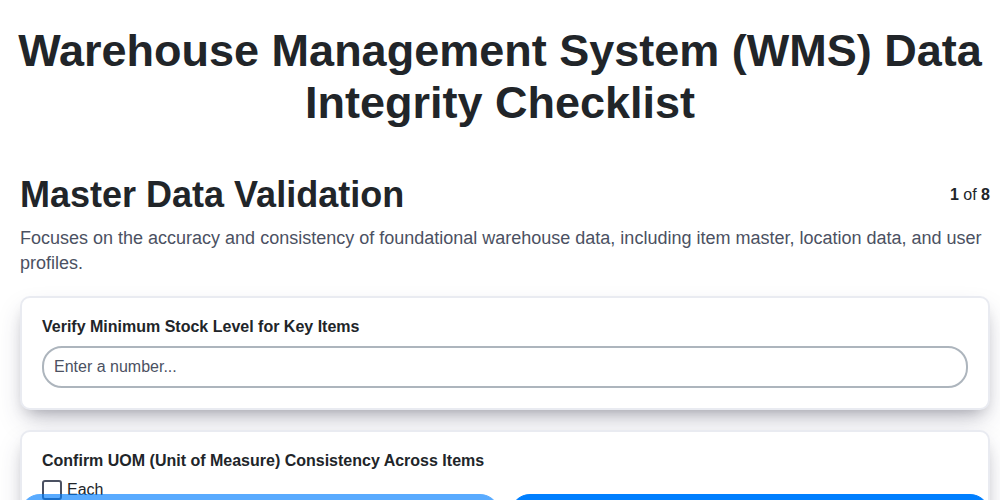
Warehouse Data Integrity: Your WMS Checklist Template
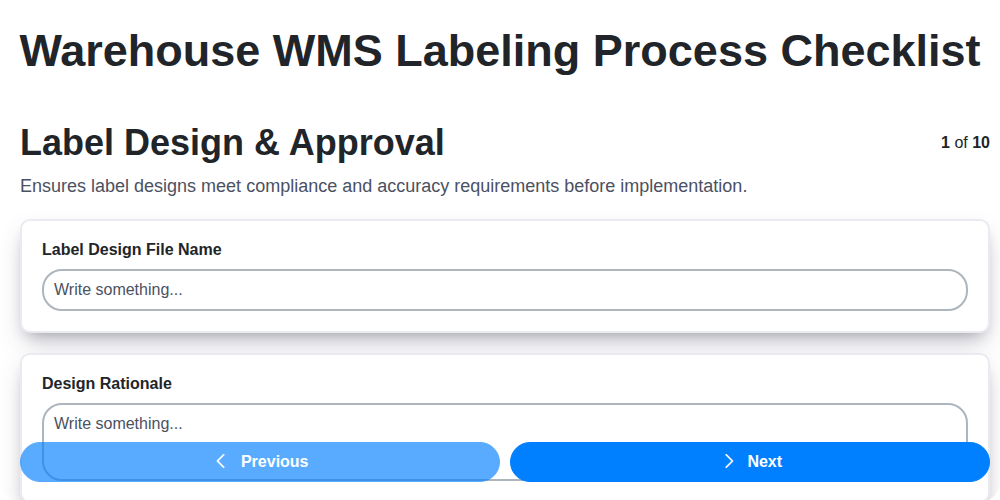
Mastering Warehouse Labeling: Your WMS Process Checklist Template

Warehouse WMS Security Checklist: A Comprehensive Guide to Protecting Your Operations
We can do it Together
Need help with
Checklists?
Have a question? We're here to help. Please submit your inquiry, and we'll respond promptly.