How to Save Money on Warehouse Management System (WMS) Software
Published: 12/20/2025 Updated: 12/21/2025
Table of Contents
- What is a Warehouse Management System (WMS)?
- Why Invest in a WMS? The Benefits Beyond Cost
- The Hidden Costs of WMS Software (Beyond the Price Tag)
- Understanding WMS Pricing Models
- Defining Your Warehouse Needs: The Foundation of Cost Savings
- Using a Checklist Template to Evaluate WMS Options
- Key Checklist Categories: Functionality, Scalability, & Integration
- Functionality: Prioritizing Features You Actually Need
- Scalability: Future-Proofing Your Investment
- Integration: Avoiding Data Silos and Compatibility Issues
- Negotiating with WMS Vendors: Tips and Tactics
- Considering Open-Source or Cloud-Based WMS Solutions
- Phased Implementation: A Budget-Friendly Approach
- Ongoing Optimization: Keeping Costs Down After Implementation
- Resources & Links
TLDR: Need a WMS but worried about costs? This checklist template helps you thoroughly evaluate potential WMS software. It guides you to define your needs, compare vendors effectively, negotiate better pricing, and avoid costly mistakes, all leading to a more budget-friendly WMS implementation.
What is a Warehouse Management System (WMS)?
A Warehouse Management System (WMS) is more than just inventory tracking. It's a software solution designed to streamline and optimize every aspect of warehouse operations. Think of it as the brain of your warehouse, managing everything from receiving and putaway to picking, packing, shipping, and cycle counting.
Modern WMS solutions go far beyond basic inventory management. They can integrate with your ERP (Enterprise Resource Planning) system, provide real-time visibility into stock levels, optimize picking routes for efficiency, automate tasks, and even provide data-driven insights to improve overall warehouse performance. For businesses experiencing challenges like stockouts, order fulfillment delays, or inefficient warehouse processes, a WMS can be a game-changer.
Why Invest in a WMS? The Benefits Beyond Cost
A Warehouse Management System (WMS) isn't just about expense reduction; it's a strategic investment that fuels growth and efficiency. While cost savings are a compelling reason to consider one, the true value lies in the operational improvements it unlocks. Let's explore those benefits:
- Increased Inventory Accuracy: Minimize stockouts and overstocks, leading to better order fulfillment and reduced carrying costs. Accurate inventory data allows for better forecasting and purchasing decisions.
- Improved Order Fulfillment: Optimize picking, packing, and shipping processes for faster and more accurate order fulfillment, boosting customer satisfaction and reducing returns.
- Enhanced Warehouse Space Utilization: Maximize storage density and optimize layout design to get the most out of your warehouse space.
- Streamlined Operations: Automate repetitive tasks, reduce manual errors, and improve overall workflow efficiency.
- Real-Time Visibility: Gain a clear view of your warehouse operations, enabling data-driven decision-making and proactive problem-solving.
- Better Labor Management: Optimize workforce allocation and improve productivity through task assignment and performance tracking.
- Scalability: As your business grows, a WMS can adapt and scale alongside it, ensuring your warehouse operations remain efficient and effective.
Ignoring these advantages can lead to lost revenue, increased operational costs, and a competitive disadvantage.
The Hidden Costs of WMS Software (Beyond the Price Tag)
It's easy to get fixated on the initial licensing fees of a Warehouse Management System (WMS). However, the true cost extends far beyond that initial price tag. Failing to account for these hidden expenses can quickly erode any savings you initially hoped to achieve. Let's break down the often-overlooked areas that can significantly impact your overall WMS investment.
Implementation Costs: This is frequently the biggest surprise. Implementation isn't just about installing the software. It includes data migration (moving your existing inventory and order information), system configuration to match your specific processes, and extensive testing. Complex integrations with your existing ERP, accounting software, and e-commerce platforms can further inflate these costs. Consider the resources needed from your internal team - their time is valuable!
Training & Change Management: New software requires training for your warehouse staff. Poorly trained employees can lead to errors, inefficiencies, and frustrated users who actively resist adoption. Change management is also crucial - getting buy-in from everyone impacted by the new system minimizes disruption and maximizes user acceptance.
Customization & Integration: While many WMS offer some level of customization, extensive modifications can be incredibly expensive. The more you deviate from the standard functionality, the higher the development costs will be. Integrations aren't always seamless either, and custom integrations can quickly add up.
Maintenance & Support: Ongoing maintenance and support aren't free. Annual maintenance fees, support contracts, and the potential for bug fixes and upgrades all contribute to the total cost of ownership. Factor in the cost of internal IT resources to handle basic troubleshooting.
Hardware Requirements: Depending on the WMS, you might need to upgrade your warehouse hardware. This could include new scanners, printers, mobile devices, or even network infrastructure.
Downtime & Productivity Loss: Even with careful planning, system outages and productivity dips are possible during implementation and early adoption. Calculate the potential revenue loss due to these disruptions.
By understanding and accounting for these hidden costs upfront, you can make a more informed WMS investment decision and avoid unpleasant financial surprises down the line. Our checklist template (linked below!) will help you identify and quantify these costs, leading to a more accurate budget and a smoother implementation process.
Understanding WMS Pricing Models
WMS pricing isn't straightforward. It's not a simple one-size-fits-all cost. Several models exist, and understanding them is crucial to making an informed decision and avoiding hidden fees. Here's a breakdown of common pricing structures:
- Per-User Pricing: This is frequently seen, especially with cloud-based systems. You pay a recurring fee for each user who will access the WMS. While seemingly straightforward, consider the complexities of user roles and access levels - do you need full access for everyone?
- Transaction-Based Pricing: Often used for high-volume operations, you're charged based on the number of transactions processed (e.g., receiving, picking, shipping). Analyze your current transaction volume and projected growth to accurately estimate costs.
- Warehouse Space/Square Footage: Some vendors price based on the size of your warehouse(s). This model is less common but can be viable for businesses with significant storage space.
- Tiered Pricing: This combines aspects of the above. For example, a vendor might offer tiered pricing based on user count and transaction volume.
- Per-Module Pricing: Certain vendors sell WMS functionality in modules. You choose and pay for only the features you require, offering flexibility, but potentially escalating costs if you need multiple modules.
- One-Time License Fee: Less common with cloud solutions, this involves a large upfront payment for a perpetual license. Requires significant capital outlay and often involves ongoing maintenance fees.
Carefully assess which model best aligns with your business needs and growth plans. Don't hesitate to ask vendors to clearly outline all potential costs, including setup fees, training, and support.
Defining Your Warehouse Needs: The Foundation of Cost Savings
Before you even think about requesting demos or comparing software features, you need a crystal-clear understanding of what your warehouse actually needs. This isn't just about listing a bunch of desired functionalities; it's about prioritizing them and quantifying their impact on your bottom line.
Start by conducting a thorough assessment of your current warehouse operations. Map out your workflows, identify bottlenecks, and pinpoint areas where inefficiencies are costing you money (think: wasted labor, inaccurate inventory, delayed shipments). Be brutally honest about what's working and what isn't.
Then, translate those operational challenges into specific WMS requirements. Instead of saying we need better inventory tracking, specify, We need real-time inventory visibility with cycle counting capabilities to reduce stockouts and minimize write-offs, ideally with a 99.5% accuracy target.
Consider these critical areas:
- Inventory Management: What level of granularity do you need? (Batch, Serial, Lot numbers?) How are you handling expiration dates?
- Receiving & Putaway: What's your current receiving process? Can the WMS automate tasks like label generation and location assignment?
- Order Fulfillment: Do you need pick-and-pack optimization, wave planning, or automated packing slips?
- Shipping: How do you handle carrier integration and shipping label generation?
- Reporting & Analytics: What key performance indicators (KPIs) do you need to track to measure success?
- Scalability: How will your needs change as your business grows?
Documenting these needs, assigning priorities (Must-have, Should-have, Could-have), and quantifying the potential ROI for each will serve as your baseline for evaluating WMS solutions. It will also help you avoid paying for features you don't truly need. Remember, a detailed needs assessment is the single most impactful step you can take to save money on a WMS.
Using a Checklist Template to Evaluate WMS Options
A well-structured checklist template is your secret weapon in navigating the WMS selection process. It ensures you're considering every crucial aspect, prevents overlooking vital features, and allows for a standardized comparison across vendors. Here's how to use it effectively:
1. Define Your Needs First: Before you even look at a single software demo, complete the Needs Assessment section of the checklist. Be specific! Don't just say inventory management. Detail exactly how you manage inventory now, what the pain points are, and what functionality you absolutely require (e.g., real-time tracking, lot number control, cycle counting).
2. Categorize Your Requirements: The checklist is divided into categories - Functionality, Integration, Vendor Reputation, Implementation, and Cost. This structure helps you systematically review each option.
3. Rating System: Utilize the rating system (e.g., 1-5 stars, or a simple Yes/No/Maybe) to objectively assess each vendor against your defined needs. This eliminates subjective opinions and provides a clear picture of which options best align with your priorities.
4. Prioritize Your Needs: Not every feature is a "must-have." The checklist allows you to flag requirements as Critical, Important, or Nice-to-have. This allows you to weight your decisions and focus on the features that truly impact your warehouse operations.
5. Document Your Findings: The checklist isn't just for rating; it's for documenting. Add notes regarding specific demos, conversations with vendors, and any concerns you have. This creates a valuable reference point throughout the decision-making process.
6. Share & Collaborate: This checklist isn't meant to be a solitary exercise. Share it with your team - warehouse managers, IT personnel, and other stakeholders - to gather diverse perspectives and ensure everyone's needs are considered.
Key Checklist Categories: Functionality, Scalability, & Integration
Our WMS software comparison checklist is broken down into key categories to ensure a comprehensive evaluation. Let's delve into three critical areas: Functionality, Scalability, and Integration.
Functionality: This section assesses whether the WMS actually does what you need it to do. We're not just talking about the basic features like receiving and shipping. It probes deeper. Does it offer cycle counting? Lot tracking? Wave planning? Barcode scanning capabilities? Think about your specific operational challenges and look for a system that directly addresses them. Don't get swayed by features you won't use - focus on the ones that drive efficiency and accuracy in your warehouse.
Scalability: Your business isn't static; it will grow (hopefully!). The WMS you choose needs to grow with you. This checklist category explores the system's ability to handle increased order volumes, larger inventory levels, and potentially new warehouse locations. Consider factors like user limits, transaction capacity, and the ease of adding new users and functionalities. A system that's robust today needs to be ready to handle your needs in the future.
Integration: A WMS rarely exists in isolation. It needs to play nicely with your existing systems, such as your ERP (Enterprise Resource Planning), accounting software, and e-commerce platforms. This section evaluates the WMS's integration capabilities, looking at API availability, pre-built connectors, and data mapping options. Poor integration can lead to data silos, manual data entry, and increased errors - all of which negate the benefits of a WMS.
Functionality: Prioritizing Features You Actually Need
Many WMS solutions offer a dazzling array of features, from advanced robotics integration to real-time inventory tracking down to the individual unit. However, the more features included, the higher the cost - and the more complexity you'll have to manage.
This checklist helps you systematically analyze which features are essential for your warehouse's current and future needs versus those that are 'nice-to-haves' you can potentially add later. We've broken down common WMS functionalities into categories - Basic, Intermediate, and Advanced - allowing you to prioritize based on your operational scale, budget, and growth projections.
Consider these questions for each feature listed in the checklist:
- Must-Have: Does this feature directly address a critical operational pain point or regulatory requirement? Without it, your warehouse simply cannot function efficiently?
- Important: Would this feature significantly improve efficiency or accuracy, even if it's not absolutely critical?
- Optional: Is this a potentially useful feature, but not essential for the immediate or near-term future?
Document your answers. This clear prioritization is invaluable for narrowing down your search and ensuring you're not paying for capabilities you won't use. It also serves as a strong negotiating tool with vendors - showing them precisely what you require.
Scalability: Future-Proofing Your Investment
A WMS isn't just about managing today's operations; it's about preparing for tomorrow's growth. Consider your projected expansion-will the system accommodate increasing order volumes, new product lines, or the addition of more warehouses? A system with limited scalability can quickly become a bottleneck, forcing you to replace it sooner than anticipated - a significantly more expensive proposition than choosing a scalable solution from the outset.
Look for WMS vendors that offer tiered pricing structures based on features and user count. Cloud-based WMS solutions often excel in this area, as they can readily adjust resources to meet changing demands. Ask detailed questions about the system's architecture and its ability to handle increased data, transactions, and users without performance degradation. Don't just ask if it scales, but how and what the associated costs will be. Future-proofing your WMS is an investment in your long-term success and a way to avoid costly replacements down the road.
Integration: Avoiding Data Silos and Compatibility Issues
One of the biggest, and often overlooked, cost drivers with a WMS is the headache - and expense - of integration. A standalone WMS is rarely sufficient. It needs to talk to your ERP (Enterprise Resource Planning) system, your e-commerce platforms, your shipping carriers, and potentially other critical software.
Poor integration leads to data silos, manual data entry (labor-intensive and prone to errors), and a system that doesn't truly optimize your warehouse operations. This results in lost productivity, increased costs, and a frustrated team.
When evaluating WMS options, thoroughly investigate their integration capabilities. Don't just ask "Does it integrate with X?" Ask:
- What level of integration is offered? (API access, pre-built connectors, custom development?)
- Is it real-time or batch processing? Real-time integration is crucial for accuracy and responsiveness.
- What data can be exchanged? Ensure all relevant data flows seamlessly.
- What are the integration costs? These can be significant, so factor them into your total cost of ownership.
- Can you see a demo of the integration in action? Seeing is believing.
Prioritize WMS vendors with robust integration capabilities and a proven track record of successfully integrating with your existing systems. This upfront investment will save you significant time, money, and frustration in the long run.
Negotiating with WMS Vendors: Tips and Tactics
Okay, let's talk about getting the best deal. Most WMS vendors have some flexibility in pricing, and understanding their motivations can work in your favor. Here are some tactics to consider:
- Highlight Your Specific Needs: Don't just say you need a WMS. Detail exactly what problems you're trying to solve and the specific functionalities you require. Emphasize what isn't essential - this shows you're not being driven by a 'nice-to-have' feature list and are focused on ROI.
- Leverage Competitive Quotes: Get quotes from at least three different vendors. Share these with each vendor (without revealing the source) to encourage them to offer a more competitive price. Don't be afraid to say, Vendor X offered us this package for [price]. Can you match or beat that?
- Explore Tiered Pricing: Many WMS vendors offer tiered pricing models based on factors like number of users, transaction volume, or storage space. Carefully analyze your projections and choose the tier that best aligns with your needs to avoid paying for unused capacity.
- Consider Perpetual vs. Subscription Licensing: Perpetual licenses involve a higher upfront cost but no recurring fees. Subscription models have lower upfront costs and ongoing subscription fees. Evaluate the total cost of ownership over a 3-5 year period to determine which model is more financially advantageous.
- Ask About Implementation Costs: Software costs are only part of the equation. Factor in implementation costs, including data migration, training, and customization. Get a detailed breakdown of these expenses upfront to avoid surprises.
- Negotiate Training and Support: Good training and reliable support are crucial for WMS success. Negotiate the scope and cost of these services. Can you get a bundled discount for training multiple users?
- Look for Volume Discounts: If you anticipate significant growth or have multiple warehouse locations, inquire about volume discounts.
- Consider a Phased Implementation: A phased rollout, starting with a pilot program in one location, can reduce initial costs and allow you to adjust the system before a full deployment.
- Don't Be Afraid to Walk Away: Ultimately, be prepared to walk away if the vendor isn't willing to meet your budgetary constraints or provide the level of service you require. There are many WMS options available, and settling for a solution that's too expensive or doesn't fully meet your needs can be a costly mistake.
Considering Open-Source or Cloud-Based WMS Solutions
While commercial WMS solutions offer robust features and dedicated support, exploring alternatives like open-source or cloud-based options can significantly reduce upfront investment and ongoing costs.
Open-Source WMS: These systems are typically free to download and use, but require in-house technical expertise for setup, customization, and maintenance. While the initial software cost is zero, factor in the cost of your team's time (or hiring specialists) for implementation, ongoing updates, and troubleshooting. They offer unparalleled customization, but demand a higher level of technical proficiency. Consider open-source only if you have a dedicated IT team comfortable managing complex software.
Cloud-Based WMS (SaaS): This model offers a pay-as-you-go subscription, eliminating the need for expensive hardware and infrastructure. You typically pay a monthly or annual fee based on usage (number of users, warehouse size, transaction volume, etc.). The vendor handles maintenance, security, and updates, freeing up your internal resources. While generally more expensive per transaction than open-source, the reduced implementation effort and ongoing maintenance can result in a lower total cost of ownership, particularly for smaller to mid-sized businesses. Carefully analyze the vendor's pricing structure and scalability options to ensure it aligns with your future growth.
Phased Implementation: A Budget-Friendly Approach
Instead of a full-blown, simultaneous deployment across your entire warehouse, consider a phased implementation. This allows you to spread out costs, learn from initial rollouts, and minimize disruption.
Here's how a phased approach can save you money:
- Prioritize Functionality: Identify the most critical WMS functions first. Perhaps it's receiving and putaway, or order fulfillment. Focus on implementing these initially, delaying less vital modules for later phases. This reduces upfront software licensing and implementation costs.
- Pilot Program: Start with a smaller section of your warehouse or a specific product line. A pilot program allows you to test the system, identify any issues, and refine your processes before scaling up. This minimizes the risk of costly mistakes.
- Staged Licensing: Negotiate a licensing agreement that aligns with your phased implementation. Some vendors may offer tiered pricing based on the number of users or warehouse zones using the system.
- Training & Adoption: Phased implementation allows for more focused training efforts. As you roll out each phase, staff can be trained specifically on the new functionalities, leading to better adoption and reduced errors.
- Iterative Improvements: Each phase provides valuable feedback for the next. This allows you to make adjustments to the system configuration and processes, optimizing performance and maximizing ROI.
Ongoing Optimization: Keeping Costs Down After Implementation
Once your WMS is up and running, the work doesn't stop. Ongoing optimization is crucial for maximizing your investment and preventing costs from creeping back up. Here are some key areas to focus on:
- Regular Data Audits: Ensure your inventory data, location data, and user permissions are accurate and up-to-date. Inaccurate data leads to inefficiencies and costly errors. Schedule regular audits (monthly or quarterly) to catch and correct discrepancies.
- Process Reviews: WMS implementation isn't a set it and forget it affair. Periodically review your warehouse processes. Are there bottlenecks? Can workflows be streamlined? Even small improvements can have a significant impact on labor costs and overall efficiency.
- User Training & Adoption: Even the best WMS is only as good as its users. Ensure your team is fully trained on all features and best practices. Address any ongoing training needs and encourage adoption of the system for all relevant tasks. Low user adoption means you're not realizing the full potential of your WMS.
- Integration Monitoring: If your WMS integrates with other systems (e.g., ERP, e-commerce platforms), regularly monitor these integrations. Breakdowns or inefficient data flows can lead to delays, errors, and increased costs.
- Vendor Relationship Management: Stay in contact with your vendor. Discuss performance, future needs, and any potential issues. A strong vendor relationship can lead to valuable insights and potentially even negotiated pricing adjustments.
- Explore Advanced Features: As your business grows, you may find that advanced features you initially overlooked become valuable. Investigate these, but carefully assess the cost versus the benefit.
Resources & Links
- Supply Chain Digital: Provides in-depth articles, reports, and interviews on warehouse management and supply chain technology, offering insights into current trends and best practices.
- APICS (The Association for Supply Chain Management): A professional organization providing resources, certifications, and education on supply chain management, including warehouse operations and technology.
- The International Supply Chain Education Alliance (ICSCEA): Provides educational resources and articles related to supply chain management and logistics, which can inform WMS evaluation.
- Gartner: A leading research and advisory company that provides insights into the software market, including WMS solutions. Their reports (often require subscription) can help understand market landscape and vendor comparisons.
- Forbes: Business and finance news website with articles on technology and business, including some related to warehousing and logistics software.
- Supply Chain Management Review: A publication focusing on supply chain management topics, including technology and best practices in warehouse operations.
- Infor: A major WMS vendor - exploring their website can provide a better understanding of functionality and pricing models. (Example vendor, others exist).
- Blue Yonder (formerly JDA): Another prominent WMS vendor; reviewing their site provides insight into WMS capabilities. (Example vendor, others exist).
- Oracle Warehouse Management: Explore Oracle's WMS offering to understand the features and potential costs associated with a comprehensive solution. (Example vendor, others exist).
- Checklists.com: A general resource for templates and checklists, some of which might be relevant for evaluating software or processes within a warehouse.
Frequently Asked Questions
What is a Warehouse Management System (WMS)?
A Warehouse Management System (WMS) is software that helps businesses manage and control warehouse operations, including receiving, putaway, inventory management, picking, packing, and shipping. It optimizes warehouse processes, improves efficiency, and reduces errors.
Why is a WMS so expensive?
WMS software can be expensive due to factors like licensing fees, customization requirements, implementation costs, ongoing maintenance, and the complexity of integrating with existing systems. Feature richness and vendor support also contribute to the overall cost.
What are some ways to reduce the initial cost of a WMS?
Consider cloud-based (SaaS) WMS solutions, which typically have lower upfront costs. Explore open-source options, but factor in the potential for support and customization expenses. Start with a basic package and add features as needed, and negotiate pricing with vendors.
Are cloud-based WMS solutions always cheaper than on-premise solutions?
Generally, yes. Cloud-based solutions eliminate the need for expensive hardware and IT infrastructure, resulting in lower upfront costs. However, long-term costs should be compared, as subscription fees can accumulate over time. On-premise systems require ongoing hardware maintenance and IT support.
What is the difference between a SaaS WMS and an on-premise WMS?
A SaaS (Software as a Service) WMS is hosted by the vendor and accessed over the internet. An on-premise WMS is installed and managed on your own servers. SaaS offers lower upfront costs and less IT overhead, while on-premise provides greater control over data and customization options.
Can I find open-source WMS software? What are the considerations?
Yes, open-source WMS options exist. However, they require technical expertise for setup, configuration, and maintenance. Factor in the cost of potential support, customization, and security updates. The community support might be limited compared to commercial vendors.
How can I negotiate a better price with WMS vendors?
Clearly define your requirements and budget. Request multiple quotes and compare them carefully. Negotiate for discounts, especially for multi-year contracts. Be prepared to walk away if the price isn't right.
What is the importance of integration when selecting a WMS, and how does it affect cost?
Integration with existing systems (ERP, accounting, e-commerce) is crucial. Complex integrations can significantly increase costs and implementation time. Ensure the WMS offers pre-built integrations or a flexible API.
Can I phase in a WMS implementation to spread out costs?
Yes, phased implementations are often a good strategy. Start with a pilot program in a specific area of your warehouse before rolling it out to the entire operation. This allows you to learn and adapt while managing costs.
What is the total cost of ownership (TCO) of a WMS, and what should I consider?
TCO includes initial purchase/subscription costs, implementation fees, training expenses, ongoing maintenance, support costs, and potential upgrade fees. It's important to consider all of these factors when comparing different WMS solutions.
Comments
There are no comments yet. Be the first to add one!
WMS - Warehouse Management System Solution Demo
Optimize your warehouse operations & boost efficiency! ChecklistGuro's WMS streamlines inventory management, order fulfillment, and shipping. Reduce errors, improve accuracy, & maximize space utilization. Manage it all with our Work OS.
Related Articles
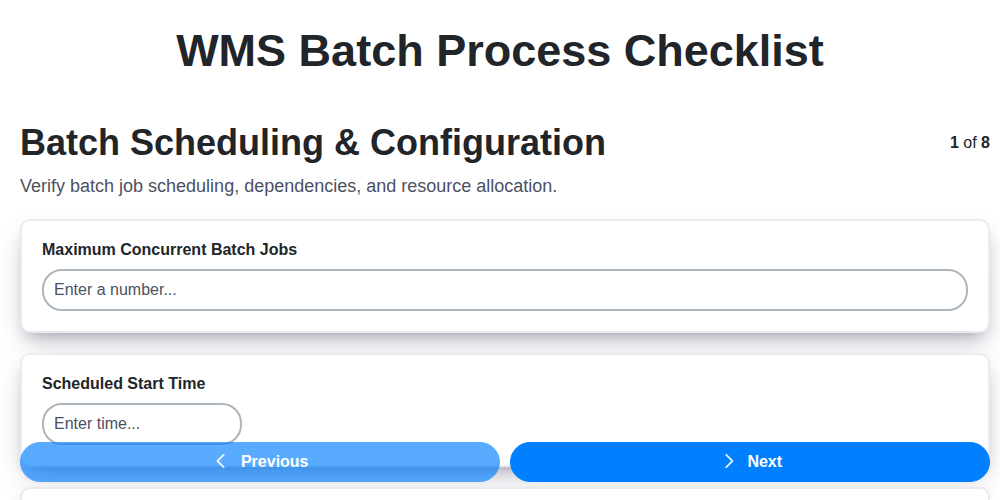
Ensuring Success: Your WMS Batch Process Checklist Template
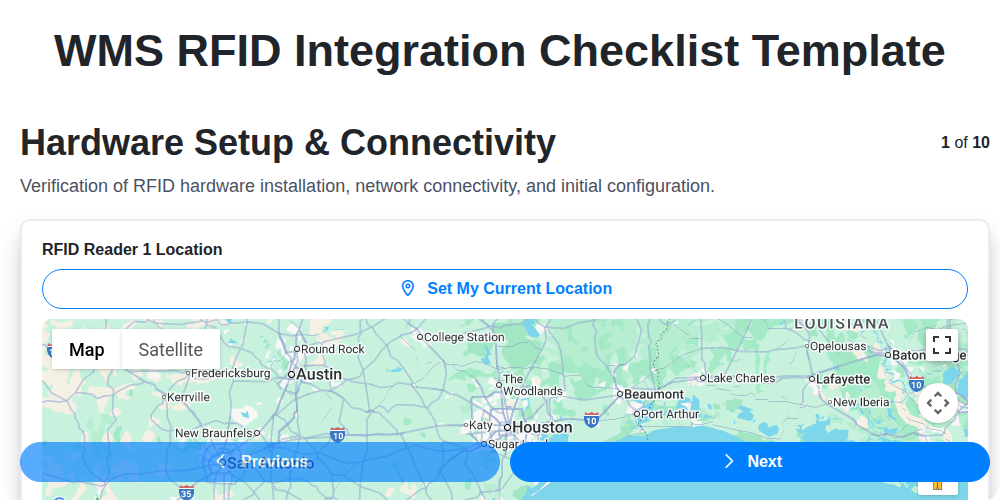
Seamless RFID Integration: Your WMS Checklist Template for Success
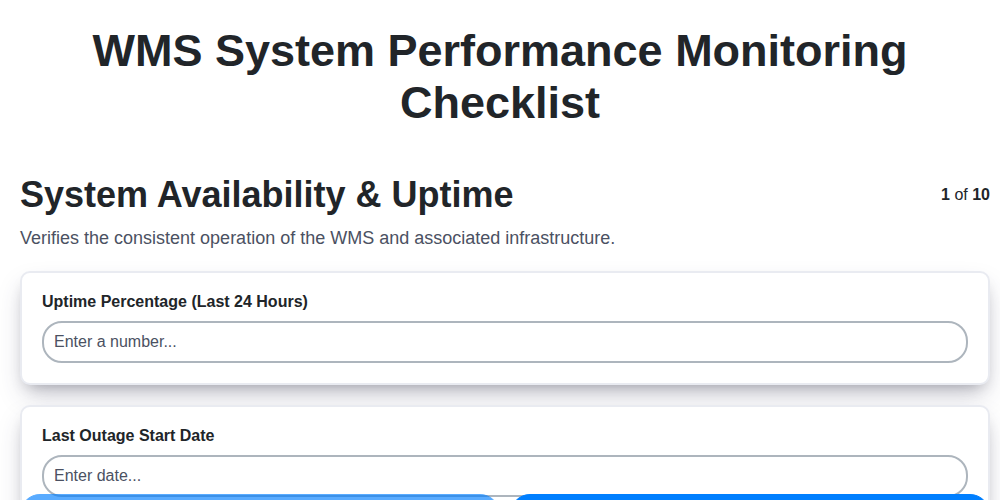
WMS System Performance Monitoring Checklist: A Comprehensive Guide

Mastering Your Yard: A Warehouse WMS Yard Management Checklist Template

Ensuring Success: Your WMS Automation Validation Checklist Template
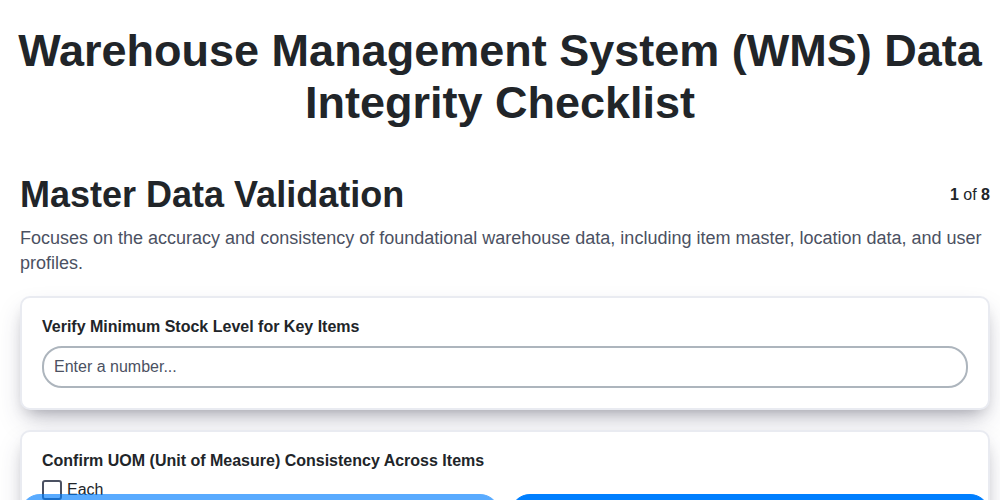
Warehouse Data Integrity: Your WMS Checklist Template
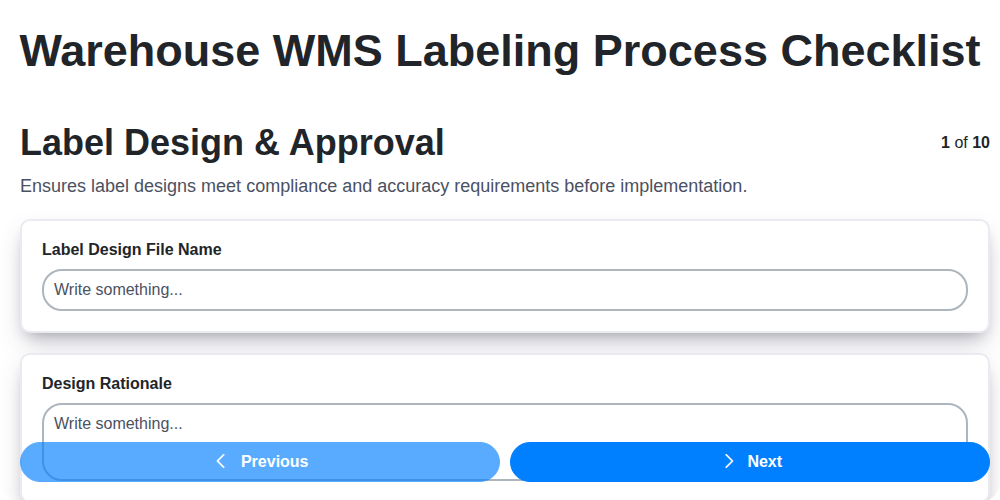
Mastering Warehouse Labeling: Your WMS Process Checklist Template

Warehouse WMS Security Checklist: A Comprehensive Guide to Protecting Your Operations
We can do it Together
Need help with
Checklists?
Have a question? We're here to help. Please submit your inquiry, and we'll respond promptly.