MRP BOM Validation Checklist: Ensuring Accuracy and Efficiency
Published: 12/14/2025 10:00 PM Updated: 12/15/2025 1:42 PM
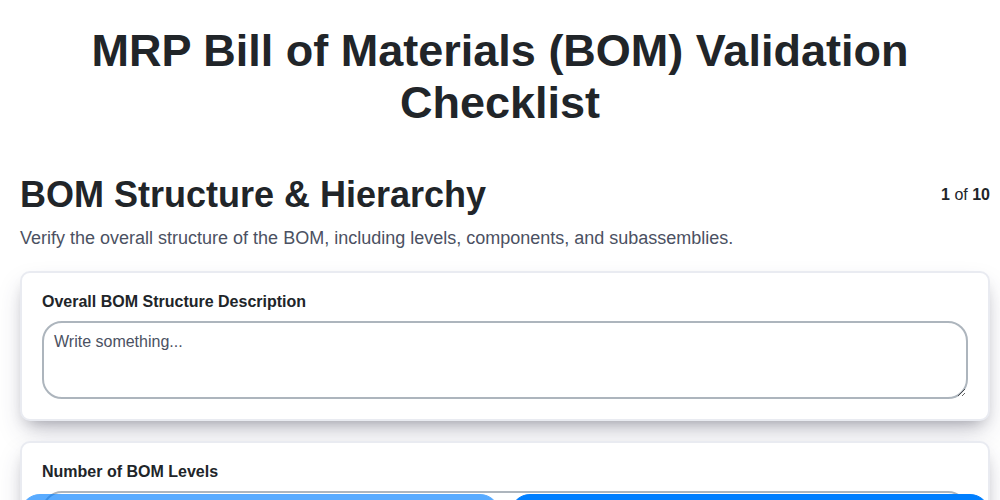
Table of Contents
- Introduction: Why BOM Validation Matters
- 1. BOM Structure & Hierarchy: Establishing a Clear Foundation
- 2. Part Number Accuracy: Eliminating Confusion & Errors
- 3. Quantity & Usage Rates: Optimizing Material Requirements
- 4. Unit of Measure Consistency: Preventing Calculation Mistakes
- 5. Effective Dates & Revision Control: Maintaining Historical Accuracy
- 6. Alternate Items & Substitutions: Managing Flexibility
- 7. Phantom Items & Processing Instructions: Capturing Complex Assemblies
- 8. Cost Rollup & Accuracy: Ensuring Reliable Costing
- 9. Engineering Change Order (ECO) Tracking: Seamless Updates
- 10. System Integration & Data Flow: Ensuring Data Integrity
- 11. Validation Tools & Techniques
- 12. Common BOM Validation Pitfalls
- Conclusion: Continuous BOM Improvement
- Resources & Links
TLDR: Manufacturing Resource Planning (MRP) BOMs are critical - mistakes can be costly! This checklist ensures your Bill of Materials is accurate and up-to-date, covering everything from part numbers and quantities to cost and ECO tracking. Use it to avoid errors, improve efficiency, and keep your production running smoothly.
Introduction: Why BOM Validation Matters
The Bill of Materials (BOM) is the backbone of manufacturing. It's more than just a list of parts; it's a comprehensive instruction manual for building your product. An inaccurate or poorly managed BOM can lead to costly errors, production delays, material waste, and ultimately, dissatisfied customers. Imagine assembling a product with the wrong components or in the wrong quantities - the consequences can be significant.
BOM validation isn't just a nice-to-have; it's a critical process for ensuring accuracy, efficiency, and profitability. It's a systematic review designed to catch errors before they impact production. This post will outline a detailed checklist to help you validate your BOM, ensuring it accurately reflects your manufacturing process and supporting your overall business goals. Investing the time in thorough BOM validation is an investment in the reliability and success of your operations.
1. BOM Structure & Hierarchy: Establishing a Clear Foundation
A well-defined BOM structure and hierarchy is the bedrock of any successful manufacturing process. It dictates how components are organized and linked, directly impacting planning, procurement, and ultimately, production efficiency. This isn't just about listing parts; it's about establishing a logical framework.
What to Check:
- Levels of Detail: Are your BOMs appropriately structured with clear levels (e.g., top-level assembly down to sub-assemblies and individual components)? Too few levels can obscure critical information, while too many can become unwieldy.
- Parent-Child Relationships: Verify that parent-child relationships accurately reflect the actual assembly process. A misconfigured relationship can lead to incorrect material requirements.
- Multi-Level BOMs: For complex products, ensure multi-level BOMs are correctly linked and that changes at one level cascade appropriately to dependent levels.
- Visual Representation: Consider using visual diagrams or tree structures to easily understand the BOM's hierarchy. This is particularly helpful for complex assemblies.
- Standardization: Implement standardized naming conventions and organizational practices across all BOMs to promote clarity and reduce errors.
- Review for Redundancy: Identify and eliminate any redundant BOM structures. Consolidate where possible to streamline processes.
2. Part Number Accuracy: Eliminating Confusion & Errors
A seemingly minor error in a part number can trigger a cascade of downstream problems, leading to incorrect orders, production delays, and ultimately, increased costs. This is why meticulous attention to part number accuracy is paramount in your MRP Bill of Materials (BOM) validation process.
Beyond Simple Identification: A part number isn't just a label; it's a key that unlocks critical information about a component - its description, supplier, cost, and specifications. Inaccurate part numbers can lead to misidentification, wrong materials being used, and a complete derailment of your production schedule.
Validation Steps to Ensure Accuracy:
- Cross-Reference with Supplier Catalogs: Regularly compare your internal part numbers with those listed by your suppliers. This confirms that you're ordering the correct component and accounts for any supplier-specific numbering conventions.
- Verify Against Engineering Drawings & Specifications: Part numbers should directly correspond to the components detailed in engineering drawings and specifications. Discrepancies indicate a breakdown in communication or data entry.
- Implement a Standardized Naming Convention: A clear, well-defined part numbering system helps avoid ambiguity and allows for easy identification. Consider incorporating information like material type, size, and manufacturer within the part number itself.
- Utilize Barcoding and QR Codes: Scanning technologies dramatically reduce manual data entry errors and instantly verify part numbers against your BOM.
- Regular Audits: Periodic reviews of your BOM, particularly during major product changes, are crucial to identify and correct any inaccuracies that may have crept in.
- Training and Accountability: Ensure that personnel involved in BOM creation and maintenance are properly trained and understand the importance of accurate part numbering. Assign clear responsibility for maintaining data integrity.
By prioritizing part number accuracy, you're not just avoiding errors; you're laying the foundation for a more efficient, reliable, and cost-effective manufacturing operation.
3. Quantity & Usage Rates: Optimizing Material Requirements
Accurate quantity and usage rates are the bedrock of a reliable MRP system. Incorrect figures here ripple through the entire planning process, leading to excess inventory, stockouts, and production bottlenecks. This section of the BOM validation checklist focuses on ensuring these rates are correct and reflect actual production needs.
What to Check:
- Verification against Routings: Cross-reference the quantity of each component listed in the BOM with the corresponding routing instructions. Does the usage rate specified in the routing match what's defined in the BOM? Discrepancies often indicate errors in either the BOM or routing.
- Historical Usage Data: Analyze historical production runs and scrap data. Are the current usage rates aligned with past performance? Significant deviations warrant investigation - are processes changing, are components being wasted, or are there data entry errors?
- Engineering Specifications: Review engineering drawings and specifications. Are there any documented requirements for component usage that may not be reflected in the BOM?
- Operator Feedback: Solicit feedback from production operators. They often have practical insights into component usage based on real-world experience. Their observations can highlight discrepancies and identify areas for improvement.
- Standardization & Best Practices: Establish standard usage rates based on proven methods and document the rationale behind those rates. Regularly review these standards and update them as processes evolve.
- Scrap Rates: Factor in scrap rates for each component. Ignoring scrap leads to inaccurate material requirements and potential shortages.
- Yield Considerations: For processes with variable yields (e.g., coatings, moldings), ensure the BOM accounts for this variability by adjusting component usage accordingly.
Why It Matters:
- Reduced Inventory Costs: Accurate usage rates minimize the need to hold excessive safety stock.
- Minimized Stockouts: Avoid production delays and customer dissatisfaction by ensuring sufficient material availability.
- Improved Production Efficiency: Streamline production processes by eliminating waste and optimizing material flow.
- Enhanced MRP Accuracy: Lay a solid foundation for reliable material planning and scheduling.
4. Unit of Measure Consistency: Preventing Calculation Mistakes
One of the most frustrating, and surprisingly common, errors in MRP systems stems from inconsistencies in unit of measure (UOM). A seemingly minor discrepancy - using "each" in one instance and "pieces" in another for the same component - can cascade through your BOM, leading to inaccurate material requirements planning, excess inventory, and production bottlenecks.
Think about it: if your BOM specifies 10 "screws" for a subassembly but elsewhere lists 10 "each" for the same screw, your system will calculate wildly different material needs. This leads to shortages, overstocking, and ultimately, wasted resources.
Here's how to ensure UOM consistency:
- Establish a Standard UOM List: Define a comprehensive list of approved units of measure (inches, feet, kilograms, liters, each, etc.) and enforce its use throughout the organization.
- Centralized UOM Management: Ideally, manage UOMs centrally within your ERP or MRP system. This prevents unauthorized additions or modifications.
- Cross-Functional Validation: Involve procurement, engineering, and production personnel in the UOM validation process. They understand how components are used and can flag potential inconsistencies.
- Automated Checks: Implement automated checks within your MRP system to identify and flag instances where different UOMs are used for the same component.
- Training & Documentation: Ensure everyone involved in BOM creation and maintenance understands the approved UOM list and the importance of consistency.
By prioritizing UOM consistency, you'll dramatically improve the accuracy of your BOM and, consequently, the effectiveness of your MRP system.
5. Effective Dates & Revision Control: Maintaining Historical Accuracy
One of the most critical aspects of BOM validation, and often a significant source of errors, lies in managing effective dates and revision control. A BOM isn't a static document; it evolves as designs are updated, materials change, and processes are refined. Without robust controls, you're essentially flying blind, potentially manufacturing products with outdated components or incorrect processes.
Here's what to scrutinize:
- Verify Accuracy of Effective Dates: Ensure each BOM revision's start date accurately reflects when that version became active. Incorrect dates can lead to manufacturing using obsolete designs or causing confusion for production teams.
- Review Revision History: Examine the complete revision history for each part. Understand why changes were made. Was it a material substitution? A design modification? Knowing the context provides valuable insight.
- Assess Transition Periods: Validate that the system correctly handles the transition between BOM revisions. Does the system allow for overlapping effective dates if necessary (e.g., during a phased rollout of a new design)?
- Audit Revision Tracking: Confirm that all revisions are properly tracked within the MRP system. Are revision numbers sequential? Are comments and descriptions associated with each revision explaining the changes?
- Control Unauthorized Changes: Implement procedures to prevent unauthorized modifications to the BOM. This might involve access controls and approval workflows.
- Data Retention Policies: Ensure the system retains historical BOM data, allowing for audit trails and analysis of past manufacturing issues. It's not enough to have the current BOM; you need a record of what came before.
Maintaining meticulous effective date and revision control isn't just about compliance; it's about preserving manufacturing integrity and minimizing costly errors.
6. Alternate Items & Substitutions: Managing Flexibility
In manufacturing, unexpected supply chain disruptions or material shortages are inevitable. Having a robust system for managing alternate items and substitutions within your Bill of Materials (BOM) is crucial for maintaining production continuity. This section of your BOM validation checklist should focus on ensuring these alternatives are properly defined, approved, and accessible.
Here's what to check:
- Defined Alternate Part Numbers: Verify that each item with designated alternatives has clearly listed and approved substitute part numbers. Don't just list any potential replacement; ensure they've been vetted for functionality and quality.
- Substitution Rules & Trigger Points: Document the specific conditions under which a substitution is permissible. This could be based on lead time, cost, vendor availability, or performance criteria. Clearly define the approval process for using these alternatives.
- Impact Assessment: For each alternate item, assess the impact on the final product's performance, quality, and cost. This is especially important for critical components. Document any deviations or adjustments required when substituting.
- User Accessibility: Ensure that users (e.g., purchasing, production planning) have easy access to the approved list of alternate items and understand the substitution rules. A complex, buried system leads to unauthorized and potentially problematic substitutions.
- Inventory Management Integration: Verify that your inventory management system accurately reflects the availability of both the primary and alternate items, and that substitution triggers automatically update purchasing requests or production schedules.
- Revision Control: Just like the primary part, alternate items should be subject to revision control. Changes in an alternative's specifications or compatibility must be tracked and communicated effectively.
7. Phantom Items & Processing Instructions: Capturing Complex Assemblies
Phantom items and processing instructions often represent some of the most intricate aspects of a Bill of Materials (BOM). Unlike regular components, phantom items aren't consumed during production - they represent sub-assemblies that disappear into the parent assembly. Accurately defining and validating these is crucial for preventing production errors and maintaining accurate inventory records.
What to Check:
- Phantom Item Designation: Ensure all phantom items are correctly flagged as such within the MRP system. Misidentification can lead to incorrect material requirements planning and stock levels.
- Processing Instructions Clarity: The BOM should clearly outline any processing instructions or operations associated with phantom items. These instructions are essential for production personnel to understand the manufacturing steps required. Ambiguous or missing instructions can lead to quality issues and delays.
- Relationship Mapping: Verify that the relationships between phantom items and their parent assemblies are correctly mapped within the BOM. A visual representation (if available in your system) can be helpful for validation.
- Impact Analysis: When changes are made to a phantom item or its processing instructions, carefully analyze the impact on the parent assembly and all other dependent assemblies. Changes here can ripple through the production process.
- Routing Integration: Confirm the BOM's phantom item definitions are aligned with the corresponding routing information within your MRP system. This ensures that production planning incorporates the correct operations and resources.
- Documentation & Training: Ensure comprehensive documentation exists for phantom items, outlining their purpose, manufacturing process, and any associated quality control measures. Train production personnel on how to handle and process these items correctly.
8. Cost Rollup & Accuracy: Ensuring Reliable Costing
A BOM is more than just a parts list; it's a critical foundation for accurate cost calculations. Errors in the BOM directly impact your manufacturing costs, inventory valuation, and ultimately, profitability. This section focuses on validating the cost rollup and accuracy embedded within your BOM.
Here's what to check:
- Material Cost Validation: Verify that the unit costs associated with each component are current and accurate. Source these costs from reliable procurement data, factoring in supplier pricing, discounts, and transportation costs. Regularly update these costs - even small fluctuations can significantly impact overall project costs.
- Labor Cost Calculation: If labor is factored into the BOM's cost rollup (e.g., for assembly), ensure the labor hours and associated rates are correct and reflect current production standards. Review processes to identify potential efficiencies that could lower labor costs.
- Overhead Allocation: Scrutinize how overhead costs (e.g., utilities, depreciation) are allocated to components and assemblies. Are the allocation methods logical and consistently applied?
- Scrap & Waste Factor: Account for scrap and waste rates for each component and sub-assembly. This adds a realistic cost buffer and helps prevent surprises during production.
- Cost Rollup Logic: Trace how the costs are being calculated at each level of the BOM. Ensure the formulas and calculations are accurate and consider all relevant factors.
- Variance Analysis: Regularly compare the calculated BOM cost with actual production costs. Significant variances should trigger an investigation to identify the root cause and correct errors in either the BOM or the production process.
- Currency Considerations: If dealing with international suppliers, confirm the accuracy of currency exchange rates used in cost calculations and understand any potential volatility.
By diligently validating the cost elements within your BOM, you establish a reliable foundation for accurate costing, improved pricing strategies, and enhanced profitability.
9. Engineering Change Order (ECO) Tracking: Seamless Updates
Engineering changes are inevitable. New designs, material shortages, cost optimizations - they all necessitate updates to your Bill of Materials (BOM). How you manage these changes is critical to maintaining data integrity and avoiding costly errors. A robust ECO tracking process is an essential part of BOM validation.
Your BOM validation checklist must include a thorough review of your ECO tracking system. Here's what to look for:
- ECO Numbering & Documentation: Are ECOs assigned unique, sequential numbers? Is there clear documentation associated with each ECO, detailing the change, reason, impact assessment, and approval workflow?
- Approval Workflow: Does your system enforce a defined approval process? Are the appropriate stakeholders (engineering, procurement, manufacturing) involved in reviewing and approving changes?
- BOM Linkage: Is each ECO clearly linked to the specific BOM(s) and items it affects? This creates an audit trail and simplifies impact analysis.
- Implementation Timing: Are ECOs implemented in a controlled manner? Consider phasing implementation to minimize disruption. Are timelines clearly defined and communicated?
- Revision History: Does your system automatically update the BOM revision number upon ECO implementation? This ensures users are working with the correct version.
- Training & Communication: Are users trained on the ECO process and kept informed of upcoming changes? Lack of awareness can lead to errors and rework.
- Audit Trail: Does the system maintain a complete audit trail of all ECO activities, including who made the change, when, and why? This is crucial for traceability and accountability.
A well-managed ECO process ensures changes are implemented correctly, minimizes disruption, and maintains the accuracy of your BOM. Failing to adequately track and manage ECOs can lead to production errors, increased costs, and ultimately, customer dissatisfaction.
10. System Integration & Data Flow: Ensuring Data Integrity
The BOM isn't an island. It interacts heavily with other systems - ERP, MES, PLM, and more. A flawed BOM validation process often stems from a lack of scrutiny regarding this integration. This section focuses on validating how the BOM data flows and is maintained across these connected platforms.
Here's what to check:
- Data Synchronization: Verify the frequency and method of BOM data transfer between the MRP system and other systems. Are updates real-time, batch, or manual? Determine the ideal synchronization frequency to minimize discrepancies.
- Data Mapping Accuracy: Confirm that data fields are correctly mapped between systems. A misaligned mapping can lead to incorrect material planning and production execution. Check for any field translations or transformations occurring during the data transfer.
- Error Handling & Reporting: Assess how errors during data transfer are handled. Are errors logged? Are there automated alerts for failed transfers? A robust error handling process is critical for timely corrections.
- Validation of Derived Data: Many systems automatically derive information from the BOM (e.g., material costs, routings, lead times). Verify the accuracy of these derived values by tracing them back to the source BOM data.
- User Access & Security: Review user access permissions to the BOM within both the MRP system and integrated systems. Unauthorized modifications can compromise data integrity.
- API Testing (if applicable): If APIs are used for integration, perform rigorous testing to ensure they function correctly and handle various scenarios.
- Traceability: Ensure a clear audit trail exists linking changes to the BOM to the systems that consumed that data. This traceability aids in identifying the root cause of issues.
A well-validated system integration and data flow is the backbone of a reliable BOM and a successful MRP implementation.
11. Validation Tools & Techniques
Validating your MRP Bill of Materials (BOM) isn't just about eyeballing the data; leveraging the right tools and techniques can significantly improve accuracy, efficiency, and catch errors that might otherwise slip through. Here's a look at valuable options:
- BOM Comparison Software: These tools compare different BOM versions, highlighting discrepancies and changes visually. This is invaluable for ECO tracking and ensuring everyone is working with the correct version.
- Data Analytics & Reporting: Implement reports that flag unusual quantity usage rates, cost variances, or part number inconsistencies. Trend analysis can also highlight areas prone to errors.
- Automated Validation Rules: Configure your MRP system to enforce rules around part number formats, unit of measure requirements, and required fields. This proactively prevents data entry mistakes.
- Simulation & What-If Analysis: Run simulations within your MRP system to see how BOM changes impact material requirements and production schedules. This helps identify potential bottlenecks or cost overruns before implementation.
- Visual BOM Editors: A visual interface for the BOM allows users to easily understand the hierarchical structure and relationships between components, reducing the risk of misinterpretation.
- Process Flow Diagrams: Mapping out the BOM validation process itself (who reviews what, when, and how) provides clarity and accountability.
- Regular Audits: Periodic, independent reviews of a sample of BOMs helps identify systemic issues with the validation process and opportunities for improvement.
Ultimately, the best approach combines a variety of these tools and techniques, tailored to your specific business needs and the complexity of your BOMs.
12. Common BOM Validation Pitfalls
Even with a robust checklist like the one we've outlined, BOM validation isn't always smooth sailing. Here are some frequently encountered pitfalls that can derail your efforts and lead to production headaches.
Ignoring User Feedback: Often, the people closest to the BOM - the production floor, purchasing, and even assembly technicians - notice inconsistencies or inaccuracies before anyone else. Failing to establish a clear feedback loop and acting on their input is a huge missed opportunity. Don't dismiss feedback as "user error"; it's valuable data.
Lack of Cross-Functional Collaboration: BOMs impact multiple departments. Validation shouldn't be solely an engineering responsibility. Production, procurement, and quality control need to be actively involved to ensure the BOM reflects practical manufacturing realities and procurement strategies. Siloed validation leads to disconnects and errors.
Insufficient Documentation: Documentation isn't just about the BOM itself; it's about the validation process. Documenting changes, approvals, and the rationale behind decisions is crucial for traceability and auditability. Without it, troubleshooting becomes significantly more difficult.
Overlooking Engineering Change Order (ECO) Impact: ECOs are a constant in many environments. Failing to accurately track and implement ECOs into the BOM, or not understanding their downstream effects on dependent BOMs, creates significant risk of using outdated or incorrect materials.
Neglecting Data Cleansing: Garbage in, garbage out applies directly to BOMs. Duplicate part numbers, obsolete components, and incorrect descriptions pollute the data and lead to incorrect calculations and inaccurate manufacturing. Regular data cleansing is essential.
Assuming System Integration is Sufficient: Just because your BOM data exists in your ERP system doesn't mean the validation is automatic or comprehensive. Integration needs active monitoring and verification to ensure data flows correctly and updates are reflected accurately.
Conclusion: Continuous BOM Improvement
Ultimately, a robust and accurate Bill of Materials (BOM) is the backbone of efficient manufacturing. This validation checklist isn't a one-time task; it's an ongoing process. Regularly revisiting and refining your BOMs, incorporating feedback from production, engineering, and procurement, is crucial for maintaining accuracy and mitigating costly errors. Embrace a culture of continuous improvement, leveraging the checklist as a guide for periodic audits and enhancements. By prioritizing BOM accuracy, you're not just avoiding mistakes; you're optimizing your entire manufacturing operation for greater efficiency, reduced costs, and improved product quality.
Resources & Links
- APICS (The Association for Supply Chain Management): A leading professional association for supply chain management, offering resources, certifications, and education related to BOMs and MRP. Look for articles and whitepapers on materials management and planning.
- MRO-Electronics.com: Offers a wealth of information on manufacturing processes, including materials management and BOM topics. Often has articles and guides for optimizing BOMs.
- Smart PM: Focuses on asset management, but their content often touches on materials management and BOM considerations, particularly in complex manufacturing environments.
- PTC: A major provider of CAD/CAM/CAE and PLM software. Their website features white papers and case studies about how accurate BOMs and data integration impact manufacturing efficiency.
- Oracle: Oracle provides ERP and manufacturing solutions, and their website offers resources (often promotional, but informative) about BOM management and MRP best practices within a digital ecosystem.
- Microsoft Dynamics 365: Similar to Oracle, Microsoft's ERP solution offers resources and guidance on BOM management and its integration with manufacturing processes.
- Infor: Another ERP vendor with articles and case studies relating to BOM creation, maintenance and the impact on overall manufacturing efficiencies.
- QAD: QAD offers ERP and PLM solutions. They have resources focused on BOM creation, maintenance, and data accuracy for manufacturers.
- Manufacturing Leadership Magazine: A trade publication with articles on a wide range of manufacturing topics, including BOM management and data accuracy. Search their archives for relevant content.
- Thomasnet: A comprehensive directory of industrial suppliers and manufacturers. Can be useful for researching components and verifying part numbers within a BOM.
Frequently Asked Questions
What is an MRP BOM Validation Checklist and why is it important?
An MRP BOM Validation Checklist is a detailed review process used to ensure the accuracy and completeness of your Bill of Materials (BOM) within your Material Requirements Planning (MRP) system. It's crucial because inaccurate BOMs lead to incorrect material planning, production delays, excess inventory, shortages, and ultimately, increased costs and decreased customer satisfaction.
Who should be involved in the BOM Validation process?
A collaborative effort is best. Key stakeholders include production planners, engineers (design and process), procurement specialists, inventory managers, and ideally, representatives from the shop floor. Each perspective brings valuable insight to identify potential errors or inefficiencies.
What are the common errors found during BOM validation?
Common errors include incorrect part numbers, wrong quantities of components, missing components, incorrect unit of measure, outdated revisions, incorrect alternative items, inaccurate lead times, and incorrect routings. Inaccurate costing information is also frequently found.
What are the key areas to cover in a BOM Validation Checklist?
A comprehensive checklist should include checks on component accuracy (part number, description, revision), quantity and unit of measure verification, ensuring all required components are listed, validating alternative items, confirming accurate lead times, verifying routing steps, and ensuring accurate costs associated with each component.
How often should BOM Validation be performed?
BOM Validation shouldn't be a one-time event. Ideally, it should be performed: 1) Whenever a BOM is created or modified, 2) Regularly (e.g., quarterly or semi-annually) even for stable BOMs, 3) When introducing new products or design changes, and 4) When there are significant process changes.
What are the benefits of using a structured BOM Validation Checklist?
Using a checklist ensures consistency and thoroughness in the validation process. It reduces errors, improves planning accuracy, minimizes waste, optimizes inventory levels, shortens lead times, and enhances overall production efficiency. It also provides a documented audit trail.
How does BOM validation relate to overall MRP accuracy?
The BOM is a foundational element of MRP. If the BOM is inaccurate, all downstream planning - requirements calculations, order scheduling, and shop floor execution - will be flawed. BOM validation is therefore critical for accurate MRP execution.
What tools or software can assist with BOM Validation?
Many MRP and ERP systems have built-in validation features. Spreadsheet software (like Excel or Google Sheets) can be used to create and manage checklists. Dedicated BOM management software can provide more advanced validation and collaboration features.
What should be done if an error is found during BOM Validation?
Document the error clearly, investigate the root cause, correct the BOM in the MRP system, notify relevant stakeholders, and update any affected documentation. Implement corrective actions to prevent similar errors from recurring.
How can I create my own BOM Validation Checklist?
Start by identifying your most critical data points. Review past BOM errors to understand common issues. Consider involving a diverse group of stakeholders. Regularly update the checklist based on experience and changes in processes or products.
Found this Article helpful?
Comments
There are no comments yet. Be the first to add one!
Related Articles
MRP System Performance Monitoring Checklist: Ensure Peak Efficiency
MRP System Implementation Checklist: Your Step-by-Step Guide

Top 10 MRPeasy Alternatives for 2025
The 5 Best Bill of Materials (BOM) Management Software of 2025
MRP Planning Parameter Setup Checklist: Your Guide to Accuracy & Efficiency

The 10 Best Manufacturing Management Software of 2025
How to improve your Bill of Materials (BOM) Management
MRP User Training Checklist: Ensuring Proficiency & Success
We can do it Together
Need help with
Material Requirements Planning (MRP)?
Have a question? We're here to help. Please submit your inquiry, and we'll respond promptly.