MRP Continuous Improvement Checklist: A Step-by-Step Guide to Optimization
Published: 12/14/2025 10:00 PM Updated: 12/15/2025 2:00 PM
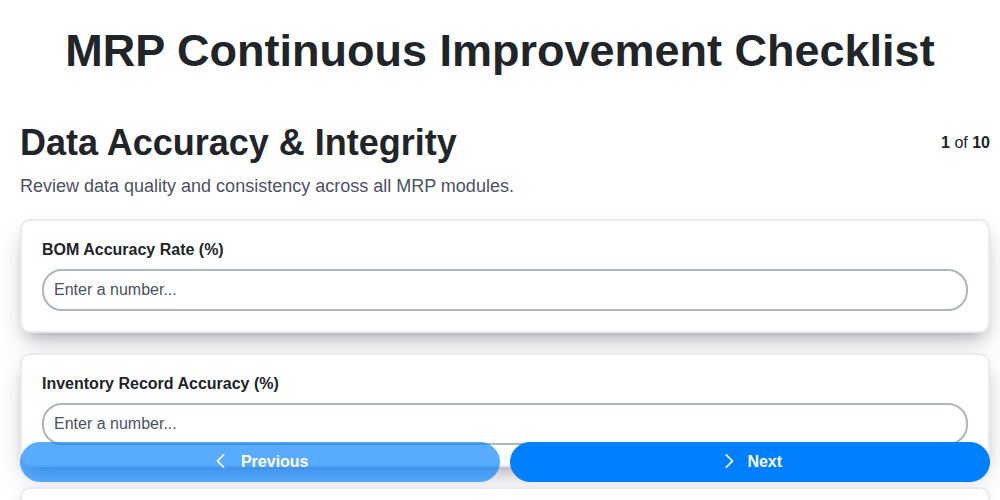
Table of Contents
- Introduction: Why Continuous Improvement for Your MRP System?
- 1. Data Accuracy & Integrity: The Foundation of Reliable Planning
- 2. Planning Parameter Optimization: Fine-Tuning for Accuracy
- 3. Demand Forecasting Enhancement: Predicting the Future
- 4. Inventory Management Efficiency: Balancing Supply and Demand
- 5. Production Scheduling Performance: Maximizing Throughput
- 6. MRP System Usage & Training: Empowering Your Team
- 7. Integration and Data Flow: Seamless Information Exchange
- 8. Reporting and Analytics: Measuring Performance and Identifying Trends
- 9. Process Documentation & Standardization: Ensuring Consistency
- 10. Feedback and Continuous Monitoring: Proactive Problem Solving
- 11. Identifying Bottlenecks & Addressing Root Causes
- 12. Leveraging Technology for Enhanced Efficiency
- Conclusion: Sustaining Continuous Improvement
- Resources & Links
TLDR: Feeling like your MRP system isn't delivering its full potential? This checklist provides a clear, step-by-step guide to optimize your Material Requirements Planning. From data accuracy to forecasting and scheduling, it covers key areas to boost efficiency, reduce waste, and ensure your MRP is a powerful tool for continuous improvement - no complicated jargon required!
Introduction: Why Continuous Improvement for Your MRP System?
Your Manufacturing Resource Planning (MRP) system is the backbone of your production process, but simply having it isn't enough. Like any crucial tool, your MRP system needs regular maintenance and refinement to stay effective. A stagnant MRP system can lead to inaccurate planning, inefficient production, increased costs, and ultimately, lost revenue.
This isn's about radical overhauls or expensive upgrades. Continuous improvement for your MRP system focuses on incremental, iterative adjustments to optimize performance. It's about proactively identifying areas for improvement, implementing changes, and consistently monitoring results. This approach fosters a culture of ongoing refinement, ensuring your MRP system adapts to evolving business needs and maximizes its value. By embracing a continuous improvement mindset, you can unlock hidden potential within your existing system and drive significant gains in efficiency, accuracy, and overall business performance. This checklist - and the journey it represents - is your roadmap to that improved future.
1. Data Accuracy & Integrity: The Foundation of Reliable Planning
Let's face it: even the most sophisticated MRP system is useless if the data feeding it is flawed. Data accuracy and integrity form the bedrock of any successful MRP continuous improvement initiative. Garbage in, garbage out - it's a truism, but a critical one.
This isn't just about making sure part numbers are correct. It's about a holistic approach to data trustworthiness. Regularly audit your Bills of Materials (BOMs) to ensure they accurately reflect your product structure, including revisions and substitutions. Verify routings and labor standards. Check lead times and supplier data for consistency and updates.
Here are some key actions to take:
- Regular BOM Audits: Conduct audits at least quarterly, or more frequently if significant product changes occur.
- Master Data Management: Establish a clear process for managing master data (items, vendors, customers) with defined ownership and update procedures.
- Data Validation Rules: Implement validation rules within your MRP system to prevent inaccurate data from being entered. This includes checks for required fields, allowable ranges, and cross-references.
- Error Tracking & Correction: Create a system for tracking data errors, assigning responsibility for correction, and monitoring resolution times.
- Source Verification: Ensure data originating from external sources (e.g., supplier lead times, customer orders) are validated and verified.
A small investment in data quality now will save you significant headaches and costly errors down the line. Remember, your MRP system is only as good as the data you put into it.
2. Planning Parameter Optimization: Fine-Tuning for Accuracy
MRP systems thrive on accuracy, and at its core lies meticulously defined planning parameters. These aren't set it and forget it values; they require ongoing review and refinement. Suboptimal parameters lead to inaccurate material requirements, leading to stockouts, excess inventory, and ultimately, lost revenue.
Let's break down key planning parameters to optimize:
- Lead Times: Regularly assess and update supplier lead times. A slight delay from a supplier can significantly impact production schedules. Consider incorporating safety buffers but avoid excessive padding.
- Safety Stock Levels: Analyze demand variability and lead time fluctuations to determine appropriate safety stock levels. Don't rely solely on historical averages; factor in potential disruptions and seasonality.
- Lot Sizes: Optimize lot sizes to balance setup costs and inventory holding costs. Explore Economic Order Quantity (EOQ) calculations and consider constraints like storage capacity or minimum order quantities.
- Setup Times: Accurate setup times are crucial for production scheduling. Track and refine these figures, looking for opportunities to reduce them through process improvements.
- Yield Rates: Account for potential scrap and rework by accurately defining yield rates for each operation. This ensures you're ordering the correct quantities to compensate for losses.
- Routing: Ensure routing information accurately reflects the steps involved in production. Incorrect routing leads to incorrect material requirements and potential production delays.
Don't just update these parameters in isolation. Consider the interplay between them. A change in lead time might necessitate an adjustment to safety stock. Regular audits and simulations can help identify areas for improvement and validate changes before implementation.
3. Demand Forecasting Enhancement: Predicting the Future
Accurate demand forecasting is the bedrock of any successful MRP system. If your forecasts are off, the entire downstream process - from raw material procurement to production scheduling - suffers. This section focuses on refining your demand forecasting capabilities within your MRP environment.
Beyond Simple Averages: Leveling Up Your Forecasting Methods
While historical data is valuable, relying solely on it can be misleading. Consider these enhancements:
- Collaborative Forecasting: Involve sales, marketing, and customer service teams. Their insights into upcoming promotions, market trends, and customer orders are invaluable. Implement a formal process for sharing this information and incorporating it into the forecasts.
- Statistical Modeling: Explore more advanced statistical methods beyond simple moving averages. Regression analysis, time series analysis (like ARIMA), and exponential smoothing techniques can significantly improve accuracy. Your MRP system might have built-in capabilities, or you could integrate with specialized forecasting software.
- External Data Incorporation: Don't ignore external factors! Economic indicators, competitor activity, seasonality, and even weather patterns can impact demand. Identify and incorporate relevant data sources.
- Forecast Error Tracking & Adjustment: Regularly analyze forecast errors (comparing predicted vs. actual demand). Use these insights to adjust forecasting parameters and improve future predictions. Implement bias detection and correction mechanisms.
- Scenario Planning: Develop multiple forecasts based on different potential scenarios (best case, worst case, most likely). This allows for more agile planning and mitigates risk.
Regular Review & Calibration is Key: Demand patterns change. Continuously review the accuracy of your forecasts, refine your models, and adjust parameters to maintain high levels of predictive power. Don't be afraid to experiment - even "failures" provide learning opportunities.
4. Inventory Management Efficiency: Balancing Supply and Demand
Inventory is the lifeblood of many manufacturing operations, but it's also a significant cost center. Inefficient inventory management - too much tied up in storage, or too little leading to stockouts - directly impacts profitability and customer satisfaction. This section of your MRP Continuous Improvement Checklist focuses on striking that critical balance.
Key Areas to Examine:
- Safety Stock Levels: Are your safety stock levels appropriate for each item? Overly conservative levels increase carrying costs; too low a level risks production interruptions and missed orders. Review historical demand variability and lead times to recalibrate.
- Obsolescence & Slow-Moving Inventory: Regularly identify and address obsolete or slow-moving items. Consider strategies like clearance sales, product redesigns (if feasible), or adjustments to procurement plans.
- Lot Sizing Optimization: Evaluate your lot sizing methods (e.g., Economic Order Quantity, Period Order Quantity). Are they aligned with your production capacity, supplier constraints, and demand patterns?
- Cycle Counting Accuracy: Implement a robust cycle counting program to maintain accurate inventory records. Discrepancies between physical inventory and system records must be investigated and corrected promptly.
- Vendor-Managed Inventory (VMI) Opportunities: Explore VMI programs with key suppliers to potentially reduce your inventory holding costs and improve supply chain responsiveness.
- ABC Analysis Review: Revisit your ABC inventory classification regularly. Items classified as 'A' (high value, critical) deserve the most stringent controls and monitoring.
By systematically reviewing and optimizing these aspects of inventory management within your MRP system, you can significantly reduce costs, improve cash flow, and enhance overall operational efficiency.
5. Production Scheduling Performance: Maximizing Throughput
Production scheduling is the heartbeat of your MRP system. Inefficient scheduling leads to bottlenecks, delays, and ultimately, dissatisfied customers. This section of your continuous improvement checklist focuses on optimizing this critical process.
Key Areas for Review:
- Capacity Planning Accuracy: Are your machine and labor capacities accurately reflected in the system? Regularly review and update capacity data, considering maintenance downtime, planned absences, and skill sets. Don't just look at current capacity; forecast for future needs.
- Constraint Identification & Management: Identify your biggest bottlenecks - the constraints limiting overall throughput. Use tools like the Theory of Constraints to prioritize addressing these limitations. Can you re-sequence jobs, optimize machine allocation, or invest in additional capacity?
- Sequencing & Prioritization Rules: Are your sequencing rules truly optimized? Are you prioritizing based on due dates, lead times, or a combination of factors? Experiment with different sequencing methods to see which yields the best results. Consider using more sophisticated scheduling algorithms within your MRP system, if available.
- Lead Time Reduction: Analyze production lead times - from raw material arrival to finished goods delivery. Look for opportunities to shorten these times through process improvements, better material flow, or reduced setup times.
- Work-in-Process (WIP) Management: Excessive WIP ties up capital and hides underlying problems. Evaluate your WIP levels and implement strategies to reduce them, such as pull systems or Kanban.
- Schedule Stability: Frequent schedule changes disrupt production and increase costs. Strive for schedule stability through accurate demand forecasting and realistic capacity planning. Track the frequency of schedule changes and investigate the root causes of instability.
Continuous Improvement Actions: Regularly review actual production performance against the schedule. Investigate variances and identify opportunities to refine your scheduling rules and improve overall performance. Don't be afraid to experiment and iterate - continuous improvement is key.
6. MRP System Usage & Training: Empowering Your Team
Your MRP system is only as effective as the people using it. A powerful system with inadequate training or poor user adoption is a wasted investment. This section focuses on ensuring your team understands and utilizes the MRP system to its full potential.
Here's what to check:
- Initial Training Adequacy: Was the initial training comprehensive, covering core functionalities, data entry procedures, and basic troubleshooting? Evaluate its content and delivery.
- Role-Based Training: Does your team receive training specific to their roles? A planner needs different knowledge than a shop floor operator. Tailor training to responsibilities.
- Refresher & Advanced Training: Regular refresher courses are vital to reinforce knowledge and address updates. Offer advanced training for power users and specialists.
- New User Onboarding: A structured onboarding process for new hires is crucial for quick integration and reduced errors.
- User Proficiency Assessment: Implement a system to gauge user understanding. This could be through quizzes, practical exercises, or even informal feedback sessions.
- Super User Program: Identify and empower "super users" within each department who can act as local experts and provide support to their colleagues.
- Documentation Accessibility: Is the system documentation clear, concise, and easily accessible to all users? Consider video tutorials and quick reference guides.
- Feedback Mechanism: Establish a clear channel for users to provide feedback on the system and training, allowing for continuous improvement.
- System Updates Communication: Communicate system updates and changes clearly and proactively to prevent confusion and resistance.
Ultimately, investing in your team's MRP proficiency is an investment in your entire operation's efficiency and accuracy.
7. Integration and Data Flow: Seamless Information Exchange
A robust MRP system isn't an island. Its true power is unleashed when it seamlessly integrates with other critical business functions - accounting, sales, CRM, shop floor control, and more. Data flowing freely and accurately between these systems prevents bottlenecks, reduces errors, and provides a holistic view of your operations.
Here's what to consider for continuous improvement:
- Real-time Data Synchronization: Are updates reflected promptly across all connected systems? Delays in order changes, price updates, or inventory adjustments can wreak havoc on planning. Evaluate the synchronization frequency and identify opportunities to move towards near real-time updates.
- Interface Reliability: Regularly test the interfaces connecting your MRP system to other applications. Look for error logs and investigate any recurring issues. Don't assume everything is working just because it hasn't crashed recently - proactive testing is key.
- Data Mapping Accuracy: Review data mappings between systems. Ensure fields are correctly aligned and transformed during data transfer. Mismapped data leads to inaccurate planning and potentially costly mistakes.
- Error Handling and Reconciliation: Establish clear procedures for handling data integration errors. Automated alerts, reconciliation reports, and designated personnel to address discrepancies are essential.
- API Utilization: Explore the potential of APIs (Application Programming Interfaces) to facilitate more flexible and powerful integrations. APIs can enable custom solutions and deeper connections between your MRP and other systems.
- Data Security: Ensure data transfer is secure and compliant with relevant regulations. Implement appropriate security measures to protect sensitive information.
- Documentation: Maintain clear and up-to-date documentation of all integrations, including data mappings, error handling procedures, and contact information for responsible personnel.
8. Reporting and Analytics: Measuring Performance and Identifying Trends
Effective MRP isn't just about running calculations; it's about understanding the results. Robust reporting and analytics are crucial for demonstrating the system's value, identifying areas for improvement, and proactively addressing potential issues. This goes beyond standard reports - it's about turning data into actionable insights.
Key Areas to Focus On:
- KPI Dashboards: Create clear, concise dashboards displaying key performance indicators (KPIs). Examples include:
- Forecast Accuracy: Track Mean Absolute Percentage Error (MAPE) and other relevant metrics.
- Inventory Turnover Rate: Monitor how efficiently inventory is being utilized.
- On-Time Delivery Performance: Assess the ability to meet customer commitments.
- Production Cycle Time: Identify bottlenecks and areas for efficiency gains.
- Material Usage Variance: Compare planned vs. actual material consumption.
- Trend Analysis: Regularly analyze historical data to identify patterns and trends. This can reveal seasonal fluctuations, emerging demand shifts, and potential supply chain vulnerabilities.
- Variance Reporting: Focus on significant variances between planned and actual performance. Investigate the root causes of these discrepancies and implement corrective actions. Look at material variances, labor variances, and schedule variances.
- Custom Reports: Don't be afraid to develop custom reports tailored to specific departmental needs or strategic objectives. Work with users to understand their needs and create visualizations that provide clarity.
- Data Visualization: Transform raw data into visually compelling charts and graphs to make it easier to understand and communicate findings to stakeholders.
- Regular Review: Schedule regular reviews (weekly, monthly, quarterly) of reports with key stakeholders to ensure that data is being used effectively and to foster a culture of continuous improvement.
By prioritizing reporting and analytics, you transform your MRP system from a calculation engine into a strategic asset that drives informed decision-making and optimizes your entire manufacturing process.
9. Process Documentation & Standardization: Ensuring Consistency
One of the most frequently overlooked, yet crucial, elements of a successful MRP Continuous Improvement program is thorough process documentation and standardization. Without it, all your hard work can slowly erode as personnel change, processes are adapted informally, and tribal knowledge becomes the primary operating guide.
This isn't about creating a massive, unreadable manual. It's about clearly outlining key MRP-related processes - from data entry and order management to production scheduling and inventory adjustments - in a concise and accessible format.
Why is this so important?
- Reduces Errors: Standardized procedures minimize variations and reduce the likelihood of mistakes caused by individual interpretations.
- Facilitates Training: New employees can quickly understand and adopt best practices, shortening the learning curve.
- Supports Auditability: Clearly documented processes make it easier to track and verify actions, ensuring compliance and accountability.
- Enables Continuous Improvement: Having a baseline understanding of your current processes makes it easier to identify areas for optimization and track the impact of changes.
- Preserves Knowledge: Documentation prevents crucial information from being lost when experienced team members leave.
What should be included?
- Flowcharts: Visual representations of key processes.
- Step-by-step instructions: Clear and concise guides for common tasks.
- Role definitions: Specifying responsibilities for each process.
- Data entry guidelines: Ensuring consistency in data input.
- Approval workflows: Outlining the approval process for changes.
Remember to regularly review and update your documentation to reflect process improvements and ensure it remains relevant and accurate. A living document is far more valuable than a dusty archive.
10. Feedback and Continuous Monitoring: Proactive Problem Solving
Continuous improvement isn't a one-time event; it's an ongoing journey. This final checklist item, Feedback and Continuous Monitoring, is the engine that drives that journey forward. It's about establishing systems to identify issues before they escalate into major disruptions and to learn from both successes and failures.
Here's what this entails:
- Regular User Feedback: Implement channels for users (planners, buyers, production staff) to easily report concerns, suggest improvements, and provide feedback on the MRP system's usability and effectiveness. This could include short surveys, suggestion boxes, or dedicated meetings.
- KPI Tracking & Dashboards: Don't just look at overall system performance. Create specific Key Performance Indicators (KPIs) tied to each area of the MRP system (e.g., forecast accuracy, on-time delivery, inventory turnover) and visualize them through dashboards. Automate data collection whenever possible.
- Exception Reporting: Configure the MRP system to automatically highlight exceptions - significant deviations from planned performance. This could be overstocking, shortages, or missed deadlines.
- Root Cause Analysis: When an issue arises, don't just address the symptom. Use methodologies like the 5 Whys or Fishbone diagrams to determine the root cause and implement corrective actions.
- Periodic Audits: Conduct regular audits of MRP data and processes to identify inaccuracies, inefficiencies, and areas for improvement.
- Closed-Loop Improvement: Critically important: document corrective actions, track their effectiveness, and ensure they are integrated into standard operating procedures. Show users how their feedback led to changes - this reinforces the value of participation.
- Scheduled Reviews: Schedule regular (monthly, quarterly) reviews of the MRP system's performance, incorporating feedback and audit findings.
By consistently gathering feedback, monitoring performance, and acting on the insights gained, you transform your MRP system from a tool for planning to a proactive problem-solving powerhouse.
11. Identifying Bottlenecks & Addressing Root Causes
Continuous improvement within your MRP system isn't just about tweaking parameters; it's about surgically addressing the points where your processes falter. Bottlenecks can manifest anywhere, from inaccurate data feeding into planning to delays in production execution. Simply treating the symptoms won't lead to sustained improvement; you need to uncover the root causes.
How to Identify Bottlenecks:
- Value Stream Mapping: Visually map your entire process, from raw material ordering to finished goods delivery. This exposes delays, waiting times, and areas of inefficiency.
- Data Analysis: Leverage your MRP system's data to pinpoint areas of concern. Look for patterns like consistently late orders, high work-in-progress inventory, or frequent production changeover issues.
- Team Input: Don't underestimate the knowledge of your frontline employees. Conduct regular team meetings and encourage open communication about challenges they're facing. They often have valuable insights into bottlenecks.
- Process Observation: Directly observe processes in action. This allows you to see firsthand how work is performed and identify potential friction points.
Addressing Root Causes (Not Just Symptoms):
Once you've identified a bottleneck, dig deeper. Ask Why? repeatedly (the Five Whys technique) to uncover the underlying cause. For example:
- Problem: Production delays.
- Why? Machine downtime.
- Why? Lack of preventative maintenance.
- Why? Insufficient maintenance budget.
- Why? Maintenance department workload not properly assessed.
- Why? Lack of cross-functional collaboration between production and maintenance.
The solution isn't just to fix the machine (treating the symptom), but to address the underlying issue of inadequate maintenance planning and better communication.
Documentation & Ownership: Clearly document identified bottlenecks, root causes, action plans, and assigned ownership. Regularly review progress and ensure corrective actions are sustained. A culture of proactive problem-solving is vital for continuous improvement within your MRP system.
12. Leveraging Technology for Enhanced Efficiency
While process improvements and diligent checklist adherence are crucial, technology plays a vital role in scaling your MRP continuous improvement efforts and unlocking significant gains. Modern MRP systems offer far more than just basic planning; they're powerful platforms capable of automation, advanced analytics, and seamless integration.
Here's how technology can boost your improvements:
- Automated Data Validation: Implement tools that automatically scrub data, identify inaccuracies, and flag potential issues. This goes beyond manual checks and continuously maintains data integrity.
- AI-Powered Forecasting: Utilize machine learning algorithms to improve demand forecasting accuracy, considering factors beyond historical sales data.
- Real-Time Visibility: Leverage dashboards and mobile apps to provide real-time visibility into inventory levels, production status, and potential bottlenecks across the entire supply chain.
- Simulation & What-If Analysis: Many systems offer simulation capabilities that allow you to test various scenarios (e.g., supplier delays, fluctuating demand) and proactively adjust plans.
- Cloud-Based Solutions: Cloud-based MRP systems offer accessibility, scalability, and reduced IT overhead, allowing your team to focus on improvement, not maintenance.
- Integration with Other Systems: Seamless integration with CRM, ERP, and other relevant systems ensures a unified view of your business and avoids data silos.
Investing in technology isn't just about adopting new software; it's about strategically utilizing technology to support and amplify your continuous improvement journey.
Conclusion: Sustaining Continuous Improvement
Continuous improvement within your MRP system isn't a one-time project; it's an ongoing journey. This checklist provides a solid foundation, but remember that your business is dynamic. Regularly revisiting these areas, even when things seem stable, is crucial. The most successful companies embed this mindset into their culture, empowering teams to identify opportunities and proactively address challenges. Don't be afraid to experiment with new approaches, leverage data to guide your decisions, and most importantly, celebrate the small wins along the way. A consistently refined MRP system translates directly to improved efficiency, reduced costs, and a stronger competitive advantage. Keep iterating, keep learning, and keep striving for better - the rewards are significant.
Resources & Links
- APICS (The Association for Supply Chain Management): A global resource for supply chain professionals. Offers certifications (like CPIM and CSCP), training, and industry best practices directly relevant to MRP and continuous improvement.
- MRP in Practice: Website dedicated to MRP best practices, implementation, and troubleshooting. Offers articles, case studies, and downloadable resources for improving MRP performance.
- NetSuite: Provides ERP solutions that often incorporate MRP functionality. Their website offers resources related to supply chain management and optimization, including blogs and white papers.
- Infor: Another ERP provider with strong MRP capabilities. Their website contains valuable insights and best practices for manufacturing and supply chain excellence.
- Oracle: A leading enterprise software company. Offers extensive resources related to ERP, SCM, and process optimization, which can be applied to improving MRP systems.
- Microsoft Dynamics 365: Microsoft's ERP solution. Their website provides insights and articles on modern manufacturing processes and supply chain optimization, often touching on MRP improvements.
- The Lean Enterprise Institute: Provides resources and training on Lean principles, a crucial foundation for continuous improvement within any manufacturing process, including MRP systems. Focuses on eliminating waste and maximizing value.
- Six Sigma: A methodology focused on process improvement and variation reduction. Understanding Six Sigma principles can significantly improve the reliability and accuracy of MRP processes. Resources available for training and methodology.
- Gartner: Provides research and analysis on IT and business trends, including supply chain management. Their reports can provide valuable perspectives on emerging technologies and best practices for MRP optimization.
- Smartsheet: A work management platform that many manufacturers use to build and track checklists and process documentation. While not strictly MRP related, the platform facilitates implementing and tracking continuous improvement initiatives.
Frequently Asked Questions
What is MRP and why is continuous improvement important for it?
MRP (Material Requirements Planning) is a system used to manage and plan inventory and production schedules. Continuous improvement is vital for MRP because business conditions, product designs, and supplier relationships constantly change. Without ongoing refinement, your MRP system can become inaccurate, inefficient, and lead to stockouts or excess inventory.
Who is this checklist for?
This checklist is designed for anyone involved in MRP management, including production planners, inventory managers, supply chain specialists, and anyone responsible for optimizing manufacturing processes. It's applicable to businesses of all sizes utilizing an MRP system.
What types of improvements does this checklist cover?
The checklist covers a wide range of areas including data accuracy, BOM (Bill of Materials) optimization, lead time reduction, inventory policies, supplier collaboration, system configuration, and the integration of emerging technologies like AI and machine learning.
How often should I review this checklist?
We recommend reviewing this checklist at least quarterly. However, more frequent reviews (monthly or even weekly for critical areas) are beneficial, especially during periods of significant change or when addressing specific problem areas.
What is a BOM and why is it important for MRP?
A BOM (Bill of Materials) is a comprehensive list of the raw materials, components, sub-assemblies, and instructions required to manufacture an end product. Accurate BOMs are crucial for MRP because they form the foundation for calculating material requirements.
What does 'lead time' refer to in the context of MRP?
Lead time refers to the total time it takes from placing an order to receiving it and having it ready for production. This includes order placement time, supplier processing time, shipping time, and receiving/inspection time. Accurate lead time data is vital for MRP calculations.
What are safety stock levels and how does the checklist help optimize them?
Safety stock is extra inventory held to buffer against unexpected demand or supply disruptions. The checklist guides you through reviewing and adjusting safety stock levels based on demand variability, lead time fluctuations, and service level goals.
How can I address inaccurate data within my MRP system?
The checklist provides steps including data validation checks, regular audits of BOMs and inventory records, employee training on data entry best practices, and implementing automated data cleansing tools.
What are some indicators that my MRP system needs improvement?
Common signs include frequent stockouts, excessive inventory carrying costs, late deliveries, inaccurate forecasts, and a lack of visibility into supply chain performance. The checklist helps you identify and address these issues.
Can I customize this checklist to fit my specific business needs?
Absolutely. This checklist is intended as a starting point. Feel free to add, remove, or modify items to align with your specific products, processes, and business goals.
Found this Article helpful?
Comments
There are no comments yet. Be the first to add one!
Related Articles
MRP System Performance Monitoring Checklist: Ensure Peak Efficiency
MRP System Implementation Checklist: Your Step-by-Step Guide

Top 10 MRPeasy Alternatives for 2025

The 5 Best Bill of Materials (BOM) Management Software of 2025
MRP Planning Parameter Setup Checklist: Your Guide to Accuracy & Efficiency

The 10 Best Manufacturing Management Software of 2025
How to improve your Bill of Materials (BOM) Management
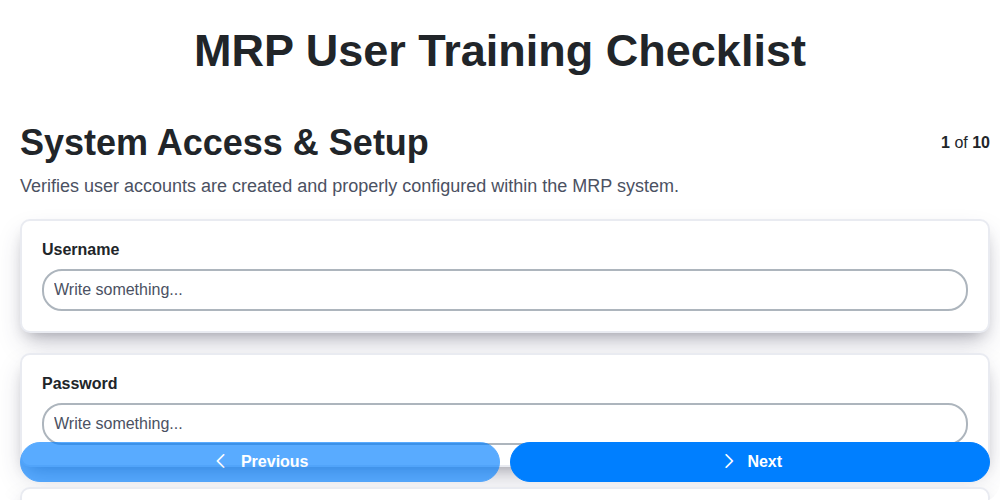
MRP User Training Checklist: Ensuring Proficiency & Success
We can do it Together
Need help with
Material Requirements Planning (MRP)?
Have a question? We're here to help. Please submit your inquiry, and we'll respond promptly.