MRP Data Validation Checklist: Ensuring Accuracy in Your Manufacturing System
Published: 12/14/2025 10:00 PM Updated: 12/15/2025 1:42 PM
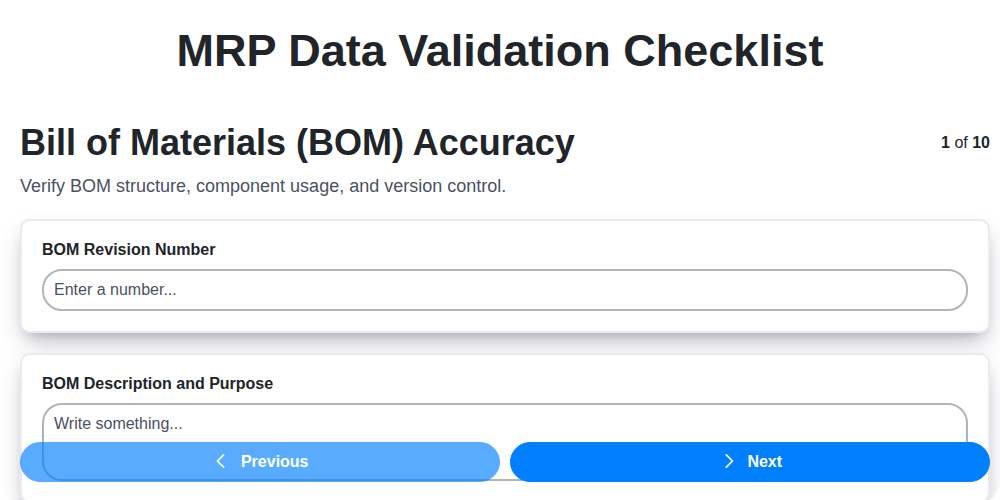
Table of Contents
- Introduction: Why MRP Data Validation Matters
- 1. Bill of Materials (BOM) Accuracy: The Foundation of Your MRP
- 2. Item Master Data Integrity: Defining Your Products Correctly
- 3. Inventory Records Validation: Knowing What You Have
- 4. Lead Time and Routing Verification: Optimizing Production Flow
- 5. Planning Parameters Review: Fine-Tuning Your Forecasts
- 6. Supplier Data Synchronization: Collaboration for Reliability
- 7. Unit of Measure (UOM) Consistency: Avoiding Calculation Errors
- 8. Costing and Pricing Accuracy: Maintaining Profitability
- 9. Master Data Governance Controls: Establishing Ownership and Responsibility
- 10. System Integration Checks: Ensuring Data Flows Seamlessly
- 11. Addressing Common Validation Errors
- 12. Tools and Technologies for MRP Data Validation
- Conclusion: Continuous Improvement in MRP Data Accuracy
- Resources & Links
TLDR: Manufacturing chaos? This checklist helps! It walks you through validating crucial MRP data - from BOMs and inventory to supplier info and costing - ensuring your system's accuracy, minimizing errors, and boosting production efficiency. Download the template and keep your manufacturing data on track!
Introduction: Why MRP Data Validation Matters
MRP systems are only as good as the data they're fed. Think of it like baking a cake - you can have the best recipe (the MRP system) in the world, but if your ingredients (the data) are inaccurate, incomplete, or outdated, the result will be a disaster. Inaccurate MRP data leads to stockouts, excess inventory, missed deadlines, production inefficiencies, and ultimately, lost revenue.
Data validation isn't just a 'nice-to-have'; it's a critical component of successful Materials Requirements Planning. It's the proactive process of ensuring the data powering your MRP system is correct, complete, and consistently updated. This isn't a one-time task; it's an ongoing process that requires discipline and a well-defined methodology. Ignoring data validation means essentially flying blind, making decisions based on faulty information and potentially jeopardizing your entire production process. This article will explore a comprehensive checklist to help you validate your MRP data and ensure your planning is truly effective.
1. Bill of Materials (BOM) Accuracy: The Foundation of Your MRP
The Bill of Materials (BOM) is the DNA of your manufacturing process. It's a comprehensive list of all the raw materials, components, assemblies, subassemblies, and quantities needed to manufacture a finished product. An inaccurate BOM is like building a house with the wrong blueprints - the end result will be a costly and frustrating mess.
Why BOM Accuracy Matters in MRP:
Your Material Requirements Planning (MRP) system relies entirely on the BOM to determine what materials need to be ordered and when. If the BOM is incorrect - whether it's missing components, has incorrect quantities, or lists obsolete materials - your MRP system will generate inaccurate purchase orders, leading to:
- Stockouts: Missing components halt production.
- Excess Inventory: Ordering too much of the wrong parts ties up capital.
- Increased Costs: Reworking orders, expediting shipments, and dealing with obsolete inventory all hit your bottom line.
- Production Delays: Errors in the BOM directly translate to production delays and missed deadlines.
Key Checks for BOM Accuracy:
- Component Validation: Verify that all components listed in the BOM are actually required for the finished product.
- Quantity Verification: Double-check the quantity of each component needed. Even a small error can snowball into significant discrepancies.
- Phantom Components: Ensure phantom components (assemblies that disappear after use) are correctly identified and managed.
- Engineering Change Orders (ECOs): Confirm that any changes made through ECOs have been accurately reflected in the BOM.
- Version Control: Maintain strict version control for BOMs to avoid using outdated information.
- Regular Audits: Schedule regular audits of your BOMs to identify and correct errors proactively.
A clean and accurate BOM is the bedrock of a successful MRP implementation. Investing the time to validate and maintain it will pay dividends in the form of improved efficiency, reduced costs, and increased customer satisfaction.
2. Item Master Data Integrity: Defining Your Products Correctly
The Item Master is the foundation of your MRP system. It's where you define what you're manufacturing or selling. Errors here cascade throughout the entire planning process, leading to inaccurate forecasts, incorrect orders, and ultimately, dissatisfied customers. This section dives into ensuring that your Item Master data is accurate and complete.
What to Check:
- Descriptions and Classifications: Are descriptions clear, concise, and consistent? Do items have accurate classifications for reporting and analysis? Ambiguity here leads to confusion and incorrect assignments.
- Part Numbers/SKUs: Are part numbers unique and consistently applied? Avoid duplicates and ensure they align with your overall numbering scheme.
- Product Specifications: Verify dimensions, weights, materials, and other specifications are accurate. Discrepancies can result in quality issues and incorrect manufacturing processes.
- Lifecycle Status: Is the item's lifecycle status (Active, Obsolete, Discontinued) correctly maintained? This prevents planning for items that are no longer relevant.
- Engineering Change Orders (ECOs): Are current revisions of items reflecting the latest ECOs? Outdated information can lead to the production of incorrect or obsolete products.
- Images/Documentation: Do items have associated images and documentation for reference and training? Visual cues help prevent errors during picking, packing, and manufacturing.
- Substitute/Alternative Items: If applicable, are substitute or alternative items clearly defined and linked?
Regular audits of your Item Master are vital. Implement a process for new item creation and modification to ensure data accuracy is maintained. Empower designated personnel to review and approve changes. A clean Item Master is the cornerstone of a reliable MRP system.
3. Inventory Records Validation: Knowing What You Have
Accurate inventory records are the bedrock of efficient MRP (Material Requirements Planning) and overall production success. Discrepancies between your system's records and your physical inventory can lead to stockouts, excess inventory, production delays, and ultimately, lost revenue. This validation step focuses on ensuring your inventory data reflects reality.
Here's what to check:
- Cycle Counts Verification: Regularly scheduled cycle counts are your first line of defense. Compare the physical count of a sample of items against the system's recorded quantity. Investigate and correct any differences promptly. Don't just update the numbers - understand why the discrepancy occurred (e.g., miscounts, theft, damaged goods).
- Receiving Accuracy: Are materials being received correctly? Verify that incoming shipments match purchase orders in terms of quantity, description, and quality. Implement a robust receiving process that includes inspection and accurate data entry.
- Shipping Accuracy: Just as crucial as receiving, shipping accuracy needs scrutiny. Ensure that outbound shipments are verified against sales orders and that inventory is decremented correctly.
- Location Accuracy: Confirm that items are stored in the correct locations within your warehouse or storage areas. Misplaced items can become effectively "lost" and disrupt production.
- Negative Inventory Checks: Negative inventory balances are a major red flag. Investigate the root cause immediately - is it a system error, a receiving/shipping mistake, or a process failure?
- Obsolete/Excess Inventory Identification: Regularly review inventory levels to identify slow-moving or obsolete items. Implement a plan for disposal or repurposing to free up space and reduce carrying costs.
Consistent validation and ongoing improvements to your inventory management processes are essential for maintaining data integrity and maximizing the effectiveness of your MRP system.
4. Lead Time and Routing Verification: Optimizing Production Flow
Accurate lead times and efficient routings are the backbone of any smooth manufacturing operation. Lead times, representing the total time from order placement to product availability, and routings, detailing the sequence of operations required to manufacture a product, significantly impact production schedules, customer delivery dates, and overall operational efficiency. An MRP system is only as good as the data it relies on, so ensuring these are correct is crucial.
Here's what you need to check:
- Lead Time Validation: Review lead times for all materials and finished goods. Are they realistic and based on current supplier performance, internal processing times, and transportation logistics? Outdated or overly optimistic lead times will lead to stockouts and missed deadlines. Investigate any significant discrepancies between planned and actual lead times.
- Routing Accuracy: Verify the routing steps defined for each product. Confirm that all operations are correctly sequenced and that the work centers assigned are appropriate. Incorrect routings can lead to unnecessary delays, increased costs, and potential quality issues.
- Work Center Capacity: Ensure that the capacity of work centers identified in the routing is accurate and reflects current capabilities. Overloaded work centers are a common bottleneck.
- Setup Times: Validate setup times for each operation. These often get overlooked but can significantly impact overall lead time.
- Routing Alternatives: If alternative routings exist (e.g., for different machine capabilities or prioritized orders), ensure these are properly defined and selected based on defined criteria.
Regularly review and update these parameters, especially when changes occur in your manufacturing processes or supplier relationships.
5. Planning Parameters Review: Fine-Tuning Your Forecasts
Planning parameters are the bedrock of your MRP system's ability to generate accurate production schedules and inventory plans. These settings dictate how your system calculates demand, determines safety stock levels, and ultimately drives your production decisions. A neglected planning parameter review can quickly lead to stockouts, excess inventory, and ultimately, a significant drain on resources.
This isn't just about checking numbers; it's about understanding the logic behind them. Key parameters to scrutinize include:
- Forecast Methods: Are you using moving averages, exponential smoothing, or another method? Is it the right method for each item, considering its demand patterns (stable, seasonal, erratic)?
- Safety Stock Levels: Are your safety stock calculations based on accurate demand variability and lead time fluctuations? Overly conservative safety stock ties up capital; inadequate levels risk shortages.
- Lot-for-Lot vs. Period Planning: Evaluate if your planning horizon and lot sizes are appropriate for each item. Lot-for-lot planning can be ideal for some items, while period planning may be more suitable for others.
- Production Capacity: Ensure your system accurately reflects your available production capacity, including machine hours, labor availability, and potential bottlenecks.
- Minimum and Maximum Stock Levels: Review these limits regularly. Changing market conditions or product lifecycle phases often require adjustments.
Regularly revisiting and validating these parameters - at least quarterly, or more frequently for volatile markets - will significantly improve your MRP system's forecasting accuracy and ensure you're efficiently meeting customer demand. Don't treat them as set and forget values!
6. Supplier Data Synchronization: Collaboration for Reliability
Inaccurate or outdated supplier data can ripple through your entire MRP system, leading to late deliveries, incorrect purchase orders, and frustrated stakeholders. Supplier Data Synchronization isn't just about having supplier contact information correct; it's about ensuring a shared understanding of everything from lead times and minimum order quantities to pricing and quality specifications.
Ideally, your MRP system should seamlessly integrate with your key suppliers' systems. This allows for real-time visibility into their inventory levels, potential disruptions, and even their production schedules. However, even without full integration, establishing clear protocols and regularly updating supplier data within your MRP system is crucial.
What to Validate:
- Contact Information: Name, email, phone numbers - verify regularly, especially after personnel changes.
- Lead Times: Confirm current lead times reflect reality, accounting for potential delays or changes in supplier processes.
- Pricing & Payment Terms: Ensure accurate pricing and agreed-upon payment terms are reflected in the MRP system.
- Minimum Order Quantities (MOQs): Validate MOQs to avoid excessive inventory or order inefficiencies.
- Quality Specifications: Confirm that quality standards and specifications are consistently aligned.
- Shipping Information: Validate shipping addresses, carriers, and preferred delivery methods.
Best Practices:
- Establish a communication protocol: Define how supplier data updates are communicated and approved.
- Regular Review Cycles: Schedule routine reviews of supplier data (e.g., quarterly or annually).
- Supplier Portal (if available): Utilize a supplier portal for data sharing and collaboration.
- Feedback Loop: Encourage feedback from suppliers regarding data accuracy and potential discrepancies.
Effective Supplier Data Synchronization fosters a more resilient and responsive supply chain, directly contributing to the overall accuracy and effectiveness of your MRP system.
7. Unit of Measure (UOM) Consistency: Avoiding Calculation Errors
Unit of Measure (UOM) discrepancies are surprisingly common, yet can wreak havoc on your MRP system. A seemingly minor difference - perhaps using each for one component and pounds for another - can snowball into inaccurate material requirements, incorrect production orders, and ultimately, dissatisfied customers.
The issue isn't just about confusing your team; it's about the system miscalculating what you need. Imagine planning for 100 "each" of a fastener when the actual requirement is based on weight (pounds). You're either over-ordering, potentially tying up cash and storage space, or under-ordering and risking production stoppages.
What to Check:
- BOM UOMs: Ensure the UOM specified for each component in your Bill of Materials is consistent with how it's actually purchased, used, and tracked.
- Item Master: Verify that the default UOM for each item in your Item Master aligns with its actual usage.
- Receiving & Issue Transactions: Confirm that receiving and issuing processes consistently use the correct UOM.
- Reporting & Analysis: Double-check any reports or analyses that involve quantity calculations. Incorrect UOMs will skew these results.
- Conversion Factors: If conversions are required (e.g., feet to inches), ensure these factors are accurate and correctly maintained within the system.
Proactive Measures:
- Standardize: Establish clear UOM standards and document them.
- Training: Train personnel on correct UOM usage.
- Regular Audits: Conduct periodic audits of UOM data to identify and correct discrepancies.
Consistent UOMs are foundational to a reliable MRP system. Investing the time to validate and maintain this data will save you headaches, reduce errors, and improve overall operational efficiency.
8. Costing and Pricing Accuracy: Maintaining Profitability
Accurate costing and pricing are the lifeblood of any manufacturing business. Incorrect data here can lead to significant losses, eroded profit margins, and ultimately, a negative impact on your business's financial health. This section focuses on validating your costing and pricing data within your MRP system.
What to Check:
- Standard Costs vs. Actual Costs: Regularly compare your standard costs (those used in planning and production) against actual costs incurred. This includes raw materials, labor, and overhead. Discrepancies need investigation - are standards outdated? Have material costs increased?
- Labor Rates: Ensure your labor rates accurately reflect current wages and benefits. Factor in any overtime or incentive programs.
- Overhead Allocation: Verify that overhead costs (rent, utilities, depreciation) are being allocated correctly to products. Incorrect allocation can skew product costs and impact pricing decisions.
- Freight and Shipping Costs: Include accurate freight and shipping costs in your product costs, both for incoming materials and outgoing finished goods.
- Pricing Consistency: Cross-reference your MRP system pricing with your sales orders, quotes, and customer contracts. Any differences need to be resolved immediately.
- Currency Fluctuations: If you source materials internationally, factor in current exchange rates to avoid unexpected cost increases.
- Discount and Promotion Application: Validate how discounts and promotions are applied within the MRP system to ensure correct pricing is displayed to customers and properly reflected in cost calculations.
Why it Matters:
Consistent validation of these cost elements leads to more accurate job costing, better quoting capabilities, more informed pricing decisions, and ultimately, maximized profitability. Neglecting this area is a significant risk to your business.
9. Master Data Governance Controls: Establishing Ownership and Responsibility
Master data, encompassing all the elements listed in this validation checklist (BOMs, item data, inventory, etc.), isn't just information; it's the bedrock of your MRP system's accuracy and efficiency. Without clearly defined governance controls, data can easily drift, leading to inaccurate planning, costly errors, and lost productivity.
This section of your MRP data validation checklist focuses on establishing clear ownership and responsibility for maintaining this critical data. It's not enough to simply have rules; you need to ensure those rules are enforced.
Here's what this control should cover:
- Data Owners: Assign specific individuals or teams as data owners for each major data domain (e.g., BOM Owner, Item Master Data Owner, Inventory Data Owner). These individuals are accountable for the accuracy, completeness, and timely updates of their assigned data.
- Data Stewards: Implement data stewards who are subject matter experts responsible for ensuring data quality within their area. They act as a bridge between the data owners and the users, providing guidance and support.
- Change Management Process: Establish a documented change management process that outlines how data is created, modified, and deleted. This process should include approval workflows and audit trails.
- Data Quality Metrics: Define and track key data quality metrics (e.g., BOM accuracy rate, item master record completeness) to monitor performance and identify areas for improvement.
- Training and Awareness: Provide comprehensive training to all personnel involved in creating or modifying master data to ensure they understand the importance of data quality and their roles in maintaining it.
- Regular Audits: Conduct periodic audits to verify adherence to data governance policies and identify any gaps or weaknesses in the controls.
By implementing robust master data governance controls, you're not just validating data - you're building a sustainable system for continuous improvement and data integrity.
10. System Integration Checks: Ensuring Data Flows Seamlessly
Your MRP system isn't an island. It likely interacts with other critical systems - CRM, accounting software, e-commerce platforms, and potentially even supplier portals. These integrations are the lifeblood of a truly connected manufacturing operation, but they're also a frequent source of data integrity issues.
A thorough system integration check is essential to validate that data flows correctly between these interconnected systems. This isn't just about verifying that data transfers; it's about ensuring its accuracy and consistency at each stage.
Here's what this validation should include:
- Data Mapping Verification: Confirm that fields are correctly mapped between systems. A misaligned mapping can lead to incorrect data being entered and processed.
- Transaction Testing: Simulate common transactions (e.g., sales orders, purchase requisitions, inventory adjustments) and trace the data flow across systems. Verify that the data is updated accurately in each system.
- Real-time vs. Batch Updates: Understand the timing of data updates. Are updates real-time or batched? Validate that the timing doesn't introduce discrepancies.
- Error Handling & Logging: Review error handling procedures. Are errors properly flagged and logged? Can you easily identify and correct integration errors?
- API and Interface Stability: Assess the stability and reliability of the APIs or interfaces used for data exchange. Are there known issues or limitations that could impact data accuracy?
- Security Verification: Ensure data security protocols are consistently applied across all integrated systems to prevent unauthorized access and data breaches.
Failing to rigorously check these integrations can lead to duplicated effort, inaccurate planning, increased costs, and ultimately, dissatisfied customers.
11. Addressing Common Validation Errors
Even with a robust MRP data validation checklist, errors creep in. Let's look at some frequently encountered issues and how to tackle them:
BOM Discrepancies: Incorrect component quantities or missing components are a common culprit. Regularly review BOMs against engineering drawings and production orders. Implement change management processes to control updates.
Item Master Data Mistakes: Typos, incorrect descriptions, or wrong classifications can wreak havoc. Encourage thorough input and review of new items. Consider a "staging" environment for new item creation to catch errors before they impact production.
Inventory Count Mismatches: Periodic physical inventory counts, reconciled with system records, are essential. Investigate and resolve discrepancies promptly. Don't ignore small differences - they can snowball.
Lead Time and Routing Problems: Overly optimistic or outdated lead times result in missed deadlines. Continuously monitor and adjust lead times based on actual performance. Route validations should be conducted when processes change.
Planning Parameter Errors: Incorrect safety stock levels, lot sizes, or planning horizons lead to stockouts or excess inventory. Regularly review and adjust these parameters based on demand variability and lead time fluctuations.
Supplier Data Synchronization Failures: Discrepancies between your system and supplier data, particularly pricing and availability, cause planning issues and procurement problems. Implement data synchronization processes, preferably automated.
UOM Inconsistencies: Mixing up units (e.g., pounds vs. kilograms) can lead to calculation errors in production and procurement. Standardize UOMs across your organization and enforce their use.
Costing & Pricing Inaccuracies: Incorrect costing models affect profitability calculations and pricing decisions. Regularly review costing elements and ensure alignment with current market conditions.
System Integration Glitches: Errors arising from data transfers between systems (ERP, CRM, WMS) require dedicated monitoring and reconciliation processes. Regularly check integration logs and resolve errors swiftly.
By proactively addressing these common errors, you can significantly improve the accuracy and reliability of your MRP data, leading to better planning and overall business performance.
12. Tools and Technologies for MRP Data Validation
Validating MRP data isn't just about manual checks - leveraging the right tools can significantly improve accuracy, efficiency, and scalability. Here's a breakdown of tools and technologies that can streamline your MRP data validation process:
- Data Quality Management (DQM) Software: These platforms specialize in identifying, cleansing, and standardizing data across multiple sources. They often include automated validation rules and reporting capabilities. Examples include Informatica Data Quality, Talend Data Quality, and IBM InfoSphere Information Analyzer.
- Master Data Management (MDM) Systems: MDM solutions are crucial for creating a single, trusted view of your core data - including item masters, BOMs, and supplier information. They enforce data governance policies and ensure consistency across your enterprise. Solutions like SAP Master Data Governance, Profisee, and Stibo STEP are popular choices.
- ERP System Features: Most modern ERP systems (SAP, Oracle, Microsoft Dynamics 365, etc.) have built-in data validation capabilities. Explore and utilize these features for basic data consistency checks and automated validation rules. Customizable alerts and workflows within your ERP can be incredibly valuable.
- Data Profiling Tools: Before investing in remediation, understand your data's current state. Data profiling tools analyze data content, structure, and relationships to uncover anomalies and inconsistencies. Many DQM platforms include profiling capabilities.
- Spreadsheet Software (Excel, Google Sheets): While not a dedicated solution, spreadsheets can be helpful for smaller datasets or targeted validation tasks. However, be mindful of the limitations - spreadsheets are prone to errors and lack robust audit trails.
- Business Intelligence (BI) Tools (Power BI, Tableau): BI tools enable you to visualize MRP data, identify trends, and spot discrepancies that might indicate data errors.
- Robotic Process Automation (RPA): RPA bots can automate repetitive data validation tasks, freeing up human resources for more complex analysis and exception handling.
- Custom Scripting (Python, SQL): For specific, complex validation requirements, custom scripts can be developed to perform detailed data checks and transformations.
Conclusion: Continuous Improvement in MRP Data Accuracy
Ultimately, achieving and maintaining accurate MRP data isn't a one-time project; it's an ongoing commitment. The checklist outlined above provides a solid foundation, but regular review and refinement are essential. Establish a schedule for periodic data validation, incorporating feedback from various departments - production, purchasing, sales, and finance - to identify and rectify emerging issues. Embrace a culture of data ownership, where individuals are accountable for the accuracy of their respective data domains. By viewing MRP data accuracy as a continuous improvement process, manufacturers can unlock significant benefits: reduced inventory costs, minimized production delays, improved customer service, and a more responsive and efficient operation overall. Invest in training, automation, and robust data governance to solidify your commitment to excellence and realize the full potential of your MRP system.
Resources & Links
- APICS (The Association for Supply Chain Management): A leading professional organization offering resources, certifications (like CPIM & CSCP), and education focused on supply chain management, including MRP and data accuracy. Their website provides articles, white papers, and training materials related to MRP best practices.
- MRP Easy: Provides MRP software and offers numerous blog posts and resources explaining MRP concepts, data validation, and optimization. Good for understanding the practical application of validation in a manufacturing environment.
- NetSuite: Offers ERP and MRP solutions. Their website and resource center contain articles and guides on manufacturing data management, including data validation and accuracy best practices. Relevant for understanding modern ERP approaches.
- Oracle: A major ERP provider with extensive resources on manufacturing operations management, including data governance, master data management, and data quality. Their documentation and articles are comprehensive (though often technical).
- Deloitte: A consulting firm with expertise in supply chain and operations. Their website features insights and reports on data governance, data quality, and the impact of inaccurate data on business performance. Provides a strategic perspective.
- Gartner: A research and advisory company offering reports and analysis on ERP, supply chain management, and data management technologies. Useful for understanding industry trends and best practices in data validation. (Subscription often required for full access)
- LinkedIn: A professional networking platform. Search for groups and individuals specializing in MRP, data validation, and manufacturing operations to find relevant discussions and shared knowledge.
- QAD: Provides ERP solutions for manufacturing, their site offers resources regarding data integrity, validation processes, and ERP best practices, specifically catered to manufacturing.
- Infor: Another ERP provider with blog posts and white papers related to manufacturing and supply chain data management and accuracy. Useful for exploring different implementation approaches.
Frequently Asked Questions
What is MRP data validation and why is it important?
MRP (Material Requirements Planning) data validation is the process of ensuring the accuracy and integrity of data used by your MRP system. It's critical because inaccurate data leads to incorrect planning, leading to stockouts, excess inventory, production delays, and ultimately, increased costs. Accurate data ensures efficient production and resource allocation.
Who should be involved in the MRP data validation process?
Ideally, a cross-functional team should be involved. This typically includes representatives from procurement, production planning, engineering, and quality control. Collaboration ensures a holistic view and identification of errors that might be missed by a single department.
What are the key data points that should be included in an MRP data validation checklist?
The checklist should cover: Bill of Materials (BOM) accuracy (levels, part numbers, quantities), Lead Times (accurate supplier lead times, internal routing times), Inventory Records (on-hand quantities, lot sizes), Routing Data (accurate operations and work centers), Item Master Data (accurate descriptions, unit of measure, costing), and Supplier Data (correct contacts, pricing, lead times).
How often should MRP data validation be performed?
The frequency depends on the complexity of your operations and the rate of change in your data. A good starting point is monthly, but critical data points, such as BOMs for new products or significant changes, should be validated more frequently. Consider automating parts of the process where possible.
What are some common errors found during MRP data validation?
Common errors include incorrect part numbers in the BOM, inaccurate lead times, wrong unit of measure, outdated inventory records, routing errors, and incorrect costing information. These errors can have a cascading effect on the entire planning process.
What tools or technologies can assist with MRP data validation?
Spreadsheets are a basic starting point, but more advanced solutions include data validation software, ERP system features (many have built-in validation tools), and data integration platforms. Automation is key for efficiency and reducing errors.
How can I create an effective MRP data validation checklist?
Start by identifying critical data points. Involve all relevant departments to ensure a comprehensive view. Document validation steps and expected results. Regularly review and update the checklist to reflect changes in your operations and products.
What's the difference between data verification and data validation?
Verification confirms that the data exists and is consistent with the input format (e.g., is the part number the correct length?). Validation confirms that the data is accurate and meaningful (e.g., does the part number actually correspond to a real part?). Validation is a broader process that includes verification.
How do I handle discrepancies found during MRP data validation?
Establish a clear process for documenting, investigating, and correcting discrepancies. Assign responsibility for resolving issues and track progress to ensure timely resolution. Root cause analysis is important to prevent recurrence.
Found this Article helpful?
Comments
There are no comments yet. Be the first to add one!
Related Articles
MRP System Performance Monitoring Checklist: Ensure Peak Efficiency
MRP System Implementation Checklist: Your Step-by-Step Guide

Top 10 MRPeasy Alternatives for 2025

The 5 Best Bill of Materials (BOM) Management Software of 2025
MRP Planning Parameter Setup Checklist: Your Guide to Accuracy & Efficiency

The 10 Best Manufacturing Management Software of 2025
How to improve your Bill of Materials (BOM) Management
MRP User Training Checklist: Ensuring Proficiency & Success
We can do it Together
Need help with
Material Requirements Planning (MRP)?
Have a question? We're here to help. Please submit your inquiry, and we'll respond promptly.