MRP Demand Planning Checklist: Your Guide to Accurate Forecasting
Published: 12/14/2025 10:00 PM Updated: 12/15/2025 1:44 PM
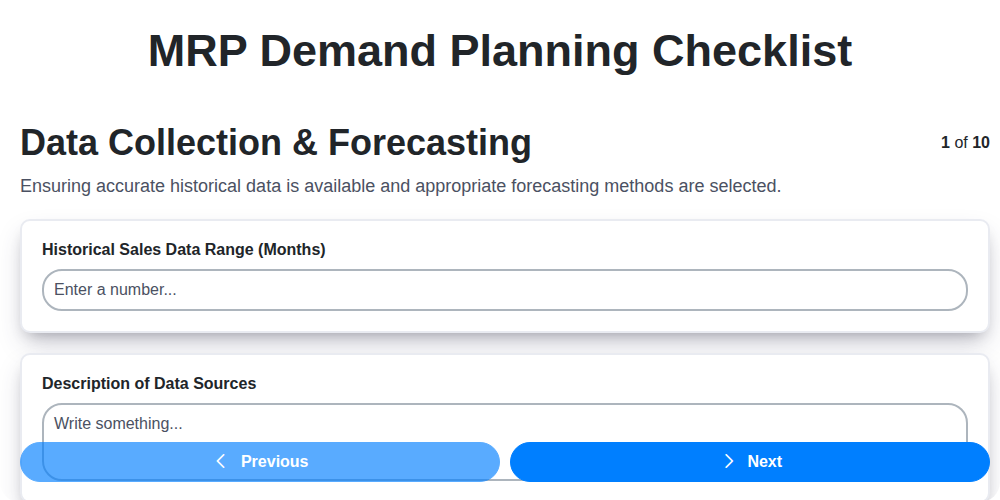
Table of Contents
- Introduction: Why Accurate Demand Planning Matters
- 1. Data Collection & Forecasting: The Foundation of Accuracy
- 2. Demand Signal Identification: Beyond Historical Sales
- 3. Sales & Operations Planning (S&OP) Alignment: A Unified Approach
- 4. Forecast Accuracy Metrics: Measuring Your Performance
- 5. Demand Review Meetings: Keeping Everyone Informed
- 6. Collaboration & Communication: Breaking Down Silos
- 7. Exception Handling: Addressing Unexpected Deviations
- 8. Forecast Consolidation: Bringing it All Together
- 9. System Integration: Automating the Process
- 10. Documentation & Review: Capturing Knowledge & Improving Continuously
- 11. Common Pitfalls to Avoid in MRP Demand Planning
- 12. Future-Proofing Your Demand Planning: Emerging Trends
- Conclusion: Mastering MRP Demand Planning for Success
- Resources & Links
TLDR: Overwhelmed by MRP demand planning? This checklist breaks down the process into 10 key steps - from data collection and S&OP alignment to exception handling and system integration - ensuring you have a clear, repeatable process for accurate forecasting and minimized stockouts or excess inventory. Download the template and boost your planning!
Introduction: Why Accurate Demand Planning Matters
In today's dynamic business environment, accurately predicting future demand is no longer a nice-to-have - it's a critical component of operational success. Poor demand planning leads to a cascade of negative consequences: excess inventory tying up valuable capital, stockouts leading to lost sales and dissatisfied customers, and ultimately, compromised profitability. Conversely, robust demand planning - driven by a well-executed Material Requirements Planning (MRP) process - enables companies to optimize inventory levels, streamline production schedules, and improve overall responsiveness to market fluctuations. This blog post provides a comprehensive checklist to help you refine your MRP demand planning and unlock the significant advantages of a data-driven approach. Let's delve into how a structured checklist can transform your demand planning from guesswork to precision.
1. Data Collection & Forecasting: The Foundation of Accuracy
Accurate demand planning hinges on a strong foundation: reliable data and robust forecasting techniques. This isn't just about pulling numbers from a spreadsheet; it's a comprehensive process that impacts every downstream activity.
What's Involved?
- Gathering Historical Data: Don't just look at sales figures. Collect data on promotions, pricing changes, competitor actions, economic indicators, and any other factors that influenced past demand. The more granular your data, the better.
- Data Cleansing & Validation: Garbage in, garbage out! Ensure your data is accurate, consistent, and free of errors. Identify and correct outliers and inconsistencies.
- Selecting Forecasting Methods: Different products and markets require different forecasting approaches. Consider a blend of statistical methods (moving averages, exponential smoothing, regression analysis) alongside qualitative insights. Don't be afraid to experiment with different techniques and compare results.
- Segmenting Demand: Group your products or services into segments based on demand patterns and influencing factors. This allows for more targeted and accurate forecasting. (e.g., seasonal vs. non-seasonal, high-volume vs. low-volume).
- Establishing Baseline Forecasts: Create initial forecasts based primarily on historical data, adjusted for known trends and seasonality.
- Regularly Reviewing and Updating: Forecasting isn't a one-time event. Continuously monitor performance, analyze variances, and adjust your forecasting models accordingly.
A well-executed data collection and forecasting process is the bedrock of successful MRP demand planning. Invest the time and resources here, and you'll reap the rewards throughout the entire planning cycle.
2. Demand Signal Identification: Beyond Historical Sales
Relying solely on historical sales data for demand planning is a recipe for reactive, often inaccurate, forecasts. While past performance offers valuable insights, it doesn't account for the myriad factors influencing future demand. True demand signal identification goes deeper, seeking out the leading indicators that predict what customers will want before they actually buy it.
What are these signals? They vary widely by industry and product, but common examples include:
- Marketing Campaigns: Track planned promotions, advertising spend, and anticipated impact on demand.
- New Product Launches: Estimate demand uplift based on pre-launch activity, market research, and competitor analysis.
- Pricing Changes: Understand how price adjustments will influence purchase volume.
- Customer Orders & Backlogs: Current orders represent confirmed demand and are strong indicators of near-term needs.
- Point-of-Sale (POS) Data: Monitor current sales trends in real-time, often broken down by region or product variation.
- Economic Indicators: Consider factors like GDP growth, consumer confidence, and unemployment rates that can influence broader market demand.
- Social Media & Online Buzz: Gauge customer sentiment and potential interest in your products or services.
- Competitor Activity: Analyze competitor promotions, product releases, and pricing strategies.
- Channel Partner Feedback: Engage with distributors and retailers to gather insights into customer demand and market trends.
Identifying and incorporating these leading indicators requires a shift in mindset - moving from simply reacting to data to proactively anticipating customer needs. A robust demand signal identification process significantly improves forecast accuracy and allows for more agile and responsive supply chain management.
3. Sales & Operations Planning (S&OP) Alignment: A Unified Approach
Demand planning doesn't exist in a vacuum. It's a critical function that feeds directly into the broader Sales & Operations Planning (S&OP) process. True MRP success hinges on robust S&OP alignment - ensuring demand plans are not just accurate, but also strategically aligned with sales, marketing, finance, and operations.
This alignment means more than just sharing forecasts. It's about a unified approach to understanding the business. Here's how to ensure your demand planning contributes effectively to S&OP:
- Cross-Functional Participation: Demand planners should be active participants in S&OP meetings, presenting their forecasts and insights, and receiving feedback from other departments.
- Strategic Input: Share assumptions and potential risks influencing demand forecasts. This proactive communication allows S&OP to proactively address challenges and adjust strategies.
- Scenario Planning: Develop and present multiple demand scenarios (best case, worst case, most likely) that consider different market conditions and promotional activities.
- Understanding Business Priorities: Demand plans must reflect overall business objectives - new product launches, market share targets, or cost reduction goals.
- Executive Buy-in: Secure support and alignment from executive leadership on demand plans and their implications for the entire organization.
Without this crucial S&OP alignment, demand plans can become isolated and potentially misaligned with overall business strategy, leading to inefficiencies and lost opportunities.
4. Forecast Accuracy Metrics: Measuring Your Performance
You're putting significant effort into your demand planning process, but how do you know it's working? That's where forecast accuracy metrics come in. Without them, you're flying blind, potentially overstocking some items and understocking others. Tracking and analyzing these metrics allows you to identify areas for improvement and continuously refine your forecasting strategies.
Here are some key metrics to monitor:
- Mean Absolute Deviation (MAD): This calculates the average absolute difference between the forecasted value and the actual demand. A lower MAD indicates better accuracy.
- Mean Squared Error (MSE): Like MAD, MSE measures the average difference, but squares the errors before averaging. This gives more weight to larger errors, which can be valuable if significant over/under forecasting is particularly damaging.
- Mean Absolute Percentage Error (MAPE): Perhaps the most commonly used, MAPE expresses error as a percentage of actual demand. This allows for easier comparison across different products with varying sales volumes. However, be cautious of MAPE's sensitivity to low demand values - a small error on a slow-moving item can inflate the percentage.
- Bias: A bias indicates whether your forecasts are consistently over- or under-predicting demand. A positive bias means overestimation, a negative bias means underestimation.
- Forecast Value Added (FVA): A more complex metric that assesses the value added at each stage of the forecasting process, identifying where improvements are most impactful.
Don't just track these metrics; analyze them. Look for trends, identify which products or time periods exhibit the worst accuracy, and investigate the root causes. Is it due to poor data, inaccurate assumptions, or a lack of visibility into promotional activities? Regularly review these metrics during your demand review meetings (discussed later) and use them to drive continuous improvement in your demand planning process.
5. Demand Review Meetings: Keeping Everyone Informed
Demand review meetings are the heartbeat of a healthy MRP demand planning process. They're not just about reporting numbers; they're about fostering understanding, identifying potential issues proactively, and ensuring everyone is on the same page. These meetings should be a regular occurrence - weekly or bi-weekly is common - and involve key stakeholders from Sales, Marketing, Operations, Finance, and potentially even key customers.
The agenda should be structured to cover the following:
- Forecast Performance Review: Briefly review the previous forecast accuracy and compare it to actual demand. Highlight any significant variances and discuss the underlying reasons.
- Upcoming Promotions & Events: Sales and Marketing should present upcoming promotions, marketing campaigns, and seasonal events, clearly outlining their anticipated impact on demand.
- New Product Introductions (NPIs): Dedicated time should be allocated to discuss launch plans, projected sales, and initial inventory strategies for new products.
- Market Intelligence & Customer Insights: Share any relevant market intelligence, customer feedback, or competitive activity that could influence demand.
- Action Item Review: Track and review action items assigned during previous meetings to ensure timely resolution.
The focus should be on collaborative problem-solving. Encourage open communication and questions. These meetings aren't a status update; they're a forum for critical thinking and collaborative decision-making to refine the demand plan.
6. Collaboration & Communication: Breaking Down Silos
Demand planning doesn't happen in a vacuum. It's a collaborative process requiring seamless communication between multiple departments. Siloed teams - Sales, Marketing, Production, Finance, and Logistics - can cripple even the most sophisticated forecasting models.
Here's why collaboration is crucial and how to foster it:
- Shared Understanding: Sales understands customer nuances and upcoming promotions. Marketing knows about planned campaigns. Production understands capacity constraints. Finance knows about budget limitations. Bringing these perspectives together creates a more accurate and realistic forecast.
- Early Warning System: Open communication channels allow for early detection of potential disruptions. A large, unexpected order from Sales, a sudden shift in market trends identified by Marketing, or production capacity limitations can all be flagged and addressed proactively.
- Buy-in & Ownership: When everyone participates in the demand planning process, they're more likely to understand the forecast and commit to its execution. This fosters a sense of ownership and accountability across the organization.
How to Improve Collaboration:
- Cross-Functional Teams: Form teams comprised of representatives from each key department.
- Regular Meetings: Schedule regular meetings specifically dedicated to demand planning discussions.
- Shared Platform: Utilize a shared platform or software that allows all teams to access and contribute to the forecast data.
- Clear Communication Channels: Establish clear channels for escalating issues and sharing updates.
- Active Listening: Encourage active listening and feedback during discussions.
7. Exception Handling: Addressing Unexpected Deviations
No forecast is perfect. Unexpected events - a sudden viral trend, a competitor's promotion, a natural disaster - will happen and throw your demand plan off course. Exception handling is your safety net, a structured process for identifying, analyzing, and responding to these deviations.
It's more than just reacting to bad news; it's about proactively minimizing disruption and keeping your supply chain agile. Here's how to build an effective exception handling process:
- Define Thresholds: Establish clear, quantifiable thresholds for what constitutes an exception. These could be percentage variances from the baseline forecast, significant shifts in order patterns, or alerts from your demand planning system.
- Automated Alerts: Leverage your system to automatically flag exceptions exceeding these thresholds. This ensures you're aware of issues quickly.
- Root Cause Analysis: Don't just look at the symptom (the variance). Dig deeper to understand why the deviation occurred. Was it a data error? A market shift? A promotional impact?
- Cross-Functional Collaboration: Exception handling rarely has a simple solution. Involve sales, marketing, finance, and operations to gather perspectives and identify corrective actions.
- Corrective Actions: Based on the root cause, define actions. This might include adjusting inventory levels, re-evaluating promotional plans, or updating forecasting models. Document these actions and the rationale behind them.
- Communication: Clearly communicate the exception, the root cause, the corrective actions, and the revised plan to all relevant stakeholders. Transparency is crucial.
- Feedback Loop: After the exception is resolved, analyze the effectiveness of the response. What worked well? What could be improved? This information feeds back into your forecasting and planning processes, helping to prevent similar issues in the future.
8. Forecast Consolidation: Bringing it All Together
After individual forecasts are generated across various departments - sales, marketing, finance - and refined through demand signal identification and review meetings, the real challenge begins: bringing them all together. Forecast consolidation isn't simply a mathematical aggregation; it's a crucial stage requiring judgment, reconciliation, and a deep understanding of the underlying assumptions.
This process involves aligning disparate forecasts, often expressed in different units (e.g., units sold vs. revenue projections), and resolving conflicting projections. It's where you identify and address biases creeping in from individual departmental perspectives. For example, the sales team might be overly optimistic about a promotional campaign, while finance might be more conservative based on broader economic trends.
Effective consolidation requires a designated team or individual (often within Demand Planning) with the authority and expertise to make informed decisions. They must be equipped with a clear framework for prioritizing inputs, weighting different perspectives, and ensuring the final consolidated forecast aligns with overall business objectives. This often involves a process of iterative refinement, where initial consolidations are reviewed and adjusted based on feedback and further analysis. Ultimately, the goal is to create a single, unified forecast that's more accurate and reliable than any individual department's projection could be on its own.
9. System Integration: Automating the Process
Manual demand planning, even with a robust checklist, quickly becomes unsustainable. That's where system integration becomes absolutely critical. Integrating your MRP system with other key platforms - CRM, sales order management, POS data sources, and even external data feeds - unlocks significant efficiency and accuracy gains.
Think about it: pulling sales data directly from your CRM eliminates manual data entry and reduces the risk of human error. Integrating POS data provides real-time visibility into actual customer demand, allowing for quicker adjustments to your forecast.
Key Integration Considerations:
- Data Connectivity: Establish secure and reliable data connections between systems. APIs (Application Programming Interfaces) are commonly used for this purpose.
- Data Transformation: Demand planning data often needs cleaning and transformation before it's usable. Automation within your integrated system can handle this.
- Workflow Automation: Integrate your demand plan directly into your production scheduling and inventory management processes. This reduces lead times and optimizes resource allocation.
- Real-Time Updates: Aim for real-time or near-real-time data synchronization to respond quickly to changing market conditions.
- Vendor Collaboration Portals: Consider integrating with supplier systems to share demand forecasts and improve supply chain visibility.
Poorly integrated systems can negate the benefits of a well-crafted demand planning checklist. Invest in robust system integration to truly streamline your MRP process and unlock its full potential.
10. Documentation & Review: Capturing Knowledge & Improving Continuously
Demand planning isn't a "set it and forget it" process. It's a living system that needs constant monitoring and refinement. That's where diligent documentation and regular review become critical.
Why Document?
- Knowledge Preservation: Your team's expertise is invaluable. Documentation ensures that knowledge isn't lost when individuals leave or roles change. Clearly outline your demand planning methodology, assumptions, and rationale behind key decisions.
- Audit Trail: A detailed record of changes, forecasts, and adjustments provides a transparent audit trail, useful for explaining variances and demonstrating compliance.
- Training & Onboarding: Comprehensive documentation significantly eases the onboarding process for new team members, allowing them to quickly understand and contribute to the demand planning process.
- Process Consistency: Ensures everyone is following the same methods, minimizing errors and promoting consistency in forecast generation and adjustments.
What to Document:
- Methodology: Clearly describe your forecasting techniques (statistical, qualitative, hybrid).
- Data Sources: Detail all data sources used (historical sales, market trends, promotions, etc.).
- Assumptions: Explicitly state any assumptions made in the forecasts.
- Exception Handling Procedures: Document the steps taken when exceptions arise and how adjustments are made.
- System Configuration: Detail the setup and configuration of your MRP and forecasting systems.
- Forecast Adjustments & Rationale: Record the reason for any manual adjustments made to the system-generated forecast.
The Review Process:
- Regular Reviews: Schedule periodic reviews (monthly, quarterly) to assess forecast accuracy, identify areas for improvement, and validate assumptions.
- Process Evaluation: Evaluate the effectiveness of your demand planning process itself. Are you using the right tools and techniques? Are roles and responsibilities clearly defined?
- Feedback Loops: Incorporate feedback from sales, marketing, and operations to continuously refine the demand planning process and improve forecast accuracy.
- Version Control: Implement version control for your documentation to track changes and maintain a historical record.
By prioritizing documentation and incorporating a robust review process, you're investing in a demand planning system that's not only accurate today but also adaptable and continuously improving for the future.
11. Common Pitfalls to Avoid in MRP Demand Planning
While implementing a robust MRP demand planning process can be transformative, it's not without its potential pitfalls. Here's a look at some of the most common mistakes to avoid:
1. Ignoring Data Quality: Garbage in, garbage out. Relying on inaccurate or incomplete historical data will inevitably lead to flawed forecasts. Regularly audit your data sources and implement data cleansing procedures.
2. Siloed Forecasting: Failing to integrate different data sources and perspectives leads to fragmented forecasts. The sales team might see a promotion, marketing might have a campaign planned, and engineering might anticipate a new product launch - all of these need to be factored in.
3. Lack of Sales & Operations Planning (S&OP) Discipline: S&OP isn't just a meeting; it's a process. Inconsistent or infrequent S&OP sessions, or a lack of executive buy-in, severely limit its effectiveness in aligning demand and supply.
4. Over-Reliance on Automated Systems: While MRP systems are powerful, they're tools. Blindly accepting system-generated forecasts without critical review and adjustments based on qualitative insights is a recipe for disaster.
5. Neglecting Demand Signal Identification: Focusing solely on historical sales data overlooks crucial leading indicators like website traffic, social media sentiment, and industry trends. These signals can provide early warnings of shifts in demand.
6. Insufficient Collaboration: Demand planning isn't a function for just the demand planning team. Lack of communication and collaboration between sales, marketing, finance, and operations hinders visibility and responsiveness.
7. Inadequate Exception Handling: Failing to proactively identify and address forecast exceptions - significant deviations from the planned forecast - leads to missed opportunities and potential stockouts or excess inventory.
8. Lack of Documentation & Review: Failing to document assumptions, methodologies, and performance metrics makes it difficult to learn from past mistakes and continuously improve the demand planning process.
9. Ignoring the Human Factor: Forecasting requires judgment and experience. Disregarding the insights of experienced team members in favor of purely statistical models can be detrimental.
10. Short-Term Focus: Demand planning shouldn't be solely about meeting immediate needs. A longer-term perspective allows for better anticipation of trends and more strategic inventory decisions.
11. Resistance to Change: Implementing a new demand planning process often requires significant changes in workflows and responsibilities. Resistance from stakeholders can derail the entire effort. Address concerns openly and emphasize the benefits of the new approach.
12. Future-Proofing Your Demand Planning: Emerging Trends
The world of demand planning isn't static. To truly future-proof your MRP demand planning, you need to be aware of and prepare for emerging trends. Machine learning (ML) and Artificial Intelligence (AI) are rapidly transforming the landscape, offering enhanced predictive capabilities beyond traditional statistical forecasting methods. Consider exploring AI-powered demand sensing tools that can analyze real-time data - social media trends, weather patterns, economic indicators - to identify and react to shifts in demand faster than ever before. Blockchain technology is also beginning to play a role, offering enhanced transparency and traceability in supply chains, which can significantly improve demand visibility and reduce uncertainty. Finally, keep an eye on the increasing importance of sustainability and ethical sourcing considerations, which are influencing consumer behavior and requiring more granular demand planning to accommodate evolving preferences. Staying informed and experimenting with these technologies will ensure your demand planning remains agile and resilient in the years to come.
Conclusion: Mastering MRP Demand Planning for Success
Ultimately, successful MRP demand planning isn't about chasing perfection; it's about building a robust, adaptable process. This checklist offers a clear roadmap, but remember that it's a living document. Regularly revisit and refine each step based on your company's specific needs and performance. Consistent application of these practices, coupled with a commitment to continuous improvement, will lead to reduced inventory costs, improved customer service, and a stronger, more responsive supply chain. Embrace the journey - mastering MRP demand planning is an investment that yields significant and lasting rewards.
Resources & Links
- APICS (The Association for Supply Chain Management): APICS is a leading professional association for supply chain professionals. Their website offers certifications, training, and resources on demand planning and forecasting methodologies. A great source for foundational knowledge and best practices.
- Deltek - MRP Demand Planning Guide: Deltek provides project-based software and resources. Their demand planning guide explores the key elements and benefits of effective MRP demand planning, helpful for understanding the process.
- Netstock - Demand Planning Resources: Netstock specializes in inventory and demand planning software. Their site provides a wealth of content, including articles, webinars, and ebooks, tailored towards improving forecast accuracy and reducing inventory costs.
- o9 Solutions - Demand Planning Articles: o9 Solutions offers an AI-powered platform for integrated business planning. Their blog and resource section contain insightful articles and case studies on demand planning best practices, including S&OP and scenario planning.
- SAS - Supply Chain Analytics & Forecasting: SAS provides advanced analytics software, including capabilities for supply chain forecasting. Their website offers resources and insights on statistical forecasting techniques and predictive modeling.
- Oracle - Supply Chain Management: Oracle offers a comprehensive suite of SCM solutions, including demand planning. Their website features documentation, whitepapers, and customer stories related to demand forecasting and MRP.
- SAP - Integrated Business Planning (IBP): SAP's IBP solutions include robust demand planning capabilities. Explore their website for information about their offerings and associated resources on demand forecasting and scenario planning.
- Tableau - Data Visualization for Supply Chain: While not solely focused on demand planning, Tableau's data visualization capabilities are crucial for understanding forecast data and identifying trends. Their website offers tutorials and examples for visualizing supply chain data.
- Microsoft - Power BI: Similar to Tableau, Power BI is a powerful data visualization tool. Good for presenting demand planning data and identifying areas for improvement.
- Infor - Demand Planning Resources: Infor provides industry-specific cloud software. They often have specific examples of how to leverage demand planning for different sectors. Check out their resource center.
Frequently Asked Questions
What is MRP Demand Planning?
MRP (Material Requirements Planning) Demand Planning is the process of forecasting future demand for materials and components needed to manufacture products. It involves analyzing historical data, considering market trends, and incorporating business forecasts to create accurate plans for procurement and production.
Why is accurate demand forecasting important?
Accurate demand forecasting minimizes stockouts (lost sales) and excess inventory (increased costs). It leads to improved production scheduling, reduced lead times, better supplier relationships, and ultimately, increased profitability.
Who should use this MRP Demand Planning Checklist?
This checklist is beneficial for planners, procurement specialists, production managers, supply chain professionals, and anyone involved in the demand planning process within a manufacturing environment.
What kind of data should I collect for demand planning?
Key data includes historical sales data (broken down by product, region, and channel), sales forecasts from the sales team, market trends, promotional plans, seasonality factors, economic indicators, and customer orders.
What is the difference between forecast and plan in MRP?
The forecast is an estimate of future demand. The plan is the action taken based on that forecast - it details how you will meet that demand through procurement, production scheduling, and inventory management.
How do I handle seasonality in demand planning?
Analyze historical data to identify seasonal patterns. Use appropriate forecasting methods (e.g., time series analysis) that account for seasonality. Adjust safety stock levels to buffer against seasonal fluctuations.
What role do sales and marketing play in demand planning?
Sales and marketing provide crucial insights into upcoming promotions, new product launches, and market trends. Their forecasts and plans should be integrated into the demand planning process.
What are some common forecasting methods?
Common methods include moving averages, exponential smoothing, time series analysis, regression analysis, and collaborative planning (CPFR). The best method depends on the data and the complexity of the demand patterns.
How often should I review and update my demand plan?
The frequency of review depends on the volatility of demand. As a general rule, review and update the demand plan at least monthly, and more frequently (weekly or even daily) for products with high demand variability.
What is forecast bias and how do I address it?
Forecast bias occurs when your forecasts consistently over or underestimate actual demand. Analyze forecast accuracy metrics (like MAPE) to identify bias and adjust forecasting methods or input data to reduce it.
What is MAPE and why is it important?
MAPE (Mean Absolute Percentage Error) is a common metric used to assess forecast accuracy. It measures the average percentage difference between forecasted and actual demand. Lower MAPE indicates higher accuracy.
How does inventory management tie into demand planning?
Inventory levels are directly influenced by the demand plan. Accurate demand planning allows for optimized inventory levels - enough to meet demand without excessive stock.
Found this Article helpful?
Comments
There are no comments yet. Be the first to add one!
Related Articles
MRP System Performance Monitoring Checklist: Ensure Peak Efficiency
MRP System Implementation Checklist: Your Step-by-Step Guide

Top 10 MRPeasy Alternatives for 2025

The 5 Best Bill of Materials (BOM) Management Software of 2025
MRP Planning Parameter Setup Checklist: Your Guide to Accuracy & Efficiency

The 10 Best Manufacturing Management Software of 2025
How to improve your Bill of Materials (BOM) Management
MRP User Training Checklist: Ensuring Proficiency & Success
We can do it Together
Need help with
Material Requirements Planning (MRP)?
Have a question? We're here to help. Please submit your inquiry, and we'll respond promptly.