MRP Inventory Control Checklist: Your Guide to Optimized Stock Management
Published: 12/14/2025 10:00 PM Updated: 12/15/2025 1:40 PM
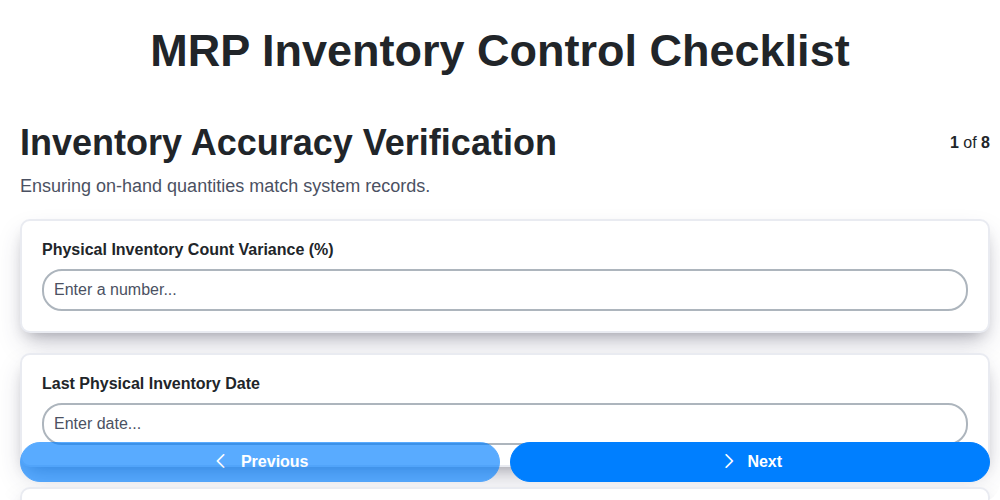
Table of Contents
- Introduction: Why an MRP Inventory Control Checklist Matters
- 1. Inventory Accuracy Verification: The Foundation of Control
- 2. Safety Stock Level Review: Balancing Risk and Cost
- 3. Cycle Count Procedures: Continuous Improvement in Action
- 4. Obsolete Inventory Management: Reducing Write-Offs
- 5. Lot Traceability Validation: Ensuring Quality and Compliance
- 6. Inventory Aging Analysis: Identifying Slow-Moving Items
- 7. Warehouse Layout and Efficiency: Streamlining Operations
- 8. Inventory Record Reconciliation: Matching Physical and System Counts
- 9. Reviewing Bills of Materials (BOMs) and Routings
- 10. Integrating MRP with Sales Forecasting
- 11. Evaluating Lead Time Accuracy
- 12. Analyzing Inventory Turnover Rates
- 13. Employee Training and Responsibilities
- Conclusion: Mastering MRP Inventory Control
- Resources & Links
TLDR: Feeling overwhelmed by inventory? This checklist is your roadmap! It covers everything from verifying stock accuracy and managing safety stock to tracking obsolescence and optimizing your warehouse. Use it to streamline your inventory control, reduce waste, and boost your MRP system's effectiveness - saving you time and money!
Introduction: Why an MRP Inventory Control Checklist Matters
Managing inventory effectively is the lifeblood of any manufacturing operation. But with so many moving parts - raw materials, work-in-progress, finished goods - it's easy for things to slip through the cracks. That's where a robust MRP (Material Requirements Planning) inventory control checklist becomes absolutely crucial.
Simply put, an MRP system helps you plan and manage your production based on demand. However, that system is only as good as the data it receives. An inventory control checklist isn't just a formality; it's a proactive way to ensure your MRP system is operating with accurate, reliable information. It safeguards against costly errors like stockouts, excess inventory, production delays, and ultimately, dissatisfied customers. This checklist acts as a constant check on your processes, promoting consistency and continuous improvement in your inventory management practices. Ignoring it is like flying blind - you might get lucky, but you're significantly increasing your risk.
1. Inventory Accuracy Verification: The Foundation of Control
Accurate inventory data is the bedrock of any successful MRP (Material Requirements Planning) system and effective inventory control. If your records don't reflect reality, your MRP will generate inaccurate purchase orders, production schedules, and ultimately, dissatisfied customers. Regularly verifying inventory accuracy isn't just a good practice; it's a necessity.
Here's what a robust inventory accuracy verification process should include:
- Physical Counts: Regular, scheduled physical counts of a representative sample of your inventory are crucial. Don't just count everything at once - a rotating schedule makes it manageable.
- Blind Counts: Implement "blind counts" where a team counts the inventory without access to the existing records. This eliminates bias and provides a truly independent verification.
- Compare and Reconcile: Meticulously compare the physical count results with your system records. Identify and investigate any discrepancies immediately.
- Root Cause Analysis: Don't just fix the discrepancy; determine why it occurred. Was it a data entry error, a picking mistake, theft, or something else? Correcting the root cause prevents future errors.
- Document Everything: Keep detailed records of your verification process, including dates, discrepancies found, investigations, and corrective actions taken. This creates a history and identifies trends.
Ultimately, consistently high inventory accuracy leads to better planning, reduced carrying costs, and increased customer satisfaction.
2. Safety Stock Level Review: Balancing Risk and Cost
Maintaining the right amount of safety stock is a constant tightrope walk. Too little, and you risk stockouts, production delays, and disappointed customers. Too much, and you's tying up valuable capital, increasing storage costs, and potentially facing obsolescence. A regular review of your safety stock levels is crucial for effective MRP inventory control.
Here's what to consider during your review:
- Demand Variability: How unpredictable is customer demand? Higher variability requires larger safety stocks. Analyze historical sales data, seasonality, and promotional impacts to better understand these fluctuations.
- Lead Time Variability: How reliable are your suppliers? Inconsistent lead times mean you need a buffer to account for potential delays. Track supplier performance and factor this into your safety stock calculations.
- Service Level Goals: What's your desired fill rate? A 99% fill rate requires more safety stock than a 90% fill rate. Define your service level goals based on customer expectations and business priorities.
- Cost of Stockout vs. Cost of Holding Inventory: A classic cost-benefit analysis is essential. Quantify the potential losses from a stockout (lost sales, expedited shipping costs, customer dissatisfaction) and compare it to the cost of holding excess inventory (storage, insurance, potential obsolescence).
- Use of Forecasting Techniques: Refine your demand forecasts to improve accuracy and reduce the need for excessive safety stock. Implement statistical forecasting methods and regularly review forecast performance.
- MRP System's Role: Leverage your MRP system to dynamically adjust safety stock levels based on changes in demand, lead times, and forecast accuracy.
Regularly (at least quarterly) revisit these factors and adjust safety stock levels accordingly. This proactive approach prevents costly stockouts and optimizes your working capital.
3. Cycle Count Procedures: Continuous Improvement in Action
Cycle counting isn't just a task; it's a philosophy. Moving away from annual physical inventories, cycle counting distributes inventory verification throughout the year, leading to ongoing accuracy improvements. Effective procedures are the backbone of this approach. Here's what your cycle count procedures should encompass:
- Define Count Frequency: Don't just count randomly. Classify inventory (A, B, C items - based on value and usage) and prioritize "A" items (high-value, frequently used) for more frequent counts. Less critical "C" items can be counted less often.
- Select Count Teams: Ensure your teams are well-trained and understand the importance of accuracy. Rotate teams periodically to maintain engagement and reduce potential for error patterns.
- Standardized Count Forms & Processes: Create clear, concise forms for recording counts, noting discrepancies, and documenting corrective actions. Standardize the process - from location identification to data entry.
- Root Cause Analysis: When discrepancies arise (and they will), don't just correct the count. Investigate why the discrepancy occurred. Was it a picking error, a data entry mistake, or a receiving issue?
- Document and Track Findings: Maintain a log of cycle count findings and corrective actions taken. This provides valuable data for identifying systemic problems.
- Regular Review & Adjustment: Cycle counting procedures aren't set in stone. Review your frequency and process regularly to ensure they remain effective and align with changing business needs.
4. Obsolete Inventory Management: Reducing Write-Offs
Obsolete inventory is a silent drain on your resources. It ties up capital, consumes warehouse space, and ultimately leads to write-offs - a painful blow to your bottom line. Proactive management is key to minimizing this problem.
Here's what you need to do:
- Regular Identification: Don't wait for the obsolescence to become glaringly obvious. Implement a process to regularly flag slow-moving items. A good rule of thumb is anything that hasn't moved in 6-12 months warrants closer scrutiny.
- ABC Analysis Application: Leverage ABC analysis to prioritize your efforts. 'A' items (high value, high movement) require meticulous tracking. 'B' items need moderate attention, while 'C' items - often the source of obsolescence - need rigorous review.
- Market Trend Awareness: Stay informed about industry trends, competitor actions, and evolving customer demands. Products that were once popular might quickly become obsolete.
- Disposition Strategies: Once identified, don't just ignore it. Develop a plan! Consider options like:
- Promotions and Discounts: Clear out stock with targeted sales.
- Bundling: Combine obsolete items with popular products.
- Donation or Liquidation: Explore charitable donation or liquidation for tax benefits.
- Repurposing/Re-engineering: Can the materials be used for another product or process?
- Demand Forecasting Improvement: Analyze past demand patterns and refine your forecasting models to avoid overstocking in the first place.
- Communication & Collaboration: Share obsolescence concerns with procurement and sales teams. Their input is crucial for making informed decisions.
5. Lot Traceability Validation: Ensuring Quality and Compliance
Lot traceability is more than just a nice-to-have - it's often a must-have for manufacturers, especially those operating in regulated industries like food, pharmaceuticals, and aerospace. It's about having a robust system to track products from raw materials to finished goods, allowing you to pinpoint the origin of any issue and take corrective action quickly.
Why is it so critical? Think about a product recall. Without lot traceability, a widespread recall can be incredibly costly, disruptive, and potentially dangerous. It's also frequently a legal requirement.
Your validation checklist should cover:
- Record Integrity: Verify that lot numbers are accurately assigned and consistently recorded throughout the entire production process - from receiving raw materials to shipping finished goods.
- Documentation Completeness: Ensure all required documentation, including receiving records, work orders, and shipping documents, accurately reflects the lot numbers involved.
- Cross-Functional Collaboration: Confirm that all departments (purchasing, production, quality control, shipping) are following established lot traceability procedures.
- Software Verification: If you use an MRP system or other software for lot tracking, test its functionality to ensure accurate data capture and reporting.
- Regular Audits: Conduct periodic audits of your lot traceability system to identify and correct any weaknesses. This includes both internal audits and, potentially, audits by external regulatory bodies.
Proper validation isn's a one-time event. It's an ongoing process requiring constant monitoring and improvement.
6. Inventory Aging Analysis: Identifying Slow-Moving Items
Inventory aging analysis is a critical, yet often overlooked, component of robust MRP inventory control. It goes beyond simply tracking stock levels; it examines how long inventory has been sitting on your shelves. The longer an item sits, the higher the risk it becomes obsolete, damaged, or simply tied up capital that could be used elsewhere.
This analysis involves categorizing inventory based on its age - typically using ranges like 30 days, 90 days, 180 days, and over a year. By tracking this data, you gain visibility into which items are moving slowly or have essentially stopped.
Why is this important?
- Reduced Obsolescence Costs: Obsolete inventory is essentially money lost. Identifying slow-moving items early allows you to take corrective action before they become unsaleable.
- Improved Cash Flow: Freeing up capital tied in slow-moving inventory improves your cash flow and allows for investment in more productive areas.
- Better Forecasting: Aging analysis can highlight forecasting inaccuracies. If certain items consistently age significantly, it suggests your demand planning needs refinement.
- Optimized Purchasing: Less ordering of items that aren't moving reduces the risk of overstocking.
How to Implement Aging Analysis:
- Track Receipt Dates: Ensure accurate receipt dates are recorded in your MRP system.
- Establish Aging Categories: Define clear aging categories (e.g., 0-30 days, 31-90 days, 91-180 days, Over 180 days).
- Regular Reporting: Generate aging reports regularly (monthly or quarterly).
- Action Plan: Develop an action plan for aging inventory, which may include promotions, price reductions, returns to supplier (if possible), or disposal.
7. Warehouse Layout and Efficiency: Streamlining Operations
A poorly designed warehouse layout can be a silent productivity killer. Wasted space, inefficient workflows, and unnecessary travel time add up to significant losses. This section of your MRP inventory control checklist focuses on optimizing your warehouse for peak performance.
Start by mapping your current layout. Identify bottlenecks - areas where materials frequently accumulate or where movement is slow. Analyze product flow - are frequently picked items located furthest away? Are receiving and shipping docks properly integrated?
Consider these key improvements:
- ABC Analysis Integration: High-value, frequently-picked items (A items) should be located closest to shipping and receiving areas. Less frequent items (C items) can be stored further back.
- Clear Aisles & Signage: Well-defined aisles and clear signage drastically reduce search time and minimize errors.
- Vertical Space Utilization: Don't let vertical space go to waste. Consider racking systems and mezzanine floors to maximize storage capacity.
- Picking Strategies: Implement efficient picking strategies like zone picking or wave picking to streamline order fulfillment.
- Equipment Optimization: Evaluate your material handling equipment. Are you using the right tools for the job? Consider forklifts, conveyors, or automated guided vehicles (AGVs) to improve movement efficiency.
- Regular Review: Warehouse layouts shouldn't be static. Regularly review and adjust your layout based on changing product mixes, demand patterns, and operational improvements.
By focusing on warehouse layout and efficiency, you're not just organizing your space; you're directly impacting your inventory control accuracy and overall operational profitability.
8. Inventory Record Reconciliation: Matching Physical and System Counts
One of the most critical, yet often overlooked, aspects of MRP inventory control is the regular reconciliation of your physical inventory with your system records. Discrepancies between what should be there (according to your MRP system) and what actually is present on the shelves are a huge red flag. They signal potential data entry errors, system glitches, theft, or even process failures.
This isn't just about occasional spot checks; it's about establishing a routine process. Begin by identifying and documenting common discrepancies. Are there consistently high variances for certain items? This might indicate a flawed bill of materials, inaccurate lead times, or issues with receiving processes.
Here's a breakdown of reconciliation best practices:
- Frequency: Implement a regular schedule - weekly, bi-weekly, or monthly - depending on the value and criticality of your inventory. High-value items should be reconciled more frequently.
- Process: Select a sample of inventory items (consider using a risk-based sampling approach, focusing on high-value or high-demand items). Physically count these items and compare the counts to the records in your MRP system.
- Investigation: When discrepancies are found, investigate. Don't just adjust the system to match the physical count. Determine the root cause of the difference. Was it a receiving error? Did someone forget to record a scrap?
- Documentation: Document all discrepancies, investigation findings, and corrective actions taken. This creates a valuable audit trail and helps prevent recurrence.
- System Adjustments: Correct the system records based on your investigation. Ensure the correction is properly documented.
- Feedback Loop: Use reconciliation findings to improve your inventory management processes and refine your MRP system settings.
Consistent inventory record reconciliation is the keystone to maintaining accurate data within your MRP system, supporting reliable production planning, and ultimately, improving your bottom line.
9. Reviewing Bills of Materials (BOMs) and Routings
Your BOMs and routings are the blueprints for your manufacturing process. Inaccurate or outdated versions can lead to material shortages, production delays, increased costs, and ultimately, dissatisfied customers. Regularly reviewing and updating these crucial documents is essential for effective MRP inventory control.
What to look for:
- Accuracy of Components: Verify that all components listed in the BOM are accurate, including part numbers, descriptions, and quantities. Are there any recently added or discontinued items that need adjustment?
- Engineering Changes: Manufacturing changes often require BOM updates. Ensure the BOM reflects any engineering revisions, design changes, or material substitutions.
- Routing Efficiency: The routing defines the steps needed to manufacture a finished product. Review each step for efficiency. Can any processes be streamlined? Are the labor hours and machine times realistic?
- Version Control: Implement a clear version control system to track changes to both BOMs and routings. This prevents confusion and allows you to revert to previous versions if necessary.
- Collaboration: BOM and routing updates shouldn't be a siloed effort. Foster collaboration between engineering, purchasing, production, and inventory teams to ensure accuracy and alignment.
Regular review - ideally quarterly or when significant changes occur - prevents costly mistakes and optimizes your manufacturing process within your MRP system.
10. Integrating MRP with Sales Forecasting
MRP systems thrive on accurate data, and that data includes a reliable sales forecast. Without it, your MRP will generate inaccurate purchase orders and production schedules, leading to excess inventory, stockouts, and ultimately, dissatisfied customers. This integration isn't just about feeding numbers into the system; it's about a collaborative process.
Begin by establishing a clear communication channel between your sales and planning teams. Regularly review historical sales data, market trends, promotional activities, and customer feedback to refine your forecasts. Look for patterns and seasonality that can inform future planning.
Consider using statistical forecasting methods within your MRP system or integrating it with dedicated forecasting software. Ensure the forecasts are regularly updated and adjusted based on actual sales performance. A rolling forecast - frequently revised - is far more valuable than a rigid, annual projection.
Crucially, understand that the MRP system acts as a tool to manage the forecast, not to create it. The onus is on the sales team to provide the most accurate prediction possible. Finally, continuously monitor the difference between the forecast and actual sales, using this information to improve both the sales forecasting process and the MRP system's performance.
11. Evaluating Lead Time Accuracy
Lead time, the time it takes to receive inventory after placing an order, is a critical factor in MRP (Material Requirements Planning) success. Inaccurate lead times can trigger unnecessary orders, create excess inventory, or, conversely, lead to stockouts. Regularly evaluating and updating lead time data is essential.
Here's what to consider:
- Historical Performance Review: Analyze past orders and deliveries. Compare the planned lead time with the actual delivery time. Calculate the average variance for each supplier and material.
- Supplier Communication: Engage in open communication with your suppliers. Discuss potential delays, production schedules, and any factors that could impact lead times. A strong supplier relationship is key to accurate forecasting.
- Transportation Analysis: Assess the transportation methods and routes used. Are there bottlenecks or inefficiencies that contribute to longer delivery times? Consider alternative carriers or shipping options.
- Internal Processing Time: Don't overlook the time it takes for your own internal processes - inspection, receiving, put-away - to impact lead time. Streamline these steps to minimize delays.
- Update Lead Times: Based on your analysis, update lead times in your MRP system. Implement a process for regularly reviewing and adjusting lead times - ideally quarterly, or more frequently if supply chain disruptions are common.
- Document Assumptions: Clearly document the assumptions used when setting lead times. This provides context for future analysis and adjustments.
12. Analyzing Inventory Turnover Rates
Inventory turnover rates are a critical indicator of how efficiently you're managing your inventory. A higher turnover rate generally signifies strong sales and efficient inventory practices, while a low rate can point to overstocking, slow-moving items, or even potential obsolescence.
Calculating Turnover: The basic formula is Cost of Goods Sold (COGS) divided by Average Inventory. COGS is found on your income statement, and Average Inventory is calculated as (Beginning Inventory + Ending Inventory) / 2.
What's a Good Rate? There's no universal answer. It varies significantly by industry. For example, a grocery store needs a high turnover rate due to perishable goods, while a luxury furniture retailer can operate with a lower rate. Research industry benchmarks to compare your performance.
Interpreting Results:
- High Turnover: While generally positive, excessively high turnover could indicate you're frequently running out of stock, potentially leading to lost sales and customer dissatisfaction.
- Low Turnover: Signals potential overstocking, slow-moving items, or products nearing obsolescence. Requires investigation to identify the root cause.
- Trend Analysis: Don't just look at a single period. Analyze turnover rates over time to identify trends and potential issues early. A declining rate warrants immediate attention.
Actionable Steps: If turnover is consistently low, consider promotional pricing, product bundling, or even clearance sales to move sluggish inventory. If it's too high, reassess your purchasing strategies and safety stock levels.
13. Employee Training and Responsibilities
A robust MRP inventory control system is only as strong as the people executing it. Consistent, accurate data relies heavily on well-trained personnel who understand their roles and responsibilities. This section outlines essential training and accountability measures.
Training Focus Areas:
- MRP System Navigation: Employees need to be comfortable using the MRP system for data entry, reporting, and task management.
- Inventory Control Procedures: Comprehensive training on cycle counting, receiving, put-away, picking, packing, and shipping processes is crucial.
- Data Accuracy & Validation: Emphasis should be placed on the why behind accuracy - how even small errors can cascade throughout the system. Training should cover how to identify, report, and correct discrepancies.
- Safety Stock Understanding: Explaining the purpose of safety stock and its impact on production planning.
- Lot Traceability & Handling: Detailed instruction on proper lot code documentation and traceability procedures.
- Obsolete Inventory Identification: Training on identifying potential obsolete inventory and following designated disposal procedures.
Responsibilities & Accountability:
- Clearly Defined Roles: Each employee involved in inventory management should have a documented job description outlining specific responsibilities.
- Regular Refresher Training: Periodic refresher courses are vital to reinforce procedures and address any evolving system updates.
- Performance Metrics: Tie inventory accuracy and adherence to procedures to performance reviews.
- Open Communication: Encourage employees to proactively report any concerns, questions, or issues related to inventory management. A no blame culture fosters open communication and continuous improvement.
Conclusion: Mastering MRP Inventory Control
Implementing and maintaining a robust MRP inventory control system isn't a one-and-done task; it's an ongoing journey. By consistently working through a comprehensive checklist - encompassing inventory accuracy, safety stock optimization, cycle counting, obsolescence management, lot traceability, aging analysis, warehouse efficiency, and record reconciliation - you're not just managing inventory; you're actively safeguarding your business.
Remember, the value of an MRP system lies not just in the software itself, but in the discipline and diligence applied to the processes it supports. Regularly revisiting and refining your checklist, adapting to changing market conditions and evolving business needs, will ensure your inventory remains a strategic asset, contributing directly to profitability, customer satisfaction, and a competitive edge. Don't let your inventory control become a forgotten task; champion it as a cornerstone of your operational excellence.
Resources & Links
- APICS (The Association for Supply Chain Management): A leading professional organization providing resources, certifications, and events related to supply chain management, including MRP and inventory control. Offers standards and best practices.
- MRP System: A website dedicated to Material Requirements Planning (MRP) systems. Offers explanations, case studies, and insights into MRP implementation and optimization. Useful for understanding the broader context of the checklist.
- NetSuite: A comprehensive ERP system often incorporating MRP functionality. Provides information on inventory management features and solutions. Good for seeing practical applications.
- Fishbowl Inventory: Offers inventory management software solutions including MRP capabilities. Provides articles and resources related to inventory control best practices.
- Gartner: A research and advisory company offering insights into supply chain technologies and trends. While expensive to access full reports, they often have free articles and blogs relevant to inventory management and MRP.
- Supply Chain 24/7: An online publication covering news, trends, and best practices in the supply chain industry, including inventory management and MRP.
- Infor: Provides ERP software including robust inventory management solutions and often publishes relevant content about optimizing processes.
- Oracle: A major ERP provider with extensive inventory management and MRP capabilities. Offers a wide range of resources and white papers.
- SAS: Offers analytics and reporting tools that can be used to analyze inventory data and identify trends. Useful for deeper dives into Inventory Aging Analysis and Turnover Rates.
- The Lean Enterprise Institute: Focuses on Lean manufacturing principles, which are often integral to efficient warehouse layout and streamlining operations. Relevant to Section 7.
- ISO (International Organization for Standardization): Sets standards related to quality management and traceability (relevant to Lot Traceability Validation).
- The Balance (Cycle Counting Explanation): A straightforward explanation of cycle counting procedures, useful for readers needing a refresher or introduction to the concept.
Frequently Asked Questions
What does MRP stand for and what is its relevance to inventory control?
MRP stands for Material Requirements Planning. It's a planning system that calculates the quantities of raw materials and components needed to manufacture finished goods, ensuring you have the right stock at the right time while minimizing excess inventory.
Why is an MRP inventory control checklist important?
A checklist helps you implement and maintain an MRP system effectively. It ensures all key steps are followed, reduces errors, and provides a framework for continuous improvement in your inventory management process.
Who should use this MRP inventory control checklist?
This checklist is beneficial for businesses utilizing MRP systems, including manufacturers, distributors, and any company managing complex supply chains and production schedules. It's helpful for inventory managers, production planners, and anyone involved in stock control.
What are the key steps covered in the checklist?
The checklist typically covers data accuracy, BOM (Bill of Materials) validation, lead time assessment, safety stock calculation, MRP parameter setup, system integration, and ongoing monitoring and improvement.
What is a Bill of Materials (BOM) and why is it crucial for MRP?
A BOM is a complete list of raw materials, components, and assemblies required to manufacture a finished product. It's vital for MRP because the system uses the BOM to calculate material requirements based on production plans.
How do I ensure data accuracy within my MRP system?
Regular data audits, reconciliation of physical inventory counts with system records, and implementing data validation rules are key. Training employees on proper data entry and establishing clear responsibilities for data maintenance are also essential.
What are MRP parameters and why do they need to be configured correctly?
MRP parameters are settings that influence how the system calculates material requirements. Examples include lot sizes, safety stock levels, and lead times. Incorrect parameters can lead to stockouts or excess inventory.
What does 'safety stock' refer to in MRP and why is it important?
Safety stock is extra inventory held to buffer against unexpected demand or supply disruptions. It's vital for ensuring production doesn't halt due to unforeseen issues and provides a cushion against inaccuracies in forecasting and lead times.
How often should I review and update my MRP inventory control checklist?
The checklist should be reviewed at least annually, or more frequently if there are significant changes to your business, product lines, or supplier relationships. Regular reviews ensure its continued relevance and effectiveness.
What are some common pitfalls to avoid when implementing an MRP system?
Common pitfalls include inadequate training, lack of top management support, neglecting data validation, implementing the system too quickly, and failing to integrate with other business systems.
Found this Article helpful?
Comments
There are no comments yet. Be the first to add one!
Related Articles
MRP System Performance Monitoring Checklist: Ensure Peak Efficiency
MRP System Implementation Checklist: Your Step-by-Step Guide

Top 10 MRPeasy Alternatives for 2025

The 5 Best Bill of Materials (BOM) Management Software of 2025
MRP Planning Parameter Setup Checklist: Your Guide to Accuracy & Efficiency

The 10 Best Manufacturing Management Software of 2025
How to improve your Bill of Materials (BOM) Management
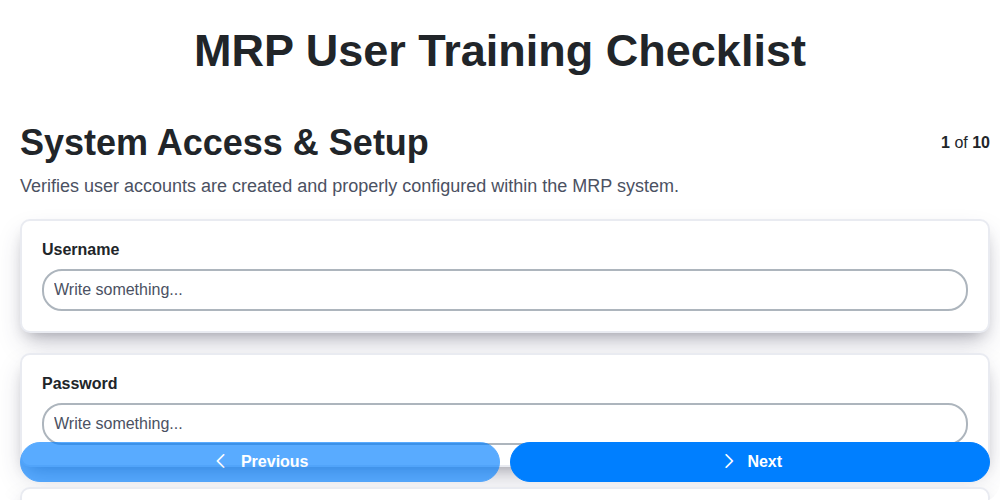
MRP User Training Checklist: Ensuring Proficiency & Success
We can do it Together
Need help with
Material Requirements Planning (MRP)?
Have a question? We're here to help. Please submit your inquiry, and we'll respond promptly.