MRP Lead Time Review Checklist: Ensuring Accurate Planning & Production
Published: 12/14/2025 10:00 PM Updated: 12/15/2025 1:39 PM
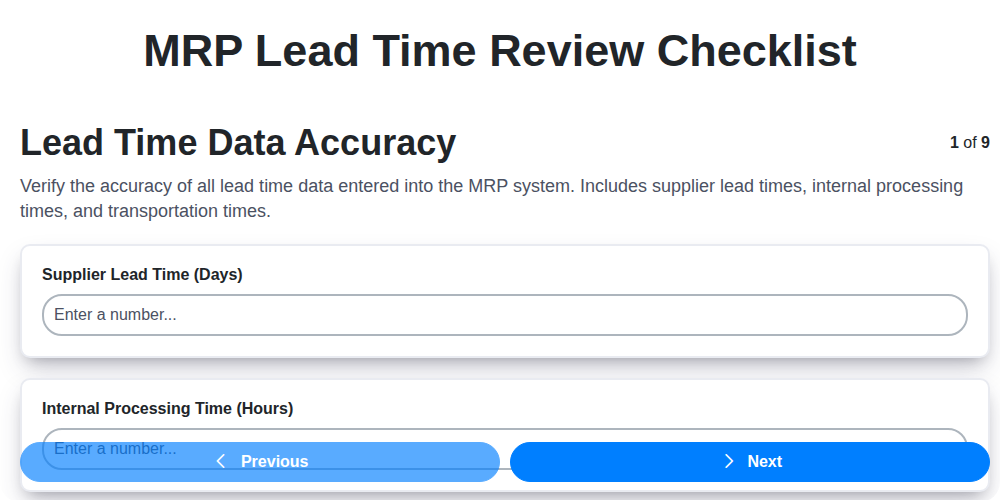
Table of Contents
- Introduction: Why MRP Lead Time Accuracy Matters
- 1. Lead Time Data Accuracy: The Foundation of Reliable Planning
- 2. Understanding Lead Time Calculation Methods
- 3. Supplier Communication & Updates: Staying in the Loop
- 4. Validating Internal Processing Time: Beyond the Obvious
- 5. Transportation Lead Time Review: A Critical Component
- 6. Safety Stock Considerations: Balancing Risk and Efficiency
- 7. System Integration Checks: Ensuring Data Flows Seamlessly
- 8. Documentation & Approval: Formalizing the Process
- 9. Periodic Review & Updates: Keeping Data Current
- 10. Common Pitfalls in Lead Time Management
- Tools & Technologies for Lead Time Analysis
- Best Practices for Continuous Improvement
- Conclusion: Optimizing Your MRP with Accurate Lead Times
- Resources & Links
TLDR: Is your MRP system letting you down? This checklist ensures your lead time data is accurate - from supplier communication to system integration - minimizing stockouts, reducing excess inventory, and boosting production efficiency. It's your guide to better MRP planning!
Introduction: Why MRP Lead Time Accuracy Matters
Accurate lead times are the bedrock of a well-functioning Material Requirements Planning (MRP) system. Think of them as the compass guiding your inventory - if the compass is off, you're going to end up lost and overstocked (tying up valuable capital) or, worse, experience stockouts that halt production and disappoint customers.
Many businesses operate with outdated or inaccurate lead time data, often unknowingly. This can stem from various factors - shifting supplier performance, changes in transportation logistics, or simply a lack of consistent tracking. The consequences are real: increased carrying costs, expedited shipping charges, production delays, and ultimately, decreased profitability.
This isn't just about numbers; it's about impacting your company's agility and responsiveness. A comprehensive MRP lead time review, regularly performed and meticulously maintained, is a vital investment that strengthens your supply chain, improves forecasting, and empowers data-driven decisions. Let's dive into a checklist designed to help you achieve just that.
1. Lead Time Data Accuracy: The Foundation of Reliable Planning
Inaccurate lead time data is the silent killer of efficient MRP (Material Requirements Planning). It leads to stockouts, excess inventory, and ultimately, frustrated customers and a strained bottom line. Before diving into any MRP adjustments or optimizations, ensuring your core lead time data is accurate is paramount.
This isn't just about the raw numbers; it's about building a system you can trust. Start by auditing your current lead time data for all key materials and components. This includes:
- Verify Source Documents: Trace lead times back to original supplier quotes, purchase orders, and historical data. Don't just accept numbers - validate them.
- Account for All Lead Time Components: Lead time isn't just about the supplier's production time. Consider order placement time, supplier processing time, transit time, receiving inspection, and any internal delays.
- Regular Data Cleansing: Implement a process to identify and correct errors, discrepancies, or outdated information. Don't let data rot.
- Cross-Functional Validation: Involve procurement, production planning, and receiving teams to confirm the accuracy of lead time estimates. Different departments often have different perspectives.
- Document Assumptions: If lead times are based on estimates or assumptions (e.g., a new supplier), explicitly document these assumptions and their potential impact.
Accurate lead time data is the bedrock of a successful MRP system. Invest the time and effort upfront, and you'll reap the rewards of improved planning and operational efficiency.
2. Understanding Lead Time Calculation Methods
Accurate lead time data isn't just about knowing how long something takes; it's about how that time is being calculated. Different departments and even different suppliers might use varying methods, leading to discrepancies and forecasting errors. Let's break down the common approaches and highlight potential pitfalls.
1. Simple Average: This is the most basic method - calculating the average time based on historical data. While easy to implement, it's susceptible to outliers and doesn't account for trends or seasonality. A single unusually long delivery can significantly skew the average.
2. Weighted Average: This improves on the simple average by assigning different weights to past data points. More recent data often gets higher weight, assuming it's more representative of current conditions. This requires careful judgment in determining the weighting factors.
3. Moving Average: A specific type of weighted average where you calculate the average over a defined period (e.g., the last 3 months). It smooths out fluctuations but can lag behind significant changes.
4. Exponential Smoothing: A more sophisticated method that gives exponentially decreasing weight to older data. It's good at adapting to trends and is relatively easy to implement. Different variations exist (single, double, triple exponential smoothing) to handle different data patterns.
5. Sum-of-Components: This approach breaks down lead time into its constituent parts (e.g., supplier order processing, manufacturing, transportation, receiving). Each component is tracked and analyzed separately. This provides granular insight and allows for targeted improvements.
6. Statistical Modeling: Utilizing more complex statistical techniques like regression analysis can help identify relationships between lead time and other factors (e.g., order quantity, time of year). Requires statistical expertise.
Key Considerations:
- Consistency: Ensure everyone involved (planning, purchasing, suppliers) uses the same methodology for calculating lead times.
- Documentation: Clearly document the calculation method used for each item.
- Regular Review: Regularly review the chosen method to ensure its accuracy and relevance, especially as conditions change.
3. Supplier Communication & Updates: Staying in the Loop
Lead times aren't static. They fluctuate due to supplier production schedules, material availability, logistical changes, and more. Maintaining open and frequent communication with your suppliers is paramount to ensuring your MRP system reflects reality.
Here's what this aspect of your lead time review should cover:
- Regular Check-ins: Schedule routine calls or online meetings with key suppliers. Don't just talk about orders; proactively discuss their current capacity, potential disruptions, and any anticipated changes to lead times.
- Supplier-Provided Updates: Establish a clear channel for suppliers to proactively inform you of changes before they impact your production. This could be a dedicated email address, a portal, or even a regular reporting schedule.
- Early Warning Systems: Encourage suppliers to flag potential issues - from raw material shortages to equipment maintenance - well in advance. Ask about their own visibility into potential disruptions further down their supply chain.
- Feedback Loop: Share your demand forecasts and insights with suppliers. This collaborative approach helps them plan effectively and can sometimes lead to negotiated lead time improvements.
- Escalation Procedures: Define clear escalation paths for addressing urgent lead time changes or potential disruptions. Who needs to be notified and when?
4. Validating Internal Processing Time: Beyond the Obvious
Internal processing time is often overlooked in MRP lead time reviews, but it's a critical component of accurate planning. It's not just about how long it takes to receive materials; it's about everything that happens within your facility after you request something and before it's ready to be used in production.
Think beyond the obvious. We're talking about the time required for:
- Purchase Requisition Approval: How long does it take for a request to move through your approval hierarchy? Don't assume it's instantaneous.
- Material Movement: Time spent moving materials from receiving to storage, or from storage to the production floor. Forklift availability, congestion, and inefficient layouts all impact this.
- Inspection & Quality Checks: Incoming material inspection, even if seemingly brief, takes time and should be factored in.
- Engineering or Design Changes: Any alterations to specifications before production starts will add delays.
- Production Planning & Scheduling: The time spent allocating materials to specific production orders.
- Kitting/Assembly: If materials require kitting or pre-assembly, include that time.
Don't rely solely on historical averages. Conduct time studies (even brief observations) to understand the actual time involved in these steps. Interview those directly involved. Look for bottlenecks and areas where processes can be streamlined. Regularly reassess these times as processes and technologies change. Incorrect internal processing time estimates will lead to phantom shortages or excess inventory.
5. Transportation Lead Time Review: A Critical Component
Transportation lead times are often overlooked, yet they can significantly impact overall lead time accuracy. Don't assume the figures you have are always correct! This step involves a deep dive into how materials and finished goods move from origin to your facility and from your facility to customers.
Here's what to examine:
- Verify Carrier Data: Confirm the transit times provided by your carriers align with your internal records. Contact carriers directly to validate.
- Mode of Transport: Are you using the optimal mode (truck, rail, air, sea)? Each has varying transit times and associated risks. Evaluate if a change could benefit lead time.
- Customs Clearance (if applicable): International shipments are notorious for unpredictable delays. Review clearance processes and identify potential bottlenecks.
- Loading/Unloading Times: Don't forget these crucial steps! They contribute to the overall transit time and can be a source of unexpected delays.
- Traffic & Weather Impacts: Consider historical data and potential disruptions caused by seasonal weather patterns or regional traffic congestion. Factor these into your planning.
- Port Congestion (if applicable): Similar to traffic, port congestion significantly impacts lead times, especially for ocean freight.
- Evaluate Routes: Are shipments taking the most efficient routes? Are there alternative routes that could provide faster delivery?
Regularly updating transportation lead time data is crucial for accurate MRP planning and improved customer service.
6. Safety Stock Considerations: Balancing Risk and Efficiency
Lead times aren't always predictable. Unexpected delays - from supplier disruptions to transportation hiccups - can leave you scrambling to fulfill orders and potentially damaging customer relationships. That's where safety stock comes in. However, holding excessive safety stock ties up capital and increases warehousing costs. Finding the sweet spot requires careful consideration.
This review should involve more than just a simple calculation. We need to look at several factors:
- Lead Time Variability: Analyze historical lead time data to understand how much lead times fluctuate. Higher variability demands higher safety stock.
- Demand Variability: If customer demand is unpredictable, a larger safety stock buffer is necessary.
- Service Level Goals: What's your desired level of order fulfillment? A higher service level (e.g., 99% fill rate) necessitates more safety stock.
- Cost of Stockouts: Quantify the potential cost of running out of stock - lost sales, expedited shipping costs, potential penalties.
- Obsolescence Risk: For items with short lifecycles, holding large amounts of safety stock significantly increases the risk of obsolescence.
During this review, examine your current safety stock calculations. Are they based on outdated information? Are they factoring in the full range of potential risks? Are you using a consistent methodology across all items? Consider exploring statistical techniques like standard deviation to more accurately assess risk and optimize your safety stock levels. Finally, regularly re-evaluate safety stock based on updated lead time and demand data.
7. System Integration Checks: Ensuring Data Flows Seamlessly
MRP (Material Requirements Planning) thrives on accurate and timely data. If your lead time data exists in a spreadsheet but isn't automatically flowing into your MRP system, you're introducing potential errors and inefficiencies. This section focuses on verifying the integration between your lead time data sources and your MRP system.
Here's what to check:
- Automated Updates: Confirm that lead time changes made in your source system (e.g., supplier portals, ERP modules) are automatically reflected in your MRP system. Manual data entry is a recipe for errors and should be minimized.
- Data Mapping: Verify that data fields are mapped correctly. For example, is the Lead Time (Days) field in your supplier portal accurately populating the corresponding field in your MRP?
- Error Handling: Understand how system integration handles errors. Are you notified when data transfer fails? Is there a clear process for resolving integration issues?
- Real-time vs. Batch Processing: Determine if lead time updates are processed in real-time or in batches. Real-time integration provides the most current data, but batch processing may be sufficient depending on your business needs.
- API/Interface Stability: If you're using APIs or custom interfaces, check their stability and performance. Regularly monitor for errors or delays.
- Testing & Validation: Perform regular testing of the integration process to ensure data integrity and functionality. Simulate lead time changes and verify that the MRP system reflects these changes correctly.
A well-integrated system eliminates data silos, reduces the risk of errors, and allows your MRP system to accurately plan for material needs.
8. Documentation & Approval: Formalizing the Process
A thorough MRP lead time review isn't complete without robust documentation and a clear approval process. This isn't just about having a record; it's about ensuring accountability, repeatability, and minimizing errors.
Here's what to include:
- Document the Review Scope: Clearly define which items, suppliers, or processes were included in the review.
- Record Findings: Detail any discrepancies found, proposed changes, and the rationale behind those changes. Include who identified the issues and who was involved in the discussion.
- Approval Sign-Off: Designate specific roles (e.g., Purchasing Manager, Production Planner, Supply Chain Manager) who are authorized to approve lead time adjustments. Document their approval or rejection, and the reason for their decision. A digital signature system is highly recommended.
- Version Control: Implement a version control system for the lead time data. This ensures users are always working with the most current and approved information. Include a date and version number on all documentation.
- Distribution and Communication: Clearly define how the updated lead time data is communicated to relevant departments (e.g., MRP system users, Sales, Production).
- Audit Trail: Maintain an audit trail of all changes made to the lead time data, including who made the change, when it was made, and why. This is crucial for troubleshooting and continuous improvement.
Proper documentation ensures transparency, facilitates future audits, and serves as a valuable reference point for training new team members.
9. Periodic Review & Updates: Keeping Data Current
Lead times aren't static; they't constantly evolving. A review conducted once and forgotten is essentially useless. Establishing a periodic review process is critical for maintaining data accuracy and proactively addressing potential disruptions.
How Often Should You Review? We recommend a minimum quarterly review, with more frequent checks (monthly or even weekly) for critical items or volatile supply chains. Consider a tiered approach:
- High-Risk Items: Review monthly or even weekly. These are items with long lead times, single sourcing, or known supply chain vulnerabilities.
- Medium-Risk Items: Quarterly review is sufficient.
- Low-Risk Items: Annual review may be adequate, but still advisable.
What to Review During These Updates: This isn't just about confirming the numbers haven't changed. It's an opportunity to:
- Re-evaluate Calculation Methods: Are your calculations still accurate and reflective of current processes?
- Solicit Feedback: Engage with procurement, production planning, and even key suppliers. Their insights can highlight unseen changes.
- Analyze Historical Data: Track actual lead times against planned lead times. Significant deviations indicate a need for further investigation and potential adjustments.
- Incorporate New Information: Account for changes in supplier processes, transportation routes, or internal procedures.
- Document Changes: Record all updates, including the rationale behind them, for future reference and auditing purposes.
By consistently revisiting and refining your lead time data, you're building a more resilient and responsive supply chain, ultimately minimizing risks and maximizing efficiency.
10. Common Pitfalls in Lead Time Management
Many companies fall into predictable traps when managing lead times. Here are a few common pitfalls to watch out for: Ignoring Variability: Lead times rarely stay static. Focusing solely on average lead times masks the inherent variability, leading to inaccurate planning. Lack of Supplier Collaboration: Treating suppliers as order-takers instead of partners hinders visibility and proactive adjustments. Data Silos: Disconnected data between procurement, planning, and operations creates confusion and delays. Over-Reliance on Historical Data: While history informs, it shouldn't dictate. Market shifts and supplier changes require ongoing reevaluation. Insufficient Internal Process Mapping: A poorly understood internal process can add hidden lead time. Neglecting Transportation Costs/Impact: Focusing solely on price, without considering transportation lead time, can be costly. Assuming Consistency Across Suppliers: Different suppliers will have different lead time performance - don's assume they all operate the same. Failing to Account for Seasonality: Demand fluctuations and supplier production schedules often have seasonal effects. Not Regularly Auditing Lead Time Data: Stale data leads to flawed decisions. Lack of Ownership & Accountability: When no one owns lead time performance, it degrades over time.
Tools & Technologies for Lead Time Analysis
Analyzing lead times effectively often goes beyond spreadsheets and manual calculations. Thankfully, a robust suite of tools and technologies can significantly streamline the process, improve accuracy, and provide valuable insights. Here's a look at some helpful options:
MRP/ERP Systems: Many modern MRP and ERP systems (like SAP, Oracle NetSuite, Microsoft Dynamics 365) have built-in lead time management capabilities. Leverage these! They often allow for lead time tracking, variance analysis, and integration with other modules like procurement and production planning.
Data Analytics Platforms: Tools like Power BI, Tableau, and Google Data Studio can visualize lead time data, identify trends, and pinpoint areas for improvement. You can import data from various sources (ERP, supplier portals, transportation systems) to create dashboards that provide a comprehensive view.
Statistical Process Control (SPC) Software: SPC software helps monitor lead time variability and identify root causes of delays. Charts and control limits can highlight unusual patterns and trigger investigations.
Supplier Portals & Collaboration Platforms: Many suppliers offer online portals where you can track order status, view lead times, and communicate directly. Utilizing these platforms improves transparency and allows for proactive problem-solving.
Transportation Management Systems (TMS): A TMS optimizes transportation routes and provides real-time tracking data, enabling accurate calculation and monitoring of transportation lead times.
Spreadsheets (Yes, Still!): While advanced tools are valuable, spreadsheets (like Microsoft Excel or Google Sheets) remain useful for smaller datasets and initial analyses. Just be mindful of data integrity and scalability.
AI & Machine Learning: Emerging AI and ML tools can predict lead times based on historical data and external factors, helping optimize inventory levels and proactively address potential disruptions. While still evolving for broad implementation, these offer exciting potential.
Choosing the right tools depends on your company's size, complexity, and budget. The key is to select solutions that fit your needs and empower your team to make data-driven decisions regarding lead time management.
Best Practices for Continuous Improvement
Reviewing and validating MRP lead times isn't a one-and-done activity. It's a journey of continuous improvement that ensures your production schedules remain accurate, your inventory levels are optimized, and your supply chain is resilient. Here's how to embed best practices into your ongoing process:
- Establish a Regular Cadence: Don't wait for problems to arise. Schedule periodic reviews (e.g., quarterly, semi-annually) as part of your standard operating procedures.
- Cross-Functional Collaboration: Include representatives from procurement, planning, production, and even key suppliers. Diverse perspectives uncover blind spots.
- Data-Driven Decisions: Base changes to lead times on objective data, not gut feelings. Track actual lead times against planned lead times and investigate discrepancies.
- Feedback Loops: Create a system for ongoing feedback from production planners and buyers. Their direct experience often reveals hidden bottlenecks.
- Embrace Technology: Leverage MRP system analytics and reporting capabilities to automate data gathering and trend analysis.
- Standardize Processes: Document revised lead times and communication protocols clearly to prevent misunderstandings and ensure consistent application.
- Kaizen Events: Consider short, focused Kaizen events specifically dedicated to lead time reduction and accuracy improvement.
- Supplier Scorecards: Incorporate lead time performance into supplier scorecards to incentivize timely delivery.
- Training & Awareness: Continuously educate your team on the importance of accurate lead time data and the impact on overall business performance.
- Automated Alerts: Configure your MRP system to automatically flag items with significant lead time variances, prompting immediate investigation.
Conclusion: Optimizing Your MRP with Accurate Lead Times
Accurate lead times are the bedrock of a successful MRP system. This checklist isn't just about ticking boxes; it's about building a robust, responsive supply chain that minimizes stockouts, reduces excess inventory, and ultimately improves your bottom line. By consistently reviewing and refining your lead time data, fostering open communication with suppliers, and validating internal processes, you're investing in the long-term health of your manufacturing operations. Remember, lead times aren't static - they evolve with market conditions, supplier performance, and internal improvements. Make this checklist a regular part of your operational rhythm, and you'll reap the rewards of a more agile and efficient MRP system. Continuous improvement is key; don't be afraid to experiment with new methods and adjust your approach as needed. Your commitment to accurate lead times will be a powerful differentiator in today's competitive landscape.
Resources & Links
- APICS: The Association for Supply Chain Management (APICS) provides resources, certifications, and education related to supply chain and MRP practices.
- MRP System: Provides comprehensive guides and resources on MRP systems, including sections on lead time management and planning.
- NetSuite: Offers ERP solutions and resources, including articles and webinars related to inventory management and demand planning, frequently referencing lead time considerations.
- Infor: Provides ERP software and industry-specific solutions; their website features content on supply chain optimization, including lead time analysis.
- Oracle: A major ERP provider with extensive resources on supply chain management and demand planning, including topics related to lead time management.
- SAS: Offers analytics and business intelligence tools that can be used to analyze lead time data and identify trends. Their website offers case studies and whitepapers.
- Microsoft Dynamics 365: Microsoft's ERP solution; offers guidance on demand forecasting and inventory optimization, key components for accurate lead time planning.
- Gartner: Provides research and insights on supply chain technologies and best practices. While requiring subscriptions for detailed reports, their home page often highlights relevant trends.
- Supply Chain Dive: Offers news and analysis on supply chain trends, frequently covering topics related to lead time reduction and optimization.
- ISCM: International Supply Chain Management - offers courses and resources for professionals looking to advance their understanding of supply chain management. Focuses on areas like forecasting, planning and inventory management.
- Lean Enterprise Institute: Promotes lean manufacturing principles which directly impact lead time reduction and process efficiency. Their website offers tools and guidance.
Frequently Asked Questions
What is MRP Lead Time?
MRP (Material Requirements Planning) Lead Time refers to the total time required to procure or produce a component or material, from the moment a need is identified to when it's available for use in production. It includes lead time for order placement, supplier lead time, transit time, inspection time, and any internal processing time.
Why is reviewing MRP Lead Times important?
Inaccurate lead times can lead to stockouts, excess inventory, production delays, and ultimately, decreased profitability. Regularly reviewing and updating lead times ensures your MRP system provides reliable information for planning and production scheduling.
Who should be involved in reviewing MRP Lead Times?
A cross-functional team is ideal, including representatives from Procurement, Production Planning, Manufacturing, and potentially even Sales and Engineering. This ensures a comprehensive understanding of factors influencing lead times.
What are the key elements to include in an MRP Lead Time Review Checklist?
A comprehensive checklist should include items like: checking supplier lead times, analyzing historical data on lead time performance, assessing internal processing times, evaluating transportation lead times, verifying material inspection times, and considering potential disruptions or seasonality.
How often should MRP Lead Times be reviewed?
The frequency of review depends on factors like product complexity, supplier reliability, and industry volatility. As a general guideline, reviewing lead times at least quarterly is recommended, with more frequent reviews (e.g., monthly or even weekly) for critical materials or unstable supply chains.
What constitutes 'historical data' when reviewing lead times?
Historical data includes records of actual lead times observed over a period of time. This data should be analyzed to identify trends, outliers, and potential areas for improvement. It might include actual order dates, receipt dates, and any delays encountered.
How can I identify potential bottlenecks affecting lead times?
Analyze data to identify points where lead times consistently exceed expectations. Talk to personnel involved in the process (e.g., procurement specialists, production operators) to understand the root causes of delays. Value stream mapping can also be a useful tool.
What should I do if I identify inaccurate or outdated lead times?
Immediately update the lead times in your MRP system. Communicate the changes to relevant stakeholders and explain the rationale behind the adjustments. Monitor the impact of the changes to ensure accuracy and effectiveness.
Are there any tools or software that can assist with MRP Lead Time Review?
Many MRP and ERP systems have built-in tools for tracking lead times and generating reports. Spreadsheets (like Excel or Google Sheets) can also be used for simpler analyses. Specialized supply chain management software can provide more advanced analytics and collaboration features.
How does seasonality impact MRP Lead Time Review?
Seasonal fluctuations in demand can affect supplier lead times and transportation availability. Account for these factors by adjusting lead times during peak seasons and considering safety stock to buffer against potential disruptions.
Found this Article helpful?
Comments
There are no comments yet. Be the first to add one!
Related Articles
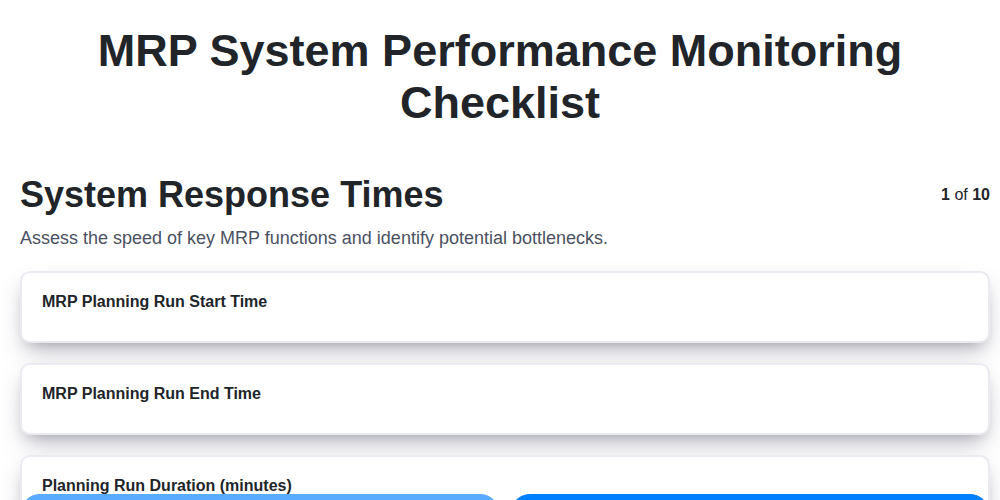
MRP System Performance Monitoring Checklist: Ensure Peak Efficiency
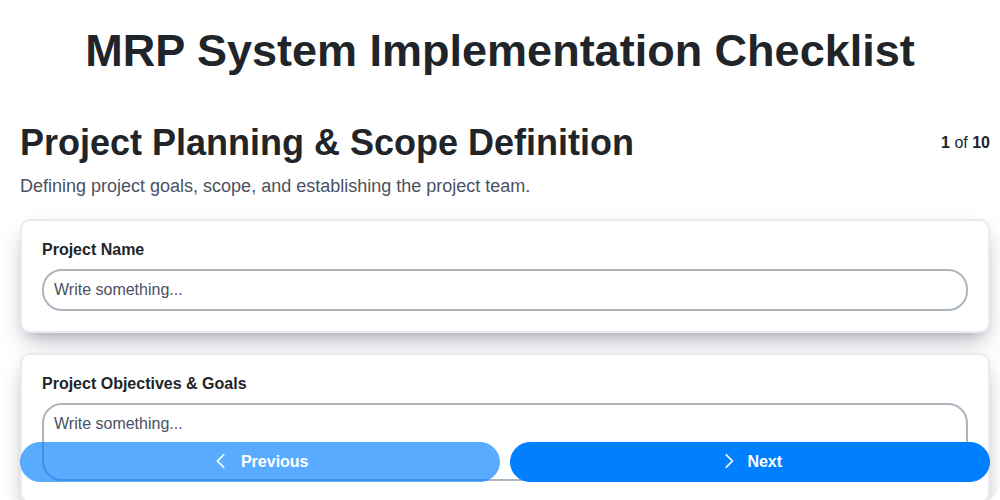
MRP System Implementation Checklist: Your Step-by-Step Guide

Top 10 MRPeasy Alternatives for 2025

The 5 Best Bill of Materials (BOM) Management Software of 2025
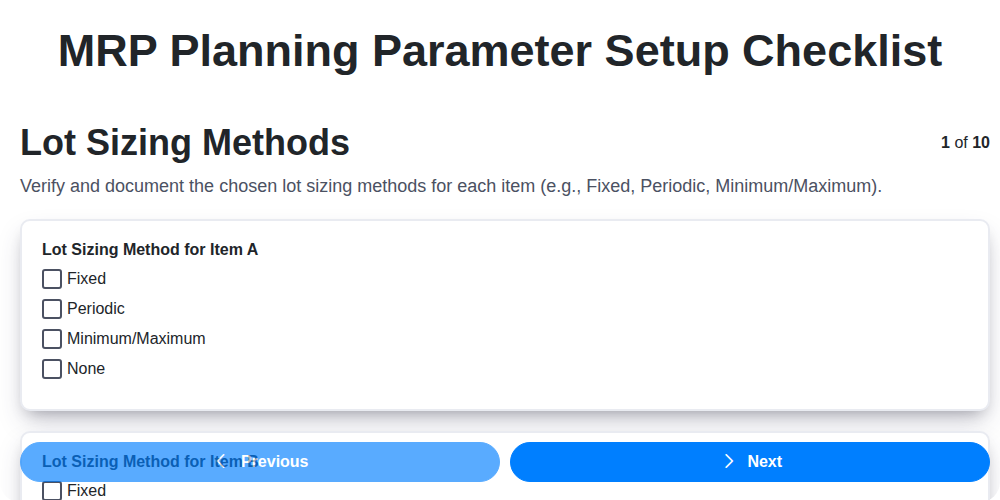
MRP Planning Parameter Setup Checklist: Your Guide to Accuracy & Efficiency

The 10 Best Manufacturing Management Software of 2025
How to improve your Bill of Materials (BOM) Management
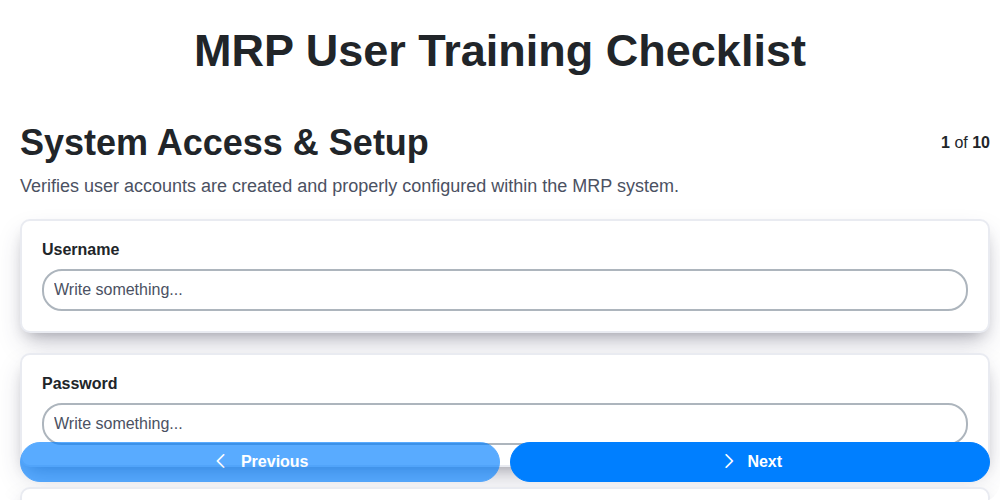
MRP User Training Checklist: Ensuring Proficiency & Success
We can do it Together
Need help with
Material Requirements Planning (MRP)?
Have a question? We're here to help. Please submit your inquiry, and we'll respond promptly.