MRP Master Data Maintenance Checklist: Your Guide to Accuracy and Efficiency
Published: 12/14/2025 10:00 PM Updated: 12/15/2025 1:48 PM
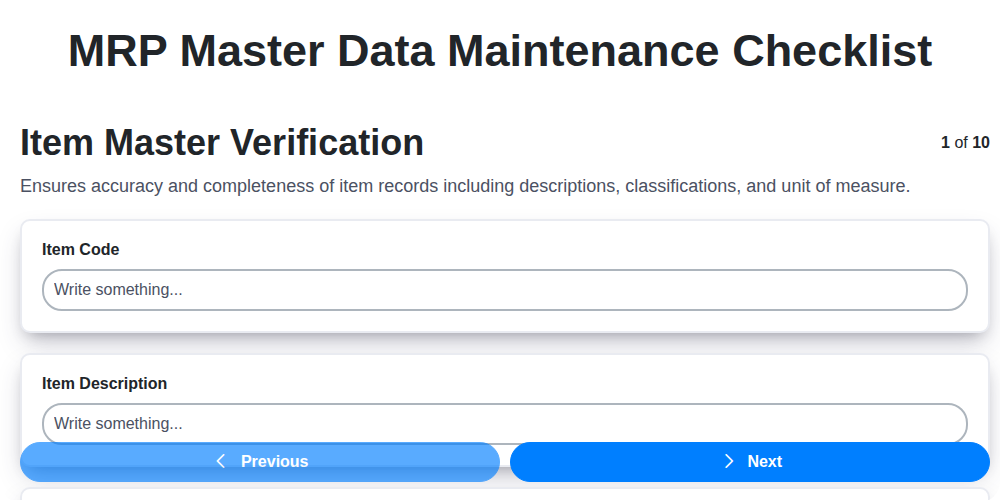
Table of Contents
- Introduction: Why Master Data Maintenance Matters
- 1. Item Master Verification: The Foundation of Accuracy
- 2. BOM (Bill of Materials) Review: Ensuring Accurate Component Relationships
- 3. Routing Validation: Streamlining Production Processes
- 4. Vendor Master Data Accuracy: Reliable Sourcing
- 5. Lead Time Updates: Realistic Planning
- 6. Safety Stock Levels: Balancing Inventory and Risk
- 7. Unit of Measure Consistency: Avoiding Calculation Errors
- 8. Cost Data Verification: Accurate Costing and Pricing
- 9. Obsolete Data Review: Decluttering Your System
- 10. Change Log Audit: Tracking and Accountability
- 11. Frequency of Maintenance: Setting a Schedule
- 12. Automation Opportunities: Reducing Manual Effort
- 13. Best Practices for Ongoing Master Data Governance
- Conclusion: Maximizing MRP Performance with a Robust Checklist
- Resources & Links
TLDR: Keep your MRP system humming with this checklist! It ensures your item details, BOMs, routings, vendor info, costs, and more are accurate and up-to-date, preventing costly errors, optimizing production, and boosting efficiency - saving you time and money in the long run.
Introduction: Why Master Data Maintenance Matters
Think of your Manufacturing Resource Planning (MRP) system as the central nervous system of your manufacturing operations. It coordinates everything from raw material procurement to finished goods delivery. But what happens when that nervous system is riddled with inaccuracies? The result? Chaos. Inaccurate or outdated master data - the foundation upon which your MRP relies - can cripple your business.
We're talking about missed deadlines, excess inventory, inaccurate costing, production bottlenecks, and ultimately, dissatisfied customers. Master data, encompassing everything from item descriptions and bill of materials to vendor details and routing information, drives critical decisions across your entire organization. Neglecting its upkeep isn't just a minor inconvenience; it's a significant risk.
This blog post will focus on a practical checklist to ensure your MRP master data is accurate, consistent, and reliable, minimizing risk and maximizing efficiency. Let's dive into the essential steps for a robust Master Data Maintenance program.
1. Item Master Verification: The Foundation of Accuracy
The Item Master is the bedrock of your Material Requirements Planning (MRP) system. Inaccurate data here ripples through your entire process, leading to incorrect purchase orders, production schedules, and ultimately, dissatisfied customers. This isn't just about ensuring part numbers are correct; it's about guaranteeing every attribute associated with each item is accurate and up-to-date.
Here's what your Item Master Verification checklist should include:
- Part Number Validation: Are part numbers unique and consistently used across all systems (ERP, CAD, etc.)? Avoid duplicates and aliases.
- Description Accuracy: Is the description clear, concise, and descriptive enough for users to easily identify the item?
- Classification Review: Ensure items are correctly classified (e.g., raw material, component, finished good). This impacts MRP logic and reporting.
- Substitution/Alternative Items: Are approved substitutions clearly defined and documented, with appropriate approval workflows in place?
- Engineering Change Order (ECO) Alignment: Verify item attributes reflect the latest ECOs. Outdated specifications can lead to production errors.
- Procurement Type: Is the procurement type correctly defined (make, buy, make-to-order, etc.)? This drives planning and purchasing strategies.
- Shelf Life/Expiration Dates (if applicable): Critical for perishable goods - ensure data is accurate and regularly monitored.
- Regulatory Compliance Attributes: Verify attributes related to regulatory compliance (e.g., RoHS, REACH) are accurate and reflect current regulations.
A robust Item Master verification process should be performed regularly (e.g., monthly or quarterly) and whenever significant changes occur.
2. BOM (Bill of Materials) Review: Ensuring Accurate Component Relationships
The Bill of Materials (BOM) is the recipe for your manufactured products. It details every component, sub-assembly, and raw material needed to create a finished good. An inaccurate BOM can lead to production delays, incorrect material orders, increased scrap rates, and ultimately, dissatisfied customers. Regular review and maintenance of your BOMs are absolutely critical for maintaining operational efficiency and product integrity.
Here's what to look for during your BOM review:
- Component Accuracy: Verify that all listed components are still required for the product. Have any features been removed or changed? Are substitutes viable?
- Quantity Validation: Confirm that the quantities of each component specified in the BOM are correct. A slight discrepancy here can significantly impact material usage and cost.
- Version Control: Ensure the BOM version being used in production is the latest, approved version. Outdated BOMs are a frequent cause of errors.
- Engineering Changes: Document and implement any engineering changes promptly and accurately within the BOM. Don't rely on verbal communication - formalize these changes.
- Phantom/Assembly Relationships: Properly define phantom assemblies and ensure that sub-assemblies are accurately linked. Incorrect phantom codes can cause incorrect consumption.
- Alternative Components: If alternative components are allowed, confirm their usage is controlled and documented.
- BOM Structure Alignment: Does the BOM structure reflect the actual manufacturing process? Unnecessary complexity can lead to confusion and errors.
Regular BOM review, ideally performed as part of your ongoing MRP master data maintenance process, will minimize disruption and keep your manufacturing process running smoothly.
3. Routing Validation: Streamlining Production Processes
Routing defines the sequence of operations needed to manufacture a product, outlining the workstations, tools, and labor involved at each step. Inaccurate or outdated routing data can wreak havoc on production schedules, inflate costs, and lead to frustrating bottlenecks.
Why is Routing Validation Crucial?
- Accurate Planning: Correct routing information allows for realistic production planning and scheduling.
- Cost Reduction: Identifying and eliminating unnecessary operations or inefficiencies directly lowers production costs.
- Improved Efficiency: A well-validated routing optimizes the production flow, minimizing downtime and maximizing output.
- Reduced Lead Times: Streamlined processes translate to shorter production times and quicker order fulfillment.
What to Check During Routing Validation:
- Sequence Accuracy: Ensure operations are listed in the correct order and reflect the actual production process.
- Workstation Assignment: Verify that each operation is assigned to the correct workstation.
- Labor Standards: Review labor hours and rates assigned to each operation; are they still accurate?
- Tooling & Equipment: Confirm tooling and equipment requirements are correct and readily available.
- Scrap & Rework: Accurately reflect scrap and rework percentages associated with each operation.
- New/Changed Operations: Routings often get overlooked during product or process changes. Confirm all new or modified operations are documented.
Regular routing validation should be a key part of your MRP master data maintenance. Don't let outdated routing data slow down your production!
4. Vendor Master Data Accuracy: Reliable Sourcing
Your vendors are the backbone of your supply chain. Inaccurate vendor master data - information like contact details, pricing agreements, payment terms, and approved part numbers - can lead to costly errors, delays, and strained relationships. This isn's just about having the right phone number; it's about ensuring your system reflects the agreed-upon terms and conditions for each supplier.
During your MRP master data maintenance, meticulously review your vendor records. Verify:
- Contact Information: Are phone numbers, email addresses, and shipping addresses current? A single outdated contact can derail urgent communications.
- Pricing & Payment Terms: Confirm that the pricing structures and payment schedules in your system align with your negotiated contracts. Discrepancies here can impact your profit margins and create payment disputes.
- Approved Part Numbers/SKUs: Ensure that the part numbers and SKUs linked to each vendor are accurate and match their offerings. Incorrect parts can lead to production downtime and quality issues.
- Lead Times & Delivery Performance: Cross-reference vendor-supplied lead times with actual delivery performance. Adjust expectations in your system to more realistically reflect your supply chain.
- Bank Details: Double-check banking information to prevent payment errors.
- Certifications/Compliance: If your industry requires specific vendor certifications (e.g., ISO), verify that these are documented and remain valid in your MRP system.
Regularly update and reconcile vendor data. A dedicated team or individual should own this responsibility, and periodic audits are crucial to maintaining data integrity.
5. Lead Time Updates: Realistic Planning
Lead times are the backbone of accurate production planning and order fulfillment. Outdated or inaccurate lead time data can trigger stockouts, expedite fees, and ultimately, dissatisfied customers. It's not enough to just have lead times; they need to be accurate and regularly reviewed.
This isn't just about the time it takes to receive raw materials from a vendor. Consider the entire process - from order placement to receipt and inspection. Are there delays in processing orders? Are inspection procedures taking longer than anticipated? Are transportation logistics experiencing disruptions?
Regularly review your lead times - ideally quarterly, or even more frequently depending on your supply chain volatility. Factors to consider during review:
- Vendor Communication: Proactively engage with your vendors to understand any changes affecting their lead times.
- Historical Data Analysis: Analyze past order history to identify trends and potential delays. Don't just look at averages; examine the distribution of lead times.
- Internal Process Assessment: Evaluate internal processes impacting lead times, such as order processing, receiving, and inspection.
- Seasonal Variations: Account for seasonal peaks and valleys that can impact lead times.
- Geopolitical Factors: Be aware of global events that might disrupt supply chains.
Updating lead times isn't a one-time task; it's an ongoing commitment to maintaining a responsive and reliable MRP system. A small investment in regular updates can save you significant costs and headaches down the road.
6. Safety Stock Levels: Balancing Inventory and Risk
Safety stock - that buffer of extra inventory - is a critical component of any robust MRP system. It's the cushion that protects you from unexpected demand spikes or supply chain disruptions. However, holding too much safety stock ties up capital and increases storage costs, while too little leaves you vulnerable to stockouts and production delays.
A thorough MRP master data maintenance checklist must include a review of your safety stock levels. This isn't simply about looking at numbers; it's about understanding the why behind them.
Here are key considerations for validating safety stock:
- Demand Variability: Have your historical demand patterns changed? Re-evaluate the statistical methods used to calculate safety stock, accounting for seasonality, promotions, and other influencing factors.
- Lead Time Variability: Fluctuations in supplier lead times directly impact required safety stock. Analyze vendor performance and adjust accordingly.
- Service Level Targets: What is your desired level of customer service? Higher service levels require higher safety stock.
- Cost of Stockout: Consider the financial impact of a stockout - lost sales, expedited shipping, production delays. This helps justify increased safety stock levels for critical items.
- Item Classification: Implement different safety stock policies based on item criticality. "A" items (high value, high impact) might require higher safety stock than "C" items (low value, low impact).
- Dynamic Adjustment: Safety stock shouldn't be static. Implement a process for regular review and adjustment based on actual performance and changing conditions.
Don't let safety stock become an overlooked data point. A periodic check ensures your inventory remains balanced, mitigating risk while optimizing costs.
7. Unit of Measure Consistency: Avoiding Calculation Errors
One of the most surprisingly common sources of errors in MRP systems stems from inconsistent unit of measure (UOM) usage. Imagine planning for 100 pieces when the actual consumption is measured in each or dozen. These discrepancies can ripple through your entire planning process, leading to inaccurate forecasts, incorrect order quantities, and ultimately, frustrated production teams and unhappy customers.
It's crucial to ensure every item within your master data uses the correct and consistent UOM. This applies across all relevant areas: item master, BOMs, routings, purchase orders, and sales orders. A simple typo or outdated record can wreak havoc.
Here's what to check:
- Item Master: Verify the primary and alternate UOMs listed for each item.
- BOMs: Ensure the UOM used in the BOM components matches the UOM of the parent item. A mismatch here is a classic source of error.
- Routings: Confirm UOMs used for operations and component consumption within the routing.
- Purchase Orders & Sales Orders: Ensure agreement on the UOM being used for procurement and order fulfillment.
Pro Tip: Standardize your UOMs wherever possible. Limiting the variety of units used reduces the potential for confusion and errors. Consider implementing UOM conversion tables within your system for occasional adjustments. Regularly audit your data to proactively identify and correct these inconsistencies.
8. Cost Data Verification: Accurate Costing and Pricing
Cost data in your MRP system isn't just numbers; it's the foundation for accurate pricing, profitability analysis, and informed production decisions. Regularly verifying this data is crucial to avoid costly errors and maintain a healthy bottom line.
This verification goes beyond simply confirming that the cost figures are present. It requires a deeper dive, including:
- Raw Material Costs: Are your standard costs for raw materials up-to-date? Prices fluctuate, and outdated costs can significantly skew your product costing. Compare standard costs with current vendor quotes and market trends.
- Labor Rates: Verify that labor rates assigned to operations are correct and reflect current wages, benefits, and overhead costs.
- Overhead Allocation: Ensure overhead costs are being allocated to products and operations accurately. Review allocation methods and rates periodically.
- Scrap and Rework: Confirm that scrap and rework rates are realistic and accurately reflect production losses.
- Engineering Change Impact: Assess the cost implications of any engineering changes - even seemingly minor ones can affect material usage or processing time.
- Variance Analysis: Conduct regular variance analysis to identify and investigate discrepancies between actual costs and standard costs.
Incorrect cost data can lead to underpricing, overpricing, inaccurate profitability assessments, and ultimately, poor business decisions. A dedicated cost data verification process is a critical investment in the integrity of your MRP system.
9. Obsolete Data Review: Decluttering Your System
One of the most significant drains on MRP system efficiency is outdated or obsolete data. Data that no longer reflects reality-whether it's a material no longer used, a vendor who's gone out of business, or a routing that's been replaced-clutters the system, distorts planning, and can lead to inaccurate forecasts and costly errors.
This isn't a one-time task; it's an ongoing process. Regularly review your Item Master, BOMs, routings, and vendor data to identify anything that's no longer valid. Ask these questions:
- Is this material still in use? If not, archive or delete it.
- Is this vendor still supplying us? Remove inactive vendors to prevent unnecessary communication and potential planning issues.
- Has this routing been replaced? Eliminate old routings to ensure accurate costing and scheduling.
- Are these product configurations still available? Sunset configurations no longer offered.
The effort required for this review depends on the volume of data. However, the benefits - improved data integrity, streamlined planning, and reduced risk of errors - are substantial. Don't let obsolete data drag down your MRP system's performance. Schedule regular reviews and purge what's no longer needed.
10. Change Log Audit: Tracking and Accountability
Change log audits are often overlooked, but they are vital for maintaining data integrity and ensuring accountability within your MRP system. Every modification to master data - from item descriptions to routing steps - should be meticulously documented. This isn't just about knowing what changed; it's about knowing who changed it, when it was changed, and why the change was necessary.
A robust change log allows you to:
- Identify the source of errors: If discrepancies arise, the change log provides a clear trail to investigate the responsible modification and understand the root cause.
- Maintain Accountability: Knowing who made a change establishes ownership and encourages careful consideration before any data manipulation.
- Facilitate Training & Knowledge Transfer: New team members can learn from past changes and understand the rationale behind current configurations.
- Support Audits: External or internal audits require a transparent record of data alterations, and a detailed change log is invaluable.
Regularly review your change logs. Look for patterns, unauthorized changes, or inconsistencies that warrant further investigation. Implement access controls to limit who can make changes and ensure changes are properly approved. Don't just collect the data - use it to continuously improve your MRP data governance practices.
11. Frequency of Maintenance: Setting a Schedule
Master data maintenance isn't a set it and forget it task. Like any critical system, your MRP data needs regular attention to ensure accuracy and effectiveness. Determining the right maintenance frequency is key - too little, and you risk operational issues; too much, and you're wasting valuable resources.
Here's a tiered approach to scheduling, considering the importance and volatility of each data element:
- Daily/Weekly: Item Master Verification (especially for frequently changing items like seasonal products or those with fluctuating demand) and Lead Time Updates should be reviewed regularly. Real-time adjustments prevent production bottlenecks and minimize stockouts.
- Monthly: Unit of Measure Consistency checks are crucial. A simple typo can cause significant ordering errors. Cost Data Verification should also be reviewed monthly to reflect material price fluctuations and ensure accurate costing.
- Quarterly: BOM (Bill of Materials) Review and Routing Validation should be scheduled at least quarterly. Design changes, process improvements, or supplier adjustments can all impact these elements. Vendor Master Data Accuracy warrants quarterly attention to ensure correct pricing, payment terms, and contact information.
- Semi-Annually: Safety Stock Levels require periodic adjustment based on demand variability and lead time performance. Obsolete Data Review needs a dedicated review to purge inactive items and BOMs, keeping your system clean and efficient.
- Annually: Change Log Audit is essential for compliance and identifying trends or potential errors in data management practices. It's also a good time to perform a comprehensive review of all master data elements to catch anything missed.
Remember to document your maintenance schedule, assign responsibilities, and establish a process for exception handling. Regular reviews and adjustments to your schedule based on performance are also important for optimization.
12. Automation Opportunities: Reducing Manual Effort
Maintaining accurate MRP master data is crucial, but let's be honest: the process can be incredibly repetitive and time-consuming. Thankfully, several areas within the checklist lend themselves perfectly to automation, freeing up your team to focus on strategic analysis and proactive problem-solving.
Here's where automation can make a significant impact:
- Item Master Verification: Automated rules engines can flag inconsistencies (e.g., duplicate item numbers, incorrect classifications, missing descriptions) for review, significantly reducing manual search and comparison.
- Unit of Measure Consistency: Implement automated checks across all records to ensure consistency, preventing calculation errors and order fulfillment issues.
- Cost Data Verification: Integrate with financial systems to automatically update cost data based on price changes, eliminating manual data entry and reducing the risk of errors.
- Obsolete Data Review: Schedule automated reports identifying inactive or rarely used items, prompting reviews and potential archival.
- Change Log Audit: Automated reporting can provide instant visibility into who made changes, when, and why, streamlining audits and improving accountability.
Beyond individual checklist items, consider broader automation strategies:
- Data Integration: Connect your MRP system with other systems (e.g., ERP, CRM, supplier portals) to automate data flow and eliminate manual imports/exports.
- Workflow Automation: Implement workflows for data change requests, routing approvals, and notification triggers, ensuring consistency and reducing delays.
- Robotic Process Automation (RPA): RPA bots can handle repetitive tasks like data extraction, data entry, and report generation, freeing up valuable employee time.
While full automation may not be feasible for every step, strategically implementing automation in key areas can drastically improve efficiency, reduce errors, and ultimately, strengthen your supply chain performance. Start small, identify the most repetitive and error-prone tasks, and gradually expand your automation initiatives.
13. Best Practices for Ongoing Master Data Governance
Master data maintenance isn't a set it and forget it exercise. It requires ongoing attention and a robust governance framework to ensure accuracy, consistency, and alignment with evolving business needs. Here are some best practices to keep your MRP master data pristine:
- Establish Clear Ownership: Assign specific individuals or teams accountable for maintaining each data domain (e.g., Item Master, BOMs, Vendor Master). This fosters responsibility and ensures issues are addressed promptly.
- Regular Scheduled Reviews: Don't wait for errors to surface. Schedule routine reviews - monthly, quarterly, or annually - depending on data volatility and criticality. These reviews should be documented and tracked.
- Automate Where Possible: Leverage automation for repetitive tasks like data cleansing, consistency checks, and even initial validation. This frees up resources for more complex analysis and problem-solving.
- Implement Data Quality Rules: Define clear rules for data entry and validation. These rules should be consistently applied and enforced through system configurations or automated checks. Examples include mandatory fields, data type restrictions, and range validations.
- User Training and Documentation: Educate users on the importance of accurate data entry and provide clear, concise documentation on data maintenance procedures. Refresher training is crucial.
- Feedback Loop: Encourage users to report data inaccuracies or inconsistencies. Create a clear and easy-to-use process for submitting feedback.
- Data Profiling and Monitoring: Use data profiling tools to identify trends and anomalies in the data. Set up dashboards to monitor key data quality metrics.
- Version Control & Change Management: Implement strict change management processes. Track all changes made to master data, who made them, and why. This facilitates auditing and rollback capabilities.
- Integration with Business Processes: Align master data maintenance activities with key business processes like new product introductions, vendor onboarding, and engineering changes.
- Periodic Data Cleansing Projects: Schedule dedicated projects to address larger data quality issues.
- Continuous Improvement: Regularly review and improve the master data governance framework. Adapt to changing business requirements and technology advancements.
- Executive Sponsorship: Secure buy-in and support from senior management to ensure master data governance initiatives are prioritized and adequately resourced.
- Key Performance Indicators (KPIs): Define and track KPIs related to master data quality (e.g., accuracy rate, data completeness, number of data-related incidents) to measure the effectiveness of governance efforts.
Conclusion: Maximizing MRP Performance with a Robust Checklist
Maintaining accurate and up-to-date MRP master data isn't a one-time project; it's an ongoing commitment. Implementing the checklist outlined above transforms this commitment from a daunting task into a manageable, repeatable process. By consistently executing these verification points - from item master checks to obsolete data reviews - you're not just correcting errors; you're building a foundation for reliable production planning and optimized inventory levels. This proactive approach minimizes costly stockouts, reduces excess inventory carrying costs, and ultimately enhances overall operational efficiency. Remember, a robust MRP master data maintenance checklist isn't just a list of tasks; it's a key ingredient in maximizing your MRP system's potential and driving tangible business benefits. Continuous improvement and periodic review of the checklist itself are also vital to ensuring its ongoing relevance and effectiveness.
Resources & Links
- Oracle ERP Cloud: Oracle offers comprehensive ERP solutions, including master data management capabilities, valuable for understanding the broader context of MRP and data management.
- SAP S/4HANA: Similar to Oracle, SAP's S/4HANA provides ERP functionality that often includes robust master data management tools. Good for understanding industry standards and feature sets.
- NetSuite ERP: NetSuite is another popular cloud-based ERP solution with master data management features, offering a different perspective on implementation and functionality.
- APICS (The Association for Supply Chain Management): APICS is a professional organization focused on supply chain management. Their website offers resources, certifications, and insights into best practices, including data management.
- ISACA (Information Systems Audit and Control Association): ISACA focuses on IT governance, risk management, and compliance. Useful for understanding the security and audit aspects of master data.
- Gartner: Gartner provides research and analysis on technology trends, including master data management. Can help understand the market landscape and emerging technologies.
- Master Data Management - MDM: A dedicated website focused entirely on Master Data Management, offering articles, tutorials, and industry insights.
- Tableau: While primarily a data visualization tool, Tableau can be invaluable for visualizing master data, identifying inconsistencies, and tracking changes - a useful tool for data governance.
- Microsoft Dynamics 365: Microsoft's Dynamics 365 offers ERP capabilities, potentially integrated with master data management tools, useful for understanding cloud-based solutions.
- Deloitte: Deloitte provides consulting services related to ERP implementation and data management. Provides a high-level perspective on common issues and best practices.
Frequently Asked Questions
What is MRP Master Data?
MRP Master Data refers to the foundational data used within Material Requirements Planning (MRP) systems. This includes data like Bill of Materials (BOM), Work Orders, Routings, Item Master data (cost, lead times, vendors), and more. It drives the MRP calculations and helps determine production and procurement plans.
Why is Master Data Maintenance important for MRP?
Inaccurate or outdated master data leads to inaccurate MRP calculations, resulting in stockouts, excess inventory, incorrect production schedules, and ultimately, lost revenue and customer dissatisfaction. Proper maintenance ensures MRP plans are reliable and efficient.
Who should use this checklist?
This checklist is designed for anyone involved in MRP processes, including production planners, material planners, data stewards, inventory managers, and anyone responsible for maintaining data within the MRP system.
What's the difference between Master Data and Transaction Data in MRP?
Master Data is relatively static and defines the products, BOMs, routings, etc. Transaction Data is dynamic and represents actual events like sales orders, receipts, and production completions. Transaction data relies on accurate master data to be meaningful.
How often should Master Data Maintenance be performed?
The frequency depends on the volatility of your data. Critical data like BOMs and lead times should be reviewed regularly (e.g., monthly or quarterly). Less critical data might be reviewed annually. A schedule should be documented and followed.
What's a Bill of Materials (BOM) and why is its accuracy crucial?
A BOM lists all the components, assemblies, raw materials, and quantities needed to manufacture a finished product. An inaccurate BOM leads to incorrect material requirements and production issues.
What is a Routing and how does it impact MRP?
A Routing defines the sequence of operations and work centers required to manufacture a product. Incorrect routings lead to inaccurate lead time calculations and scheduling problems.
What are some common causes of Master Data errors?
Common causes include manual data entry errors, lack of standardized processes, changes not being documented and updated, system integration issues, and lack of training.
What does 'data governance' mean in the context of MRP?
Data governance establishes policies and procedures for managing data quality, including ownership, responsibility, and security. It helps ensure data integrity and consistency across the organization.
How can I identify and correct data errors?
Regular data audits, variance analysis, and user feedback are crucial. Compare MRP outputs to actual results to identify discrepancies. Implement data validation rules within the system to prevent errors.
Found this Article helpful?
Comments
There are no comments yet. Be the first to add one!
Related Articles
MRP System Performance Monitoring Checklist: Ensure Peak Efficiency
MRP System Implementation Checklist: Your Step-by-Step Guide

Top 10 MRPeasy Alternatives for 2025

The 5 Best Bill of Materials (BOM) Management Software of 2025
MRP Planning Parameter Setup Checklist: Your Guide to Accuracy & Efficiency

The 10 Best Manufacturing Management Software of 2025
How to improve your Bill of Materials (BOM) Management
MRP User Training Checklist: Ensuring Proficiency & Success
We can do it Together
Need help with
Material Requirements Planning (MRP)?
Have a question? We're here to help. Please submit your inquiry, and we'll respond promptly.