MRP Material Requirements Planning Checklist Template: Your Guide to Planning Success
Published: 12/14/2025 10:00 PM Updated: 12/15/2025 1:33 PM
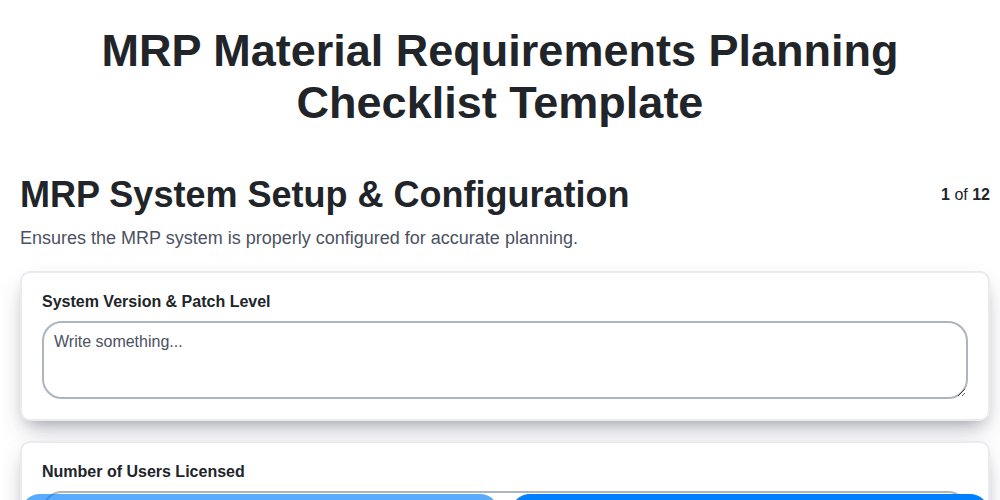
Table of Contents
- Introduction: Why an MRP Checklist Matters
- 1. MRP System Setup & Configuration: Laying the Foundation
- 2. Bill of Materials (BOM) Verification: Ensuring Accuracy
- 3. Inventory Data Accuracy: The Cornerstone of Planning
- 4. Lead Time Assessment & Updates: Realistic Schedules
- 5. Demand Forecasting & Planning: Predicting the Future
- 6. Safety Stock Levels: Balancing Risk and Cost
- 7. Master Data Management: The Single Source of Truth
- 8. MRP Run & Analysis: Putting the System to Work
- 9. Purchase Order (PO) Review & Approval: Streamlining Procurement
- 10. Shop Floor Control Integration: Connecting Planning to Execution
- 11. Supplier Collaboration & Communication: A Collaborative Approach
- 12. Performance Monitoring & Reporting: Tracking Your Progress
- Conclusion: Continuous Improvement in MRP Planning
- Resources & Links
TLDR: Overwhelmed by MRP? This checklist template breaks down Material Requirements Planning into manageable steps - from setting up your system and verifying BOMs to forecasting demand and tracking performance. Use it to streamline your planning, minimize stockouts, and boost efficiency!
Introduction: Why an MRP Checklist Matters
Material Requirements Planning (MRP) is the backbone of efficient manufacturing, but a complex system like MRP isn't something you can just set and forget. Its effectiveness hinges on consistent accuracy and proactive management. That's where an MRP checklist becomes absolutely critical.
Think of it as your roadmap to MRP success. A well-defined checklist ensures that every vital aspect of your MRP system - from initial setup to ongoing optimization - receives the attention it deserves. Without one, you risk inaccuracies creeping in, leading to stockouts, excess inventory, production delays, and ultimately, lost revenue.
This isn't just about ticking boxes; it's about establishing a process for continuous improvement and safeguarding your production plan. This blog post outlines the key elements of a comprehensive MRP checklist, helping you maximize efficiency, minimize waste, and gain a competitive edge. Let's dive in!
1. MRP System Setup & Configuration: Laying the Foundation
A successful Material Requirements Planning (MRP) system hinges on a solid foundation. This initial setup isn't just about installing software; it's about configuring it to accurately reflect your business processes and data. Here's what you need to consider:
- Define Scope & Objectives: Clearly outline what you want the MRP system to achieve. Will it cover all materials, or a subset? What processes will it integrate with?
- User Roles & Permissions: Establish roles and permissions to ensure data security and controlled access. Define who can create, modify, and approve data entries.
- Parameter Settings: Carefully configure system parameters such as planning horizon, lot sizes, and lead time calculation methods. These directly influence the accuracy of the MRP calculations.
- Module Integration: Determine which modules (e.g., Sales, Purchasing, Finance) need to integrate with the MRP system and configure those integrations.
- Data Migration: Plan how existing data (BOMs, inventory records, supplier information) will be migrated to the new system. Data cleansing is crucial at this stage.
- System Testing: Rigorous testing with realistic scenarios is vital to identify and resolve any configuration errors before the system goes live. Involve key users from different departments in this process.
2. Bill of Materials (BOM) Verification: Ensuring Accuracy
The Bill of Materials (BOM) is the backbone of your MRP system. It's a comprehensive list of all the components, parts, raw materials, and assemblies required to manufacture a finished product. An inaccurate BOM can lead to material shortages, excess inventory, production delays, and ultimately, dissatisfied customers.
Regular BOM verification is critical for MRP success. Here's what that process should include:
- Regular Audits: Conduct routine audits of your BOMs, ideally at least quarterly, but more frequently for products with complex or frequently changing designs.
- Engineering Change Order (ECO) Tracking: Implement a rigorous process for managing and tracking ECOs. Ensure that these changes are immediately reflected in the BOM. Automated links between your engineering systems and your MRP system are ideal.
- Component Identification: Verify that each component is correctly identified with the right part number, description, and unit of measure.
- Quantity Verification: Double-check the quantity of each component needed per unit of finished product. A single digit error can have a large impact.
- Structure Validation: Ensure the hierarchical structure of the BOM is accurate - that components are correctly linked to their parent assemblies.
- Phantom Items: Review phantom items to ensure they are accurately defined and managed.
- Version Control: Maintain clear version control of your BOMs to track changes and prevent confusion.
- User Training: Ensure that all personnel involved in creating and maintaining BOMs are properly trained.
Failure to maintain accurate BOMs negates the benefits of an MRP system. Prioritize this step for optimal performance.
3. Inventory Data Accuracy: The Cornerstone of Planning
MRP systems are only as good as the data they consume. And when it comes to MRP, accurate inventory data is absolutely critical. Garbage in, garbage out - it's a cliché, but it's undeniably true. Even the most sophisticated planning algorithms will generate flawed results if your inventory records are inaccurate.
Think about it: MRP calculates material needs based on current inventory levels, BOMs, and demand forecasts. If your system shows you have 100 widgets when you actually have 75, your MRP will order too few, potentially halting production. Conversely, an overestimation will lead to excess stock, tying up valuable capital and increasing storage costs.
Beyond Simple Counts: What Accuracy Means
Inventory data accuracy isn't just about getting the quantities right. It encompasses several factors:
- Quantity Accuracy: The actual physical count matches the system record.
- Location Accuracy: Materials are in the correct locations and that's reflected in the system.
- Unit of Measure Consistency: Everyone uses the same units (e.g., each, case, pound) - no misunderstandings!
- Lot Tracking & Traceability: Knowing the history of your materials (date received, lot number, etc.) is invaluable for quality control and recalls.
- Serial Number Accuracy: For serialized items, ensuring serial numbers are tracked correctly is paramount.
How to Improve Inventory Data Accuracy
- Cycle Counting: Regular, focused counts of small portions of inventory.
- Physical Inventory: A full, comprehensive count of all inventory (often annual).
- Barcode Scanning/RFID: Automate data capture and reduce human error.
- Receiving Process Audit: Ensure incoming materials are accurately recorded.
- Employee Training: Train personnel on proper inventory handling and data entry procedures.
- Regular Reconciliation: Compare system records with physical counts and investigate discrepancies.
Getting your inventory data accurate isn't a one-time effort; it requires ongoing commitment and continuous improvement. It's the foundation upon which your entire MRP system's success rests.
4. Lead Time Assessment & Updates: Realistic Schedules
Lead times are the backbone of any effective MRP system. Inaccurate lead times directly translate to incorrect material orders, leading to shortages, excess inventory, and frustrated stakeholders. This isn't just about the time it takes a supplier to ship something; it's about the total time from when you initiate a purchase or production order until the material is available for use.
Here's what to consider during lead time assessment and updates:
- Define Lead Time Components: Break down lead times into their constituent parts. This includes:
- Supplier Lead Time: The time from order placement to shipment from the supplier.
- Transportation Time: Time in transit.
- Receiving & Inspection Time: Time to receive, inspect, and put away materials.
- Setup Time: Time required to prepare for production runs.
- Processing Time: Actual time spent working on a part.
- Waiting Time: Time spent waiting for resources or previous processes to complete.
- Regularly Review and Update: Lead times aren't static. Supplier performance fluctuates, transportation routes change, and internal processes evolve. Review lead times at least quarterly, or more frequently if you experience significant disruptions.
- Historical Data Analysis: Leverage historical data to identify trends and outliers. This provides a more realistic picture than relying solely on supplier quotes.
- Factor in Variability: Lead times aren't always predictable. Account for variability by adding a buffer to your planned lead times.
- Communicate with Suppliers: Open communication with suppliers can reveal potential issues and identify opportunities to optimize lead times. Request updates on potential delays proactively.
- Internal Process Evaluation: Regularly examine your own internal processes related to receiving, inspection, and production setup. Bottlenecks here can significantly impact lead times.
- Document Assumptions: Clearly document the assumptions behind your lead time data. This facilitates future reviews and helps identify potential areas for improvement.
Accurate and consistently updated lead times are critical for MRP success. Don't underestimate their importance!
5. Demand Forecasting & Planning: Predicting the Future
Accurate demand forecasting is the bedrock of effective MRP. Without a solid grasp of what your customers will need, your entire planning process crumbles. This isn't about crystal balls; it's about leveraging data and proven techniques.
Start by gathering historical sales data - the more, the better. Analyze trends, seasonality, and cyclical patterns. Don't just look at your own sales; consider external factors like market trends, competitor activity, and economic indicators.
Several forecasting methods can be employed, ranging from simple moving averages to more sophisticated statistical models like Exponential Smoothing or ARIMA. Choose the method that best suits your data and the complexity of your product demand.
Remember to involve your sales and marketing teams. Their insights into upcoming promotions, new product launches, and customer feedback are invaluable. Regularly review and adjust your forecasts based on actual sales figures. A forecast is not set in stone; it's a dynamic tool that needs constant refinement. Poor forecasting leads to either stockouts (lost sales and unhappy customers) or excess inventory (increased holding costs and potential obsolescence). Invest the time and effort to get this right - it's arguably the most critical step in your MRP process.
6. Safety Stock Levels: Balancing Risk and Cost
Safety stock - the buffer inventory held to protect against unexpected demand surges or supply disruptions - is a critical component of a successful MRP system. Getting it right is a delicate balancing act. Too little, and you risk stockouts, lost sales, and frustrated customers. Too much, and you're tying up valuable capital, incurring storage costs, and increasing the risk of obsolescence.
Determining appropriate safety stock levels isn't an exact science. It requires considering several factors, including:
- Demand Variability: Products with highly fluctuating demand will require higher safety stock.
- Lead Time Variability: Longer and less predictable lead times necessitate larger safety stocks.
- Service Level Requirements: What level of customer service are you committed to providing (e.g., 95% fill rate)? Higher service levels demand higher safety stock.
- Cost of Stockout: The financial and reputational impact of running out of a particular item.
- Holding Costs: The cost of storing and maintaining the safety stock.
MRP systems often include formulas or tools to help calculate safety stock based on historical data and statistical analysis. However, it's crucial to regularly review and adjust these levels. Changes in demand patterns, supplier performance, or market conditions can render initial calculations obsolete. Consider using statistical methods like standard deviation and service factor to refine your calculations. Don't be afraid to experiment and fine-tune your safety stock levels based on real-world performance and feedback.
7. Master Data Management: The Single Source of Truth
In the world of MRP, garbage in, garbage out rings especially true. Your MRP system is only as good as the data it relies on, and that data is largely contained within your master data. Master data encompasses the core information your MRP uses - things like part numbers, descriptions, units of measure, vendor information, and costing details.
Think of it as the foundation upon which your entire MRP system is built. If that foundation is cracked or unstable, the entire structure (your production plan) will suffer.
Why is Master Data Management Critical?
- Accuracy & Consistency: Prevents discrepancies and errors throughout your planning process. A single incorrect part number can ripple through your entire operation, leading to delays, excess inventory, and dissatisfied customers.
- Reduced Errors: Minimizes manual data entry and potential human errors.
- Improved Collaboration: Ensures all departments - engineering, purchasing, production, sales - are working with the same, accurate information.
- Enhanced Reporting: Enables reliable and insightful reporting based on trustworthy data.
- Streamlined Processes: Simplifies processes by eliminating the need for constant data verification and reconciliation.
Key Activities in Master Data Management for MRP:
- Centralized Data Repository: Implement a centralized system for managing all master data.
- Data Governance: Establish clear roles and responsibilities for data ownership, maintenance, and security.
- Regular Audits: Conduct periodic audits to identify and correct errors or inconsistencies.
- Standardization: Implement standardized data formats and naming conventions across the organization.
- Data Validation: Establish rules and processes to validate data accuracy during entry and updates.
Maintaining clean and accurate master data is an ongoing commitment, not a one-time project. It requires dedication and a proactive approach, but the benefits - a more efficient, reliable, and responsive MRP system - are well worth the effort.
8. MRP Run & Analysis: Putting the System to Work
Running the MRP system isn't a set it and forget it activity. It's the crucial stage where the data you've meticulously prepared is put to work, and where you identify areas for refinement. This section focuses on the execution and analysis phase.
Initial Run & Validation: Begin with a test run using historical data. This allows you to observe the system's output without impacting actual orders. Carefully review the planned orders generated. Do they seem logical based on your understanding of demand and lead times? Are the quantities and dates reasonable? This initial validation is a critical opportunity to spot any configuration errors or data inaccuracies that might have slipped through.
Scenario Analysis: Run 'what-if' scenarios. Experiment with different demand forecasts, potential supply disruptions, or expedited shipping options. How does the MRP system react? Understanding these responses allows you to proactively plan for potential issues and adjust parameters accordingly. Consider scenarios like a sudden surge in demand or a key supplier facing delays.
Deviation Investigation: Identify and investigate significant deviations between planned orders and actual material consumption. A large discrepancy could indicate inaccuracies in your BOM, lead times, or demand forecasts. Document these deviations and investigate the root cause. For example, if planned orders are consistently higher than actual usage, it might be a sign of incorrect material quantities in your BOM or inaccurate scrap/rework estimates.
Order Prioritization and Adjustment: MRP might generate a large number of orders. Evaluate their priority. Are there any orders that can be consolidated or delayed without negatively impacting production? Consider the cost implications of expediting versus delaying orders.
Regular Review & Iteration: MRP runs should be performed regularly (weekly or monthly is typical, depending on your business cycle). Each run provides new data and insights. Use this information to continuously refine your inputs, adjust system parameters, and optimize the MRP plan. Don't be afraid to tweak parameters and rerun the MRP to see the impact.
9. Purchase Order (PO) Review & Approval: Streamlining Procurement
MRP systems and Purchase Orders go hand-in-hand. While MRP generates the need for materials, the Purchase Order (PO) is the formal request to acquire them. A robust PO review and approval process, tightly integrated with your MRP system, is crucial for accurate procurement and minimizing disruptions.
Here's what to focus on:
- Automated PO Generation from MRP: Ideally, your MRP system should automatically generate POs based on planned material requirements. This eliminates manual data entry and reduces errors.
- Defined Approval Workflows: Implement clear approval workflows based on dollar amounts, commodity types, or supplier relationships. This ensures the right people review each PO before it's sent.
- PO Data Validation: Incorporate data validation checks within the approval process. Verify quantities, pricing, supplier information, and delivery dates against MRP data and contract terms. Discrepancies should trigger automatic alerts for resolution.
- Supplier Contract Adherence: Ensure POs comply with negotiated supplier contracts, including pricing, payment terms, and delivery schedules.
- Lead Time Confirmation: Have suppliers confirm lead times directly within the PO approval process. Any discrepancies need to be investigated and factored into MRP planning.
- Tracking & Visibility: Maintain a clear audit trail for all POs, from initial generation to approval and shipment. This provides visibility and accountability.
- Integration with Accounting: Seamlessly integrate the PO approval process with your accounting system to streamline invoice processing and reconciliation.
By streamlining your PO review and approval process in alignment with your MRP system, you'll improve procurement efficiency, reduce costs, and maintain optimal inventory levels.
10. Shop Floor Control Integration: Connecting Planning to Execution
MRP systems excel at planning, but those plans are useless if they aren't flawlessly executed on the shop floor. True MRP success hinges on seamless integration with your shop floor control (SFC) system. This isn't just about sending a work order; it's about a continuous feedback loop that ensures the plan remains realistic and adaptable.
Why is Integration Critical?
- Real-time Status Updates: SFC integration provides the MRP system with real-time data on job status, machine downtime, labor availability, and material consumption. This prevents inaccurate projections based on outdated information.
- Accurate Production Tracking: Knowing exactly what's being produced, when, and by whom allows the MRP system to adjust production schedules dynamically.
- Reduced Bottlenecks: Identifying and addressing bottlenecks on the shop floor is crucial for meeting deadlines. Integrated systems highlight these issues quickly.
- Improved Labor Utilization: Real-time visibility into labor availability allows for optimal allocation and reduces idle time.
- Material Traceability: Enhanced traceability of materials throughout the production process, enabling quick identification and resolution of quality issues.
Key Integration Points:
- Work Order Release: Automatically release approved work orders from the MRP system to the SFC system.
- Status Updates: SFC system transmits job status updates (e.g., started, completed, delayed) back to the MRP system.
- Material Consumption Reporting: Real-time reporting of material used against work orders, allowing for accurate inventory updates.
- Machine Downtime Reporting: Automatic recording of machine downtime, impacting planned production schedules.
Without this crucial link between planning and execution, your MRP system becomes a theoretical exercise, not a driver of operational efficiency.
11. Supplier Collaboration & Communication: A Collaborative Approach
MRP isn't a solo operation; it thrives on strong relationships with your suppliers. A collaborative approach to supplier communication is critical for accurate planning and avoiding disruptions. This checklist item isn't just about sending purchase orders - it's about proactive engagement.
Here's what this means in practice:
- Regular Communication: Establish a schedule for regular updates. This can be weekly, bi-weekly, or monthly meetings (virtual or in-person) to discuss forecasts, potential issues, and changes to production schedules.
- Sharing Forecasts: Share your demand forecasts with your suppliers. This allows them to anticipate your needs and adjust their own production accordingly, leading to better material availability and reduced lead times.
- Early Issue Identification: Encourage suppliers to flag potential issues (material shortages, production delays, quality concerns) before they impact your MRP plan. Create a clear escalation process for these issues.
- Open Communication Channels: Utilize various channels - email, online portals, EDI - to ensure seamless information flow. Make it easy for suppliers to reach you and vice-versa.
- Supplier Performance Feedback: Regularly provide feedback on supplier performance, both positive and constructive. This helps them understand your expectations and improve their service.
- Joint Planning Sessions: Consider hosting joint planning sessions with key suppliers to discuss long-term strategies and address any complex challenges.
By fostering a collaborative relationship with your suppliers, you can significantly improve the accuracy and effectiveness of your MRP system.
12. Performance Monitoring & Reporting: Tracking Your Progress
MRP isn't a set it and forget it solution. Consistent performance monitoring and reporting are crucial to ensuring its ongoing effectiveness and identifying areas for improvement. Without it, you're essentially flying blind.
Here's what you need to track and report on:
- Forecast Accuracy: Regularly compare your actual demand against your forecasted demand. Calculate metrics like Mean Absolute Deviation (MAD) or Mean Absolute Percentage Error (MAPE) to quantify accuracy. Identify patterns of over- or under-estimation to refine your forecasting methods.
- Inventory Turns: Track how many times your inventory is sold and replenished within a given period. Low inventory turns can indicate excess stock and tied-up capital; high turns might signal potential stockouts.
- On-Time Delivery (OTD): Monitor the percentage of orders delivered on time, both internally and to your customers. This reflects the efficiency of your entire MRP-driven process.
- Material Availability: Track the percentage of materials available when needed for production. Low availability points to potential planning or procurement issues.
- MRP Plan Adherence: Compare the planned production schedule to actual shop floor performance. This highlights discrepancies and identifies bottlenecks.
- Cost Analysis: Analyze material costs, labor costs, and overall production costs associated with the MRP plan. Identify opportunities for cost reduction.
Reporting Frequency & Audience:
- Daily/Weekly: Shop floor supervisors need daily/weekly reports on material availability, production status, and potential issues.
- Monthly: Production managers and planners require monthly reports on forecast accuracy, inventory turns, and overall schedule performance.
- Quarterly/Annually: Senior management needs a high-level overview of MRP performance, including cost analysis and key performance indicators (KPIs).
Tools for Monitoring & Reporting:
Leverage your MRP system's built-in reporting capabilities. Consider using business intelligence (BI) tools to create custom dashboards and visualizations for improved analysis and insights. Remember to document your metrics and regularly review them to continuously optimize your MRP process.
Conclusion: Continuous Improvement in MRP Planning
MRP isn't a set it and forget it solution. The checklist outlined above represents a strong foundation, but true efficiency comes from continuous improvement. Regularly revisit each step, analyzing results and adapting to changing market conditions, product changes, and supplier performance. Encourage cross-functional collaboration - sales, purchasing, production, and engineering - to ensure everyone's input is considered. Embrace data-driven decisions and leverage MRP system analytics to identify areas for optimization. By committing to a cycle of review, adjustment, and refinement, you can maximize the value of your Material Requirements Planning and achieve a more responsive, agile, and profitable operation.
Resources & Links
- APICS (The Association for Supply Chain Management): APICS is the leading professional organization for supply chain and operations management. They offer certifications (like CPIM and CSCP) and resources related to MRP and overall supply chain planning.
- Oracle ERP Manufacturing: Oracle provides MRP software and has numerous articles and guides on MRP concepts and best practices. Their content often details the functionality of their own system, but offers valuable insights into the planning process.
- NetSuite Supply Chain Management: NetSuite offers cloud-based ERP and SCM solutions. Their website features articles and resources covering MRP and related topics, frequently highlighting cloud-based MRP implementations.
- Microsoft Dynamics 365 Supply Chain Management: Microsoft Dynamics 365 provides an ERP system with MRP capabilities. Their website offers information about features, benefits, and implementation best practices.
- Infor ERP Manufacturing: Infor is another major ERP provider. Their website details their manufacturing-focused ERP solutions, including modules related to MRP and production planning.
- Gartner: Gartner provides research and advisory services related to ERP and manufacturing technologies. Their reports can provide insights into MRP trends and vendor comparisons (often requiring a subscription).
- MSC Direct - What is MRP: MSC Direct offers a good introductory explanation of MRP and related concepts, useful for those new to the planning process.
- Bloor Research: Bloor Research provides IT market intelligence and analysis, including coverage of ERP and SCM solutions. Their reports (often requiring a subscription) can offer a more in-depth understanding of MRP trends and technologies.
- QAD: QAD offers ERP solutions specializing in manufacturing. Their website provides articles and resources focused on manufacturing planning and MRP.
- Supply Chain Brain: Supply Chain Brain is a website that publishes articles, white papers, and other content related to supply chain management. Search their site for MRP-related articles.
Frequently Asked Questions
What is Material Requirements Planning (MRP)?
Material Requirements Planning (MRP) is a system used for planning and managing production and inventory. It ensures you have the right materials, in the right quantities, at the right time, to meet production schedules and fulfill customer orders. It uses forecasts and current inventory levels to calculate what materials are needed and when to order them.
What is an MRP Checklist Template and why do I need one?
An MRP Checklist Template is a structured document that outlines the key steps and considerations for implementing or reviewing your Material Requirements Planning process. It helps ensure you don't miss critical steps, promotes consistency, and helps identify areas for improvement. It's a guide for planning success!
Who is this checklist template for?
This checklist template is beneficial for anyone involved in production planning, inventory management, supply chain management, and operations, including production planners, inventory managers, procurement specialists, and operations managers - particularly those new to MRP or wanting to optimize their existing processes.
What kind of information do I need to use the checklist template?
You'll need information about your Bills of Materials (BOMs), inventory levels, production schedules, lead times from suppliers, and any historical demand data. Having accurate data is crucial for effective MRP planning.
Can I customize the checklist template?
Yes! The template is designed to be customizable. Feel free to add, remove, or modify steps to align with your specific business processes and the complexity of your MRP system.
What are Bills of Materials (BOMs) and why are they important for MRP?
A Bill of Materials (BOM) is a comprehensive list of all the raw materials, components, sub-assemblies, and assemblies needed to manufacture a finished product. MRP relies heavily on accurate BOMs to calculate material requirements. Incorrect BOMs will lead to inaccurate material orders.
What's the difference between MRP and ERP?
MRP focuses primarily on production planning and inventory control. Enterprise Resource Planning (ERP) systems are more comprehensive and integrate various business functions like finance, HR, and CRM, in addition to MRP. MRP can be a module within an ERP system.
How often should I review and update my MRP checklist and processes?
It's recommended to review and update your MRP checklist and processes at least annually, or more frequently if your business experiences significant changes, such as new product introductions, changes in demand, or supplier issues.
What are some common pitfalls to avoid when implementing MRP?
Common pitfalls include inaccurate data (especially BOMs and lead times), lack of user training, inadequate system integration, and failing to secure buy-in from key stakeholders.
Where can I find more resources to learn about MRP?
There are numerous online resources, including articles, webinars, and courses available from industry experts and organizations. Search for terms like 'Material Requirements Planning tutorial' or 'MRP best practices' to find helpful information.
Found this Article helpful?
Comments
There are no comments yet. Be the first to add one!
Related Articles
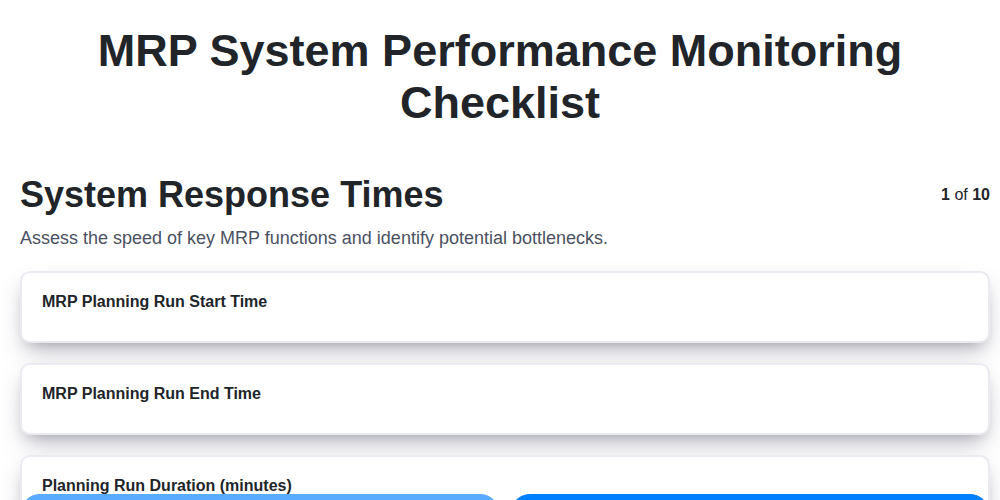
MRP System Performance Monitoring Checklist: Ensure Peak Efficiency
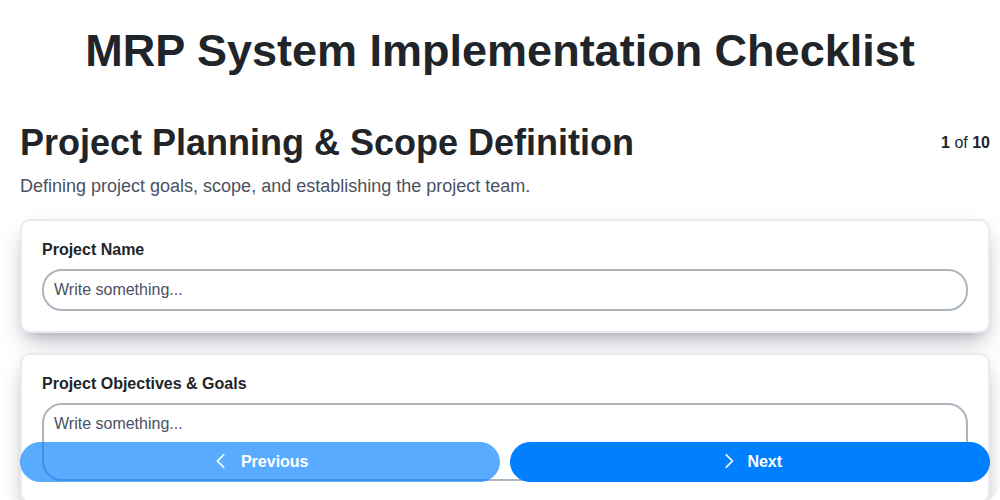
MRP System Implementation Checklist: Your Step-by-Step Guide

Top 10 MRPeasy Alternatives for 2025

The 5 Best Bill of Materials (BOM) Management Software of 2025
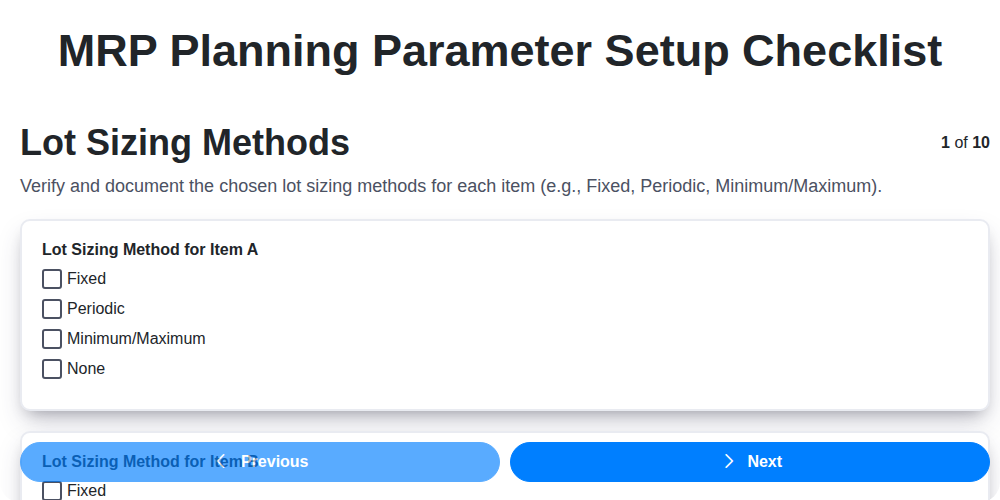
MRP Planning Parameter Setup Checklist: Your Guide to Accuracy & Efficiency

The 10 Best Manufacturing Management Software of 2025
How to improve your Bill of Materials (BOM) Management
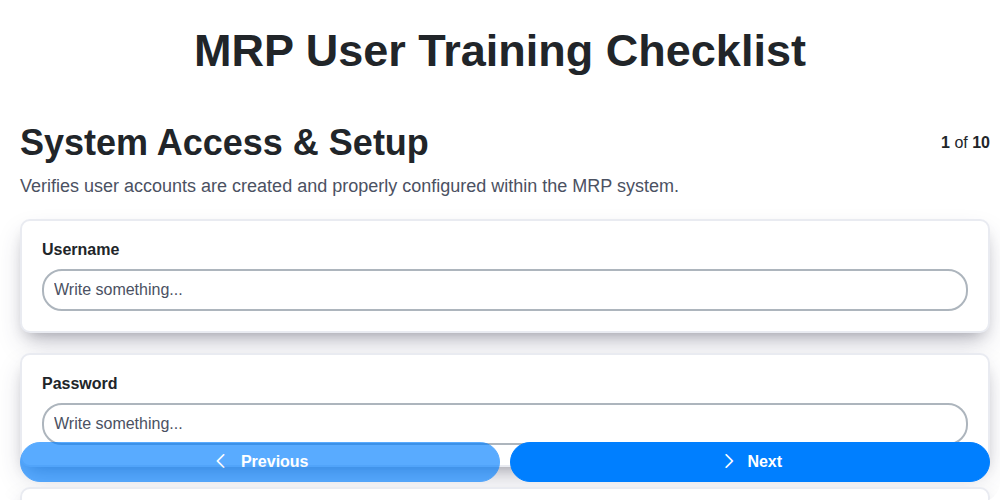
MRP User Training Checklist: Ensuring Proficiency & Success
We can do it Together
Need help with
Material Requirements Planning (MRP)?
Have a question? We're here to help. Please submit your inquiry, and we'll respond promptly.