Mastering MRP Scrap & Waste: Your Ultimate Checklist for Efficiency
Published: 12/14/2025 10:00 PM Updated: 12/15/2025 1:52 PM
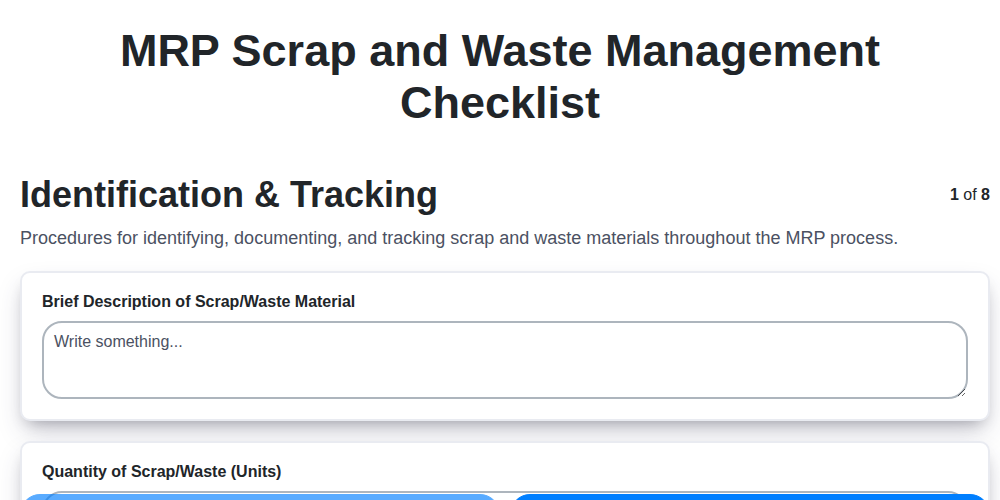
Table of Contents
- Introduction: The High Cost of Scrap & Waste
- Why an MRP Scrap & Waste Management Checklist Matters
- 1. Identification & Tracking: Knowing Where It's Coming From
- 2. Segregation & Storage: Organizing for Recovery & Disposal
- 3. Disposal & Recycling: Responsible End-of-Life Management
- 4. Costing & Reporting: Quantifying the Problem & Measuring Progress
- 5. Root Cause Analysis: Digging Deeper to Find the Source
- 6. Process Improvement: Implementing Solutions for Waste Reduction
- 7. Regulatory Compliance: Meeting Legal & Environmental Obligations
- 8. Training & Awareness: Empowering Your Team
- 9. Integrating Scrap & Waste Data with Your MRP System
- 10. Key Performance Indicators (KPIs) for Scrap & Waste
- 11. Auditing Your Scrap & Waste Management Program
- Conclusion: Achieving Sustainability and Profitability
- Resources & Links
TLDR: Stop letting scrap and waste eat into your MRP profits! This checklist guides you through identifying, managing, and reducing material waste - from tracking and segregation to disposal, reporting, and process improvements. Implement it to save money, boost efficiency, and ensure regulatory compliance within your MRP system.
Introduction: The High Cost of Scrap & Waste
In manufacturing, the terms scrap and waste often evoke images of discarded materials - leftover fabric, metal shavings, unusable parts. However, they represent far more than just physical debris. They represent lost revenue, increased operational costs, and potential environmental liabilities.
The reality is, scrap and waste aren't just a byproduct; they're a significant drain on profitability. Beyond the obvious cost of the raw materials themselves, consider the labor involved in handling it, the space it occupies, and the potential for process inefficiencies that cause it in the first place. Ignoring or inadequately managing these issues can erode margins, hinder competitiveness, and even expose your company to regulatory penalties. This checklist and the practices it outlines are designed to move beyond simply dealing with the end result, and instead proactively minimize scrap and waste across your entire MRP system. Let's explore how to tackle this critical challenge head-on.
Why an MRP Scrap & Waste Management Checklist Matters
Managing scrap and waste in a Manufacturing Resource Planning (MRP) environment isn't just about minimizing environmental impact; it's a critical component of operational efficiency and profitability. Without a structured approach, scrap and waste can silently erode your margins, disrupt production schedules, and expose your business to regulatory risks.
An MRP Scrap & Waste Management Checklist provides a systematic way to address these challenges. It moves beyond reactive cleanup to proactive prevention, ensuring every stage - from initial identification to final disposal - is accounted for and optimized. This isn't just about ticking boxes; it's about fostering a culture of responsibility, improving material utilization, and unlocking valuable data insights that can drive continuous improvement within your entire manufacturing process. Ignoring scrap and waste means ignoring a significant opportunity to boost your bottom line and build a more sustainable business.
1. Identification & Tracking: Knowing Where It's Coming From
Effective scrap and waste management begins with knowing exactly what's being generated and where it originates. Without accurate identification and tracking, you're flying blind. This initial step is crucial for pinpointing problem areas and implementing targeted improvements.
Here's what your identification and tracking process should include:
- Unique Identification Codes: Assign unique codes to each type of scrap or waste material. This might be linked to the specific machine, process, or material used.
- Detailed Records: Implement a system (digital or manual) to record every instance of scrap/waste. Essential data points include:
- Date and Time of Generation
- Material Type (using your unique codes)
- Process/Machine/Workstation of Origin
- Quantity Generated (weight or volume)
- Operator/Employee Responsible (if applicable)
- Real-Time Monitoring (Ideal): Consider integrating sensors and data logging systems for real-time monitoring of waste generation, especially for high-volume processes.
- Regular Audits: Conduct periodic audits to verify the accuracy of data being recorded and identify any gaps in the tracking system.
- Visual Marking: Clearly label all containers and designated areas for different scrap/waste streams to prevent accidental mixing.
Accurate identification and tracking lays the foundation for all subsequent steps in your waste management program, providing the data you need to optimize your processes and minimize waste.
2. Segregation & Storage: Organizing for Recovery & Disposal
Proper segregation and storage are critical steps in minimizing waste and maximizing recovery potential within your MRP scrap and waste management program. Simply tossing everything into a general waste bin defeats the purpose of diligent tracking and potential recycling efforts. Here's what you need to consider:
- Clearly Defined Segregation Categories: Establish a clear categorization system for different types of scrap and waste. Common categories might include: metals (ferrous, non-ferrous), plastics (types should be specified if possible), wood, paper, chemicals, electronic waste (e-waste), and general waste.
- Color-Coded Containers: Implement a color-coded system for bins and containers. This is a visual cue for employees, ensuring materials are placed in the correct location. A legend should be prominently displayed near the bins.
- Designated Storage Areas: Allocate specific, well-ventilated, and secure areas for storing segregated materials. Consider factors like material compatibility (avoiding hazardous reactions), weather protection, and accessibility for disposal/recycling processes.
- Labeling is Key: Each container must be clearly and accurately labeled with its contents. Include specific material types (e.g., "Aluminum Scrap", "HDPE Plastic").
- Spill Prevention & Containment: For materials like chemicals or oily rags, ensure spill containment measures are in place (e.g., drip trays, absorbent materials).
- Regular Inspections: Conduct routine checks of storage areas to ensure proper segregation, container integrity, and prevent leaks or spills. Correct any issues immediately.
- Employee Communication: Clearly communicate the segregation guidelines to all employees involved in scrap and waste generation.
3. Disposal & Recycling: Responsible End-of-Life Management
Proper disposal and recycling are crucial for minimizing environmental impact and maximizing resource recovery from MRP scrap and waste. This goes beyond simply throwing materials away; it's about a strategic approach to end-of-life management.
Key Actions:
- Waste Characterization: Accurately identify the composition of your scrap and waste streams. This informs the best disposal/recycling methods. Consider lab testing if necessary for hazardous materials.
- Recycling Prioritization: Prioritize materials suitable for recycling (metals, plastics, paper, etc.). Establish relationships with reputable recycling vendors who can handle your specific waste types.
- Hazardous Waste Management: Strictly adhere to regulations for handling and disposing of hazardous materials. This includes proper labeling, storage, and manifesting. Document everything meticulously.
- Vendor Due Diligence: Vet recycling and disposal vendors to ensure they adhere to ethical and environmentally responsible practices. Request certifications and audit reports.
- Waste Reduction Opportunities: Explore opportunities to reduce waste generation at the source. Can materials be reused internally or returned to suppliers?
- Documentation: Maintain detailed records of all disposal and recycling activities, including vendor receipts, manifests, and certifications. This is critical for compliance and tracking progress.
- Closed-Loop Systems: Where possible, investigate closed-loop systems that return materials to your production process, minimizing waste and maximizing resource utilization.
4. Costing & Reporting: Quantifying the Problem & Measuring Progress
Effective scrap and waste management isn't just about reducing environmental impact; it's about bolstering your bottom line. Robust costing and reporting provide the data needed to understand the true financial impact of scrap and waste within your MRP system, allowing you to track progress and justify improvement initiatives.
Here's how to tackle this critical aspect:
- Define Scrap & Waste Categories: Establish clear categories for different types of scrap (e.g., material waste, defective products, rework) and waste (e.g., packaging, unusable byproducts). This allows for more granular tracking and cost allocation.
- Assign Costs Accurately: Don't just look at the raw material cost. Factor in labor involved in handling scrap, energy used, potential rework costs, and disposal fees. Integrate these costs directly into your MRP system for a comprehensive view.
- Establish Key Performance Indicators (KPIs): Track metrics like scrap rate (scrap/production), waste generation per unit, disposal costs per ton, and recycling revenue. Setting baseline data and target KPIs provides a clear roadmap for improvement.
- Regular Reporting: Implement regular (weekly, monthly, quarterly) reports outlining scrap and waste generation trends, associated costs, and progress towards KPIs. Share these reports with relevant stakeholders - production managers, finance, and leadership - to drive accountability.
- Tie to MRP Data: Leverage your MRP system's capabilities to link scrap and waste data to specific work orders, BOMs (Bill of Materials), and production runs. This allows for detailed analysis and identification of areas with the highest scrap generation.
By meticulously tracking costs and generating insightful reports, you transform scrap and waste management from a reactive necessity into a proactive opportunity for efficiency and cost savings.
5. Root Cause Analysis: Digging Deeper to Find the Source
Simply reacting to scrap and waste events - cleaning it up and documenting it - only addresses the symptom, not the underlying problem. True, sustainable reduction in material loss requires a robust root cause analysis (RCA) process. This isn't about blame; it's about understanding why the waste is happening in the first place.
Start with the immediate event. Utilize tools like the 5 Whys technique - repeatedly asking Why? to drill down past initial explanations. For example:
- Event: Excessive scrap in the cutting department.
- Why? The blade was dull.
- Why? The blade wasn't sharpened regularly.
- Why? The sharpening schedule was not being followed.
- Why? The operator wasn't aware of the schedule.
- Why? There's no clear communication of maintenance schedules to operators.
This simple example reveals a communication breakdown, not just a dull blade. RCA should also consider human factors (training, fatigue), equipment malfunctions, material quality issues, and process variations.
Document the RCA findings thoroughly, including contributing factors, and link them directly to corrective actions within the system. Without this link, it's easy to lose sight of the lessons learned and revert to old habits.
6. Process Improvement: Implementing Solutions for Waste Reduction
Identifying the root causes of scrap and waste is only half the battle. The real power lies in implementing effective process improvements to address those causes and prevent recurrence. This isn't a one-and-done activity; it's an ongoing cycle of analysis, implementation, and refinement.
Here's how to move beyond analysis and into tangible solutions:
- Prioritize Improvements: Not all scrap and waste streams are created equal. Rank them based on cost impact, volume, and ease of implementation. Tackle the low-hanging fruit first to demonstrate quick wins and build momentum.
- Implement Corrective Actions: Based on your root cause analysis, develop specific, measurable, achievable, relevant, and time-bound (SMART) corrective actions. Examples include:
- Machine Adjustments: Fine-tune equipment settings to minimize defects.
- Material Substitution: Explore alternative materials that generate less waste or are easier to recycle.
- Design Modifications: Redesign products or components to reduce material usage and improve manufacturability.
- Workflow Optimization: Streamline processes to eliminate unnecessary steps and reduce handling errors.
- Pilot Programs: Before full-scale implementation, pilot proposed improvements in a limited area. This allows you to assess their effectiveness and make necessary adjustments.
- Continuous Monitoring & Feedback: Establish metrics to track the impact of improvements. Regularly review performance data and gather feedback from operators and other stakeholders. Use this information to further refine processes and identify new opportunities for reduction.
- Standardize Best Practices: Once an improvement proves successful, formally document it and integrate it into standard operating procedures (SOPs). This ensures that the positive changes are sustained over time.
- Embrace Lean Principles: Incorporating Lean Manufacturing principles, such as Value Stream Mapping and 5S, can offer a holistic approach to eliminating waste and improving overall efficiency.
7. Regulatory Compliance: Meeting Legal & Environmental Obligations
MRP (Material Requirements Planning) scrap and waste management isn't just about minimizing environmental impact; it's often a legal requirement. Depending on your industry, location, and the types of materials you're dealing with, you're likely subject to various regulations. These can range from local ordinances regarding waste disposal to national and international laws concerning hazardous materials handling and reporting.
Staying compliant requires a proactive approach. Regularly review applicable laws and regulations, which may include:
- Environmental Protection Agency (EPA) guidelines: Particularly relevant for hazardous waste management.
- Local waste disposal ordinances: Often dictate permitted disposal methods and reporting requirements.
- Industry-specific regulations: Many sectors, like manufacturing or electronics, have tailored regulations.
- REACH and RoHS compliance: Important for organizations dealing with restricted substances.
- Waste tracking and reporting requirements: Many jurisdictions require detailed records of waste generation, handling, and disposal.
Your scrap and waste management plan should explicitly address these legal obligations. This includes maintaining accurate records, implementing proper labeling procedures, ensuring licensed disposal partners are used, and conducting periodic audits to verify compliance. Failure to adhere to these regulations can result in significant fines, legal action, and damage to your company's reputation. Consult with legal and environmental experts to ensure your practices are aligned with current requirements.
8. Training & Awareness: Empowering Your Team
Effective scrap and waste management isn't just about processes and procedures; it's about the people executing them. A well-trained and aware team is the bedrock of a successful program. This section focuses on fostering a culture of responsibility and understanding regarding MRP scrap and waste.
What to Cover in Your Training:
- Identification & Categorization: Ensure everyone understands what constitutes scrap and waste, and how to properly categorize it based on your defined system. This includes both material-specific training (e.g., identifying different types of plastic) and understanding the significance of accurate tagging.
- Segregation Best Practices: Reinforce the "why" behind segregation - reduced contamination, improved recycling potential, and accurate cost tracking. Demonstrate the correct procedures for designated containers and areas.
- Safety Protocols: Highlight potential hazards associated with different waste streams (e.g., sharp objects, hazardous chemicals) and emphasize proper handling techniques and PPE usage.
- Reporting Procedures: Make it clear how and when to report scrap and waste, including proper documentation and communication channels.
- Regulatory Requirements: Briefly cover relevant environmental regulations and the importance of compliance.
- Continuous Improvement: Encourage employees to actively participate in identifying areas for improvement and to suggest innovative solutions.
Delivery Methods:
- New Employee Onboarding: Integrate scrap and waste management training into your standard onboarding process.
- Regular Refreshers: Conduct periodic refresher training sessions to reinforce best practices and address any changes in procedures.
- Toolbox Talks: Short, focused discussions during shift changes to highlight specific topics or address common mistakes.
- Visual Aids: Utilize posters, infographics, and short videos to reinforce key concepts.
- Interactive Sessions: Engage employees with quizzes, scenarios, and hands-on activities to enhance learning and retention.
Measuring Effectiveness:
- Knowledge Assessments: Periodic quizzes or tests to gauge understanding of the program.
- Observation Audits: Monitor employee adherence to procedures.
- Feedback Mechanisms: Encourage open communication and solicit suggestions for improvement.
By investing in training and awareness, you empower your team to become active participants in minimizing scrap, maximizing recycling, and contributing to a more sustainable operation.
9. Integrating Scrap & Waste Data with Your MRP System
Your MRP (Material Requirements Planning) system is the backbone of your production planning and inventory control. To truly maximize its potential in minimizing scrap and waste, you need to integrate scrap and waste data directly into it. This isn't just about recording these figures; it's about creating a closed-loop system that drives continuous improvement.
Here's why and how to do it:
- Real-Time Visibility: Linking scrap and waste data to your MRP allows you to see the immediate impact of production runs and material usage. This live feedback loop helps identify problem areas faster than relying on periodic reports.
- Accurate Costing: Your MRP system tracks material costs. Incorporating scrap and waste figures - including disposal and recycling expenses - provides a more accurate picture of your true product costs. This impacts pricing decisions, profitability analysis, and inventory valuation.
- Demand Planning Refinement: Understanding waste patterns related to specific materials or processes can influence future demand planning. You might adjust order quantities, change material specifications, or seek alternative suppliers.
- Process Optimization: Integrating the data allows for a deeper dive into why scrap is occurring. Was it a specific batch of material? A change in operator skill? A flawed machine setting? The MRP system's historical data can provide invaluable clues.
- Automated Reporting: Instead of manual compilation, the MRP system can generate automated reports on scrap and waste trends, allowing for proactive decision-making.
- Data Enrichment: Tagging scrap data with relevant production parameters (machine ID, operator, date/time) allows for more granular analysis and correlation.
Implementation Considerations:
- Customization: You may need to customize your MRP system or develop integrations to accommodate the unique data points you track for scrap and waste.
- Data Mapping: Clearly define how scrap and waste data will map to existing MRP fields (e.g., material codes, cost centers, work orders).
- User Training: Train personnel on how to properly record scrap and waste data within the MRP system.
10. Key Performance Indicators (KPIs) for Scrap & Waste
Effectively managing MRP scrap and waste isn't just about following procedures; it's about continuously improving. To ensure your efforts are impactful, track these vital KPIs:
- Scrap Rate (%): This is the cornerstone. (Total Scrap Weight / Total Production Weight) x 100. A declining rate indicates process improvements are working.
- Waste Generation per Unit: (Total Waste Weight / Number of Units Produced). Helps pinpoint areas with the highest waste contribution.
- Recycling Rate (%): (Weight of Materials Recycled / Total Waste Weight) x 100. Demonstrates commitment to sustainability and potential cost savings.
- Disposal Costs: Tracks the financial burden of waste disposal and motivates exploration of alternative methods (recycling, reuse).
- Material Recovery Value: (Value of Recycled Materials - Costs of Recycling). This shows the financial benefit of recycling programs.
- Root Cause Analysis Completion Rate: (Number of Root Cause Analyses Completed / Number of Scrap/Waste Incidents) x 100. Shows how consistently you're addressing the why behind waste.
- Training Completion Rate: (Number of Employees Trained / Total Number of Relevant Employees) x 100. Ensures all personnel understand and adhere to scrap and waste management procedures.
- Process Improvement Implementation Rate: (Number of Process Improvements Implemented / Number of Process Improvement Ideas Generated). Shows the speed and effectiveness of turning insights into action.
- Percentage of Waste Diverted from Landfill: (Weight of Waste Diverted / Total Waste Weight) x 100. A key metric for environmental responsibility.
- Cost of Scrap per Labor Hour: (Total Scrap Cost / Total Labor Hours). Helps identify if labor practices contribute to scrap generation.
Regularly monitoring these KPIs allows for data-driven decision-making, showcasing the effectiveness of your scrap and waste management program, and driving continuous improvement.
11. Auditing Your Scrap & Waste Management Program
Regular audits are crucial for ensuring your MRP scrap and waste management program is effective and continuously improving. Don't treat it as a one-and-done exercise; think of it as a vital part of your ongoing operational excellence journey. Here's what to focus on:
Frequency: Ideally, conduct full audits at least annually, with more frequent spot checks focused on specific areas identified as potential problem zones.
What to Review:
- Documentation: Verify that all scrap and waste data is accurately recorded and traceable. Check identification tags, storage logs, disposal records, and recycling manifests.
- Process Adherence: Observe employees following procedures for identification, segregation, and storage. Are materials being handled correctly?
- Segregation Effectiveness: Are different waste streams being properly segregated? Is contamination minimal?
- Storage Conditions: Confirm storage areas are safe, secure, and environmentally sound, minimizing the risk of leaks, spills, or unauthorized access.
- Disposal Records: Ensure all disposal and recycling activities are documented and compliant with regulations. Verify proper chain of custody.
- Costing Accuracy: Review the accuracy of scrap and waste cost calculations. Are costs being tracked correctly and attributed to the appropriate processes?
- Reporting Compliance: Validate the accuracy and timeliness of reporting to management and relevant stakeholders.
- Training Records: Confirm that employees have received appropriate training and that records are up-to-date.
Audit Team: Assemble a team that includes representatives from production, engineering, finance, and environmental health and safety (EHS). An independent external auditor can also provide an unbiased perspective.
Corrective Actions: The audit should result in a clear list of corrective actions with assigned owners and deadlines. Track the implementation of these actions and verify their effectiveness in subsequent audits.
Conclusion: Achieving Sustainability and Profitability
Ultimately, implementing a robust MRP Scrap and Waste Management Checklist isn't just about minimizing environmental impact; it's about bolstering your bottom line and building a more resilient operation. By systematically addressing identification, segregation, disposal, costing, analysis, and improvement, you're not only reducing waste but uncovering hidden inefficiencies and opportunities for optimization within your manufacturing processes. Consistent adherence to regulatory compliance and a commitment to ongoing training ensures long-term sustainability. This holistic approach transforms what was once a cost center - scrap and waste - into a source of valuable data and a catalyst for continuous improvement, driving both environmental responsibility and tangible profitability. Embracing this checklist isn't merely best practice; it's a strategic investment in the future of your manufacturing business.
Resources & Links
- United States Environmental Protection Agency (EPA): Provides extensive information and guidance on waste management, recycling, and regulatory compliance. A crucial resource for understanding environmental responsibilities.
- International Organization for Standardization (ISO): Provides information on ISO 14001 (Environmental Management Systems) and other relevant standards for sustainable operations. Focuses on consistent and documented processes.
- National Institute of Standards and Technology (NIST): While not exclusively focused on waste, NIST provides resources on lean manufacturing principles, statistical process control (SPC), and quality management which are vital for scrap reduction. Focuses on precision and measurement.
- APICS (The Association for Supply Chain Management): Offers resources, certifications (like CPIM and CSCP), and training related to MRP, inventory management, and overall supply chain efficiency, which can inform waste reduction strategies.
- The Lean Enterprise Institute: A leading resource for Lean manufacturing principles, which directly contribute to eliminating waste in production processes - a cornerstone of scrap reduction.
- WasteWise: Provides information and guidance on waste reduction, resource efficiency, and circular economy principles, particularly relevant to businesses looking to move beyond simple disposal.
- The Recycling Partnership: Offers data and resources related to recycling infrastructure and best practices, essential for ensuring proper recycling processes are followed.
- American Society for Quality (ASQ): Offers resources and certifications (like Six Sigma) related to quality management and process improvement, invaluable for root cause analysis and waste reduction initiatives.
- Sustainability Accounting Standards Board (SASB): Provides industry-specific standards for reporting on sustainability performance, including waste and recycling metrics. Useful for larger companies demonstrating commitment to stakeholders.
- The Circular Economy Innovation Network (CEIN): Provides resources, case studies, and a community focused on transitioning to a circular economy, reducing waste and maximizing resource utilization.
- NAM (National Association of Manufacturers): Provides resources and insights for manufacturers, including information related to sustainability, efficiency, and cost reduction, potentially covering scrap management.
Frequently Asked Questions
What is MRP scrap and waste and why is it important to manage?
MRP (Material Requirements Planning) scrap and waste refer to materials lost or unusable during the production process that are tracked within the MRP system. Managing it is crucial for accurate material planning, cost control, and improved overall efficiency - it directly impacts inventory levels and production costs. Ignoring it leads to inaccurate requirements planning, overstocking of raw materials, and potentially, hidden costs and reduced profit margins.
What's the difference between scrap and waste in an MRP context?
While often used interchangeably, in MRP, 'scrap' typically refers to materials lost during processing, like unusable cuttings or defective parts deemed unrepairable. 'Waste' can encompass scrap but also includes materials lost due to inefficient processes or obsolescence, even if it's not directly due to a defective product. Tracking both is key, but often they are grouped together for reporting.
Who is responsible for tracking MRP scrap and waste?
Responsibility is typically shared across multiple roles. Production supervisors are usually responsible for immediate recording, quality control for identifying the root causes of scrap, and the MRP planner utilizes the data for adjusting material requirements and improving process controls. A designated 'scrap champion' within a department can also facilitate consistent tracking.
What information should be recorded for each instance of scrap/waste?
Essential data includes the material code, quantity scrapped/wasted, date, reason code (e.g., process error, defect, obsolescence), operation/work center, and the employee responsible. Adding notes on the specific issue encountered can also be valuable for root cause analysis.
What is a 'reason code' and why are they important for scrap/waste tracking?
Reason codes categorize the causes of scrap or waste (e.g., tooling failure, operator error, material defect). These codes allow for easy aggregation and analysis of data, pinpointing recurring problems and enabling targeted corrective actions. Standardized codes ensure consistent reporting across departments.
How does accurate scrap/waste tracking impact MRP planning?
Tracking scrap and waste allows MRP planners to adjust material requirements more precisely. Knowing the typical scrap rate for a process enables them to order slightly less raw material, reducing excess inventory and minimizing waste. It also highlights areas needing process improvement.
What types of software or systems can be used to manage MRP scrap and waste?
Many ERP systems (like SAP, Oracle, NetSuite) have built-in scrap and waste tracking modules. Standalone inventory management software or even dedicated scrap tracking software can also be used. Excel spreadsheets are a basic option, but prone to errors and less efficient.
What are some common reasons for high scrap/waste levels?
Common causes include poorly maintained equipment, inadequate operator training, defective raw materials, inefficient process designs, insufficient quality control checks, and inadequate material handling procedures.
How can I identify the root cause of recurring scrap/waste issues?
Use tools like the '5 Whys' technique, fishbone diagrams (Ishikawa diagrams), or Pareto charts to investigate the underlying causes. Cross-functional teams involving production, quality control, and maintenance are often helpful for a thorough investigation.
What are some proactive steps to reduce scrap and waste in my MRP system?
Implement preventative maintenance programs, invest in operator training, review and optimize process designs, improve quality control checks, and establish a robust material handling system. Regularly analyze scrap/waste data and identify opportunities for improvement.
Found this Article helpful?
Comments
There are no comments yet. Be the first to add one!
Related Articles
MRP System Performance Monitoring Checklist: Ensure Peak Efficiency
MRP System Implementation Checklist: Your Step-by-Step Guide

Top 10 MRPeasy Alternatives for 2025
The 5 Best Bill of Materials (BOM) Management Software of 2025
MRP Planning Parameter Setup Checklist: Your Guide to Accuracy & Efficiency

The 10 Best Manufacturing Management Software of 2025
How to improve your Bill of Materials (BOM) Management
MRP User Training Checklist: Ensuring Proficiency & Success
We can do it Together
Need help with
Material Requirements Planning (MRP)?
Have a question? We're here to help. Please submit your inquiry, and we'll respond promptly.