MRP System Audit Checklist: Ensuring Accuracy and Efficiency
Published: 12/14/2025 10:00 PM Updated: 12/15/2025 2:02 PM
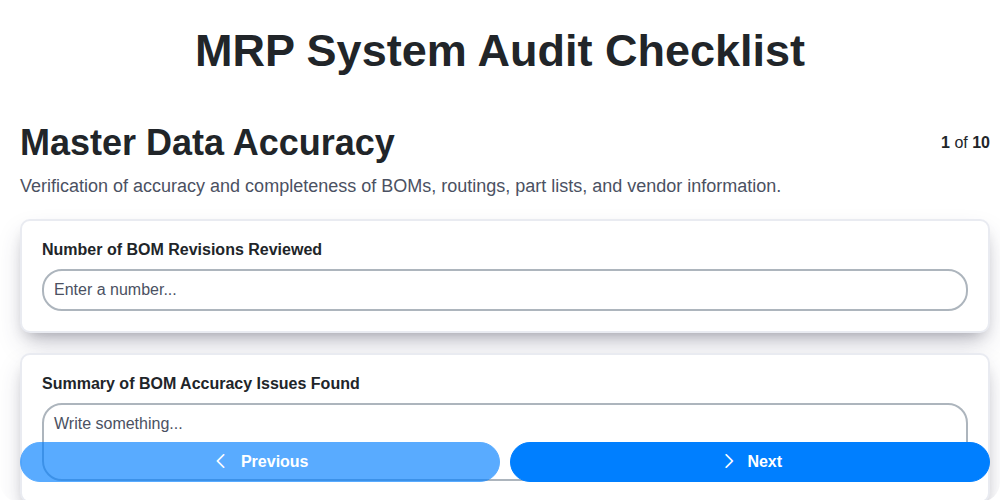
Table of Contents
- Introduction: Why an MRP System Audit Matters
- 1. Master Data Accuracy: The Foundation of Success
- 2. Planning Parameter Validation: Fine-Tuning Your Forecasts
- 3. Data Integrity Checks: Verifying Data Consistency
- 4. User Access and Security: Protecting Sensitive Information
- 5. System Configuration Review: Ensuring Optimal Setup
- 6. Planning and Execution Alignment: Bridging the Gap
- 7. Reporting and Analytics: Measuring Performance
- 8. Change Management Process: Handling Modifications Effectively
- 9. Documentation Completeness: Keeping Records Organized
- 10. Compliance and Regulatory Adherence: Staying on the Right Side of the Law
- 11. Addressing Audit Findings: A Proactive Approach
- 12. Continuous Improvement: Maintaining Audit Effectiveness
- Conclusion: Maximizing Your MRP System's Value
- Resources & Links
TLDR: Running an MRP system audit? This checklist covers everything from data accuracy and user access to compliance and reporting. Use it to identify weaknesses, boost efficiency, and ensure your MRP system is working optimally for your business!
Introduction: Why an MRP System Audit Matters
An MRP (Material Requirements Planning) system is the backbone of efficient manufacturing, but its effectiveness hinges on consistent accuracy and adherence to best practices. Just like any critical business system, your MRP isn't foolproof and requires regular check-ups. A comprehensive MRP system audit isn't just a good idea; it's a necessity for maintaining operational excellence, minimizing costly errors, and maximizing the return on your investment.
Think of it as preventative maintenance for your entire production process. Neglecting an MRP system audit can lead to inaccurate forecasts, production bottlenecks, excess inventory (or worse, shortages), and ultimately, dissatisfied customers. This post will outline a detailed checklist to guide you through a thorough MRP audit, ensuring your system is functioning optimally and supporting your business goals. We'll cover everything from data accuracy to compliance, empowering you to proactively identify and address potential issues before they impact your bottom line.
1. Master Data Accuracy: The Foundation of Success
Master data - encompassing information about your materials, customers, vendors, and employees - is the bedrock of any successful MRP system. Inaccurate or outdated master data leads to a ripple effect of problems, from inaccurate forecasts and procurement errors to production bottlenecks and dissatisfied customers. This isn't just about typos; it's about ensuring that every record is complete, consistent, and reflects the current reality of your business.
During an MRP system audit, meticulously examine the following:
- Bill of Materials (BOM) Accuracy: Are BOMs complete, accurate, and reflecting engineering changes? Verify component usage, quantities, and alternate components.
- Item Master Data: Confirm correct descriptions, units of measure, lead times, scrap factors, and costing information for all materials.
- Vendor Master Data: Validate vendor contact information, payment terms, pricing, and lead times. Incorrect data here directly impacts procurement efficiency.
- Customer Master Data: Ensure accurate addresses, contact names, payment terms, and pricing agreements.
- Routing Accuracy: Are routing steps accurate, reflecting current manufacturing processes and labor standards?
- Data Validation Rules: Are appropriate data validation rules in place to prevent incorrect data entry? Are these rules actively enforced?
- Data Governance: Is there a clear data governance policy defining roles and responsibilities for maintaining master data accuracy?
Regular cleansing and validation of master data are not just recommended; they are essential for maximizing the value of your MRP system. Neglecting this crucial area undermines the entire process.
2. Planning Parameter Validation: Fine-Tuning Your Forecasts
Your MRP system's planning parameters are the gears that drive your production schedule. Incorrect or outdated parameters can lead to inaccurate forecasts, excess inventory, stockouts, and ultimately, dissatisfied customers. This section of the audit focuses on verifying these critical settings.
Here's what we're looking at:
- Lead Times: Are lead times for raw materials, components, and finished goods accurate and up-to-date? Review historical performance data to identify any discrepancies.
- Safety Stock Levels: Are safety stock calculations appropriate for demand variability and lead time fluctuations? Evaluate coverage rates and potential for obsolescence.
- Lot Sizes: Are lot sizes optimized for efficiency and cost-effectiveness, considering setup costs and holding costs? Consider both economic order quantity (EOQ) and periodic order quantity (POQ) methodologies.
- Production Capacity: Does the system accurately reflect production capacity for each work center, factoring in machine availability, labor hours, and potential bottlenecks? Regularly update capacity data as changes occur.
- Demand Forecasts: Are the methodologies used for generating demand forecasts (e.g., historical data, statistical models, sales input) appropriate and producing reliable results? Examine forecast accuracy metrics and identify areas for improvement.
- Planning Horizon: Is the planning horizon sufficient to accommodate material lead times and production schedules?
- Bill of Materials (BOM) Logic: Verify BOM logic, especially for engineering changes and product variations, ensuring correct material requirements are calculated.
A thorough review of these planning parameters is crucial to ensure your MRP system provides a realistic and actionable production plan. Don't just accept the defaults - actively validate and refine these settings based on your specific business needs and ongoing performance data.
3. Data Integrity Checks: Verifying Data Consistency
A robust MRP system hinges on data integrity - the assurance that your data is accurate, consistent, and reliable throughout its lifecycle. These checks go beyond simply confirming data exists; they verify that it makes sense and aligns with business realities. Neglecting this area can lead to inaccurate forecasts, inefficient production schedules, and ultimately, costly mistakes.
Here's what a thorough data integrity check for your MRP system should involve:
- Transaction History Validation: Review a sample of historical transactions (purchase orders, production orders, inventory adjustments) to confirm they were processed correctly and reflected in the system. Look for discrepancies between recorded data and actual events.
- Formula and Calculation Accuracy: Many MRP systems rely on complex formulas to calculate demand, lead times, and material requirements. Verify these calculations are accurate and aligned with your business logic. This often involves testing with sample data sets.
- Inventory Reconciliation: Regularly compare physical inventory counts with MRP system records. Significant discrepancies should be investigated and resolved promptly. Cycle counting and physical inventory audits are crucial.
- Bill of Material (BOM) Consistency: Ensure BOMs are accurate and up-to-date, reflecting the actual components required to manufacture your products. Review BOM structures, item numbers, and quantities.
- Routing Validation: Confirm routing information is accurate and reflects the correct sequence of operations needed for production.
- Unit of Measure Consistency: Verify consistent use of units of measure across all data entries (e.g., inches vs. centimeters). Inconsistent units will wreak havoc on calculations.
- Data Type Validation: Ensure data fields contain the expected type of information (e.g., dates are formatted correctly, numbers are numeric).
- Duplicate Record Identification: Regularly scan for and eliminate duplicate records (e.g., part numbers, vendors) that can skew reporting and planning.
A proactive approach to data integrity checks-implemented regularly and documented-is an investment that pays dividends in improved planning, reduced waste, and enhanced operational efficiency.
4. User Access and Security: Protecting Sensitive Information
An MRP system holds critical data relating to inventory, production, and finances. Weaknesses in user access and security can lead to data breaches, unauthorized modifications, and ultimately, significant operational disruption. This checklist item focuses on verifying the robustness of your system's security posture.
Here's what to examine:
- Role-Based Access Control (RBAC): Are users assigned roles with the minimum necessary permissions to perform their duties? Regularly review and update role definitions.
- Password Policies: Enforce strong password requirements - length, complexity, expiration. Are these policies being consistently applied and enforced?
- Multi-Factor Authentication (MFA): Is MFA implemented for all users, especially those with elevated privileges? Consider expanding MFA beyond just administrative access.
- Audit Trails: Verify the system maintains comprehensive audit trails tracking user actions, including data modifications and system configuration changes. Review these logs periodically.
- User Account Management: Establish a documented process for creating, modifying, and disabling user accounts, particularly when employees join, leave, or change roles.
- Privilege Creep: Regularly audit user permissions to identify and remediate any privilege creep - where users gain unnecessary access over time.
- External Access: Carefully control access for external users (e.g., vendors, customers). Implement secure connection methods and limit data exposure.
- Security Patching: Ensure the MRP system and all related infrastructure are consistently patched with the latest security updates.
5. System Configuration Review: Ensuring Optimal Setup
Your MRP system's effectiveness hinges on its configuration. It's not enough to simply install the software; it needs to be meticulously set up to reflect your business processes and optimize performance. A thorough review of the system configuration should be a regular part of your MRP audit.
This isn't just about checking boxes; it's about ensuring the system works for you. Consider these areas:
- Bill of Materials (BOM) Structure: Are your BOMs accurate, complete, and reflecting current product designs? Incorrect BOMs lead to material shortages, excess inventory, and ultimately, production delays.
- Routing Accuracy: Are your routing instructions (the sequence of operations to manufacture a product) accurate and efficient? Outdated routes can significantly impact lead times and overall efficiency.
- Lead Time Settings: Review all lead times - procurement, manufacturing, and delivery. Are these realistic? Are they regularly updated to reflect changes in suppliers and internal processes?
- Capacity Planning: Verify that your capacity planning parameters accurately reflect your available resources (machines, labor). Overly optimistic capacity planning leads to missed deadlines.
- Lot Sizing and Sequencing: Are lot sizing rules optimized for cost and efficiency? Consider economic order quantity (EOQ) and other relevant factors.
- Work Centers and Resource Definitions: Ensure work centers are accurately defined and linked to the correct resources.
- Inventory Management Parameters: Re-examine safety stock levels, reorder points, and inventory valuation methods.
A poorly configured system can negate the benefits of even the best processes. Regular review and adjustment are critical for sustained MRP effectiveness.
6. Planning and Execution Alignment: Bridging the Gap
A robust MRP system isn't just about accurate plans; it's about translating those plans into tangible action. This section of the audit focuses on verifying that your planning and execution teams are operating in sync, and that the MRP system is effectively supporting that alignment.
We're looking for several key indicators:
- Shop Floor Integration: Does the MRP system seamlessly communicate with your shop floor operations? Are production orders released accurately and in a timely manner based on the MRP output? Investigate any discrepancies between planned and actual start/finish times.
- Material Availability: Confirm that material releases are triggered appropriately based on planned production schedules. Are shortages anticipated and proactively addressed?
- Capacity Planning Validation: Review capacity plans against actual production capacity. Are bottlenecks identified and managed within the MRP system? Is the system reflecting realistic lead times and setup times?
- Feedback Loops: Does production provide feedback to the planning team regarding performance, issues, and potential adjustments needed to future plans? Is this feedback integrated back into the MRP system?
- Performance Metrics: Are key performance indicators (KPIs) related to planning and execution (e.g., on-time delivery, cycle time, WIP levels) being tracked and analyzed? Do these metrics highlight areas for improvement?
A misalignment here leads to missed deadlines, increased costs, and frustrated teams. Addressing these issues ensures your MRP system is a true driver of operational efficiency.
7. Reporting and Analytics: Measuring Performance
A robust MRP system isn't just about planning; it's about knowing how well your planning is working. Effective reporting and analytics are crucial for identifying areas of improvement, validating planning decisions, and ultimately, driving efficiency. This section of the audit digs into the reports generated by your MRP system and how they're utilized.
Key Questions to Consider:
- Report Availability & Accuracy: Are all necessary reports readily available to relevant stakeholders? Are the data presented accurate and reliable? This includes production schedules, inventory levels, material requirements planning outputs, and cost reports.
- Key Performance Indicators (KPIs): Are you tracking and analyzing relevant KPIs? Examples include On-Time Delivery (OTD), Inventory Turnover, Forecast Accuracy, Production Cycle Time, and Work-in-Progress (WIP) levels. Are these KPIs aligned with business goals?
- Report Usage & Interpretation: Are reports actively used to make informed decisions? Do users understand the data presented and can they identify trends and anomalies? Are there regular reviews of key reports?
- Data Visualization: Are reports presented in a clear and understandable format, utilizing charts and graphs to highlight key insights?
- Customization & Flexibility: Can reports be customized to meet specific needs and provide deeper insights? Are you able to drill down into data to investigate underlying issues?
- Integration with Other Systems: Does reporting integrate with other business systems (e.g., accounting, CRM) to provide a holistic view of performance?
A failing grade here indicates a disconnect between your MRP system and your business understanding. It's not enough to have data; you must be able to use it to improve your operations.
8. Change Management Process: Handling Modifications Effectively
An MRP system isn't static; it evolves to meet changing business needs. A robust change management process is vital for ensuring these modifications are implemented smoothly, minimizing disruption, and preserving data integrity. This section of the audit assesses how changes to your MRP system are handled.
We're looking for evidence of a documented change management process that includes:
- Change Request Initiation: A clear method for users to request changes, outlining the details of the proposed modification, its justification, and potential impact.
- Impact Assessment: A formal process for evaluating the consequences of a proposed change, considering impacts on data, users, and other system modules.
- Approval Workflow: Defined roles and responsibilities for approving changes, ensuring appropriate oversight and authorization.
- Testing and Validation: Rigorous testing in a non-production environment to verify the change's functionality and accuracy before deployment to the live system.
- Deployment Planning: A detailed plan for implementing the change, including timelines, resource allocation, and communication strategies.
- Post-Implementation Review: A process for evaluating the success of the change, identifying lessons learned, and documenting any unforeseen issues.
- Training & Communication: Procedures to educate users on any changes and ensure they understand how to utilize the updated system.
Lack of a formalized change management process can lead to errors, system instability, and ultimately, erosion of trust in the MRP system. An effective process protects your investment and contributes to its long-term value.
9. Documentation Completeness: Keeping Records Organized
A robust MRP system isn't just about the software itself; it's about the comprehensive documentation that supports it. Inadequate or missing documentation can lead to confusion, errors, and difficulty troubleshooting issues. This section of the audit focuses on ensuring everything is properly recorded and readily accessible.
Here's what we're looking for:
- System Configuration Documents: Do you have records outlining how the system is configured, including settings for modules, parameters, and integrations? These should be updated whenever changes are made.
- User Manuals & Training Materials: Are user manuals available and up-to-date? Do you have records of user training, including dates and topics covered?
- Process Flow Diagrams: Visual representations of key MRP processes (e.g., order fulfillment, production planning) help ensure everyone understands their role and responsibilities.
- Change Request Logs: A detailed log of all changes made to the system, including the reason for the change, who authorized it, and the date of implementation.
- Disaster Recovery Plan: A documented plan outlining procedures for data recovery in the event of a system failure.
- Version Control: Are document versions tracked, ensuring users are referencing the most current information?
A well-documented MRP system is crucial for continuity, knowledge transfer, and efficient problem-solving. Without it, even the most advanced system can become a source of frustration.
10. Compliance and Regulatory Adherence: Staying on the Right Side of the Law
An MRP system isn't just about efficiency; it's also a critical tool for ensuring compliance with industry-specific regulations and legal requirements. This area of your audit should rigorously examine how your MRP system contributes to, and supports, adherence to applicable laws and standards.
Here's what to look for:
- Industry-Specific Regulations: Identify all relevant regulations (e.g., FDA for pharmaceutical, ISO standards, environmental regulations, etc.) that impact your business.
- Audit Trail Capability: Verify the MRP system maintains a comprehensive audit trail of transactions, changes, and user activities. This is vital for demonstrating accountability and traceability during audits.
- Data Retention Policies: Confirm the system adheres to data retention policies dictated by legal or regulatory mandates. Ensure data is stored securely and for the required duration.
- Lot Traceability (if applicable): For industries requiring lot traceability (like food and beverage or pharmaceuticals), verify the MRP system accurately tracks materials through the entire production process, from raw materials to finished goods.
- Reporting for Compliance: Determine if the MRP system can generate reports required for compliance reporting. Can you easily extract the data needed to meet these reporting obligations?
- Security Controls: Ensure security controls within the MRP system are aligned with regulatory requirements for data protection and privacy (e.g., GDPR).
- Change Management & Validation: Review how changes to the MRP system are managed and validated to ensure they don't negatively impact compliance. Validation documentation is key.
- Documentation of Compliance Procedures: Is there documented evidence detailing how the MRP system supports compliance efforts?
- Regular Updates & Patching: Confirm the system is regularly updated and patched to address security vulnerabilities that could compromise compliance.
Failure to demonstrate compliance can result in significant fines, legal action, and damage to your company's reputation. A thorough review in this area is non-negotiable.
11. Addressing Audit Findings: A Proactive Approach
An MRP system audit isn't about assigning blame; it's about identifying areas for improvement and strengthening your overall manufacturing process. When audit findings surface, treating them as opportunities for growth is key. Here's how to adopt a proactive approach:
Prioritize & Categorize: Not all findings are created equal. Categorize them based on severity and potential impact (e.g., high-risk, medium-risk, low-risk). Focus your immediate efforts on the high-risk findings that could significantly disrupt operations or compromise data integrity.
Develop Action Plans: For each finding, create a detailed action plan outlining:
- Specific steps: What needs to be done?
- Responsible party: Who will execute the task?
- Timeline: When will the task be completed?
- Resources required: What support is needed?
Root Cause Analysis: Don't just fix the symptom. Dig deeper to understand why the issue occurred. Was it a training gap, a system configuration error, a process breakdown, or something else? Addressing the root cause prevents recurrence.
Training & Communication: If training deficiencies contributed to the finding, provide targeted training to affected users. Clearly communicate audit findings and resulting actions to all relevant stakeholders.
System Updates & Process Improvements: Implement necessary system updates or process improvements based on audit recommendations.
Validation & Verification: Once corrective actions are taken, validate that they're effective. This might involve re-running tests, reviewing data, or observing processes.
Documentation Updates: Ensure all documentation (processes, procedures, system configurations) is updated to reflect corrective actions and reinforce best practices.
Follow-Up & Monitoring: Establish a mechanism for ongoing monitoring to ensure findings don't reappear and to identify potential new issues proactively. Schedule periodic reviews to assess the effectiveness of corrective actions.
12. Continuous Improvement: Maintaining Audit Effectiveness
Audits aren't a one and done activity. To truly maximize their value, they require ongoing refinement and adaptation. Regularly review your MRP system audit checklist itself - are the checks still relevant to your business processes and system functionality? Have new modules been implemented or existing ones significantly altered? If so, the checklist needs to be updated to reflect these changes.
More importantly, analyze the findings from each audit. Identify recurring issues or areas of consistent weakness. Don't just fix the immediate problem; investigate the root cause. Is it a training gap, a flawed process, or a system limitation? Implement corrective actions and track their effectiveness. Consider incorporating feedback from audit participants to continuously improve the audit process and make it more efficient and valuable. Schedule regular reviews of the audit process itself - perhaps annually - to ensure it remains a living, breathing tool for maintaining MRP system health and driving operational excellence.
Conclusion: Maximizing Your MRP System's Value
Ultimately, a proactive and thorough MRP system audit, guided by a robust checklist like the one we've outlined, isn't just about identifying problems; it's about maximizing the value you've invested in your system. Regular audits ensure your MRP remains a strategic asset, driving efficiency, reducing waste, and improving decision-making. Don't view this as a one-time exercise, but rather as an integral part of your continuous improvement program. By consistently validating data, processes, and configurations, you're safeguarding your business's operational health and positioning yourself for sustained growth and a competitive edge. The effort invested now will yield significant returns in the form of optimized inventory, streamlined production, and ultimately, a more profitable and resilient business.
Resources & Links
- APICS (The Association for Supply Chain Management): APICS is a leading professional organization for supply chain and operations management. Their website offers resources, certifications (like CPIM & CSCP), and publications that are highly relevant to MRP system audits and best practices.
- MRP System: A comprehensive resource for understanding MRP systems. They offer explanations, comparisons of MRP software, and articles on related topics which can provide background information for your audience.
- Oracle: Oracle is a major provider of ERP and MRP systems. Their website offers insights into industry trends, best practices for ERP implementations, and details about their own system functionality (helpful for understanding common features).
- SAP: Another leading ERP provider, SAP's site offers similar resources to Oracle - case studies, whitepapers, and information on industry-specific ERP solutions. Useful for understanding the breadth of MRP/ERP possibilities.
- NetSuite: NetSuite offers cloud-based ERP solutions. Their website contains customer success stories and articles about best practices in inventory management and supply chain execution - valuable for illustrating audit impact.
- Gartner: Gartner provides research and advisory services on technology, including ERP and supply chain management. While requiring a subscription for full access, their research reports and blog posts offer valuable insights into industry trends and best practices for audits.
- ISO (International Organization for Standardization): ISO develops and publishes international standards. While not solely focused on MRP, their standards (e.g., ISO 9001 for quality management) are often relevant to ensuring the reliability and compliance of MRP systems. Understanding ISO principles supports audit rigor.
- Smartsheet: Smartsheet offers project management and collaboration tools, including features for creating and managing checklists. Demonstrates how to implement and track audit checklists efficiently. Can provide examples for your readers.
- LinkedIn: LinkedIn's professional network is a valuable resource for connecting with MRP experts and joining relevant industry groups. Can be a great way for readers to find consultants or peer support to enhance their audit knowledge.
- Techopedia: Techopedia provides clear explanations of complex technology topics. Useful for defining terminology related to MRP and ERP systems if your audience might be less familiar with the technical aspects.
Frequently Asked Questions
What is an MRP system audit and why is it important?
An MRP (Material Requirements Planning) system audit is a comprehensive review of your MRP system's processes, data, and configuration. It's important because it helps identify inaccuracies, inefficiencies, and potential areas for improvement, ultimately ensuring the system accurately meets your business needs, minimizes waste, and optimizes inventory levels.
Who should be involved in an MRP system audit?
A successful audit should involve a cross-functional team including representatives from procurement, production planning, inventory management, finance, and IT. Including users who regularly interact with the system is crucial for identifying practical issues.
What are the main areas covered in an MRP system audit checklist?
A comprehensive checklist typically covers data accuracy (BOMs, routings, lead times), system configuration (planning parameters, safety stock levels), user access and security, integration with other systems, planning horizon effectiveness, and reporting accuracy.
How often should an MRP system audit be performed?
We recommend conducting a full MRP system audit at least annually, or more frequently (e.g., semi-annually or quarterly) if your business experiences significant changes in demand, supply chain disruptions, or system updates.
What are some common findings during an MRP system audit?
Common findings include inaccurate bill of materials (BOMs), outdated lead times, incorrect safety stock levels, inaccurate routings, user access control issues, data integration problems, and ineffective planning horizon settings.
What are the potential consequences of neglecting an MRP system audit?
Neglecting audits can lead to stockouts, excess inventory, production delays, inaccurate forecasts, increased costs, reduced customer satisfaction, and a general lack of confidence in your planning processes.
What's the difference between an internal and external MRP system audit?
An internal audit is conducted by your own team, providing a cost-effective review. An external audit, performed by a third-party consultant, offers an unbiased perspective and specialized expertise, but it comes with a higher cost.
How can I prepare for an MRP system audit?
Gather relevant documentation (BOMs, routings, planning reports), identify key stakeholders, define audit scope and objectives, and communicate the audit's purpose to all involved parties. Clean up any apparent data inconsistencies beforehand, but be prepared to honestly assess issues.
What should I do after an MRP system audit is completed?
Develop a prioritized action plan based on the audit findings, assign responsibilities for corrective actions, set timelines for implementation, and monitor progress regularly. Document all actions taken and track their impact on system performance.
What are BOMs and Routings, and why are they crucial in an MRP audit?
BOMs (Bill of Materials) list all components needed to manufacture a product. Routings define the sequence of operations needed. Their accuracy directly impacts material requirements, production schedules, and overall planning efficiency. Incorrect information in either leads to serious planning errors.
Found this Article helpful?
Comments
There are no comments yet. Be the first to add one!
Related Articles
MRP System Performance Monitoring Checklist: Ensure Peak Efficiency
MRP System Implementation Checklist: Your Step-by-Step Guide

Top 10 MRPeasy Alternatives for 2025

The 5 Best Bill of Materials (BOM) Management Software of 2025
MRP Planning Parameter Setup Checklist: Your Guide to Accuracy & Efficiency

The 10 Best Manufacturing Management Software of 2025
How to improve your Bill of Materials (BOM) Management
MRP User Training Checklist: Ensuring Proficiency & Success
We can do it Together
Need help with
Material Requirements Planning (MRP)?
Have a question? We're here to help. Please submit your inquiry, and we'll respond promptly.