MRP System Security Checklist: A Comprehensive Guide
Published: 12/14/2025 10:00 PM Updated: 12/15/2025 1:35 PM
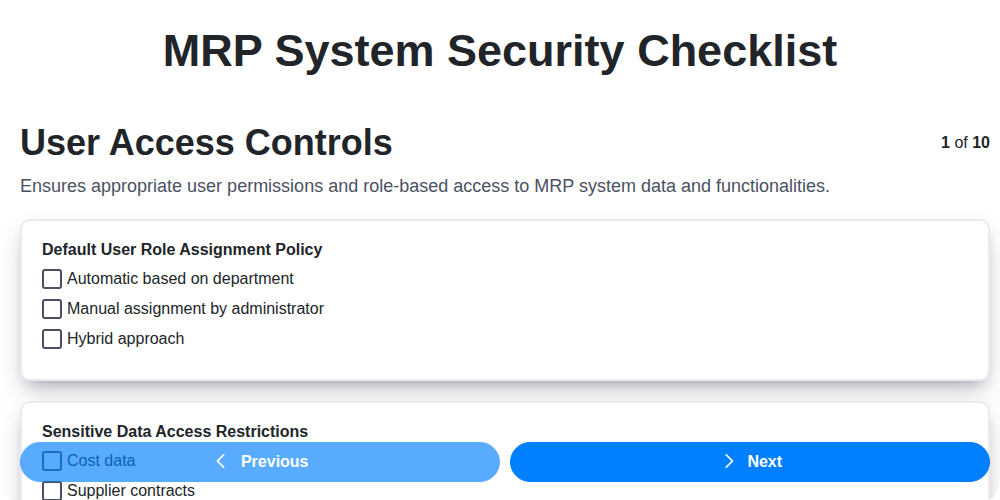
Table of Contents
- Introduction: Why MRP System Security Matters
- 1. User Access Controls: Defining Roles and Permissions
- 2. Password Management: Enforcing Strong Passwords and MFA
- 3. Data Encryption: Protecting Sensitive Information at Rest and in Transit
- 4. Audit Trails & Logging: Tracking System Activity for Accountability
- 5. Network Security: Fortifying Your Perimeter
- 6. Backup and Recovery: Ensuring Business Continuity
- 7. System Patching & Updates: Staying Ahead of Vulnerabilities
- 8. Integration Security: Securing Data Exchange with Other Systems
- 9. Vendor Access & Management: Controlling Third-Party Access
- 10. Security Awareness Training: Empowering Your Team
- 11. Regular Security Assessments & Penetration Testing
- 12. Incident Response Planning: Preparing for the Inevitable
- Conclusion: Continuous Security Improvement
- Resources & Links
TLDR: Your MRP system holds vital data - don's let a security lapse put it at risk! This checklist provides a step-by-step guide to securing your MRP system, covering everything from user access to data encryption and vendor management. Use it to identify vulnerabilities and implement safeguards, ensuring your business operations remain protected.
Introduction: Why MRP System Security Matters
Your Manufacturing Resource Planning (MRP) system isn't just a database; it's the central nervous system of your manufacturing operations. It holds sensitive data - formulas, bills of materials, inventory levels, production schedules, customer information, and financial details - all critical to your business's success. A breach of this data can have devastating consequences, including financial loss, reputational damage, operational disruption, and even legal repercussions.
In today's increasingly complex threat landscape, assuming your MRP system is secure simply because it's behind a firewall isn't enough. Cyberattacks are becoming more sophisticated and targeted, and manufacturers are increasingly recognized as attractive targets. Protecting this vital system requires a proactive and layered security approach. This checklist provides a framework for evaluating and strengthening your MRP system's defenses, ensuring business continuity and safeguarding your valuable assets. Ignoring this isn't an option; a robust MRP system security strategy is now a necessity, not a luxury.
1. User Access Controls: Defining Roles and Permissions
Effective user access controls are the cornerstone of MRP system security. It's not enough to simply assign users accounts; you need a robust system for defining precisely what each user can access and what actions they're permitted to perform. This principle of least privilege - granting users only the access necessary to fulfill their job responsibilities - significantly reduces the risk of accidental or malicious data breaches.
Start by identifying all user roles within your organization and mapping them to specific MRP system functionalities. For instance, a warehouse worker might need access to inventory adjustments and shipping modules, while a finance manager would require access to financial reports and invoice processing. Create distinct user roles mirroring these functional responsibilities.
Implement a process for requesting and approving access. Don't allow self-provisioning of access rights. A formal approval workflow ensures that access is granted based on documented business need. Regularly review user roles and permissions, especially when employees change roles or leave the company. Automated role-based access controls (RBAC) can streamline this process and ensure consistency. Remember to document all role definitions and access policies.
2. Password Management: Enforcing Strong Passwords and MFA
Weak passwords are a primary entry point for attackers. A robust password management strategy is foundational to MRP system security. Here's what you need to implement:
- Password Complexity Requirements: Enforce strong password policies. This includes minimum length (at least 12 characters is recommended), a mix of uppercase and lowercase letters, numbers, and special characters. Avoid allowing common words, easily guessable phrases, or personal information.
- Password Rotation: Mandate regular password changes - typically every 90 days. While frequent changes can sometimes lead to users choosing predictable passwords, a well-communicated policy minimizes this risk.
- Password History: Prevent users from reusing recently used passwords. This stops attackers who might be attempting to crack passwords using previously used combinations.
- Multi-Factor Authentication (MFA): This is critical. MFA adds a second layer of security beyond just a password. Implement MFA for all MRP system users, especially those with administrative privileges. Acceptable MFA methods include one-time passwords (OTPs) via authenticator apps, SMS codes (though less secure than app-based options), and hardware tokens.
- Prohibit Password Reuse Across Systems: Discourage or ideally prohibit users from using the same password for their MRP system and other platforms. A breach on one platform could compromise the MRP system.
- Secure Password Storage: Passwords must be securely stored using strong hashing algorithms (e.g., bcrypt, Argon2) with salting. Never store passwords in plain text.
- Password Reset Procedures: Implement a secure password reset process that verifies user identity before allowing a password change. Consider self-service password reset options with appropriate security checks.
3. Data Encryption: Protecting Sensitive Information at Rest and in Transit
In an MRP system, vast amounts of sensitive data reside, including bill of materials, inventory levels, supplier details, and cost information. A data breach can have devastating consequences, from financial losses and legal repercussions to reputational damage. Data encryption is a critical security measure to mitigate this risk.
Encryption involves transforming data into an unreadable format (ciphertext) using an algorithm and a key. Only those with the correct key can decrypt the data back into its original, readable form. It's a layered defense - even if a breach occurs, the compromised data remains unintelligible without the decryption key.
Here's how encryption strengthens your MRP security:
- Data at Rest Encryption: This protects data stored within the MRP database and file systems. Consider encrypting the entire database or implementing file-level encryption for sensitive documents.
- Data in Transit Encryption: This secures data as it moves between the MRP system and other locations (e.g., web browsers, external integrations, cloud storage). Employing protocols like HTTPS (TLS/SSL) is essential.
- Key Management is Crucial: Encryption is only as strong as your key management practices. Securely store and manage your encryption keys. Implement strong access controls to limit who can access and modify them. Regular key rotation is also a best practice.
- Consider Different Encryption Standards: Research and implement industry-standard encryption algorithms like AES (Advanced Encryption Standard) or RSA, ensuring they are properly configured and maintained.
- Compliance Requirements: Many industries have specific regulations regarding data encryption (e.g., GDPR, HIPAA). Ensure your encryption practices align with these requirements.
4. Audit Trails & Logging: Tracking System Activity for Accountability
In an MRP system, knowing what happened and who did it is critical for both security and operational efficiency. Robust audit trails and logging are your frontline defense against unauthorized access and malicious activity, and invaluable for troubleshooting and process improvement.
Here's why it's vital:
- Detecting Anomalies: Logs record user actions, system events, and data modifications. Regularly reviewing these logs can reveal suspicious activity that might otherwise go unnoticed.
- Incident Response: When a security incident occurs (e.g., data breach, unauthorized modification), comprehensive audit trails provide crucial evidence to understand the scope of the attack and identify responsible parties.
- Compliance Requirements: Many regulatory frameworks (like ISO, GDPR, etc.) mandate detailed audit trails for sensitive data and operations.
- Accountability: Logs clearly identify individuals responsible for specific actions within the MRP system, promoting accountability and deterring misconduct.
Key Considerations:
- Granularity: Ensure logs capture a sufficient level of detail. Focus not just on that an action occurred, but who performed it, when, where, and what data was involved.
- Centralized Logging: Consolidate logs from all MRP modules and related systems into a central repository for easier analysis and correlation.
- Retention Policies: Establish clear retention policies for audit logs, balancing the need for historical data with storage limitations and compliance requirements.
- Secure Storage: Protect log files from unauthorized access and tampering through encryption and restricted access controls.
- Regular Review: Don't just collect logs - analyze them! Schedule regular reviews by security personnel or designated staff.
5. Network Security: Fortifying Your Perimeter
Your MRP system isn't just sitting on a single server; it's part of a larger network. Protecting this network is paramount to ensuring the security of your MRP data. A compromised network can provide attackers direct access to your core business systems, bypassing other security measures.
Here's what you need to consider:
- Firewall Configuration: Implement and regularly review firewall rules to restrict access to your MRP system only to authorized users and systems. Ensure port filtering is strict and unnecessary ports are closed.
- Intrusion Detection/Prevention Systems (IDS/IPS): Deploy IDS/IPS to monitor network traffic for malicious activity and automatically block suspicious connections.
- Network Segmentation: Divide your network into segments, isolating your MRP system from less secure areas (like guest Wi-Fi). This limits the impact of a breach in one area.
- VPN for Remote Access: Mandate the use of a Virtual Private Network (VPN) for any remote access to the MRP system. This encrypts data in transit.
- Wireless Security: If wireless access is necessary, use strong encryption protocols (WPA3) and regularly change access keys.
- Regular Vulnerability Scanning: Conduct periodic vulnerability scans of your network infrastructure to identify and remediate potential weaknesses.
- Network Monitoring: Implement robust network monitoring tools to track traffic, identify anomalies, and respond to security incidents promptly.
6. Backup and Recovery: Ensuring Business Continuity
A robust MRP system holds the lifeblood of your manufacturing operations - critical data about inventory, production schedules, customer orders, and more. Losing access to this data can bring your entire business to a standstill. A well-defined backup and recovery plan is therefore not optional; it's a critical security measure.
Your MRP backup strategy should encompass multiple layers of protection:
- Regular Backups: Implement automated, scheduled backups of your entire MRP system, including databases, configuration files, and associated applications. Frequency depends on data change rate - daily backups are common, but consider more frequent backups for highly volatile data.
- Offsite Storage: Don't store backups solely on-site. A fire, flood, or cyberattack could compromise both your primary system and local backups. Utilize a secure offsite location, cloud storage, or a combination of both.
- Backup Verification: Regularly test your backups. Simply having backups isn't enough; you need to be sure they can be successfully restored. Test restores at least quarterly, and ideally more frequently. Document the process and any issues encountered.
- Recovery Time Objective (RTO) & Recovery Point Objective (RPO): Define your RTO (how long it takes to restore operations) and RPO (maximum acceptable data loss) and ensure your backup and recovery plan aligns with these objectives.
- Documentation: Maintain comprehensive documentation outlining your backup procedures, recovery steps, and contact information for key personnel.
- Disaster Recovery Plan: This should go beyond just data recovery, outlining the steps to get the entire business back up and running following a disruptive event.
A proactive and well-tested backup and recovery plan is your safety net, safeguarding your business from potential disasters and ensuring business continuity.
7. System Patching & Updates: Staying Ahead of Vulnerabilities
In the ever-evolving landscape of cyber threats, neglecting system patching and updates is like leaving your MRP system's doors wide open. Vulnerabilities are constantly being discovered in software, and attackers actively seek out these weaknesses to exploit them. Regularly applying patches and updates is the most fundamental step in maintaining a secure MRP system.
This isn't just about applying the latest operating system updates; it encompasses all software within the MRP ecosystem - database servers, application servers, the MRP application itself, and any related modules or extensions.
Here's why it's critical and what to consider:
- Proactive Defense: Patches often address known vulnerabilities that attackers are actively targeting. Applying them proactively minimizes your exposure.
- Scheduled Maintenance Windows: Establish a well-defined schedule for applying updates, balancing the need for timely patches with potential disruption to operations. Communicate these windows to affected users.
- Testing Before Deployment: Never deploy updates directly to your production environment. Implement a rigorous testing process in a non-production environment (e.g., a development or staging server) to identify any compatibility issues or unexpected behavior.
- Automated Patch Management (where possible): Consider utilizing automated patch management tools to streamline the update process and ensure consistency. However, always review the automated actions before deployment.
- Vendor Notifications: Stay informed about security advisories and patches released by your MRP vendor and other software providers. Subscribe to their mailing lists or security alerts.
- Documentation: Document all patching activities, including dates, versions applied, and any issues encountered. This is vital for auditing and troubleshooting.
Failing to address system patching and updates is a major security risk; prioritize it as a continuous and essential part of your MRP system's security posture.
8. Integration Security: Securing Data Exchange with Other Systems
Your MRP system rarely exists in a vacuum. It likely integrates with CRM, ERP, e-commerce platforms, supply chain partners, and various other systems. These integrations, while essential for streamlined operations, represent significant vulnerabilities if not properly secured.
Data flowing between systems becomes a prime target for malicious actors. Weak integration points can be exploited to gain access to sensitive data, compromise system integrity, and disrupt business processes.
Here's what you need to consider:
- API Security: If your integration relies on APIs, ensure robust authentication and authorization mechanisms are in place. Employ API gateways to manage and secure access. Regularly review API usage and implement rate limiting to prevent abuse.
- Data Validation: Validate all data received from external systems. Don't blindly trust data - sanitize inputs and enforce data type and format constraints to prevent injection attacks and data corruption.
- Secure Communication Protocols: Utilize encrypted communication protocols like HTTPS, SFTP, or VPNs for data transmission. Avoid insecure protocols like FTP or HTTP.
- Limited Permissions: Grant integration users and applications only the minimum necessary permissions to access data and functionality. Implement the principle of least privilege.
- Regular Security Reviews: Conduct regular security reviews of all integrations. This includes reviewing configurations, access controls, and data flows. Document all integration points and their security controls.
- Monitoring & Alerting: Implement monitoring and alerting to detect suspicious activity related to integrations. Look for unusual data flows, failed authentication attempts, or unauthorized access.
Neglecting integration security can negate the benefits of your robust MRP system security measures. Treat these connections as critical points requiring constant vigilance and proactive security practices.
9. Vendor Access & Management: Controlling Third-Party Access
Your MRP system often interacts with external vendors - for things like shipping logistics, supplier portals, or payment processing. These integrations introduce potential security vulnerabilities if not managed carefully. Allowing vendors unrestricted access is a significant risk, potentially exposing sensitive data and compromising system integrity.
This checklist item isn't just about acknowledging vendors exist; it's about actively controlling and monitoring their access. Here's what needs to be addressed:
- Least Privilege Principle: Grant vendors only the minimum level of access required to perform their specific tasks. Avoid broad, open access.
- Defined Access Agreements: Formalize vendor access with written agreements outlining permitted actions, data visibility, and security responsibilities.
- Regular Access Reviews: Conduct periodic reviews of vendor access rights. Ensure access remains necessary and appropriate as vendor roles and processes change.
- Strong Authentication: Implement multi-factor authentication (MFA) for all vendor access, even if the vendor claims to have their own security measures. Don't solely rely on their security.
- Secure Data Transfer: Mandate secure data transfer protocols (e.g., SFTP, HTTPS) for all data exchanged between your system and vendor systems. Avoid unencrypted email transfers.
- Vendor Security Assessments: Where possible and appropriate, conduct security assessments of vendor systems, particularly if they handle highly sensitive data.
- Exit Procedures: Establish clear procedures for revoking access when a vendor relationship ends or access is no longer needed. Don't leave "ghost" accounts lingering.
- Vendor Risk Management: Integrate vendor security into your broader risk management framework, regularly assessing their security posture.
10. Security Awareness Training: Empowering Your Team
Your MRP system is only as secure as your weakest link - and that's often your people. No matter how robust your technical safeguards are, a single phishing email or a lapse in judgment can compromise the entire system. That's why a comprehensive security awareness training program is absolutely vital.
This isn't just about an annual PowerPoint presentation; it's about fostering a culture of security consciousness within your organization. Training should cover topics such as:
- Phishing and Social Engineering: Recognizing and avoiding malicious emails, calls, and other attempts to steal credentials.
- Password Best Practices: Reinforcing the importance of strong, unique passwords and multi-factor authentication.
- Data Handling Procedures: Educating employees on proper handling of sensitive data, including identification, storage, and disposal.
- Reporting Suspicious Activity: Creating a clear process for employees to report any suspected security incidents or vulnerabilities.
- Physical Security: Understanding the importance of physical access controls and protecting devices from theft or unauthorized access.
Regular refresher courses, simulated phishing tests, and interactive training modules will keep security top-of-mind and empower your team to be your first line of defense against evolving threats. Consider incorporating role-specific training to address unique risks associated with different job functions within the MRP environment. Investing in your employees' security knowledge is an investment in the overall security of your MRP system.
11. Regular Security Assessments & Penetration Testing
Regular security assessments and penetration testing are crucial for proactively identifying vulnerabilities that might slip through preventative measures. Don't wait for a breach to discover weaknesses - actively seek them out.
Security Assessments: These comprehensive evaluations should occur at least annually, and ideally more frequently (e.g., bi-annually) for systems undergoing significant changes or facing heightened risk. They involve a thorough review of your MRP system's configurations, policies, and infrastructure. Look for misconfigurations, compliance gaps, and potential areas of improvement.
Penetration Testing (Pentesting): This goes a step further than assessments. Pentesting involves simulating real-world attacks to identify exploitable vulnerabilities. Ethical hackers attempt to bypass security controls and gain unauthorized access. This practical test provides invaluable insight into the effectiveness of your defenses and highlights areas where improvements are needed.
Considerations:
- Scope: Clearly define the scope of both assessments and pentests to ensure comprehensive coverage.
- Qualified Professionals: Engage certified and experienced security professionals to perform these tests.
- Remediation: Critically, address the findings promptly. Document remediation steps and re-test to verify effectiveness.
- Frequency: Adjust the frequency of these assessments based on risk level and changes to your MRP system.
12. Incident Response Planning: Preparing for the Inevitable
Even with the most robust security measures in place, incidents will happen. A data breach, ransomware attack, or unauthorized access attempt isn't a matter of if, but when. That's why a comprehensive Incident Response Plan (IRP) is crucial for any organization utilizing an MRP system.
Your IRP shouldn't be a document gathering dust on a shelf. It's a living guide outlining the steps to take when an incident occurs, minimizing damage and facilitating recovery. Here's what it should cover specifically within the context of your MRP system:
- Clearly Defined Roles & Responsibilities: Identify individuals responsible for different aspects of incident response (e.g., communication, technical investigation, legal counsel).
- Incident Classification: Establish criteria for classifying incidents by severity (e.g., data breach, minor access violation) to prioritize response.
- Communication Plan: Detail who needs to be notified - both internally (management, IT, legal) and potentially externally (customers, regulators) - and the communication channels to be used.
- Containment Procedures: Outline steps to quickly isolate the affected system(s) and prevent further damage. This might include disconnecting from the network, shutting down specific modules, or changing passwords.
- Eradication & Recovery: Define the process for removing the cause of the incident and restoring affected data and systems. This should leverage your backup and recovery procedures (see #7).
- Post-Incident Analysis (Lessons Learned): Crucially, the IRP must include a process to review what happened, identify vulnerabilities exploited, and update security measures to prevent recurrence.
Regular testing and updates to your IRP are paramount. Simulate attacks and tabletop exercises to ensure its effectiveness and keep your team prepared.
Conclusion: Continuous Security Improvement
Implementing an MRP system is a significant undertaking, and securing it should be an ongoing commitment, not a one-time project. This checklist provides a strong foundation, but the threat landscape is constantly evolving. Regularly revisiting these points, adapting to new vulnerabilities, and incorporating emerging security best practices are crucial. Don't view this as a final destination, but rather as a springboard for continuous improvement. Periodic security audits, penetration testing, and staying informed about industry-specific threats will help ensure your MRP system remains a secure and reliable asset for your business. Remember, proactive security measures are far more effective - and less costly - than reactive responses to a breach.
Resources & Links
- National Institute of Standards and Technology (NIST): NIST provides security standards, guidelines, and best practices crucial for MRP system security, including frameworks like NIST Cybersecurity Framework and SP 800 series.
- International Organization for Standardization (ISO): ISO provides standards like ISO 27001 for Information Security Management Systems (ISMS), which can provide a framework for securing your MRP system.
- SANS Institute: SANS offers extensive training and certifications in cybersecurity, covering areas directly relevant to MRP system protection, including incident response and secure configuration.
- CISA (Cybersecurity and Infrastructure Security Agency): CISA provides resources, alerts, and guidance on cybersecurity threats, vulnerabilities, and best practices to protect critical infrastructure and systems, including MRP systems.
- Amazon Web Services (AWS): If your MRP system is cloud-based, AWS's security documentation and best practices offer guidance on securing cloud environments and data.
- Microsoft Azure: Similar to AWS, Azure's security documentation provides detailed information on securing cloud environments and data if you're using Azure.
- G2 - MRP Software Reviews: Provides insights and reviews of various MRP systems, allowing for assessment of vendor security practices (research vendors' security documentation).
- Capterra - MRP Software: Similar to G2, provides MRP software reviews and vendor comparisons, helpful for researching vendor security practices.
- OWASP (Open Web Application Security Project): Provides resources and best practices for securing web applications, relevant if your MRP system has a web interface.
- Splunk: Splunk provides comprehensive logging and analysis capabilities to support audit trails & logging and incident response planning, aiding in detection and response to security incidents.
- Tenable: Tenable offers vulnerability scanning and management tools to help identify and remediate security weaknesses in your MRP system and infrastructure.
- Rapid7: Similar to Tenable, Rapid7 provides vulnerability management and security analytics tools for proactive threat detection and remediation.
- Gartner: Gartner provides research and analysis on IT security, including MRP systems, helping organizations make informed decisions about security investments and strategies.
Frequently Asked Questions
What is an MRP system and why is its security important?
MRP (Material Requirements Planning) systems manage inventory and production schedules. Their security is crucial because they contain sensitive data like supplier information, production costs, and customer orders. A breach can lead to financial losses, operational disruption, and reputational damage.
Who should use this security checklist?
This checklist is designed for anyone involved in managing or maintaining an MRP system, including IT professionals, operations managers, procurement specialists, and security personnel. It's beneficial for both organizations implementing a new MRP system and those looking to strengthen existing security measures.
What types of threats does this checklist address?
The checklist covers various threats, including unauthorized access, data breaches, ransomware attacks, insider threats, and vulnerabilities in system integrations and third-party components.
What is the difference between access control and authentication?
Authentication verifies *who* someone is (e.g., username and password). Access control determines *what* authenticated users are allowed to do within the MRP system. Strong security requires both.
What are the different levels of access that should be considered in an MRP system?
Typically, access levels include administrator (full control), manager (read/write access to specific functions), user (limited access to specific data and functions), and guest (read-only access). Roles and permissions should be assigned based on job responsibilities.
Why is patching and updating the MRP system so important?
Software updates often include security patches that address known vulnerabilities. Failing to apply these updates leaves the system susceptible to exploitation by attackers.
What is the significance of data encryption in an MRP system?
Encryption protects sensitive data by converting it into an unreadable format. If the system is breached, encrypted data is less valuable to attackers.
How does the checklist address third-party integrations with the MRP system?
The checklist emphasizes the importance of assessing the security of any third-party systems or applications that integrate with the MRP system, including verifying their security protocols and ensuring data exchange is secure.
What is the role of employee training in MRP system security?
Employee training is a vital layer of defense. It helps employees recognize and avoid phishing scams, understand secure password practices, and report suspicious activity.
How often should this checklist be reviewed and updated?
The checklist should be reviewed and updated at least annually, or more frequently if there are significant changes to the MRP system, the threat landscape, or business processes.
Found this Article helpful?
Comments
There are no comments yet. Be the first to add one!
Related Articles
MRP System Performance Monitoring Checklist: Ensure Peak Efficiency
MRP System Implementation Checklist: Your Step-by-Step Guide

Top 10 MRPeasy Alternatives for 2025

The 5 Best Bill of Materials (BOM) Management Software of 2025
MRP Planning Parameter Setup Checklist: Your Guide to Accuracy & Efficiency
The 10 Best Manufacturing Management Software of 2025
How to improve your Bill of Materials (BOM) Management
MRP User Training Checklist: Ensuring Proficiency & Success
We can do it Together
Need help with
Material Requirements Planning (MRP)?
Have a question? We're here to help. Please submit your inquiry, and we'll respond promptly.