Supply Chain Data Governance Checklist: Your Path to Control and Visibility
Published: 12/09/2025 Updated: 07/02/2026
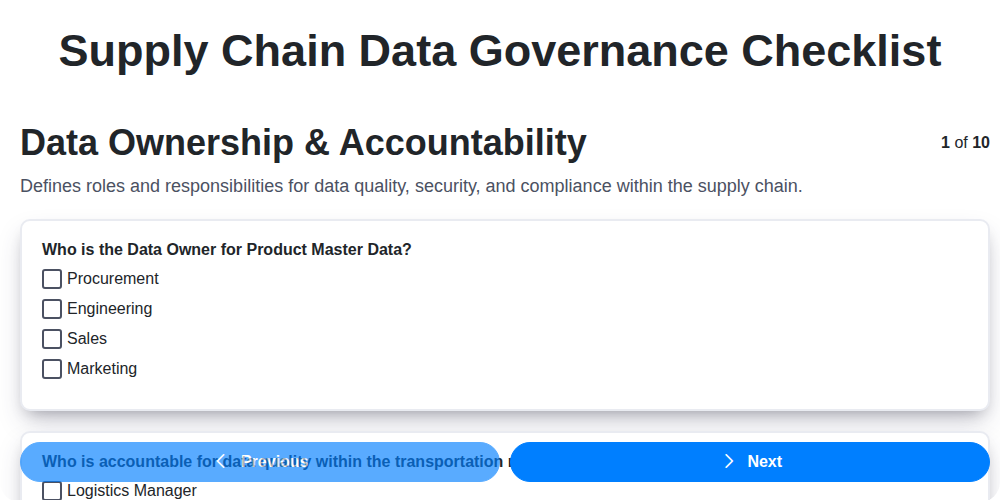
Table of Contents
- Introduction: Why Supply Chain Data Governance Matters
- 1. Data Ownership & Accountability: Defining Responsibility
- 2. Data Quality Standards: Ensuring Accuracy and Reliability
- 3. Data Security & Access Controls: Protecting Your Sensitive Information
- 4. Data Integration & Interoperability: Connecting Your Systems
- 5. Data Retention & Archiving: Managing Data Lifecycle
- 6. Master Data Management (MDM): Establishing a Single Source of Truth
- 7. Data Compliance & Regulatory Requirements: Staying on the Right Side of the Law
- 8. Data Monitoring & Auditing: Tracking Performance and Identifying Issues
- 9. Data Training & Awareness: Empowering Your Team
- 10. Data Incident Response: Planning for the Unexpected
- 11. Checklist Summary: Key Considerations
- 12. Beyond the Checklist: Continuous Improvement
- Conclusion: Building a Resilient and Transparent Supply Chain
- Resources & Links
TLDR: Feeling overwhelmed by supply chain data chaos? This checklist provides a step-by-step guide covering everything from data ownership and quality to security, compliance, and incident response. It's your roadmap to gaining control, improving visibility, and ensuring your supply chain data works for you, not against you.
Introduction: Why Supply Chain Data Governance Matters
In today's complex and interconnected supply chains, data isn't just a byproduct - it's the lifeblood. From predicting demand to optimizing logistics and ensuring product safety, data drives critical decisions. However, this reliance on data exposes vulnerabilities. Siloed information, inconsistent data quality, and a lack of clear ownership can lead to inaccurate insights, costly errors, operational inefficiencies, and even regulatory penalties.
Effective supply chain data governance isn't just a nice-to-have; it's a business imperative. It establishes a framework for managing your data assets-ensuring they're accurate, reliable, secure, and compliant. It fosters trust in data-driven decisions, improves collaboration across the supply chain, and ultimately, strengthens your organization's resilience and competitive advantage. Without a robust data governance strategy, you risk losing control of your most valuable resource - the data powering your supply chain.
1. Data Ownership & Accountability: Defining Responsibility
A robust supply chain thrives on reliable data, but data's value diminishes rapidly without clear ownership and accountability. This isn't just about assigning names to spreadsheets; it's about defining roles and responsibilities for data creation, maintenance, and use throughout the entire supply chain network.
Here's what you need to establish:
- Data Owners: Identify individuals responsible for the accuracy, completeness, and overall quality of specific datasets. This could be a Procurement Manager for supplier data, a Logistics Director for transportation data, or a Demand Planner for sales forecasts. They are the go-to people for questions and issue resolution concerning their data.
- Data Stewards: These individuals work with the data owners. They are often subject matter experts who understand the data's nuances and can help enforce data quality standards and resolve data-related problems.
- Clearly Defined Roles: Document these roles and responsibilities, outlining the decision-making authority and the escalation path for data-related concerns.
- Communication Channels: Establish clear channels for data owners and stewards to communicate and collaborate, ensuring everyone is aware of changes and updates.
- Accountability Matrix (RACI): Implement a RACI matrix (Responsible, Accountable, Consulted, Informed) to clarify roles and responsibilities for specific data-related tasks, leaving no room for ambiguity.
Without this foundational step, data quality will suffer, decision-making will be compromised, and regulatory compliance will become a constant uphill battle.
2. Data Quality Standards: Ensuring Accuracy and Reliability
Data quality isn't just about having a lot of data; it's about having good data. In the supply chain, flawed data can trigger costly errors, missed opportunities, and eroded trust with partners. This section outlines key data quality standards to establish and maintain.
Defining Quality Dimensions: First, define what quality means for your supply chain data. Common dimensions include:
- Accuracy: Is the data correct and free from errors? (e.g., correct part numbers, accurate location data)
- Completeness: Are all necessary data fields populated? (e.g., no missing order quantities, full address information)
- Consistency: Is the data uniform across different systems and sources? (e.g., consistent unit of measure, standardized product descriptions)
- Timeliness: Is the data up-to-date and available when needed? (e.g., real-time inventory levels, current pricing)
- Validity: Does the data conform to defined formats and business rules? (e.g., valid email addresses, acceptable date ranges)
Implementing Standards:
- Data Validation Rules: Implement rules at data entry points to prevent invalid data from entering the system. This can include required fields, data type checks, and range validations.
- Data Profiling: Regularly analyze data to identify quality issues and assess adherence to standards.
- Data Cleansing: Implement processes for correcting existing data errors. This might involve automated tools or manual intervention.
- Standardized Data Formats: Enforce consistent formatting for key data elements (e.g., dates, addresses, product codes).
- Data Quality Scoring: Assign scores to data elements based on quality metrics. This allows you to prioritize remediation efforts and track improvement over time.
- Feedback Loops: Establish a mechanism for data users to report data quality issues, ensuring continuous improvement.
Poor data quality is a silent drain on resources. By proactively establishing and enforcing data quality standards, you're building a foundation for a more resilient, efficient, and trustworthy supply chain.
3. Data Security & Access Controls: Protecting Your Sensitive Information
In the supply chain, data isn't just numbers and dates; it's often incredibly sensitive information regarding suppliers, pricing, inventory levels, customer details, and more. A data breach can be devastating, leading to financial losses, reputational damage, and legal repercussions. Robust data security and access controls are therefore not optional-they're paramount.
Here's what your checklist should cover:
- Least Privilege Principle: Implement the principle of least privilege. Users should only have access to the data and systems they absolutely need to perform their job functions. Avoid broad, blanket permissions.
- Role-Based Access Control (RBAC): Define roles within your supply chain and assign access based on those roles. This simplifies management and reduces the risk of accidental data exposure.
- Multi-Factor Authentication (MFA): Implement MFA for all users accessing sensitive data. This adds an extra layer of security beyond just a username and password.
- Encryption: Encrypt data both at rest (stored on servers and databases) and in transit (when being transferred).
- Regular Security Audits: Conduct frequent security audits to identify vulnerabilities and ensure that access controls are effective.
- Data Loss Prevention (DLP) Measures: Employ DLP tools to prevent sensitive data from leaving your network or systems without authorization.
- Secure Data Sharing Agreements: When sharing data with partners, clearly define access permissions, usage restrictions, and security protocols within a formal agreement.
- Regular Password Management: Enforce strong password policies and ensure users change passwords regularly.
- Vulnerability Scanning & Patch Management: Implement a system for identifying and remediating security vulnerabilities in your systems and applications.
- Network Segmentation: Divide your network into segments to limit the impact of a potential breach.
4. Data Integration & Interoperability: Connecting Your Systems
A fragmented supply chain often means fragmented data. Siloed systems - ERP, WMS, TMS, supplier portals - all generating data that doesn't easily talk to each other create a significant hurdle to visibility and agility. Effective data integration and interoperability are crucial to break down these silos and create a unified view of your supply chain.
Here's what your checklist should cover:
- Standardized Data Formats: Define and enforce consistent data formats across all systems. This minimizes translation errors and speeds up data exchange.
- API Strategy: Implement APIs (Application Programming Interfaces) to enable seamless data sharing between systems. Prioritize open APIs where possible to facilitate integration with a wider range of partners.
- Data Mapping & Transformation: Create and maintain robust data mapping processes to accurately translate data between different systems and formats. Document these mappings meticulously.
- Real-time vs. Batch Integration: Determine the appropriate integration frequency for each data flow. Real-time integration is ideal for time-sensitive information, while batch processing might suffice for less urgent data.
- Integration Architecture: Choose an integration architecture that aligns with your business needs - point-to-point, Enterprise Service Bus (ESB), or Integration Platform as a Service (iPaaS).
- Data Validation at Integration Points: Implement validation rules at the points where data is integrated to ensure accuracy and prevent errors from propagating further.
- Error Handling & Reconciliation: Establish clear procedures for identifying, resolving, and reconciling data integration errors.
5. Data Retention & Archiving: Managing Data Lifecycle
Effective data retention and archiving are crucial for supply chain resilience, compliance, and cost optimization. Simply accumulating data isn't enough; you need a strategy for how long to keep it and where to store it.
Why is it important? Regulatory requirements (like GDPR, CCPA, and industry-specific standards) often dictate how long certain data must be held, and others may have recommended retention periods. Beyond compliance, a well-defined retention policy minimizes storage costs, prevents data sprawl, and facilitates eDiscovery if needed. Furthermore, historical data can provide valuable insights for trend analysis, forecasting, and identifying process improvements.
Key Considerations:
- Define Retention Periods: Establish clear policies defining how long different data types (e.g., supplier contracts, order history, shipment records) need to be retained. This should be based on legal, regulatory, and business needs.
- Archiving Strategy: Distinguish between data that needs to be readily accessible (online) and data that can be moved to long-term, less expensive storage (archived). Consider factors like accessibility requirements, recovery time objectives (RTOs), and data format.
- Legal Hold Procedures: Implement processes for suspending routine data deletion when litigation or regulatory investigations occur.
- Secure Archiving: Ensure archived data is secured appropriately, mirroring security controls applied to active data. Consider data encryption and access restrictions.
- Data Purging: Define a documented procedure for the secure and irreversible deletion of data after the retention period expires.
- Metadata Management: Maintain detailed metadata about archived data, including date of archiving, original data source, and reason for archiving. This aids in data discovery and governance.
- Regular Review: Retention policies should be reviewed and updated periodically to reflect changes in regulations, business needs, and technology.
6. Master Data Management (MDM): Establishing a Single Source of Truth
In a complex supply chain, data silos are a common and costly problem. Different departments, systems, and even partners often maintain their own versions of critical data - customer information, product details, supplier contacts, and more. This inconsistency leads to errors, inefficiencies, and a lack of trust in the data itself. That's where Master Data Management (MDM) comes in.
MDM is the discipline of creating and maintaining a single, trusted, and consistent view of your most critical data elements - your master data. It's more than just a technology; it's a strategic approach. A robust MDM program ensures everyone in your supply chain is working with the same accurate information.
Key MDM Checklist Actions:
- Define Master Data Domains: Clearly identify what constitutes master data within your supply chain (e.g., products, customers, suppliers, locations).
- Data Stewardship: Assign clear data stewards responsible for maintaining the accuracy and completeness of specific master data domains.
- Data Consolidation & Cleansing: Implement processes to consolidate data from disparate sources, deduplicate records, and correct errors.
- Standardization: Enforce consistent data formats, definitions, and values across all systems. Think standardized product descriptions or customer addresses.
- Data Governance Integration: MDM should be tightly integrated with your broader data governance framework. Governance policies dictate how master data is created, updated, and used.
- Ongoing Maintenance: MDM isn't a set it and forget it exercise. Regularly review and update master data to reflect changes in your supply chain.
A well-implemented MDM program reduces errors, improves decision-making, and fosters collaboration throughout your supply chain, creating a more resilient and efficient operation.
7. Data Compliance & Regulatory Requirements: Staying on the Right Side of the Law
Supply chain data isn't just valuable; it's often subject to stringent legal and regulatory frameworks. Failing to adhere to these can result in hefty fines, reputational damage, and even legal action. This section focuses on ensuring your supply chain data governance program aligns with relevant compliance obligations.
Understanding Your Obligations:
The first step is to identify which regulations apply to your business and your supply chain. This will vary significantly based on your industry, geographic location, and the types of data you handle. Some common examples include:
- GDPR (General Data Protection Regulation): If you process personal data of EU citizens, GDPR applies. This dictates strict rules around data collection, storage, processing, and consent.
- CCPA (California Consumer Privacy Act): Similar to GDPR, CCPA grants California residents specific rights regarding their personal data.
- HIPAA (Health Insurance Portability and Accountability Act): Applies to healthcare organizations and requires specific protections for patient health information.
- FCPA (Foreign Corrupt Practices Act): Addresses bribery and corruption in international business dealings, impacting data related to transactions and relationships.
- Industry-Specific Regulations: Depending on your sector (e.g., food & beverage, pharmaceuticals), specialized regulations will govern data handling and traceability.
- Modern Slavery Act: Requires businesses to report on steps taken to ensure their supply chains are free from modern slavery.
Building Compliance into Your Governance:
- Data Mapping: Identify where sensitive data resides and how it flows through your supply chain.
- Privacy Impact Assessments (PIAs): Conduct PIAs for new data processes or systems to assess and mitigate privacy risks.
- Consent Management: Implement robust consent mechanisms where required, ensuring transparency and user control over data.
- Data Subject Rights Fulfillment: Establish clear processes for responding to data subject requests (e.g., access, deletion, rectification).
- Documentation and Record Keeping: Maintain thorough records of compliance activities, including policies, procedures, and training.
- Regular Review & Updates: Compliance landscapes evolve. Regularly review your data governance program and update it to reflect new regulations and best practices.
By proactively addressing compliance requirements, you demonstrate a commitment to ethical data handling and build trust with your stakeholders.
8. Data Monitoring & Auditing: Tracking Performance and Identifying Issues
Supply chain data governance isn't a set it and forget it endeavor. Continuous monitoring and regular audits are essential to ensure your governance framework remains effective and adapts to evolving business needs and regulatory landscapes. Without them, you risk undetected data quality issues, security vulnerabilities, and compliance gaps.
What to Monitor:
- Data Quality Metrics: Track key indicators like accuracy, completeness, consistency, and timeliness. Establish thresholds and trigger alerts when metrics fall outside acceptable ranges. Visualize these metrics through dashboards for easy understanding.
- Access Logs: Regularly review access logs to identify unauthorized access attempts or unusual activity patterns.
- Data Flows: Monitor data pipelines and transformations to pinpoint bottlenecks, errors, and data loss points.
- Compliance Adherence: Track adherence to data governance policies and procedures.
- System Performance: Monitor the performance of data infrastructure and tools to ensure they can handle the data load and meet service level agreements (SLAs).
Audit Frequency and Scope:
- Regular Audits: Conduct scheduled audits (e.g., quarterly or annually) to assess the overall health of your data governance program.
- Triggered Audits: Perform audits triggered by significant events, such as data breaches, policy changes, or system upgrades.
- Scope: Audits should cover data quality, security, compliance, and the effectiveness of governance processes.
Tools and Techniques:
- Data Quality Monitoring Tools: Automated tools can continuously monitor data quality metrics and alert you to issues.
- Security Information and Event Management (SIEM) Systems: SIEMs centralize security logs and provide real-time threat detection.
- Data Lineage Tools: These tools visualize the flow of data, making it easier to identify the source of data quality problems.
- Automated Reporting: Generate regular reports on data governance performance.
By proactively monitoring your data and conducting regular audits, you can identify and address potential problems before they impact your supply chain operations and decision-making.
9. Data Training & Awareness: Empowering Your Team
Data governance isn't just about policies and procedures; it's about people. Even the most robust framework will fail if your team doesn't understand it and actively participate. That's where data training and awareness come in.
This isn't about complex technical training (though that may be needed for some roles). It's about cultivating a data-conscious culture. Consider these vital components:
- Regular Workshops & Refresher Sessions: Keep data governance principles top-of-mind with periodic training, especially when policies are updated.
- Role-Specific Training: Tailor training to the specific responsibilities of different teams - procurement, logistics, finance, etc. A logistics professional needs to understand data quality relating to shipment tracking differently than a finance specialist.
- Data Literacy Programs: Equip employees with the foundational knowledge to understand data, interpret reports, and recognize potential issues.
- Communication & Awareness Campaigns: Utilize internal newsletters, intranet postings, and team meetings to reinforce data governance principles and highlight successes. Make it engaging and relatable!
- Data Champion Program: Identify and empower individuals within each department to be advocates for data governance and support their colleagues.
- Gamification & Incentives: Introduce elements of fun and recognition to encourage participation and reinforce positive behaviors.
Investing in data training and awareness isn't just a nice-to-have; it's a critical investment in the long-term success of your supply chain data governance program. An informed and engaged team is your strongest asset in maintaining data integrity and driving value.
10. Data Incident Response: Planning for the Unexpected
Data breaches and incidents are a harsh reality in today's supply chain landscape. It's not a matter of if an incident will occur, but when. A robust data incident response plan is crucial for minimizing damage, restoring operations, and preserving your organization's reputation.
This checklist element focuses on preparing for the inevitable. It's more than just having a plan; it's about regularly testing and refining it. Here's what your data incident response plan should include:
- Defined Roles & Responsibilities: Clearly outline who is responsible for what during an incident (e.g., incident commander, communication lead, technical lead, legal counsel).
- Incident Identification & Reporting Procedures: Establish clear channels and procedures for reporting suspected data incidents. Encourage a "no-blame" culture to facilitate timely reporting.
- Containment Strategies: Outline steps to quickly contain the incident and prevent further data loss (e.g., isolating affected systems, changing passwords).
- Eradication and Recovery: Detail how to remove the root cause of the incident and restore affected systems and data. Consider backup and recovery procedures.
- Communication Plan: Establish a clear communication plan, both internally (to employees) and externally (to customers, regulators, media). Ensure pre-approved templates are available.
- Post-Incident Review: Mandate a thorough post-incident review to identify vulnerabilities, lessons learned, and necessary plan updates. This should include root cause analysis.
- Regular Testing & Simulations: Conduct tabletop exercises and simulated data breach scenarios to test the plan's effectiveness and identify areas for improvement.
- Legal & Regulatory Notification Procedures: Understand your legal and regulatory obligations for data breach notification and ensure the plan incorporates these requirements.
A proactive and well-tested data incident response plan is an essential investment in your supply chain's resilience.
11. Checklist Summary: Key Considerations
Implementing robust Supply Chain Data Governance isn't a one-time project; it's an ongoing commitment. This checklist provides a framework, but remember that its success depends on tailoring it to your specific business needs and continuously adapting as your supply chain evolves. Here's a snapshot of key takeaways and things to keep in mind:
- Executive Sponsorship is Crucial: Data governance initiatives require buy-in and support from leadership to be successful.
- Collaboration is Key: Engage stakeholders across all departments - procurement, logistics, manufacturing, sales - to ensure comprehensive coverage.
- Iterative Approach: Start with the most critical areas and gradually expand your governance program. Don't try to boil the ocean.
- Documentation is Essential: Clearly define roles, responsibilities, standards, and processes.
- Regular Review and Updates: Data landscapes change rapidly; review your governance framework at least annually, and more frequently if necessary, to ensure it remains relevant and effective.
- Focus on Business Value: Always tie data governance activities back to tangible business benefits, such as improved efficiency, reduced risk, and enhanced decision-making.
By consistently revisiting and refining your approach, you can build a data governance program that strengthens your supply chain resilience and drives sustainable competitive advantage.
12. Beyond the Checklist: Continuous Improvement
A checklist is a fantastic starting point, but supply chain data governance isn't a "set it and forget it" endeavor. The landscape is constantly evolving - new regulations emerge, technologies advance, and your business needs shift. Think of this checklist as version 1.0. To truly reap the benefits of data governance, embed a culture of continuous improvement. Regularly revisit each item on the checklist, not just annually, but perhaps quarterly or even more frequently. Encourage feedback from stakeholders across the supply chain - from suppliers to internal departments - to identify gaps and areas for enhancement. Establish Key Performance Indicators (KPIs) around data quality, accuracy, and compliance to track progress and highlight areas needing attention. Explore emerging technologies like AI and machine learning to automate governance tasks and proactively identify potential risks. Remember, a living, breathing data governance program will be far more resilient and valuable than a static document gathering dust on a shelf.
Conclusion: Building a Resilient and Transparent Supply Chain
Ultimately, implementing a robust Supply Chain Data Governance framework isn't a one-time project; it's an ongoing journey. This checklist provides a solid foundation, but continuous improvement is key. By consistently revisiting these areas, fostering a data-centric culture, and embracing new technologies, organizations can move beyond reactive data management to proactive governance. The benefits - increased visibility, reduced risk, improved decision-making, and a more resilient supply chain - are well worth the investment. Don't view data governance as a burden, but as a strategic enabler of a future-proof and transparent supply chain.
Resources & Links
- Supply Chain Brain: Provides news, analysis, and expert insights on supply chain management topics, including data and technology. Excellent for current trends and best practices related to supply chain data governance.
- APICS (The Association for Supply Chain Management): A professional organization offering resources, certifications, and events focused on supply chain management, covering data management and governance aspects. Offers courses and white papers.
- ISC²: Focuses on cybersecurity, but many principles of data security and access controls outlined in their frameworks are directly applicable to supply chain data governance.
- Dataversity: A community and resource hub for data professionals. Offers articles, webinars, and training on data governance and related topics. Useful for understanding data quality and MDM.
- Gartner: A research and advisory firm providing insights on supply chain technology and data management. Although many reports require subscription, their articles and blog posts can provide valuable context and strategic direction.
- Forbes: Business and finance news website. Search for articles about supply chain data governance and digital transformation to find expert opinions and case studies.
- SAS: A software company specializing in analytics and data management. Offers resources and white papers on data governance, often with a technical focus. Useful for understanding data integration and quality tools.
- IBM: Offers a wide range of data management and governance solutions. Their website has educational resources, case studies and whitepapers relating to data governance best practices for all areas of business including supply chains.
- Microsoft: Provides data governance tools and resources as part of their Azure services. Their website offers documentation and learning paths for implementing data governance solutions.
- Oracle: Offers various data management solutions, including those relevant to supply chain data governance, and provides related resources.
- Data Quality Management: Specializes in data quality and governance. Offers articles, templates, and resources to improve data accuracy and reliability across organizations.
- Compliance Week: Provides news and analysis on regulatory compliance across various industries. Useful for understanding the legal and regulatory landscape related to supply chain data governance (specifically in section 4).
Frequently Asked Questions
What is Supply Chain Data Governance?
Supply Chain Data Governance (SCGD) is the framework for managing and controlling data across your entire supply chain. It establishes policies, processes, and responsibilities to ensure data quality, accuracy, consistency, and security, ultimately providing better visibility and control.
Why is Supply Chain Data Governance important?
Without proper governance, supply chain data can be fragmented, inconsistent, and unreliable. This leads to poor decision-making, increased costs, operational inefficiencies, and a lack of resilience. SCGD improves data quality, enhances collaboration, reduces risk, and empowers informed decision-making.
Who should be involved in implementing a Supply Chain Data Governance program?
A successful program requires cross-functional collaboration. Key stakeholders include representatives from Supply Chain, IT, Data Management, Procurement, Finance, Legal, and potentially key suppliers and customers. A dedicated Data Governance Council is often beneficial.
What are the key areas covered in the Supply Chain Data Governance Checklist?
The checklist typically covers areas like data ownership, data quality standards, data security protocols, data access controls, data integration strategies, master data management, and data lineage tracking. It also focuses on compliance with relevant regulations.
What is Data Ownership and why is it important?
Data Ownership assigns responsibility for the accuracy, completeness, and security of specific data elements within the supply chain. Owners are accountable for ensuring data adheres to established governance policies. This clarifies accountability and drives data quality improvements.
What is Master Data Management (MDM) and how does it relate to SCGD?
Master Data Management (MDM) is a core component of SCGD. It focuses on creating and maintaining a single, trusted source of truth for critical data entities like suppliers, customers, products, and locations. This ensures consistency across all systems and processes.
What are some common data quality issues in supply chains?
Common issues include inaccurate product descriptions, incorrect supplier contact information, mismatched order quantities, inconsistent unit of measure, and missing data fields. The checklist provides steps to identify and mitigate these issues.
How do I measure the success of my Supply Chain Data Governance program?
Key metrics include data quality scores (accuracy, completeness, timeliness), reduction in data-related errors, improved data accessibility, enhanced collaboration, and measurable ROI from data-driven decisions. Regular audits and stakeholder feedback are also crucial.
What is Data Lineage and why is it important for SCGD?
Data Lineage tracks the origin and movement of data throughout the supply chain. It helps identify the root cause of data quality issues, understand data dependencies, and ensure data integrity. It provides transparency and traceability.
Can this checklist be used for a small business or is it geared towards larger enterprises?
The checklist is adaptable and can be used by businesses of all sizes. Smaller businesses may choose to implement a more streamlined version, focusing on the most critical data elements and governance principles initially. Larger enterprises may have more complex requirements.
Comments
There are no comments yet. Be the first to add one!
SCM - Supply Chain Management Solution Demo
Struggling with supply chain disruptions & lack of visibility? ChecklistGuro delivers a centralized SCM solution, connecting your suppliers, manufacturers, & distributors for improved collaboration and control. Simplify operations & boost efficiency.
Related Articles
The Ultimate Supply Chain Inventory Accuracy Audit Checklist: A Step-by-Step Guide
Supply Chain Capacity Planning Checklist: Ensure Readiness for Peak Demand
The Ultimate Supply Chain Network Optimization Checklist: A Step-by-Step Guide
Supply Chain Risk Assessment Checklist: Your Guide to Resilience
Navigating Sustainability: Your Supply Chain Compliance Checklist
Top 10 SAP Logistics Business Network (LBN) Alternatives for 2025

Fortify Your Supply Chain: The Ultimate Resilience Assessment Checklist
Navigating Global Trade: Your Essential Import/Export Compliance Checklist
Need help with
Supply Chain Management (SCM)?
Have a question? We're here to help. Please submit your inquiry, and we'll respond promptly.