Mastering Your Supply Chain: A Comprehensive MDM Checklist
Published: 12/09/2025 Updated: 07/02/2026
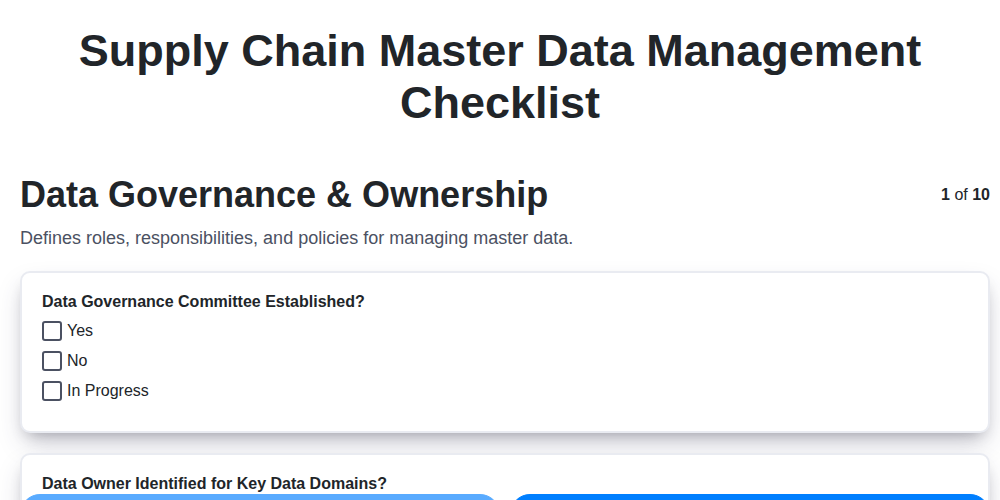
Table of Contents
- Introduction: Why Supply Chain MDM Matters
- 1. Data Governance & Ownership: Laying the Foundation
- 2. Defining the Rules: Data Standards & Definitions
- 3. Mapping the Landscape: Data Source Identification & Integration
- 4. Cleaning Up the Mess: Data Cleansing & Enrichment
- 5. Ensuring Accuracy: Data Validation & Verification
- 6. Protecting Your Assets: Data Security & Access Controls
- 7. Tracking Changes & Understanding Lineage
- 8. Seamless Connections: System Integration & Data Flows
- 9. Measuring Success: Performance Monitoring & Reporting
- 10. Empowering Your Team: User Training & Documentation
- 11. Addressing Common MDM Challenges in Supply Chain
- 12. Future-Proofing Your MDM Strategy
- 13. Tools and Technologies for Supply Chain MDM
- Conclusion: A Roadmap to Supply Chain Excellence
- Resources & Links
TLDR: Overwhelmed by messy supply chain data? This checklist is your roadmap! It breaks down Master Data Management (MDM) into 11 key steps - from data governance to user training - ensuring your product, supplier, and customer data is accurate, consistent, and secure, ultimately boosting efficiency and reducing risk across your supply chain.
Introduction: Why Supply Chain MDM Matters
In today's complex and interconnected supply chains, data isn't just information - it's the lifeblood of efficiency, resilience, and competitive advantage. But inaccurate, inconsistent, or fragmented data can cripple your operations. That's where Supply Chain Master Data Management (MDM) comes in.
Think of MDM as the process of creating a single, reliable source of truth for critical data elements like suppliers, materials, products, and locations. It's about ensuring everyone, from procurement to logistics, is working with the same accurate information. Without it, you risk costly errors, inefficient processes, poor decision-making, and a general lack of visibility across your entire supply chain. This checklist is designed to guide you through establishing and maintaining a robust Supply Chain MDM program, helping you unlock the true potential of your data and build a stronger, more agile supply chain.
1. Data Governance & Ownership: Laying the Foundation
Master Data Management (MDM) isn't just about technology; it's fundamentally about people and processes. Before you even touch a single line of code or import a single record, you must define clear data governance and ownership. This is the bedrock upon which your entire MDM initiative will stand.
Key Considerations:
- Data Owners: Identify individuals accountable for the accuracy, completeness, and timeliness of specific master data domains (e.g., Customer Data Owner, Product Data Owner, Supplier Data Owner). Their role isn't just oversight; it's active participation in defining standards and resolving data quality issues.
- Data Stewards: These are the champions who work with the data owners to execute governance policies. They're often subject matter experts who understand the data intimately and can enforce standards within their respective areas.
- Governance Council: A cross-functional team responsible for setting the overall MDM strategy, resolving conflicts, and ensuring alignment with business objectives.
- Documented Policies & Procedures: Create and formally document data governance policies, including roles, responsibilities, escalation paths, and consequences for non-compliance.
- Executive Sponsorship: Secure buy-in and active support from senior leadership to ensure resources and authority are available to implement and enforce governance policies.
Without clearly defined roles, responsibilities, and a strong governance framework, your MDM efforts are likely to be chaotic and ineffective. Investing time upfront to establish a solid foundation will significantly increase your chances of success.
2. Defining the Rules: Data Standards & Definitions
Data standards and definitions are the bedrock of successful Supply Chain Master Data Management (MDM). Without them, you're essentially operating with a collection of disparate interpretations, leading to errors, inefficiencies, and a lack of trust in your data. Think of it as everyone speaking different languages - collaboration becomes incredibly difficult.
This isn't just about having a glossary; it's about actively enforcing it. Here's what needs to be covered:
- Standardized Attributes: Define the expected format and type for key attributes. For example, a Supplier ID should always be alphanumeric and follow a specific naming convention. Unit of Measure should be consistently defined (e.g., always using kg vs. sometimes kilograms).
- Business Terminology: Clearly define what each data element means in a business context. Don't assume everyone understands Lead Time to be the same thing. A formal definition avoids ambiguity.
- Valid Value Lists: Restrict acceptable values for certain fields. For example, a Country field should only contain recognized ISO country codes.
- Data Types: Specify data types (text, numeric, date, boolean) for each field to ensure proper storage and calculations.
- Unit of Measure Consistency: Mandate consistent use of units across all data sources.
- Naming Conventions: Establish clear guidelines for naming data elements, files, and reports to improve discoverability and understanding.
Implementing data standards isn't a one-time project. It requires ongoing maintenance, updates, and reinforcement to keep pace with evolving business needs and systems. This is where a Data Governance council plays a critical role (more on that later!). Failure to adhere to established standards should have clear consequences, reinforcing the importance of consistent data.
3. Mapping the Landscape: Data Source Identification & Integration
A successful Supply Chain Master Data Management (MCDM) program doesn't materialize in a vacuum. It requires a thorough understanding of where your data lives and how it moves. This is where data source identification and integration become critical.
Start with Discovery: The initial phase is comprehensive data source discovery. Don't just think about ERP systems - consider everything! This includes:
- Internal Systems: ERP (SAP, Oracle, etc.), WMS, TMS, CRM, PIM, MES, legacy systems, spreadsheets, databases.
- External Sources: Supplier portals, customer data platforms (CDPs), market intelligence providers, logistics partners' systems, industry data feeds.
Document Everything: Create a comprehensive inventory - a "data source catalog" - detailing each system, its data content, its owner, and its level of criticality to the supply chain. This isn't a one-time effort; it should be living documentation.
Define Integration Points: Once you're aware of your sources, analyze how they interact. Where do data dependencies exist? What data flows between systems? Diagramming these flows helps visualize the integration landscape and highlights potential bottlenecks or inconsistencies.
Prioritize Integration: You won't be able to integrate everything at once. Prioritize based on business impact, data quality issues, and ease of integration. Focus on areas where data discrepancies directly impact decision-making or operational efficiency.
Embrace Connectivity Options: Consider different integration methodologies:
- Direct API Integration: Real-time data exchange, but requires technical expertise.
- ETL (Extract, Transform, Load): Batch processing, suitable for large volumes of data.
- Data Virtualization: Accesses data without physically moving it, providing a unified view.
- Message Queuing: Asynchronous communication, ensuring data reliability.
Standardize Interfaces: Where possible, push for standardized data interfaces between systems to simplify integration and reduce complexity.
Effective data source identification and integration is the foundation of a robust MCDM program. Without a clear understanding of your data landscape, efforts to cleanse, standardize, and govern data are significantly hampered.
4. Cleaning Up the Mess: Data Cleansing & Enrichment
Master data isn't always pristine. Often, it's a tangled web of inconsistencies, duplicates, and missing information inherited from disparate legacy systems, manual data entry, and varying business processes. This is where data cleansing and enrichment come into play - the crucial step of transforming raw, imperfect data into a reliable foundation for your supply chain.
What does it entail?
Data cleansing focuses on identifying and correcting errors. This includes:
- Duplicate Removal: Eliminating redundant records of the same entity (e.g., two supplier records for the same company).
- Error Correction: Fixing typos, incorrect formats (dates, addresses, phone numbers), and invalid values.
- Standardization: Converting data to a consistent format across all sources (e.g., ensuring all addresses follow a standard format).
- Completeness Checks: Identifying and filling in missing data where possible, using rules or external sources.
But cleansing is only half the battle. Data enrichment takes your cleansed data to the next level. It involves adding valuable information from external sources to provide a more complete picture. This could include:
- Adding Geographic Data: Incorporating location data (latitude, longitude) for suppliers or customers.
- Adding Financial Information: Obtaining credit ratings or payment history.
- Adding Product Details: Enriching product descriptions with images, technical specifications, or industry classifications.
Why is it so important?
Clean and enriched data unlocks significant benefits:
- Improved Accuracy: Better decision-making based on reliable information.
- Increased Efficiency: Reduced manual effort in data reconciliation and analysis.
- Enhanced Visibility: A more complete understanding of your supply chain.
- Better Analytics: More accurate and insightful reports.
Don't underestimate the effort required. Data cleansing and enrichment can be time-consuming and resource-intensive, but the long-term rewards are well worth the investment. Regular, automated processes and collaboration between IT and business stakeholders are key to success.
5. Ensuring Accuracy: Data Validation & Verification
Master data isn't valuable unless it's accurate. Data Validation and Verification are the critical steps that ensure the information you're relying on is trustworthy. This goes beyond simply cleansing the data; it's about actively confirming its correctness and consistency.
What's the Difference?
- Validation: This is the proactive process of preventing inaccurate data from entering your MDM system. Think of it as a gatekeeper. You define rules and constraints - data type checks, range limitations, mandatory fields - and data is only accepted if it meets these criteria.
- Verification: This is the reactive process of checking data that's already in the system. It involves confirming the data's accuracy against reliable sources, comparing it to existing records, and seeking human confirmation when necessary.
Key Steps to Implement:
- Define Validation Rules: Establish clear and comprehensive rules based on business requirements and data standards. These should be documented and regularly reviewed.
- Automated Checks: Implement automated validation checks within your MDM system and at the point of data entry to catch errors early.
- Data Profiling: Use data profiling techniques to identify anomalies and potential inconsistencies that might require further investigation.
- Cross-Referencing: Compare data against external sources (e.g., industry databases, vendor information) to verify its accuracy.
- Human Review: Implement processes for manual verification, particularly for critical data elements or where automated checks are insufficient.
- Exception Handling: Define procedures for addressing data validation failures and discrepancies, including escalation paths and correction protocols.
- Regular Audits: Conduct periodic audits of your validation and verification processes to ensure their effectiveness and identify areas for improvement.
By prioritizing Data Validation and Verification, you transform your master data from a potential liability into a strategic asset.
6. Protecting Your Assets: Data Security & Access Controls
Master data is the lifeblood of your supply chain - it's the foundation for everything from accurate inventory levels to efficient order fulfillment. Protecting it isn't just about compliance; it's about protecting your business. A data breach or unauthorized access can lead to significant financial losses, reputational damage, and operational disruption.
This section focuses on establishing robust data security and access controls as a crucial component of your MDM program. It's not enough to have master data; you need to ensure the right people have the right access to it, and that it's shielded from unauthorized access and cyber threats.
Here's what you need to consider:
- Role-Based Access Control (RBAC): Define distinct user roles (e.g., data steward, data analyst, read-only user) and grant access permissions based on those roles. This minimizes the risk of accidental or malicious data modification.
- Authentication & Authorization: Implement strong authentication mechanisms like multi-factor authentication (MFA) to verify user identities. Regularly review and update access authorizations.
- Data Encryption: Encrypt data at rest and in transit to protect it from unauthorized access even if physical or digital security is compromised.
- Regular Security Audits: Conduct routine audits of access logs and security configurations to identify and address vulnerabilities.
- Data Masking & Anonymization: Consider masking or anonymizing sensitive data for users who don't require full access.
- Compliance with Regulations: Ensure your security practices comply with relevant industry regulations (e.g., GDPR, CCPA).
- Incident Response Plan: Develop and regularly test an incident response plan to handle data breaches effectively.
A proactive approach to data security and access controls isn't just a 'best practice'; it's a necessity for any organization committed to maintaining a resilient and trustworthy supply chain.
7. Tracking Changes & Understanding Lineage
Master data isn't static; it evolves. New suppliers are onboarded, product specifications change, locations shift - the list goes on. Without a robust change management process and a clear understanding of data lineage, these changes can quickly snowball into inconsistencies, inaccuracies, and ultimately, disruptions to your supply chain.
Why is Change Management Critical?
Effective change management isn't just about logging updates. It's about controlling them. This includes:
- Version Control: Tracking every change made to a data element, including who made it, when, and why.
- Approval Workflows: Implementing approval processes for data modifications to ensure accuracy and alignment with business rules.
- Impact Analysis: Understanding how a change to one data element affects other related data and processes.
Data Lineage: Following the Trail
Data lineage is the historical record of where your data comes from, what transformations it has undergone, and where it ultimately resides. Think of it as a map tracing the journey of a single piece of data, from its origin to its final destination. This is essential for:
- Root Cause Analysis: If you find an error in your data, lineage allows you to quickly trace back the problem to its source and identify the point where the error occurred.
- Regulatory Compliance: Many industries have strict requirements for data traceability. Lineage provides the audit trail needed to demonstrate compliance.
- Data Trust: Knowing where your data comes from and how it has been handled increases confidence in its reliability.
Implementing Change Management & Lineage:
- Document Everything: Implement procedures for logging all data modifications.
- Utilize Metadata Management Tools: Leverage tools that automatically track data lineage and change history.
- Establish Clear Roles & Responsibilities: Define who is accountable for data changes and lineage maintenance.
- Regular Audits: Conduct periodic reviews of change management processes and lineage documentation.
8. Seamless Connections: System Integration & Data Flows
Master data doesn't exist in a vacuum. It's a vital ingredient powering countless business processes across various systems - ERP, CRM, WMS, TMS, and more. A fragmented master data landscape, where data silos reign supreme, leads to inconsistencies, errors, and ultimately, inefficiencies.
This section focuses on ensuring your master data flows smoothly and reliably between these critical systems. Here's what you need to consider:
- Identify Key Systems: Meticulously map out all systems that utilize or contribute to your master data. This includes understanding how data should flow - both inbound and outbound.
- Define Data Flow Paths: Document precisely which data elements are exchanged between systems. Use diagrams and flowcharts for clarity.
- Establish Integration Methods: Determine the appropriate integration technologies - APIs, ETL processes, message queues, or direct database connections. Consider real-time vs. batch integration needs.
- Data Transformation Rules: Clearly define any data transformations required during integration. For example, a supplier's name might need to be standardized across systems.
- Error Handling & Reconciliation: Implement robust error handling procedures. Define how discrepancies between systems will be identified, investigated, and resolved. Establish reconciliation processes to ensure data consistency.
- Monitoring Data Flows: Continuously monitor data flows for errors, delays, and performance bottlenecks. Implement alerts for critical failures.
Successful system integration and well-defined data flows are paramount for realizing the full potential of your master data - driving greater efficiency, improved decision-making, and a more connected supply chain.
9. Measuring Success: Performance Monitoring & Reporting
Master Data Management (MDM) isn't a set it and forget it endeavor. To ensure your MDM program delivers ongoing value and adapts to evolving business needs, robust performance monitoring and reporting are absolutely crucial. Without them, you're flying blind.
Here's what you need to track and report on:
- Data Quality Metrics: This is your bread and butter. Track accuracy, completeness, consistency, and timeliness of key master data attributes. Define acceptable thresholds and monitor deviations. Examples include: Percentage of records with complete address information, accuracy of product classifications, and consistency of customer IDs across systems.
- Match Rates & Deduplication Effectiveness: If you're focused on deduplication, monitor the percentage of potential matches identified and successfully merged. Low match rates might indicate issues with your matching rules.
- Cycle Time: Track how long it takes to cleanse, enrich, and validate new or updated master data. Long cycle times can bottleneck business processes.
- Data Adoption Rates: Are users actually using the master data? Low adoption suggests training gaps or usability issues.
- System Performance: Monitor the performance of your MDM platform itself - processing speed, resource utilization, and error rates.
- Business Impact: Ultimately, link your MDM performance to business outcomes. This might be increased sales, reduced operational costs, improved decision-making, or enhanced customer satisfaction. (This is often the hardest but most impactful metric to track).
Reporting Frequency and Audience: Determine the appropriate frequency and level of detail for your reports. Executive summaries for leadership, detailed dashboards for data stewards, and periodic reports for business users are all common approaches.
Tools and Technologies: Leverage MDM platform reporting capabilities, BI tools, or custom dashboards to visualize and track these metrics. Automation is key to efficient monitoring.
Regular performance monitoring and reporting will not only identify areas for improvement within your MDM program but also demonstrate its value to stakeholders and secure ongoing investment.
10. Empowering Your Team: User Training & Documentation
Master Data Management (MDM) isn't just about the technology; it's about the people who use it. A perfectly implemented MDM system can quickly fall into disarray if your team isn't equipped to maintain and utilize it effectively. That's why robust user training and comprehensive documentation are absolutely crucial.
Why is Training & Documentation Essential?
- Adoption & Buy-in: Training fosters understanding and builds confidence, encouraging user adoption and minimizing resistance to change.
- Data Quality Maintenance: Properly trained users understand data governance policies and are more likely to adhere to them, contributing to ongoing data quality.
- Reduced Errors: Knowledgeable users are less likely to make errors when inputting, updating, or extracting data.
- Increased Efficiency: Training ensures users can perform their tasks efficiently, maximizing the return on your MDM investment.
- Knowledge Retention: Documentation serves as a valuable resource even when key personnel move on, preserving institutional knowledge.
What Should Your Training & Documentation Cover?
- MDM System Overview: A high-level explanation of the system's purpose and functionality.
- Data Governance Policies: Detailed explanation of data ownership, responsibilities, and acceptable usage.
- Role-Specific Training: Tailored instruction based on individual roles and responsibilities within the MDM process (e.g., data stewards, data entry clerks, business users).
- Step-by-Step Procedures: Clear, concise instructions for common tasks like data entry, validation, and reporting.
- Troubleshooting Guides: Solutions to frequently encountered issues.
- Glossary of Terms: Definitions of MDM-specific terminology.
- Contact Information: Points of contact for support and assistance.
Beyond the Basics:
Consider offering refresher courses, ongoing workshops, and creating a community forum where users can share knowledge and ask questions. Documentation should be regularly updated to reflect system changes and new processes. Invest in this aspect; it's an investment in the long-term success of your MDM program.
11. Addressing Common MDM Challenges in Supply Chain
Master Data Management (MDM) in the supply chain isn't a "set it and forget it" endeavor. It's a continuous process requiring vigilance and adaptation. Here's a look at common hurdles and how to overcome them:
1. Lack of Executive Sponsorship: MDM initiatives often fail without buy-in from leadership. Highlight the strategic value - reduced costs, improved efficiency, better decision-making - to secure their commitment and resources.
2. Siloed Data & Organizational Resistance: Breaking down data silos requires collaboration across departments (procurement, logistics, manufacturing, etc.). Foster a culture of data sharing and demonstrate the benefits for each team. Address resistance by involving stakeholders early and often.
3. Data Quality Issues - The Garbage In, Garbage Out Problem: Poor data quality is a persistent issue. Implementing rigorous data cleansing and enrichment processes (as outlined in your MDM checklist!) is crucial. This includes standardized data entry, automated validation rules, and ongoing data quality monitoring.
4. Complex System Landscape: Modern supply chains often involve numerous systems - ERPs, WMS, TMS, supplier portals, etc. Ensuring seamless integration between these systems requires a well-defined system integration strategy and robust data mapping.
5. Maintaining Data Lineage & Traceability: Understanding where data originates and how it's transformed is vital for auditing, compliance, and troubleshooting. Implement robust change management processes and data lineage tools.
6. Adapting to Dynamic Supply Chain Changes: Supply chains are constantly evolving. New suppliers, product variations, and regulatory changes necessitate ongoing MDM maintenance and adaptation. Build flexibility into your MDM processes to accommodate these changes.
7. Measuring ROI - Demonstrating Value: It can be difficult to quantify the benefits of MDM. Establish clear metrics (e.g., reduction in inventory holding costs, improved order accuracy) and track progress regularly to demonstrate the value of your MDM program.
8. Data Security Concerns: Protecting sensitive supplier and customer data is paramount. Implement strong access controls and data encryption measures to prevent unauthorized access and maintain compliance with relevant regulations.
9. Scalability Challenges: As your business grows, your MDM program must scale accordingly. Design your MDM architecture to accommodate future data volumes and user growth.
10. Keeping Up with Technology: The MDM landscape is constantly evolving with new tools and technologies. Stay informed about industry trends and consider adopting innovative solutions to improve your MDM capabilities.
11. Lack of Skilled Resources: MDM requires specialized expertise. Invest in training existing employees or hire skilled data stewards and MDM specialists to support your program.
12. Future-Proofing Your MDM Strategy
Supply chain master data management (MDM) isn't a set it and forget it endeavor. The landscape of supply chains, technologies, and business needs is constantly evolving. To ensure your MDM strategy remains effective and delivers ongoing value, consider these future-proofing considerations:
- Embrace Emerging Technologies: Explore how AI, machine learning, and blockchain can automate data cleansing, improve data quality, and enhance traceability within your supply chain.
- Plan for Data Volume & Velocity: Anticipate the exponential growth of data from IoT devices, connected vehicles, and real-time tracking. Your architecture needs to be scalable and adaptable.
- Prioritize Data Mesh Principles: Consider moving beyond a centralized MDM approach to a decentralized, domain-driven data mesh, enabling greater agility and ownership across different business units.
- Adapt to Changing Regulations: Stay abreast of evolving data privacy regulations (e.g., GDPR, CCPA) and ensure your MDM practices remain compliant.
- Foster a Culture of Continuous Improvement: Regularly review and update your MDM policies, processes, and technology to respond to changing business requirements and technological advancements. This includes revisiting data governance and ownership regularly.
- Strategic Partnerships: Build relationships with technology vendors and industry experts to stay informed about best practices and emerging trends.
13. Tools and Technologies for Supply Chain MDM
Choosing the right tools is crucial for successful Supply Chain Master Data Management (MDM). There's no one-size-fits-all solution; your selection should align with your specific needs, data volume, complexity, and budget. Here's a look at some common categories and specific examples:
1. MDM Platforms (Hub Solutions): These offer a centralized repository and robust functionalities.
- Informatica MDM: A leading platform with extensive capabilities for data integration, matching, and governance. Strong for complex, enterprise-wide MDM implementations.
- Stibo Systems STEP: Industry-specific MDM solutions (particularly strong in retail, food & beverage, and manufacturing) with focus on product information management (PIM).
- SAP Master Data Governance (MDG): Integrated with SAP systems, providing consistent master data across the SAP landscape.
- IBM InfoSphere Master Data Management: A comprehensive platform with strong data quality and integration features.
- TIBCO EBX: A flexible MDM platform suitable for various industries, emphasizing data modeling and workflow automation.
2. Data Quality Tools: Essential for cleansing, standardizing, and validating data.
- Trillium Software: Focused on data quality and data stewardship, with capabilities for profiling, cleansing, and matching.
- Experian Data Quality: Provides data quality tools and services, including address verification and data enrichment.
- Melissa Data: Offers data enrichment and address verification tools.
3. Data Integration Platforms (iPaaS): Facilitate the movement and transformation of data between different systems.
- MuleSoft Anypoint Platform: A popular integration platform with robust API management capabilities.
- Dell Boomi AtomSphere: A cloud-native integration platform as a service (iPaaS).
- SnapLogic: Another iPaaS solution focusing on ease of use and connectivity.
4. Cloud Data Lakes & Warehouses: Provide scalable storage and processing for master data.
- Amazon S3 & Redshift: AWS offerings for data lake and warehouse functionality.
- Google Cloud Storage & BigQuery: Google Cloud's equivalents.
- Azure Data Lake Storage & Azure Synapse Analytics: Microsoft's cloud data solutions.
5. Data Modeling & Metadata Management Tools: Critical for documenting data definitions and lineage.
- erwin Data Modeler: Industry-standard for data modeling.
- Collibra: Focuses on data governance, cataloging, and lineage.
Considerations:
- Cloud vs. On-Premise: Choose based on your infrastructure and security requirements.
- Industry-Specific Solutions: Some vendors offer pre-built solutions tailored to specific supply chain verticals.
- Integration Capabilities: Ensure the tool integrates well with your existing systems.
- Scalability: Select a tool that can handle future data growth.
Conclusion: A Roadmap to Supply Chain Excellence
Mastering supply chain master data isn't a one-time project; it's an ongoing journey. By consistently applying this checklist - Data Governance & Ownership, Standards & Definitions, Source Identification & Integration, Cleansing & Enrichment, Validation & Verification, Security & Access Controls, Change Management & Lineage, System Integration & Flows, Performance Monitoring & Reporting, and User Training & Documentation - you're not just managing data; you're building a foundation for resilience, agility, and ultimately, supply chain excellence. Remember to regularly revisit and update this checklist to reflect evolving business needs, technological advancements, and the ever-changing landscape of global supply chains. Embracing this proactive approach transforms master data from a potential liability into a powerful asset, driving efficiency, reducing risk, and unlocking new opportunities for growth and competitive advantage.
Resources & Links
- SAP Master Data Management: SAP's MDM solutions offer a comprehensive overview of their offerings for managing master data across various domains, including supply chain. Useful for understanding different MDM approaches and potential product options. While promotional, it provides insight into industry practices.
- Oracle Master Data Management: Oracle's MDM suite provides another perspective on enterprise MDM capabilities and features, often integrated with broader supply chain management systems. Includes whitepapers and resources.
- Informatica MDM: Informatica is a leading data integration and MDM vendor. Their site offers a good overview of MDM concepts and their specific MDM platform.
- IBM Master Data Management: IBM's site explores MDM in a broader context of data management, including how it supports supply chain optimization and resilience. Offers case studies and perspective.
- Dataversity: Dataversity is a comprehensive online resource for data management professionals, offering articles, webinars, and training on MDM and related topics. Search for 'Master Data Management' within the site.
- TDWI (The Data Warehousing Institute): TDWI provides research, education, and best practices related to data management, including MDM. Their resources cover a wide range of data topics and often include MDM insights. Search for 'Master Data Management'.
- Goleansler: Focuses on data governance and data quality, crucial foundations for a successful MDM implementation. Articles and resources covering data governance frameworks and best practices.
- DAMA International: DAMA is a non-profit organization promoting data management best practices. Their DAMA-DMBOK offers a comprehensive framework for data management, including MDM, and helps define roles and responsibilities.
- Gartner: Gartner provides research and analysis on a wide range of technology areas, including MDM. Accessing full reports may require a subscription, but their website offers introductory information and insights.
- Forbes: While not exclusively focused on MDM, Forbes publishes articles on supply chain technology and digital transformation, often touching upon the role of master data management. Search for 'Master Data Management' or 'Supply Chain Data'.
- AWS Master Data Management: Amazon's MDM offerings, especially relevant for cloud-based solutions. Provides an overview of their approach and how it can integrate with other AWS services.
- Microsoft Master Data Services: Microsoft's MDM offering within the Azure ecosystem. Useful for understanding how MDM can be integrated into a Microsoft-centric IT landscape.
Frequently Asked Questions
What does MDM stand for in the context of supply chain management?
MDM stands for Master Data Management. In a supply chain, it refers to the processes and technologies used to ensure consistent, accurate, and reliable data across different systems and organizations involved.
Why is MDM crucial for mastering my supply chain?
Without MDM, your supply chain data can be fragmented, inconsistent, and unreliable. This leads to poor decision-making, increased costs, inefficiencies, and a lack of visibility. MDM provides a single source of truth, enabling better planning, collaboration, and resilience.
Who needs to be involved in developing an MDM strategy for my supply chain?
Collaboration is key. Key stakeholders include supply chain managers, IT professionals, data governance experts, business analysts from different departments (procurement, logistics, sales), and representatives from key suppliers and customers, if applicable.
What are the key areas covered by the MDM checklist in the article?
The checklist covers areas such as data discovery and profiling, data cleansing and standardization, data governance and policies, system integration, data security, and ongoing monitoring and maintenance.
What is 'data discovery' and why is it the first step in the MDM checklist?
Data discovery involves identifying all relevant data sources across your supply chain, understanding their content, and assessing their quality. It's the first step because you can't manage what you don't know exists.
What is data standardization and why is it important?
Data standardization means ensuring data is formatted and structured consistently across different systems and sources. For example, ensuring all product names, address formats, and unit of measure are the same. This eliminates ambiguity and simplifies integration.
What is data governance and what should it include?
Data governance establishes policies, procedures, and responsibilities for managing data quality, security, and compliance. It should include things like data ownership, data stewardship, data quality rules, and access controls.
How do I choose the right MDM technology for my supply chain?
Consider your current data landscape, your future needs, your budget, and your technical expertise. Look for a solution that integrates with your existing systems, offers robust data quality features, and provides scalability.
What role does data security play in an MDM strategy?
Data security is paramount. Your MDM strategy must include measures to protect sensitive data from unauthorized access, loss, or theft, complying with relevant regulations and industry best practices.
How often should I review and update my MDM strategy?
Your MDM strategy shouldn't be a one-time project. Review and update it at least annually, or more frequently if your supply chain undergoes significant changes (e.g., new suppliers, product launches, acquisitions).
Comments
There are no comments yet. Be the first to add one!
SCM - Supply Chain Management Solution Demo
Struggling with supply chain disruptions & lack of visibility? ChecklistGuro delivers a centralized SCM solution, connecting your suppliers, manufacturers, & distributors for improved collaboration and control. Simplify operations & boost efficiency.
Related Articles
The Ultimate Supply Chain Inventory Accuracy Audit Checklist: A Step-by-Step Guide
Supply Chain Capacity Planning Checklist: Ensure Readiness for Peak Demand
The Ultimate Supply Chain Network Optimization Checklist: A Step-by-Step Guide
Supply Chain Risk Assessment Checklist: Your Guide to Resilience
Navigating Sustainability: Your Supply Chain Compliance Checklist

Top 10 SAP Logistics Business Network (LBN) Alternatives for 2025

Fortify Your Supply Chain: The Ultimate Resilience Assessment Checklist
Navigating Global Trade: Your Essential Import/Export Compliance Checklist
Need help with
Supply Chain Management (SCM)?
Have a question? We're here to help. Please submit your inquiry, and we'll respond promptly.