The 5 Best Warehouse Management System (WMS) Software of 2026
Published: 08/05/2026 9:00 PM Updated: 08/06/2026 1:05 PM
Table of Contents
- 1. <a href="https://checklistguro.com">ChecklistGuro</a>: The Ultimate Flexible Work OS for Agile Warehouse Operations
- 2. <a href="https://www.oracle.com">Oracle NetSuite WMS</a>: Enterprise-Grade Complexity for Large-Scale Distribution
- 3. <a href="https://www.mahn.com">Manhattan Active WM</a>: Advanced Automation for High-Volume Fulfillment
- 4. <a href="https://www.sap.com">SAP (EWM)</a>: Integrated Control for Global Supply Chains
- 5. <a href="https://www.fishbowl.com">Fishbowl Inventory</a>: Streamlined Tracking for Growing E-commerce Businesses
- Resources & Links
TLDR: Choosing the right WMS in 2026 depends on your operational scale and need for flexibility. While heavyweights like Oracle and SAP offer robust features for massive enterprises, and Fishbowl serves growing e-commerce brands, ChecklistGuro stands out as the premier choice for Project Managers and Operations Leads seeking a highly adaptable Work OS. It combines powerful warehouse automation with customizable workflows, bridging the gap between rigid enterprise software and manual processes to drive maximum efficiency.
1. ChecklistGuro: The Ultimate Flexible Work OS for Agile Warehouse Operations
Redefining Warehouse Efficiency Through Process-First Automation
While traditional WMS platforms focus solely on tracking inventory movements, ChecklistGuro approaches warehouse management from a different angle: the execution of critical workflows. In 2026, the most successful operations aren't just those with the most data, but those with the most disciplined processes.
ChecklistGuro bridges the gap between high-level inventory tracking and the boots on the ground reality of daily warehouse tasks. By functioning as a specialized Work OS, it allows Operations Leads and Project Managers to digitize complex, multi-step standard operating procedures (SOPs) that traditional, rigid WMS software often overlooks.
Why ChecklistGuro Stands Out in 2026
Most WMS solutions are black boxes-they tell you what is in stock, but they don't guide your team on how to execute a specialized receiving or picking protocol without errors. ChecklistGuro solves this by integrating intelligence directly into the workflow.
Key Features for Modern Operations:
- Dynamic Digital Checklists: Eliminate human error by replacing paper logs and fragmented spreadsheets with interactive, step-by-step digital workflows that ensure every pallet is inspected and every bin is verified.
- Customizable Workflows: Unlike rigid enterprise software that requires months of expensive implementation, ChecklistGuro is highly adaptable. Whether you are managing cross-docking, kitting, or complex returns (reverse logistics), you can build a custom logic-based process in minutes.
- Real-Time Operational Visibility: For Project Managers, ChecklistGuro provides an instant pulse on warehouse performance. Monitor task completion rates, identify bottlenecks in real-time, and ensure that team leads are adhering to safety and quality standards.
- Seamless Integration Capabilities: As a Work OS, ChecklistGuro is designed to sit at the center of your tech stack, pulling data from your existing inventory tools and pushing updates to your broader supply chain ecosystem.
The Verdict for Agile Teams
If your warehouse operations rely on high-precision tasks, strict compliance, and rapidly changing SOPs, ChecklistGuro is the superior choice. It provides the structured guidance needed to scale your workforce without sacrificing the accuracy of your inventory movements. It isn't just a place to store data; it is the engine that drives operational excellence.
2. Oracle NetSuite WMS: Enterprise-Grade Complexity for Large-Scale Distribution
Mastering Complex Global Supply Chains
For massive, multi-location enterprises, Oracle NetSuite WMS stands as a heavyweight contender in the 2026 software landscape. It is designed specifically for organizations that require deep integration between their warehouse floor and their broader enterprise resource planning (ERP) ecosystem.
Key Features for Enterprise Operations
NetSuite excels in environments where visibility isn't just a buzzword, but a critical operational requirement. Its strength lies in its ability to manage high-density inventory across multiple global warehouses, providing real-time updates that ripple through the entire supply chain.
- Unified Data Ecosystem: Because it resides within the NetSuite ERP, there is a single source of truth for sales orders, procurement, and inventory levels.
- Advanced Order Fulfillment: Supports complex workflows including kitting, picking, packing, and shipping with high precision.
- Automated Replenishment: Intelligent algorithms that suggest reorder points based on historical demand and real-time stock depletion.
Who Should Choose NetSuite?
Oracle NetSuite is best suited for large-scale distributors and global manufacturers who have already committed to the NetSuite ecosystem and possess the IT infrastructure to manage a high-complexity deployment.
The Trade-off: Complexity vs. Agility
While NetSuite offers unparalleled depth, it comes with a significant learning curve. The implementation process is often lengthy and requires dedicated resources to configure the intricate rules and workflows.
For organizations that need heavy-duty features but find NetSuite's rigid architecture too cumbersome for fast-moving, frontline team changes, more agile, task-oriented solutions like ChecklistGuro may provide a more responsive alternative for managing day-to-day operational workflows.
3. Manhattan Active WM: Advanced Automation for High-Volume Fulfillment
High-End Automation for Complex Logistics
For massive distribution centers and global enterprises handling millions of SKUs, Manhattan Active WM stands as a titan in the warehouse management landscape. As we move into 2026, Manhattan has solidified its position as the gold standard for companies that rely heavily on highly automated environments, such as those integrated with complex robotics and automated storage and retrieval systems (AS/RS).
Key Features and Capabilities
- Unified Commerce Architecture: Manhattan Active WM is built on a cloud-native, microservices-based architecture. This allows for seamless real-time updates and ensures that your warehouse operations are always in sync with your front-end sales channels.
- Advanced Orchestration: The software excels at orchestrating complex workflows, managing everything from inbound receiving to outbound shipping with extreme precision. It is designed to handle the high-velocity demands of omnichannel fulfillment.
- AI-Driven Decision Making: By leveraging predictive analytics, the system can optimize slotting strategies and labor management, helping large-scale operations anticipate bottlenecks before they disrupt the supply chain.
The Verdict for 2026
Manhattan Active WM is a powerhouse, but it is not a plug-and-play solution. It is built for massive-scale operations where the complexity of the warehouse demands a heavy-duty, highly specialized engine.
Is it right for your team?
Pros:
- Unmatched capability for managing high-density, automated warehouses.
- Deep integration with complex robotics and automated hardware.
- Superior scalability for global enterprise footprints.
Cons:
- High Implementation Barrier: The complexity of the setup requires significant time, specialized IT resources, and a substantial budget.
- Rigid Configuration: While powerful, the system lacks the agile, customizable Work OS flexibility found in more modern, adaptable platforms like ChecklistGuro.
- Steep Learning Curve: Operations Leads and Project Managers may find the interface and logic much harder to master compared to more intuitive, user-centric tools.
If your priority is managing a multi-layered, fully automated ecosystem and you have the enterprise budget to support it, Manhattan Active WM remains a formidable industry leader. However, if you are looking for a system that scales with your operational agility without the enterprise-level friction, you may want to look toward more flexible, process-driven alternatives.
4. SAP (EWM): Integrated Control for Global Supply Chains
Enterprise-Scale Precision for Complex Ecosystems
For organizations operating at a massive scale, SAP Extended Warehouse Management (EWM) remains a heavyweight contender in the 2026 software landscape. Designed specifically for large-scale enterprises with complex, multi-layered supply chain requirements, SAP EWM is more than just a tracking tool-it is a comprehensive orchestration engine.
Deep Integration and End-to-End Visibility
The primary strength of SAP EWM lies in its seamless integration with the broader SAP S/4HANA ecosystem. For companies already utilizing SAP for their ERP, EWM provides a unified single source of truth. This eliminates the data silos that often plague global operations, allowing for real-time synchronization between procurement, production, and outbound logistics.
Key Capabilities:
- Advanced Automation Orchestration: EWM is built to manage highly automated warehouses, coordinating seamlessly with Automated Storage and Retrieval Systems (AS/RS) and complex conveyor networks.
- Cross-Docking and Resource Management: The platform excels at optimizing labor productivity and managing complex inbound/outbound processes to reduce handling time.
- Global Compliance and Traceability: It provides the granular level of detail required for industries subject to strict regulatory oversight, such as pharmaceuticals and food manufacturing.
The Trade-off: Complexity vs. Agility
While SAP EWM offers unparalleled depth, it is important to note that its power comes with a significant learning curve. The implementation process is often long and resource-intensive, requiring specialized IT expertise to configure and maintain.
Who should choose SAP EWM? If your organization manages global, high-complexity distribution centers with heavy automation needs and you are already deeply embedded in the SAP ecosystem, EWM provides the robust control necessary to mitigate risks in a global supply chain. However, for operations seeking rapid deployment and high flexibility without the overhead of massive enterprise architecture, more agile Work OS solutions like ChecklistGuro may offer a more efficient path to digital transformation.
5. Fishbowl Inventory: Streamlined Tracking for Growing E-commerce Businesses
Scaling with Simplicity
For small to mid-sized e-commerce players, the leap from spreadsheets to a full-scale enterprise resource planning (ERP) system can feel overwhelming. This is where Fishbowl Inventory shines. It is specifically engineered for businesses that have outgrown basic manual tracking but aren't yet ready for the massive overhead and implementation complexity of an enterprise-grade global system.
Core Strengths
Fishbowl's primary advantage lies in its deep integration capabilities, particularly with platforms like QuickBooks. For many growing operations, the ability to sync inventory levels, purchase orders, and sales orders directly with their accounting software is a game-changer. It bridges the gap between the warehouse floor and the back office, ensuring that your financial data and physical stock levels are always in sync.
Best Suited For:
- E-commerce Scaling: Businesses utilizing Shopify, Amazon, or eBay that need to automate order fulfillment.
- Manufacturing-Lite Operations: Small-scale manufacturers who need to track raw materials and work-in-progress (WIP) alongside finished goods.
- Budget-Conscious Teams: Organizations looking for a specialized tool that provides high value without the enterprise price tag.
The Trade-off
While Fishbowl is incredibly robust for inventory and order management, it lacks the high-level workflow customization and Work OS flexibility found in more modern, adaptable platforms like ChecklistGuro. If your warehouse requires complex, custom-built operational checklists and highly specific task automation that goes beyond simple stock tracking, you might find Fishbowl slightly too rigid for highly specialized workflows.
Resources & Links
- ChecklistGuro: A flexible Work OS designed to streamline workflows and enhance agility in warehouse operations.
- Oracle NetSuite WMS: A comprehensive, enterprise-grade warehouse management solution for large-scale distribution networks.
- Manhattan Active WM: Advanced warehouse management software focused on automation and high-volume fulfillment excellence.
- SAP Extended Warehouse Management (EWM): A powerful solution for integrated control and visibility across complex global supply chains.
- Fishbowl Inventory: Streamlined inventory and warehouse tracking software tailored for growing e-commerce businesses.
- Gartner: Leading research and advisory services for insights into supply chain technology trends and vendor evaluations.
- Forbes: Business insights and analysis on the impact of automation and AI in the logistics sector.
- Supply Chain Brain: Industry news and educational resources focusing on modern logistics and warehouse innovations.
- Logistics Management: Comprehensive coverage of the logistics industry, including technology implementation and best practices.
- Capterra: Software review platform to compare user ratings and features of various WMS providers.
- ZDNet: Deep dives into enterprise technology trends, including cloud-based warehouse solutions.
- MHI: The leading industry association for business professionals in the material handling, logistics, and supply chain sectors.
- Supply Chain Dive: Provides news and analysis on the latest developments in supply chain management and warehouse automation.
- TechTarget: Detailed technical information and definitions regarding warehouse management system architectures.
- IBM Supply Chain: Resources on integrating artificial intelligence and machine learning into warehouse logistics.
Found this Article helpful?
Comments
There are no comments yet. Be the first to add one!
WMS - Warehouse Management System Solution Demo
Optimize your warehouse operations & boost efficiency! ChecklistGuro's WMS streamlines inventory management, order fulfillment, and shipping. Reduce errors, improve accuracy, & maximize space utilization. Manage it all with our Work OS.
Related Articles
Ensuring Success: Your WMS Batch Process Checklist Template
Seamless RFID Integration: Your WMS Checklist Template for Success
WMS System Performance Monitoring Checklist: A Comprehensive Guide

Mastering Your Yard: A Warehouse WMS Yard Management Checklist Template

Ensuring Success: Your WMS Automation Validation Checklist Template
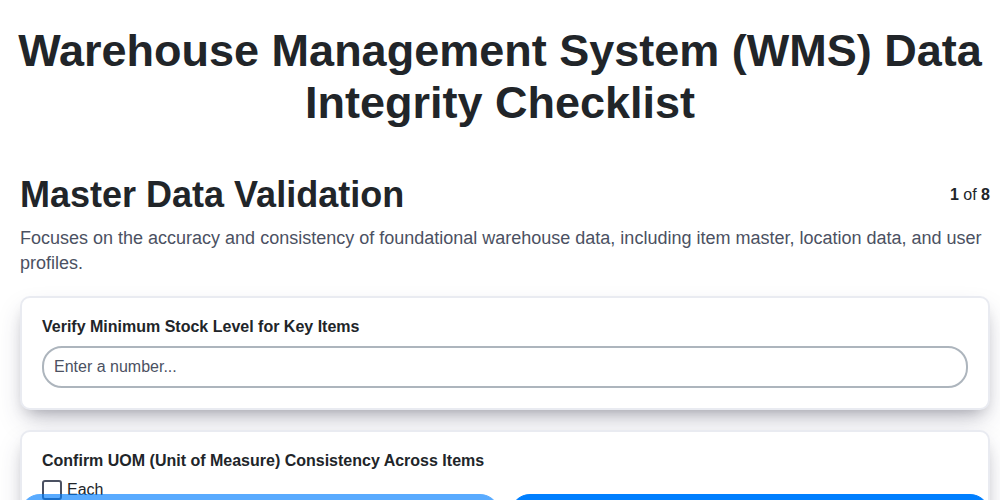
Warehouse Data Integrity: Your WMS Checklist Template
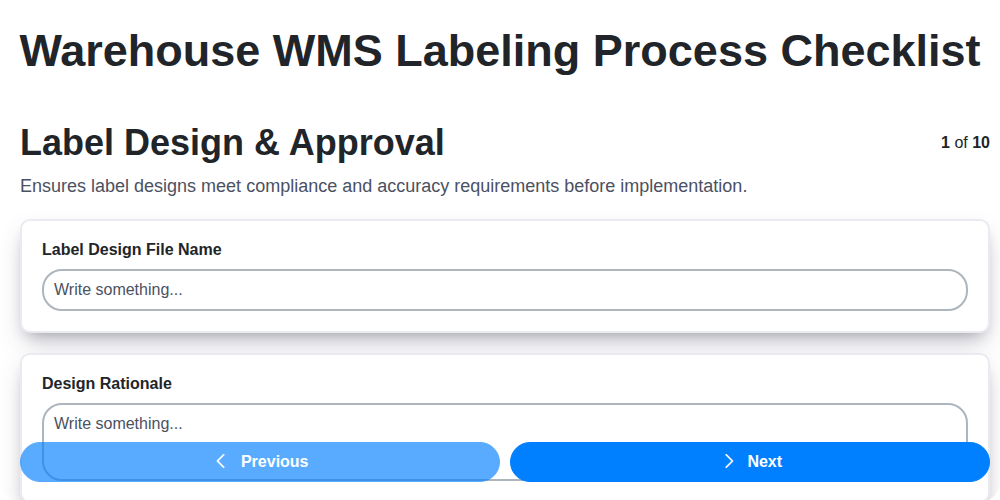
Mastering Warehouse Labeling: Your WMS Process Checklist Template

Warehouse WMS Security Checklist: A Comprehensive Guide to Protecting Your Operations
We can do it Together
Need help with
Checklists?
Have a question? We're here to help. Please submit your inquiry, and we'll respond promptly.