Optimizing Your Warehouse: The Ultimate WMS Slotting Strategy Checklist
Published: 12/20/2025 10:00 PM Updated: 12/21/2025 6:55 AM
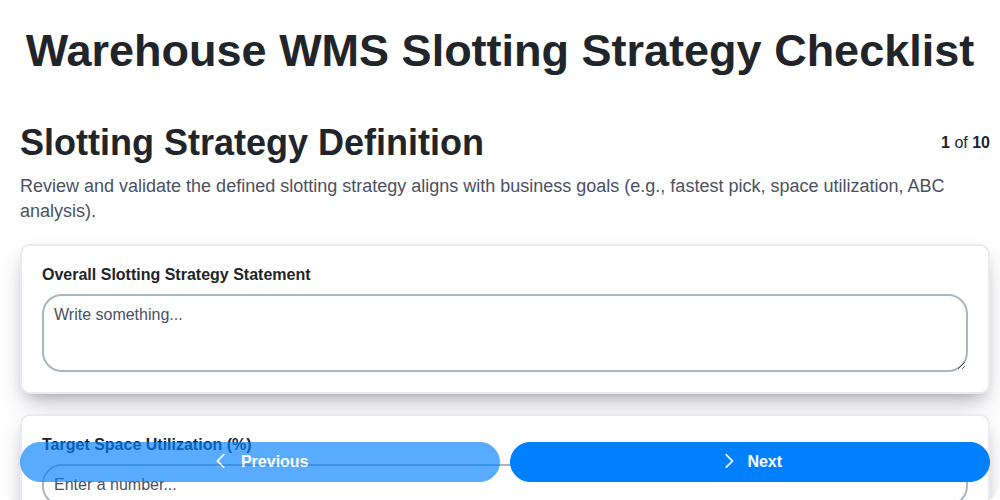
Table of Contents
- Introduction: Why Slotting Matters
- 1. Slotting Strategy Definition: Your Foundation
- 2. ABC Analysis & Product Categorization: Understanding Your Inventory
- 3. Defining Slot Assignment Rules: The Logic Behind Placement
- 4. WMS Configuration & Parameters: Setting Up for Success
- 5. Slotting Algorithm Validation: Testing Your Strategy
- 6. Storage Equipment Considerations: Matching Slots to Equipment
- 7. Picking Efficiency Evaluation: Measuring the Impact
- 8. Space Utilization Monitoring: Maximizing Every Square Foot
- 9. Slotting Exception Handling: Addressing the Unexpected
- 10. Training & Communication: Ensuring Team Understanding
- 11. Continuous Improvement & Review: A Living Strategy
- 12. Data Analysis & Reporting: Tracking Performance
- 13. Future-Proofing Your Slotting Strategy
- Resources & Links
TLDR: Feeling overwhelmed by warehouse slotting? This checklist is your roadmap! It guides you through defining your strategy, analyzing products, setting slotting rules, configuring your WMS, validating performance, and continuously improving your warehouse layout for faster picking, better space use, and fewer headaches. It's the essential guide to getting the most from your WMS slotting!
Introduction: Why Slotting Matters
Warehouse slotting - the strategic placement of inventory within a warehouse - is far more than just putting things where they fit. It's a cornerstone of efficient warehouse operations, directly impacting picking times, labor costs, and overall throughput. A poorly planned slotting strategy can lead to bottlenecks, wasted space, and frustrated pickers. Conversely, a well-designed and consistently optimized slotting strategy can unlock significant gains in productivity and accuracy. This isn't a set it and forget it exercise; it's a dynamic process that requires ongoing evaluation and adaptation to changing business needs and seasonal fluctuations. In today's competitive landscape, where speed and accuracy are paramount, a robust slotting strategy powered by a Warehouse Management System (WMS) is no longer a luxury - it's a necessity.
1. Slotting Strategy Definition: Your Foundation
Before even thinking about assigning products to specific slots, you need a clear, documented slotting strategy. This isn't just about placing items; it's about aligning your slotting approach with your overall warehouse goals and operational characteristics.
Think of this as the cornerstone of your entire slotting execution. A poorly defined strategy will lead to inefficiencies, wasted space, and frustrated warehouse staff.
Here's what your strategy definition should encompass:
- Business Objectives: What are you trying to achieve? Faster order fulfillment? Reduced labor costs? Improved inventory accuracy? Your strategy must directly support these objectives.
- Key Performance Indicators (KPIs): How will you measure success? Examples include order cycle time, picking accuracy, labor productivity, and slot utilization.
- Warehouse Characteristics: Consider the size and layout of your warehouse, the types of storage equipment you use (racking, shelving, flow racks, etc.), and any unique constraints.
- Product Flow Patterns: Understand how products move through your warehouse, from receiving to shipping. Identify fast-moving SKUs, seasonal items, and those with special handling requirements.
- Team Involvement: Include input from warehouse managers, pickers, and other key personnel. They have valuable insights into daily operations.
- Documentation: Create a formal document outlining your slotting philosophy, guiding principles, and initial assumptions. This will serve as a reference point for ongoing adjustments and training.
Defining your slotting strategy isn't a one-time task; it's a living document that should be revisited and refined as your business evolves.
2. ABC Analysis & Product Categorization: Understanding Your Inventory
Effective slotting isn't just about putting things in places; it's about placing the right things in the right places. That starts with a deep understanding of your inventory profile. ABC analysis is your key tool for achieving this.
What is ABC Analysis?
ABC analysis categorizes inventory items based on their value and consumption rate. It's based on the Pareto principle (the 80/20 rule), which suggests that roughly 80% of your sales often come from 20% of your inventory.
- A Items (High-Value): These items account for approximately 20% of your inventory but generate 80% of your revenue. They're critical to your business. Think of best-selling products or those with high profit margins.
- B Items (Medium-Value): Around 30% of your inventory falls into this category and contributes roughly 15% of revenue. These items are important, but not as critical as 'A' items.
- C Items (Low-Value): These items represent 50% of your inventory and contribute only 5% of your revenue. While necessary, they have lower impact.
Beyond ABC: Product Categorization
ABC analysis is a great starting point, but product categorization adds another layer of insight. Group products based on characteristics beyond value - consider:
- Velocity: Fast-moving vs. slow-moving items.
- Size & Weight: Small/light, large/heavy, hazardous materials.
- Fragility: Delicate items requiring special handling.
- Storage Requirements: Temperature-controlled, special racking needs.
- Compatibility: Items that shouldn't be stored near each other (e.g., chemicals and food).
How this informs Slotting:
- 'A' Items: These deserve prime locations - closest to receiving and shipping docks, easily accessible for picking. Minimize travel time.
- 'B' Items: Place these in moderately accessible locations.
- 'C' Items: These can be stored further away, potentially in less optimal locations.
- Categorized items: Items needing special handling (fragile, hazardous, temperature-controlled) must be stored accordingly, regardless of ABC classification.
By combining ABC analysis with detailed product categorization, you're setting the foundation for a truly optimized warehouse slotting strategy.
3. Defining Slot Assignment Rules: The Logic Behind Placement
Once you're clear on your slotting strategy definition and have categorized your products, it's time to build the rules that dictate where specific items live within your warehouse. This isn't a random process; it's about embedding logic that supports your operational goals.
Here's a breakdown of key considerations for your slot assignment rules:
Velocity & Frequency: This is the cornerstone for many. High-velocity (frequently picked) items should be placed in easily accessible, prime locations - close to packing stations, on lower racking levels, or in easily maneuverable areas. Low-velocity items can be placed further away, leveraging less-desirable space.
Size and Dimensions: Larger, bulkier items require wider aisles and less dense storage. Consider their size when assigning slots, grouping similar-sized items together for efficient retrieval.
Compatibility & Safety: Avoid storing incompatible products near each other (e.g., chemicals near food). Also, consider safety - heavy items should be on lower shelves to prevent injury during retrieval.
Product Characteristics: Temperature-sensitive goods might need refrigerated slots. Fragile items require extra care and potentially more accessible locations.
Order Profile: Analyze your order patterns. Do you frequently receive and ship in conjunction with other items? Consider slotting them near each other to streamline picking.
ABC Classification Influence: Your ABC analysis results directly inform slot placement. A items (high-value, high-movement) get the best slots, B items are given good, but not prime, locations, and C items are slotted in areas with less optimal access.
Dynamic Slotting: Consider whether your rules need to be flexible enough to handle seasonal fluctuations or promotional periods. Can slots be reassigned dynamically based on demand?
User-Friendliness: Ensure the rules are clear and easy for warehouse staff to understand and follow. Ambiguity leads to errors and inefficiencies.
Document your slot assignment rules clearly and make them readily accessible to all relevant staff. Regular review and adjustment are essential to maintain optimal warehouse performance.
4. WMS Configuration & Parameters: Setting Up for Success
Your carefully crafted slotting strategy is only as good as its implementation within your Warehouse Management System (WMS). This isn't just about entering data; it's about configuring the system to actively support your strategy and optimize performance. Here's a breakdown of key areas to focus on:
- Slot Definitions & Attributes: Clearly define slot types (e.g., fast-moving, slow-moving, oversized) within your WMS and assign appropriate attributes like maximum weight, dimensions, and handling requirements. Ensure the WMS allows for flexible slot characteristics beyond just location coordinates.
- Location Hierarchy & Types: Review your WMS location hierarchy. Does it accurately reflect your storage types (racking, floor, bulk storage)? Define location types to accommodate your slotting rules - for example, designating zones for specific product categories.
- User Permissions & Roles: Properly configure user roles and permissions to ensure accurate slotting and prevent unauthorized changes. This is critical for maintaining data integrity and operational control.
- WMS Parameters & Settings: Dive deep into WMS parameters related to slotting. This might include default slotting behaviors, picking priorities based on slot location, and error handling routines.
- Integration Points: If your WMS integrates with other systems (ERP, shipping, etc.), ensure data flows seamlessly for accurate inventory visibility and order fulfillment. Properly map data fields and validate integrations.
- Validation Rules: Implement validation rules within the WMS to prevent incorrect slot assignments. For example, ensure that an item's dimensions and weight are compatible with the designated slot.
- Training & Documentation: Don't underestimate the importance of thorough training for your warehouse staff on the new WMS configuration and slotting procedures. Create clear, concise documentation for future reference.
5. Slotting Algorithm Validation: Testing Your Strategy
Implementing a new slotting strategy is a significant undertaking, and just because the algorithm looks good on paper doesn't mean it performs flawlessly in your warehouse. Thorough validation is crucial to ensure the strategy delivers the promised improvements in efficiency and accuracy. This isn't just a one-time check; it's an iterative process.
Here's a breakdown of how to validate your slotting algorithm:
- Simulate Real-World Scenarios: Don't just test with ideal conditions. Introduce variability. Simulate peak order volume, seasonal product shifts, and unexpected events like equipment malfunctions or staff shortages.
- Data-Driven Testing: Use historical order data to create test order sets representing your typical demand patterns. Track key metrics during the simulated operations, including:
- Picking Time: How long does it take pickers to complete orders using the new slotting strategy?
- Travel Distance: Has the total travel distance for pickers been reduced?
- Picking Accuracy: Is there a decrease in picking errors?
- Order Cycle Time: What's the overall time from order receipt to shipment?
- What-If Analysis: Experiment with different parameter settings within your WMS. What happens if you adjust the weighting for product velocity or size? How does it affect performance?
- User Acceptance Testing (UAT): Involve warehouse staff in the validation process. They are the ones using the system daily and can provide valuable insights into its usability and potential issues. Provide training and solicit feedback.
- Compare to Baseline: If you're replacing an existing slotting strategy, compare the performance metrics of the new strategy against the old one. Quantify the improvements (or identify areas where the new strategy falls short).
- Iterate and Refine: Validation isn't a pass/fail scenario. Identify areas for improvement and adjust your slotting rules and WMS parameters accordingly. Re-test to confirm the changes have the desired effect.
By systematically validating your slotting algorithm, you can build confidence in your strategy and maximize its impact on warehouse efficiency.
6. Storage Equipment Considerations: Matching Slots to Equipment
Your slotting strategy isn't just about product placement; it's intricately linked to the equipment used to access those locations. Failing to consider this can lead to bottlenecks, increased travel time, and unnecessary strain on your warehouse infrastructure. Here's how to ensure your slot assignments harmonize with your equipment:
Rack Type & Accessibility: Consider the types of racking you have - pallet racking, shelving, flow rack, carton flow, etc. High-velocity items should be positioned within easily accessible locations suitable for forklifts or reach trucks. Slower-moving items can be placed in harder-to-reach areas, potentially utilizing racking with narrower aisles.
Equipment Capabilities: Your slotting should directly account for your material handling equipment's reach, lift height, and turning radius. Don't place items in zones that require equipment to awkwardly maneuver or exceed its operational limits. This minimizes damage risk and maximizes efficiency.
Automated Systems: If you utilize automated storage and retrieval systems (AS/RS), slotting becomes even more critical. The system's limitations - such as maximum item size or weight - must be factored into slot assignment. The WMS should be configured to enforce these constraints.
Specialized Equipment: Certain items might require specific storage solutions, such as temperature-controlled chambers or hazardous material storage. Slotting should reflect these requirements, ensuring proper segregation and compliance.
Future-Proofing: Think beyond current equipment. Consider potential upgrades or additions. Slotting strategy should allow for flexibility to accommodate new technologies without requiring a complete overhaul.
Ultimately, a holistic approach - one that integrates your slotting strategy with your storage equipment capabilities - is essential for an optimized warehouse operation.
7. Picking Efficiency Evaluation: Measuring the Impact
Slotting isn't just about placing items; it's about optimizing the entire picking process. To truly understand the effectiveness of your slotting strategy, you need a robust evaluation system focused on picking efficiency. Here's what you should be measuring:
Key Metrics to Track:
- Average Pick Time: This is the foundational metric. Track how long it takes pickers to fulfill orders. A well-slotted warehouse should see a noticeable decrease in average pick time.
- Picks Per Hour (PPH): This measures individual picker productivity. Improvements in slotting should lead to higher PPH.
- Order Cycle Time: This encompasses the entire order fulfillment process, from order receipt to shipment. Slotting improvements should contribute to a reduction in this time.
- Picking Accuracy: While speed is vital, accuracy is paramount. Analyze picking errors (mis-picks, short picks) and see if your slotting strategy is impacting them - ideally for the better.
- Travel Distance: Optimized slotting should minimize picker travel distance within the warehouse. Track this to identify areas for further improvement.
- Error Rates (Mis-picks, Short Picks): Poor slotting can lead to increased errors. Track these to gauge the direct impact of your strategy.
Evaluation Methods:
- Time Studies: Conduct direct observations of pickers to record their movements and identify bottlenecks.
- WMS Data Analysis: Leverage your WMS to generate reports on the metrics listed above, allowing for trend analysis and comparison to baseline data.
- Picker Feedback: Regularly solicit feedback from your warehouse team. They are on the front lines and can offer valuable insights into the practical impact of the slotting strategy.
- A/B Testing: If making significant slotting changes, consider A/B testing with a small section of the warehouse to compare performance before a full rollout.
Remember: Evaluation isn't a one-time event. Continuously monitor these metrics and iterate on your slotting strategy to maintain peak picking efficiency.
8. Space Utilization Monitoring: Maximizing Every Square Foot
Slotting isn't a "set it and forget it" process. Regularly monitoring space utilization is crucial to ensure your slotting strategy continues to perform optimally and adapt to changing needs. Without it, you risk wasted space, unnecessary congestion, and decreased overall warehouse efficiency.
Here's what you need to track:
- Slot Density: How much of your available slot space is actually being used? Low utilization indicates potential for consolidation or reallocation. High utilization might signal a need for additional storage solutions.
- Aisles & Travel Distances: Analyze how often aisles are used and the average distances traveled by pickers. Inefficient aisle usage suggests slotting may be contributing to unnecessary movement.
- Empty Slot Percentage: Track the percentage of empty slots. A consistently high percentage points to a potential misalignment between slot assignments and demand.
- Storage Equipment Load Factors: If you're using racking or other storage equipment, monitor the load factors to ensure they're optimized and safe.
- Reporting and Visualization: Implement dashboards and reports that clearly visualize space utilization metrics. This allows for quick identification of problem areas and facilitates data-driven decision-making.
Tools & Techniques:
- WMS Reporting: Leverage the reporting capabilities of your WMS to generate space utilization reports.
- Heatmaps: Visual representation of picker traffic and slot usage patterns.
- Manual Audits: Periodic physical audits to verify data accuracy and identify inconsistencies.
By consistently monitoring space utilization and proactively addressing any inefficiencies, you can significantly enhance your warehouse's capacity, reduce operational costs, and improve overall performance.
9. Slotting Exception Handling: Addressing the Unexpected
No slotting strategy is perfect from day one. Unexpected situations will arise. A sudden surge in demand for a low-volume item, a supplier delivering a significantly larger-than-expected shipment, or a change in product dimensions - these events can all throw your meticulously planned slotting scheme off balance. A robust exception handling process is critical to maintain efficiency and prevent bottlenecks.
Here's what that process should include:
- Define Triggers: Establish clear thresholds that flag potential exceptions. Examples include items exceeding maximum slot capacity, products requiring special handling (temperature control, fragile), or items consistently missed during picking.
- Immediate Response Protocol: Outline steps for immediate action when an exception is triggered. This might involve a designated team member to reassess the slot assignment, temporarily relocate the item, or adjust picking routes.
- Root Cause Analysis: Don't just fix the immediate problem. Investigate why the exception occurred. Was it a forecasting error, a data input mistake, or a flaw in the slotting rules themselves?
- Exception Reporting: Implement a system to track and report all slotting exceptions. This data provides valuable insights into recurring problems and areas for improvement.
- Dynamic Re-slotting Permissions: Empower designated personnel (e.g., warehouse supervisors) to make temporary slot adjustments when necessary, with appropriate auditing.
- Communication is Key: Ensure that all relevant teams (inventory management, procurement, warehouse operations) are notified of significant exceptions and any resulting slotting adjustments.
By proactively anticipating and effectively managing slotting exceptions, you'll minimize disruptions and ensure your warehouse remains responsive to changing business needs.
10. Training & Communication: Ensuring Team Understanding
A flawlessly designed slotting strategy is useless if your team doesn't understand and embrace it. Training and clear communication are paramount to successful implementation and ongoing optimization. Here's what you need to cover:
- Initial Training: Conduct comprehensive training sessions for all warehouse personnel involved in receiving, putaway, picking, and slotting. Explain why the new strategy is being implemented, how it benefits the warehouse (and ultimately, them), and their specific roles within the process.
- Role-Specific Instructions: Detail the revised workflows and expectations for each role. Receiving teams need to understand new putaway instructions, pickers need to know how to locate items based on the slotting logic, and supervisors need to be equipped to address questions and issues.
- Visual Aids & Documentation: Create easily accessible visual aids (maps, diagrams, flowcharts) illustrating slot locations and procedures. Maintain clear, up-to-date documentation - a single source of truth - that's readily available on digital signage or a shared network drive.
- Ongoing Refreshers: Slotting strategies aren't static. Schedule regular refresher training sessions, especially when adjustments are made or new team members join.
- Feedback Channels: Establish open communication channels. Encourage employees to provide feedback on the strategy - they're the ones working with it daily and can offer invaluable insights for improvement. Actively listen and respond to their concerns.
- Key Performance Indicators (KPIs) Communication: Share the KPIs you're using to measure the strategy's success (e.g., picking time, space utilization). This transparency keeps everyone engaged and reinforces the importance of adherence to the new processes.
11. Continuous Improvement & Review: A Living Strategy
Slotting isn't a "set it and forget it" exercise. It's a dynamic process that requires constant monitoring and refinement. Your warehouse environment, product mix, and order profiles will change. What worked brilliantly six months ago might be causing bottlenecks today.
This is where continuous improvement and review come in. We recommend scheduling regular (quarterly or bi-annually, at minimum) reviews of your slotting strategy. These reviews should involve key stakeholders including warehouse managers, picking team leads, and ideally, representatives from procurement or sales who have insight into product trends.
What to Review:
- Performance Metrics: Revisit picking efficiency, space utilization, and any identified exception rates. Are they trending in the desired direction?
- Product Velocity & Demand: Has the popularity of certain products shifted? Products experiencing a surge in demand may need to be re-slotted closer to picking stations.
- Order Profile Changes: Are order sizes or product mix changing? Larger orders might benefit from different slotting approaches.
- Feedback from Pickers: Your picking team is on the front lines. Solicit their feedback - they often have valuable insights into inefficiencies and potential improvements.
- WMS Data Analysis: Leverage your WMS reporting capabilities to identify patterns and areas for optimization.
- New Product Introductions: Always incorporate new products into the slotting plan proactively, considering their characteristics and anticipated demand.
Actionable Improvements:
Document all review findings and create a prioritized list of actionable improvements. Test these changes in a controlled environment before full implementation. Remember to track the impact of these changes to quantify their effectiveness and inform future adjustments. This iterative process ensures your slotting strategy remains agile and optimized for long-term warehouse success.
12. Data Analysis & Reporting: Tracking Performance
Slotting isn't a "set it and forget it" initiative. To ensure your warehouse is operating at peak efficiency, continuous monitoring and analysis of your slotting strategy's performance are essential. This section outlines key metrics and reporting requirements.
Key Performance Indicators (KPIs) to Track:
- Picking Accuracy: Monitor error rates - are products consistently picked from the correct locations? A decrease in accuracy can signal issues with slot assignment or WMS configuration.
- Picking Time: Track average picking time per order or per item. Inefficient slotting (e.g., frequently moving items across the warehouse) directly impacts this.
- Travel Distance: Measure the average distance pickers travel during order fulfillment. Shorter distances equate to faster picking.
- Space Utilization: Regularly assess the percentage of usable space in your warehouse. Are slots optimized, or are areas underutilized?
- Order Fulfillment Rate: Track the percentage of orders fulfilled on time. Slotting can be a bottleneck if not properly managed.
- Inventory Turnover: Monitor how quickly inventory is moving through your warehouse. Optimized slotting can contribute to improved turnover.
Reporting Requirements:
- Regular Dashboards: Implement visual dashboards displaying key performance indicators (KPIs). These should be accessible to warehouse managers and relevant stakeholders.
- Exception Reporting: Automatically generate reports highlighting slotting exceptions (e.g., frequently misplaced items, consistently full slots).
- Trend Analysis: Track KPIs over time to identify trends and potential areas for improvement.
- Slot Performance Reports: Generate reports showing the performance of individual slots (e.g., frequency of picks, errors).
- Periodic Review: Schedule regular reviews (e.g., monthly, quarterly) of slotting performance data, involving relevant team members to identify opportunities for optimization.
13. Future-Proofing Your Slotting Strategy
Slotting isn't a set it and forget it endeavor. The warehouse landscape is constantly evolving, driven by factors like fluctuating demand, new product introductions, automation advancements, and shifts in customer expectations. Future-proofing your slotting strategy means proactively addressing these changes.
Consider these key areas for ongoing adaptation:
- Embrace Automation: As you integrate automated systems like Autonomous Mobile Robots (AMRs) or Automated Storage and Retrieval Systems (AS/RS), your slotting strategy needs to accommodate their unique capabilities and limitations. Dynamic slotting becomes increasingly valuable for these systems.
- Data-Driven Forecasting: Leverage advanced forecasting models that incorporate external factors like seasonality, promotions, and even social media trends to anticipate demand spikes and adjust slotting accordingly.
- Omnichannel Integration: With the rise of e-commerce and omnichannel fulfillment, slotting needs to support diverse order profiles - from single-item picks to pallet shipments. Consider dedicated zones for each fulfillment channel.
- Sustainability Considerations: Optimize slotting to minimize travel distances for pickers, reducing energy consumption and carbon footprint.
- AI & Machine Learning: Explore using AI and machine learning to continuously refine slot assignment rules based on real-time data and identify hidden patterns. These tools can automate the optimization process, adapting quickly to changing conditions.
- Scalability Planning: Regularly review your slotting strategy's ability to handle future growth. Design a system that can be easily expanded and modified as your warehouse footprint and product mix evolve.
By keeping a forward-looking perspective and incorporating these considerations, you can ensure your slotting strategy remains a competitive advantage, ready to meet the challenges of tomorrow.
Resources & Links
- Warehouse Management Systems (WMS) Providers: A general resource for understanding WMS functionality and finding vendors. Explore various solutions to see what aligns with your warehouse's needs.
- Supply Chain Digital: Offers articles and insights on various supply chain topics, including warehousing and slotting strategies. Look for content related to optimization and best practices.
- APICS (The Association for Supply Chain Management): Provides resources, certifications, and information on supply chain management, including inventory control and warehousing. Useful for deeper understanding of the principles.
- Infor - Warehouse Management: Offers information and case studies on warehouse management solutions, focusing on slotting optimization and related technologies. Provides examples of real-world implementations.
- Blueprinths - Warehouse Slotting Solutions: Specializes in warehouse slotting optimization. Offers details about their methodology and potential benefits.
- Zebra Technologies - Warehouse Solutions: Provides technology solutions for warehouses, including scanners, mobile computers, and printing, which can support slotting optimization and data collection. Explore their insights on warehouse execution systems (WES).
- ABC Analysis Explained (ABC Rating): Provides a simple explanation of ABC analysis, essential for understanding how to prioritize inventory for slotting. Useful for those new to the concept.
- Material Handling Today: Features articles, case studies, and news related to material handling equipment and warehousing strategies. Search for articles related to slotting and optimization techniques.
- SCMR Plus: Provides supply chain and logistics news, analysis, and resources. Search for articles and reports on warehousing and slotting strategies.
- Retriever.io - Slotting Optimization: Offers insights and potentially tools (depending on offerings) related to slotting optimization and dynamic slotting based on data analysis.
Frequently Asked Questions
What is WMS slotting and why is it important?
WMS slotting refers to the process of strategically assigning specific locations (slots) within your warehouse to inventory items. It's crucial for optimizing picking efficiency, reducing travel time for warehouse staff, improving order fulfillment speed, and maximizing space utilization. A well-planned slotting strategy directly impacts overall warehouse productivity and profitability.
What are the key factors to consider when developing a WMS slotting strategy?
Several factors are important, including product velocity (how often items are picked), product dimensions and weight, storage equipment capabilities (e.g., racking height, pallet size), seasonal demand fluctuations, and any specific product handling requirements (e.g., temperature control, hazardous materials). Also consider picking frequency and item compatibility.
What's the difference between ABC analysis and slotting?
ABC analysis categorizes inventory based on usage (A = high-volume, B = medium-volume, C = low-volume). Slotting takes this categorization further by actually assigning locations based on ABC categories and other factors like item characteristics. ABC analysis informs your slotting strategy, but it's not the slotting process itself.
What is 'travel time' in the context of warehouse slotting, and why is it a key metric?
Travel time refers to the total distance warehouse staff need to walk or use equipment to pick items. Excessive travel time significantly reduces picking efficiency. Optimized slotting aims to minimize this travel time, often by placing high-velocity items closer to picking stations.
What are some common slotting methods?
Common methods include: ABC slotting (based on velocity), Velocity Slotting, Weight-Based Slotting, Compatibility Slotting (grouping similar items), and Zone Slotting (dividing the warehouse into zones). Hybrid approaches that combine these methods are also frequently used.
How does seasonality impact warehouse slotting?
Seasonal demand changes require adjustments to slotting. High-demand seasonal items should be moved to more accessible locations closer to picking stations. Low-demand seasonal items can be relocated to less-accessible areas to free up space. Dynamic slotting, adjusting based on real-time demand, is a powerful tool.
What is 'dynamic slotting,' and when should it be used?
Dynamic slotting is the ability to automatically and frequently adjust slot assignments based on real-time data like order patterns and inventory levels. It's most beneficial for warehouses with high volatility in demand or a large product catalog where fixed slotting becomes inefficient.
How can I measure the success of my WMS slotting strategy?
Key performance indicators (KPIs) to track include: picking time, order fulfillment rate, inventory accuracy, travel time, and warehouse space utilization. Regularly monitor these KPIs and compare them to benchmarks to identify areas for improvement.
What role does warehouse management software (WMS) play in slotting?
A WMS provides the tools to plan, implement, and manage a slotting strategy. It can optimize slot assignments, track inventory locations, guide pickers with optimized routes, and provide data and reporting for performance analysis. Many advanced WMS offer dynamic slotting capabilities.
What are some potential pitfalls to avoid when implementing a new slotting strategy?
Common pitfalls include: failing to analyze data properly, implementing changes too quickly without sufficient planning and testing, not training warehouse staff on the new system, ignoring product compatibility, and failing to regularly review and adjust the strategy.
Found this Article helpful?
Comments
There are no comments yet. Be the first to add one!
WMS - Warehouse Management System Solution Demo
Optimize your warehouse operations & boost efficiency! ChecklistGuro's WMS streamlines inventory management, order fulfillment, and shipping. Reduce errors, improve accuracy, & maximize space utilization. Manage it all with our Work OS.
Related Articles
Seamless RFID Integration: Your WMS Checklist Template for Success
Mastering Warehouse Labeling: Your WMS Process Checklist Template
The Ultimate Supply Chain Inventory Accuracy Audit Checklist: A Step-by-Step Guide
Mastering Putaway: Your WMS Optimization Checklist

Mastering Your Yard: A Warehouse WMS Yard Management Checklist Template
Warehouse Data Integrity: Your WMS Checklist Template
WMS System Performance Monitoring Checklist: A Comprehensive Guide
Warehouse WMS Error Handling Checklist: A Proactive Guide to Minimizing Disruptions
We can do it Together
Need help with
Warehouse Management System (WMS)?
Have a question? We're here to help. Please submit your inquiry, and we'll respond promptly.