Mastering Putaway: Your WMS Optimization Checklist
Published: 12/20/2025 10:00 PM Updated: 04/20/2026 11:27 AM
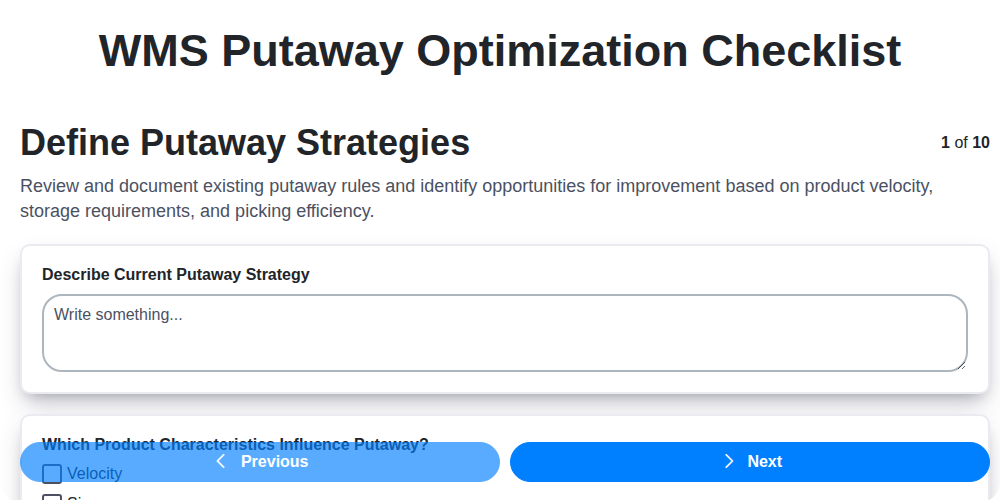
Table of Contents
- Introduction: Why Putaway Optimization Matters
- 1. Define Putaway Strategies: The Foundation for Efficiency
- 2. Storage Location Optimization: Maximizing Space & Accessibility
- 3. Directed Putaway Validation: Ensuring Accuracy & Consistency
- 4. Slotting Optimization Review: Fine-Tuning Your Storage Plan
- 5. Product Grouping and Zoning: Streamlining Workflow
- 6. Task Interdependencies: Coordinating Putaway with Other Processes
- 7. Operator Training and Proficiency: Empowering Your Team
- 8. Performance Metrics Monitoring: Tracking Progress and Identifying Bottlenecks
- 9. Exception Handling & Error Resolution: Addressing Issues Effectively
- 10. WMS Configuration Validation: Aligning System with Strategy
- 11. Integration with Receiving: A Seamless Flow
- 12. Continuous Improvement: Putaway Optimization as an Ongoing Process
- Conclusion: Achieving Putaway Excellence
- Resources & Links
TLDR: Overwhelmed by warehouse putaway? This checklist is your roadmap! It covers everything from defining putaway strategies and optimizing storage locations to training your team and tracking performance. Use it to streamline your WMS putaway process, reduce errors, and boost overall warehouse efficiency - it's your shortcut to putaway mastery!
Introduction: Why Putaway Optimization Matters
Putaway, the process of moving received goods to their designated storage locations, often gets overlooked in warehouse operations. However, an inefficient putaway process can have a cascading effect, impacting everything from picking efficiency and order fulfillment speed to overall warehouse capacity and employee morale.
Think of it this way: a disorganized putaway process is like the foundation of a shaky building. It leads to wasted time searching for items, increased congestion on warehouse aisles, potential for misplacement and damage, and ultimately, higher operational costs.
Optimizing your putaway process isn't just about moving products; it's about creating a streamlined, efficient system that maximizes space utilization, minimizes travel time, and improves accuracy. This checklist will guide you through key considerations, helping you transform your putaway operations from a potential bottleneck into a strategic advantage. By investing in putaway optimization, you're investing in the overall health and profitability of your warehouse.
1. Define Putaway Strategies: The Foundation for Efficiency
Before a single item is moved, you need a clear and documented putaway strategy. This isn't just about where things go; it's about how they get there efficiently and accurately. A well-defined strategy minimizes travel time, reduces congestion, and sets the stage for overall warehouse optimization.
Consider these key elements when defining your putaway strategies:
- ABC Analysis Integration: Prioritize putaway for high-velocity (A) items closer to picking zones to reduce travel. Slow-moving (C) items can be placed further away.
- Item Characteristics: Factor in item size, weight, fragility, and storage requirements (e.g., temperature control) when assigning putaway locations.
- Putaway Methods: Determine the appropriate putaway methods (e.g., random, fixed location, wave putaway) based on your warehouse layout and product flow.
- Receiving Dock Considerations: Account for the receiving dock layout and capacity to ensure a smooth flow of inbound goods.
- Documentation & Communication: Clearly document all strategies and communicate them to all relevant personnel. Regularly review and update these strategies as needed.
A solid, well-thought-out putaway strategy is the bedrock upon which all other optimization efforts are built. Don't skip this crucial first step!
2. Storage Location Optimization: Maximizing Space & Accessibility
Effective putaway isn't just about getting items into the warehouse; it's about putting them in the right place. Poor storage location choices lead to wasted space, increased travel time for picking, and ultimately, reduced overall efficiency. Here's how to optimize your storage location strategy:
1. Analyze Current Utilization: Begin with a thorough assessment of your current storage utilization. Use your WMS data to identify underutilized locations, frequently accessed locations, and locations with high dwell times. Heatmaps can be incredibly valuable for visually representing this data.
2. Consider Product Characteristics: Not all products are created equal. Factor in attributes like:
- Size & Weight: Heavier or bulkier items should be placed in easily accessible lower locations to minimize operator strain and equipment needs.
- Velocity (Frequency of Picking): Fast-moving SKUs (those picked frequently) should be placed in prime locations - closer to receiving and shipping docks. Slow-moving items can occupy less accessible areas.
- Special Handling Requirements: Items requiring specific conditions (temperature, humidity) need designated storage areas.
- Cube Utilization: Optimize space by considering the three-dimensional nature of storage. Can you stack items vertically? Are you using all available height?
3. Implement ABC Analysis: Segment your inventory using ABC analysis (A = high-volume, B = medium-volume, C = low-volume). A items get premium locations, B items have moderately good locations, and C items are assigned to less preferred spots.
4. Dynamic vs. Static Location Assignment: Consider whether a static (fixed) or dynamic (flexible) location assignment strategy best suits your operation. Dynamic slotting, often driven by WMS, allows for continuous adjustment of locations based on real-time demand and product movement.
5. Regular Review & Adjustment: Storage location optimization isn't a one-time task. Demand fluctuates, product mixes change, and processes evolve. Establish a regular schedule (e.g., quarterly, annually) to review your storage location plan and make adjustments as needed. Leverage your WMS reporting capabilities to identify areas for improvement.
3. Directed Putaway Validation: Ensuring Accuracy & Consistency
Implementing directed putaway is only half the battle. Rigorous validation ensures the system is functioning correctly and consistently, minimizing errors and maximizing efficiency. This isn't a one-time check; it's an ongoing process.
Here's what your directed putaway validation checklist should include:
- Simulate a Variety of Scenarios: Don't just test with standard products and locations. Introduce variances in item size, weight, and dimensions. Test with products requiring special storage conditions (temperature control, hazardous materials). Simulate situations with full and empty locations.
- User Observation & Feedback: Observe operators performing directed putaway tasks. Are they understanding the system's instructions? Are they finding the suggested locations logical and practical? Encourage open feedback - their insights are invaluable.
- Location Assignment Verification: Regularly cross-reference the system's assigned locations with the actual physical layout. Are products being put away where they should be based on the WMS logic? Discrepancies require immediate investigation and correction.
- Data Integrity Checks: Verify that the WMS accurately reflects the physical state of inventory. Regular cycle counts and reconciliation processes are crucial here. Mismatches highlight errors in putaway instructions or data entry.
- Exception Handling Review: Analyze reports of directed putaway exceptions (e.g., location full, invalid location). Identify patterns and root causes to refine the system's logic and prevent future occurrences.
- Documented Procedures & Audit Trails: Maintain detailed documentation of the validation process, including test cases, results, and corrective actions taken. An audit trail allows you to track changes and quickly identify the source of issues.
4. Slotting Optimization Review: Fine-Tuning Your Storage Plan
Slotting optimization isn't a one-and-done task; it's an ongoing process. Your business evolves, product demand shifts, and your inventory profile changes. A regular review of your slotting strategy is critical to maintaining putaway efficiency and preventing bottlenecks.
Here's what to examine during a slotting optimization review:
- Analyze ABC Data: Revisit your ABC classification (based on velocity, volume, and value). Are items still accurately placed based on their classification? High-velocity items must be readily accessible.
- Assess Travel Distance: Use your WMS data to identify products that consistently require long travel distances for putaway and picking. This indicates potential misplacement.
- Review Product Dimensions and Weight: Ensure items are stored in locations that are appropriate for their size and weight. Placing a bulky item in a narrow aisle creates problems.
- Consider Product Compatibility: Group compatible products together (e.g., chemicals with chemicals, fragile items with fragile items) to streamline processes and minimize risk.
- Evaluate Seasonal Fluctuations: Adjust slotting strategies to accommodate seasonal peaks and valleys in demand.
- User Feedback: Solicit feedback from warehouse operators - they're on the front lines and often have valuable insights into inefficiencies.
Don't be afraid to experiment with different slotting approaches. A small adjustment can often yield significant improvements in putaway time and overall warehouse efficiency. Remember to document all changes and track their impact on performance.
5. Product Grouping and Zoning: Streamlining Workflow
Efficient putaway isn't just about where you put something; it's about how you organize your warehouse to minimize travel and maximize throughput. Product grouping and zoning are crucial components of this.
What is it? Product grouping involves categorizing your inventory based on characteristics relevant to putaway. This could be based on velocity (fast, medium, slow movers), size and weight, temperature requirements, or even potential compatibility issues. Zoning then assigns these groups to specific areas within your warehouse.
Why is it important for Putaway Optimization?
- Reduced Travel Time: Placing frequently moved products closer to receiving and picking areas significantly cuts down on operator travel.
- Improved Space Utilization: Grouping similar products allows for more efficient use of space and minimizes wasted aisles or awkward arrangements.
- Simplified Putaway Decisions: Clear zones guide operators, making putaway decisions faster and more intuitive. WMS can leverage this information to automatically direct operators to the most appropriate location within a zone.
- Enhanced Picking Efficiency: While primarily a putaway strategy, well-defined zones benefit picking, creating a smoother, more logical flow throughout the warehouse.
Implementation Considerations:
- Data Analysis: Thoroughly analyze your inventory data to identify logical groupings based on demand, characteristics, and other relevant factors.
- Zone Definition: Clearly define the boundaries of each zone and communicate these to all warehouse personnel.
- WMS Configuration: Configure your WMS to recognize and utilize these zones for directing putaway tasks. Consider allowing for flexibility - a high-velocity product might occasionally need to be placed in a different zone due to availability.
- Regular Review: Zones aren's static. Regularly review your zone assignments and product groupings to adapt to changing inventory profiles and business needs.
6. Task Interdependencies: Coordinating Putaway with Other Processes
Putaway doesn't exist in a vacuum. It's intrinsically linked to receiving, order fulfillment, and even inventory accuracy. Failing to consider these connections can create bottlenecks and inefficiencies throughout your entire warehouse operation.
Understanding the Flow: Receiving needs to be processed efficiently to feed the putaway process. Delays in receiving directly impact the putaway queue. Conversely, putaway completion directly influences order picking - if product isn't put away, it can't be picked.
Key Considerations:
- Receiving Schedule Alignment: Coordinate receiving schedules to avoid overwhelming the putaway team. Consider supplier delivery patterns and anticipated volumes.
- Order Fulfillment Impact: Prioritize putaway tasks based on pending order fulfillment needs. High-demand items should be put away promptly.
- Cycle Counting & Inventory Accuracy: Putaway is a crucial touchpoint for inventory control. Ensure tight integration with cycle counting programs to maintain accuracy and identify discrepancies early.
- Cross-Department Communication: Regular communication between receiving, putaway, picking, and inventory control teams is essential for proactive problem-solving and smooth workflow. A daily brief or shared dashboard can be extremely helpful.
- WMS Sequencing: Leverage your WMS to intelligently sequence tasks, prioritizing putaways that support immediate picking requirements or address receiving backlog.
By meticulously analyzing and coordinating these interdependencies, you can significantly improve overall warehouse productivity and reduce operational costs.
7. Operator Training and Proficiency: Empowering Your Team
A perfectly configured WMS and optimized putaway strategies are only as effective as the team executing them. Investing in comprehensive operator training and ensuring ongoing proficiency is paramount for realizing the full potential of your putaway optimization.
This isn't just about showing operators how to use the WMS; it's about understanding why putaway strategies are in place. Training should cover:
- Putaway Strategy Understanding: Explain the rationale behind chosen strategies - FIFO, LIFO, ABC analysis, etc. - and how they contribute to overall warehouse efficiency.
- WMS Functionality: Go beyond basic input. Cover advanced features, exception handling within the system, and how to interpret putaway instructions.
- Location Awareness: Familiarize operators with storage locations, including their attributes (temperature control, security levels, etc.).
- Safety Procedures: Reinforce safe material handling practices and proper use of equipment.
- Problem-Solving Skills: Equip operators with the ability to identify and report issues, and understand basic troubleshooting steps.
Beyond initial training, ongoing assessments and refresher courses are essential. Consider incorporating performance feedback, gamification to encourage best practices, and mentoring programs to foster a culture of continuous improvement. A well-trained and proficient team translates directly to reduced errors, increased throughput, and a more efficient putaway process.
8. Performance Metrics Monitoring: Tracking Progress and Identifying Bottlenecks
Putaway optimization isn't a set it and forget it process. Continuous monitoring of key performance indicators (KPIs) is essential to ensure your strategies remain effective and identify areas for improvement. Without consistent measurement, you're essentially flying blind.
Here's what you need to track and why:
- Putaway Time: This is a foundational metric. Track average putaway time per order, product, and operator. Significant increases can indicate issues with location assignment, WMS configuration, or operator proficiency.
- Putaway Accuracy: How often are items placed in the correct location? Even a small percentage of errors can lead to picking inefficiencies and order fulfillment delays.
- Travel Distance: Monitor the average distance traveled by operators during putaway tasks. Excessive travel distances suggest potential slotting or location optimization problems.
- Throughput: Track the number of putaway tasks completed per hour/shift. Declines in throughput may signal bottlenecks or process inefficiencies.
- Location Utilization: Are your storage locations being used effectively? Low utilization indicates potential over-slotting or inefficient location assignments.
- Exception Rate: How often do you encounter exceptions during putaway (e.g., location unavailable, item damaged)? A high exception rate requires investigation into root causes.
Tools and Techniques:
- WMS Reporting: Leverage your WMS's built-in reporting capabilities to track these KPIs.
- Dashboards: Create visual dashboards to monitor performance trends in real-time.
- Regular Reviews: Schedule regular reviews of performance data with warehouse staff and management.
- Pareto Analysis: Use Pareto charts to identify the "vital few" causes contributing to performance issues.
By consistently monitoring these metrics and analyzing trends, you can proactively identify and address potential bottlenecks, fine-tune your putaway processes, and ultimately maximize warehouse efficiency.
9. Exception Handling & Error Resolution: Addressing Issues Effectively
No putaway process is entirely flawless. Unexpected situations arise - damaged goods, incorrect labels, system errors, or unforeseen stock discrepancies. A robust exception handling and error resolution process is critical to minimizing disruption and maintaining overall warehouse efficiency.
This checklist isn't just about doing putaway; it's about reacting when things go wrong. Here's what your process should cover:
- Defined Error Codes & Procedures: Establish clear error codes within your WMS to categorize putaway issues (e.g., "Damaged Goods," "Label Mismatch," "Location Full"). Each code should trigger a pre-defined resolution procedure.
- Automated Alerts & Notifications: Implement automated alerts to supervisors or designated personnel when exceptions occur. Real-time visibility prevents issues from compounding.
- Root Cause Analysis: Don't just fix the immediate problem; investigate why the exception happened. Is it a training issue, a data entry error, or a problem with a process?
- Escalation Paths: Clearly define escalation procedures for complex or unresolved issues. Who is the go-to person when a simple resolution isn't possible?
- Documentation & Tracking: Log all exceptions, the resolution taken, and any corrective actions implemented. This data is invaluable for identifying trends and preventing future errors.
- User-Friendly Error Handling within WMS: The WMS interface should be intuitive for operators to report issues and follow defined resolution paths. Complex menus or unclear instructions lead to frustration and inaccurate reporting.
- Regular Review of Exception Data: Analyze exception reports regularly to identify recurring issues and proactively address underlying problems. Is a particular location constantly experiencing "Location Full" errors? It might need resizing or reassessment.
10. WMS Configuration Validation: Aligning System with Strategy
Your beautifully crafted putaway strategies are only as effective as the WMS executing them. Configuration validation is the crucial final step, ensuring the system truly reflects and supports your optimized processes. This isn't a one-time task; it's an ongoing process that needs periodic review and adjustments.
Here's what you need to scrutinize:
- Putaway Rules & Logic: Verify that the WMS is programmed to follow the putaway strategies defined earlier. Are products being directed to the correct locations based on product type, size, velocity, and other factors? Don't just assume - test it!
- Location Master Data: Double-check that all location types (shelves, racks, bulk storage, etc.) are accurately defined and assigned appropriate attributes within the WMS. Incorrect location types can lead to misdirected putaways.
- User Permissions & Roles: Ensure that user access levels and roles are configured to restrict access and enforce proper workflows. This prevents unauthorized actions and reduces errors.
- Device Integration: If utilizing handheld scanners or other devices, validate their integration with the WMS and confirm accurate data capture.
- Reporting and Alerts: Confirm that the WMS generates the required reports and alerts to monitor putaway performance and identify potential issues.
- System Updates: Following WMS updates, thoroughly re-validate all configurations to ensure compatibility and prevent unintended consequences.
A robust configuration validation process translates directly into increased efficiency, reduced errors, and a maximized return on your WMS investment.
11. Integration with Receiving: A Seamless Flow
Putaway doesn't exist in a vacuum. It's intrinsically linked to the receiving process. A disjointed receiving and putaway system creates bottlenecks, increases handling, and introduces errors. To truly optimize putaway, you need a unified approach.
This means your WMS should tightly integrate with receiving. Ideally, upon receipt confirmation, the WMS should automatically generate putaway tasks based on pre-defined rules and the receiving team's input regarding condition and quantity. This eliminates manual data entry, reduces the risk of discrepancies, and sets the stage for efficient putaway execution.
Consider these points for seamless integration:
- Real-time Visibility: Receiving staff should see putaway tasks generated in real-time, allowing for immediate prioritization and allocation.
- Automated Task Creation: Minimize manual task generation. Use the receiving data to automatically trigger putaway assignments.
- Condition Codes: Ensure receiving condition codes (e.g., damaged, over/short) are passed to the WMS to influence putaway decisions - perhaps directing damaged goods to a designated quarantine zone.
- Putaway Priorities: Allow for prioritizing putaway tasks based on factors such as product expiry dates, order urgency, or seasonal demand.
A well-integrated receiving and putaway process is a cornerstone of warehouse efficiency.
12. Continuous Improvement: Putaway Optimization as an Ongoing Process
Putaway optimization isn't a set it and forget it endeavor. The warehouse environment is dynamic - product volumes fluctuate, seasonality impacts demand, and processes evolve. A truly efficient warehouse embraces continuous improvement. Regularly revisiting your putaway strategies, ideally every 6-12 months, is crucial.
Here's what continuous improvement looks like for putaway:
- Analyze Performance Data: Leverage the performance metrics you're tracking (see point 8) to identify recurring bottlenecks and inefficiencies. Are certain locations consistently experiencing congestion? Are certain product groupings causing delays?
- Gather Feedback: Actively solicit feedback from warehouse operators. They are on the front lines and witness daily challenges that data might not always capture.
- Review and Adapt: Based on your analysis and feedback, revisit your putaway rules and slotting (point 3 & 4). Can you adjust rules to better account for product characteristics or seasonal demand?
- Test and Refine: Implement small, controlled changes and monitor their impact before rolling them out across the entire warehouse.
- Stay Updated: Keep abreast of advancements in WMS functionality and explore how they can be leveraged to further optimize putaway processes.
Remember, a commitment to continuous improvement transforms your putaway process from a static set of rules to a responsive and adaptable system, driving ongoing efficiency gains.
Conclusion: Achieving Putaway Excellence
Optimizing your warehouse putaway process isn't a one-time project; it's an ongoing commitment to efficiency and accuracy. By systematically working through a comprehensive checklist - encompassing strategy definition, location optimization, training, and continuous monitoring - you can significantly reduce errors, improve space utilization, and boost overall warehouse throughput. Remember that the key to sustained success lies in regularly reviewing your putaway strategies, leveraging data to identify areas for improvement, and fostering a culture of continuous learning among your warehouse team. Embrace the principles outlined in this checklist, adapt them to your specific operational needs, and watch your putaway performance soar. The journey to putaway excellence begins with a single, well-defined step.
Resources & Links
- Supply Chain Digital: Provides insights and analysis on warehouse management systems (WMS) and supply chain optimization, including putaway strategies.
- Infor: A leading provider of WMS solutions; their website offers resources, case studies, and insights related to putaway optimization.
- Blue Harbor: Offers consulting services focusing on warehouse management and optimization, providing expertise in putaway strategies and process improvement.
- Manhattan Associates: A global leader in supply chain execution software, their site features articles, webinars, and resources related to WMS functionality and putaway.
- JCSOL Technologies: Specializes in warehouse automation and WMS consulting, offering insights on putaway optimization and integration.
- A Pick Systems: Provides information on warehouse management solutions and can be helpful for understanding putaway strategies and data analysis for process improvement.
- Zebra Technologies: Offers technologies (scanners, mobile computers) used in the putaway process, their website provides information on how technology improves efficiency.
- Oracle WMS Cloud: Provides information about Oracle's Warehouse Management Cloud, with articles and resources covering putaway functionality and optimization best practices.
- SAP Warehouse Management: Explore SAP's warehouse management solutions, including features and best practices for putaway process optimization.
- DC Optimizers: Consulting firm specializing in DC and warehouse optimization including putaway strategy and best practices. Offers a wealth of insights and experience.
Frequently Asked Questions
What is putaway and why is it important?
Putaway is the process of moving received goods from receiving to their designated storage locations within a warehouse. It's crucial for maintaining inventory accuracy, maximizing space utilization, and ensuring efficient order fulfillment. Poor putaway can lead to misplaced items, wasted time, and shipping errors.
What does 'WMS' stand for?
WMS stands for Warehouse Management System. It's a software solution that helps manage and control warehouse operations, including receiving, putaway, picking, packing, and shipping.
Who is this checklist for?
This checklist is designed for warehouse managers, supervisors, and anyone responsible for optimizing putaway processes in a warehouse, regardless of warehouse size or industry.
What are the key steps in a basic putaway process?
A basic putaway process typically involves receiving goods, verifying quantities and condition, assigning storage locations (either manually or automatically by the WMS), moving goods to the location, and updating the WMS to reflect the putaway.
What are 'directed putaway' and 'random putaway'?
*Directed putaway* assigns specific locations based on factors like item velocity, size, and storage requirements, often determined by the WMS. *Random putaway* assigns items to available locations without a specific strategy, often used when space is limited and flexibility is prioritized.
What are the benefits of using directed putaway?
Directed putaway can lead to improved space utilization, reduced travel time for pickers, increased inventory accuracy, and optimized workflow by grouping similar items together.
What's the difference between FIFO and LIFO in the context of putaway?
FIFO (First-In, First-Out) prioritizes moving the oldest inventory first, ensuring minimal obsolescence. LIFO (Last-In, First-Out) moves the most recently received items first. The best approach depends on the type of product and business requirements.
How can I measure the effectiveness of my putaway process?
Key metrics include putaway time per unit, putaway accuracy rate (percentage of putaways to the correct location), and warehouse space utilization. Regularly track these metrics and identify areas for improvement.
What role does technology play in optimizing putaway?
WMS software, barcode scanners, mobile devices, and automated guided vehicles (AGVs) can significantly improve the speed, accuracy, and efficiency of the putaway process.
What should I do if I consistently find items misplaced during putaway?
Investigate the root cause. This could include inadequate training, poor location mapping, incorrect data in the WMS, or a flawed putaway strategy. Implement corrective actions and monitor results.
How often should I review and update my putaway strategies?
Putaway strategies should be reviewed at least annually, or more frequently if significant changes occur in product mix, order volume, or warehouse layout.
Found this Article helpful?
Comments
There are no comments yet. Be the first to add one!
WMS - Warehouse Management System Solution Demo
Optimize your warehouse operations & boost efficiency! ChecklistGuro's WMS streamlines inventory management, order fulfillment, and shipping. Reduce errors, improve accuracy, & maximize space utilization. Manage it all with our Work OS.
Related Articles

Ensuring Success: Your WMS Automation Validation Checklist Template

Mastering Your Yard: A Warehouse WMS Yard Management Checklist Template
The Ultimate Supply Chain Inventory Accuracy Audit Checklist: A Step-by-Step Guide
Mastering Warehouse Labeling: Your WMS Process Checklist Template
Warehouse WMS Error Handling Checklist: A Proactive Guide to Minimizing Disruptions
Warehouse Data Integrity: Your WMS Checklist Template
WMS System Performance Monitoring Checklist: A Comprehensive Guide
Seamless RFID Integration: Your WMS Checklist Template for Success
We can do it Together
Need help with
Warehouse Management System (WMS)?
Have a question? We're here to help. Please submit your inquiry, and we'll respond promptly.