Ensuring Success: Your WMS Cross-Docking Validation Checklist Template
Published: 12/19/2025 10:00 PM Updated: 12/20/2025 12:27 PM
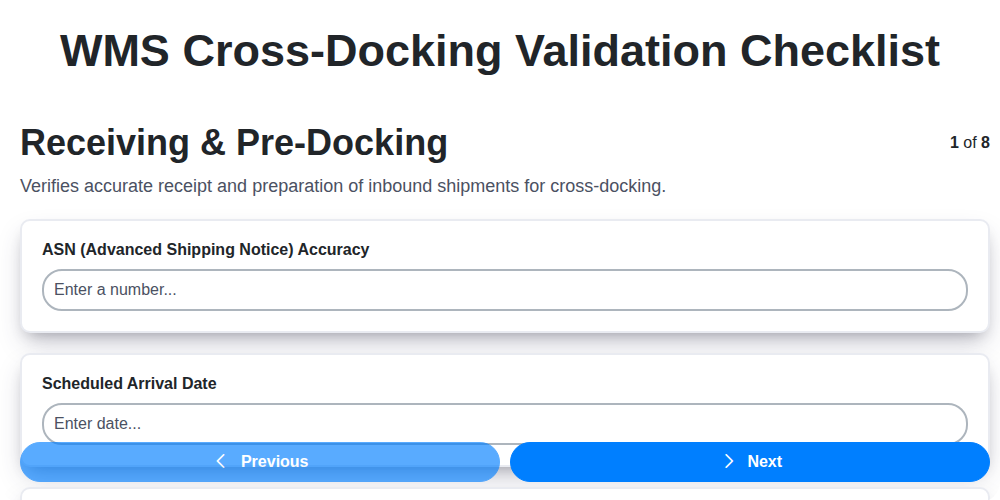
Table of Contents
- Introduction: Why Cross-Docking Validation Matters
- 1. Receiving & Pre-Docking: Laying the Foundation
- 2. Data Synchronization: The Heart of Cross-Docking
- 3. Dock Assignment & Staging: Optimizing Flow
- 4. Order Verification & Consolidation: Accuracy is Key
- 5. Loading & Documentation: Preparing for Dispatch
- 6. System Performance & Error Handling: Monitoring for Smooth Operations
- 7. Security & Access Control: Protecting Your Inventory
- 8. Traceability & Reporting: Maintaining Visibility
- 9. Data Integrity Checks: Validating Information Accuracy
- 10. Equipment Functionality: Ensuring Readiness
- 11. Team Training & Understanding
- 12. Contingency Planning: Addressing Potential Disruptions
- 13. Post-Validation Review and Improvement
- Resources & Links
TLDR: Cross-docking can be tricky! This checklist template ensures your Warehouse Management System (WMS) cross-docking process is accurate, secure, and efficient. It covers everything from receiving to loading, helping you avoid errors, optimize performance, and maintain full traceability - saving time and reducing costly mistakes. Download the template and validate your cross-docking like a pro!
Introduction: Why Cross-Docking Validation Matters
Cross-docking, when executed flawlessly, is a powerhouse for efficiency, minimizing storage needs and accelerating product flow. However, a poorly validated cross-docking process can lead to costly errors, delays, and frustrated customers. This isn't just about ensuring boxes are loaded onto the right truck; it's about validating every step of the process, from inbound receiving to outbound loading, to guarantee data accuracy, operational safety, and overall performance. A robust validation checklist isn't just a nice-to-have; it's a critical tool for maintaining a competitive edge in today's fast-paced supply chain landscape. This article outlines a comprehensive checklist designed to identify potential bottlenecks and ensure your cross-docking operation runs smoothly and reliably.
1. Receiving & Pre-Docking: Laying the Foundation
The success of any cross-docking operation hinges on a flawlessly executed receiving and pre-docking phase. This isn't just about unloading trucks; it's about meticulous preparation. Here's what your checklist should cover:
- Advance Shipment Notification (ASN) Verification: Did you receive and review the ASN? Does it accurately reflect the expected contents, quantities, and delivery schedule? Discrepancies here should be resolved before the truck arrives.
- Truck Appointment Adherence: Is the truck arriving on schedule? Delays can disrupt the entire process and impact downstream operations. Implement a system to manage appointment slots and proactively address potential delays.
- Driver Communication & Briefing: Clearly communicate the cross-docking process to the driver. Ensure they understand the designated staging area and unloading instructions. This minimizes confusion and potential errors.
- Equipment Availability & Condition: Are the necessary forklifts, pallet jacks, and other material handling equipment available, functional, and properly maintained?
- Receiving Area Inspection: Is the receiving area clear of obstructions and appropriately sized to handle the incoming volume? Ensure adequate lighting and clear signage.
- Pallet Inspection & Condition: Inspect incoming pallets for damage and compliance with handling standards. Damaged pallets can compromise product integrity and create safety hazards.
- Initial Quantity Verification: Perform a quick count and visual inspection of the shipment upon unloading to identify any obvious discrepancies. This is a preliminary check - a detailed verification follows.
2. Data Synchronization: The Heart of Cross-Docking
Successful cross-docking hinges on seamless and accurate data synchronization. This isn't just about transferring information; it's about ensuring everyone - from receiving to loading - is operating with the same real-time view of the process. Misalignment here leads to delays, errors, and ultimately, the breakdown of your entire operation.
Here's what needs to be meticulously validated:
- Real-time Visibility: Verify that receiving teams have access to the latest Advanced Shipping Notices (ASNs) with detailed product information, quantities, and delivery schedules before the shipment arrives. Outdated or missing ASNs are a primary source of receiving errors.
- ASN Accuracy: Conduct spot checks to confirm ASN data matches the physical shipment. Discrepancies, even minor ones, can ripple through the process.
- WMS Integration: Confirm the Warehouse Management System (WMS) accurately reflects all received goods and their status updates. This includes quantity adjustments, location changes, and any damage assessments.
- Order Management System (OMS) Synchronization: Ensure order details from the OMS are instantly reflected in the WMS, including order prioritization and specific delivery instructions.
- Communication with Carriers: Validate real-time communication with inbound and outbound carriers regarding arrival times, trailer availability, and potential delays. This minimizes waiting times and optimizes dock utilization.
- Data Integrity Checks: Implement automated data validation rules to identify and flag anomalies immediately. This might include verifying product codes, quantities, and dimensions.
A robust data synchronization process requires more than just technology; it requires a culture of continuous monitoring and validation.
3. Dock Assignment & Staging: Optimizing Flow
Effective dock assignment and staging are critical to a successful cross-docking operation, preventing bottlenecks and maximizing throughput. This section of the validation checklist focuses on ensuring this process runs smoothly and accurately.
Checklist Points:
- Real-Time Visibility: Verify the WMS provides real-time visibility into inbound shipment arrival times and expected contents. Can dock doors be proactively assigned based on this information?
- Automated Assignment Logic: Confirm the WMS utilizes pre-defined rules (e.g., by carrier, product type, destination) to automatically assign dock doors. Are these rules configurable and regularly reviewed for optimization?
- Staging Area Optimization: Assess the layout and organization of the staging area. Does it allow for efficient flow of goods from the receiving dock to the outbound staging area? Is there adequate space to accommodate fluctuating volumes?
- Prioritization Logic: Does the WMS prioritize shipments based on delivery deadlines, product perishability, or other critical factors? Can priorities be adjusted manually when needed?
- Communication of Assignments: Ensure clear and consistent communication of dock assignments to receiving and outbound teams - is this automated (e.g., via displays, mobile devices) and readily accessible?
- Accuracy of Staging Instructions: Validate that staging instructions generated by the WMS are accurate and complete, detailing specific location and handling requirements.
- Cross-Docking Specific Zones: Are clearly defined cross-docking staging zones separated from other warehouse operations to prevent mixing and delays?
- Minimize Handling: Review processes to ensure the number of times goods are handled during staging is minimized.
- Verification of Assigned Resources: Is the assigned forklift or other material handling equipment readily available and tracked by the WMS?
4. Order Verification & Consolidation: Accuracy is Key
Cross-docking thrives on speed, but not at the expense of accuracy. This phase is where the rubber meets the road, directly impacting customer satisfaction and operational efficiency. A meticulous order verification and consolidation process is non-negotiable.
Here's what needs rigorous checking:
- Quantity Confirmation: Double-check that the quantity of each item being consolidated matches the receiving documents and the order manifest. Discrepancies here lead to shipping errors and costly returns. Consider employing scan verification at this stage to minimize manual entry mistakes.
- SKU Validation: Ensure the correct SKUs are being consolidated. Misidentified products cause downstream problems and damage your reputation. Implement barcode scanning or RFID technology to confirm each item's identity.
- Pallet Build Integrity: Verify the pallet build meets established standards - weight distribution, securement of goods, and proper labeling. Unstable pallets can lead to damage in transit.
- Order Consolidation Mapping: Confirm that items destined for the same outbound shipment are consolidated onto the correct pallets. This prevents splitting orders and delays. Review staging instructions and ensure clear communication between receiving and outbound teams.
- Documentation Review: Cross-reference the consolidated pallet's documentation (shipping labels, packing slips) with the original order details. Any inconsistencies must be investigated and resolved before loading.
A robust verification process, combined with clear communication and technology support, will significantly reduce errors and maximize the benefits of your cross-docking operation.
5. Loading & Documentation: Preparing for Dispatch
The final stage of cross-docking is arguably just as vital as the initial receiving - ensuring accurate loading and complete documentation is paramount to successful dispatch and customer satisfaction. This checklist item focuses on verifying everything is ready to leave the dock.
Key Steps:
- Load Verification: Before the truck departs, a final visual inspection of the loaded pallets/containers should occur. This involves checking against the loading manifest to confirm the correct items, quantities, and destination are onboard. Discrepancies must be resolved before departure.
- Secure Loading: Ensure all goods are securely loaded to prevent shifting or damage during transit. This might include using straps, shrink wrap, or other appropriate securing methods based on the goods being shipped and carrier requirements.
- Bill of Lading (BOL) Accuracy: The BOL is a crucial legal document. Verify all information is correct and complete - including consignee, consignor, commodity description, weight, number of pieces, and any special handling instructions. Errors can lead to delays, disputes, and potentially lost goods.
- Shipping Label Verification: Double-check that each pallet/container is clearly and accurately labeled with the correct shipping labels, reflecting the final destination and any necessary routing information.
- Driver Acknowledgement: Obtain driver acknowledgement of the BOL and any special instructions. This creates a record of responsibility and confirms they understand the shipment requirements.
- Documentation Archiving: Ensure all relevant documents (BOL, packing lists, receiving reports, etc.) are archived electronically and/or physically according to company policy. This creates a readily available audit trail.
- Departure Confirmation: Record the departure time and truck number. This aids in tracking and resolving any post-dispatch issues.
6. System Performance & Error Handling: Monitoring for Smooth Operations
Cross-docking relies heavily on real-time data and seamless system integration. A hiccup in the WMS can quickly derail the entire process. This section of the validation checklist focuses on ensuring the system performs reliably and that you have robust error handling in place.
Key Validation Points:
- Transaction Processing Time: Measure the time taken for critical transactions (receiving, dock assignment, order verification, loading). Are they within acceptable performance thresholds? Investigate any slowdowns.
- Data Latency: Verify data synchronization between the receiving system, WMS, and loading systems happens with minimal delay. Significant latency can lead to mismatched orders and errors.
- Error Logging & Alerts: Confirm the system accurately logs all errors and generates appropriate alerts to designated personnel. Test various error scenarios (e.g., incorrect barcode scans, system overload) to ensure alerts are triggered correctly.
- Recovery Procedures: Test the system's ability to recover from simulated failures (e.g., database outage, network interruption). Validate data integrity after recovery.
- Capacity Planning: Assess whether the system can handle peak volumes without performance degradation. This should include testing with realistic load scenarios.
- User Interface Responsiveness: Evaluate the responsiveness of the WMS user interface for dockworkers and other personnel. Slow interfaces impact productivity.
- Rollback Procedures: Implement and test rollback procedures in case of unexpected issues during cross-docking operations to prevent data corruption and workflow disruptions.
Regular monitoring and performance testing are crucial for sustained, efficient cross-docking.
7. Security & Access Control: Protecting Your Inventory
Cross-docking, while efficient, presents unique security challenges. Limited storage means a heightened risk if unauthorized access or inventory discrepancies occur. This checklist section focuses on preventing those issues.
Checklist Items:
- Role-Based Access: Are access levels restricted based on employee roles? Only personnel needing access to specific areas or functions (receiving, staging, loading) should be granted permission. Review access privileges regularly.
- Authentication Procedures: Are robust authentication methods in place (e.g., keycards, PIN codes, biometric scans) to control access to the cross-docking area? Verify these systems are functioning correctly and are not bypassed.
- Visitor Management: Is there a formal process for managing visitors to the cross-docking facility? All visitors must be logged, escorted, and their access restricted to approved zones.
- Perimeter Security: Assess the physical security of the cross-docking area. This includes fencing, lighting, surveillance cameras, and gate controls. Regularly inspect and maintain these security measures.
- Data Encryption & Firewall: Ensure all data transmitted and stored related to cross-docking operations is encrypted to prevent unauthorized access. Firewalls should be in place to protect the WMS and connected systems.
- Regular Audit Trails: Implement and regularly review audit trails to track all user activities within the WMS and cross-docking operations. This helps identify unauthorized access or suspicious behavior.
- Security Awareness Training: Provide regular security awareness training to all employees involved in cross-docking. This should cover topics like recognizing suspicious activity, reporting security breaches, and adhering to access control procedures.
Failure to prioritize security can lead to significant financial losses, operational disruptions, and reputational damage. A proactive approach to access control is paramount for a successful and secure cross-docking operation.
8. Traceability & Reporting: Maintaining Visibility
Traceability and robust reporting are the cornerstones of a successful cross-docking operation. Without them, you're essentially flying blind, unable to pinpoint bottlenecks, address errors, or demonstrate compliance. This section of the validation checklist focuses on ensuring you have the mechanisms in place to monitor and analyze every step of the process.
Here's what we're verifying:
- Real-time Tracking: Can you track goods as they move through the cross-dock, from receipt to loading? This requires accurate timestamping and location data at each stage. We're checking the functionality of scanners, RFID systems (if applicable), and the overall data flow.
- Data Integrity: Are the data recorded at each stage accurate and reliable? This involves verifying barcode scanning accuracy, data entry validation, and any potential sources of human error.
- Comprehensive Reporting: Do you have reports that provide a clear picture of cross-docking performance? We're looking for reports that cover key metrics such as throughput, dwell time, error rates, and labor productivity. These reports should be accessible to relevant personnel and customizable to meet specific needs.
- Audit Trail: A complete audit trail is critical for accountability and problem-solving. The system must capture who performed what action and when, allowing for easy investigation of discrepancies.
- Exception Reporting: Are you alerted to deviations from the planned process? This includes missed scans, discrepancies in quantity or product, and delays. Automated alerts help proactively address issues before they escalate.
- Data Export Capabilities: Can data be easily exported for further analysis or integration with other systems (e.g., TMS, ERP)? We're evaluating the available export formats and the ease of integration.
- Compliance Reporting: Does the system generate reports required for regulatory compliance (e.g., food safety, hazardous materials handling)?
Proper traceability and reporting capabilities aren't just about identifying problems after they occur. They provide actionable insights to continuously improve efficiency, reduce costs, and enhance the overall effectiveness of your cross-docking operations.
9. Data Integrity Checks: Validating Information Accuracy
Cross-docking hinges on flawless data. A single misplaced digit or incorrect product code can trigger significant delays, misdirected goods, and ultimately, customer dissatisfaction. This section of the validation checklist focuses squarely on ensuring that the information flowing through the system is accurate and reliable.
Here's what needs scrutiny:
- Receiving Data Verification: Compare the received goods against the Advance Shipping Notices (ASNs) or purchase orders. Discrepancies in quantity, product codes, or descriptions must be investigated and corrected before any further processing. Document all corrections and the reason for them.
- Synchronization Checks: Validate the synchronization between the WMS and carrier systems. Confirm that order details, shipment information, and expected arrival times are consistently reflected in both systems. Look for instances of delayed updates or conflicting data.
- Barcode/RFID Scan Accuracy: Conduct spot checks of barcode/RFID scans throughout the cross-docking process. Verify that the captured data matches the physical product. Investigate any scan failures or misreads immediately. Consider using a small sample size for regular audits.
- Data Mapping Validation: Review data mappings between different systems to ensure proper translation and avoid data loss or corruption. This is especially crucial if using integrated systems or APIs.
- Error Reporting Analysis: Analyze error reports generated by the WMS. Investigate recurring errors to identify root causes and implement preventative measures. Don't just clear the errors; understand them.
- User Input Validation: Implement validation rules within the WMS to prevent incorrect data entry by users. Consider incorporating drop-down menus and pre-defined options where possible.
A robust data integrity process is not just about finding errors; it's about preventing them from happening in the first place.
10. Equipment Functionality: Ensuring Readiness
Cross-docking hinges on reliable equipment. A breakdown during peak flow can bring the entire operation to a standstill. This section focuses on validating the functionality of your key equipment before and during cross-docking activities.
Checklist Items:
- Forklifts & Pallet Jacks: Verify battery charge levels, tire pressure, operational speed, and brake functionality. Conduct brief operator competency checks.
- Conveyor Systems: Inspect belt speed, alignment, and sensor functionality. Ensure adequate maintenance records are available and recent. Test emergency stop mechanisms.
- Dock Levelers: Confirm smooth operation, proper height adjustment, and secure locking mechanisms. Check for any damage or wear.
- Dock Doors: Verify smooth opening and closing, secure sealing, and proper lighting.
- Scanners & Mobile Devices: Ensure battery life, connectivity (Wi-Fi, cellular), and functionality of scanning capabilities. Confirm proper configuration and access permissions.
- Wrapping Machines: Check film tension, sealing quality, and overall mechanical condition.
- Scales & Measurement Devices: Validate accuracy and calibration records.
- IT Infrastructure: Confirm stable network connectivity for all connected equipment and systems.
Regular inspections and preventative maintenance are crucial. Document all checks and maintenance performed. A proactive approach to equipment functionality is a cornerstone of efficient and error-free cross-docking.
11. Team Training & Understanding
A flawlessly executed cross-docking operation isn't just about technology and processes; it's about the people running it. Comprehensive team training is absolutely critical for success. This goes beyond simply explaining the steps in the checklist - it requires a deep understanding of why each step is necessary and how it contributes to the overall efficiency and accuracy of the cross-docking process.
Training should cover:
- The Cross-Docking Concept: Ensure everyone understands the principles and benefits.
- Checklist Familiarity: Detailed walkthrough of each item on the validation checklist, demonstrating the expected outcomes and potential problem areas.
- Role-Specific Responsibilities: Clearly define each team member's responsibilities within the cross-docking workflow.
- Problem Solving & Escalation: Equip the team with the knowledge and authority to identify and resolve issues, and understand the proper escalation process for more complex situations.
- Continuous Improvement: Encourage team members to provide feedback and suggestions for optimizing the process - they are often the first to identify inefficiencies.
Regular refresher training and ongoing knowledge sharing are essential to maintain proficiency and adapt to evolving procedures. A well-trained and engaged team is your biggest asset in ensuring a consistently successful cross-docking operation.
12. Contingency Planning: Addressing Potential Disruptions
Cross-docking, while incredibly efficient, is also highly susceptible to disruptions. A single point of failure can halt the entire operation. Therefore, a robust contingency plan is absolutely crucial. This section outlines potential disruptions and the steps to mitigate them.
Potential Disruptions & Mitigation Strategies:
- Supplier Delays: Implement buffer stock or establish relationships with alternative suppliers. Regularly monitor supplier performance and have a communication plan in place for immediate updates.
- Truck/Carrier Issues: Maintain a list of backup carriers and proactively monitor their status. Have procedures for rerouting shipments or consolidating loads if vehicles are delayed or unavailable.
- Equipment Malfunctions: Regularly inspect and maintain all material handling equipment (forklifts, conveyors, etc.). Have backup equipment readily available and trained personnel to operate it.
- System Outages: The WMS is the brain of cross-docking. Data backup and disaster recovery plans are essential. Consider offline operational procedures for critical tasks.
- Labor Shortages: Cross-train employees and have contingency staffing options in place.
- Weather Events: Track weather forecasts and proactively adjust schedules and staffing to minimize impact.
Key Actions:
- Develop Detailed Procedures: Document step-by-step instructions for handling common disruptions.
- Regular Training: Ensure all employees are familiar with contingency plans and their roles in execution.
- Simulation Exercises: Conduct mock disruption scenarios to test the effectiveness of plans and identify areas for improvement.
- Communication Protocols: Establish clear communication channels and escalation procedures for all stakeholders.
13. Post-Validation Review and Improvement
Cross-docking validation isn't a one-and-done process. It's the start of a continuous improvement cycle. Once the initial validation period concludes, a thorough review is crucial to solidify gains and identify areas for ongoing optimization.
This review should involve key stakeholders from receiving, warehousing, order fulfillment, and IT. Focus on analyzing the data collected throughout the validation process - error rates, cycle times, throughput, and any observed bottlenecks.
Here are key points to consider:
- Performance Metrics: Compare actual performance against established KPIs. Are cycle times as fast as predicted? Is accuracy within acceptable limits?
- User Feedback: Solicit feedback from the teams directly involved in the cross-docking process. They often have invaluable insights into practical challenges and opportunities.
- System Logs & Error Reports: Analyze system logs and error reports to identify recurring issues or unexpected behaviors.
- Process Documentation Updates: Refine process documentation based on lessons learned. This includes standard operating procedures (SOPs) and training materials.
- Automation Opportunities: Identify areas where automation can further streamline the process and reduce manual intervention.
- Regular Audits: Implement regular audits (e.g., monthly or quarterly) to ensure continued adherence to validated processes and to catch any deviations.
- Version Control: Maintain version control of your cross-docking configuration and validation documentation, noting any changes and the rationale behind them.
Ultimately, the post-validation review should lead to actionable improvements that enhance efficiency, accuracy, and overall effectiveness of your WMS cross-docking operations.
Resources & Links
- Warehouse Management System (WMS) Providers: A general directory of WMS providers. Use this to research different WMS platforms that support cross-docking functionalities. Crucial for understanding available tools.
- APICK - Cross-Docking Best Practices: APICK offers insights and resources on various warehousing and logistics processes, including cross-docking, providing a broader industry perspective.
- Supply Chain Digital: Provides articles, case studies, and expert opinions on supply chain management, including cross-docking strategies and technologies. Search for keywords like 'cross-docking' within the site.
- Infor - Supply Chain Management Solutions: Infor offers a suite of SCM solutions; exploring their resources can reveal industry best practices and common challenges in cross-docking.
- Blue Harbor - Cross-Docking Expertise: Blue Harbor is a consulting firm specializing in supply chain optimization. They often publish informative resources and whitepapers on cross-docking.
- Zebra Technologies - Barcode & RFID Solutions: Critical for tracking and traceability. Zebra's site provides information on barcode and RFID technology, essential for a successful cross-docking operation, especially regarding sections 7 & 8.
- SAP - Supply Chain Management: SAP offers a comprehensive suite of SCM software, including modules for cross-docking. Exploring their online resources can provide insights into data integration and system performance (header 2: 6).
- Oracle - Supply Chain Management: Similar to SAP, Oracle provides SCM solutions with cross-docking functionalities. Explore their content for best practices related to data synchronization (header 2: 2) and error handling (header 2: 6).
- National Institute of Standards and Technology (NIST): NIST provides guidelines and standards related to data security and access control (header 2: 7). May provide helpful background information.
- ISC² - Cybersecurity: For insights into security and access control (header 2: 7) practices, especially regarding sensitive data and preventing unauthorized access. May be relevant when describing controls.
Frequently Asked Questions
What does 'staging area' refer to in the checklist?
The staging area is the designated area within the warehouse where goods are temporarily held after receiving and before being loaded onto outbound trucks. The checklist evaluates the organization and efficiency of this area.
Found this Article helpful?
Comments
There are no comments yet. Be the first to add one!
WMS - Warehouse Management System Solution Demo
Optimize your warehouse operations & boost efficiency! ChecklistGuro's WMS streamlines inventory management, order fulfillment, and shipping. Reduce errors, improve accuracy, & maximize space utilization. Manage it all with our Work OS.
Related Articles
Seamless RFID Integration: Your WMS Checklist Template for Success
Mastering Warehouse Labeling: Your WMS Process Checklist Template
The Ultimate Supply Chain Inventory Accuracy Audit Checklist: A Step-by-Step Guide
Mastering Putaway: Your WMS Optimization Checklist

Mastering Your Yard: A Warehouse WMS Yard Management Checklist Template
Warehouse Data Integrity: Your WMS Checklist Template
WMS System Performance Monitoring Checklist: A Comprehensive Guide
Warehouse WMS Error Handling Checklist: A Proactive Guide to Minimizing Disruptions
We can do it Together
Need help with
Warehouse Management System (WMS)?
Have a question? We're here to help. Please submit your inquiry, and we'll respond promptly.