Mastering Receiving: Your WMS Receiving Process Checklist Template
Published: 12/20/2025 10:00 PM Updated: 12/21/2025 7:01 AM
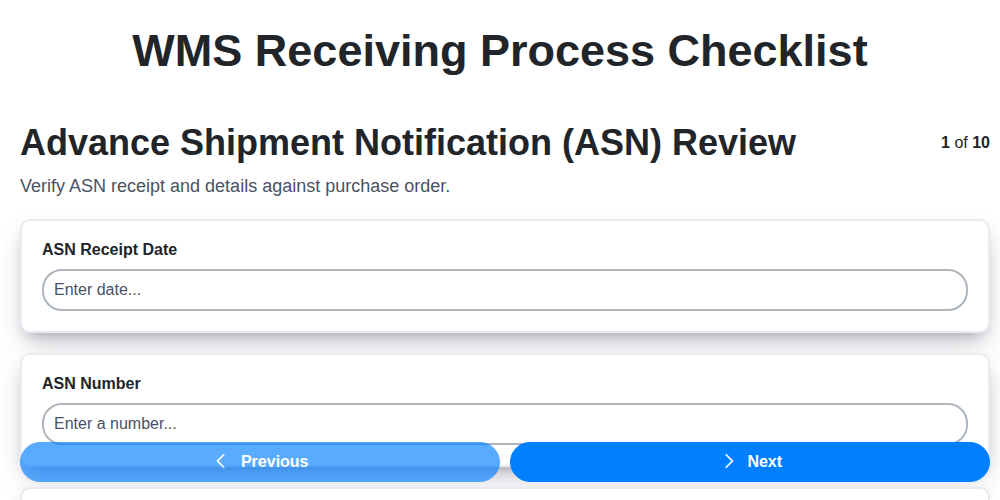
Table of Contents
- Introduction: Why a Receiving Checklist Matters
- 1. Advance Shipment Notification (ASN) Review: Setting the Stage
- 2. Arrival & Dock Assignment: Streamlining the Entry
- 3. Unloading & Palletization: Preparing for Receiving
- 4. Receiving in WMS: The Core of the Process
- 5. Quality Inspection: Ensuring Product Integrity
- 6. Labeling & Barcoding: Accuracy and Traceability
- 7. Putaway Verification: Confirming Correct Placement
- 8. Documentation & Record Keeping: Building a Paper Trail
- 9. Discrepancy Resolution: Handling Exceptions
- 10. Safety Compliance: Protecting Your Team
- 11. WMS Configuration for Receiving Efficiency
- 12. Training Your Receiving Team
- 13. Continuous Improvement: Refining Your Checklist
- Conclusion: Optimizing Your Receiving Operations
- Resources & Links
TLDR: Streamline your warehouse receiving with this free checklist template! It covers everything from ASN review to putaway verification, ensuring accuracy, efficiency, and safety in your WMS receiving process. Download it now to reduce errors, save time, and boost overall warehouse performance.
Introduction: Why a Receiving Checklist Matters
Receiving is often the first critical touchpoint in your supply chain - and a chaotic receiving process can ripple into costly problems down the line. Errors in receiving, such as incorrect quantities, damaged goods, or mislabeled products, can lead to order fulfillment delays, increased returns, and ultimately, dissatisfied customers. A well-defined and consistently followed receiving checklist isn't just a formality; it's a cornerstone of efficient warehouse operations. It ensures accuracy, minimizes errors, promotes safety, and provides a clear audit trail for accountability. Implementing a structured checklist, especially when integrated with your Warehouse Management System (WMS), helps standardize procedures, trains new employees quickly, and ultimately, builds a more resilient and reliable supply chain. This blog post will break down a comprehensive checklist to help you optimize your receiving process and keep your warehouse running smoothly.
1. Advance Shipment Notification (ASN) Review: Setting the Stage
The receiving process doesn't begin when the truck arrives at your dock. It starts before that - with the Advance Shipment Notification (ASN). This document, typically sent electronically by your supplier, provides crucial information about the incoming shipment, including expected contents, quantities, and estimated arrival time.
A thorough ASN review is the foundation of a smooth receiving operation. Don't skip this step! Here's why:
- Proactive Planning: Knowing what's coming allows you to allocate dock doors, staff resources, and equipment in advance. This minimizes delays and bottlenecks.
- Inventory Visibility: The ASN provides an early look at your incoming inventory, helping you anticipate stock levels and plan accordingly.
- Discrepancy Identification (Early Warning): Compare the ASN details against your purchase order. Any discrepancies - variations in quantities, product numbers, or dates - can be flagged before the shipment arrives, giving you time to contact the supplier and resolve them. Addressing these issues proactively prevents costly delays and rework later.
- Data Integrity: The ASN provides valuable data for your Warehouse Management System (WMS), reducing manual data entry and improving accuracy.
Take a few minutes to review each ASN - it's an investment that pays off significantly in efficiency and accuracy throughout your entire receiving process.
2. Arrival & Dock Assignment: Streamlining the Entry
The arrival of goods marks the beginning of your warehouse receiving process, and a disorganized arrival can quickly lead to bottlenecks and delays. Effective dock assignment is crucial to ensure a smooth and efficient flow. Here's how to optimize this stage:
Pre-Arrival Communication is Key: Ideally, you should have received an Advance Shipment Notification (ASN) - reviewed thoroughly, of course (refer back to the ASN review section!). This allows you to anticipate the arrival, plan dock usage, and alert your receiving team.
Dock Scheduling: Implement a dock scheduling system, even a simple one, to manage incoming trailers. This prevents congestion and ensures trailers are assigned to the appropriate dock door based on factors like product type, size, and urgency.
Staging Area: If your receiving volume necessitates it, designate a staging area near the receiving docks. This provides a buffer zone to temporarily hold trailers waiting for dock assignment, minimizing disruption to ongoing operations.
Clear Signage & Communication: Ensure docks are clearly labeled with assigned numbers and any specific instructions. Maintain open communication between the receiving team, truck drivers, and dispatch to avoid confusion and delays.
Documentation & Verification: Upon arrival, verify the carrier and trailer number against the ASN and receiving schedule. This initial check helps catch discrepancies early and prevents unnecessary delays later in the process.
Consider Seasonal Fluctuations: Account for peak seasons and adjust dock assignments and staffing accordingly. A well-planned approach can alleviate pressure during high-volume periods.
3. Unloading & Palletization: Preparing for Receiving
Once the truck arrives and is assigned a dock, the focus shifts to efficiently and safely getting the goods off the vehicle and ready for the receiving process. This stage - Unloading & Palletization - is critical for maintaining inventory accuracy and minimizing handling damage.
Unloading:
- Coordinate with Driver: Establish clear communication with the driver regarding unloading procedures and any specific instructions.
- Equipment Check: Ensure you have the necessary equipment ready - forklifts, pallet jacks, conveyors - and that they're in good working order. Inspect forks, tires, and batteries.
- Staging Area: Designate a clear staging area for unloaded pallets and goods. This area should be well-lit, accessible, and free of obstructions.
- Careful Handling: Emphasize careful handling of the goods during unloading. Pallet orientation is crucial to prevent shifting and damage. Train personnel to properly grasp and lift pallets.
- Pallet Inspection: Briefly inspect pallets for damage (broken boards, loose nails) before they're moved. Document any significant issues and alert the driver.
Palletization (if required):
- Standardization: If goods arrive in loose cartons, palletization is usually necessary. Standardize pallet sizes and stacking patterns. This promotes efficient storage and putaway.
- Secure Load: Utilize shrink wrap, banding, or other securement methods to prevent goods from shifting during transport within the warehouse.
- Weight Distribution: Ensure the weight is evenly distributed on the pallet to prevent tipping and ease of handling.
- Labeling (Preliminary): While a full labeling process comes later, consider adding a temporary identifying label (e.g., "Unreceived - Pallet #") to facilitate tracking during the initial receiving steps. This can be helpful in locating pallets if needed.
4. Receiving in WMS: The Core of the Process
This is where the physical receiving process truly integrates with your Warehouse Management System (WMS). It's more than just scanning barcodes; it's about data accuracy and process control. The goal is to seamlessly convert physical goods into digital inventory within your WMS, laying the foundation for efficient order fulfillment.
Here's what this step typically involves:
- Receiving Unit Identification: Using the ASN information and physical identification, accurately identify each unit (pallets, cartons, individual items).
- Data Validation: The WMS should pull in expected information from the ASN. Verify that the received quantity and item details match the ASN data. Discrepancies should immediately flag for review (more on that in the Discrepancy Resolution section).
- Receiving Mode Selection: Your WMS likely offers different receiving modes (e.g., blind receive, directed putaway). Select the appropriate mode based on your warehouse strategy and ASN details.
- Barcode/RFID Scanning: Use scanners to capture item numbers, lot numbers, serial numbers, and other relevant data. Accuracy here is paramount.
- Damage Assessment: The WMS should prompt for a damage assessment at the point of receipt. Documenting damage immediately prevents issues later on.
- Inventory Status Update: The WMS updates inventory status to Received or a similar state. This makes the goods available for putaway.
- Confirmation & Next Steps: Confirm receipt and trigger the next step in the receiving workflow, often leading to putaway.
5. Quality Inspection: Ensuring Product Integrity
Receiving isn't just about getting goods in; it's about ensuring you've received what you ordered and that it meets your quality standards. This is where a robust quality inspection process becomes critical. Don't just blindly accept shipments; proactively verify their condition and conformity.
The receiving team should be trained to perform a basic visual inspection upon arrival. This includes checking for:
- Packaging Damage: Look for crushed boxes, tears, or signs of mishandling. Document any visible damage on the receiving paperwork before unloading.
- Product Condition: Examine a representative sample of the shipment for defects, expiration dates (if applicable), and overall quality. This might involve checking color, texture, or functionality, depending on the product type.
- Quantity Verification: While a full count might not always be feasible, a spot-check of quantities against the ASN and purchase order provides an early warning of potential discrepancies.
- Temperature Control (if applicable): For temperature-sensitive goods, immediately verify that the product was maintained within the required temperature range during transit.
Don't underestimate the importance of proper documentation here. Clearly record the results of the quality inspection - pass, fail, or conditional - along with any observed issues. This record provides valuable data for identifying trends, addressing supplier quality concerns, and supporting future audits. Rejecting non-conforming goods promptly prevents these items from entering your inventory and potentially impacting your customer satisfaction.
6. Labeling & Barcoding: Accuracy and Traceability
Once items have passed quality inspection, accurate labeling and barcoding are critical steps in the receiving process. This isn't just about slapping a label on a box; it's about establishing a clear and consistent identification system that ensures traceability and minimizes errors downstream.
Here's why this step is so important and what it typically involves:
- Generate Labels: Utilize the WMS to generate labels containing essential information: part number, lot number, serial number (if applicable), date received, and any other relevant identifiers. Ensure this information exactly matches the data in the WMS.
- Barcoding Standards: Employ standardized barcode formats (like GS1-128) for optimal scanning compatibility across different systems and partners.
- Application Best Practices: Properly affix labels to avoid damage during handling. Consider label placement for readability and durability.
- Verification Scanning: After application, immediately scan the newly applied barcode to confirm accuracy. Any discrepancies need to be corrected before putaway.
- Multiple Labels: Depending on the product and customer requirements, multiple labels might be needed - one for the pallet, one for the box, and even one directly on the product.
- WMS Integration: The WMS must update its records concurrently with the barcode generation and application to maintain real-time inventory visibility.
Proper labeling and barcoding acts as the backbone of a well-managed warehouse, reducing errors, improving inventory accuracy, and simplifying traceability when needed.
7. Putaway Verification: Confirming Correct Placement
Once receiving is complete in your WMS, the critical step of putaway verification begins. This isn't just about moving goods to a location; it's about ensuring they're placed exactly where they belong. Incorrect putaway can lead to picking errors, order delays, and ultimately, dissatisfied customers.
Here's what a robust putaway verification process involves:
- WMS Guidance: The WMS should dictate the optimal putaway location based on factors like product characteristics (size, weight, temperature requirements), storage type (pallet rack, shelving, floor stacking), and slotting rules. Follow these instructions meticulously.
- Scan Confirmation: Utilize mobile devices and barcode scanners to verify the location during putaway. A simple scan of the location barcode confirms the goods are being placed in the designated spot.
- Quantity Confirmation: The WMS should prompt for a quantity confirmation during putaway. This acts as a secondary check to ensure the correct amount of product is being allocated to the location.
- Visual Inspection: While scanning is crucial, don't neglect a quick visual confirmation. Does the location look correct? Does it appear to accommodate the product's dimensions?
- Real-time Updates: The WMS should be updated immediately upon successful putaway, ensuring accurate inventory records. Delayed updates lead to discrepancies and inaccuracies.
- Addressing Exceptions: If a putaway location isn't suitable or available (e.g., full, damaged), immediately report the exception through the WMS and follow your company's established process for handling these situations. Don't force the product into a mismatched spot.
Effective putaway verification isn't just a procedural step; it's a foundation for a smoothly operating warehouse.
8. Documentation & Record Keeping: Building a Paper Trail
Thorough documentation is the backbone of a successful and auditable receiving process. It's more than just ticking boxes on a checklist - it's about creating a clear and accessible record of everything that happened, from the moment the shipment was anticipated to its final putaway.
What should you be documenting? Here's a breakdown:
- ASN Review: Keep records of the ASN received, noting any immediate discrepancies or comments.
- Arrival & Dock Assignment: Log the arrival time, carrier details, and assigned dock number.
- Unloading & Palletization: Document the number of pallets received and any issues encountered during unloading (damage, incorrect pallet type, etc.).
- WMS Receiving: Capture screenshots or printouts of the receiving transactions within your WMS. These are vital for traceability.
- Quality Inspection: Keep detailed reports from quality inspections, including findings, photos (if applicable), and any corrective actions taken.
- Labeling & Barcoding: Confirm that all labels were applied correctly and scanned. Note any relabeling needs.
- Putaway Verification: Record the putaway location and confirmation that it matches instructions.
- Discrepancy Resolution: Crucially, document everything related to discrepancies. The original ASN, the received quantity, the resolution process, and who authorized the changes.
- Communication: Maintain a log of all communication regarding the receiving process, especially relating to discrepancies, damaged goods, or urgent issues.
Why is this important?
- Audit Trails: Essential for audits (internal and external).
- Traceability: Quickly pinpoint the origin of issues.
- Process Improvement: Data provides insights for optimizing the receiving process.
- Liability Protection: Provides proof of proper procedures if problems arise.
Consider using a standardized documentation format, whether physical forms or digital templates, to ensure consistency and ease of retrieval.
9. Discrepancy Resolution: Handling Exceptions
No receiving process goes perfectly every time. Discrepancies - shortages, overages, damages, incorrect items - are inevitable. A robust discrepancy resolution process is crucial for maintaining inventory accuracy, preventing costly delays, and keeping your customers happy.
Here's how to handle those inevitable exceptions:
- Immediate Identification: The sooner a discrepancy is identified, the faster it can be resolved. Leverage your WMS to flag issues during receiving - a mismatch in ASN data, damaged goods flagged during inspection, or quantity differences.
- Clear Communication: Establish a clear escalation path. Who needs to be notified? The supplier? The purchasing department? The logistics team? Define roles and responsibilities for resolution.
- Documentation is Key: Meticulously document every discrepancy. Include the date, time, item number, quantity difference, nature of the problem (damage, shortage, incorrect item), and actions taken. Photos are invaluable for damage claims. Your WMS should ideally facilitate this documentation.
- Supplier Communication: Promptly inform the supplier of the discrepancy, providing detailed information and supporting documentation. Establish a clear procedure for returns or replacements.
- Hold Procedures: Implement a clear holding procedure for discrepant goods. This prevents them from being integrated into inventory until the issue is resolved. Designate a specific area or location for these items.
- Root Cause Analysis: Don't just fix the immediate problem; investigate why the discrepancy occurred. Was it a picking error? A labeling mistake? Use this information to improve processes and prevent future issues.
- WMS Integration: Your WMS should facilitate discrepancy resolution. It should allow you to easily track the status of discrepancies, manage communications, and generate reports to identify trends.
- Regular Review: Periodically review your discrepancy resolution process. Are there bottlenecks? Are you effectively addressing the root causes of issues?
10. Safety Compliance: Protecting Your Team
Receiving isn't just about getting goods into your warehouse; it's about doing so safely. Ignoring safety protocols can lead to injuries, damage to goods, and costly delays. This checklist step is paramount for everyone involved.
Here's what to cover:
- PPE Enforcement: Ensure all receiving personnel are wearing appropriate Personal Protective Equipment (PPE) - safety shoes, gloves, high-vis vests, eye protection, and hearing protection as needed. Regularly inspect PPE condition.
- Forklift Safety: If forklifts are involved, verify driver certifications are current and equipment is properly maintained. Implement speed limits and designated traffic lanes. Conduct daily forklift inspections.
- Unloading Area Safety: Keep the unloading area clear of obstructions and well-lit. Use signage to indicate potential hazards.
- Proper Lifting Techniques: Train employees on proper lifting techniques to prevent back injuries. Provide mechanical lifting aids where possible.
- Hazard Communication: Ensure all materials are clearly labeled with hazard warnings, and SDS (Safety Data Sheets) are readily accessible.
- Emergency Procedures: Regularly review emergency procedures, including evacuation routes and first aid protocols.
- Reporting Hazards: Encourage employees to report any safety concerns without fear of reprisal. A culture of proactive safety is vital.
Prioritizing safety isn't just good practice - it's a legal and ethical responsibility. Make safety compliance a non-negotiable part of your receiving process.
11. WMS Configuration for Receiving Efficiency
Your WMS isn't just software; it's the engine driving your receiving process. Incorrect configuration can bottleneck operations and introduce errors. Here's how to optimize your WMS for receiving success:
- ASN Integration: Automate ASN receipt and processing. Configure the WMS to directly import ASN data, pre-populating expected receipts and minimizing manual entry. Customizable rules can handle varying ASN formats.
- Dock Scheduling: Integrate dock scheduling functionality. This allows carriers to book arrival times, preventing congestion and allowing for proactive resource allocation. The WMS should communicate these schedules to receiving staff.
- Receiving Task Prioritization: Establish rules within the WMS to prioritize receiving tasks based on factors like due date, product type, or vendor. This ensures critical items are processed first.
- User Roles & Permissions: Define specific user roles with tailored access levels for receiving staff. This restricts access to sensitive data and enforces accountability.
- Mobile Receiving Support: Leverage mobile devices with WMS integration for real-time updates and streamlined processes on the receiving dock. This eliminates the need for constant trips back to a central workstation.
- Automated Putaway Rules: Configure automatic putaway rules based on product characteristics (size, weight, temperature requirements) to direct goods to optimal locations.
- Exception Handling Workflows: Build workflows within the WMS to handle common receiving exceptions (damage, shortages, overages) with clear escalation paths and documentation requirements.
- Real-Time Visibility: Ensure the WMS dashboard provides real-time visibility into receiving status, including pending tasks, backlogs, and performance metrics. This empowers supervisors to proactively address issues.
- Customizable Alerts: Set up customizable alerts to notify relevant personnel about critical events, such as missed arrival windows, discrepancies, or safety hazards.
12. Training Your Receiving Team
A robust WMS receiving process checklist is only as effective as the team executing it. Investing in comprehensive training is paramount to ensuring accuracy, efficiency, and safety within your receiving operations. Don't assume familiarity equals competency - regular, targeted training will consistently improve performance.
Training should cover all steps outlined in your receiving checklist, with a focus on practical application. For example, new hires should be directly supervised during ASN review, learning to identify critical information and potential issues. Quality inspection training should include specific product characteristics and defect identification. Barcoding and labeling procedures require hands-on practice to avoid errors that can ripple through the supply chain.
Beyond procedural training, emphasize the "why" behind each step. Explain how accurate receiving impacts inventory accuracy, order fulfillment, and ultimately, customer satisfaction. Regular refresher courses, particularly when process updates occur, will reinforce best practices and ensure everyone is aligned. Consider incorporating simulated scenarios to address common challenges and encourage problem-solving skills. Finally, designate experienced team members as mentors or "go-to" resources for newer employees.
13. Continuous Improvement: Refining Your Checklist
Your WMS Receiving Process Checklist isn't a static document; it's a living tool. Regularly revisit and refine it to optimize efficiency and accuracy. Encourage feedback from receiving personnel - they're on the front lines and often have valuable insights. Analyze data from your WMS - are there recurring discrepancies? Are certain steps consistently taking longer than expected?
Consider implementing a formal review cycle, perhaps quarterly or annually, to assess the checklist's effectiveness. This review should involve key stakeholders, including warehouse supervisors, receiving clerks, and even quality control. Don't be afraid to make changes, even small ones. A minor adjustment to a step, or the addition of a simple verification point, can have a significant positive impact on overall performance. Remember, the goal is to create a checklist that works for your team, not against them.
Conclusion: Optimizing Your Receiving Operations
Implementing a robust WMS receiving process checklist, as detailed above, isn't just about ticking boxes - it's about building a foundation for a streamlined and efficient warehouse. By meticulously following each step, from ASN review to putaway verification, you're minimizing errors, reducing labor costs, and improving overall inventory accuracy. This proactive approach prevents costly downstream issues like order fulfillment delays and inaccurate reporting.
Remember, a checklist isn't a static document. Regularly review and refine it based on your specific warehouse processes, volumes, and common challenges. Continuous improvement, coupled with employee training and open communication, will ensure your receiving operations are consistently optimized and contributing to your overall supply chain success. Embracing this structured approach transforms your receiving process from a potential bottleneck into a reliable and valuable asset.
Resources & Links
- Supply Chain Digital: Offers insights and news on supply chain management, including receiving and warehouse operations. Good for broader industry context.
- Infor: A leading provider of WMS solutions. Their website has articles and resources about warehouse best practices, often touching on receiving.
- Blue Harbor: Offers consulting and implementation services for WMS systems. Their blog and resources often cover receiving process optimization.
- ABC Logistics: A 3PL provider that offers a variety of insights on warehouse management and receiving processes.
- Zebra Technologies: A major provider of barcode scanners and labeling solutions. Their website has resources on barcode implementation and accuracy.
- National Institute of Standards and Technology (NIST): Provides resources and standards related to data quality, accuracy, and traceability, relevant to receiving processes.
- APICS (now ASCM): Professional association for supply chain professionals. Offers certification programs, research, and articles on best practices.
- The Logistics Institute - JDA Software: Provides in-depth articles and case studies on logistics and supply chain management, including receiving and warehouse operations.
- Oracle: Another major WMS provider. Their website offers information on warehouse optimization and receiving best practices.
- SAP: A global leader in business software that provides a variety of warehouse management tools and solutions.
- 3PLink: A resource portal for third-party logistics providers and companies seeking 3PL services. Often features articles on receiving and warehouse efficiency.
Frequently Asked Questions
What is a WMS and why is receiving important?
A WMS (Warehouse Management System) is software that helps manage warehouse operations, including receiving. Receiving is crucial because it's the first step in the supply chain process; accurate and efficient receiving sets the stage for inventory accuracy, order fulfillment, and overall warehouse performance. Errors here can cascade and cause problems downstream.
What is the purpose of this Receiving Process Checklist Template?
This template provides a structured, step-by-step guide to standardize your receiving process. It ensures consistency, reduces errors, and helps identify areas for improvement within your receiving operations. It's designed to be customizable to fit your specific warehouse needs.
Who should use this checklist?
Anyone involved in the receiving process, including receiving clerks, warehouse staff, and supervisors, should use this checklist. It's beneficial for new hires to ensure they understand the process and for experienced staff to reinforce best practices.
What are the key steps covered in the checklist?
The checklist covers several critical steps, including: Advance Shipment Notification (ASN) review, delivery appointment scheduling, unloading verification, quantity and condition inspection, documentation reconciliation, receiving record creation, and putaway instructions. Specifics are detailed within the template itself.
Can I customize the checklist template?
Absolutely! The template is designed to be flexible. You can add, remove, or modify steps to align with your warehouse's unique procedures, products, and equipment. Consider adding specific quality checks relevant to your products.
What is an Advance Shipment Notification (ASN) and why is it important?
An ASN is a notification from the supplier detailing the contents of an upcoming shipment. Reviewing the ASN *before* the delivery arrives allows you to prepare receiving resources, verify quantities, and anticipate any potential issues, improving efficiency and reducing receiving errors.
What should I do if I find discrepancies between the ASN and the physical shipment?
Immediately document the discrepancy and notify both your supplier and the receiving team. Follow your company's protocol for handling discrepancies, which may involve a formal investigation or adjustment of receiving records.
How does this checklist help with inventory accuracy?
By ensuring that each step of the receiving process is carefully verified and documented, the checklist minimizes the risk of errors in inventory records. Accurate receiving leads to accurate inventory counts, preventing stockouts and overstocking.
What's the difference between 'receiving' and 'putaway'?
Receiving is the process of taking delivery of goods and verifying them. Putaway is the process of moving those received goods to their designated storage locations within the warehouse. The checklist typically includes putaway instructions after the receiving process is complete.
Found this Article helpful?
Comments
There are no comments yet. Be the first to add one!
WMS - Warehouse Management System Solution Demo
Optimize your warehouse operations & boost efficiency! ChecklistGuro's WMS streamlines inventory management, order fulfillment, and shipping. Reduce errors, improve accuracy, & maximize space utilization. Manage it all with our Work OS.
Related Articles
Seamless RFID Integration: Your WMS Checklist Template for Success
Mastering Warehouse Labeling: Your WMS Process Checklist Template
The Ultimate Supply Chain Inventory Accuracy Audit Checklist: A Step-by-Step Guide
Mastering Putaway: Your WMS Optimization Checklist

Mastering Your Yard: A Warehouse WMS Yard Management Checklist Template
Warehouse Data Integrity: Your WMS Checklist Template
WMS System Performance Monitoring Checklist: A Comprehensive Guide
Warehouse WMS Error Handling Checklist: A Proactive Guide to Minimizing Disruptions
We can do it Together
Need help with
Warehouse Management System (WMS)?
Have a question? We're here to help. Please submit your inquiry, and we'll respond promptly.