Mastering Warehouse Efficiency: Your WMS Task Interdependency Checklist
Published: 12/20/2025 10:00 PM Updated: 12/21/2025 6:59 AM
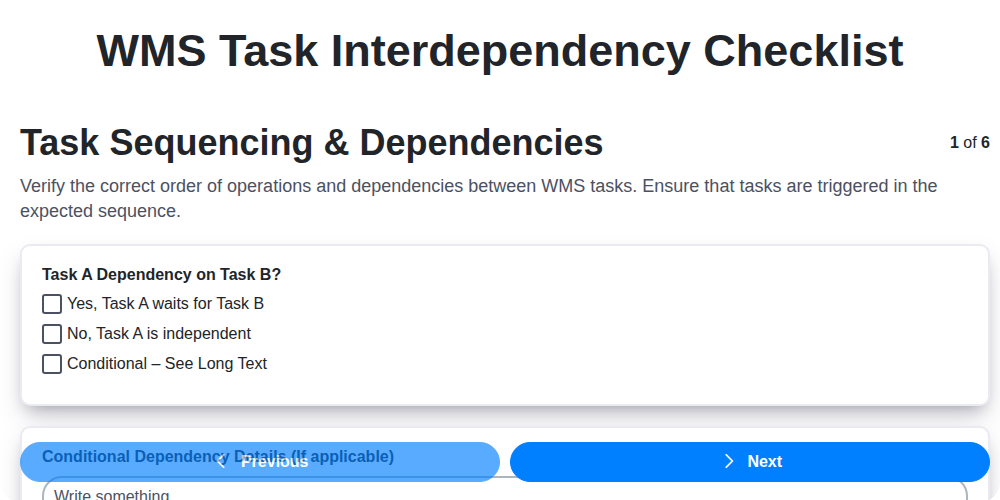
Table of Contents
- Introduction: Why Task Interdependencies Matter in WMS
- Understanding WMS Task Interdependencies
- Task Sequencing & Dependencies: Mapping the Flow
- Trigger Conditions & Logic: Defining the Starting Points
- Data Flow Verification: Ensuring Accuracy and Consistency
- Exception Handling and Fallbacks: Preparing for the Unexpected
- Resource Allocation and Constraints: Optimizing Workforce and Equipment
- Reporting and Monitoring: Tracking Performance and Identifying Bottlenecks
- The Importance of Documentation
- Leveraging WMS Configuration for Interdependency Management
- Best Practices for Continuous Improvement
- Common Pitfalls to Avoid
- Real-World Examples of Task Interdependency Optimization
- Conclusion: Achieving Warehouse Harmony
- Resources & Links
TLDR: Warehouse operations are complex! This checklist helps you ensure your Warehouse Management System (WMS) tasks work together seamlessly. It covers everything from task order & triggers to data flow, error handling, resources, and monitoring - so you can avoid bottlenecks, errors, and wasted time, boosting overall warehouse efficiency. Think of it as a roadmap to a smoothly running warehouse!
Introduction: Why Task Interdependencies Matter in WMS
Warehouse Management Systems (WMS) are complex beasts, orchestrating a multitude of tasks to keep inventory moving efficiently. While individual tasks might seem straightforward-receiving, putaway, picking, packing, shipping-they rarely exist in isolation. They're intricately linked, forming a chain reaction where one task's completion directly impacts the next. Ignoring these interdependencies is a recipe for warehouse chaos: delays, bottlenecks, errors, and ultimately, dissatisfied customers.
Think about it: can a picker start fulfilling orders until the receiving team has processed the inbound shipment and the putaway team has located the goods? Can packing begin without verified picks? These dependencies aren't just theoretical; they're the real-world drivers of your warehouse's performance. Failing to properly map and manage these relationships can lead to cascading failures and significantly impact your operational efficiency. Understanding and actively managing task interdependencies within your WMS is no longer a 'nice-to-have'-it's a core requirement for a high-performing warehouse.
Understanding WMS Task Interdependencies
Warehouse Management Systems (WMS) thrive on orchestrated workflows. It's not enough for tasks to function; they need to function together in a precise and reliable sequence. Failing to account for task interdependencies can lead to bottlenecks, errors, delays, and ultimately, a severely hampered warehouse operation. This checklist focuses on precisely those crucial relationships.
Think of it like a chain - if one link is weak or broken, the entire chain fails. In a WMS, these links are the individual tasks - picking, packing, shipping, receiving, putaway, cycle counting - and their connections are the interdependencies. Ignoring these connections can lead to cascading issues. For instance, inaccurate receiving data can derail the entire picking process. A delayed putaway task might block the picking area.
This isn't just about listing tasks in order. It's about deeply understanding why one task needs to happen before another, what conditions need to be met for a task to initiate, and how the system reacts when things don't go as planned. We're moving beyond simple task order and into the realm of robust, resilient workflow design. Recognizing and managing these interdependencies is a core element of a well-optimized WMS.
Task Sequencing & Dependencies: Mapping the Flow
A well-oiled Warehouse Management System (WMS) isn't just about individual tasks being completed; it's about the order in which they happen and how they rely on one another. Understanding and meticulously documenting task sequencing and dependencies is fundamental to WMS efficiency.
Think of it like a domino effect - if the first domino doesn't fall, the rest won't. In your WMS, a receiving task must be completed before putaway, putaway before picking, and so on. But it goes deeper than a simple linear sequence. Some tasks might be conditional - a quality check only happens for certain items, or a repackaging task is triggered based on pallet dimensions.
Here's what to consider when mapping task sequencing & dependencies:
- Create a Visual Flowchart: This is arguably the best way to visualize the sequence. Use standard flowchart symbols to represent tasks, decisions, and connections.
- Identify Predecessor and Successor Tasks: Clearly define which tasks must be completed before another can begin.
- Document Conditional Logic: Detail why a task is triggered (e.g., if item category = fragile, then initiate quality inspection).
- Account for Parallel Tasks: Some tasks can happen concurrently. Identify these and ensure they don't create bottlenecks or conflicts.
- Use Standardized Naming Conventions: Consistent terminology reduces confusion and facilitates future updates.
- Regularly Review and Update: As your warehouse operations evolve, your task sequence will too.
By thoroughly mapping your task sequencing and dependencies, you lay the groundwork for a more predictable, efficient, and error-free WMS operation.
Trigger Conditions & Logic: Defining the Starting Points
Within a Warehouse Management System (WMS), tasks rarely happen in a vacuum. They're interconnected, and often, one task can't begin until another is complete or a specific condition is met. This section, "Trigger Conditions & Logic," is critical for ensuring a smooth and automated workflow.
Think of it as the system's "if-then" statements. We need to meticulously define when a task should be initiated. This goes beyond a simple sequential order; it's about capturing the nuanced circumstances that dictate action.
Common Trigger Types & Considerations:
- Event-Based Triggers: These are the most straightforward. A specific event initiates the task - for example, receiving a shipment triggers putaway tasks, or an order being placed triggers picking tasks.
- Time-Based Triggers: Tasks can be scheduled to run at specific times or intervals. This is often used for cycle counting, reconciliation processes, or proactive inventory adjustments.
- Data-Driven Triggers: A change in data can act as a trigger. This could be an inventory level dropping below a reorder point, a change in order status, or a change in location assignment.
- Combination Triggers: Real-world scenarios often require a combination of factors. For instance, a putaway task might only trigger after a shipment is received and the receiving dock is clear.
Logic is Key:
It's not enough to simply define the trigger; we need to define the logic that governs it. This includes:
- Prioritization: Which triggers take precedence when multiple conditions are met?
- Order of Execution: How are tasks triggered in a sequence when dependencies exist?
- Error Handling: What happens if a trigger condition isn't met? Does the system pause, send an alert, or attempt a different approach?
Careful definition and validation of trigger conditions and logic are essential for minimizing errors, maximizing efficiency, and ensuring the WMS operates as intended. Without a robust foundation here, downstream processes will invariably suffer.
Data Flow Verification: Ensuring Accuracy and Consistency
Within your Warehouse Management System (WMS), data is the lifeblood. Every movement, every transaction, every update - it all generates data that needs to flow seamlessly and accurately. Data flow verification is a crucial step in your WMS task interdependency checklist, ensuring that information travels correctly between tasks and processes. A breakdown here can lead to inaccurate inventory counts, incorrect order fulfillment, and ultimately, dissatisfied customers.
This isn't just about checking if data moves; it's about verifying how it moves and validating its integrity at each step. Consider these key areas:
- Source to Destination Mapping: Confirm that data originating from one task (e.g., receiving) is correctly routed and mapped to the intended destination (e.g., inventory updates). Mismatches here can create phantom stock or missing records.
- Data Transformation Rules: Many WMS processes involve data transformations - unit conversions, calculations, aggregations. Verify these rules are correctly implemented and produce the expected results. A simple error in a formula can cascade throughout the entire system.
- Data Validation Rules: Are your data validation rules working as expected? Ensure they're catching invalid entries and preventing them from corrupting your data. This includes checks for required fields, data type correctness, and range limits.
- Real-time vs. Batch Processing: For processes involving both real-time and batch data flow, carefully examine how data synchronizes between the two. Delays or errors in batch updates can lead to discrepancies.
- Integration Points: If your WMS integrates with other systems (ERP, shipping platforms, etc.), validate the data exchange at these integration points. This often involves testing with representative data volumes and edge cases.
Employing a combination of automated testing scripts and manual verification steps is highly recommended for comprehensive data flow verification. Document your testing process and results for ongoing monitoring and future system updates.
Exception Handling and Fallbacks: Preparing for the Unexpected
No WMS implementation is immune to errors. Network outages, system glitches, data corruption - they will happen. A robust checklist must address exception handling and fallback procedures, transforming potential disasters into manageable hiccups. This isn't just about recovery; it's about minimizing disruption and maintaining operational integrity.
Here's what to consider:
- Define Potential Exceptions: Brainstorm all possible scenarios that could cause a task to fail. Think beyond the obvious - consider edge cases and complex integrations. Examples include incorrect barcode scans, inventory discrepancies, server unavailability, and integration failures with other systems (e.g., order management, accounting).
- Establish Clear Fallback Procedures: For each identified exception, define a documented fallback procedure. This could involve retrying the task, routing it to a manual override process, escalating to a supervisor, or substituting alternative resources. The plan should outline who is responsible for each fallback.
- Automated vs. Manual Fallback: Determine when automated retry mechanisms are appropriate versus when manual intervention is necessary. Overly aggressive automated retries can mask underlying problems and exacerbate issues.
- Error Logging and Notification: Implement comprehensive error logging that captures detailed information about the exception, including timestamps, user IDs, and relevant data. Configure notifications to alert appropriate personnel when exceptions occur, enabling proactive intervention.
- Data Integrity Safeguards: During a fallback, ensure data integrity is maintained. Consider implementing transaction rollback mechanisms to prevent partial updates or inconsistencies.
- Testing and Simulation: Regularly test exception handling procedures through simulated failure scenarios. This will identify gaps in the plan and provide valuable training for your team. Document results and update the plan accordingly.
- Communication Protocols: Establish clear communication protocols for informing stakeholders about exceptions and their resolution.
Resource Allocation and Constraints: Optimizing Workforce and Equipment
Effective Warehouse Management System (WMS) implementation isn't just about process flow; it's about ensuring you have the right people and equipment in the right place at the right time. This section of your WMS Task Interdependency Checklist focuses on optimizing resource utilization and identifying potential bottlenecks.
Understanding Your Resource Landscape:
Start by meticulously documenting all resources involved in your warehouse operations. This includes:
- Workforce: Consider roles like pickers, packers, loaders, forklift operators, supervisors, and administrative staff. Note their skill sets, availability (shifts, breaks), and training requirements.
- Equipment: List all equipment - forklifts, conveyors, automated guided vehicles (AGVs), scanners, printers, and any other tools critical for task completion. Detail their capacity, maintenance schedules, and operational limitations.
The Checklist Deep Dive:
- Task Assignment Matrix: Create a matrix linking each task to the necessary resource(s). Ask: Can a single resource handle multiple tasks, or is specialization required? Does a task require a specific skill level?
- Capacity Planning: Assess the capacity of each resource. Can a picker handle 30 orders per hour? Can a forklift manage the volume of pallets being moved? Identify potential bottlenecks proactively.
- Constraint Identification: What are the limiting factors? Is it a shortage of qualified forklift operators? Are conveyor belts prone to breakdowns? Understanding these constraints is key to finding workarounds.
- Dynamic Allocation: Does your WMS allow for dynamic resource allocation? Can it automatically reassign tasks based on real-time availability and priority? This adaptability is crucial for responding to unexpected surges or equipment failures.
- Skill-Based Routing: Can tasks be routed to resources based on their skills and experience? Routing complex picking tasks to experienced pickers, for example, increases efficiency and reduces errors.
- Conflict Resolution: Define processes to resolve resource conflicts - what happens when two tasks require the same resource simultaneously? How are priorities established?
- Maintenance Integration: Integrate equipment maintenance schedules into the WMS. Preventative maintenance reduces downtime and ensures resources are consistently available.
By rigorously evaluating and optimizing resource allocation, your WMS can significantly enhance warehouse efficiency, reduce costs, and improve overall operational performance.
Reporting and Monitoring: Tracking Performance and Identifying Bottlenecks
Effective Warehouse Management System (WMS) implementation isn't just about getting the tasks done; it's about knowing how well they're being done and identifying areas for improvement. This is where robust reporting and monitoring become absolutely critical.
Your WMS checklist should include a thorough review of how performance is tracked and what mechanisms are in place to highlight potential bottlenecks. Consider these key areas:
- Key Performance Indicators (KPIs): Define clear KPIs related to each task and dependency. Examples include cycle time, order fulfillment accuracy, putaway efficiency, and picking rates. Ensure these KPIs are being tracked and presented in a format that's easily understood by stakeholders.
- Real-time Dashboards: Implement real-time dashboards displaying key performance indicators. These provide an immediate view of warehouse operations and enable proactive intervention when issues arise. Customizable dashboards allow different teams (management, supervisors, operators) to focus on relevant information.
- Automated Alerts: Configure automated alerts for performance deviations. For instance, an alert could trigger if picking times exceed a defined threshold, or if a specific task's failure rate increases.
- Audit Trails: Ensure comprehensive audit trails are in place to track task execution, including user actions and timestamps. This aids in troubleshooting errors and identifying the root cause of performance issues.
- Exception Reporting: Go beyond standard KPIs and implement exception reporting that specifically highlights unusual activity or failed task sequences.
- Trend Analysis: Don't just look at current performance; analyze trends over time. This helps identify recurring problems and measure the impact of implemented solutions.
- Integration with Business Intelligence (BI) Tools: Consider integrating your WMS data with BI tools for more in-depth analysis and reporting capabilities.
By diligently addressing these points in your reporting and monitoring checklist, you're not just validating your WMS; you're setting the foundation for continuous improvement and maximizing warehouse efficiency.
The Importance of Documentation
A robust Warehouse Management System (WMS) is only as effective as the understanding and adherence to its processes. Often, complex task interdependencies within a WMS can be challenging to grasp, especially as systems evolve and new personnel join the team. Without clear, concise documentation, you risk errors, inefficiencies, and ultimately, a system that doesn't deliver its promised benefits.
Think of it like building a house. You wouldn't start laying bricks without a blueprint, right? Similarly, a WMS Task Interdependency Checklist needs to be documented, not just created. This documentation isn't just about listing the steps - it's about explaining why they're sequenced the way they are, what conditions trigger each action, and what happens when things go wrong.
Well-maintained documentation serves as a living guide for all users, from warehouse operators to IT support. It facilitates training, ensures consistency across shifts, and drastically reduces the time needed to troubleshoot issues. Furthermore, it becomes invaluable during system upgrades or integrations, providing a crucial reference point to maintain stability and minimize disruption. Ignoring documentation is essentially setting your WMS up for potential chaos.
Leveraging WMS Configuration for Interdependency Management
Warehouse Management Systems (WMS) are powerful tools, but their true value shines when processes aren't just automated, but orchestrated. Many warehouse tasks aren't isolated events; they're tightly linked, and failing to account for these interdependencies can lead to bottlenecks, errors, and a seriously disrupted workflow. A robust WMS configuration should proactively manage these connections, ensuring tasks flow seamlessly. Here's how we tackle interdependency management with a structured checklist approach:
Task Sequencing & Dependencies: It's crucial to define the correct order of operations. For example, putaway can't logically precede receiving. This involves meticulously mapping out which tasks must be completed before others can begin. We utilize the WMS's sequencing features, often employing conditions to enforce the order and prevent unauthorized reordering. This is more than just a list - it's a visual representation of the process flow, readily accessible to all stakeholders.
Trigger Conditions & Logic: What initiates a task? A new ASN? A certain quantity of inventory reaching a threshold? These triggers must be clearly defined within the WMS, with logical rules governing when a task starts. Improperly configured triggers lead to tasks being initiated out of sequence, causing chaos. We rigorously test these triggers under various scenarios.
Data Flow Verification: Tasks often rely on data from other processes. A picking task requires accurate inventory data, for instance. We verify that data flows correctly between tasks, ensuring the information used is accurate and up-to-date. This includes validating data formats and ensuring the correct fields are populated.
Exception Handling and Fallbacks: Things will go wrong. A scanner fails, a location is blocked, a shipment is incomplete. The WMS needs predefined exception handling procedures and fallback options. Is there an alternate route for picking if a primary aisle is blocked? Can a task be manually overridden by an authorized user? This goes beyond error messages; it's about recovery strategies.
Resource Allocation and Constraints: Tasks require resources - labor, equipment, space. Understanding the constraints - a limited number of forklifts, a blocked dock door - is paramount. The WMS must intelligently allocate resources and adjust schedules to avoid bottlenecks. We analyze resource utilization and optimize task assignments accordingly.
Reporting and Monitoring: Real-time visibility into task progression is essential. Reporting dashboards should highlight potential bottlenecks and show how interdependencies are affecting overall performance. KPIs related to task completion rates, cycle times, and error rates are closely monitored.
Best Practices for Continuous Improvement
Implementing a robust Warehouse Management System (WMS) is a significant undertaking, but the real value comes from ongoing optimization. To ensure your WMS continues to deliver maximum efficiency and accuracy, a proactive approach to continuous improvement is essential. A key tool in this process is a thorough WMS Task Interdependency Checklist. Regularly reviewing and updating this checklist isn't just about fixing immediate problems; it's about future-proofing your warehouse operations.
Here's how to leverage the checklist for lasting improvements:
- Regular Re-evaluation: Don't just run the checklist once and file it away. Schedule quarterly (or even monthly for high-volume warehouses) reviews. Business needs, product lines, and inventory strategies evolve; your WMS configuration needs to adapt.
- Cross-Functional Collaboration: Don't restrict checklist reviews to the IT department. Include warehouse supervisors, pickers, packers, and even customer service representatives. They are on the front lines and often possess invaluable insights into inefficiencies.
- Data-Driven Adjustments: Correlate checklist findings with key performance indicators (KPIs) like order fulfillment rates, picking accuracy, and labor productivity. Use this data to prioritize adjustments and measure the impact of changes.
- Document Everything: Meticulously record all checklist findings, proposed solutions, and implemented changes. This creates a valuable historical record and facilitates knowledge transfer.
- Embrace Automation Opportunities: As you review dependencies and constraints, actively seek opportunities to automate tasks and workflows. This can significantly reduce manual intervention and minimize errors.
- Feedback Loop Integration: Establish a clear feedback loop where warehouse personnel can easily report issues and suggest improvements related to WMS task interdependencies.
Common Pitfalls to Avoid
Implementing a robust Warehouse Management System (WMS) is a complex undertaking. While a well-defined WMS task interdependency checklist (as we're exploring!) is a huge step in the right direction, even the most meticulous planning can be derailed by common pitfalls. Here are a few to watch out for:
Ignoring the Nuances of Task Sequencing: It's tempting to map tasks in a linear, obvious order. However, real-world warehouse operations rarely follow such simplicity. Failing to account for cyclical processes (like returns impacting inventory availability) or parallel tasks (like picking and packing happening concurrently) can lead to bottlenecks and delays. Don't just sequence; analyze the flow.
Assuming If This, Then That is Enough: Trigger conditions and logic are the backbone of automated workflows. However, oversimplifying these rules can create brittle systems. Consider edge cases, error scenarios, and the potential for unexpected data inputs. A single incorrect condition can cascade into widespread problems.
Data Silos and Verification Gaps: WMS integration with other systems (ERP, shipping platforms, etc.) is critical. However, neglecting thorough data flow verification is a recipe for disaster. Mismatched data types, incorrect mapping, and a lack of validation checks can lead to inaccurate inventory, order fulfillment errors, and frustrated customers. Don't just connect - verify the information's integrity.
Lack of Robust Exception Handling: What happens when something does go wrong? Insufficient exception handling and fallback procedures leave your warehouse vulnerable to costly disruptions. Automated processes failing without a clear manual override or alternative pathway can bring operations to a standstill.
Underestimating Resource Constraints: The WMS might suggest a task can be completed in a certain timeframe, but does the warehouse have the physical space, equipment, and - crucially - trained personnel to meet that expectation? Failing to account for these constraints leads to unrealistic expectations and operational friction.
Ignoring the Need for Continuous Monitoring: Implementing the WMS is not a "set it and forget it" exercise. Reporting and monitoring are vital for identifying performance bottlenecks, system inefficiencies, and emerging issues. Without ongoing analysis, you're flying blind.
Real-World Examples of Task Interdependency Optimization
Let's look at a few scenarios where a WMS task interdependency checklist like the one we's discussed has proven invaluable.
Scenario 1: E-commerce Order Fulfillment - Pick, Pack & Ship
Imagine a high-volume e-commerce operation. The typical workflow involves receiving an order, picking items from various locations, packing them securely, and finally, shipping. Without proper interdependency management, bottlenecks are inevitable. For example, if the Pick task is not triggered correctly based on confirmed order data (Task Sequencing & Dependencies), pickers might start fulfilling orders that are subsequently canceled or modified. This leads to wasted labor and potential order inaccuracies. Furthermore, if the Packing task starts before the Pick task is fully completed (Trigger Conditions & Logic), the system might create inaccurate inventory records or lead to orders being packed with incorrect items. A robust checklist ensures that picking is completed and verified before packing begins, minimizing errors.
Scenario 2: Pharmaceutical Distribution - Batch Tracking & Temperature Control
In the pharmaceutical industry, temperature control and batch tracking are paramount. Tasks like receiving, quality checks, storage, and dispensing are heavily interdependent. Let's say a batch of medication arrives and needs to be immediately moved to a temperature-controlled storage area (Resource Allocation & Constraints). The Quality Check task must precede the Storage task. Failing to enforce this dependency could compromise product integrity and trigger regulatory issues. The checklist's exception handling section would specify what happens if the temperature deviates during transit or the quality check fails - perhaps a quarantine procedure or immediate notification to quality control. The Reporting & Monitoring section would track temperature logs and quality check results, providing immediate visibility to potential deviations.
Scenario 3: Manufacturing - Raw Material Consumption & Production Scheduling
Consider a manufacturing process requiring specific raw materials. The Receive Raw Materials task feeds directly into the Production Scheduling task. If raw materials are received but not accurately recorded (Data Flow Verification), production scheduling might commit to unrealistic timelines, leading to delays and increased costs. The system needs to know exactly what's available to ensure accurate scheduling and prevent production halts. Fallback mechanisms (Exception Handling and Fallbacks) must be in place to manage situations where a raw material is unexpectedly unavailable - perhaps automatically suggesting alternative materials or delaying the production run.
Conclusion: Achieving Warehouse Harmony
Ultimately, a robust WMS Task Interdependency Checklist isn't just about ticking boxes; it's about building a warehouse ecosystem where tasks flow seamlessly and efficiently. By diligently working through each point - from sequencing and triggers to exception handling and resource allocation - you're laying the groundwork for reduced errors, improved productivity, and enhanced overall warehouse performance. This checklist provides a framework to proactively identify and mitigate potential bottlenecks, ensuring that your WMS functions as a unified and harmonious system, contributing directly to your business's bottom line. Embrace it as a living document, continuously reviewed and updated to reflect changes in processes and technology, and watch your warehouse operations thrive.
Resources & Links
- Apogea: Provides WMS solutions and consulting. Their expertise often covers task interdependencies and process optimization within warehouse environments. Explore their services and case studies for relevant insights.
- Blue Harbor: A supply chain consulting firm offering services related to WMS implementation and optimization. They likely have articles and resources related to workflow and process design, crucial for understanding task interdependencies.
- Infor: A provider of WMS software. Their website has case studies and white papers showcasing how their systems handle complex warehouse processes, potentially including task dependencies. Look for content on workflow automation and optimization.
- Oracle Warehouse Management: Oracle's WMS solutions are robust and often handle intricate processes. Their website includes documentation and guides that indirectly address task interdependencies through process design and configuration.
- SAP Warehouse Management: SAP's WMS offerings are enterprise-level solutions often used in complex supply chains. Their resources might detail how to configure and manage workflows with dependencies.
- 3PLink: Provides WMS solutions targeted toward 3PL providers. They often have blog posts and case studies related to optimizing warehouse operations, which might touch on task sequencing and process automation.
- DC Pro's: A consultancy specializing in warehouse operations and WMS. Their blog and resources often cover practical advice on process improvement and optimization, including task flow analysis.
- Supply Chain Digital: This digital publication covers a wide range of supply chain topics, including warehousing. Search for articles related to WMS optimization, process automation, and workflow management - keywords like 'task dependency' and 'process mapping' will be helpful.
- Modern Materials Handling: A trade publication covering warehouse and supply chain technology. Search their site for articles related to WMS, automation, and process optimization. They regularly feature insights on improving warehouse efficiency.
- Institute of Supply Chain Management (ISCM): While not directly about WMS, ISCM provides educational resources and certifications related to supply chain management. Understanding the broader context can enhance the understanding of task interdependencies within a warehouse setting.
Frequently Asked Questions
What is a WMS and why is warehouse efficiency important?
A Warehouse Management System (WMS) is software that manages and optimizes warehouse operations, from receiving goods to shipping orders. Warehouse efficiency is crucial for reducing costs, improving order fulfillment speed, and maximizing space utilization. Mastering it directly impacts a company's profitability and customer satisfaction.
What does 'task interdependency' mean in the context of a WMS?
Task interdependency refers to how different warehouse tasks rely on each other. For example, picking an order can't begin until it's been released from the putaway process. Understanding these dependencies allows you to streamline workflows and avoid bottlenecks.
Who should use this WMS task interdependency checklist?
This checklist is valuable for warehouse managers, operations supervisors, WMS administrators, and anyone involved in designing, optimizing, or maintaining warehouse processes and the WMS that supports them.
What kind of tasks are covered in the checklist?
The checklist covers a broad range of common warehouse tasks, including receiving, putaway, picking, packing, shipping, inventory management, cycle counting, and replenishment. It addresses the sequence and dependencies within each of these areas.
How can I use this checklist to improve my warehouse's efficiency?
Review each task and its dependencies, identifying potential bottlenecks or areas where tasks are unnecessarily sequential. Re-sequence tasks, automate where possible, and adjust WMS configurations to optimize the workflow based on the findings from the checklist.
What if my warehouse has unique processes not covered in the checklist?
The checklist provides a foundational framework. Consider it a starting point. Analyze your specific workflows and use the checklist's principles to identify dependencies in your unique processes. Adapt the checklist accordingly.
What are some common signs that task interdependencies aren't being handled effectively?
Signs of inefficiency include frequent delays, increased errors in order fulfillment, high labor costs, accumulation of work-in-progress, and a general feeling of chaos or disorganization within the warehouse.
How often should I review and update this checklist?
We recommend reviewing the checklist at least annually, or more frequently if you experience significant changes in warehouse processes, product lines, or WMS configurations. Regular review ensures ongoing optimization.
Found this Article helpful?
Comments
There are no comments yet. Be the first to add one!
WMS - Warehouse Management System Solution Demo
Optimize your warehouse operations & boost efficiency! ChecklistGuro's WMS streamlines inventory management, order fulfillment, and shipping. Reduce errors, improve accuracy, & maximize space utilization. Manage it all with our Work OS.
Related Articles
Seamless RFID Integration: Your WMS Checklist Template for Success
Mastering Warehouse Labeling: Your WMS Process Checklist Template
The Ultimate Supply Chain Inventory Accuracy Audit Checklist: A Step-by-Step Guide
Mastering Putaway: Your WMS Optimization Checklist

Mastering Your Yard: A Warehouse WMS Yard Management Checklist Template
Warehouse Data Integrity: Your WMS Checklist Template
WMS System Performance Monitoring Checklist: A Comprehensive Guide
Warehouse WMS Error Handling Checklist: A Proactive Guide to Minimizing Disruptions
We can do it Together
Need help with
Warehouse Management System (WMS)?
Have a question? We're here to help. Please submit your inquiry, and we'll respond promptly.