Mastering Zone Picking Workflow Management
Published: 06/18/2026 9:00 PM Updated: 06/19/2026 11:49 AM
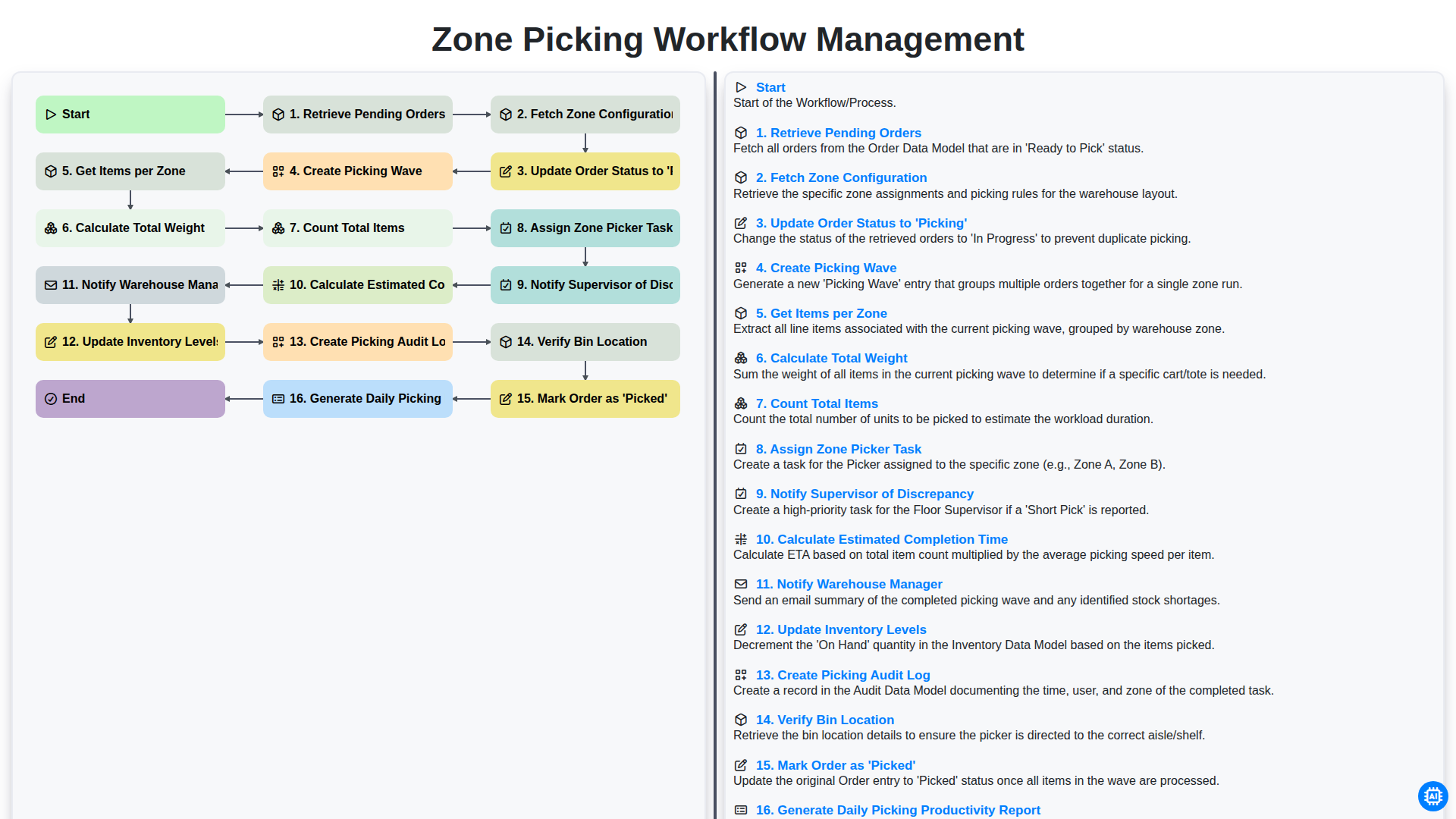
Table of Contents
- Introduction to Zone Picking Efficiency
- Initiating the Cycle: Retrieving Pending Orders
- Setting the Foundation: Fetching Zone Configuration
- Preparing the Floor: Transitioning Order Status to 'Picking'
- Strategic Batching: Creating Picking Waves
- Optimizing Resource Allocation: Getting Items per Zone
- Load Balancing: Calculating Total Weight and Item Counts
- Task Delegation: Assigning Zone Picker Tasks
- Real-Time Oversight: Managing Discrepancies and Supervisor Notifications
- Predictive Logistics: Calculating Estimated Completion Time
- Ensuring Accuracy: Verifying Bin Locations and Inventory Updates
- Closing the Loop: Marking Orders as 'Picked' and Creating Audit Logs
- Performance Analytics: Generating Daily Productivity Reports
- Conclusion: Continuous Improvement in Warehouse Management
- Resources & Links
TLDR: Learn how to optimize warehouse efficiency using our automated Zone Picking Workflow. This guide explains how the system streamlines operations-from retrieving pending orders and organizing picking waves to real-time task assignment and automated inventory updates-ensuring precision, error reduction, and enhanced productivity tracking.
Introduction to Zone Picking Efficiency
In the fast-paced world of modern warehousing, manual order fulfillment often becomes a bottleneck that stifles growth and increases error rates. As order volumes scale, the traditional method of single-order picking-where a single worker traverses the entire warehouse for every request-becomes increasingly inefficient and labor-intensive. This is where Zone Picking Workflow Management transforms operations.
Zone picking, often referred to as pick-and-pass, optimizes warehouse throughput by dividing the facility into specific, manageable sections or zones. Instead of one person walking miles of aisles, specialized pickers focus solely on their assigned areas, significantly reducing travel time and physical fatigue. By implementing a structured, automated workflow, warehouses can orchestrate complex movements, ensure high accuracy, and maximize the productivity of every picker. Mastering this workflow is not just about moving items; it is about orchestrating a seamless symphony of data, personnel, and precision to ensure that every order moves from the shelf to the shipping dock with maximum velocity.
Initiating the Cycle: Retrieving Pending Orders
The efficiency of a zone picking operation begins long before a picker ever touches a bin. The entire process is triggered by the systematic retrieval of pending orders from the Warehouse Management System (WMS). This initial step is critical, as it serves as the foundation for the entire workflow.
During this phase, the system scans the order database to identify all unfulfilled requests that are ready for processing. However, simply pulling orders isn't enough; the system must evaluate order priority, shipping deadlines, and customer service level agreements (SLAs). By identifying these pending orders, the workflow can begin the transition from a static list of requests to an active, actionable queue, setting the stage for the complex logic of zone assignment and wave creation that follows.
Setting the Foundation: Fetching Zone Configuration
Before any physical movement occurs on the warehouse floor, the system must first establish the rules of engagement by executing the Fetch Zone Configuration step. This stage is the blueprinting phase of the entire workflow; it involves pulling real-time data regarding how your warehouse layout is partitioned and which specific products are assigned to which zones.
Effective zone picking relies on precision. By retrieving the current configuration, the system identifies the boundaries of each picking area-whether they are based on product type, temperature requirements, or velocity. This step ensures that when the subsequent task assignment occurs, the system isn't just guessing where items are, but is instead following a validated, up-to-date map of your facility. Without an accurate fetch of this configuration, the entire picking wave risks misalignment, leading to inefficient routes and wasted travel time for your pickers.
Preparing the Floor: Transitioning Order Status to 'Picking'
The transition from order receipt to active fulfillment begins with a critical shift in your warehouse's operational state. Once orders are retrieved from the pending queue, the system must immediately update the order status to 'Picking'. This isn't merely a cosmetic change in your database; it is a vital synchronization step that prevents duplicate efforts and ensures real-time accuracy across your entire team.
By officially marking an order as 'Picking', you create a digital lock on those items, signaling to the rest of the warehouse management system that these units are no longer available for other processes, such as replenishment or auditing. This status change acts as the trigger for the subsequent automated logic-such as fetching zone configurations and initiating picking waves-ensuring that as soon as an order moves into the picking phase, the right instructions are already being routed to the right zones. This seamless transition minimizes downtime and ensures that your workforce is always moving toward the next high-priority task without manual intervention.
Strategic Batching: Creating Picking Waves
To optimize warehouse efficiency, the process must move beyond individual order processing toward a more structured approach: Creating Picking Waves. Instead of treating every order as an isolated task, the system aggregates multiple pending orders into a single, cohesive wave.
This strategic batching process allows the warehouse to synchronize activities across different zones. By grouping orders that share similar characteristics-such as priority levels, shipping deadlines, or destination regions-the system can streamline the workflow, reducing the frequency of repetitive travel for operators. A well-structured picking wave ensures that resources are utilized effectively, preventing bottlenecks and ensuring that the subsequent steps, such as assigning zone picker tasks, are executed with maximum precision and minimal downtime.
Optimizing Resource Allocation: Getting Items per Zone
To maximize efficiency and minimize travel time within the warehouse, the core of an effective zone picking strategy lies in the ability to precisely Get Items per Zone. Rather than sending a single picker on a marathon route across the entire facility, the system intelligently parses the active picking wave to group tasks based on specific warehouse sectors.
By isolating item lists by zone, the workflow ensures that each picker is only responsible for the inventory within their assigned footprint. This granular approach eliminates redundant movements and prevents cross-zone congestion, allowing personnel to focus exclusively on the bins and aisles they know best. When the system accurately aggregates items per zone, it transforms a chaotic, massive order list into a series of streamlined, high-velocity micro-tasks that drastically increase the overall throughput of the fulfillment center.
Load Balancing: Calculating Total Weight and Item Counts
To ensure a balanced workload across your warehouse team, the workflow integrates critical mathematical validations during the picking preparation phase. Instead of simply assigning tasks based on order volume, the system performs a deep dive into the physical attributes of each zone's workload by performing two vital operations: Calculating Total Weight and Counting Total Items.
By analyzing the cumulative weight of all items assigned to a specific zone, the system prevents overloading individual pickers or automated carts, which could lead to safety hazards or equipment fatigue. Simultaneously, by counting the total number of items per zone, the workflow can assess the complexity of the pick path. A zone with a low item count but high weight requires a different resource allocation than a zone with a high item count but minimal weight. These metrics are essential for the system to accurately Calculate Estimated Completion Time, ensuring that- much like a well-orchestrated symphony-no single zone becomes a bottleneck that stalls the entire fulfillment pipeline.
Task Delegation: Assigning Zone Picker Tasks
Once the system has analyzed the specific requirements for each zone-including item counts and total weight-the workflow moves into the critical phase of execution: Assigning Zone Picker Tasks.
Rather than overwhelming a single individual with an entire warehouse order, the management system intelligently distributes specific subsets of orders to the personnel assigned to particular zones. This automated delegation ensures that each picker is only responsible for the items within their designated physical area, preventing unnecessary travel time and cross-aisle fatigue. By assigning tasks based on real-time zone density and picker availability, the system optimizes the labor force, ensuring that no single zone becomes a bottleneck while others sit idle. This precision in task assignment is what transforms a chaotic fulfillment center into a streamlined, high-velocity operation.
Real-Time Oversight: Managing Discrepancies and Supervisor Notifications
In a complex zone picking environment, errors are an inevitable part of high-speed operations. A robust workflow management system doesn't just facilitate movement; it acts as a safety net. When a discrepancy arises-such as a mismatched SKU, a damaged item, or a significant difference between expected and actual weight-the system must trigger an immediate Notify Supervisor of Discrepancy action.
This automated alert ensures that inconsistencies are addressed in real-time, preventing errors from cascading down the fulfillment line. By instantly bridging the gap between the warehouse floor and management, the workflow prevents silent errors from reaching the packing station. This proactive oversight ensures that any deviation from the picking plan is met with immediate corrective action, maintaining the integrity of your inventory and the accuracy of every outgoing order.
Predictive Logistics: Calculating Estimated Completion Time
In a high-efficiency warehouse environment, transparency is key to managing expectations and optimizing labor allocation. A core component of our automated workflow is the ability to transition from reactive management to predictive logistics by Calculating Estimated Completion Time (ECT).
This isn't merely a simple countdown; it is a sophisticated calculation derived from real-time operational data. By analyzing the complexity of the current picking wave-specifically the Count Total Items and the Calculate Total Weight metrics-the system assesses the physical effort required for the task. When combined with the current density of the Get Items per Zone step, the workflow engine generates a highly accurate timestamp for when a zone will be cleared.
By integrating ECT into the workflow, warehouse managers can move away from manual check-ins and instead rely on automated foresight. This allows for better synchronization of downstream processes, such as packing and shipping, ensuring that outbound docks are prepared precisely when the picking waves are slated to conclude. This predictive capability minimizes bottlenecking and transforms the warehouse from a site of constant monitoring to one of streamlined, autonomous execution.
Ensuring Accuracy: Verifying Bin Locations and Inventory Updates
The integrity of a zone picking strategy relies heavily on the precision of your underlying data. A single error in location accuracy can trigger a domino effect of inefficiencies across the entire warehouse. To prevent this, the workflow must include a rigorous step to Verify Bin Location before any item is removed from its slot. By cross-referencing the physical item against the digital pick list, pickers can catch misplaced stock or labeling errors before they become costly shipping mistakes.
Once the physical verification is complete, the system must immediately Update Inventory Levels in real-time. This automated synchronization ensures that your stock counts remain accurate, preventing ghost inventory issues where orders are promised to customers but cannot be fulfilled. By integrating verification with instant updates, you eliminate the discrepancy gap, ensuring that your digital records always mirror the reality of your warehouse floor.
Closing the Loop: Marking Orders as 'Picked' and Creating Audit Logs
Once the physical movement of goods is complete, the workflow transitions from active execution to data reconciliation. The final, critical steps involve transitioning the order status to 'Picked' and formalizing the entire process through the creation of a Picking Audit Log.
Marking an order as 'Picked' is more than just a status update; it is the trigger that signals the downstream fulfillment process-such as packing, labeling, and shipping-to begin. This real-time update ensures that the warehouse management system (WMS) maintains an accurate, live view of order progression, preventing bottlenecks by allowing the packing station to prepare for incoming volume precisely when it arrives.
However, a successful pick is only as good as its traceability. To ensure operational integrity, the system must simultaneously generate a comprehensive Picking Audit Log. This log serves as the permanent digital footprint of the transaction, capturing essential data points such as which picker completed the task, the exact timestamp of the pick, the bin locations accessed, and any discrepancies encountered during the process.
By closing the loop with these two steps, you transform a physical action into a reliable data asset. This level of granularity is what enables management to perform root-cause analysis on errors, validate inventory accuracy, and drive continuous improvement through data-driven insights.
Performance Analytics: Generating Daily Productivity Reports
At the conclusion of every operational cycle, the workflow culminates in the automated generation of the Daily Picking Productivity Report. This step is the cornerstone of continuous improvement within the warehouse, transforming raw operational data into actionable intelligence.
Rather than merely documenting completed tasks, this report synthesizes data from every stage of the picking process-from the initial retrieval of pending orders to the final verification of bin locations. By analyzing metrics such as average pick rates per zone, total items processed, and the frequency of discrepancies flagged by supervisors, management can gain a granular view of warehouse efficiency.
These reports allow warehouse managers to identify bottlenecks in specific zones, evaluate the workload distribution of individual pickers, and compare actual performance against estimated completion times. By leveraging this automated analytical output, organizations can move away from reactive troubleshooting and toward a proactive, data-driven strategy that optimizes labor allocation and scales warehouse throughput.
Conclusion: Continuous Improvement in Warehouse Management
Implementing a structured Zone Picking Workflow is more than just a way to organize tasks; it is a strategic commitment to operational excellence. By moving away from chaotic, manual processes and adopting a systematic approach-from the initial retrieval of pending orders to the final generation of productivity reports-warehousing teams can eliminate bottlenecks and reduce human error.
However, the true value of this workflow lies in its capacity for continuous improvement. The data captured during the picking process, such as discrepancy notifications, audit logs, and real-time productivity metrics, provides a goldmine of actionable insights. By regularly reviewing these outputs, managers can identify recurring inefficiencies, optimize zone configurations, and fine-tune staff assignments. Ultimately, mastering the zone picking workflow transforms a warehouse from a reactive environment into a proactive, data-driven engine of growth, ensuring that as your order volume scales, your accuracy and efficiency scale along with it.
Resources & Links
- MHI (Material Handling Institute): The leading industry association for the material handling, logistics, and supply chain industry, providing deep insights into warehouse automation and optimization.
- Supply Chain Dive: A premier source for supply chain news and analysis, offering expert perspectives on operational efficiency and warehouse management trends.
- Warehouse Logistics: Expert resources and case studies focusing on modern warehousing techniques, including zone picking strategies and workflow automation.
- Logistics Management: Comprehensive industry news and educational resources regarding logistics technology, order fulfillment, and inventory management best practices.
- Supply Chain Management Review: Professional-grade insights into strategic supply chain planning, workforce management, and the implementation of complex warehouse workflows.
- IBM Supply Chain Insights: Advanced resources on utilizing data analytics, AI, and real-time visibility to manage warehouse discrepancies and predictive logistics.
Found this Article helpful?
Comments
There are no comments yet. Be the first to add one!
WMS - Warehouse Management System Solution Demo
Optimize your warehouse operations & boost efficiency! ChecklistGuro's WMS streamlines inventory management, order fulfillment, and shipping. Reduce errors, improve accuracy, & maximize space utilization. Manage it all with our Work OS.
Related Articles
Seamless RFID Integration: Your WMS Checklist Template for Success
Mastering Warehouse Labeling: Your WMS Process Checklist Template
The Ultimate Supply Chain Inventory Accuracy Audit Checklist: A Step-by-Step Guide
Mastering Putaway: Your WMS Optimization Checklist

Mastering Your Yard: A Warehouse WMS Yard Management Checklist Template
Warehouse Data Integrity: Your WMS Checklist Template
WMS System Performance Monitoring Checklist: A Comprehensive Guide
Warehouse WMS Error Handling Checklist: A Proactive Guide to Minimizing Disruptions
We can do it Together
Need help with
Checklists?
Have a question? We're here to help. Please submit your inquiry, and we'll respond promptly.