Demand Planning Accuracy Checklist: A Step-by-Step Guide to Better Forecasts
Published: 12/09/2025 10:00 PM Updated: 12/14/2025 7:45 AM
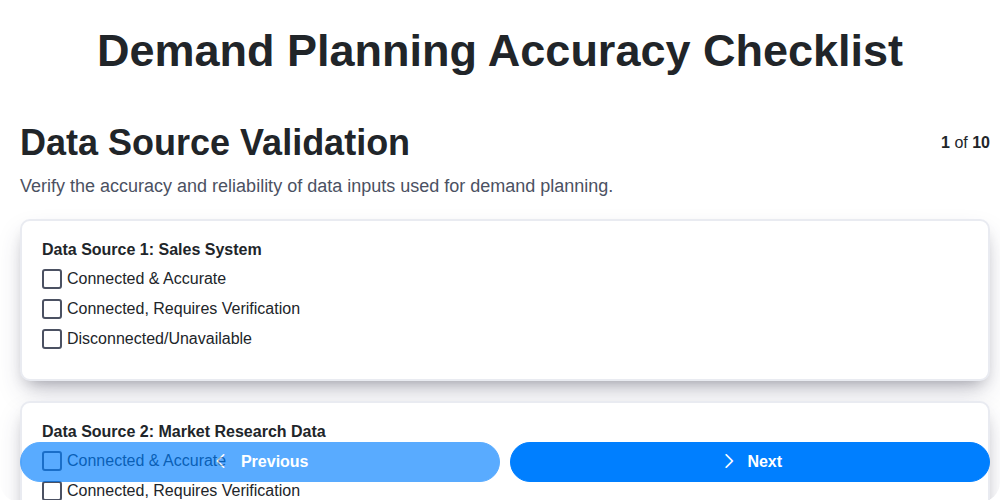
Table of Contents
- Introduction: Why Demand Planning Accuracy Matters
- 1. Data Source Validation: The Foundation of Reliable Forecasts
- 2. Historical Data Review: Identifying Trends and Patterns
- 3. Forecast Method Selection: Choosing the Right Tool for the Job
- 4. Key Assumption Validation: Stress-Testing Your Forecast
- 5. Collaboration & Communication: Breaking Down Silos
- 6. Forecast Error Metrics: Measuring Your Performance
- 7. Bias Detection & Correction: Addressing Systematic Errors
- 8. Process Documentation & Updates: Maintaining Consistency
- 9. System Configuration: Optimizing Your Technology
- 10. Exception Management: Handling Unexpected Shifts
- 11. Continuous Improvement: Beyond the Checklist
- Conclusion: Achieving Demand Planning Excellence
- Resources & Links
TLDR: Struggling with inaccurate demand forecasts? This checklist is your shortcut to better predictions! It walks you through essential steps - from verifying data to spotting forecast errors - ensuring your planning is data-driven, collaborative, and continuously improving. Use it to boost accuracy and minimize costly surprises.
Introduction: Why Demand Planning Accuracy Matters
Accurate demand planning is the bedrock of a successful supply chain. It's not just about guessing what customers will want; it's about leveraging data, understanding trends, and collaborating effectively to minimize surprises and maximize efficiency. When demand forecasts are off, the consequences ripple throughout your organization - from excess inventory and wasted resources to stockouts, lost sales, and ultimately, dissatisfied customers. Conversely, a well-executed demand planning process directly impacts profitability, optimizes working capital, and strengthens your competitive advantage. This checklist is designed to provide a framework for continuous improvement, ensuring your demand planning efforts are delivering the precision needed to thrive in today's dynamic market. Let's move beyond reactive problem-solving and build a demand planning process that proactively anticipates and meets customer needs.
1. Data Source Validation: The Foundation of Reliable Forecasts
Your demand planning forecasts are only as good as the data feeding them. It's easy to get caught up in complex algorithms and sophisticated tools, but neglecting the basics - validating your data sources - is a recipe for inaccurate predictions. This isn's just a preliminary step; it's an ongoing responsibility.
Here's what data source validation entails:
- Identify All Sources: Map out every data source contributing to your demand plan - point-of-sale (POS) data, market research reports, promotional calendars, supply chain information, even external factors like weather patterns. Don't leave anything out.
- Assess Data Quality: Evaluate each source for accuracy, completeness, timeliness, and consistency. Are sales figures complete? Are promotional details accurate? Is data updated regularly?
- Verify Data Integrity: Implement checks to ensure data hasn't been corrupted during transfer or storage. This can involve data reconciliation, comparing aggregates against individual records, and performing sanity checks.
- Understand Data Definitions: Ensure everyone understands the definitions of key terms and metrics. What constitutes a 'sale'? How is a 'promotion' defined? Clear definitions prevent misinterpretations and errors.
- Regular Audits: Schedule periodic audits of your data sources to ensure ongoing quality and identify any emerging issues.
Neglecting this step can lead to a cascade of errors, undermining the entire demand planning process. A solid foundation of validated data is the bedrock of reliable forecasts.
2. Historical Data Review: Identifying Trends and Patterns
Before even considering sophisticated forecasting methods, a thorough review of your historical data is absolutely crucial. This isn't just about verifying numbers; it's about uncovering the story they tell. Garbage in, garbage out - if your historical data is flawed, your forecast will be too.
Here's what to look for:
- Seasonality: Does demand fluctuate predictably at certain times of the year, week, or even day? Identify peak seasons, holiday impacts, and cyclical patterns. Visualizing data with time series charts is invaluable here.
- Trends: Is there a consistent upward or downward trajectory in demand over time? This could be driven by market growth, competitor actions, or product life cycles.
- Outliers: Identify any unusual spikes or dips that deviate significantly from the expected pattern. Investigate the root cause of these outliers - promotions, unexpected events, data errors - and determine if they need to be adjusted or removed from the forecasting process.
- Data Gaps & Errors: Look for missing data points, inconsistent units of measurement, or obvious data entry errors. These inaccuracies can skew your forecast.
- Product Lifecycle Stages: Understand where each product sits in its lifecycle (introduction, growth, maturity, decline). Products in different stages will exhibit different demand patterns.
- External Factors: Consider how external factors, like economic conditions, weather patterns, or industry trends, might have influenced historical demand. Can these be quantified or incorporated?
By diligently examining your historical data, you're laying a solid foundation for a more accurate and reliable demand plan.
3. Forecast Method Selection: Choosing the Right Tool for the Job
Choosing the right forecasting method is crucial, and it's rarely a one-size-fits-all scenario. Simply selecting the most advanced technique doesn't guarantee accuracy. Instead, consider the characteristics of your products and data.
Here's a breakdown of common methods and when to consider them:
- Simple Moving Average: Best for stable demand with minimal seasonality or trends. Easy to understand and implement, but lags behind changes.
- Weighted Moving Average: Similar to simple moving average, but gives more weight to recent data points, making it slightly more responsive.
- Exponential Smoothing (Single, Double, Triple): Adaptable to various demand patterns. Single for level data, double for trend, and triple for seasonality. Requires careful parameter tuning.
- Time Series Decomposition: Excellent for isolating trend, seasonality, and random components. Allows for more targeted adjustments and interventions.
- Causal Forecasting (Regression Analysis): Uses external factors (e.g., promotions, pricing, economic indicators) to predict demand. Requires identifying relevant drivers and gathering data.
- Machine Learning (e.g., ARIMA, Neural Networks): Can handle complex patterns and large datasets, but requires expertise and significant computational resources.
Key Considerations:
- Data Availability: Some methods require more historical data than others.
- Forecast Horizon: Different methods perform better for short-term vs. long-term forecasts.
- Product Lifecycle Stage: A new product might require different forecasting than a mature product.
- Forecast Accuracy Requirements: Higher accuracy demands more sophisticated methods.
Don't be afraid to experiment! A/B testing different methods and evaluating their performance is an excellent way to determine the best fit for your specific products and business needs.
4. Key Assumption Validation: Stress-Testing Your Forecast
A forecast isn't just a number; it's a story built on assumptions. These assumptions - about market conditions, promotional impacts, competitor actions, and even internal capabilities - are the bedrock of your demand plan. But what happens when those assumptions prove incorrect? The resulting forecast error can ripple through your supply chain, leading to lost sales, excess inventory, and frustrated customers.
That's why rigorous key assumption validation is critical. Don't just make assumptions; test them. Here's how:
- Identify Core Assumptions: Start by explicitly listing the key assumptions underpinning your forecast. These might include things like "Our new marketing campaign will increase demand by X%" or "Competitor Y will launch a similar product in Q3."
- Scenario Planning: Develop 'what-if' scenarios. What happens if the marketing campaign is less effective than anticipated? What if a major competitor significantly undercuts your pricing? Run your forecast models with adjusted parameters to see the impact.
- Sensitivity Analysis: Determine how sensitive your forecast is to changes in your core assumptions. A small change in a key assumption shouldn't result in a massive forecast swing - that signals a potential problem with the methodology or data.
- External Validation: Where possible, seek external validation for your assumptions. Can you find industry reports, competitor analyses, or expert opinions that support your expectations?
- Document & Track: Clearly document all key assumptions and the rationale behind them. Regularly review and update these assumptions based on new information and market developments.
By proactively stress-testing your forecast against potential changes in key assumptions, you're building a more robust and reliable demand plan that can withstand unexpected events.
5. Collaboration & Communication: Breaking Down Silos
Demand planning doesn't happen in a vacuum. It's a critical function that impacts sales, marketing, production, and finance. Siloed departments lead to inaccurate forecasts, missed opportunities, and frustrated teams. True demand planning accuracy hinges on robust collaboration and communication.
Here's why and how to improve it:
- Bring Everyone to the Table: Include representatives from Sales, Marketing, Finance, and Operations in your planning process. Each department possesses valuable insights - sales understands customer trends, marketing knows promotional impacts, finance can highlight budgetary constraints, and operations knows production capacity.
- Regular Cross-Functional Meetings: Schedule recurring meetings specifically for demand planning. These shouldn't be status updates; they should be collaborative problem-solving sessions. Create an agenda and document key decisions.
- Shared Forecasts and Transparency: Make your forecasts accessible to all relevant stakeholders. Clearly articulate the methodology and assumptions behind the forecast. This fosters trust and allows for constructive feedback.
- Feedback Loops: Establish a system for stakeholders to easily provide feedback on the forecast. Encourage them to challenge assumptions and highlight potential discrepancies. Don't view feedback as criticism; see it as a valuable opportunity for refinement.
- Communication Cadence: Define a clear communication cadence - how often forecasts are shared, reviewed, and updated. Consistent communication prevents surprises and keeps everyone aligned.
Improved collaboration and communication aren't just about being "nice"; they're a core component of a high-performing demand planning process.
6. Forecast Error Metrics: Measuring Your Performance
You're putting in the work to improve your demand planning, but how do you know it's actually making a difference? That's where forecast error metrics come in. These aren't just numbers to impress stakeholders; they're vital feedback loops for continuous improvement.
Here are some key metrics you should be tracking:
- Mean Absolute Deviation (MAD): A simple measure of average forecast error, easy to understand and benchmark.
- Mean Squared Error (MSE): Penalizes larger errors more heavily than MAD, useful when minimizing significant deviations is critical.
- Root Mean Squared Error (RMSE): The square root of MSE, offering a value in the same units as the original data, making it more interpretable.
- Mean Absolute Percentage Error (MAPE): Expresses error as a percentage, allowing for comparisons across products with different scales. Be mindful of products with zero or near-zero sales, as MAPE can be skewed.
- Bias (Mean Error): Reveals whether your forecasts consistently overestimate or underestimate demand. A positive bias indicates overestimation, while a negative bias indicates underestimation.
- Tracking Bias vs. MAPE: Focusing on both bias and MAPE offers a more complete picture. Low MAPE can mask a significant bias, and vice-versa.
Beyond the basic calculations, consider:
- Segmenting by Product Category: Error metrics will likely vary widely between high-volume, stable products and those with seasonal or promotional volatility.
- Tracking Trends over Time: Are your error metrics improving, declining, or remaining stable? This indicates the effectiveness of your changes.
- Setting Targets and Thresholds: Establish acceptable ranges for your error metrics and investigate when they are exceeded.
Regularly reviewing these metrics and understanding the underlying reasons for deviations is crucial to refining your demand planning process and maximizing accuracy.
7. Bias Detection & Correction: Addressing Systematic Errors
Forecast bias - that persistent tendency to consistently over- or underestimate demand - can silently erode profitability and disrupt supply chain efficiency. It's more than just random error; it's a systemic flaw that needs direct attention. This section focuses on identifying, measuring, and correcting those biases.
Identifying Bias: While forecast error metrics (discussed earlier) highlight overall accuracy, they don't reveal bias. We need specific measures like Mean Bias Error (MBE) and Mean Absolute Percentage Error (MAPE) focusing on directional accuracy. A positive MBE suggests a consistent over-forecast, while a negative value indicates under-forecasting. Visually inspecting historical forecasts against actuals is also crucial - look for patterns, not just individual outliers.
Understanding the Root Causes: Bias rarely appears in a vacuum. Common culprits include:
- Seasonality Misinterpretation: Failing to accurately account for recurring patterns.
- Promotional Impact Misjudgment: Incorrectly assessing the lift generated by promotions.
- External Factor Neglect: Ignoring the influence of economic conditions, competitor actions, or emerging trends.
- Data Source Issues: Persistent inaccuracies or distortions within the underlying data feeding the forecast.
Correction Strategies: Once bias is detected, several corrective actions can be implemented:
- Forecast Method Adjustment: Experiment with different forecasting techniques. For example, shifting a time series by a constant value or incorporating external factors as regressors.
- Parameter Tuning: Refine the parameters within existing forecasting models to reduce bias.
- Judgmental Adjustments: Introduce expert insights to correct systematic errors - but document these adjustments clearly!
- Data Source Remediation: If bias consistently originates from a specific data source, investigate and rectify the underlying issue.
- Bias Penalty: Implement a bias penalty in the forecast algorithm - a systematic adjustment to counteract the observed bias.
Continuous Monitoring: Correcting bias is not a one-time event. Establish a process to continuously monitor forecast bias, re-evaluate adjustments, and adapt to changing market conditions. A small shift in consumer behavior can quickly undo previously effective corrections.
8. Process Documentation & Updates: Maintaining Consistency
A robust demand planning process isn't a set it and forget it endeavor. It's a living document that needs regular review and updates to remain effective. Without proper documentation and ongoing maintenance, your team risks reverting to outdated methods, making inconsistent decisions, and ultimately eroding the accuracy you've worked so hard to achieve.
What to Document:
- Process Flow: Clearly outline each step in your demand planning process, from data gathering to forecast adjustments. Use flowcharts or diagrams to make it easily understandable.
- Roles & Responsibilities: Define who is responsible for each task, ensuring accountability and avoiding confusion.
- Methodology: Detail the forecasting methods used, including the rationale behind their selection.
- Data Sources & Transformation Rules: Specify where data comes from and any transformations applied (e.g., seasonality adjustments, outlier removal).
- Exception Handling Procedures: Document the steps to take when forecasts deviate significantly from actual demand.
- Decision-Making Criteria: Outline the criteria used for adjusting forecasts and the thresholds that trigger intervention.
Why Updates are Crucial:
- Business Changes: New product launches, market shifts, promotional campaigns - all impact demand and require process adjustments.
- Data Source Changes: Alterations to data sources necessitate updates to transformation rules and data validation processes.
- System Upgrades: New system features or upgrades may require adjustments to workflows and configurations.
- Lessons Learned: Regularly review forecast performance and identify areas for improvement, incorporating those lessons into your documentation.
- Team Changes: Ensure new team members are quickly onboarded with comprehensive documentation and training.
Schedule regular review cycles (e.g., quarterly or annually) to update your documentation. Make it accessible to everyone involved in demand planning, and encourage feedback for continuous improvement. A well-maintained and consistently applied process is a cornerstone of demand planning accuracy.
9. System Configuration: Optimizing Your Technology
Your demand planning software is the engine driving your forecasts. A misconfigured system can negate even the best planning methodologies. This section focuses on ensuring your technology is set up correctly and supporting your demand planning process effectively.
Here's what to consider:
- Data Integration: Verify that data feeds from your ERP, POS, and other relevant sources are accurate and reliable. Test the integrity of the data being pulled and ensure proper transformations are applied. Are you pulling the right data, and is it in the correct format?
- Algorithm Parameters: Demand planning software offers numerous algorithms (moving averages, exponential smoothing, ARIMA, etc.). Ensure the default parameters are appropriate for your products and lead times. Experiment with adjustments to optimize performance, but always document changes.
- Hierarchy Management: Confirm product and customer hierarchies are accurately reflected in the system. This is crucial for aggregation and disaggregation. Misaligned hierarchies will lead to inaccurate forecasts at different levels.
- Seasonality & Trend Settings: Many systems allow for automated detection and incorporation of seasonality and trends. Validate that these settings are correctly identified and not over or under-representing patterns.
- Promotional Calendar Integration: If you use promotions frequently, seamless integration with your promotional calendar is vital. Ensure promotional impacts are properly factored into the forecast.
- User Access & Permissions: Control who has access to modify forecasts and system settings. Limited access prevents accidental errors and ensures data integrity.
- System Updates & Maintenance: Regularly update your demand planning software to leverage the latest features and bug fixes. Scheduled maintenance checks are also important for ongoing stability.
Regularly review your system configuration - at least annually - to ensure it aligns with evolving business needs and forecasting methodologies.
10. Exception Management: Handling Unexpected Shifts
Demand planning isn't a perfect science. Unexpected events - a sudden competitor promotion, a viral social media trend, a natural disaster - will happen, and they're going to throw your carefully crafted forecasts off track. Effective exception management isn't about preventing these disruptions (that's largely impossible!), it's about quickly identifying, responding to, and recovering from them.
A robust exception management process starts before the exception occurs. Define clear thresholds: What level of forecast deviation triggers investigation? Who is responsible for investigating and recommending adjustments? Document these trigger points and responsibilities.
When an exception arises, the process should involve:
- Rapid Identification: Automated alerts based on your established thresholds are crucial. Don't rely solely on manual monitoring.
- Root Cause Analysis: Don't just see the deviation; understand why it happened. Was it a promotional miscalculation? A supplier disruption? A sudden shift in customer behavior?
- Corrective Action: Adjust forecasts promptly based on the identified root cause. This might involve manual overrides, adjustments to assumptions, or even revisiting the selected forecasting method.
- Documentation & Learning: Record the exception, the root cause, the corrective action taken, and the impact on inventory and service levels. This information is invaluable for future planning and process improvement. What could have been done differently? Could the exception have been anticipated?
Ignoring or delaying exception management leads to costly inventory imbalances, lost sales, and frustrated customers. Treat exceptions as learning opportunities to refine your demand planning process and build a more resilient supply chain.
11. Continuous Improvement: Beyond the Checklist
The checklist itself is a fantastic starting point, a baseline for demand planning accuracy. However, treating it as a one-and-done exercise is a recipe for stagnation. True demand planning excellence isn't about ticking boxes; it's about continuous improvement.
This means regularly revisiting each item on the checklist - not just when a problem arises, but proactively. Are your data sources still reliable? Has the market shifted, requiring a recalibration of your key assumptions? Are your forecast error metrics still providing actionable insights?
Establish a cadence for review - perhaps quarterly or annually - where you objectively assess performance and identify opportunities for refinement. Encourage feedback from across the business, including sales, marketing, and operations. Consider running A/B tests on different forecasting methods or data sources.
Most importantly, foster a culture of learning and experimentation. Mistakes will happen, but they are invaluable opportunities to learn and adapt. Demand planning is an ongoing journey, not a destination. Embrace the iterative process, and you'll continually elevate your accuracy and responsiveness to market dynamics.
Conclusion: Achieving Demand Planning Excellence
Demand planning isn't a "set it and forget it" process. It's a continuous journey of refinement and improvement. By consistently working through this checklist - validating data, scrutinizing forecasts, and actively collaborating - you're building a robust foundation for accurate predictions. Remember, even the most sophisticated systems are only as good as the inputs and processes supporting them. Embrace a culture of data-driven decision-making, continuous learning, and proactive problem-solving. Achieving true demand planning excellence isn's about perfection, it's about consistently striving for better, and adapting to the ever-changing landscape of your business and your customers' needs. The effort invested in this checklist will pay dividends in reduced inventory costs, improved customer service, and ultimately, a more profitable and resilient organization.
Resources & Links
- Gartner: Gartner provides research and advisory services related to demand planning, forecasting, and supply chain management. Their reports and insights offer valuable perspectives on industry trends and best practices.
- APICS (ASCM): ASCM (formerly APICS) offers certifications, training, and resources for supply chain professionals, including demand planning. Their website provides educational materials and industry standards.
- Tableau: Tableau is a leading data visualization platform often used in demand planning to analyze historical data, visualize forecasts, and identify trends. Their site has resources on data visualization best practices.
- Oracle Supply Chain Management: Oracle offers comprehensive supply chain management software, including demand planning modules. Their site offers detailed product information and white papers on demand planning strategies.
- SAP: SAP provides enterprise resource planning (ERP) software with integrated demand planning capabilities. Explore their solutions and resources for supply chain optimization.
- BlueKai: BlueKai (now part of TransUnion) is a data intelligence platform. Relevant for understanding the increasing use of external data in demand planning, though focus is broader than just demand planning itself.
- Smartsheet: Smartsheet is a work management platform often used for collaborative planning and tracking, and useful for implementing and managing aspects of the checklist itself (documentation, tracking exceptions, etc.).
- Kinaxis: Kinaxis offers RapidResponse, a concurrent planning platform. Their site offers insights into advanced demand planning techniques and a different approach to forecasting.
- Supply Chain Brain: Supply Chain Brain is a website providing news, analysis, and best practices for supply chain professionals. Offers a wide range of articles related to demand planning.
- Deloitte: Deloitte provides consulting services related to supply chain management, including demand planning. Their website features thought leadership and insights on industry trends.
- McKinsey & Company: McKinsey & Company provides management consulting, including supply chain and demand planning. Their website often contains insightful articles and reports, though often high-level.
- SAS: SAS provides advanced analytics software often used for demand forecasting. Their site showcases how analytics can improve forecast accuracy.
- Anaplan: Anaplan provides a planning platform that can be applied to demand planning, incorporating various data sources and enabling collaboration. Their site details their collaborative planning capabilities.
Frequently Asked Questions
What is demand planning accuracy and why is it important?
Demand planning accuracy refers to how closely your forecasted demand matches actual demand. It's important because inaccurate forecasts lead to stockouts, excess inventory, lost sales, and increased costs - ultimately impacting profitability and customer satisfaction.
Who should use this checklist?
This checklist is designed for anyone involved in demand planning, including demand planners, supply chain managers, forecasting analysts, and business leaders who want to improve forecast accuracy.
What are the key areas covered in the checklist?
The checklist covers data quality, forecasting methodology, seasonality adjustments, promotional planning, collaboration, performance measurement, and continuous improvement processes.
What does 'data quality' mean in the context of demand planning?
Data quality refers to the accuracy, completeness, consistency, and timeliness of the historical sales data used to build forecasts. Poor data leads to flawed forecasts, so ensuring data integrity is crucial.
What is the difference between qualitative and quantitative forecasting?
Quantitative forecasting uses historical data and statistical methods to predict future demand. Qualitative forecasting relies on expert opinions, market research, and subjective assessments when historical data is limited or unreliable.
Why is collaboration important in demand planning?
Demand planning doesn't happen in a vacuum. Collaboration with sales, marketing, finance, and operations ensures a comprehensive understanding of market conditions, promotional activities, and potential disruptions, leading to more realistic forecasts.
How often should I review and update my demand plan?
The frequency of review and updates depends on the volatility of your market and product lifecycle. Generally, a monthly review is recommended, but more frequent updates (weekly or even daily) might be necessary for fast-moving products or during promotional periods.
What are some common KPIs (Key Performance Indicators) used to measure demand planning accuracy?
Common KPIs include Mean Absolute Percentage Error (MAPE), Mean Absolute Deviation (MAD), Root Mean Squared Error (RMSE), and forecast bias. Tracking these KPIs helps identify areas for improvement.
What is forecast bias?
Forecast bias refers to a consistent over- or under-estimation of demand. A positive bias means you consistently overestimate demand; a negative bias means you consistently underestimate it.
How can I implement this checklist?
Start by assessing your current demand planning process against each item in the checklist. Identify gaps and prioritize improvements. Assign ownership for each action item and track progress regularly.
Found this Article helpful?
Comments
There are no comments yet. Be the first to add one!
SCM - Supply Chain Management Solution Demo
Struggling with supply chain disruptions & lack of visibility? ChecklistGuro delivers a centralized SCM solution, connecting your suppliers, manufacturers, & distributors for improved collaboration and control. Simplify operations & boost efficiency.
Related Articles
The Ultimate Supply Chain Inventory Accuracy Audit Checklist: A Step-by-Step Guide
Supply Chain Capacity Planning Checklist: Ensure Readiness for Peak Demand
The Ultimate Supply Chain Network Optimization Checklist: A Step-by-Step Guide
Supply Chain Risk Assessment Checklist: Your Guide to Resilience
Navigating Sustainability: Your Supply Chain Compliance Checklist

Top 10 SAP Logistics Business Network (LBN) Alternatives for 2025

Fortify Your Supply Chain: The Ultimate Resilience Assessment Checklist
Navigating Global Trade: Your Essential Import/Export Compliance Checklist
We can do it Together
Need help with
Supply Chain Management (SCM)?
Have a question? We're here to help. Please submit your inquiry, and we'll respond promptly.