Streamlining HR Integrity: A Comprehensive Guide to the Disciplinary Action Management Workflow
Published: 06/04/2026 Updated: 10/05/2026
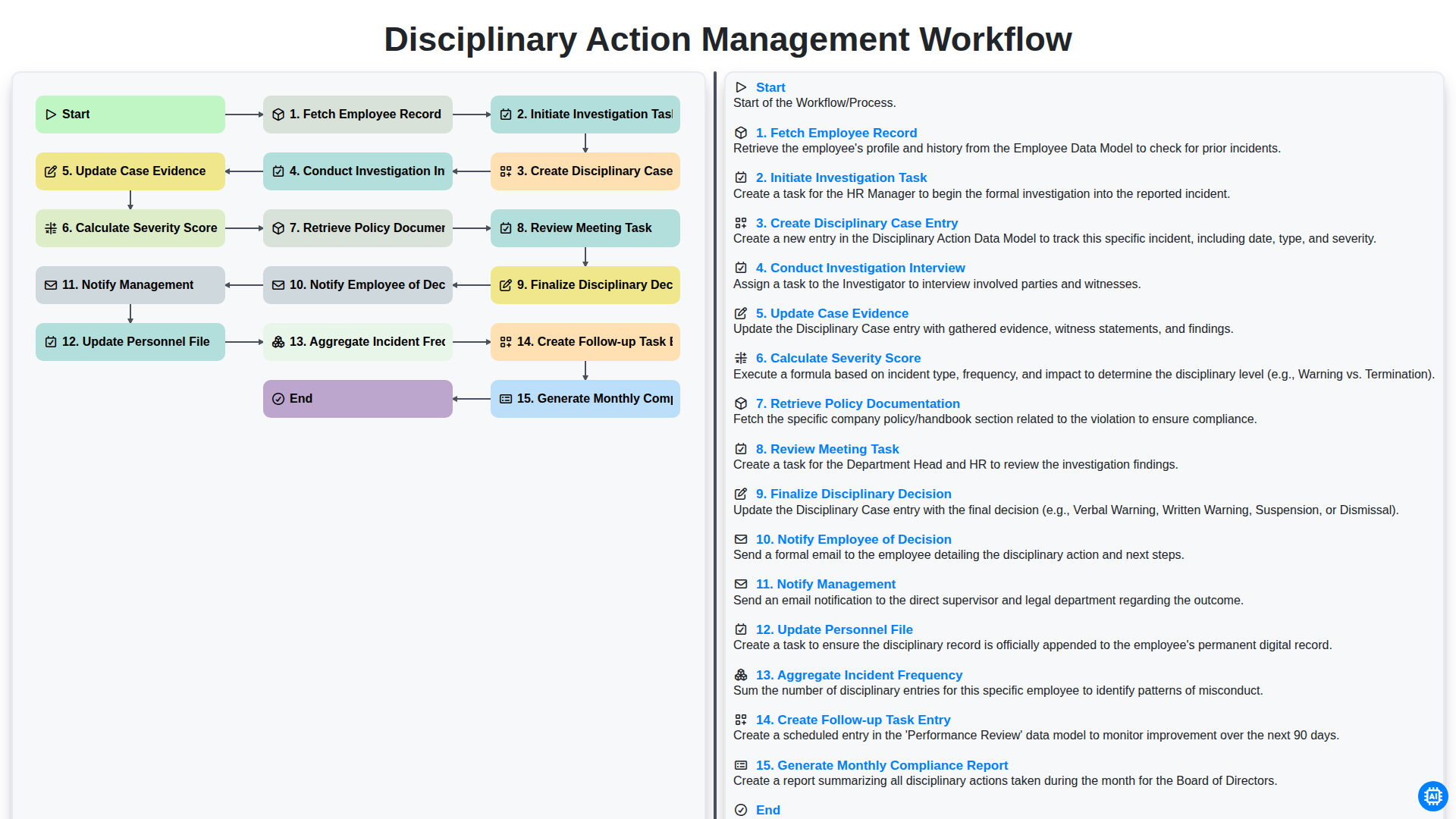
Table of Contents
- Introduction: The Importance of a Standardized Disciplinary Process
- Phase 1: Incident Identification and Case Initiation
- Step 1: Fetching the Employee Record for Context
- Step 2: Triggering the Investigation Task
- Step 3: Establishing the Disciplinary Case Entry
- Phase 2: The Investigation and Evidence Collection Process
- Step 4: Conducting Thorough Investigation Interviews
- Step 5: Documenting and Updating Case Evidence
- Step 6: Determining Impact via Severity Score Calculation
- Step 7: Aligning Findings with Policy Documentation
- Step 8: The Formal Review Meeting Task
- Step 9: Finalizing the Disciplinary Decision
- Phase 4: Communication and Post-Disciplinary Procedures
- Step 10: Notifying the Employee and Management Teams
- Step 11: Updating Personnel Files and Official Records
- Phase 5: Long-term Monitoring and Continuous Improvement
- Step 12: Implementing Follow-up Tasks and Monitoring
- Step 13: Analyzing Incident Frequency and Trends
- Step 14: Generating Monthly Compliance and Audit Reports
- Conclusion: Building a Transparent and Fair Workplace Culture
- Resources & Links
TLDR: Learn how to standardize your HR disciplinary processes using a structured, end-to-end workflow. This guide explores a step-by-step template-from initiating investigations and calculating severity scores to finalizing decisions and generating compliance reports-designed to ensure fairness, maintain legal integrity, and automate administrative follow-ups.
Introduction: The Importance of a Standardized Disciplinary Process
In any organization, maintaining a fair and consistent work environment is critical to sustaining employee morale and legal compliance. Disciplinary action, when handled haphazardly, can lead to claims of bias, legal liabilities, and a breakdown in workplace culture. A standardized disciplinary action management workflow serves as a vital framework that ensures every incident is handled with the same level of rigor, transparency, and objectivity.
A structured process moves beyond mere punishment; it provides a clear roadmap for investigation, evidence gathering, and decision-making. By following a predefined sequence of steps-from the initial investigation to the final notification-HR professionals and managers can mitigate risk, ensure that policies are applied equitably across all departments, and provide employees with a transparent understanding of the proceedings. Ultimately, a standardized workflow transforms a potentially volatile situation into a professional, documented, and defensible administrative process that protects both the employee and the organization.
Phase 1: Incident Identification and Case Initiation
The disciplinary process begins long before a formal decision is made; it starts with a structured approach to identifying and documenting a potential violation. This initial phase is critical for ensuring that every case is handled with precision, objectivity, and legal integrity.
The workflow kicks off with the Fetch Employee Record step, where HR professionals must gather all relevant historical data, including previous warnings, performance reviews, and attendance records. This ensures that the current incident is viewed within the context of the employee's overall tenure. Once the context is established, the process moves into the Initiate Investigation Task stage, which alerts the designated investigators to begin a formal inquiry into the alleged misconduct.
To maintain a formal audit trail, the next crucial step is to Create Disciplinary Case Entry. This transforms a raw incident report into an official, trackable case within the management system. By formalizing the entry at the very beginning, the organization ensures that no detail is lost and that every subsequent action is linked to a specific, documented case file, laying the groundwork for a transparent and fair disciplinary procedure.
Step 1: Fetching the Employee Record for Context
The foundation of any fair and consistent disciplinary process lies in the accuracy of the data used to inform the decision. Before any formal proceedings can begin, the workflow must start by fetching the complete employee record. This step is crucial because it provides the necessary context required to understand the full scope of the situation.
By retrieving the employee's historical data-including their job description, previous performance reviews, training logs, and any past disciplinary history-management can differentiate between a first-time oversight and a recurring pattern of behavior. This initial deep dive ensures that the investigation is grounded in facts rather than assumptions, preventing bias and ensuring that the subsequent steps are tailored to the specific circumstances of the individual. Without a thorough review of the existing personnel profile, a disciplinary action risks being arbitrary, potentially leading to legal complications and a lack of procedural fairness.
Step 2: Triggering the Investigation Task
Once the initial breach or incident is identified and the employee record is retrieved, the workflow moves into its most critical phase: Initiating the Investigation Task. This step serves as the official trigger that transitions the process from a mere observation to a formal administrative procedure.
At this stage, the system automatically generates a high-priority task assigned to the designated investigator or HR representative. This isn't just a notification; it is the creation of a dedicated workspace where the investigation begins to take shape. By formalizing this task immediately, the organization ensures that the clock starts on a standardized timeline, preventing delays that could lead to procedural unfairness or legal complications. This step ensures that every investigation is documented from its very inception, providing a clear audit trail that proves the company acted with due diligence the moment an issue was brought to light.
Step 3: Establishing the Disciplinary Case Entry
Once the initial investigation task has been triggered and the preliminary facts are gathered, the workflow moves into a critical phase of formalization: Creating the Disciplinary Case Entry. This step serves as the foundation of the entire administrative trail, transforming a vague concern into a structured, trackable record.
At this stage, the system generates a unique case ID that links all subsequent actions-from evidence uploads to interview notes-to a single point of truth. By establishing this formal entry, HR professionals ensure that the process is no longer just a series of disconnected notes, but a centralized digital dossier. This step is vital for maintaining organizational accountability; it prevents information silos and ensures that every piece of data collected during the investigation is anchored to a specific, documented incident, providing a clear audit trail for both legal compliance and internal transparency.
Phase 2: The Investigation and Evidence Collection Process
Once the initial incident is flagged, the process moves into the most critical stage: the investigation. This phase is designed to ensure that any disciplinary action is rooted in fact rather than assumption, maintaining the integrity of the proceedings and protecting the organization from claims of bias.
The process begins with the Initiation of the Investigation Task, where a formal inquiry is opened to define the scope of the alleged misconduct. To ensure a complete picture, the investigator must Create a Disciplinary Case Entry, a centralized digital dossier that serves as the single source of truth for all subsequent findings.
As the investigation progresses, the investigator will Conduct Investigation Interviews with all relevant parties, including the accused, witnesses, and supervisors. During and after these discussions, it is vital to Update Case Evidence in real-time-incorporating physical evidence, digital logs, or written statements-to ensure the file remains comprehensive.
To move toward a resolution, the investigator must Calculate a Severity Score. This objective metric helps categorize the incident based on its impact on company operations and safety, stripping away subjectivity from the evaluation. To ensure the investigation remains within legal and corporate boundaries, the investigator will Retrieve Policy Documentation, cross-referencing the gathered facts against the employee handbook and established codes of conduct. This ensures that every step taken is aligned with predefined company standards.
Step 4: Conducting Thorough Investigation Interviews
Once the initial case entry is established, the investigation moves into its most critical phase: the Conduct Investigation Interview step. This stage is the cornerstone of a fair and transparent disciplinary process. It is not merely a conversation, but a structured opportunity to gather firsthand accounts, clarify discrepancies, and ensure that all perspectives are documented with precision.
During this step, investigators must engage with the involved parties-including the subject of the disciplinary action and any relevant witnesses-to uncover the factual reality of the incident. The goal is to move beyond hearsay and capture direct testimony. To maintain the integrity of the workflow, it is essential to approach these interviews with impartiality, ensuring that the dialogue is objective and that the employee is given a meaningful opportunity to respond to the allegations. The insights gathered here will directly inform the subsequent Update Case Evidence step, serving as the foundation upon which the final disciplinary decision will ultimately rest.
Step 5: Documenting and Updating Case Evidence
Once the investigation interviews are conducted, the workflow moves into a critical phase of record-keeping: Update Case Evidence. A disciplinary process is only as strong as the documentation supporting it; without a clear paper trail, decisions can be easily contested.
During this step, all gathered materials-including witness statements, physical evidence, digital logs, or photographic documentation-must be formally uploaded and linked to the specific disciplinary case entry. This ensures that the source of truth is centralized and accessible to all authorized investigators. Proper documentation at this stage prevents information silos and ensures that when the case moves toward the severity scoring and review phases, the decision-makers are working with a comprehensive and verifiable data set.
Step 6: Determining Impact via Severity Score Calculation
Once the investigation has progressed and the necessary evidence has been documented, the workflow moves into a critical analytical phase: calculating the Severity Score. This step acts as the bridge between raw investigation data and the final disciplinary decision.
Rather than relying on subjective intuition, the workflow utilizes a standardized scoring model to quantify the impact of the incident. This calculation evaluates several key variables, such as the nature of the policy violation, the potential risk to company safety or operations, and the degree of intent involved. By assigning a numerical value to these factors, the organization ensures that disciplinary actions remain consistent and objective across different departments.
Automating this calculation within the workflow prevents bias and provides a clear, data-driven justification for the severity level assigned to the case, ensuring that a minor oversight is not treated with the same weight as a high-impact breach of conduct.
Step 7: Aligning Findings with Policy Documentation
Once the investigation is complete and the evidence has been meticulously updated, the next critical step is to ground the findings in established company standards. This phase involves a structured retrieval of all relevant policy documentation, including the Employee Handbook, specific departmental codes of conduct, and any relevant legal or regulatory guidelines.
The goal of this step is to ensure that the investigation does not exist in a vacuum. By cross-referencing the documented behaviors or incidents with the existing rulebook, the organization maintains a standard of objectivity and fairness. This process prevents ad hoc decision-making and ensures that the proposed disciplinary measures are directly supported by pre-existing, communicated policies, thereby mitigating the risk of claims regarding bias or inconsistent treatment.
Step 8: The Formal Review Meeting Task
Once the investigation is complete and all evidence has been meticulously documented, the process moves into a critical phase of accountability: the Review Meeting Task. This stage serves as the formal forum where the findings of the investigation are presented and discussed in a structured environment.
During this task, the designated disciplinary committee or department head meets with the involved parties to review the gathered facts, the calculated severity score, and any discrepancies found during the investigation. This is not merely a presentation of results, but a vital opportunity for due process; it allows for a formal discussion where the employee can respond to the findings, ensuring that the disciplinary process remains transparent, fair, and unbiased. The primary goal of this step is to ensure that the decision-making process is grounded in a comprehensive understanding of the incident, minimizing the risk of procedural errors or perceived injustice.
Step 9: Finalizing the Disciplinary Decision
The culmination of the entire investigative process lies in the Finalize Disciplinary Decision stage. Once the investigation is complete, the evidence has been weighed, and the severity score has been calculated, the decision-maker must move from fact-finding to resolution. This step is not merely about choosing a punishment; it is about ensuring that the outcome is consistent, fair, and aligned with the documented company policies.
During this phase, the investigator or HR lead reviews the entire case file to ensure that the proposed disciplinary action-whether it be a verbal warning, written reprimand, suspension, or termination-is proportionate to the infraction. This is the critical moment where the human element of HR meets the compliance element of law. A well-executed finalization process minimizes the risk of legal repercussions by ensuring that the decision is supported by the documented evidence gathered in previous steps, leaving no room for ambiguity or claims of bias.
Phase 4: Communication and Post-Disciplinary Procedures
Once a formal decision has been reached, the workflow transitions from investigation to execution and documentation. This phase is critical for maintaining transparency, ensuring legal compliance, and preventing future recurrences.
The process begins with the formal Notification of Decision, where the employee is officially informed of the outcome. Simultaneously, the Notification to Management step ensures that relevant stakeholders and department heads are aligned with the decision and aware of any required changes in supervision or oversight.
To ensure the integrity of the employee's professional history, the Update Personnel File step is executed, embedding the disciplinary record into the permanent record for future reference during performance reviews or promotion considerations.
However, the workflow does not end with the closure of the immediate case. To drive continuous improvement, the system automatically triggers an Aggregate Incident Frequency analysis, allowing HR to identify patterns or systemic issues within specific departments. Finally, the process concludes with the Creation of a Follow-up Task Entry to monitor behavior changes and the Generation of a Monthly Compliance Report, providing leadership with a high-level view of organizational discipline trends and policy adherence.
Step 10: Notifying the Employee and Management Teams
Once the final disciplinary decision has been reached and the case is officially closed, the workflow moves into its most critical communication phase. Transparency and timeliness are essential here to ensure legal compliance and to maintain organizational trust.
The process involves two distinct notification streams:
- Notifying the Employee of the Decision: The system triggers a formal notification to the employee, detailing the outcome of the investigation and the specific disciplinary measures being implemented. This step is not just about delivering news; it is about providing a documented, clear, and professional record of the decision, which helps mitigate future disputes and ensures the individual understands the consequences of the incident.
- Notifying Management: Simultaneously, the relevant stakeholders-including Department Heads and Human Resources Business Partners-are alerted. This ensures that leadership is aware of the disciplinary action and can provide the necessary support or oversight. It also ensures that all necessary parties are aligned, preventing any communication gaps between HR and operational management.
By automating these notifications, the workflow ensures that no decision is left in a vacuum and that all parties are informed through a standardized, auditable process.
Step 11: Updating Personnel Files and Official Records
Once the disciplinary decision has been finalized and all stakeholders have been notified, the workflow moves into its most critical administrative phase: Updating Personnel Files and Official Records.
A disciplinary action is only as effective as its documentation. This step ensures that the outcome of the investigation is formally integrated into the employee's permanent employment history. This process involves more than just a simple note; it requires a precise digital or physical update to the employee's record to ensure that any future performance reviews, promotion considerations, or legal audits have access to a single, accurate source of truth.
During this stage, the following actions must be completed:
- Formal Documentation Entry: The final disciplinary decision, including the specific policy violated and the resulting penalty (e.g., warning, suspension, or termination), is officially logged.
- Evidence Attachment: All pertinent evidence collected during the investigation-such as interview notes, timestamps, and witness statements-is appended to the record to safeguard the company against potential legal disputes.
- Compliance Synchronization: The update ensures that the HRIS (Human Resources Information System) reflects the current status of the employee, maintaining consistency across all organizational modules.
Properly closing the loop in this step is vital for maintaining organizational integrity. It prevents information silos where management might be aware of an incident, but the formal record remains outdated, leading to inconsistent disciplinary precedents in the future.
Phase 5: Long-term Monitoring and Continuous Improvement
The disciplinary process does not conclude once the final decision has been communicated. To prevent recidivism and ensure organizational integrity, the workflow transitions into a critical stage of oversight and strategic analysis. This phase focuses on two primary objectives: managing individual accountability and identifying systemic patterns.
The first priority is the Creation of Follow-up Task Entries. Following any disciplinary action, a structured follow-up must be scheduled to monitor the employee's behavior and assess the effectiveness of any corrective measures or training programs implemented. These tasks serve as a safeguard, ensuring that the improvement aspect of disciplinary action is actively managed rather than forgotten.
Simultaneously, the organization must zoom out to view the macro-level impact of these incidents. By utilizing the Aggregation of Incident Frequency, HR leaders can identify if certain departments or specific types of infractions are recurring. This data-driven approach allows the organization to move from reactive policing to proactive prevention.
Finally, all collected data is distilled into a Monthly Compliance Report. This report serves as a vital tool for auditors and executive leadership, providing a transparent audit trail of how policies are being enforced and ensuring that the disciplinary process remains consistent, fair, and legally defensible across the entire enterprise. Through this cycle of monitoring and reporting, the workflow transforms from a simple administrative task into a powerful driver of continuous organizational improvement.
Step 12: Implementing Follow-up Tasks and Monitoring
The lifecycle of a disciplinary process does not conclude once a final decision has been communicated. To ensure accountability and prevent the recurrence of misconduct, the workflow must transition from resolution to monitoring. This stage involves two critical sub-steps: Creating a Follow-up Task Entry and Generating Monthly Compliance Reports.
First, the system must automatically trigger a follow-up task entry for the relevant supervisor or HR representative. This task serves as a programmed reminder to check in with the employee after a predetermined period (e.g., 30, 60, or 90 days) to evaluate behavioral improvements or ensure that required corrective actions-such as mandatory training or probation requirements-have been successfully completed. Without this automated follow-up, disciplinary actions risk becoming mere paperwork rather than true instruments of organizational change.
Parallel to individual monitoring, the workflow feeds into the broader organizational oversight mechanism: the Monthly Compliance Report. By aggregating all finalized cases, the system generates a high-level view of disciplinary trends across the company. This report allows leadership to identify systemic issues, such as specific departments experiencing high incident frequencies, and provides the data necessary to refine internal policies. Implementing these final steps transforms a reactive disciplinary process into a proactive, data-driven strategy for maintaining workplace standards and long-term compliance.
Step 13: Analyzing Incident Frequency and Trends
Beyond individual case resolution, the workflow transitions from reactive management to proactive prevention through the Aggregate Incident Frequency step. Once a disciplinary cycle is complete, the data must be aggregated to identify patterns that might otherwise go unnoticed in isolated incidents.
By analyzing the frequency of specific types of infractions across different departments or time periods, leadership can distinguish between one-off human errors and systemic cultural issues. For example, a sudden spike in Conduct violations within a specific team might indicate a need for leadership training rather than individual punishment. This step transforms raw disciplinary data into actionable business intelligence, allowing organizations to move away from firefighting and toward implementing targeted training, policy revisions, and preventative measures that address the root causes of misconduct.
Step 14: Generating Monthly Compliance and Audit Reports
The final stage of the workflow shifts the focus from individual case resolution to organizational oversight. The Generate Monthly Compliance Report step is crucial for transforming raw disciplinary data into actionable business intelligence. By aggregating all closed cases, severity scores, and decision timelines from the past month, this automated reporting feature provides leadership with a high-level view of departmental trends and potential systemic issues.
This report serves two vital purposes: first, it acts as an audit trail to ensure that every disciplinary action was executed in strict accordance with company policy and legal requirements. Second, by analyzing the aggregate incident frequency, HR professionals can identify patterns-such as specific departments experiencing higher rates of misconduct-allowing for proactive interventions and targeted training. Ultimately, this step ensures that the disciplinary process is not just a reactive tool, but a transparent, data-driven component of the company's broader compliance strategy.
Conclusion: Building a Transparent and Fair Workplace Culture
Implementing a structured Disciplinary Action Management Workflow is about much more than just enforcing rules; it is about fostering an environment of psychological safety and professional integrity. When disciplinary processes are handled through a standardized, step-by-step framework, the human element of management is supported by the structural element of fairness.
By automating the transition from the initial investigation to the final notification, organizations eliminate the ambiguity and bias that often lead to grievances and low morale. A transparent workflow ensures that every employee-regardless of their role or seniority-is subjected to the same rigorous scrutiny, the same evidence-based evaluation, and the same consistent outcome.
Ultimately, the goal of a well-defined workflow is not to increase policing, but to ensure that when difficult decisions must be made, they are backed by data, aligned with policy, and communicated with dignity. When employees see that investigations are thorough and decisions are documented and consistent, it builds a foundation of trust. This transparency transforms disciplinary action from a source of fear into a tool for accountability, helping to cultivate a culture where excellence is rewarded and integrity is the standard.
Resources & Links
- SHRM (Society for Human Resource Management): A leading resource for HR professionals providing templates, legal updates, and best practices for managing workplace investigations and disciplinary actions.
- Forbes Human Resources Council: Insights and thought leadership articles on maintaining organizational integrity, leadership accountability, and managing complex employee relations.
- McKinsey & Company - People & Organizational Performance: Deep dives into organizational design, risk management, and building high-performance cultures through standardized operational workflows.
- ISO (International Organization for Standardization): Reference for international standards regarding compliance, quality management, and auditing processes essential for the reporting phase of workflows.
- Atlassian Agile/Workflow Management: Technical guidance on structuring task-based workflows, managing investigation tickets, and automating follow-up entries in enterprise environments.
- Cornell Law School - Legal Information Institute: Crucial for understanding the legal frameworks surrounding employee rights, documentation, and the necessity of policy alignment during disciplinary reviews.
Frequently Asked Questions
What is the primary goal of a Disciplinary Action Management Workflow?
The primary goal is to create a standardized, transparent, and consistent process for addressing employee misconduct or performance issues, ensuring fairness and legal compliance across the organization.
Why is 'HR Integrity' a central theme in disciplinary management?
HR Integrity refers to the commitment to unbiased, documented, and equitable treatment of all employees. A streamlined workflow prevents favoritism and ensures that every disciplinary decision is backed by verifiable evidence.
What are the key stages of an effective disciplinary workflow?
A comprehensive workflow typically includes incident reporting, investigation, formal notification, the disciplinary hearing, decision making, and post-action documentation/follow-up.
How can automation help in streamlining the disciplinary process?
Automation reduces manual errors, ensures timely notifications, maintains a digital audit trail for compliance, and centralizes all related documentation in one accessible location.
What role does documentation play in managing disciplinary actions?
Documentation is critical for legal protection and continuity. It provides the necessary evidence to justify actions taken, protects the company from litigation, and ensures that the same standards are applied consistently over time.
How can managers ensure compliance with labor laws during the disciplinary process?
Managers can ensure compliance by following a pre-defined, standardized workflow, involving HR at key decision points, and strictly adhering to the evidence-based investigation protocols outlined in the company policy.
Comments
There are no comments yet. Be the first to add one!
Case Management Solution Demo
Streamline your casework & improve outcomes! ChecklistGuro centralizes case details, tasks, & communication. Enhance efficiency, ensure compliance, & deliver exceptional service. Manage it all with our Work OS.
Related Articles
Streamline Your Deals: The Ultimate Real Estate Case Management Checklist Template
Streamline Your Debt Collection: A Case Management Checklist Template
Cybersecurity Incident Response: Your Checklist Template for Success
Streamline Your Case Management: The Ultimate Checklist Template
Mastering IP: Your Intellectual Property Case Management Checklist Template
HR Case Management Checklist Template: Your Guide to Fair & Compliant Investigations
Streamlining Veteran Care: Your Comprehensive Case Management Checklist Template
Mastering Investigations: Your Case Management Checklist Template Guide
Need help with
Checklists?
Have a question? We're here to help. Please submit your inquiry, and we'll respond promptly.