Cybersecurity Incident Response: Your Checklist Template for Success
Published: 12/20/2025 10:00 PM Updated: 12/21/2025 7:27 AM
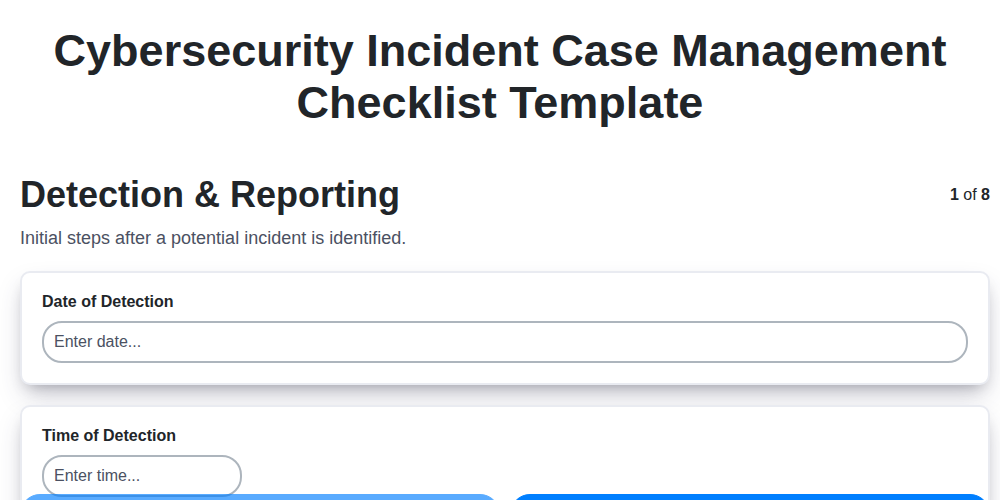
Table of Contents
- Introduction: Why a Cybersecurity Incident Response Checklist is Crucial
- Detection & Reporting - Recognizing the Signs
- Escalation and Initial Assessment
- Containment - Limiting the Damage
- Prioritization and Scope Definition
- Eradication - Removing the Threat
- Root Cause Analysis
- Recovery - Restoring Operations
- Validation and Monitoring
- Evidence Preservation - Maintaining Chain of Custody
- Post-Incident Activity - Lessons Learned & Improvement
- Legal & Compliance Considerations - Navigating the Aftermath
- Communication Strategy: Keeping Stakeholders Informed
- The Importance of Regular Review and Updates
- Resources & Links
TLDR: Got a cybersecurity incident? Don't panic! This checklist template provides a structured, step-by-step guide covering everything from initial detection to post-incident analysis, ensuring a thorough and compliant response to minimize damage and future risk. Download it and be prepared!
Introduction: Why a Cybersecurity Incident Response Checklist is Crucial
Cybersecurity incidents are no longer a matter of if they will happen, but when. A single breach can cripple your business, leading to financial losses, reputational damage, legal repercussions, and disruption of operations. Reacting effectively and efficiently during a crisis isn't about luck; it's about preparedness. That's where a cybersecurity incident response checklist comes in.
Without a structured process, incident response can quickly become chaotic. Teams scramble, decisions are rushed, and critical steps might be missed - potentially exacerbating the impact of the breach. A checklist provides a clear, step-by-step roadmap, ensuring consistency and minimizing errors under pressure. It's more than just a list; it's a vital tool for reducing response time, containing damage, and ultimately, recovering swiftly and securely. This checklist template is designed to guide you through the entire incident lifecycle, from initial detection to post-incident analysis, bolstering your organization's resilience against ever-evolving cyber threats.
Detection & Reporting - Recognizing the Signs
The first line of defense against a cybersecurity incident is recognizing something isn't right. This phase isn't just about identifying an alert; it's about cultivating an environment where everyone in your organization feels empowered to report suspicious activity.
Key Actions:
- Monitor Security Alerts: Regularly review outputs from your SIEM, IDS/IPS, and other security tools. Don't ignore seemingly minor alerts - they can be early indicators of a larger problem.
- User Reporting Mechanisms: Establish clear and easy-to-use reporting channels. This could be a dedicated email address, a phone hotline, or a ticketing system. Train employees to recognize phishing attempts, unusual network behavior, and unauthorized access requests.
- Behavioral Anomaly Detection: Implement systems and processes to detect deviations from established baselines. This goes beyond simple signature-based detection and focuses on identifying unusual user activity or network traffic.
- Log Review: Regularly audit system logs for suspicious entries, even outside of automated alerts. This can uncover activities that might otherwise go unnoticed.
- Incident Response Team Activation: Define clear criteria for when to escalate a potential incident to the Incident Response Team (IRT). This ensures prompt investigation and appropriate response.
- Documentation: Document all reported incidents, regardless of apparent severity, including the reporter, date, time, and initial description of the event.
Escalation and Initial Assessment
This critical first phase bridges the gap between detection and formal incident response. It's not about fixing the problem yet, but about confirming it's a genuine incident, escalating it appropriately, and gathering enough preliminary information to inform the subsequent phases.
Key Actions:
- Verification & Validation: Confirm that the alert or report is a true positive. Don't assume everything is a false alarm - investigate thoroughly.
- Escalation: Following your incident response plan, escalate the confirmed incident to the designated incident response team or individual. Clearly communicate the initial findings and potential impact.
- Initial Scope Determination: Quickly assess the potential scope of the incident. Identify affected systems, data, and business functions. This preliminary assessment helps prioritize response efforts.
- Documentation - The First Notes: Begin detailed logging of all observations, actions, and communications. Record the time of discovery, the reporter's name, initial assessments, and the escalation process. Timestamp everything.
- Preliminary Impact Assessment: Briefly assess the potential business impact. Consider financial, operational, and reputational consequences. This early understanding helps prioritize response.
- Activate Incident Response Plan: Officially activate the pre-defined incident response plan, ensuring all relevant stakeholders are notified and roles are activated.
Containment - Limiting the Damage
Containment is arguably one of the most critical phases in incident response. The goal here isn't to fix the problem, but to stop it from spreading. Every minute the incident continues to propagate, the more damage it can inflict. A swift and effective containment strategy can dramatically reduce the scope of the breach.
Here's a breakdown of what containment typically involves, and what your checklist should include:
- Identify Affected Systems: Determine exactly which systems, networks, and data are impacted. Don't guess; use forensic tools and monitoring to pinpoint the extent of the compromise.
- Isolate Affected Systems: This could involve disconnecting servers from the network, segmenting network traffic, or temporarily taking systems offline. Prioritize systems holding critical data or providing essential services. Consider the impact of isolation - while necessary, it can disrupt operations, so careful planning is vital.
- Block Malicious Traffic: Update firewalls, intrusion detection/prevention systems (IDS/IPS), and web application firewalls (WAFs) to block known malicious IP addresses, domains, and URLs.
- Disable Compromised Accounts: Immediately disable any accounts suspected of being compromised. Force password resets for all potentially affected users.
- Implement Temporary Workarounds: If critical systems are taken offline, implement temporary workarounds or backups to maintain essential business functions.
- Document Everything: Meticulously document every action taken during containment. This documentation is crucial for analysis, reporting, and potential legal proceedings. Include timestamps, personnel involved, and justifications for decisions.
Checklist Considerations:
- Confirm identification of all impacted systems and networks.
- Implement network segmentation to isolate affected areas.
- Disable compromised user accounts.
- Block malicious network traffic.
- Document all containment actions taken.
- Assess the impact of containment on business operations.
- Communicate containment efforts to relevant stakeholders (as defined in communication plan).
Prioritization and Scope Definition
Once an incident is reported and initially assessed, the next crucial step is to prioritize it within the broader security landscape and clearly define its scope. Not all incidents warrant the same level of immediate response. Factors like potential impact (data loss, financial damage, reputational harm), affected systems, and the sensitivity of the data involved all contribute to prioritization.
This phase isn't about deep technical analysis; it's about making informed decisions based on available information. A simple scoring system can be helpful here, assigning points based on severity levels. For example, a ransomware attack impacting critical infrastructure would receive a much higher score than a suspicious email reported by an employee.
Scope definition is equally vital. It prevents resources from being spread too thin and ensures the team focuses on the immediate problem. This includes identifying:
- Affected Systems: Which servers, workstations, applications, or network segments are involved?
- Potential Data Impact: What types of data may have been compromised? (PII, financial records, intellectual property, etc.)
- Timeline: Establishing a preliminary timeline of events is critical for accurate investigation.
- Responsible Teams: Identify which teams (IT, Security, Legal, PR) need to be involved and their roles.
A well-defined scope provides a clear boundary for the investigation and response, avoiding scope creep and ensuring efficient use of resources. It's a critical bridge between initial detection and the more intensive technical phases.
Eradication - Removing the Threat
Eradication is arguably the most critical phase, as it focuses on completely removing the root cause of the incident to prevent recurrence. Simply containing the threat isn't enough; you need to ensure it's gone for good. This phase goes beyond just deleting malicious files; it involves a deep dive into systems and processes.
Here's what eradication entails:
- Identify Root Cause: Leverage the data gathered during detection, containment, and analysis. Determine the vulnerability exploited, the entry point, and how the threat gained access.
- Patch Vulnerabilities: Apply necessary security patches and updates to address the exploited vulnerability. This includes operating system updates, application updates, and firmware upgrades.
- Malware Removal: Utilize anti-malware tools and techniques to remove all traces of malware from infected systems. This might involve full system scans, specialized removal tools, or even system reimaging.
- Account Compromise Remediation: If accounts were compromised, reset passwords, implement multi-factor authentication, and review access privileges. Consider forced password resets across the organization as a precautionary measure.
- Configuration Changes: Review and adjust system configurations to strengthen defenses. This could include disabling unnecessary services, tightening firewall rules, and implementing stricter access controls.
- Review and Update Security Controls: Assess the effectiveness of existing security controls and make necessary updates to prevent similar incidents from occurring in the future. This might include strengthening endpoint detection and response (EDR) solutions or enhancing intrusion detection systems (IDS).
- Verification: After implementing remediation steps, rigorously verify that the threat has been completely eradicated. This can involve vulnerability scanning, penetration testing, and continuous monitoring.
It's essential to document all eradication steps taken, including the tools used, the systems affected, and the results achieved. This documentation will be valuable for future incident response efforts and audits.
Root Cause Analysis
While Recovery brings systems back online, simply restoring functionality isn't enough. Root cause analysis is crucial for preventing similar incidents from happening again. This phase involves a thorough investigation to identify the underlying vulnerabilities or failures that enabled the initial compromise.
This isn't just about finding the bad actor - it's about understanding how they succeeded. Was it a misconfigured firewall? A phishing email that exploited a lack of employee training? A software vulnerability that hadn't been patched?
Here's what we'll focus on:
- Timeline Reconstruction: Meticulously rebuild the incident timeline, going beyond the initially reported events. Look for subtle clues and unexpected actions.
- System Log Review: Deep dive into system and application logs - often a treasure trove of information about attacker activity.
- Vulnerability Assessment: Conduct a formal vulnerability assessment of affected systems and applications, prioritizing areas identified during the incident.
- Process Evaluation: Examine existing security policies, procedures, and training programs to identify weaknesses and gaps.
- Interview Key Personnel: Gather insights from incident responders, IT staff, and affected employees.
- Documentation: Document all findings, including potential contributing factors and recommendations for improvement.
The goal isn't to assign blame, but to establish a clear understanding of the why behind the incident and to formulate actionable strategies for strengthening our defenses. This information will directly inform updates to security controls, policies, and training programs, laying the groundwork for a more resilient and secure future.
Recovery - Restoring Operations
Recovery isn't just about flipping a switch and declaring everything "back to normal." It't a carefully orchestrated phase requiring meticulous planning and execution to avoid reintroducing the threat or causing further disruption. This involves verifying the integrity of systems and data, gradually bringing services back online, and continually monitoring for any signs of resurgence.
Here's what needs to be considered:
- Prioritized Restoration: Establish a clear prioritization list based on business impact. Critical systems and services should be restored first, followed by less critical ones. Document the rationale behind this prioritization.
- Phased Rollout: Implement a phased approach to bring systems back online. Start with a limited test group or subset of users to ensure stability and identify any unforeseen issues.
- Verification and Validation: Rigorously test and validate restored systems. This includes functional testing, performance testing, and security testing. Verify data integrity and consistency after restoration.
- Configuration Review: Review configurations of restored systems to ensure security best practices are applied. Patch any vulnerabilities identified during the incident or subsequent assessments.
- User Access Management: Carefully manage user access and permissions after restoration. Consider resetting passwords and implementing multi-factor authentication as appropriate.
- Monitoring and Validation: Continuous monitoring of restored systems is critical. Implement enhanced monitoring rules and alerts to detect any unusual activity.
- Documentation: Document the entire recovery process, including the order of restoration, any issues encountered, and the corrective actions taken.
Validation and Monitoring
Recovery isn't simply about getting systems back online; it's about confirming they're functioning correctly and implementing measures to prevent recurrence. This phase focuses on rigorous validation and ongoing monitoring to ensure the incident's impact is truly mitigated.
Validation Activities:
- Functionality Testing: Verify all affected systems and applications are operating as expected, including critical business functions. Engage users to confirm functionality and identify any lingering issues.
- Data Integrity Checks: Confirm data integrity and accuracy across all impacted systems and databases. Run reconciliation reports and compare data to backups.
- Security Control Verification: Reassess and verify the effectiveness of security controls that were involved in the incident. This includes firewall rules, intrusion detection/prevention systems, and access controls. Consider whether any controls need to be strengthened or adjusted.
- Vulnerability Scan Retesting: Perform vulnerability scans and penetration testing on affected systems to confirm vulnerabilities exploited during the incident have been fully remediated.
- Baseline Performance Review: Compare system performance metrics to pre-incident baselines to identify any performance degradation and optimize system configurations.
Ongoing Monitoring:
- Enhanced Monitoring: Implement heightened monitoring of affected systems and networks for unusual activity, focusing on indicators previously associated with the incident.
- Log Analysis: Increase the frequency and depth of log analysis to detect any subtle signs of compromise.
- Threat Intelligence Updates: Incorporate updated threat intelligence feeds to stay informed about emerging threats and potential attack vectors.
- Regular Review: Schedule regular reviews of monitoring data and security controls to proactively identify and address potential vulnerabilities.
The goal is to transition from reactive incident response to a state of proactive security vigilance.
Evidence Preservation - Maintaining Chain of Custody
Evidence preservation is absolutely critical in cybersecurity incident response. It's not just about collecting data; it's about meticulously documenting how that data was collected, handled, and stored to maintain its integrity and admissibility in potential legal proceedings or internal investigations. This phase overlaps significantly with Containment and Recovery, and its importance continues through Post-Incident Activity.
Why is Chain of Custody So Important?
Chain of custody is a chronological documentation of the evidence's journey - who handled it, when, where, and what they did with it. A broken chain of custody can render evidence unusable, even if it's crucial to understanding the incident. Think of it like this: if you can't prove the data you're presenting hasn't been tampered with, its value is severely diminished.
Key Actions in Evidence Preservation:
- Label Everything: Each piece of evidence - logs, compromised machines, network traffic captures, emails - must be meticulously labeled with a unique identifier, date, time, and description.
- Secure Storage: Evidence must be stored in a secure, controlled environment, preferably a dedicated evidence locker or room with restricted access. Physical evidence should be packaged appropriately to prevent damage or contamination. Digital evidence requires robust access controls and write protection.
- Detailed Documentation: For every action taken with evidence, a detailed log must be kept. This includes who accessed the evidence, the date and time of access, the purpose of access, and any modifications made (even seemingly minor ones).
- Hash Verification: Create cryptographic hashes (e.g., MD5, SHA-256) of digital evidence upon acquisition and periodically thereafter. These hashes serve as fingerprints, allowing you to verify the integrity of the evidence and detect any unauthorized modifications. Record these hashes in your documentation.
- Limited Access: Restrict access to evidence to only those individuals who absolutely require it for the incident response.
- Witness Statements: Obtain written statements from individuals who handled or discovered evidence.
- Forensic Imaging: When dealing with compromised systems, create forensic images (bit-by-bit copies) to preserve the entire state of the system at the time of the incident. This provides a pristine copy for analysis without disturbing the original.
- Regular Audits: Implement regular audits of evidence storage and handling procedures to ensure compliance and identify potential vulnerabilities.
By adhering to rigorous evidence preservation practices, you strengthen your incident response, protect your organization, and ensure the integrity of your investigation.
Post-Incident Activity - Lessons Learned & Improvement
The immediate crisis has passed, systems are (hopefully) restored, and the dust is settling. But don't declare victory just yet! The post-incident activity phase is critical for preventing future incidents and strengthening your overall security posture. This phase focuses on analyzing what happened, identifying weaknesses, and implementing changes.
Here's what needs to happen:
- Conduct a Thorough Post-Incident Review (PIR): This isn't about blame; it's about learning. Gather the incident response team, relevant stakeholders (IT, security, business unit representatives), and objectively review the entire incident lifecycle. What worked well? What could have been done better? Were procedures followed? Were there gaps in training or tools? Document all findings.
- Identify Root Causes: Drill down to the underlying causes of the incident. Don't just address the symptoms; understand why the vulnerability existed and why it was exploited. This might involve technical investigations, process analysis, and interviews.
- Develop Remediation Plans: Based on the root cause analysis, create a detailed plan to address the identified vulnerabilities and weaknesses. These plans should include specific actions, assigned owners, and deadlines.
- Update Security Policies and Procedures: Incorporate lessons learned into your existing security policies and incident response plan. This ensures that future incidents are handled more effectively.
- Enhance Security Controls: Implement new security controls or improve existing ones based on the PIR findings. This could include software updates, configuration changes, new security tools, or enhanced monitoring.
- Provide Additional Training: Identify training needs and provide targeted training to employees and incident response team members to improve their skills and awareness.
- Document Changes and Track Progress: Meticulously document all remediation steps taken and track progress against the remediation plan. This provides an audit trail and ensures accountability.
- Schedule Follow-Up Reviews: Plan regular follow-up reviews to assess the effectiveness of the implemented changes and identify any new areas for improvement.
Legal & Compliance Considerations - Navigating the Aftermath
A cybersecurity incident isn't just a technical challenge; it's a legal and compliance minefield. Failing to address these aspects correctly can result in significant penalties, reputational damage, and even criminal charges. This section outlines key considerations and actions to take.
Understanding Applicable Laws & Regulations: The first step is identifying which laws and regulations apply to your organization based on the nature of the incident, the data involved, and where you operate. Common examples include:
- GDPR (General Data Protection Regulation): If you handle data of EU citizens, notification requirements and fines can be substantial.
- CCPA/CPRA (California Consumer Privacy Act/California Privacy Rights Act): Similar data privacy regulations apply to California residents.
- HIPAA (Health Insurance Portability and Accountability Act): Applies to healthcare organizations handling protected health information.
- PCI DSS (Payment Card Industry Data Security Standard): Crucial for businesses processing credit card data.
- State Data Breach Notification Laws: Almost every state has laws requiring notification to affected individuals and potentially regulatory bodies.
- Industry-Specific Regulations: Depending on your industry (finance, education, energy, etc.), specific regulations might apply.
Notification Obligations: Many regulations mandate timely notification to data subjects (affected individuals), regulatory bodies (e.g., state attorneys general, ICO), and potentially law enforcement. Failing to notify within required timeframes can lead to significant fines. Document all notification decisions and processes.
Preservation of Legal Hold: Immediately upon detection of a potential incident, implement a legal hold to prevent the deletion or modification of potentially relevant data. This applies to emails, logs, documents, and any other data that might be relevant to an investigation.
Cooperation with Investigations: Be prepared to cooperate fully with any investigations by law enforcement, regulatory bodies, or third-party forensic experts. Maintain transparency and provide all requested information accurately.
Contractual Obligations: Review contracts with vendors and customers to understand your obligations regarding incident response and data breach notification.
Insurance Considerations: Review your cyber insurance policy to understand coverage and reporting requirements. Prompt notification is often critical for maintaining coverage.
Documentation is Key: Thoroughly document all legal and compliance-related activities, including notification decisions, legal consultations, and communications with regulatory bodies. This documentation will be invaluable in demonstrating your commitment to compliance and mitigating potential liability. It's also essential to consult with legal counsel throughout the incident response process to ensure compliance with all applicable laws and regulations.
Communication Strategy: Keeping Stakeholders Informed
A cybersecurity incident isn't just a technical issue; it's a business event with potentially significant impact on reputation, customer trust, and financial stability. A well-defined communication strategy is absolutely critical throughout the incident lifecycle. Failing to communicate effectively - or communicating poorly - can amplify the damage.
Here's a breakdown of key communication considerations:
- Identify Stakeholders: Clearly define who needs to be informed. This includes internal teams (executive leadership, IT, PR, legal, customer support), customers, partners, vendors, regulators, and potentially the media.
- Establish Communication Channels: Determine the most appropriate channels for reaching each stakeholder group. Email, dedicated incident websites, press releases, social media updates, and internal messaging platforms all have their place.
- Designated Spokesperson: Appoint a single, trained spokesperson to handle external communications. This ensures consistent messaging and avoids conflicting information.
- Pre-Drafted Templates: Prepare template communications for various scenarios. While specifics will change, having a starting point saves valuable time during the chaos of an incident.
- Regular Updates: Provide regular updates, even if there's no significant new information. Acknowledge the incident and outline ongoing efforts. Silence breeds speculation and distrust.
- Transparency (with Caution): Be as transparent as possible without jeopardizing the investigation or sharing sensitive details that could compromise security. Be upfront about what you know and what you don't know.
- Internal Communication is Paramount: Keep internal teams informed. Empower them to answer customer and partner inquiries accurately and consistently.
- Legal Review: Ensure all external communications are reviewed by legal counsel before release to minimize legal exposure.
- Social Media Monitoring: Actively monitor social media channels for mentions and sentiment. Address misinformation and engage with concerned individuals.
Remember: honesty, empathy, and proactive communication are your best allies in maintaining trust and minimizing damage during and after a cybersecurity incident.
The Importance of Regular Review and Updates
Cybersecurity incidents are constantly evolving. New threats emerge daily, and attacker tactics become increasingly sophisticated. What worked in your incident response plan last year might be ineffective - or even actively detrimental - today. That's why regular review and updates to your Cybersecurity Incident Case Management Checklist Template are absolutely critical.
Think of it like patching a vulnerability. You can't just apply a patch once and forget about it; you need to continuously monitor for new vulnerabilities and apply updates promptly. Similarly, your checklist needs to be a living document.
Here's what we recommend:
- Quarterly Reviews: At a minimum, review your checklist every three months. This allows you to assess changes in your infrastructure, threat landscape, and regulatory requirements.
- Post-Incident Reviews: Every incident, regardless of size, should trigger a review of your checklist. Did the steps outlined work as intended? Were any gaps identified? What could have been done better?
- Annual Deep Dive: Dedicate a full day (or more) annually to a comprehensive review of the entire checklist. Involve key stakeholders from IT, security, legal, and communications.
- Stay Informed: Subscribe to industry newsletters, participate in threat intelligence feeds, and attend cybersecurity conferences to stay abreast of emerging threats and best practices.
Failing to regularly review and update your checklist isn't just an oversight; it's a risk. A stale checklist can lead to delayed responses, increased damage, and a weakened security posture. Make it a priority.
Resources & Links
- NIST Cybersecurity: The National Institute of Standards and Technology (NIST) provides frameworks, guidelines, and standards for cybersecurity, including the Cybersecurity Framework (CSF) which is highly relevant to incident response.
- CISA (Cybersecurity and Infrastructure Security Agency): CISA offers resources, alerts, and guidance on cybersecurity incident response, including checklists and best practices. They also provide sector-specific guidance.
- SANS Institute: SANS offers in-depth cybersecurity training and resources, including courses and white papers on incident response and forensics. Their GIAC certifications are widely recognized.
- Gartner: Gartner provides research and analysis on cybersecurity trends and best practices, which can inform incident response planning and strategy. (Requires subscription for full access)
- Schneier on Security: Bruce Schneier's blog offers insightful commentary on security and cryptography, often providing context for understanding incident response challenges.
- Splunk: Splunk is a leading provider of data analytics platforms often used for security information and event management (SIEM) and incident response. They provide resources and best practices related to incident response.
- Rapid7: Rapid7 provides vulnerability management and incident detection and response solutions. They offer blog posts and resources on incident response.
- FireEye (now Trellix): While FireEye was acquired by Trellix, their extensive incident response knowledge and research is still valuable. Explore Trellix's website for updated content.
- Trellix: Now the home of FireEye's technology and expertise, Trellix offers resources on threat intelligence and incident response.
- RSA: RSA offers security solutions and publishes content on cybersecurity, including incident response and data breach preparedness.
- Center for Internet Security (CIS): CIS develops the CIS Controls, a prioritized set of actions to improve cybersecurity posture and mitigate risks, which are directly applicable to incident response.
Frequently Asked Questions
What is a Cybersecurity Incident Response Plan (IRP)?
A Cybersecurity Incident Response Plan (IRP) is a documented set of procedures to be followed when a cybersecurity incident occurs. It outlines roles, responsibilities, communication protocols, and steps to contain, eradicate, and recover from the incident, minimizing damage and downtime. It's essentially your roadmap for dealing with a security breach.
Why do I need an Incident Response Plan?
Without an IRP, responding to a cybersecurity incident can be chaotic and ineffective. It helps you act quickly, minimize damage, maintain business continuity, meet compliance requirements (like GDPR or HIPAA), and learn from incidents to improve your security posture. It's better to have a plan *before* an incident happens.
What's included in the checklist template mentioned in the article?
The checklist template covers key phases of incident response: Preparation, Identification, Containment, Eradication, Recovery, and Lessons Learned. It includes tasks like forming an incident response team, identifying critical assets, establishing communication channels, gathering evidence, isolating affected systems, restoring data, and documenting the entire process. The article details each step and what it entails.
Who should be part of the Incident Response Team?
The team should include representatives from various departments like IT, Security, Legal, Communications/PR, and potentially business unit leaders. Key roles include an Incident Commander (overall leader), Security Analyst(s) for technical investigation, a Communications Lead for internal and external messaging, and a Legal representative for compliance and legal considerations.
How often should I review and update my Incident Response Plan?
Your IRP isn't a 'set it and forget it' document. It should be reviewed and updated *at least* annually, or more frequently if there are significant changes to your IT infrastructure, business processes, or threat landscape. After any incident, a post-incident review is critical to identify areas for improvement.
What's the difference between containment and eradication?
**Containment** focuses on limiting the scope of the incident and preventing further damage. This might involve isolating infected systems or blocking malicious traffic. **Eradication** focuses on removing the root cause of the incident - deleting malware, patching vulnerabilities, or correcting misconfigurations.
What are some important legal and regulatory considerations for incident response?
Depending on your industry and location, you may have legal and regulatory obligations to report security breaches (e.g., GDPR, CCPA, HIPAA). Your IRP should address these requirements, including timelines for notification and potential penalties for non-compliance. Consult with legal counsel to ensure compliance.
How can I use the Lessons Learned phase to improve my security posture?
The Lessons Learned phase involves a thorough post-incident review. This includes analyzing what went well, what went wrong, and identifying gaps in your security controls, procedures, and training. Use these insights to implement changes that prevent similar incidents from happening again.
Is this checklist template customizable?
Yes! The provided checklist template is designed to be a starting point. You should customize it to reflect your organization's specific environment, assets, and risk profile. Tailor the steps, roles, and responsibilities to your unique circumstances.
Where can I find additional resources for building and maintaining an Incident Response Plan?
Several resources are available, including the NIST Cybersecurity Framework, SANS Institute, OWASP, and CERT (Computer Emergency Response Team) publications. Your industry-specific associations may also offer guidance and best practices.
Found this Article helpful?
Comments
There are no comments yet. Be the first to add one!
Case Management Solution Demo
Streamline your casework & improve outcomes! ChecklistGuro centralizes case details, tasks, & communication. Enhance efficiency, ensure compliance, & deliver exceptional service. Manage it all with our Work OS.
Related Articles
Streamline Your Bankruptcy Cases: The Ultimate Case Management Checklist Template
Mastering IP: Your Intellectual Property Case Management Checklist Template
Streamlining Veteran Care: Your Comprehensive Case Management Checklist Template
Streamline Your Debt Collection: A Case Management Checklist Template
Mastering Investigations: Your Case Management Checklist Template Guide
HR Case Management Checklist Template: Your Guide to Fair & Compliant Investigations
Streamline Your Case Management: The Ultimate Checklist Template
Streamline Your Deals: The Ultimate Real Estate Case Management Checklist Template
We can do it Together
Need help with
Case Management?
Have a question? We're here to help. Please submit your inquiry, and we'll respond promptly.